Showing posts with label vietnamese. Show all posts

Saturday, July 6, 2024

Hoàng Thu Phố Vietnamese sheng, 2023 and 2024 versions, from Bắc Hà, Lào Cai province


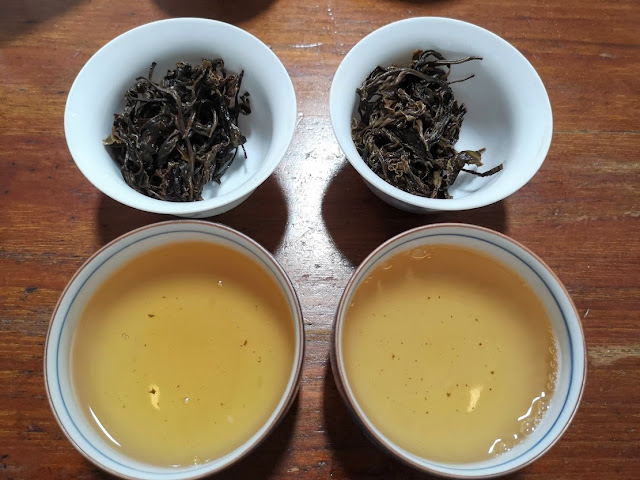
2023 left; higher compression makes it harder to separate


I've bought more of a Vietnamese sheng that my friend Huyen gave me (an earlier review, and the producer FB contact), which turned out to be a favorite version, from the Quang Tom producer.  Let's start with what it is, Huyen's description:


This tea cake is from Hoàng Thu Phố, Bắc Hà, Lào Cai province. It was made in 2023. Mostly old tea trees belongs to the H’mong people.


Seth, who was with her and also gave it to me, filled in even more background:


The area Hoang Thu Pho is in Lao Cai province on the east side of the Red River, which flows into Vietnam from Yunnan. It's in a mountain range called Tay Con Linh that peaks further eastward in Ha Giang (province). Son La is in a different mountain range called Hoang Lien Son with slightly higher elevation on the west side of the Red River, and also sits on the Black River, which also flows in from Yunnan. Both tea areas are owned by members of Hmong people groups.

The tea maker for the Hoang Thu Pho cake is a younger guy named Phuc who has been making tea for about six years. He is not Hmong, but he buys tea material from Hmong tea areas and wants to focus on making high quality teas.


I brewed and drank that cake; it was my favorite during that last 3 month stay in Honolulu.  I thought I really loved that 2023 version, but after trying the 2024 cake alongside it I guess I have a new favorite tea again.

A lot of this is about why it is atypical in style, trying to break down how others might relate to it, and why they may not love it as much as I do. As for a contact I'll add reference to their Facebook page and website:


their FB profile page


Review:


2023 #1:  This early round is muted and light, but it will really kick in.  Warm tones define the experience as rich, floral, and fruity.  

One heavy flavor range is unique, positive to me, but not necessarily objectively positive, something everyone would like.  Described positively this includes the warm, sweet richness of other tea types, leaning a little towards how a more oxidized Dan Cong might come across, with subtle and integrated roast input lending that depth.  Described more negatively, potentially in light of not fulfilling other sheng pu'er aspect / character expectations, it could be regarded as yeasty, overly heavy, lacking the brightness, astringency edge, bitterness, and lighter floral range that makes a lot of sheng distinctive.  I see it as balancing well as it is, just not in the conventional sheng profile form.


2024:  quite different; I love this already.  The other expresses heavy floral tones, bordering on rich dried fruit, along the line of dried mango or apricot, but this expresses different heavy floral and fruit range.  It's syrupy in texture, and there's a thickness, warmth, and heaviness to the flavor tones as well.  There's a trace of dry mineral edge to this version, which could either dissipate as an early round tone, or develop and probably shift to a slightly different flavor and feel range.

That heavy, rich floral tone is indescribable.  It's like walking into a flower shop where a lot of the product range is on the heavier side, orchids, roses, and lavender, and then being able to taste that heavy mixed scent as an intense version of a brewed beverage.  Could it be too much?  I suppose.  But then sheng pushing into extremes across a lot of range of intensity is part of the appeal.  It's usually just not this exact range; more typically tones would be brighter, light floral, including stronger mineral, some bitterness, and perhaps a bit of medicinal or herbal quality.  This is straight rich floral tones with a base of limited dried fruit, which will probably continue to be heavier in the other.

As so often happens I don't have the full hour plus to spare on this review so I'll keep brewing these a bit strong to push the transition process along.  These would be fine brewed lighter, taking 3 rounds to really get going instead of 2, then experienced lighter after that, but it's fine to rush them too.  

To me that's another strength of this tea too, that you can drink as very positive in character made in different ways.  For some sheng you need to drink it light to brew around high intensity, bitterness, and astringency, and I've tried other wild origin versions where you need to push them just to get normal intensity range out of it.  Neither limitation applies to these; they will work well both ways.


2023 #2:  feel structure isn't exactly what I remember, even though I last drank this tea in the last few days.  It's different when brewed heavier, at a higher infusion strength.  An astringency structure edge like that of black tea enters in, just a very mild form of it.  As a result the sweetness level seemed to drop way back.  I suppose brewing this for 10 to 15 seconds instead of 20 to 30 will bring it right back.

Feel is very rich.  There's a structure to it too, and stronger mineral than you get brewing it lighter, with floral tones and dried fruit less pronounced in the balance.  If this follows the pattern I'm remembering dried fruit comes out much heavier in later rounds, another reason I want to rush this to get through some transition.  

I still like this tea brewed in this way but the appeal isn't optimized, per my preference.  It's interesting the way feel structure and aftertaste ramp up so much.  Made this way this tea could stand up to a lot of food adjoining it, even rich and heavy versions, or breakfast foods with different aspect sets, the intensity and sourness of a strawberry cobbler, or sweetness and heaviness of a raisin pastry.  To drink this alone brewing it lighter would be better, for me.


2024:  to me this is just magical.  I love the other version, but this is richer, deeper, more complex, more floral, with more dried fruit base.  All that from a tea with less time to transition to include more depth, as occurs in the first year or two, if teas are stored in hot and humid conditions.  

To me this fruit includes a citrus tone, leaning towards bergamot.  In other tea types you typically don't experience that paired with heavy floral range, and warm tones; together it's really something.  It can come up in Darjeeling, or more as dried citrus peel in other types, often pronounced in Oriental Beauty / Dong Fang Mei Ren versions, often adjoining cinnamon spice, but the context and other flavors typically don't match this range.  The sweetness resembles honey as well, not a warm, rich version of it but a lighter type, I suppose one the bees made from orange blossoms.

Returning to one running thread, what is not to love about this experience?  It's not conventional sheng; there is that.  Bitterness is present but at a very low level; astringency structure gives it a base but that's light, and not in the same form.  It includes some mineral range but that would be easy to miss, instead of a dominant aspect balancing evenly with bitterness, astringency, sweetness, and light floral tones.

I'll be able to taste a third round without a break but then six small cups of this will be too much to keep going.  Water input for a palate break alone would work, or some food.  One Krispy Kreme glazed donut is holding down the function of coating my stomach to protect it; it's a lot to ask of just one.


2023 #3:  this seems a little flatter than I remember.  I think the comparison with a younger version is not helping, that the brighter, fresher, more intense floral range is dropping back.  

I suspect that there is an odd twist occurring with an uneven compression in this cake version too.  In the middle of the pressed disk it's frustrating how much more dense it is, hard to tease apart, or actually impossible in relation to how the 2024 version is much, much looser, so that you don't really even need a pu'er knife to access whole twisted leaves.  But I think that part has age-transitioned much slower, preserved by the lack of air contact, resulting in an odd slow-rate transition form.  That compression related transition restriction seems to draw out dried fruit tones.  Or maybe I  just imagine all this, and I've actually walked off the map.

Without the other being so much more intense, in terms of floral and fruit range, and sweetness, with a more pronounced citrus input, this would seem to express all of that, to an extent.  Fruit is more subdued, and it seems closer to dried peach or apricot than that other lighter tone.  Floral range is pronounced, but it's more of a subtle and broad layer.  Then warm tones integrate differently.  It doesn't seem right saying that it seems muted, because it's not that, but it is dialed down a little in relation to the other.  

Again, as with the other, bitterness and astringency edge being so moderate wouldn't suit everyone.  It's not standard sheng character.


2024:  fruit and floral range just pops, in a pleasant warm and rich context.  Feel seems almost liqueur-like.  It's sort of like that effect from eating a chocolate covered cherry, a theme that might have been more familiar 30 years ago, at Christmas time.  In some teas a related effect I describe as being like cognac or brandy, but this lacks the intensity of that volatile component from the alcohol.  In a different, lighter form some teas seem perfume-like, and it's closer to that, but the base context also isn't a match for that lighter volatile base in perfume.  Citrusy range is serving the same role, closer to a bergamot input.

I could relate to others seeing this as not balanced, missing the pronounced bitterness, astringency, and mineral layers in most sheng.  This is sheng for an oolong drinker, I guess.  I don't see myself as unable to appreciate moderately challenging sheng, and even feel like having the harsher tasting experience of a 10 or 12 year old Xiaguan tuocha once in awhile, or the corresponding Dayi Jia Ji tuo aspect set, well prior to when drinking either makes the most sense.  But I don't need that kind of edge or structure--a lighter version of it--to balance a tea for me to enjoy it.

I just read another tea friend describing Shui Xian, the Wuyishan / Wuyi Yancha version, not the Dan Cong plant input range, as tying to gan, the bitterness returning as sweetness effect, from "hui gan," more or less "returning sweetness."  It's an effect that happens after you swallow the tea.  That's not how I ever interpret that experience, from good, bad, or medium quality Shui Xian, but I can kind of get where he was going.  

Part of the complexity--in Shui Xian Wuyi Yancha, I'm still on that--relates to astringency range, and another part ties to complex flavor input, which varies a lot in different versions.  Bitterness isn't so typical, as with sheng, but a significant edge that takes different forms is.  He compared that to black tea experience, as being different but somehow vaguely related.  I get it; I agree, it's just down to parsing out partial similarities.  That's sort of what I'm describing as missing here, that edge.  

I don't miss the astringency, bitterness, and mineral layers though, filled in here by warmth, sweetness, rich but smoother feel, and other flavor depth.  This tea would be amazing with some of that range dialed up, but to me it's already really good in a different way.


2023 #4:  even better brewed lightly, for no more than 10 seconds.  Floral tone is much stronger.  I'd see sweetness as very pronounced, although direct comparison with a slightly sweeter tea offsets that judgment.  Warm, rich dried fruit tones are just starting to pick up, to me closest to dried apricot range at this point.


2024:  it's interesting how this version comes across so differently for including a good bit of citrus tone.  It lightens everything, and a slightly sweeter flavor range shifts context.  Fullness of feel and flavor depth play some of the same role that much heavier different inputs do in more conventional sheng.

Is this yeasty, or too heavy?  Does it drift into odd mineral range, or bread-like flavors?  I suppose, if someone is included to see it that way.  It tastes a bit like a butter croissant, or really more like a cinnamon raisin roll, not the cinnamon or raisin part so directly, but that pastry base.


this version is vegan; probably more like one made with butter


There is a touch of vegetal edge too, maybe just now entering in.  It's hard to identify for mixing with other range; maybe like green wood.


2023 #5:  note that I've not mentioned cha qi / body feel effect yet; what is that like?  Don't know.  It seems likely to me that some people are more sensitive to such things, or less so, and that vendors emphasize and even exaggerate such claims because it works as extra easily accessible, hard to critique marketing spin.  

You don't get that?  That's your own limitation.  It also makes a difference if someone doesn't eat food right before trying a tea, and drinks through a lot of rounds of one single type.  I'm not in it for the buzz anyway.  I did my time as a drug user, and I'm happy to not live that out.  Maybe I run long distances in heat at high heart rate to experience something related, but I don't see it that way.  I drank some water and ate a second glazed donut between the last two rounds; it will be all the harder to notice feel shifts as a result, which is fine.  I'd rather protect my stomach than appreciate my head spinning a little.

Brewed light (again) richness and floral tones extend, with dried fruit gradually increasing in proportion.  This tea doesn't need to be pushed, and it's better when you don't go there.  Limited feel structure, richness, and warm toned flavor depth (extra complexity) has to fill in the role that harsher aspects do in most sheng, and most other teas in general.  People who rushed through tea exploration from black teas onto sheng, barely pausing to cover oolong range, might not "get it."  

For white tea drinkers this may be all the more amazing; it's more intense, and in a related experience range.  This is what a shou mei would age to be like in a better than ideal case.  It just never gets there.


2024:  the balance of what I keep describing shifts again.  Rich and warm floral tone stands out, general sweetness, and a bright citrus edge.  Some warm mineral grounds that, and a distinct secondary aspect is just now entering in, like tea berry, between berry range and mint.

That could be interpreted in all sorts of ways.  What I've described as a touch of yeasty, bread-like, pastry aspect has shifted some too.  It's a bit like that warm, odd, distinctive edge in apple cider now, the flavor tone you don't need to actually drink the cider to experience, already present in the smell.  It's just so light that you do need to drink the tea to even notice it in this.


Conclusions


I'd better let this go for now.  Aspects will shift a little more, some of which will be positive, before these fade.  It's looking like that dried fruit flavor depth will pick up a bit more in the first (2023 version), and the second will gain unusual complexity, at least one more subtle shift that I don't see coming.  

Because these are so mild the edgier feel and flavor that tends to enter in across later rounds for sheng, often expressed as ramped-up bitterness, mineral, or even wood tone, will probably balance reasonably well.  Then sweetness and heavy floral range fading will be less positive, so in the end the teas might just be different, not so much better or worse.  At a guess the first might seem to cover it's best range, since per past experience the fruit really seems to come out, but the second losing that heavy initial floral punch probably represents the best of it's range already transitioning out.


It was interesting using the theme of considering which aspects I love could be seen as negative by others.  For me these are two personal favorites, teas that I absolutely love.  For anyone matching up with my own preferences directly these would be fantastic.  I would imagine that includes people who love oolongs as much as any other types, and then also rich flavored white teas and mild and flavorful black teas, like Dian Hong.  For sheng pu'er drinkers I guess it would just depend.

Saturday, June 8, 2024

Viet Sun YTY Hmong and Dao village sheng


I bought a good bit of Vietnamese sheng from Viet Sun, to be sent to Bangkok while I was still wrapping up that stay in Honolulu.  We're back in Thailand, so I can try it.


I generally avoid "tea haul" photos because it seems like bragging, which is odd to me, emphasizing how your own tea experience has such depth because you spent some money on it.  I bought another of an earlier favorite Son La version (I'll be skipping diacritics / accent symbols in most of this, transliterating it all to Romanized text without that), and four fresh sheng maocha versions ("pu'er-style tea," working around the Chinese regional type designation).

Then four of those cakes are from a favorite Vietnamese version Huyen gave me in January, which I've already drank through, all but about two sessions worth.  I reviewed that, and also cited the source, in this post.  Steve was nice enough to manage shipping it with his teas, well beyond what one would ask of a vendor, but he is also an online friend.  So I'm biased in judgment, about his teas?  Sure, if you think so.  To me impressions written here don't vary with that input, but who knows.  I really love those other Vietnamese sheng but that's a story for another post.


I'm in the habit of citing descriptions from web pages when I edit posts; let's do that:


Y Tý "H'Mông Village" Spring 2024  ($31 for 100 grams)


Y Tý is a beautiful tea area in Lào Cai province right on the border with China. There are two villages that have old tea trees here, one is inhabited by H’Mông people and the other Dao.

This tea is from the H’Mông village. Although only a couple kilometers apart, this area has more clay rich soil and more humid days than the Dao village. The leaves are also darker than the trees in the other area. Tea trees in Y Tý have especially beautiful leaves.

The owner of these gardens said that in the past, there were tea trees covering the entire hillside but weren’t harvested until only the past 10-20 years. The locals chopped many of these trees down but luckily there are still some that survived and many of which were left to grow naturally.

This tea brews up slowly into a rich darker golden brew. I get cane sugar, herbal medicine, deep forest with some floral flavor notes. This tea also features a pleasant minerality with a medium bitterness and astringency. Quick huigan and strong relaxing qi.


I'm not comparing this review's descriptions with those; I added the citations later and won't go back and compare them during editing.

At a rate of $31 for 100 grams that would be a $100+ cake, which is essentially the modern standard for teas of this type and quality level.  I avoid buying tea at that high a full retail level; the Son La version was listed for $77 for a 370 gram cake, which is a little better value, especially given that I like that style so much.  

Trying fresh maocha is something else though, and these teas are distinctive.  Character match to preference is something else again, which is quite hard to judge from descriptions.


Y Tý "Dao Village" Spring 2024 ($31 for 100 grams)


Y Tý is a beautiful tea area in Lào Cai province right on the border with China. There are two villages that have old tea trees here, one is inhabited by H’Mông people and the other Dao.

This tea is from the Dao village. Although only a couple kilometers apart, this area has more rocky soil and more windy, dry days than the H’Mông village. The leaves are also brighter green than the trees in the other area. Tea trees in Y Tý have especially beautiful leaves.

This tea area is about a 45 minute walk from the village up through a forest of wild bamboo. The bamboo forest eventually ends and you reach the tea gardens. There are many old and ancient trees here but many have been pruned heavily to produce buds for silver needle tea. There are still about 15 trees that have been left to grow naturally and produce some really excellent puerh tea!

This tea brews up slowly into a rich golden brew. Heavily sweet with notes of cane sugar and meadow flowers with a light herbal character. Strong mineral note with low bitterness and astringency. Lasting huigan and strong relaxing qi.


I never know what to make of these qi descriptions.  Sheng affects me, but not as much as other people describe.  It's impossible to determine a single effect input in a combined tasting but I'm essentially never reviewing qi / drug-like effect anyway.


Tea tasting back in Bangkok; it's a bit hot but very nice outdoor space.


Review:


Hmong village 1:  the dry scent of these is amazing.  I'm not really starting a review there, but the scent of this tea is bright, rich, complex, and sweet, with the other showing more richness and warm tones.  Then the brewed color matches the opposite of what one would expect from that.  Let's start with brewed flavors though.

It is bright, fresh, sweet, and complex.  Pleasant rich fruit shows through right away, even though I brewed this too fast to really pick up the full profile.  There's a different character edge to fresh sheng, especially wild origin versions, that isn't there in any other types, and this has it.  Words like complexity and intensity don't capture it at all, and individual flavor descriptions also don't.  Maybe I'll think of how to describe it as I review.


Dao village:  there is a deep plum sort of note in this not present in the other.  It's too early to call but the other might be more complex.  Both of these are going to fantastic; let's just move on to that flavor list next round.  I should hold true to form and brew them a little too strong next round.


Hmong 2:   this is brewed light again; I was just joking.  Sweetness and freshness stands out, and complexity.  Even brewed light, not fully opened up yet, there's a wonderful aftertaste finish that continues on after drinking this.  Bitterness is slow to enter in, but more surely will.  Layers of flavors include fruit and mild earthy / vegetal tones, like hay early in the curing process, closer to fresh baled.  I could guess about the fruit range, or how floral tones mix in with that, but next round might be clearer.


Dao 2:  it's interesting how this profile centers around a narrower range, one particular fruit tone, and a bit of base that might be vegetal, as the fresh-cut hay was in the other, but different.  There's a note in this very common to that favorite tea cake that I've been going on about, that I ordered with this, and essentially drank through one full cake of already.  It's my current favorite tea.  Honey sweetness is part of that, but also a rich fruit tone that's hard to completely place.  Dried apricot is close enough; that will work as a place-holder.

I really will give these a little more time this next round.  I've been brewing them at 15 seconds or so, pretty fast for a normal proportion, for teas that weren't completely wetted yet.

I'm trying these back in Bangkok.  It's 9 AM, drinking outside at my favorite tasting spot, but it's 28 C already, or about 80 F, as hot as Honolulu tends to get, and maybe a little more humid.  Honolulu is humid but breezy, offsetting the heat, and the weather is providing me a nice breeze just now, even though that's less typical here.  It's hot though; it might be over 28 right where I am, and I'm a little jet-lagged.


Hmong 3:  I'm probably never going to arrive at a clear flavor list for this tea.  I think it's more difficult because fruit, floral, and spice range are all mixing, with a light mineral base below that.  Lemongrass and holy basil stand out as spice inputs (more or less; that's just an interpretation), with the fruit a bit towards lemon or grapefruit, or in between the two.  A light dry effect joins the feel structure; it works in this.  Sweetness is pronounced, and light mineral is contributing a lot.  

The overall complexity is more than all that; I think a lot of floral range joining that is part of it.  It's sweet like plumeria or orchid, like a tropical flower, maybe like the heavily flowered vines that tend to smell very sweet, but only for one part of the day.  There's not all that much bitterness, but some, which seems to connect with that light dry feel.  This isn't challenging at all in terms of bitterness or astringency, and not only because I'm not drinking it brewed very strong.  It's best on the lighter side; the flavors shine through better, and intensity is still on the high side.


Dao 3:  there's that primary dried apricot range again; so nice!  It's not one-dimensional; warm tones and a very different mineral base fill in beyond that.  That one flavor range is half what you experience though, where the other one is more complex, spread over a broader range.  I can relate to both.  

In the case of that other sheng, that I've finished a cake of, and am describing as comparable related to a main flavor aspect, I grew more attached to it over time, and it kept evolving to be more positive.  This is quite pleasant now.  Mineral range is typically hard to describe, but this version's is warmer, and depth of other flavor enters in as a warm and deep tone, similar to how driftwood tends to smell, cured in a very unusual way.

I'm back to using water a good bit off boiling point now, for using heated water from a filtration system stored for use in a thermos.  It will change things a little.  I've been using a kettle for 3 months, full boiling point water, and it makes a difference, but people tend to overstate how positive that is.  It probably is slightly better, but it's also just different.  To claim that the tea is completely different is absurd, but I guess people discuss narrower ranges of variation when they are looking closer and basing that judgment on unusual levels of exposure.  There's an electric kettle in the house; I could switch back at some point.


Hmong 4:  the balance of the same flavors and other input is shifting some, but not enough to justify spelling out how.  I'll probably take notes for one more round and then just drink these teas.  Bitterness is picking up a bit, a form similar to how flower stem comes across, a vegetal range of bitterness.


Dao 4:  still bright as ever; that fresh note stands out in both, common to fresh sheng experience in general.  These will settle to be different in a few months, but to me it's nice to experience them like this.  It's interesting how much warmer the tone is in this version.  You'd think it would be slightly more oxidized, but the liquid color tells the opposite story.


Hmong 5:  finally brewed much longer, 30 seconds or more, just checking, but also related to losing focus and looking at something online.  Bitterness ramps up a good bit.  This works well with that.  Warm spice tones have been gradually increasing; this exhibits more of an aromatic spice than anything else now, one of those incense spices that I can't differentiate between, frankincense and such.  For someone mainly on that page this would be amazing, but I'd expect many people could relate to it.


Dao 5:  warmer and richer, still centered on that main fruit tone.  I suppose this matches what I like best in sheng experience better.  And also people who are more into black tea or oolong--Dan Cong seems closest--would relate to this better.  Probably both will settle and deepen just a bit within half a year or so, losing some of that very positive fresh edge, but gaining some depth in the trade-off.  Complexity could be the same either way, since that fresh-tone range is part of a broader experience, and heavier deeper flavors also would be.


Conclusions:


No need to add more summary or an overview take; these were really nice, as described.

I can say a little about how I perceive the value, or place these in relation to quality level of a broad range of Yunnan versions that I've tried.  They're quite good; 30 cents a gram is fine for teas that are this good.  

Often for South East Asian sheng a main difference in placing them in relation to Yunnan sheng relates to atypical style, like a higher degree of oxidation, or less frequently a hotter than average kill-green will shift them to close to green tea character.  These fit fairly well within Yunnan processing input range, per my judgment.  Material is good quality, and aspects are unique to these particular versions.  Maybe someone with a much broader mapped-out awareness of local village teas across Yunnan could cross-reference them to somewhere else, but I can't.

I've surely implied personal preference related judgment quite a bit in these descriptions, but the second--Dao village version--matches what I like most in sheng just now better.  The Hmong village version was also quite pleasant, balanced, distinctive, high in quality level, with good intensity, appropriate sweetness, and so on.  

The Dao village version including rich fruit tones, interpreted here as close to honey and dried apricot, is exactly what I really like most.  Steve's description:  cane sugar and meadow flowers with a light herbal character.  That also works.  I'd probably be describing it as more floral if I'd read that first; it's funny how interpretation can shift like that, along with expectations.

I might add that my impression of these would probably change after trying them a few times.  Sometimes an unfamiliar character type really clicks once you try it more, or the experience could become less novel and one could seem less desirable instead.  Judgment about aspects, interpretation, would also shift a little.  For teas you like having 100 grams is a decent amount for trying them a number of times, not for use as a regular choice, but enough that it doesn't run out nearly as fast as 50 grams.

It seems as well to skip discussion of aging potential for these; they're quite pleasant now, and these won't be around in a few months, never mind a few years.  A fresh edge will fade from fresh maocha, over that few months, and to me it's pleasant drinking them when new.  

They'll be pleasant in a different way in a year, picking up some extra depth and complexity, just trading out brightness and freshness.  That would be interesting as a very different effect in 2 to 3 years but I'd probably not keep these for a long time, because they're fine now.  Wild origin material sheng being distinctive, flavorful, and approachable is normal; it's how one would hope these would be.


back with family, that one missing member (grandma / Yai)


I had missed Myra so much, and she's as sweet as ever


there's even one extra aunt here now, Tukkie


Wednesday, November 8, 2023

Steve Shafer on Vietnamese wild-origin teas


all photos but finished tea imaged credit Steve's FB page


The following is a series of questions and answers about Vietnamese teas, about variations in types, especially wild-origin sheng, and all sorts of related background issues with Steve Shafer of Viet Sun

For people who are touchy about how the pu'er / puerh designation is used outside of Yunnan, the regional type designation theme, I think it works here that his first reference is to "raw puerh style" tea, versus just calling it pu'er, and then he doesn't awkwardly keep repeating that long version.  I tend to include a similar designation statement in every related post, and then just call it sheng afterwards; there has to be some practical work-around.


Can you describe what high quality tea production looks like in Vietnam, related to the most interesting styles produced and general demand?

My experience is mostly with the old tree “wild-origin” type teas so I will comment mostly on that. For raw puerh style would be good raw material selection, wok processing compared to kill-green machine processing, single day sun-drying on bamboo mats compared to tarp drying, clean factory conditions. Factory design in these areas can be similar to what you would find in Yunnan and the other bordering countries.  

The most famous green tea in Vietnam is made in Thái Nguyên. Some people still use woks and make tea from older, seed-grown tea trees there.


What are your personal favorites?

I’m a raw puerh lover at heart so that makes up most of what I drink on a day to day basis. I’d say my favorite areas for Vietnamese raw puerh are Tủa Chùa, Sùng Đô, Háng Đồng and Lào Cai. I also really enjoy teas of all styles made from those wild purple varietal trees. They tend to be easy drinking, gentle on the body and have interesting physical and mental effects for me. 


What channels are selling the best teas in Vietnam now, which forms like dedicated website portals, Facebook groups, shops, etc.? 

Many tea producers are on Facebook and it’s quite common for customers to contact them directly to buy tea. There are many tea shops in major cities like Hanoi and Ho Chi Minh but it seems like only a few have success selling tea in-person to customers. Many physical tea shops have an online presence through a website and/ or social media channels which is where I’d bet most of the sales are taking place for them. 


What is next for even better tea production to develop in Vietnam?

A major factor driving this is demand. With higher demand for these good teas, more producers will focus their efforts on making them. Knowledge will be shared and the overall average quality of tea in a given area should rise. One of the most important factors in wild-origin tea production is raw material quality. Many of these tea tree areas have unsustainable management practices and a decreasing quality of raw material. With a higher demand for quality should bring about more farmers implementing more sustainable tea area management practices. The government might eventually get involved in offering protection and implementation of these more sustainable management practices as well.


If someone had already tried pretty good rolled oolong, fishhook style green tea, and sheng from Vietnam what would be next for them to explore?  New regions, even better versions, or something else?

Trying teas from other terroirs in those styles you have enjoyed and from other reputable vendors could be a good next step. Some of the classics for me would be Tủa Chùa/ Sùng Đô raw puerh, Tà Xùa green, Suối Giàng silver needle white, Hoàng Su Phì black, Cao Bồ ripe puerh. Those wild purple varietal teas from Lai Châu province can also be great but try your best to buy from vendors with sustainable tea making practices. 


Based on my experience lots of Vietnamese sheng is oxidized a little more than for mainstream Yunnan style, but in plenty of cases this can be exceptional, if drank as young tea.  Do you feel that this impacts aging potential?  Is it something that you think producers should correct for, or does it work matched with some material type, or as a local style variation?

Yes, that is quite common here. One of the biggest factors resulting in those higher oxidation teas is weather. The spring and autumn tea seasons are quite foggy/ rainy in many tea areas. Some teas could have been under withered and/ or have had a slow multi-day sun-drying stage. These two factors can both result in a higher oxidation and “reddened” tea. Another factor that results in those higher oxidation teas is lack of a good processing schedule. Some producers do not follow processing schedules conducive to making good tea. Some could be left too long after kill green/ rolling before drying, dried in a thick layer on nylon tarps etc… Weather is something we cannot change but having a good processing schedule is something we can! 

Those unintentional higher oxidation teas are very common but there are also some pleasant intentionally oxidized teas being produced. I’ve seen producers do everything that a typical high-quality raw puerh processing schedule would include but extend the time after rolling by a few hours. I’ve also seen some people dry the leaves about halfway, keep them overnight inside the factory, and then dry them in a thicker layer the following morning. 

For aging potential, I think these styles of teas are better young than aged. The oldest raw puerh in this style that I’ve tried was 5 years old and it was already almost like a black or long aged white tea. The balance of bitterness/ astringency/ sweetness was off for me but it would be interesting to see how these teas develop over longer periods of aging. These “reddened” teas could be suitable for people new to raw puerh and/or anyone looking for a more gentle, easier drinking raw puerh experience as the bitterness and astringency are reduced significantly.


Is development and increase in incomes in Vietnam proportional to awareness and demand expansion of better teas?

I think so. The economy is growing rapidly and there is a rising middle class. It seems like many people have more disposable income than before and are taking up hobbies. Healthy/ green activities are becoming more mainstream and high quality tea easily falls into that. There are new tea shops opening frequently in bigger cities like Hanoi and Ho Chi Minh. 


Are mainstream forms of better versions of teas expanding in any way?  Is there anything like a Vietnamese Dayi or Xiaguan, or a comparable large high quality tea production, marketing, and sales, across any main tea type (black, green, per region, etc.)?

A couple of larger scale companies have been around for a while and are popular in the country. Shanam, Bash Tea, Tân Cương Xanh and Trà Việt come to mind. Shanam and Bash Tea focus on wild-origin teas, Tân Cương Xanh focus on Thái Nguyên green tea and Trà Việt on a bit of everything.


Can you say a little about terroir differences in Vietnamese wild origin tea in relation to Laos or Yunnan tea?  It’s an impossibly broad theme, and one that mixes with too many other process related factors, but an example or two of how you see it would still be interesting.

I haven’t been to enough places in Yunnan and Laos to give you concrete answers but generally the weather in the tea areas in Vietnam is warmer and more humid than areas in Yunnan. Many tea areas here have foggy, humid, misty weather many months out of the year. There are more plants/ mosses/ lichens growing on and around the tea trees in Vietnam compared to Yunnan. The elevations of good tea areas in Vietnam are lower on average than the ones in Yunnan. This could result in different soil compositions/ quality?  But you’d have to ask someone with more experience than me about that. 


Can you add a little on the difference between a general wild origin “good material” theme and final prepared tea aspects varying?

In raw puerh, raw material really is king. I’ve had teas made from great raw material and rough processing that still ended up being pretty great. On the other hand I’ve had tea made from average/ lower quality raw material that was processed well and resulted in just mediocre tea. The “taste of the mountain” shines through unless the processing is really off. 


I’ve tried Thai wild origin material tea that was quite good, distinctive in different ways for different versions, but one example was unusually sour.  Is this familiar as a plant-type related input?  Of course it could also relate to a processing flaw, but it seems like an unusual flavor range approaching sourness from some purple teas isn’t completely unrelated.

Sourness is a common note in many of those wild non-Sinensis varietal teas here. That sourness can manifest as an unripe fruit, tamarind like note in certain tea styles that I really enjoy if it balances well with the other flavors. I’ve also had sourness Assamica black/ white/ puerh tea but that was due to processing issues. 


Can you say a little about purple plant type tea?

Purple tea seems to have a couple different meanings. One could be Sinensis/ Assamica tea trees that have purple leaves due to genetic defects, the other being non-Sinensis varietals.  I’ve seen the occasional Assamica tree with some purple leaves. I’ve never tried a tea made exclusively from those trees and I think it would be hard to get enough raw material to make much tea at all due to the scarcity of those trees. 

Vietnam has many varietals of those non-Sinensis tea trees growing at 1800-2500m+ in elevation. Many of these trees have purple/ red/ orange/ yellow-green leaves with different leaf shapes compared to the typical Assamica. All of those varietals could be lumped into the “purple tea” category. I really enjoy teas made from these types of trees as they are easy drinking (gentle, fragrant, sweet, low bitterness/ astringency) when produced as any style of tea. Many have a thick mouthfeel, lasting huigan and strong body effects for me.


An Assamica based oolong I’ve tried from Viet Sun was quite pleasant.  Can you add background about that tea type, if it’s prepared in a similar way as a Chinese or Taiwanese type, and how the Assamica plant type input varies?

Sure, that was made in Hoàng Su Phì, Hà Giang province. That area is high on fragrance and sweetness and lower on bitterness/ astringency. The processing combines elements of raw puerh, oolong and black tea processing. It undergoes a long withering, shaking, medium-oxidation, wok kill-green, rolling, sun-drying and roasting. It is a loose leaf style so would be comparable to a strip-style oolong but the raw material input makes it look more like a loose-leaf raw puerh. The tea maker who makes our tea recommends aging it for at least a year. He mentions that the aging period really helps settle it down and become more balanced. Seems like it can be difficult to make that raw material work as an oolong. 


A Western-facing outlet like Hatvala has built up better Vietnamese tea awareness over a number of years.  Do you feel that Viet Sun customers are generally coming from that prior exposure, or is it more that people learn of better Vietnamese tea more than continue earlier demand for it?

We have a handful of customers who have tried Hatvala teas, enjoyed them and wanted to explore other options from Vietnam. Many of our customers have never heard about (or at least anything good about) Vietnamese tea but have found out about us through word of mouth or social media/ chat forums. It seems like a good percentage of our customers are Yunnan tea enthusiasts and with our catalog being “puerh” heavy,  it makes sense that they might be more willing to try teas from vendors like us. 


Are you being contacted by Western (US or European) shops about them carrying Vietnamese teas, or are your customers only tea enthusiasts making direct purchases?

Yes, we wholesale to a handful of businesses in the US, Canada and Europe as well as International retail. 


Thoughts on this discussion


Really the point here was to share Steve's input, to allow readers to access some of the types of ideas I sometimes run across in talking to vendors or producers.  I wanted to add just a little on how I took these ideas though.

The last two questions about development of tea awareness and demand in Vietnam related to my curiosity about trends tending to come and go in tea circles, to versions from Nepal or Georgia becoming popular, and known for quality and good character, for example.  To me Vietnam is sort of a different case because plenty of range of tea has been produced there for a long time, and quality levels have certainly been mixed, but they didn't just start producing good versions recently.  Maybe some are more consistent and better recently, but I've tried great Vietnamese tea versions for years, and it was always odd that the word didn't get out faster.  

For living in Thailand I probably shouldn't add that Vietnamese teas at the higher end have been more diverse and just better than from Thailand for years, but at least the best Thai versions are now catching up and holding their own.  There were rare exceptions before, and sheng has previously been inconsistent from both countries.

I was wondering to what extent that awareness and demand shift is happening now, and Steve covered a few points that relate to that.  Hopefully it ramps up fast enough for Steve's business to do well, for him to keep offering interesting and pleasant teas, but maybe not fast enough to outpace production, so pricing stays as favorable as it currently is.


Sort of related, the two versions I bought recently I love more and more as I keep drinking them (a black tea and sheng).  Sometimes you can try something exceptional and it's the novelty that carries the experience, something like quality level markers showing through, and other times you can relate to more basic teas even better, because they match what you like, and the limitations mean little in relation to the positive aspects or overall impression.  The best case is when good teas click for you, not necessarily those matching a standard type the best, or showing off quality through the most rare or refined aspects, but just good, pleasant versions.  Those you can enjoy over and over.  

Dian Hong often tends to be like that for me, and to me that black tea seems related to that character range.  Slightly atypical versions of sheng, related to Yunnan character range, can relate to different terroir input, or to processing variations.  In some cases the balance seems off, and in others novel flavors and extra complexity really comes together.  For me the Sơn La version balance really worked.


The rest of what Steve said covers ideas that are familiar; we have discussed similar things, or they've come up talking to other friends in Vietnam.  His input expressed a lot of range clearly and concisely, extending what I've heard before.  The parts about concerns related to sustainability, sourness in atypical plant type versions, on purple teas, and on typical regional aspect character were particularly interesting to me.  It was great that Steve was open to discussing other source options as much as he did, to help place where the whole market stands; vendors usually aren't like that.

Many thanks to Steve for sharing these ideas!


this sheng brewed color matches part of the story told here


Thursday, August 11, 2022

More Vietnamese sheng, 2022 Ta Cu Ty and 2020 Suoi Giang


I'm trying more teas from Viet Sun, provided for review by Steve Shafer, a contact I should've said more about in a review I wrote notes for yesterday (at time of tasting).  Steve is a former chef, an American living in Vietnam, which is all I was going to add here too.  We talk more about tea than our backgrounds whenever we have talked.

These areas don't mean much to me, but then even the most main areas, like Ha Giang province, I can't identify in relation to typical character or aspects, like flavors.  To a limited extent the plant types, local climate, soil type, and local conventional processing style could make for a local character to a tea version, but really any of these could vary over a very small area too, and teas could be dis-similar.  Microclimate would change with elevation, degree of sun exposure, etc., and growing conditions would vary in relation to other plant types around, how the land caught weather and held moisture, and so on.

The Son La version I tried yesterday was nice (these notes have been set aside for awhile).  A bit of smoke contact and flavor people would take differently, and the moderate degree of bitterness could seem ideal to people who value that, or high to people who try to avoid it.  Or not high enough too, I guess.  The positive tea quality was unmistakable; it was well made tea from good plant material.  I'd expect the same of these.

Let's add the vendor page descriptions of these for contact first:


Tả Củ Tỷ (I've skipped the accents in the other written versions; it's all spelled wrong, in a sense)

$23 for 100 grams (good value for tea this good)


The trees growing in this area of Tả Củ Tỷ have leaves that are longer and narrower than the typical Assamica-Shan varietals growing in northwest Vietnam. The leaves used to make this tea come from a mix of old trees (100+ years old) and Ancient trees (200+ years old)

The fragrance and flavor of this tea is complex and really interesting. Something like menthol with lotus and fragrant woods. You'll notice a building cooling sensation in the throat after a couple of cups of this tea. I'd say the bitterness and astringency is at a 6 out of 10.

It brews up strong quickly with a medium-thick body. Qi is energizing and focused without being overpowering. Floral cooling huigan lasts well after the session has ended.

Season: Spring 2022

Picking Standard: 1 bud, 2-3 leaves

Region: Tả Củ Tỷ, Lào Cai

Elevation: 1100m


I'm sure that what I've said in the following completely conflicts that description, but since I'm trying it two weeks later during the editing process it sounds right, versus what I just drank.  There's probably something subtle along the lines of dried fruit that I may not have mentioned either.


Suối Giàng 2020, ($38 for 235 gram cake, $50-some for a standard 357 gram amount, pretty good)


Suối Giàng is probably the most well known Shan tea producing area in Vietnam and this tea comes from in my opinion, some of the best ancient tree gardens there.

This tea was only produced two years ago (2020) but has already taken on a semi-aged flavor. There is a thick, complex, jammy plum sweetness aroma and taste. A pleasing gentle bitterness and astringency pairs nicely with the heavy sweetness of this tea.

Deep sweet plum huigan and relaxing qi.

This tea is quite flexible. Don't be afraid to push the brewing temperature and time. 

235 gram stone pressed cakes

Season: Spring 2020

Picking Standard: 1 bud, 2 leaves

Region: Suối Giang, Yên Bái

Elevation: 1400m


Sounds good.  I never will go back and compare my notes version to this, the usual process,  but the general character impression is similar.


Review:

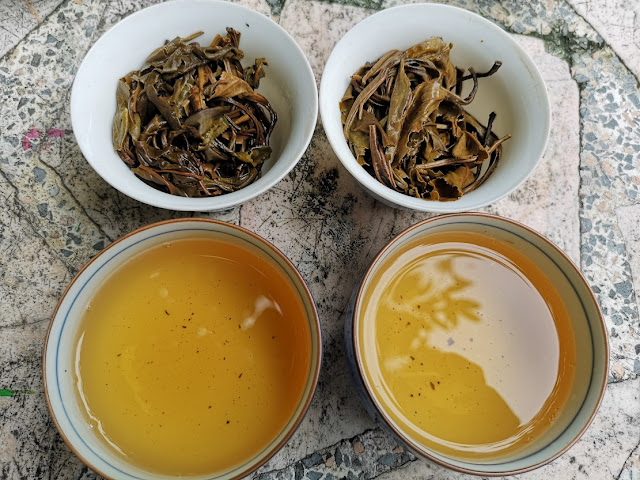
Ta Cu Ty on left in all photos


Ta Cu Ty:  a bit subtle yet; I skipped the rinse this time, in part to vary approach, and in part because one of the two Thai teas I reviewed lost one positive round from that practice.  Warm tones stand out, for this being a 2022 sheng version, not so far from the Thai tea from Leo (the Moychay cooperative version).  It's as well to not add a flavor list given this is light though.


Suoi Giang:  even darker; two years is enough for aging to change a tea, under hot and humid enough conditions, or it could've been oxidized some too.  Of course it's hard to be clear on inputs, especially tasting a first light round.  Both could apply; this could've changed a lot in comparison to a normal 2 year transition, and it might've started out warmer and less bitter and astringent due to some oxidation input.  There's a nice fruit tone already emerging in this; we'll see if that develops or else more or less drops out.
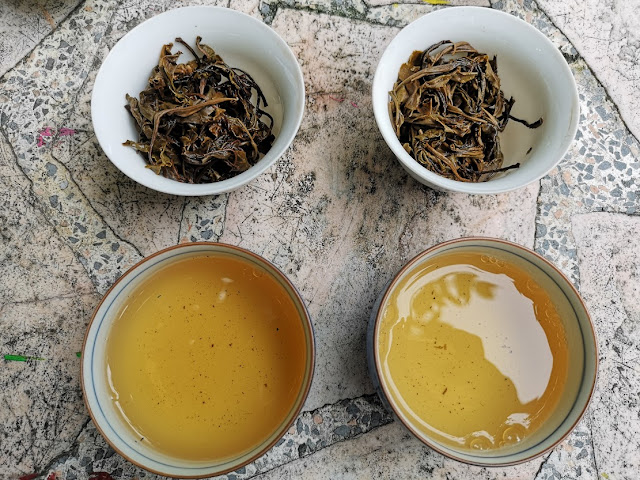

changing lighting moving outdoors changes everything


Ta Cu Ty second infusion:  a bit subtle as sheng often goes, but it has plenty of depth, so that's more about the higher end / forward aromatic range.  The warm tone ties to warm mineral depth, but the rest leans towards spice input.  It's subtle enough that it's hard to describe; along the line of bark spice, in between an aromatic wood, like cedar, or an incense scent.  Feel has good structure, some fullness that's a bit dry, adding depth, since less intense flavor and limited aftertaste limit the overall intensity.


Suoi Giang:  definitely fruitier, with a bit more intensity.  It's still not overly bitter, not heavy on floral range, or significantly sweet, so it also comes across as slightly subtle as young sheng range goes.  It's more as I would expect a version aged for a bit longer to be, after 3 or 4 years of transition, or one that swapped out some sheng character for oxidation pulling aspects towards black tea range, warmer, with good sweetness, but more mild in nature.  Or both?  Probably that is it. 

For both of these seeming a little subtle it's almost as if I'm a main factor causing that, as if a touch of congestion or general fatigue is throwing off what I pick up.  I can't rule that out, I'm just not aware of any such factor.  I'm relatively tired from the last month being really busy, but that didn't seem to affect me yesterday, and it was worse then, Saturday after a busy work-week, the day after a hard evening run, a fast 8 km. 

I have also backed off proportion just a little, after not getting through more than a half dozen rounds of notes trying three versions yesterday; maybe a slight increase in timing didn't compensate enough yet.


Ta Cu Ty, third infusion:  it's interesting how dark both are, brewed a little longer, 15+ seconds instead of under 10, too amber for that to be from brewing time.  You automatically think of oxidation level in relation to that, unless tea age could be a factor (some maybe, for a 2 year old version), but scorching a tea during pan fixing could change color, essentially roasting part of it.  People sometimes guess that this might cause some common smoke input, but I would guess not, that actual contact from smoke would be a more typical source for that.  These teas were all probably wok heated, in the fixing / sha qing step, using wood heat versus gas.  There's no smoke though, not like the Son La version had been.  That would come from storage near a wood fired heating source, I would think, not from spending that few minutes in proximity.  These teas are oxidized more than is typical; it has to be that.

This is much nicer, having opened up, and being at a more suitable infusion strength.  A bit of dried fruit joins in, and the warm tones give it a nice spice range base.  It tastes like a sassafras tea, not exactly like root beer made later to mimic that general range of flavor, but like a more original version.  I don't remember ever actually drinking that tisane, to be clear, but a childhood of contact with trees, growing up in the woods, using them as play infrastructure, and being required to cut a lot of wood for firewood, brought me exposure to many.  There's a sweetness to sassafras that's unique to that tea type, like hickory possesses in a warmer aromatic range.  The fruit in this is hard to make out, but not so far from dried Chinese date, jujube.  Interpreting part as floral tone would be natural, or even all of it as a complex version of that.


Suoi Giang:  the warm tone and bit of dryness is unusual, really for sheng of any age or background.  I don't want to say that it's not sheng-like, but it's different.  There's an aromatic edge, beyond that warm mineral / towards black tea range, that's also hard to identify, in this case even related to general range, spice versus dried fruit and so on.  The warm tones give it a savory effect, like sun-dried tomato, just not as clearly heavy on umami, but that's not what I mean.  I guess it's just floral range I'm trying to pin down further, but not in a form I'm familiar with.  It's rich and heavy, like a heavier version of lotus, or not completely different than lavender.  It's quite pleasant, but appreciating it requires shifting off a normal range of expectations about how milder and warmer character sheng would generally be.  

This is probably a good place to mention that "wild origin" sheng versions tend to be more approachable than more standard range versions, less bitter and astringent, more flavorful, and more varied in flavor profile.  The intense simple notes version of bitterness, sweetness, and a narrow range of floral tone common to many sheng versions just isn't how they often go.  Some are fruity, some covering novel or broad mixed flavor range, some well into unusual spice tones.  Sourness can come up, which may or may not be natural plant type variation input versus a processing or handling flaw, for example too much humidity left in the processed leaves.  So it's not unusual that these are a bit atypical, in relation to ordinary commercial higher volume production Yunnan sheng; they're supposed to be like that.  Wild origin Yunnan sheng can vary in these same ways too; this Moychay Yongde version, a personal favorite, was like that.


Ta Cu Ty fourth infusion:  I'm burning out on trying these teas already; I seem to be working with less focus range to begin with.  Again character is interesting for this being relatively subtle, as sheng almost always goes.  Bitterness not being significant is normal enough, that can happen, or sweetness being moderate, or even this warmer tone range, but it's all a bit dialed back for intensity.  Still quite nice, that's just not how that tends to usually go.  

That could seem to contradict what I just said about wild origin material teas, but as I see that it doesn't.  Character range can be atypical but still intense; it's more that factor.  Yunnan black teas, Dian Hong, can be milder across some flavor range, not intense, but often still just great for including a nice base, and this is a bit like that.  There's plenty to the experience but flavor intensity is below average.


Suoi Giang:  some of the same applies to this tea, about it being warm in tone and generally not intense.  I'm not completely ruling out that an odd input related to me is causing this effect.  A lot of noise in the background can mute what you experience, I'm just not in that kind of environment right now, in the usual spot outside, on the cool side as Bangkok goes.  I've heard a theory that relative humidity and pressure changes can impact how a person senses things; maybe there's some of that happening.  Or I'm getting a cold, and just don't realize it yet.  I tried drinking a bit of water; sometime resetting your palate has a positive effect.


Ta Cu Ty fifth infusion:  warmer tones, some floral, towards spice range, a cool root spice version of that, with limited dried fruit input, the same as before.  I thought dried fruit tone might evolve but I'm not noticing that.  It's pleasant, just not within conventional sheng range, without much bitterness at all.


Suoi Giang:  like the other, with a different warm spice range, a different warm mineral base, and heavier on floral range, both maybe still expressing subtle dried fruit.  Still these are fairly similar, which is odd, for both being so unconventional.  Based on a scale of evaluating oolongs or black teas maybe bitterness is more pronounced than I'm describing; it's only against a conventional young sheng range that it's quite low, and there is a little.  I suppose this is a little more bitter than the other, with a bit more of a dry edge to the feel, with the other quite light and "round" in feel.  

It's odd that I'm not mentioning feel or aftertaste aspects more, but both of these have pleasant moderate fullness of feel but nothing too pronounced, and limited lingering aftertaste effect.  It's nothing like the gap in such range one experiences from limited quality range tea though; that's something else.  I just retried one I bought for very little in China 3 years ago, somewhat aged then, a couple years along maybe, in a decent place for being further along in aging transition than these, with even more warm tones and dryness, but it didn't express the depth that these do.  A rough general intensity level might be comparable, but these are both fuller in a way that's hard to describe.  Looking that earlier tea review back up it was a 2015 Bulang (and still is; I didn't finish it), that I bought in 2019, the "300" version.  I think the other tea I reviewed along with it then was better; I should retry it and mention it here.


I've had been giving these longer than average soaks but tried on at over 20 seconds next (round 6), but there wasn't anything new to mention.


Conclusions:


I liked the teas, but this atypical range isn't one that I find that much more appealing than any other.  The Son La tea was nicer for the greater intensity level carrying through lots of infusions, but the smoke and bitterness level would divide people in that version.  And these are quite good teas but not the most exceptional, for any particular reason, beyond the milder tones and warmer range potentially being something someone else really loves.  I'm accustomed to a higher bitterness level, and higher flavor intensity level, pairing with more sweetness, so the two Thai versions that I reviewed with the Son La version are more familiar ground.

Then price enters in, and aging potential.  Related to the second these don't need to age, at all, and are fine as they are.  I suppose for someone not interested in holding onto teas that's a positive.  They might pick up a bit of depth over the next year or two but I wouldn't keep them for long expecting positive change.  Related to price they might be even harder to place, for not matching a standard style.  I don't see these as $100 a cake quality level, 35 cents a gram tea, but they're a lot better than factory sheng range, especially if one is seeking something to drink now.  That doesn't mean that they're  necessarily right in the middle, that averaging $40 and $100, coming out to $70 (for 357 gram amount) would make sense.  

Huyen has said that better quality loose sheng pricing increased a lot in Vietnam a couple years ago, and these are good enough to get swept up in that.  I wouldn't be surprised if this was selling as 40 cent a gram maocha, even though that's way off a normal competitive Yunnan version pricing, and a lot more than I would pay for Thai equivalents.  Laos and Myanmar versions are all over the map for pricing in relation to quality level and style now; it just depends.  Let's check those listings, and Steve's input on what this is.


Later input based on a second Ta Cu Ty tasting:  the tea is much better once you expect it to be as it is, if you can adjust expectations for that novel style.  I see it as really right in between sheng and black tea style, not just more oxidized as an input, but a lot more subtle than sheng tends to be (less intense), with aspect character in a warmer range.  Bitterness and astringency aren't significant.  I really like it.  

Again sometimes Dian Hong picks up a character low in front-end aromatic flavor intensity, but with good depth that compensates, and this is like that.  It's perfect for a breakfast tea, not challenging, distinctive but neutral enough to match with different foods, easy to brew.  It lacks the astringency edge and sharper flavors in a black tea that would really offset something rich, like a buttery raisin bun, but it would still be fine with that.  And it's good enough quality tea that it would hold its own in a single type tasting session, as the main focus.

It's interesting how this extra oxidation input parallels limited aging input, and how it is different.  Bitterness moderating and warmer flavors increasing is part of that, but for typical sheng even 4 or 5 years stored in a relatively wet environment won't change over character as much as this oxidation level input did (or seemed to; to some extent that's still just a guess).  Bitterness transitions to other aspect character gradually, for example, and this just didn't include it to begin with.  This doesn't taste exactly like a black tea or a medium aged sheng; it's slightly different than both.  It's good, as a unique and different type and style.  

I can also see why this style never really caught on within Yunnan producer or sheng drinker circles, since that character change came at the cost of losing so much intensity, without ever really achieving those positive black tea flavor range (dried fruit, roasted yam or sweet potato, cocao / cacao, etc.).  But then a bit of extra oxidation input seemed to change the Thai wild origin tea version I reviewed in the last review in a much different way, so it only goes so far mapping that as a consistent and necessary trade-off.  And both these teas are still more intense than average white tea range, so a lot of me going on about that as a potential limitation or trade-off relates to my expectations for the type, not to the tea not tasting like much.