Showing posts sorted by relevance for query Kinnari tea. Sort by date Show all posts

Sunday, March 7, 2021

Extending an online meetup social circle


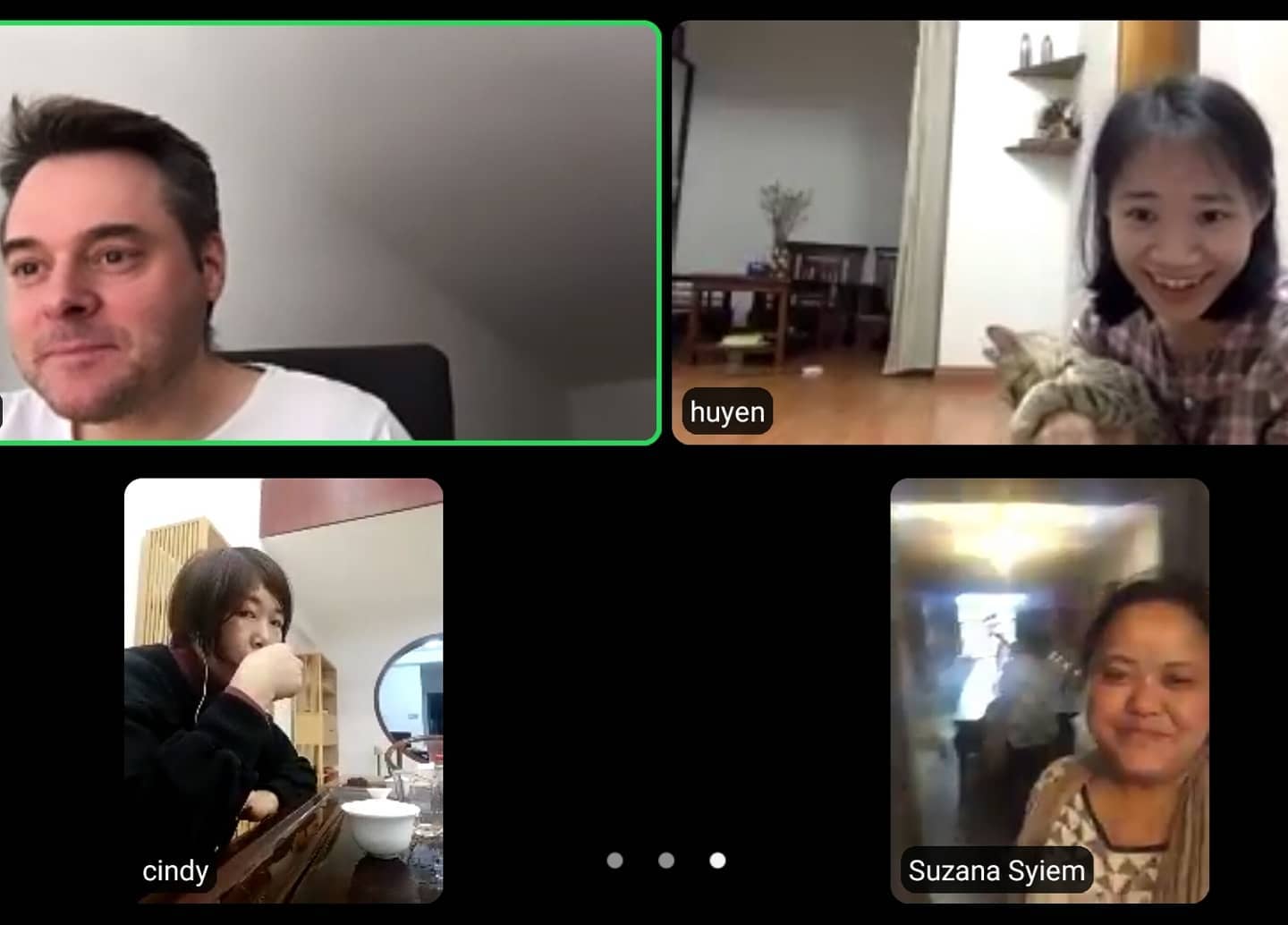
There's something new related to tea I've not mentioned yet, that meetup circle of three other friends and myself trying out extending that form to include other people joining.  This describes how that goes, and introduces those others, all with really interesting background related to tea, more than it covers the discussions content.  I wrote some notes on the specific content of one of the meetups but I'll hold off on that post until some later news adds to that.

One issue with even meeting with those four friends is dealing with the online form.  Work meetings are like that over the last year, of course, from working from home for nearly half a year, but social meetups are different.  The feel and pacing, and potential to embrace tangents, all vary a lot more than a structured work-meeting form.  For background context those friends are Ralph Rauschert, Huyen Dinh, and Suzana Syiem, all experienced, committed tea enthusiasts and active social media participants from Germany, Vietnam, and India, respectively.  

Encountering all these contacts relates to writing this blog, of course, and also to experience in moderating a tea group that I helped found, International Tea Talk.


Let's start with who we've already met with; that part is amazing.  We talked first with Jaba Borgorhain, from a tea producing family in Assam, next with Anna of Kinnari Tea, a Laos tea vendor and development consultant, and Cindy Chen of Wuyi Origin, who needs no introduction for many.  She is a very well regarded Wuyishan based producer, from a traditional tea producing family there.  She's in a very unique position for being part of a Chaozhou, Guangdong tea producing family; her husband's background. 


I've met all these friends and the meetup attendees in person with one exception: Cindy and I haven't crossed paths yet.  That's a real shame, because she's as kind and genuine as anyone could be, and experienced with the subject of tea on a level we conventional tea enthusiasts can't really relate to, born into it.  Cindy's daughter could Gongfu brew effectively at the age of two.  That girl probably could've taught me a good bit about tea at the age of four, and I'll never catch up to her current exposure level.  Cindy must have been like that, steeped in an amazing degree of tea exposure by early childhood, which kept on going from there. 


the meetup with Jaba


meetup with Anna (photo credit Suzana Syiem)


Going into these sessions one open question was how well the form would work.  It was never set up as any sort of interview session, with no fixed format or scope.  As those months of online meeting with my other friends went on over 2020 we talked more about what was going on than tea, of course always passing on local pandemic updates.  Meeting new people for the first round raised a concern over how introduction would go, and theme focus, versus actually getting to what those joiners had to contribute about their tea experiences.  

In all three cases their exposure runs incredibly deep, maybe more so for Cindy being in those unusual circumstances, but really just more different in type than degree for each.  Anna's background spans tea vending, running a shop, producing an RTD kombucha, helping producers adjust processing, and onto NGO coordinated development issues.  Jaba is from a tea producing family and covers some of that same diverse scope, with an interest in tea history and fair trade issues.  Laos and Assam are seeing changes in longstanding tea traditions as they become something they never were before, versus Chinese forms being more grounded in history and consistent, both in terms of the tea itself and the culture.  Plenty of change and disruption happens there too; I mean relatively speaking.

Talking to Jaba stuck with the subject of tea more.  Ralph and I met her here in Bangkok the first day that I met both, so that bit of introduction was already complete.  The Indian / Assam context being so familiar to Suzana probably helped.  Development issues were interesting, about what is changing, and what will continue to change.  That's the part I expect to report more on in the next couple of months, so I'll set it aside here.  One thing I didn't necessarily expect was discussing local tea preference issues and import and shipping concerns in Vietnam, Germany, and Thailand, the conversation scope going in both directions like that.


with Ralph and Jaba at Jip Eu, my favorite Chinatown shop (and Kittichai, the owner)


Meeting Anna was more of a personal introduction.  Her tea background extends to significant awareness across a broad range of traditions.  The development themes about Laos tea are perhaps even more fascinating, for starting from closer to scratch, in an odd twist based partly on use of tea plants from an older tradition that are far older than anyone living today.  That mix of inputs can result in production of some amazing forms of tea.  But we didn't get too far into that.  Interpersonal inputs can play into discussion scope, without a clear theme or central moderation keeping it on a limited track.  Anna seemed genuinely interested in finding out about the others, instead of just talking about her history. It's not as if that introduction scope is a bad outcome, or one that falls short in some sense, even though it would replace some novel potential related to the subject of tea.  

Some of the same happened with Cindy; we didn't get far talking about her tea.  At one point she discussed her personal favorites, and it even drifted into discussing pu'er versus Chinese oolongs, but it never settled into a Q & A scope, about processing or tea types, or into much history.  Cindy did mention how Wuyishan tea demand has transitioned over the last 20 years; that was really interesting.  One cool part about Cindy, which really applies to the other two friends as well, is how tea expertise and related perspective is amazing but she shines as a person even more.  If I had to choose between never talking to Cindy again or never trying any of their tea I wouldn't miss the tea, even though it consistently represents the best quality versions of any tea that I've ever tried.


my favorite picture of Cindy, as the red riding hood of tea


The complete meetup potential was never clear, if the form would turn up some novel further direction.  For now I think it's  little too chaotic and unfocused to shift to include more scope, for example to add more participants at the same time, or record sessions for sharing through video with others, or to add more structure in any way.  

It's a potential problem to look back at each session and regret what wasn't covered or expressed, a bit of which I'm guilty of passing on in this write-up, and in immediate perspective after.  That seems to be looking at the glass that's half empty.  A social meetup is about the social part first, or else it's a topical interview or whatever else.


it's nice seeing Huyen's kitten play, and just catching up


Meeting any or all of those three again would be nice.  For not getting into that much about tea we left a lot of ground uncovered in the last two sessions, but the introduction was more a main theme.  Jaba has more to cover about tea too; there will be plenty of updates about local changes we only touched on in general that time.

Maybe the most interesting potential relates to online contacts who have agreed to join but haven't yet.  Russian tea culture has been a favorite theme for a long time, since visiting there three years ago, and trying a lot of great tea from Moychay.  We've not been able to connect yet with a friend in Nepal who makes great tea, and tries out some new related themes, co-op processing and agricultural tourism.  I know some other tea producers, and Eastern European tea culture is interesting; lots of places are.  It's funny how it works out that it would be interesting to hear more about American tea culture, an interesting subject that gets far more attention online than the related Chinese experience, at least in the "Western internet."

Since I've not did justice to introducing these meetup visitors I'll share some links that go further with that, prior writing about them and what they've been up to, with an extra reference contact added.


Making rock oolong (Wuyi Yancha): an interview with Cindy Chen

Making tea in Wuyishan; sharing pictures and video from Cindy Chen

Wuyi Origin site based blog


Kinnari Tea sheng comparison (Nyot Ou district in Phongsaly, Laos)

Kinnari Tea Laos Moonlight White (maybe quite out of stock, but an example of an interesting tea)

Kinnari - ຊາຈາກລາວ Tea of Laos Facebook page


Oiirabot Assam hand made black tea

Trying Assam falap, a variation of bamboo sheng (from Jaba, an interesting tea, but I'm not sure if they actually sell it or not)


a rare off-tea theme, visiting Wat Pho, the Bangkok temple where I had ordained


Saturday, June 10, 2017

Comparing silver needle teas from Thailand, Laos, and Vietnam


Doi Inthanon left, Kinnari middle, Hatvala right


I'm comparison reviewing three white teas, all presented as silver needle style teas, from Thailand, Laos, and Vietnam (from Doi Inthanon, Kinnari Tea, and Hatvala, respectively).  It's a bit much.  I've been on a comparison tasting cycle lately and may as well stick with that, since it helps place teas better than tasting them alone would.  I'll be dropping it before long, maybe for a couple more types then I will.

There is a cost to that, a drawback and trade-off to doing comparisons, which came up in a comment on the last review, comparing Darjeelings.  If the tea plant type or style is different then the review could be more about noticing the style difference than the relative quality level of the teas, and subjective preference description can work out the same, more about type than how good either tea is.

I try to make those factors explicit in the reviews, to clarify when I think I prefer a type-related aspect, or when a set of aspects is uniquely positive in a tea within a range of one style, but there's a limit to that.  With a God's-eye view of tea types, related typical aspects, and characteristics tied to quality levels that would work better, especially if every tea stuck to a clearly defined type, but obviously all of that don't match reality.  Teas tend to vary.  In a sense it really doesn't even matter how close these three are to an original Chinese white tea version anyway; I'm experiencing them in relation to how much I like the aspects, not judging them related to trueness-to-type.

This would be a good place to introduce the teas, perhaps with a few more words at the end about the standard type and differences:


Doi Inthanon (Thailand, outside Chiang Mai):  Silver Needle #12 Bai hau cha - tra trang

Kinnari Tea (Laos) Moon Buds

Hatvala Vietnamese Floating Cloud White tea Yen Bai


This review is mostly about how I experienced the teas, not that background about any standard.  No vendor really claimed these closely matched a traditional Chinese version, and I'm not the best person to judge how well they did.

Review

Doi Inthanon lower left, Kinnari top, Hatvala lower right


The three teas look and smell quite different.  The Thai tea is much darker, with much smaller buds ("needles"), and a rich, complex scent.  The Laos version is the lightest, with a sweet, light, fruity scent, and the Vietnamese version is just a little darker than that and sweet but with a bit more of a savory edge to it.

The taste of the "silver needle" tea from Thailand, the Doi Inthanon Silver Needle, is a bit intense, perhaps closer to a black tea range than white based only first impression.  Of course white teas can oxidize to different levels based on processing differences, and this seems to have more than most.  That's not a good or bad thing, taken alone, just a variation; that just depends on how well it works.  I'll need to use short infusion time for this tea to limit the intensity, the opposite of what I expect from the other two.  It doesn't look like a silver needle tea at all, with much smaller buds than is typical, and quite a bit darker.  The dry scent is sweet and rich, heavy towards molasses and other earth tones, so I think it has lots of potential, it just won't match the typical profile, and it won't be subtle.

Tasting it the first round will involve tasting past an astringency balance that's a little high, but it's still positive.  It has an interesting citrus high note that stands out, and a great mineral intensive structure at the base, with lots of earthy range below that, the molasses, in general, maybe just not exactly that.  There's really a lot going on; it's partly floral, familiar from their other teas, and that molasses scent seems related to a woodiness in this particular infusion.  It all could be a little much for a white tea drinker looking for some subdued floral tones and maybe a little melon or whatever else mixed in; this is a little intense.  It'll review better brewed very lightly though, so I'll get back to all that.  That astringency even reminds me of pine needle tea, nothing like the bite in many other kinds of teas, a bit unique, coupled with a sharp, piney flavor element that's not negative, just quite different.

The Kinnari Tea Laos tea (Moon Buds) is subtle, as I would have expected.  It's sweet and complex though, with lots going on too, just in a completely different range.  Part seems like freshly dried hay, maybe a little floral, and that sweetness may well extend into fruity character, not so far from melon, maybe that.  I think there is some bright citrus going on too.  That citrus is so light and bright it's hard to pick a match for it, along the lines of tangerine peel spray, that citrus oil that comes out when you bend a peel.  I think it'll be easier to review on the next infusion for the opposite reason; it will take another round to really get going.  That contrast is funny.  The lightness and brightness is nice; it's not just light in the sense of being subtle, there is a bright character to it that's not easy to describe.  Someone might say "freshness" instead but to me brightness captures it.  It's a lot sweeter, or will be, once I get both of these teas brewing in a range that works for them.

The Vietnamese version (Hatvala Floating Cloud) is warmer, richer, a bit fuller.  Again this infusion is a little light for this tea; it will be easier to pin down going a little longer.  That first infusion was a bit over 30 seconds, probably still less than 45 though, long for this Gongfu proportion, but kind of normal for these types of teas that need longer to brew.  Or really the Doi Inthanon tea didn't need as long as it steeped; we live and learn.

It might not be easy to pin down the richness of this Floating Cloud even with optimized brewing; the main element seems closest to pine nut.  To me that's a really good thing, but I guess maybe not everyone loves pine nuts.  For people that haven't had them they're rich and a bit sweet, with a distinctive flavor, not so far from macadamia nut but not exactly the same.  They're a touch less creamy, but still creamy, and don't give up anything in being distinctive.  The warm aspect in this tea isn't so far from the fresh dried hay aspect in the Laos tea, they just head out in completely different directions from there, one to lighter, brighter and sweeter and the other to richer tones.  This is cool so far, and these teas have hardly gotten started.

the initial set-up

Second infusion


I went with a short infusion for the Doi Inthanon tea, around 15-20 seconds.  I think I'll go with the nicknames for these, instead of location, but this was only called silver needle (or bai hau cha - tra trang).  It's light but it works.  The sweetness and brightness stand out more, and that astringency steps back to a nice supporting level.  To be more specific it's not exactly astringency; it seems to both be a "feel" dimension and a related flavor element that seems connected with that, again close enough to pine needles.  For pine needle tisane lovers out there it's not light and sweet like white pine or hemlock (which is not the kind of plant that killed Socrates, it just shares the name), more like a Norway Spruce, a bit heavier and more intense.  It's like a light version of pine pitch.

The tea being sweet too makes that work.  The floral is still present but lighter, and something along the line of wood tones fills in some.  It might all work better than "wood, pine, and flowers" sounds, although really there would be a lot of range within those three description scopes.  There's a bit of a sage-like spice aspect filling in between that woodiness and pine that's nice.  It would too good a tea for blending with, and crazy to use it as such, but it would work well for part of the flavors base in a soup.

The Moon Buds (Kinnari tea) is still a little subtle, brewed for the same time again, in the range of 45 seconds.  I just can't measure infusion times; I'm philosophically opposed to it, but my internal clock works well enough.  There's something catchy about this tea, which I'm not going to do justice to by putting names on aspects.  It's bright and sweet, but not in a way that's familiar.  Maybe I like it more since I've been into first flush Darjeelings that emphasize brightness and sweetness, even though the character is a little different.

I should brew it for a full minute to let it go stronger, or a bit over that.  The package says 95C, 3 to 5 minutes (or was that a 7?), and of course part of going shorter on time is that I'm using a relatively high proportion of tea to water.  After 3 minutes at this proportion it would be as strong as a mild black tea in effect, but really some people would still like that.  I don't think it has enough astringency in it for that part to become a problem, but the flavor balance shift would let earthier elements play more a role and that light sweetness would drop back into a continuum of other aspects more.  I'll try it though; I can't add more to description here based on this tasting.  It's vaguely floral and citrusy, perhaps with a touch of melon, but there's more to it than that.  As for which melon, that part gets complicated.  I hate almost all melons but I like this flavor aspect, but maybe it's as well I don't expand on how that plays out.  Maybe it's not melon anyway, something fruity but slightly different, off towards apricot or plum instead.

The Floating Cloud (Hatvala tea) is still sweet but more in a richer, warmer range.  I will go a little longer on these two and describe them further for a third round.  The Doi Inthanon tea could probably handle a 30 second steep but not longer.


Third infusion


Screw the philosophy, I timed that last infusion, 30 seconds for the Doi Inthanon tea, 2 minutes for the other two.  To explain that part more, to me timing infusions puts more process between the tea drinker and the experience, as much as it standardizes and optimizes brewing.  I get it, about more people probably going the opposite way on that, but I like the minor variations in preparation, they are as informative as they are pleasant to experience.  And reviewing teas already adds a thick layer of analysis and interpretation to trying teas that I find disruptive.  It's interesting to do it, on a different level, but take away this blog communication step and I wouldn't really care to split flavors and other aspects into concept-lists like this.  Back to that though.


The Doi Inthanon tea is right at a level of intensity that works.  From here it's more about the balance of aspects working out for someone or not than dialing that in more.  It's woody, and floral, a sweet type of floral, with a bit of feel and taste matching pine needle, so more of the same.  The level of sweetness makes that work, but it's not as sweet as the other two teas.  The Kinnari tea is the sweetest, and brightest, but also the most subtle.  It's tempting to say the Hatvala tea is in the middle somehow but I'm not sure experiential space maps out like that.

The Moon Buds is picking up some warmth and depth brewed stronger, not giving up much brightness, but that aspect range is diminished for sharing some space.  The depth it gains is more in the range of sunflower seed, soft and sweet, a little rich, but still light.  I think it's a floral tone I'm not able to capture in description, as much as fruit, maybe spanning both.  It would be possible to try and focus on that dried hay / sunflower seed aspect and try to pin that down further too, and possible to interpret that in different ways.  It's hard to imagine that being read as mineral or spice tone but it's not inconceivable, really, or maybe I'm just missing something else.  The tea is a little subtle still but complex.

I haven't been saying much about feel or aftertaste (anything about those, really), but for me comparison tasting goes like that.  It works out to naturally truncate description for having so much space to cover.  A 2000+ word tea review is a bit much to write or read, beyond that extra being lots to focus on when tasting.  This tea isn't thin, and the taste does linger after swallowing it, but doubling the infusion time again would surely thicken the feel and add even more aftertaste.  It's a preference issue.  I always disliked silver needle style teas for being too subtle and not having enough dimensions but at the same time I prefer them on the light side, a bit of a contradiction.  To me--not a given, we're on what I think versus any standard understanding on this, best taken with a grain of salt--it shifts the aspect range going longer by pulling out richer, earthier flavors, at the expense of the lighter aspects, which don't drop out, but they do get crowded a little.

The Floating Cloud is similar to before, brewed stronger:  rich, sweet, a little subtle but with lots going on, with both brightness and earthiness.  The sweetness is in the range of both floral tone and honey, maybe with a trace of citrus, and that pine-nut aspect moves out to cover more range, but it gets harder to pin down.  I think I wouldn't have liked this tea as much a year or two ago for not really embracing the experience of related subtle teas, but I'm better with that now.  I've been drinking a good bit of compressed white teas lately, two shou mei cakes and some random pressed white version, and those are quite different--sort of--but the general range is not so far off.  This tea is definitely brighter than those, and more complex, with more going on at that higher end, the floral aspect, but not as bright and sweet as the Laos tea.  I think it's a bit richer and fuller than the Laos tea, maybe in feel too, but I really mean in flavors aspect range.


Doi Inthanon lower left, Kinnari top, Hatvala lower right


Fourth infusion


To push the teas a bit I went 40 seconds for the Doi Inthanon tea and three minutes for the other two (timed infusions; but I'm not going to switch over to embracing optimized brewing all the time).  They would drink just fine brewed lightly but this should help show what's going on with them better.  A full five minute steep might work to identify more about the structure, or really delve into all they have going on, but it wouldn't match my own brewing preference, at least not at this tea and water proportion.

The Doi Inthanon tea is fading just a little, although it's surely far from finished, it would probably go any number of rounds past this brewed longer.  The pine stands out a little for the rest dropping back a little, and the lighter feel works well, otherwise it's about the same.

The Moon Buds tea doesn't transition much, but it does pick up more earthiness, probably both from a natural aspects progression and from going longer on infusion time.  That one "catchy" aspect does remind me a little of that AV2 Darjeeling character, the smoothness and roundness coupled with sweetness, brightness, and melon / light citrus character (or some other fruit I'm not "getting").  Or maybe I've just described a set of aspects instead, even if to me they tie together somehow.  All of those things almost come to a central presentation point in one distinct but hard to describe bright flavor element.  At the end I can say how the Kinnari tea owner describes it as a list; she's pretty good with such things.

The Floating Cloud moves into an interesting space, transitioning the most of the three, towards a sun-dried tomato sweetness, a sweet and savory tone.  That was actually present in the initial dry tea scent but I wasn't noticing it so much in the other infusions.  I wouldn't be surprised if it would be possible to pull out a completely different type of experience from this tea by going long with infusion time initially, and maximize the savory tone that way.  The Kinnari tea would pick up more earthiness range in such an approach too, whichever way that sunflower seed element would present itself brewed stronger, but the Doi Inthanon tea wouldn't be as drinkable brewed any stronger.  This might be a good place to close this, to move onto some final thoughts based on those vendor's input.

Additional


This will only make for a token aside about traditional style, not from the most authoritative reference on the internet, but the related Baiho Yinzhen article in Wikipedia (the Chinese name for the general type) points out something worth noting:


Two regions, Zhenghe and Fuding, spanning the north to north-eastern parts of the Fujian province are the major and original producers of this tea, although neighboring counties have also been producing.[3] The two major cultivars employed by these regions are Fuding Da Bai and Zhenghe Da Bai, named after their origins. These differences are important to distinguish the two major styles of Silver Needles — the Zhenghe style and the Fuding style. The former is usually a lot darker, with significantly longer piled-up time for oxidation, yielding a tea with fuller body than the latter style, which is generally lighter with shorter oxidation.[5] 


It wouldn't have mattered to me how much these varied from traditional styles, and I'm still not really pointing towards a connection in noting that, although a guess about plant types does follow.

Related to vendor descriptions, there is no vendor description of the Hatvala version on their site, but one does appear here (edited):


...from Suoi Giang in Yen Bai province.  This is a hand crafted tea that undergoes an extended sun withering followed by gentle stirring and drying... Made from leaf buds only harvested from wild tea trees that grow in the ancient bio-diverse forests at altitudes above 1400 metres... Floating Cloud is both elegant and complex and produces a delightfully sweet tea with notes of honeysuckle, sugar cane, walnuts and pine forest. 


None of the aspect descriptions match completely directly but the general description really does (eg. swapping out walnuts for pine nuts, interpreting sugar cane as honey).  I think the tea is quite good; the general impression matches too.

Moon Buds description (not as clear due to a branch in branding)


I didn't see any description of the Doi Inthanon tea, but this graphic lists some background on the Moon Buds version (listed as White Wings; it's possible different years' versions picked up different names, or it could just be a split in branding).  Again it sort of matches what I've described, just not directly.  Brewing it light I'd pick up less texture, although "buttery" is surely intended as a flavor here.  The mineral side would stand out more brewed even stronger too (I love "pebble" as a description though; I never can really sort out different rocks as aspects).  Citrus I'd mentioned, and the fruit I never did pin down, describing it as melon perhaps towards plum or apricot.  Incense:  maybe!  It really did have a lot going on.


It's probably as well to not stretch this out but I think all three are grown at significant elevation, with both the Kinnari Tea and Hatvala tea from older natural growth environments.  Not only would the Doi Inthanon tea be farm-produced (a typical row-planted, single, selected plant type) it's probably not similar in type to the other two.  I'd be speculating to say they are both from Assamica type plants but I think they are.  More "native" versions in the North of Vietnam and Laos are, per my understanding (only native in the sense of being introduced a long time ago, most likely).  That would explain the buds size differences, smaller for the Thai version, relatively similar in appearance for the other two, just a bit different in initial color.  So it's back to the idea of comparing apples and oranges I started on initially, related to the Doi Inthanon version, but then the review was clear on that in descriptions too.

All three were nice anyway, with a lot of complexity and interesting character from all of them, I just preferred the Laos and Vietnamese teas' styles more.  There was a time when the overall subtlety of those wouldn't have matched what I like in teas so well but now I'm more on that page, maybe not in terms of overall type favorites, but related to what I can really appreciate.  Those two teas were fantastic, so similar but so different, in different senses.  The Thai tea is still nice, well worth checking out, and positive enough that someone with a different style preference still might like it more, if having a bit more edge to the tea somehow seemed better.  As I mentioned in that last post related to Darjeeling types I tend to prefer oolongs and soft, complex black teas (Dian Hong and such), but it makes perfect sense for someone to like a bit more astringency than I do to balance other aspects.


One last aside:  I've been stocking up on gaiwans lately, so I now have three each of smaller and larger size versions for reviews.  I went with the larger ones for this tasting and it was a mistake; it took me all day to come down from the buzz of drinking around 18 cups of white tea.

Monday, March 20, 2017

Kinnari Tea Laos Earl Green


A Kinnari Tea Earl Green version!  Of course I’ve heard of versions of Earl Grey made with green tea but never got around to trying one.  I don’t drink that much green tea or flavored teas (blended or infused, any types), but since Earl Grey is an acceptable exception this may work.  I’ve tried jasmine black teas that weren’t bad, and a sticky rice tea from Kinnari Tea was a pleasant surprise, and Chiang Mai shop, Monsoon, did a nice coconut flavored green tea.  Osmanthus oolong can be ok, but some might be better without the osmanthus if the oolong is good.   


I’ll say a little about expectations first, a pre-review (something different).  I’d expect it to taste like green tea with bergamot orange oil flavor added, which is basically just the recipe.  The green tea might be a bit mineral intensive, not like Vietnamese green teas are, intense flint or limestone rock mineral on top of a vegetal tea, but likely subdued, maybe more like a sun-dried black or a really mild version of sheng.  I’d expect it to not be so vegetal, and not heavy on a toasted rice or nutty element, but with a bit more dried hay range than is typical for a green tea, and soft and light minerals.  All that is just a guess, from the looks of the tea and a description of the general style of the other types as much as anything.  Of course I’m also wondering how well bergamot orange oil works with green tea, but if those guesses hold up I won’t find out how it works layered in with grass or bell pepper flavors.


actual brewing was close to that, this time


After actually tasting it:  the tea is nice; it sort of works.  Of course it does taste like bergamot (orange oil, a specific type, so citrusy).  The green tea is mild, not grassy, not vegetal, no intense minerals.  The orange is a little heavy on the first infusion, or rather the tea is a bit subdued, since the orange is where it should be, but tea flavors pick up in the second infusion.  Altogether the flavors are sweet and bright and it all balances well.


I’m making it true Western style (really! ok, maybe just a little heavy on the proportion), even in an infuser device, which my parents gave me for Christmas, just to mix things up.  Using that device makes getting water temperature just right tricky because it would soak up lots of heat but I’d expect some guesswork to land that in about the right range.  I’d expect this will brew a lot of infusions, even for using a relatively typical Western proportion and timing, because of the tea type (just a guess, though, we'll see).


another gift, my kids call "ugly person" (in Thai)

It’s hard to review what the tea itself is like for being mixed with the bergamot oil flavor, so I’ll have to focus on how well it works together, the end effect, and maybe guess backwards to what it would be like alone.  They sent a plain green tea with the other samples, which I’ll review separately, but the style might not be exactly the same.  I was wondering going in if I’d even like “Earl Green,” and it’s fine, it works better than it sounds.


A bit more vegetable range wouldn’t be as nice, I’d expect, but this tea is soft and earthy, a bit subdued, so the only issue might be that that aspects range doesn’t stand up against the orange as much as a black tea might.  But they’ve adjusted bergamot strength to compensate, so it’s just a bit mild, in a lighter balance, brighter and less earthy.


The natural question that might come to mind is “why would they flavor this tea”?  Someone else might be an Earl Green type fan, and then they wouldn’t ask that.  For others, for me I suppose, it might be more natural to make it into a black tea instead, to oxidize it.  At least it is more novel this way.


On the third infusion I went longer and the bergamot and the tea taste both ramped up, but they were already in a good range for the last infusion.  It’s nice that somehow that proportion didn’t change, orange to tea flavors.  It’s not astringent, at all, just with a trace of edge to give it some feel, which works.


As with Vietnamese green tea standard practice (in Vietnam, at least) going with full-boiling point temperature water would bring more astringency out, but I’d as soon not.  The tea being this soft gives you the option of ramping up temperature, or experimenting with different ones.  They suggest 85 C, and it wouldn't be as biting as lots of green types when brewed cooler than that.  Some people could prefer an edgy green tea (the normal preference in Vietnam, per my understanding), and I suppose that softness could be seen as a flaw, if so.


Made a little stronger in this third infusion it’s possible to teas out more tea contribution / flavor from “below” the orange.  It is rich, and mild, but full, reminding me a little of the “cereal” element in the one white tea, the Silver Cloud.  There is a little mineral but less than I expected, even though I didn’t expect much, for it to be flinty.  You would think there would be some vegetable to be noticed, at least a little, but it’s more in the floral range, it seems.  It’s all a nice effect, quite bright and lively, clean and balanced, fruit and floral with mild earth and very light mineral as a base.  The sweetness helps support the rest.


A monk gave me some Earl Grey tea not so long ago, the standard Twinings version (odd how that works out, trading teas with monks, a long story) but there’s not much comparison to be made.  The bergamot is common, the rest is different, and the balance is quite different.  I think this still would work with a more typical green tea, something less soft and subdued, less complex, more grassy or vegetal, but it might be a lot better in this form.


The fourth infusion I went quite long for, and it is fading a little, but that seems fine, getting one light and three normal strength infusions out of a green tea.


I think if I liked green teas and flavored teas more this would strike me as a really exceptional tea; as things stand it was a pleasant change of pace.  It's just a matter of preference, not an objectively accurate evaluation, but to me the Sticky Rice Silver Cloud tea worked better.  Scanning back through that post there wasn't much there for subjective take, how I liked it, which is also relevant, even if that relates as much to preference for type and attributes as to a general overall judgement.  That wasn't just nice for being novel, which it was, but well above average compared to all the plain white teas I've ever tried.  I think I liked it better in part because of how well the flavors matched but also because that flavoring was very subtle, so that it really could have been a natural tea that just happened to taste a little like sticky rice.

they grow up so fast


Wednesday, February 15, 2017

Comparison tasting golden tips teas from Nepal, Darjeeling, and Laos


I happened to have three similar buds-only or mostly-buds black teas from three different countries, different versions of golden tips, so I compared them.  Two of them including some fine leaf material, or buds developing into leaves--and one not--is an inconsistency, but then lots of variables could change the results, and they're not supposed to be completely identical.  The point is only to compare similar teas, to taste how final results stand in the cup.  I tried a vaguely related black tea from Sri Lanka not so long ago but didn't have any on hand; probably as well since three teas is enough, and stylistic variations beyond origin differences are already problematic enough.

It's unconventional to compare teas from three different suppliers, stemming from the marketing function blog reviews serve.  This blog was never supposed to be advertising, that function and discussing tea just happen to overlap.  That makes for a good placement to mention that all three of these teas were contributed by the suppliers for the purpose of review.

In general I only review teas I like, since those are most interesting, although in discussing that scope with suppliers I'm clear on reserving the right to publicly express what I really think about any of the teas.  I suppose if a tea were bad in a really interesting way that could work for a post, like reviewing a ridiculously smoky lapsang souchong recently, perhaps due to chemical treatment instead of smoking.  That tea wasn't provided by the supplier; I bought it.  Typically suppliers provide nicer teas for review, so the most frequent concern is describing when preferences don't match a style, more so than for teas being bad or mediocre.  On to it then.


Himalayan Tea Shop golden tips (Nepal tea)


Rohini (Darjeeling) golden tips


Kinnari Tea Laos golden tips (Golden Flame)


The teas, and background


I've already reviewed one of these, a Kinnari Tea Laos Golden Flame (golden tips).  It's good.  The point here is to compare that to two others, a Golden Tips from Rohini Estate, a Darjeeling, and from a private vendor reselling teas from Nepal, the Himalayan Tea Shop.  Maybe interesting similarities and differences will turn up, for example comparison of region related (terroir) aspects.  Of course terroir can also refer to other things, to the effect of the specific micro-climate (eg. amount of direct sun, effect of fog), or the minerals in that particular soil, or to effects from other plants growing nearby.  A more experienced reviewer could say more about trueness-to-type, matching a typical range, than I'm going to here.

The Nepal vendor I'd mentioned in this post reviewing a green tea (a decent green tea at that).  That vendor's name is Arpan Khambu, essentially someone with a family business background starting to sell teas internationally on his own, a very small-business model.  That's an interesting back-story, one that would be more familiar for a vendor based somewhere like the US, but those circumstances change sourcing quite a bit.  In the future his business practice may evolve to include more information about the grower, including details about growing conditions (organic claims, etc.), but due to just starting out as of yet the related information that's available is sparse.

Rohini is a major Darjeeling producer, or really a sub-set of Gopaldhara, so there is information about them and their teas on their website.  Not about this particular tea though, since it is likely not a main production version, and that producer sells teas primarily through distributors, with only the main types described there.

I was surprised that Kinnari Teas had developed materials describing the teas in great detail, just not down to grower's photos and Google's coordinates of the farms.  Here is some background on the teas they are working with that I didn't get around to mentioning last time:


All our tea plants are grown from seeds from ancient wild Lao tea trees. These unaltered tea plants are perfectly adapted to their environment, evolved to thrive in this particular microcosm without the need for human intervention. In our highly biodiverse tea gardens, the collaboration of different plants, animals, insects, minerals and microorganisms ensure healthy and rich soils, no pesticides or chemical fertilizers are required. The tea plants’ strong taproots provide them with all the water and nutrients they need, while anchoring the soil on the hillsides. Each garden is a biotope: their cultivation contributes to the protection of the environment in rural Laos.  

Growing tea from seed and artisanal hand-processing also results in less predictable and more complex aromatic characteristics within one single garden and throughout the seasonal harvests. Like with fine organic wine, each harvest and each batch is an adventure and a surprise.


Interesting!  Someone with skeptical inclinations could reject that as less valid than an organic certification but it seems to really not be intended as standing in place of that, just a bit on context.  The part about genetic diversity of plants of course is a real thing, which leads to more questions about the differences between native types of plants grown through natural breeding versus use of clones (controlled breeding).  There's more on the general background related to this particular tea:


Southern China’s Yunnan Province is widely regarded as the cradle of tea, and famous in the west for its excellent black and puer teas. But plants don’t care about borders, and northern Laos’ geographical proximity to Yunnan can be felt in this exceptional tea from Phousan Mountain in Xiengkhouang Province, which echoes the renowned Chinese Dian Hongs...  Upon infusion, the tea releases rich aromatic compounds reminiscent of Yunnan blacks, but with a distinctive elegance.


That mention of Yunnan and Dian Hongs makes perfect sense.  These teas are not that far from versions I've been reviewing in the not so distant past (like this Farmerleaf autumn sun-dried Dian Hong).  

All of this about the Laos and Yunnan origins isn't to imply that Darjeeling and regions in Nepal are giving up a lot related to working with near-ideal high elevation growing conditions, or that great results couldn't be obtained from working with modern tea plant types or species evolved elsewhere.  It's really about the final results, and different good teas can be produced in different places, which is really the whole point of this tasting exercise.


Tasting


Initial color difference seems to relate to teas including only buds (the Kinnari tea) or fine tea leaves and buds.  That will likely shift flavor profiles a lot, and change the effect of brewing times.  But then it's not science, just a comparison tasting.


The Nepal version (Himalayan Tea Shop; I'll just refer to these by country designation) is nice, darker, sweet smelling as a dry tea, and complex (they all are, really).  The initial taste is in the cocoa range, a bit subtle, sort of malty, but in that softer sense of that flavors range.  Malt is sort of complex anyway, not so definitive, but cocoa and malt describe most of the initial range.  It is nice and clean across that range, with a bit of bright citrus helping the profile.

The Darjeeling version (Rohini, a plantation associated with Gopaldhara, owned by them) is nice too, in a similar range, again malt and cocoa, maybe malt with cocoa versus the other way around.  The mineral structure below that seems to stand out more but it's still quite soft, and definitely not astringent, not even significantly "structured" versus biting, if that makes sense.  It might be the earthiest of the three, pulling a little towards wood tone, maybe even a hint of mushroom, but not in a bad sense, that clean tasting woodiness some wild mushrooms have.

The Laos version (Golden Flame from Kinnari Tea) is more subtle at the same parameters, without addition of some fine leaf content that would allow it to brew out as quickly.  It's more cocoa in the range of chocolate instead, that sweetness extended into those types of richer tones, maybe with a little brighter citrus tone mixed in.  Being more subtle offsets comparison a little; it might make sense to adjust brewing process since it may brew out slower.  I'll go a second infusion at the same times and judge that.


left to right:  Kinnari Tea, Rohini, Nepal tea


On the second infusion the Nepal tea is really nice, that cocoa and malt balancing even better.  Citrus is also there, with some spice tones joining in, close enough to cinnamon.  The sweetness is good and the feel is nice. There is a citrus element, a very light ruby red grapefruit (as a taste only; there is no bite / edge as from even mild grapefruit, just that warm sweet range is there).

The Darjeeling is in a different range, woody, maybe towards cedar, again with cocoa as dominant and plenty of malt (so maybe cocoa even picked up a little).  It's still nice, just different, it trades out citrus and spice for wood tones.  There is a lighter trace of citrus too but a different citrus, more toward bergamot.  The flavors are nice and clean.  It had seemed that woodiness could drift into a less cleaner over-all flavors range but it didn't work out like that.  That hint of wild mushroom transitioned to clean wood tones.

The Laos tea does seem to brew slower, so I'll be tasting it as a milder tea without adjusting to add time.  The proportion could also relate; going just a little heavier would add to the infusion strength.  This tea will probably last longer too, being only buds, or it might transition less later since the other two will see the fine leaves give out while the buds take more time to do that (at a guess).  The flavors are nice, again malt and cocoa (common to all of these), with citrus, and a light woodiness that's not the same as in the Darjeeling version (the Rohini).  That tea is more in the range of cedar, and this is really something that may be more like hay, it just covers the same range.  The last review also mentioned raisin, and between the more dominant cocoa and citrus underlying aspects could be sorted out as fruit, that raisin, or as malt (sweet malt, as in malted milkballs; there's nothing dry or mineral intensive about this tea, the standard pairing with other types of black teas profiles).

The citrus aspect may be the strongest in the Nepal version, or maybe it's that the spice tone adds to that sort of aspect effect, with those two sort of defining a "top" range, of sorts.  It's interesting the way there are so many comparable elements in these three teas playing out slightly differently.

On the third infusion the Nepal tea doesn't change much, maybe just a little nicer.  That cocoa, malt, cinnamon, and citrus integrate well together.  The other "earthy" range is more dark wood than mineral, or just a bit off cedar towards something darker yet, but not at all murky in effect.  The malt sort of has that brightness and complexity it seems to have in very different black teas, just not paired with astringency at all, and with different flavors altogether.  The spice tone (close to cinnamon, but not exactly that) covers range out towards coffee, just a mild version of it, a light roast, I guess.


Rohini plantation (photo credit)


The Darjeeling is moving into a richer, earthier range.  Without trying that Nepal tea just prior it would seem a lot different, brighter in comparison, with some of the same general aspects filling it out (cocoa, malt, citrus).  Due to direct comparison with the Nepal tea just prior a heavy, earthy tone stands out a lot more.  With that comparative bias going it seems a little towards a shou or aged pu'er, that dramatic, but once you adjust to tasting it on it's own it's nothing at all like that, just earthier.

Is all this clear?  It's covering similar cinnamon / coffee complexity range as in the Nepalese tea, just earthier, more centered towards a dark wood, and it seems the difference stands out more than the rest of the common flavors profile--most of what comes across--due to comparing the two teas.  It wouldn't be unusual for someone to attribute that to something else, peat, autumn leaves, mineral range, or something else, but it's clean and integrated, not "off" in any way.  The tea works well.

The Laos tea is more subtle than the others, again with part of that down to brewing parameters issues, trying to brew teas that aren't identical in the same way.  I can taste around that, and let it sit a little longer next time.  As with white teas this seems a little like tasting a silver needle style against a bai mu dan type.  Of course there is less complexity for including one type of thing instead of two (buds versus leaves and buds).  I think I'm biased towards that more complex effect, in general for both types, related to tasting these and for those white teas.  The opposite preference would also make perfect sense; it's subjective.  The tea is great though, as I just reviewed separately.  Cocoa, malt, hay, citrus, and fruit make for a nice profile, and it's quite clean and well presented.  It's possible to ramp up infusion strength different ways with brewing, it's just not possible to add more elements that aren't already there, and those aspects and balance are nice.


On the next infusion the Nepal tea is still similar, picking up just a touch of dark caramel tone.  I would expect it to start tapering off a little from here but who knows.  The Darjeeling version stays clean, with dark wood still pronounced, maybe shifting a little closer to the Nepal version, starting to come across more in between spice and light coffee.  It is a little more earthy than the Nepal tea.  The Laos tea is just hitting it's stride, bright in effect and picking up more complexity, but then it had already been complex.


not so related, but she does love tea

I think I'm liking these teas a lot more for calibrating my expectations to the range more, for appreciating them as a bit subtle (compared to leaf-only black teas).  It didn't hurt that two versions met me in the middle for including fine leaves in addition to buds, more familiar to me and a better match for my preference, that additional complexity.  And all three are really nice teas; that helps.


I suppose I am describing them in such a way that the Nepal tea sounds better, and I do like it better, slightly, but the Darjeeling is quite close in aspects range, so they are more similar than different.  The differences stand out a lot more for trying them side by side; tasted a month apart it might be harder to distinguish the two.  The Laos tea has a different effect going, brighter, in a slightly different range, but it's also nice in a different way.


It's odd the mineral aspects are so subdued in all these teas that I've barely mentioned them.  It must be an underlying element of the flavors context, part of the reason they come across as complex, but quite subtle for all.  I like the way the dark woods / spice range is doing more for the two more Himalayan teas, with different citrus higher notes supporting the more dominant cocoa for all three.


On the next infusion I think all the three teas are dropping back a bit  The same elements are there but they're thinner, and would surely keep getting thinner.  Based on the tasting last time that Laos Golden Flame really is able to go more rounds than one would expect, staying consistent across longer infusion times for a number of extra rounds.


lower left Laos, right Nepal, top Darjeeling


The spent leaves look a little different but the Nepal and Darjeeling versions aren't so far apart, more a slight color difference, with the Nepal leaves just a little darker.


That was interesting!  A word of caution about comparison tasting golden tips style teas:  the level of caffeine in these feels substantial, with that effect going a bit far given how many rounds I tasted through.  It took a good number of hours for that extra level of tweak to wear off.

Tuesday, March 9, 2021

Writing about tea culture in 17 countries


It's a strange idea, writing an index post about other posts.  I'm the admin for the International Tea Talk group and seeing people join from countries I've written about has me considering telling them about such local-specific posts, but I almost never do.  It's hard enough keeping up with moderation tasks, filtering out ads and such.

But why not?  I'll keep this simple, and include a link to the main posts I take to be about tea culture or themes in a different area.  Related to a country like China I've written countless posts, but not really about tea culture there in particular.  Oddly that's something of a blind spot for me, even though some of my closest friends here in Bangkok have been from China, and some work contacts.  We've visited China a few times (twice for vacation, and once for business, and Hong Kong a few more times, and Taiwan, if you count that), but you only see shops on visits (if you don't visit producers), versus interacting with locals about tea culture.  

Here are those post links.


Making tea in Wuyishan; sharing pictures and video from Cindy Chen:  not exactly about local tea culture, except related to tea production as a part of that.  By tea culture I usually mean tea history, preference for types, locally produced styles, or related to enthusiast groups and ceremonial practices and such.  I last visited China two years ago, and wrote about that visit and going to a tea market there in this post:  Tea shopping in a market in Shenzhen, China, with this trip summary on what the rest of the visit was like.


my favorite picture of Cindy


Russian Tea Culture:  that sentence about typical themes covering history and interest groups and such works as a summary of this post.  We visited Russia on vacation three years ago and that started an ongoing interest in Russian tea culture, and just related to the country.  It's a fantastic place to visit, discussed in more detail here:  Travel in Russia, to Moscow, St. Petersburg, and Murmansk


a very nice guy who helped me translate in this Moscow shop


Indonesian grower profile with Galung Atri; on Indonesian teas:  this is mostly focused on production over consumption themes, with some perspective on tea history mixed in.  Indonesia is amazing to visit too.  I might say that over and over in talking about different places.  Russia, China, and Indonesia were all personal favorites, but lots of other places were really cool.  Here's more on the visit details:  Tea in Indonesia; one vacation's worth of experiences


we visited a tea plantation in Java but two volcanoes really stole the show there


Wonosari plantation in Eastern Java


Searching for tea in Seoul:  ok, Seoul is amazing to visit, and I'm going to stop saying that.  Tea themes didn't get so far compared to in other places but I least I found and tried some.  I tend to focus on themes like seeing amusement parks and cultural heritage sites on my family vacations, which is appropriate enough.  An old-style spice market there was absolutely amazing but I didn't buy much.


Travel and tea in Japan, versus Korea:  this is really more about travel in Japan than tea in Japan; I didn't get far with the tea themes there.  Again that tied to doing more sightseeing than related cultural investigation.


Tea culture in Poland,  Tea culture in Poland (2), informed by a local tea blogger:  this was a bit random, reviewing tea in a place I had no connection to, experimenting with that theme.  I've never been to Poland.  It was nice that a local tea blogger saw the post and offered a lot of input as an addition, which worked for a nice second post.  I tend to see more about tea culture in places like Latvia and Georgia online; I should follow up about those countries sometime too.


Tea culture in Sweden:  kind of a similar theme, looking into local tea culture in a somewhat random place based on talking to someone living in Sweden (originally from Spain, for what that's worth).  It's interesting how the progression of uptake of awareness and preference works out in different places, typically following a similar pattern, but with some local variations.


Tea shopping in New York City:  even a short visit can work well for a post, just checking in with a few local shops, and passing on what got missed in reviewing leads and later suggestions.  We stayed in Chinatown on this visit, which made for a good starting point.  One of the most promising shops I only heard about later, but I adjusted the post content to mention it.


frantically stomping around NYC in a snowstorm looking for tea was really cool


Searching for tea in Taipei, Taiwan:  kind of similar to the last post mentioned; this is mostly about looking around over one day there.  I found two fantastic shops there (Lin Mao Sen and Lin Hua Tai), so the part about hunting for teas went well as a result.


About Thai teas and tea in Thailand:  I live in Thailand; strange I let this go this far down the list.  A search for Bangkok Chinatown in that blog would turn up more than a dozen posts about meeting people there; I visit a favorite shop there all the time.  I'm not that well integrated into a local tea culture here but of course some of that is around. I wrote about Tea as the hottest latest trend in Bangkok back in 2017 but that was more about bubble tea and matcha catching on.


Vietnamese teas! Green and Black!,  Huyen's family's trials in making Vietnamese teas:  it's strange how my awareness and context shifted so much between this 2014 and 2020 post.  I was so happy to find two basic types of tea on a trip to Hanoi way back when, and then really obscure or novel versions seemed more familiar in the latter post.


my friend Huyen, in one of my favorite tea party photos


Narendra Kumar Gurung on developing local tea production in Nepal:  this is the first Asian country on this list I've never visited (although I hadn't been to Poland or Sweden either).  This is more on production themes, co-op initiatives, local preferences, and transitions in their tea industry than on local tea culture in terms of interest groups and such.


Tea in Kazakhstan:  the first random pick-a-country themed post, reviewing tea culture in a place I'd never been, or had never heard much about.


Assam Teahaus orthodox black tea review:  this review post included a section that's a grower and producer profile based on input from Maddhurjya Gogoi, a contact I consider a friend.  Those issues came up in relation to Assam in a lot of posts, but no single article covered that theme explicitly.  I think one will pretty soon, related to Jaba Borgohain passing on more on that theme.  This post on Trying Assam falap, a variation of bamboo sheng covered some on a local type, and a few others talked about co-op initiatives and more direct sourcing ventures, and changes related to orthodox tea production.  I've written a lot about Darjeeling too, just not background posts, on status there beyond reviewing individual teas.


Kinnari Tea sheng comparison (Nyot Ou district in Phongsaly, Laos):  this covers some development issues related to Northern Laos tea production, about NGO activities and expanding use of feral / native local "wild" tea plants.  It's odd that Laos appears so far down this list, since it has long been one of my favorite sources for interesting and pleasant teas.  Anna of Kinnari is also one of my absolute favorite tea contacts.  Laos tea contact helped get me into tea; about 10 years ago I visited a Laos farm and bought fresh coffee and tea there, before starting this blog.


a wild part of Laos (photo credit and thanks to CCL)


mixing national themes, a Laos Tea tasting in a Moscow bookstore


visiting a Laos / Bolaven plateau tea farm with baby Keo, in 2011


Mission Impossible: reviewing teas from North Korea:  this isn't about local tea culture in terms of interest groups, but it does cross over from production considerations into discussing how national isolation led to it being very challenging to obtain this tea.  The same Chinese guide who brought Dennis Rodman there picked it up for me, so it probably really is from North Korea, but you just never know for sure.


That's probably plenty to mention, and most of the interesting places we've made it to.  I've been to Hong Kong a few times (3, and passing through once?), but didn't focus enough on tea there for it to warrant a post about cool shops or unique tea experiences.  The first two visits were a long time ago, before my tea interest ramped up, and the third was part of that trip to Shenzhen that I did mention, and we were in mainland China for longer that time.  

We've visited other places in South-East Asia, and limited tea themes have came up, but nothing on the same order of these other ventures I just covered.  Singapore's Chinatown is definitely unique but we cycled through a number of Singapore visits before I was as into tea too, in the first half of my 13 year stay here in Thailand.  The same is true for one short trip to Malaysia, and I actually found tea from Cambodia in a trip there but it wasn't much to get excited about, low-grade stuff.  It's nice that I was doing direct comparison posts that made no sense that early on, six years ago.  I still do that.


Thanks for reading along with me, and related discussion, or the positive comments, if any apply.  If you've made it this far at least the first scope did.  If you've got an interesting story you would like to talk about, or see covered here, look me up, probably best at this blog related FB page.  Even if it's not about tea I'm not that touchy about random contacts, and definitely not overwhelmed by the demands of fame just yet.