Showing posts with label Hatvala. Show all posts

Sunday, November 3, 2019

Hatvala Vietnamese Yen Bai black tea


This is the last of a set of samples sent by Geoff for review; many thanks for that opportunity. 

I've said over and over that Hatvala offerings represent some of the best Vietnamese teas on the market, sold at great value for tea quality.  The last set of Assamica based oolongs I reviewed added novelty to that; I've never tried Assamica based oolongs that completely pulled off being in normal oolong character range as those did, not different than any above average more-oxidized rolled oolong.  Prior sheng versions were also novel and great, green teas distinctive and pleasant, and more conventional oolongs also very solid.  Vietnamese teas in general don't get the respect for range and quality that they deserve.  Hatvala sells a good broad-character selection but that's just a good start on what is out there.

I'll taste this version without reading any background, finally getting back to a simple review, no comparison, non-standard type, or aging theme to go on about.  Per usual I am adding a vendor description at the editing step though:

Hatvala Mossy Frog black tea


PROFILE: SPICE, PEPPER, DARK CHOCOLATE, RED BEAN, WOOD, CARAMEL 

ORIGIN: SUOI GIANG, YEN BAI, VIETNAM

HARVEST: AUGUST 2019

An exclusive small batch artisan produced black tea from Suoi Giang in Yen Bai province – one of the most respected areas in Vietnam for wild tea processing.  Mossy Frog leaves carry the rich malty aromas of black tea but when brewed is far more complex with flavours ranging from spice, pepper, red bean and dark chocolate through to woody and caramel.  The bright dark amber liquor has a pleasing full-bodied mouthfeel with sweet aftertaste.  The leaves, sourced from deep rooted, slow growing ancient trees, can be infused up to 5 or 6 times and still be at their best.

Mossy Frog uses similar harvested green leaf material as our other Suoi Giang teas.  Leaves are picked from old, wild grown trees scattered across the mountain by ethnic H’Mong families.  The tea is produced in a small workshop using traditional hands-on techniques that limits batch size to between 15 and 20 kg of fresh leaf – or 3 – 4 kg of finished tea.  Mossy Frog is produced from one bud and two leaves and thus contains a high proportion of tips.


This is selling for $6.35 for 50 grams.  That's either a good price or a great price depending on how good the tea is, which I'll pass on a detailed impression of.

Review:


Dry leaf appearance is nice, long twisted leaves, varying in color.  Dry scent is sweet and malty, with apparent fruit range.  Just from that alone it seems similar to their standard Wild Boar black version.  I've not tried that in awhile but I did drink a good bit of it back when I last did so I'll probably attempt some comparison.  That's usually not a good idea for comparing a tea across a long period of time, so take that with a grain of salt.

It's interesting.  Malt does stand out most, not paired with as much astringency as is common to a lot of black teas, but then I've been trying milder versions of Assam this year as well.  It has a lot of depth and complexity; there is a lot going on.  There's more warm mineral range than is common in black teas.  That would be easy to miss, to interpret this as covering warm versions of wood tones, with related sweetness, and a hint of some sort of fruit, and not catch it.  It gives it an unusual depth.  The malt form isn't unfamiliar; it is that mineral-related malt that turns up in better orthodox Assam versions. 

The feel structure has an edge to it but that doesn't extend to dryness.  It's not really soft and full in the normal sense either, balanced in the middle.  There is a trace of dry edge, which only appears in black teas in this particular form, but it's limited in this.  That was a lot to experience for a relatively fast first infusion; it will be interesting to see how this unfolds.  Since intensity is pronounced and astringency and feel is a potential issue keeping that fast will work better; I'll try an infusion time of just under 10 seconds.

Second infusion:


An unusual toasted marshmallow flavor picks up a lot.  I don't remember experiencing that particular flavor in a tea before.  It's like the flavor right in between when those a light brown and are a bit scorched, so brown, and significantly toasted.  Obviously sweetness stands out, since I'm describing it as tasting like a toasted marshmallow, and malt is still present, but secondary to that flavor.  Feel softens just a little, losing some of that dry edge, maybe as a function of using a fast infusion, or it could've transitioned naturally.  The mineral and dark wood tones shift a little, but not so much.

Third infusion:
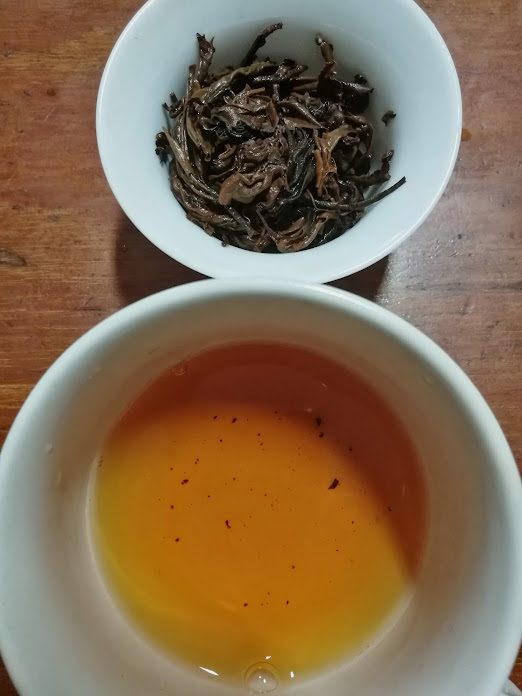

It reaches an even more pleasant balance in this round.  Toasted marshmallow is still a main flavor but the rest shifts to balance it very evenly.  It still has body, and maltiness, but astringency has dropped off to give it a smooth, full, round feel.  The rest is harder to split out due to being so evenly balanced across so much range but it seems similar.  A fruitiness might be picking up a little, a touch of dark cherry.

Fourth infusion:


Malt picks back up, again the main flavor.  Minor shifts in infusion strength would vary how the aspects come across, the relative order of intensity.  Preparing this Gongfu style has that as an advantage, that you can try the tea prepared in different ways by altering timing slightly, even if that's not the intent (and you are just inconsistent), or even if it doesn't transition naturally as much as some types.  The overall balance is what stands out.  Sweetness is good, with a fruitiness more present now than that toasted marshmallow, along with mineral base and dark wood tone.

To guess how this compares to the Wild Boar it seems more complex and more refined to me, trading out some astringency for flavor complexity.  The fruitiness seems comparable, similar to how I remember that, towards dark cherry, just not distinct enough to clearly identify as that.  I'll try a round brewed slightly stronger, but I think these have been essentially at optimum, with lots of flavor intensity and full feel character.  Even some degree of pleasant lingering aftertaste joins that.

Fifth infusion: 


Dryness does increase a little with it brewed stronger, and malt does ramp back up.  That toasted marshmallow returns stronger as more of a toasted sugar, like the browned top on a creme brulee. 

This would make an awesome breakfast tea.  It's about two full levels better than anything that finds its way into a tin of blended tea.  It would work really well prepared at different infusion strengths, and would pair well with food.  It's complex and distinctive but at the same time the character range is basic, normal, so that drinking it over and over wouldn't get old fast, compared to a tea that's pleasant in a more non-standard way.  Flavor complexity and actual flavor aspects are a bit unusual in this but general character is only novel for the light astringency and dryness balancing a soft fullness particularly well.  That dark wood tone, warm mineral, and light, non-distinct fruit all ground it in a standard range for black tea, just a much better version than typically comes up.

It's slightly closer to better orthodox Assam in style than Chinese black teas.  Those span a lot of range at this point, since better and more novel versions keep turning up from smaller producer sources.  This would probably compare really favorably to any larger plantation teas, even the best such versions.

Sixth infusion:


It's not tapering off in terms of intensity and complexity much at all, although I did brew this for around 15 seconds instead to compensate for fading a little.  It should keep going like this, with character varying for using longer and longer infusion times.  I don't think a flavor list and character description really does justice to how pleasant this comes across.  It all balances really well, and the more novel range for flavor input is all completely positive.  It couldn't be any cleaner in effect, with sweetness, feel, and the rest all integrated perfectly. 

The only limitation is that the general style is within a standard, familiar range, but that could as easily be interpreted as a strength.  I tried a couple of the best standard-type Assam versions I have yet to try not long ago, Latumoni Summer Tippy Assam, and this would compare reasonably well to those, probably more just slightly different than better or worse, but in a similar character / style range.

Seventh infusion:


Range of flavor complexity is dialing back a little, with malt and dryness picking back up, probably related to using a slightly longer infusion time, or also to the tea fading.  That warm mineral is increased in proportion to the rest again.  It seems like it has a few more positive rounds to go, it just won't be quite as pleasant as earlier.  Not far off it though; I'd essentially describe it in the same way as rounds 3-5, I'm just noticing a difference for having just tasted those. 

Conclusions:


I've pretty much said it all; it was quite good black tea.  For the price the value is really good; double that pricing rate would still seem fair to me.  It was similar in character to really good Assam, versus well above average Chinese black tea, which is probably typically priced at a slightly lower scale, but there isn't that much Assam out there on this kind of level.

I did brew it for another five or so infusions, and it could have kept going after that.  It was thinning in flavor profile and the warm mineral tone was getting a little edgier, changing in relative level and form related to the longer brewing time.  It goes without saying that this would also work well brewed Western style.  To me Gongfu brewing isn't really more messing around at this point, since I tend to brew tea like that with breakfast even when I'm in a hurry.  Character would probably vary a little based on any changes to parameters; this seemed like the kind of tea that would shift aspects a little based on altering minor factors like timing or water temperature.

About Hatvala, I'm not sure when I last mentioned they sell tea in a Saigon / Ho Chi Minh City cafe in addition to online.  It only seems to come up in discussion of where to visit in Vietnam.  I haven't been to HCMC in about 8 years, since I got further into tea and heard about this vendor, so I've not been there, but friends from the US and Indonesia did drop by not so long ago, reminding me to mention that.  They write a blog that includes pictures of that store and more on what they're up to, with some remote location photos from around Vietnam where these teas are coming from.  Vietnam is as beautiful as any country on earth, as I see it, but that's a separate and longer story.

I did meet the owners passing through Bangkok once, Geoff and Ngoc


don't take my word for it, check out the pictures (credit Hatvala blog site)


Sunday, October 13, 2019

Hatvala Vietnamese Assamica based oolongs


Sun Bear left, Moon Bear right (somewhat similar in appearance)


not a lot of extra information, but the packaging has a cool look


Breaking from normal form I wrote the review notes for this prior to doing any intro section, and talked a little to the Hatvala owner about those teas first too.  These were provided for review; many thanks for that. 

I'd lost track of the idea that these are both variety Assamica based oolongs, which is quite novel.  I remember trying an Oriental Beauty version made from Assamica and not much else comes to mind, beyond the Indian versions, which are sort of something else, more less-oxidized versions of black teas.  A Halmari Assam version was great, it just seemed nothing like a Chinese or Taiwanese oolong, a lot closer to a second flush Darjeeling.

They're both quite nice teas; I usually don't know that when writing the intro section.  I'll mostly just cite the web-page descriptions here though, getting back to descriptions and conclusion later. 


Sun Bear Oolong Tea

PROFILE: ANISE, FENNEL, SWEET, NUTTY

ORIGIN: CHO LONG, YEN CHAU, SON LA, VIETNAM

HARVEST: SEPTEMBER 2019

Sun Bear Oolong Tea is one of two experimental Oolongs produced from the leaves of wild large leaf tea trees collected from Cho Long in the Yen Chau district of Son La province.  Yen Chau lies between Moc Chau, where the tea is processed, and the Vietnam/ Lao border.  The tea is processed by an expert Oolong Tea producer.

Sun Bear Oolong Tea is produced from one bud and two leaves with an oxidation level similar to that of the farm grown Red Buffalo.  After rolling and drying the tea is subject to a short roasting phase.  Sun Bear feels a little creamy in the mouth and offers flavours that include aniseed, fennel and a sweet, nutty taste that is similar to cooked cassava (or 5 bean powder if you are familiar with that). The depth of character found in deep rooted, broad leafed, ancient tree leaves allows the tea to be infused up to 4 or 5 times without losing flavour.

The sun bear is the smallest of the bear species and is native to the tropical forests of South East Asia (including Vietnam).  It is listed as vulnerable due to large scale deforestation in recent years.  Sun Bears are also threatened by commercial hunting, both for meat and traditional medicine.  At Hatvala we are sponsoring the rescue work of Animals Asia at their Bear Sanctuary in Tam Dao National Park.


Moon Bear Oolong Tea

PROFILE: DRIED ROSE, HERBAL, MEDICINAL, SYRUP, TOAST

ORIGIN: CHO LONG, YEN CHAU, SON LA, VIETNAM

HARVEST: SEPTEMBER 2019

Moon Bear Oolong Tea is produced from one bud and two leaves harvested from wild large leafed trees. It is oxidized to a higher degree than both the Sun Bear Oolong and the farm grown Red Buffalo. Moon Bear does not have a separate roasting phase at the end of rolling and drying. It produces a full bodied amber liquor with a pleasant bitterness, subtle astringency and a delightful range of flavours encompassing dried rose, golden syrup, herbal or medicinal notes and a little toastiness in later infusions.  The depth of character in the broad leafed, ancient tree leaves allows this tea to be infused up to 5 or 6 times without losing flavour.

Moon Bear Oolong Tea is another of two experimental Oolongs produced from the leaves of wild tea trees harvested from Cho Long in the Yen Chau district of Son La province. Yen Chau lies between Moc Chau (where the tea is processed) and the Vietnam/ Lao border... 


My review notes have them a lot closer in character than those aspects lists do, and the interpretation varies, but that's all normal enough.  To cite a typical example I picked up no bitterness in the Moon Bear version at all.  Then again I've been drinking mostly sheng for two years, and an average level of bitterness in young sheng is a lot higher than in this tea version.  I might describe a sheng as "not bitter" when it includes more bitterness than any oolongs ever tend to.

Now that I think of it I'm way off being calibrated for interpreting rolled oolongs.  I've been drinking some of a cheap Tie Kuan Yin I bought in China at work but I've not reviewed better versions here for awhile, maybe only one this year.  That was a roasted Tie Kuan Yin from Jip Eu, a local shop I make it to often.  Odd, since that was my main starting point for better teas, exploring Thai rolled oolongs (which in retrospect aren't usually exceptional).


Review:


Sun Bear left, Moon Bear right, in all following pictures as well


Sun Bear:  it's not fully opened yet but clear enough where it's headed.  It's a more oxidized, probably somewhat roasted rolled oolong, although no particular level of roast comes across.  [Very moderately roasted, per the description.]  That would be comparable to their Red Buffalo oolong, which I haven't tried in awhile, so it will be hard to do aspect comparison by memory.  The flavors are nice, and though those will develop further.  The main aspect that comes across is that of toasted pastry.  From there a mild spice might develop more; we'll see.

Moon Bear:  this overlaps a little but it's different.  Toasted pastry works as a description for part of the range but it's a little more towards a root-like aspect.  Usually I'm referring to that as root spice, but in this case maybe just non-distinct root, what that range is typically like, or maybe not far off the smell you would pick up by sniffing potatoes and yams in a grocery store, especially if they were wet.  It sounds less pleasant, but the way that sweeps in an interesting underlying (or in this case primary) mineral tone has a lot of promise.  Sweetness and floral and fruit or whatever else will probably pick up to balance that, since this is just getting started.


Second infusion:


Sun bear:  mineral and earthy tone pick up in this; it approaches the other in character.  I love oolongs in this range, versions that tend to be called "red oolongs," even though that terminology doesn't make perfect sense to me.  It only means "more oxidized," so the intention and final meaning couldn't be clearer, I just don't relate well to black teas being called red.  It has more to do with how someone prefers language to be used than it being right or wrong, clear or unclear.  I'm fine with conventions evolving however they happen to, with a tea type being named after a village, for example, even when it comes from a much broader area, or the British screwing up the name for black / red tea at one point.

It's interesting how this balances.  It has enough sweetness to be pleasant, but a bit more would completely change the effect.  Mineral related to wet potato definitely joins the toasted pastry flavor, with that trace of spice not picking up much, at least yet.  The overall effect is nice, clean and balanced.  Feel has some thickness, I've just been spoiled by really structured teas that express very long aftertaste effects for awhile, so it all seems moderate to me.

Moon bear:  this shifts a little into cocoa.  It's even less sweet, which makes the mineral (root) part stand out a lot more; that shifts the perception and placement of the same aspect.  Add a little more sweetness and I think it would seem like cocoa is dominant.  Again the balance is nice, and the cleanness of the flavor aspect.  The tea is smooth with reasonable thickness.


Third infusion:


Sun Bear:  more of the same really; no difference related to transition.  As I remember a mild version of malt, more like malted milk balls, is present in the Red Buffalo version, and stands out, and this also includes that.

Moon bear:  these have drawn to be relatively close to each other.  Some of the same aspects must be in a slightly different balance, and there must be supporting aspects that vary, traces of this or that, but they're pretty close, at least at this point in an infusion cycle.  This evolves a little towards a mild woodiness, close to balsa wood, which is how I remember part of Red Buffalo as well.  I had went a little lighter on this infusion (round); I'll try it slightly stronger and see if that points out differences better.


Fourth infusion:


Sun Bear:  I had already mentioned it but this flavor profile is really clean for being in this range.  It doesn't take much for a touch of mustiness, woodiness, or some other earthy range to disrupt this given the heavy, somewhat earthy flavors at play.  This is quite clean.  Toasted pastry still stands out, a lot more than the mineral, which works as a base.  A trace of cinnamon joins that.  A bit of raisin would be perfect, matching one of my favorite pastry types, and with the right degree of imagination one could see it as there.  Sweetness isn't as pronounced as it might be but it gives it good balance.

Moon Bear:  Spice stands out a little more than any toasted pastry aspect, also closest to cinnamon, but it's non-distinct enough that it could be nutmeg instead.  Making that swap is the main difference between these, with spice range more pronounced than toasted pastry.  Mineral range has dropped off.  That malted-milk ball trace is stronger in this version than the other.


Fifth infusion:


Sun Bear:  some other spice aspect seems to be picking up, not one I can define though.

Moon Bear:  not as much transition in this version, at least for this round.


I did try these for a few more infusions but they were fading past that point.  The Moon Bear held up better in late steeps, picking up a nice roasted chestnut aspect, while the other just faded more.  Both were quite pleasant even when stretching them though, clean and balanced throughout.


Conclusions:


They're not that far off their popular Red Buffalo version in character.  Both seem like more-oxidized oolongs, not at all like partly oxidized black teas.  They lack some of the sweetness and a little of the full, round feel oolongs tend to express, but beyond that they're normal for the general range.  There is no clear narrow aspect set for more-oxidized oolongs to be shooting for so these seemed type-typical enough. 

It probably would've helped with interpreting them if I'd been drinking just a little more roasted oolong over the course of this year, versus that one example back at the beginning of it.  Not rushing to beat the Sunday morning swim class timing would've worked better, but that's a given as the tastings go.  Interpretations would naturally vary anyway; one person's rich root spice and warm mineral would be another's roasted chestnut.

Related to not interpreting them as sweet that probably ties to bias related to other types too.  I drink mostly sheng and black teas now, both of which can come across as very sweet in different ways.  By chance I've tried two of the sweetest green teas I've ever experienced in the last week.  That particular aspect layers in with others in these teas' examples, and it was enough to provide a nice balance.

They're by far the best Assamica based oolong I've ever tried, but that's not saying much, given the limited prior exposure.  With that consideration these are interesting for novelty, but they stand on their own for pleasant character well enough without that as a factor.


Wednesday, August 21, 2019

Pu'er-like teas in South East Asia


First published by TChing in three parts (here, here, and here).

I tend to talk about teas version by version, or maybe source by source, or at most type by type.  A question came up in a tea group (in the Facebook Pu'er Tea Club) about trying versions equivalent to Yunnan pu'er from South East Asia (so not pu'er, since that's a regional tea name).

In response I mentioned a number of sources, which works as an introduction to what the teas are.  I'll reference the general feedback there and what those sources sell, which will outline what is out there too (most of it; the range is quite broad).


The different versions vary a lot. Not all the styles are exactly the same as in Yunnan, and of course those vary a lot too, just in a different sense. Some versions can be just as similar to green or white teas, depending on the source. For all the ones I just mentioned the general style would tend to be familiar, quite continuous with the Yunnan processing and style conventions. 

It's hard to separate local character from processing variations, especially given that context. It had seemed to me that Myanmar sheng were very bitter, in general, but I just tried a 2018 sheng version that wasn't, necessarily, from Kokang. Compared to a Yiwu maybe it was but I mean it was quite drinkable and well-balanced for a young tea. More "local" sourced shu varies quite a bit. I've had great luck with Myanmar and Thai versions, and less with what I've tried from Vietnam [related to shu; sheng versions were generally quite pleasant], and less shu comes out of Laos.

It's a bit much to cite all those vendors but who they are and what they sell tells the story.


Hatvala, in Vietnam:  one of my favorite vendors for selling an interesting range of different local teas at a good value.  Vietnamese sheng is something of an anomaly, but really the tea traditions in this region extend back to well prior to when modern country divisions were settled where they are now.  Vietnamese versions vary but they're similar to Yunnan pu'er and in general a good value, from the right sources.  I have reviewed versions of their sheng but citing a description of one I've not tried might give some insight about the sources and into how unique those can be:


...from Y Ti in Lao Cai province. Produced in a Red Dao community where families live either side of the Vietnam/ China border which is separated by a simple stream here. This is another complex tea with a broad range of flavours – green plum, raisin, moss, stone, floral, mild spice and dried hay – that take turns to explode in the mouth. Pleasing bitterness and a very long sweet aftertaste make Forest Genie an extremely refreshing tea.


a Hatvala and local Hanoi shop sheng


That's marketing content, of course, but it adds depth to how flavor range can vary a lot in teas from vastly different sources.  That "Dao" reference relates to an indigenous people who live throughout the region, including in China.  I'm mixing themes a bit here but this Farmerleaf (Yunnan source) video about a Laos development project sheds more light on how local producers in SE Asia aren't necessarily as well organized and compensated as Yunnan pu'er producers.  This NGO reference covers more about that from a non-commercial perspective; the images communicated alone make that worth a look.

credit the Comite de Cooperation avec le Laos site


Tea Side, Thailand:  this is the main source for well above average Thai tea versions, selling a much broader range of sheng and shu than I've encountered across all the rest of all sources (and Myanmar versions, just not as many).  Again Thai versions can be distinctive but aren't necessarily uniformly different than those from Yunnan.  I own what's left of a 2006 sheng cake from Tea Side; Hong Tai Chang was an old Chinese producer who processed local Thai teas some time ago.  They're also working on small-batch shu production (well along with that, since 2013 per this 2017 article on the subject), and their newest sheng product line expanded a lot, so production of that must have changed recently too.

on Tea Side producing small-batch shu pu'er (photo credit and article)


Lamphang Tea, Thailand:  a real exception, a very small local producer.  There are actually a lot of these sources through Facebook pages, especially out of Vietnam, since tea culture and production is more mainstream there.  Such teas would less often be compressed, but this vendor does sell versions as tuochas.  Lamphang isn't in the remote North, where the older trees would tend to be found, so I'm not clear on how a producer from there makes sense, but the tea is nice.


Lampang sheng tuochas (credit their page)


Kokang, Myanmar "pu'er":  I just met this producer at a Bangkok expo, and reviewed the sheng and shu.  It's quite good.  The first two blog posts that turn up from searching that location are about a version a tea-expert contact passed on (Olivier Schneider), and a 2006 version I bought this year from Chawang Shop.  The 2017 shu and 2018 sheng I just tried are clearly well-processed teas made from good material, distinctive for expressing local character, but not quite as bitter as prior sheng versions have seemed.

meeting the Kokang producer at a Bangkok expo (description and review)


Kinnari Tea, Laos:  I love Laos teas.  This producer is a friend, and another friend and tea enthusiast travels in Laos passing on interesting versions that he turns up (Somnuc).  As with Vietnamese versions styles and quality levels vary a lot but also common to there the best examples can be distinctive and very pleasant, giving up nothing to Yunnan teas.  Kinnari isn't selling direct retail at this point (except for a new kombucha RTD venture) but reaching out to her online might work, instead of taking a flight to Vientiane to pressure her to sell some directly.  I just met Anna a few days ago; this first post is a start on reviewing some very interesting Laos versions from them in the next couple of weeks.

a small sheng cake Anna of Kinnari Tea passed on


I mentioned three other sources in those discussion comments, about buying a nice sheng from a Hanoi shop online, Hein Minh (old-tree slightly aged versions), about Farmerleaf (as I'd just mentioned), and about Moychay, a Russian vendor, selling really good Myanmar shu.  Options are around.  In an odd twist I tried Laos tea from another Russian producer in a tasting in Moscow once, but Laos Tea isn't so broadly available that it would be likely to turn up.


Laos Tea tasting in Moscow (with a rare Laos shu review here)


Black and green tea are produced in those countries too, and oolongs, even white teas; sheng and shu are just the page I've been on for around two years now.  It might seem like I would have SE Asian options somewhat sorted out but I'm not so sure; quite likely sources and types completely new to me will keep coming up.  I've heard of local Taiwanese sheng recently, and bamboo pu'er coming out of Laos (a version of falap, which is also produced in Yunnan), and sheng cakes from Assam (just outside the edge of SE Asia, really).

It's a shame that very few Thais know these teas are out there, or appreciate better quality teas of any type, but I'm working on that.

Tuesday, January 8, 2019

Lao Cai Y Ty Vietnamese sheng tea (Hatvala sample)


I'm trying the last of three sheng samples from Vietnam from Geoff of Hatvala.  This tea should be really nice.  I wanted to try it along with another version, since I'm in the habit of that, and I have lots of similar teas from Laos around that would be perfect for that.  But instead I looked through what other sheng I have samples of left to try, to see if anything would make for a decent match, and decided to go with a contrast theme instead.  I'll try this along with a Lincang (Yunnan) sample from K. Muikee Tea, a Bangkok Chinatown shop sample, that I think Noppadol passed on quite awhile back.


I kept saying over and over that combined or comparison tasting works best when the two teas are nearly identical, to help distinguish finer differences or subtle aspects, suitable only when the basic tea type and context is roughly the same.  I'm not rejecting that, just trying something else today.  Usually a type mis-match in combined tasting has occurred when I don't know what one or more is like, but in this case I really expect the two to be different. 

To spoil the surprise just a little, I thought it would work out as a more conventional contrast of a non-traditional, less bitter and astringent, more novel sheng version with a bit rougher, moderate-quality, mainstream version, but the difference wasn't as broad as I expected.  Or at least the form differed a little.

It was just a guess; teas vary by broad area, by prefecture or province (more or less by county or state, per the US breakdown of areas, with "Yunnan" more a broad region).  But they're not really consistent by any area description because there are so many other factors:  plant type and age, growing conditions (microclimate, monoculture versus integrated with other plants, etc.), and with processing differences.  I'll just go with the description as I try them rather than to guess further.

Review


quite a contrast in appearance, but then one is maocha, loose tea


K Muikee tea Lincang left, Hatvala right


Lincang (Bangkok tea shop tea Yunnan sheng):  this tea is a little better than I'd expected.  It's warm in aspect range, not overly bitter, with good complexity.  Flavor aspects include heavier mineral (towards slate), with a dark wood / tree bark range that's a bit towards pine needle or spice.  I'll pin it all down more next round.


Lao Cai (Hatvala local Vietnamese version):  this tea isn't quite soaked enough to brew as intense as it will yet; the leaves were very twisted.  These two teas may be closer than I thought.  This one is also warm in character, also not especially bitter, with a bit less dark mineral character than the other, but still a nice lighter toned mineral base.  The dry tea scent was really unique, indicating this might include some fruit aspect, a bit towards grape or raisin, closer to Darjeeling range than sheng ever gets.  We'll see if that develops more next round once this gets brewing more.

The Lincang seems more bitter when comparing the flavors.  I guess it was less than I expected initially, but still more bitter than this Vietnamese version by a good bit.  I don't mind bitterness in sheng if the overall balance of flavors and other aspects works.  How much would be too much, or if it's positive at all, would depend on that level and how the aspects match together.


Second infusion


Lincang:  bitterness is really picking up as the tea is infusing better.  I used a 10 second or so time for this and this version would probably be better at 5.  It's not just about the tea type; the leaves are a lot more broken, and will release a different proportion of compounds related to that.  Few people would interpret that as positive, unless they really appreciate bitterness as a pronounced aspect.  Supporting aspects are a bit brighter this round, with pine most noticeable, joined by an aspect that tastes a bit medicinal.  It's hard to settle on what medicine, maybe a flavor related to something dentists apply to your mouth.  Oddly that's not as bad as it sounds; adjusted a bit for other supporting aspects it could be positive. 

Per different interpretations it could just be floral, or perfume-like.  Really even if I didn't actually mention "floral" in a sheng description it could go without saying, as if I just got carried away with isolating some mineral or spice and missed that as an obvious observation, in every case.  It's conceivable that a young sheng might not be floral at all but most are, at least a little as a secondary aspect.


Lao Cai:  oddly the intensity of this tea isn't increasing as much as I expected.  It seems it's just going to be subtle.  The character is nice:  limited bitterness, some mild floral tone, a bit of green wood, supported by mineral.  There is a hint of dryness, a bit like the edge that comes with biting into the inside of a field grass blade, the part under the floral bud.  It has some sweetness but not as much as the fruit-inclined dry scent hinted at, and as of yet essentially no fruit flavor has emerged.  One part of the flavor is mild and subtle but catchy; in between that light green wood tone and like tasting field grass, or a green version of hay.


Third infusion


Lincang:  this kind of works.  The floral / perfume-like aspect picked up, a bit further off medicinal range now, and along with sweetness that flavor balances the bitterness present well.  Before drinking as much sheng as I have in the past year (or 16 months, maybe) I'd interpret this as tasting a lot like an aspirin but at this point it balances better for me, since I'm ok with a broader range of bitterness.  I don't love it but it's pleasant in its own way.  Dialed back just a bit that bitterness would work better; this tea would probably be better in a few years.


Lao Cai:  warmth is picking up in this version, and it's gaining depth.  Warm mineral picked up a bit and the grass / light wood is moving into more mature grain scope, like hay that's partially cured but not yet dried.  A very faint spice undertone, too faint to assign description to, helps the primary flavors come across better.  I'd like this tea better if I'd not been spoiled by so many great Laos versions lately, and the other two Vietnamese sheng Geoff shared.  I'm not sure that it suffers in comparison since it's evolving towards more positive character but a tea being interesting, distinctive, well-balanced, and generally positive just seems normal now; I'm looking for what goes beyond all that.

It's funny how the subtle nature in this version is fine, even pleasant, and how intense it makes the other tea version seem when tasting it after this one, in switching back and forth.  It's double the intensity, across flavor and other general impact, especially related to bitterness but not just that.  I might like this Vietnamese version a bit better now but in two or three years once that Lincang tea has settled down a bit it might be really nice.  Of course doing flash infusions is going to help the Lincang version; it's fine brewed for a more typical time-frame for me (more like 10 seconds), but probably a little better even lighter.

Fourth infusion


later during tasting; only one of them is ever looking at the camera


Lincang:  from here it seems these aspects are just going to shift in proportion to each other; bitterness will vary, warmth, floral tone, perfume-like character, etc.  I've not got around to trying a true flash infusion, just not focused in enough to pour the water in and back out quickly, and that might help.

Lao Cai:  floral range picks up in this version; it's the best that it's been.  It might just keep getting better too; I don't think it's halfway through infusions yet.  Along with the warmer cured hay (swapped in for the wood / fresher hay in the earlier rounds) the floral tone works well.  I'm feeling like that's enough tea for now but I'll run through one more round to see how the two transitions keep going.

Fifth infusion


the other one in mid-jump on that trampoline


Lincang:  the bitterness is mellowing out; it's better.  Warmth picks up a bit more too, not just a heavier version of rocks but now moved into a bit of corroded iron.  This is a pretty nice tea, within the range of style it expresses, which wouldn't be for everyone.  Intensity is good and the aspects balance reasonably well.  This might even hold up well to being set aside for a dozen years or so, but at a guess I think it would be more approachable and positive in only 2 or 3.  Or if someone is on that page, ok with that degree of bitterness, it's fine now.


Lao Cai:  that cured grain primary aspect, along with a mild and rich but light intensity version of floral, has moved a bit further towards spice.  It doesn't taste exactly like any one of the standard spices but the flavor and general impression isn't unlike the warmth and complexity of nutmeg.  It's odd that the flavor intensity is as limited as it is, a direct contrast to the other tea.  Of course brewing the other really fast and this one stretched out a bit in timing would draw them even, to some degree.  But this tea would still be more subtle, until you really let the infusion time run, and even then it would be intense in a different way.  It would be like trying to extend brewing time to get a silver needle or silver tips to be as intense as other teas' range; it kind of doesn't work that way, it's just not what you're working with.

The feel isn't thin, and the aftertaste doesn't just drop out, so the other levels establish the tea experience in the normal range; it's only subtle in flavor.  I don't miss the bitterness level in the Lincang version; I can still appreciate that tea but it's not a positive factor to me.  One nice part of this overall experience is that this Vietnamese tea is fine to drink right now; there's no concern that it might mellow out and reach its potential in 2 to 12 years, it's good as a young version.

Sixth and seventh infusions


I let off and took a long break; I'll try it and record a few more notes and see if I missed anything.

The Lincang is the best it's been for mellowing out a bit; that took a good number of rounds.  I wouldn't necessarily peg the flavor as woody in a conventional sense but it seems like brewing a tree leaf would end up a lot like this (maybe maple or oak, a hardwood).  Usually "woody" describes a tea that's on the end stretch, getting on with brewing out, but this version still has complexity going for it.  The round after seems to include a bit more spice tone, but I think that's due to infusion strength varying and changing what I pick up instead of actual transition.

The Lao Cai might be fading just a little, but subtle as it was maybe that's just what I'm picking up.  It's still nice, definitely not becoming woody, but then I'd expect it to just fade instead.  It's subtle but the sweetness and floral tone it has is nice, along with a complexity more from a neutral-tone taste than mineral or bitterness.  It reminds me a bit of chrysanthemom, the way that's floral but also a bit neutral.  The next round is stronger for this tea too; my internal clock timing system isn't ideal, unless a bit of variation is seen as ideal.

Conclusion


I really didn't add a conclusion to the notes, and didn't get around to converting this draft of those into a final post until a week later.  I liked the Lao Cai better, but then I think the Lincang is suited for hanging around for a couple more years to be better, or maybe even better in another dozen years.  I wonder how much that tea cost; I guess that's relevant, especially if the main idea is to gamble on it improving much later.

The Vietnamese Lao Cai version would've came across as a lot more novel and interesting to me if I hadn't tried another dozen versions of sheng from Vietnam, Laos, Thailand, and Myanmar in the past half a year.  As it was the aspects and tea experience were still really nice.  I wouldn't mind owning a couple hundred grams of this to drink it regularly and mess around with brewing approach more.  And it holds up well enough in comparison to those other SE Asian regional themed versions.  As I recall I liked one from the Laos set from Somnuc a little more, and it's kind of on par with the other 3 or 4 between those and what Anna shared, and maybe not necessarily better or worse than the other two Geoff had shared, more just different in style.

I'm not really trying to keep it all straight and ranked in order though.  My memory is shot; that's why I write a blog, partly.  One of the next posts is about doing two completely separate rounds of tasting two different other sheng (from Laos, that time, from Anna of Kinnari Tea) to check how much my interpretation varies.  If I had a better memory I would already know that but as it stands comparing the two sets of notes, whenever I get to that, could come as a surprise.

Saturday, December 8, 2018

Lung Phin and Bo Duot Vietnamese Ha Giang sheng


Lung Phin sheng left, Bo Duot right


the actual spelling (accent included)


Lung Phin sample


Bo Duot sample


I've been really lucky to be able to try a broad range of very interesting teas lately.  I've been through a lot of local, diverse versions of sheng from Vietnam earlier this year, after exploring some from Thailand and Myanmar, then lately onto Laos versions, now back to more from Vietnam.

These teas are from Hatvala, samples sent by one owner, Geoff, for me to try.  Many thanks!  A lot of times vendors sharing tea doesn't necessarily relate to a marketing function, as in this case.  Per discussion one of these teas might be sold later, and one probably never was a good source option related to that.

Why wouldn't they sell them, one might wonder?  They need to be able to source reasonable amounts of consistent products, and per my understanding that can be a limitation from these types of local teas.  They can vary a lot batch to batch, or volume produced can be quite limited.  That's not necessarily a bad thing, from a consumer perspective, since slight variations in tea types harvested and processing methodology could be interesting.  But it wouldn't work as well for selling a single branded tea type.  They do already sell one very pleasant Vietnamese version of sheng, but these two and one other sent are from two other provinces in Vietnam.


Laos "young" Phongsaly area sheng for comparison

Somnuc shared the last set of interesting teas (Laos sheng), with the last one mentioned in this post, and one I liked better reviewed here.  I should get a chance to meet Somnuc passing through Bangkok this week.  Anna of Kinnari Tea also just visited; it's been an interesting week.  She has provided lots of novel and very good teas in the past, the best of what I've tried from Laos, although I didn't get that far through Somnuc's set to place them.  Anna dropped off lots more too, and told cool stories about visiting remote places in Laos, about difference in tea plant types, economic development, processing variations, and so on.


It seems like all the networking and talking online is starting to pay off, not that it hasn't been.  Noppadol, a local vendor selling teas that typically don't make it out of Northern Thailand, helped with sharing teas from there (mostly from the Lamphang area) and from Myanmar earlier.  Huyen--the best kind of tea enthusiast, so genuine and positive--visited here in Bangkok before and shared some from Vietnam.

Lamphang (Thai) sheng left, Myamar sheng right (reviewed here)


It helps that Bangkok is a South East Asia crossroads, that people tend to go through here to get to those other countries.  Narendra, that small producer in Nepal, working on a new processing model, just sent some tea with an acquaintance visiting here for a convention.  Next year I hope to get out more too, with some related development to follow.  Onto actually talking about these teas.

Review


These Vietnam sheng teas are going to be amazing.  The dry tea scent hints at that but the scent of wet leaves after the rinse step makes it clear.  I could write a review just of the wet leaf smell, of how complex and varied they both are, but I'll pick this up with the first infusion instead.

Something interesting did stand out in the Bo Duot version wet leaf scent (which is not actually the right spelling; I'd need to find a version of both to copy to here adding the diacritics, the accent marks).  It's complex, warm and sweet, but one part smells a little like dill, maybe even with a hint of sourness matching how pickles end up.  The tea seems like it'll be great, even though "sour" isn't a positive start for description.

I infused both just over 10 seconds, and will probably be going with pretty fast infusions even though the proportion is moderate, just normal for sheng.

It's odd that I never cite weight estimates, isn't it?  I started brewing loose tea by eye, guessing out the amounts, the better part of a decade ago (or it might've even been 10 years now; I've been here for 11), and it always seemed unnatural to go back and put weights to that, or adjust the form of control.  I'd been drinking a lot of tea by the time I would've made it to that step, which is not how that usually works, so in the end I just passed on it altogether.


Lung Phin left, Bo Duot right (still very light)


Lung Phin:  a very interesting tea, very pleasant, but a bit unusual.  The character is a little closer to green tea than sheng typically seems, more in the "snow tea" range.  That's nothing like conventional green tea, although it does share just a little aspect range with green teas that would be conventional in Vietnam, the Thai Nguyen area versions.  It's mineral intensive; that stands out the most.  There's some bitterness, not a lot for sheng aspects balance, but plenty related to how other tea types work out.

There's more vegetal range than sheng typically has, the tie-in with green tea style I mentioned.  It's mostly towards green bell pepper, but it could probably be unpacked as a lot more complex than that.  The mineral range alone is complex.  It's more a dry mineral type, like limestone, but with depth to it, and it may even trail into a hint of smoke (which is hard to pick up, and really more a judgment than an objective read; it leads into that, it seems to me).  I'll add more and get into feel and aftertaste in later rounds.  It's a complex tea so there will be a lot more to add.


Bo Duot:  the flavor for this is quite different, mineral intensive as well, but much warmer, in a different range.  This was the tea I was saying smelled more like an herb with some sourness, dill, but it's not sour or even bitter, as sheng goes.  It's complex too but across a different scope, and a bit warmer and smoother at this early stage.  One interesting aspect is slightly savory, which one might describe as a hint of sun-dried tomato.  I don't need to say that seems positive, do I?  It would depend on how it worked with the rest.  The warmth and other range is hard to pin down since it's still developing but it reminds me of the effect of incense herbs, frankincense and myrrh.

I know some local hippies in Thailand; I should get into scent-testing those incense inputs for review training.  "Tea people" often tend to lay off the incense since even moderately strong foods can alter your palate, never mind burning strong smelling herbs.

Second infusion


Lung Phin:  again great complexity.  The tea has transitioned some, opened up a bit, but it wasn't slow to start.  This really isn't so far off teas I've tried presented as "snow tea;" it could be one of them.  It has a bit more dry mineral than those tend to, and the vegetal range is backed off a little, so it's not clearly a green tea (or not clearly a sheng, but I'd peg it as a sheng).

Expectations factor into how people take teas.  For a lot of sheng drinkers I'd expect that range to not work well, just because they aren't used to it, more than because it's too close to green tea character.  This is more bitter than the other, but then the second may have taken a round to infuse as strong as it's going to, to get started.

The mouthfeel is pleasant; it has some structure to it.  And the aftertaste lingers, especially that bitterness, trailing into a sweet effect.  It helps it all that it's so clean in effect.  Vegetal range can seem odd if it doesn't work, if it goes too far towards a type of woody tone that doesn't balance well, for example.  Wood does inform part of the base flavor context, along with a lighter balance of green bell pepper in this round.  It comes across as tree-bud to me, that biting, bitter, complex and fragrant character.


Bo Duot:  again this tea version is much warmer and softer.  Mineral also stands out but a different version, not the dry limestone-flint range in the Lung Pin version but an earthier dark clay / rusted iron pipe / artesian well version instead.  It's interesting the way that warm mineral trails over into a mild spice, not cinnamon or the other standard cooking spice range, again an aromatic incense-type version (which I can't place).

It seems a bit more subdued, not quite as intense in effect as the other, but something like the bitterness being limited to none in this might swing the effect a lot.  Other flavor intensity seems milder too though.  I'll wait until the next round to try to break down flavor aspects further; this might develop a bit more then.

Third infusion


Lung Phin:  I brewed these quite fast this round, around 5 seconds, which may work better for this first version than the second.  It is much nicer, probably related to being so light, and also to natural transition being positive.  Intensity is just fine, right at optimum.  Mineral is still pronounced.  The vegetal range had already transitioned more to green wood in the last round, and it's moving on a little from there in this.

There's a faint sweet aspect that gives it an interesting complexity.  Sweetness comes across as a certain level in teas, as bitterness does, or umami, but it can tie to a flavor that somehow seems to connect.  It's picking up a mild fruit range.  It's not too far from dried mango but not quite that, or that could work given how many kinds of mango there are, with how much that description actually varies.  It's very positive the way the different aspects fall together in this.


Bo Duot:  this didn't lose any intensity at all for being brewed fast, and may have even gained some.  Warm mineral still stands out as most pronounced but this tea is transitioning too.  The feel changed too; it's more structured, a bit dry in effect.  That hint of sundried tomato still gives it a nice overall balance, a touch of umami along with other warm and very different vegetable range.  It's also a little towards how a very well roasted red bell pepper comes across, how those are sweet and rich, nothing like other pepper range.

As far as interpreting these flavors go I wouldn't be surprised if someone else landed on a completely different list.  It's natural to expect floral range, for example, and then one ends up mapping these same attributes to different ranges of flowers instead.  The warmth in this would be most similar to sun-flower, maybe.  The other tea aspects might be more like a flower that's light, bright, and a bit sharp in a limited sense, or maybe just daisy, mapping onto only a limited range of what is there, possibly including a touch of stem.  I'll try that next round, free-associating to see if these aspects can remind me of other ranges than what I would naturally connect first (here more mineral and sun-dried tomato so far).

Fourth infusion


Lung Phin left, Bo Duot right


Lung Phin:  the character changed quite a bit due to using a longer infusion time, relating to snapping a picture of the teas while infusing.  Time passes quickly; that makes for a longer than 10 second infusion time.  Bitterness stands out more again.  This tea is well-suited to using very fast infusion times; the flavor intensity and other aspect range is ideal, more than strong enough, when brewed very quickly.  It's still nice though.


Lotus flower growing at the house

As for mapping this to floral range, or trying to, it occurs to me that a limited awareness of flower scents might actually change how I interpret teas.  I think it is floral; that part works, but as to what flower I don't know.  Maybe lotus.  If lotus is completely unfamiliar it's like a sweet, rich version of orchid, unless I've got that completely wrong.


It's quite pleasant in overall effect; that part is also hard to describe.  Tolerance for bitterness, or even appreciation for it, would have to go along with that take, but to me the aspects balance nicely.  This jumps ahead to the part about interpretation I was going to put at the end, but in discussing what I like in sheng with someone I recently said I can't describe how the overall balance "clicking" for me is a main factor.  It all works really well together or else it doesn't.  I can't help but wonder if I'm not overlooking supporting aspect range as primary factors in that judgement, for example if I'm not missing how much mouth-feel plays a role in overall effect (just an example, but it is possible).

Bo Duot:  this tea probably isn't that different than last round, although it's a bit stronger than optimum too, brewed just over 10 seconds to allow time for taking a picture.  It comes across as drier prepared this way, and softer just a little lighter.  For guessing about floral range (interpreting what's there as that) it might be warm and earthy, like sunflower, and then also sweeter, more fragrant, like rose.

Fifth infusion


These teas will keep brewing tea and transitioning, to some extent, but in the interest of keeping this post length moderate I'll leave off notes after this round.  I went back to a faster infusion and the balance is much better for the Lung Phin tea.  That sweet, mostly floral tone character really works well.  Bitterness drops back to very mild when brewed quite lightly but the flavor is still intense.  It never did transition so that the trace of dried mango fruit was stronger than the floral range but there is some complexity to the flavor, beyond a substantial mineral layer grounding it all.

The Bo Duot is actually lighter than optimum this round, a bit too thin.  Even for that the feel isn't thin and the sweetness in the aftertaste is substantial.  It has been interesting the way the bright, dryer intensity of the Lung Phin contrasts with the warmer richness of this Bo Duot version.  Sometimes tasting teas that vary just gets confusing but in this case the degree of style overlap and contrast seemed to make for a nice pairing.  I guess drinking a lot of pairs of varied teas probably helped with that.


Placing the styles related to other Laos and Yunnan sheng


It's easy to just say "every tea is different," and that catches a lot of what really is going on.  The broad patterns in aspects do map onto input differences and tea style themes, in some general sense, but even if someone had a great feel for all that discussing it might still muddy the waters as much as crystallize into meaningful trends.

I get it why the most experienced sheng drinkers don't add much at all to discussion about such inputs and patterns.  Instead they might just answer narrower scope questions to help people, show off some pictures, or criticize others for being wrong about something (pu'er discussion circles can be a bit nastier than most, for some reason).

It's hard to say how these compare to the Laos teas I've been drinking, never mind reaching across to the broad range of Yunnan styles, regional input effects, quality level differences, commercial teas versus small-producer commissioned versions, and so on.  There's a divide between more traditionally produced sheng and  modern styles made to be approachable right away that's very difficult to define (that I wrote about here, related to the misnomer "oolong pu'er"), never mind mapping to trends further.

Local, regional teas vary based on all the same inputs as others; terroir related (growing conditions, climate), related to plant types varying, and across a broad range of processing differences.  More wild-growth or combined plant type farming seems to lead to a softer, earthier, at times fruit or spice ranged more flavorful style, that's more mellow (less bitter and astringent) in character.  Of course for every clearly defined, narrowly stated generality there are exceptions.  I most recently reviewed an old-plant sourced Laos sheng (that was probably wild-grown) and it was really mineral intensive in flavor instead, not astringent, but also not complex in flavor in that particular way.

I was just discussing some of this with Geoff, the Hatvala owner, in particular mentioning that I think these local South-East Asian teas should get more attention and appreciation.  He mentioned this about one terrain input:


It is curious as to what factors most influence final character.  The processing is relatively simple but that doesn’t mean to say it is unimportant and taking correct care and making judgement on when,  where and how long to dry would be crucial.  As for the leaf material, differences will naturally come from age of tree, location and soil.  If there was to be a tea heavy in minerals it would be Lung Phin as it is a very rocky limestone environment.  Ha Giang sits on two geological plates with the eastern part being very different from the west.


That echoes the notes description about varying mineral input in an interesting way, doesn't it?  And for me makes me want to get out more, to see some of Northern Vietnam.


Ha Giang region photo (not necessarily where either is from), credit Hatvala


processing tea by hand (credit Hatvala blog site)


I think people focusing on demanding what is most in demand, limiting development of exploration of teas to what is most common--or even to what costs more, in some cases--misses a lot.  There is something to that though.  There are reasons for why people tend to move in parallel directions for later, more developed preferences.

There's also something to be said for diversity.  For people newer to sheng (or tea in general) a more horizontal approach to trying more broad types versus trying to try what is seen as best makes lots of sense to me.  Trying a lot of versions of Yunnan factory sheng isn't what I mean; those could just continue to taste bitter, or woody, or in worse cases like kerosene or dipping snuff.

There just aren't many mainstream options to try teas like these, or other related regional versions.  It's coming though; the word is getting out, and the world is getting smaller.  I feel like nothing I ever say really communicates what these teas are like (but then experiential subjects are like that in general), with this quote from Hatvala's blog page section filling in how that works out:


Old trees with deep roots and slow growth give these wild mountain teas their special character which can be very different to farm grown equivalents. A wild tea may not have the same intensity from the first steep but it will continue to develop, have greater depth and complexity and deliver flavour for longer.

Wild teas can be an acquired taste but when you have discovered a good one there can be no going back.