Showing posts with label Yen Bai. Show all posts

Saturday, April 13, 2024

Viet Sun Tả Củ Tỷ and Giàng Pằng Autumn 2023 sheng (pu'er)


photo lighting isn't dialed in where I'm trying the teas just now


I'm reviewing Tả Củ Tỷ and Giàng Pằng Autumn 2023 sheng pu'er-style teas from Vietnam, from Viet Sun.  There are plenty of earlier Viet Sun reviews of different tea types posted earlier; these were sent by Steve (the owner) as samples when I reordered a good bit more of a black tea that I loved (this one; a new version should be available for this year before too long).


Tả Củ Tỷ Autumn 2023, $36 for 200 grams, (equivalent to $64 per 357 gram cake)


This tea was made in early September from a mixture of medium, older and ancient trees growing in a few different gardens around the area. One of the most interesting parts of this tea is the varied terroir inputs. Some of the raw material was collected from higher elevation rocky/ boulder field gardens and some from lower elevation more clay-rich soil gardens.

This tea brews up quickly into a clear green-golden soup. The flavor is punchy with vegetal mossy and deep forest floral notes. Bitterness and astringency are moderate with a quick floral sweet huigan that develops after the first cup.

I like brewing it at 90-100C for short and then longer steeps.

I believe this is a good candidate for aging as the raw material is good and its aggressive edge should round out nicely after a couple of years.

Picking Standard: 1 bud, 2-3 leaves

Region: Tả Củ Tỷ, Lào Cai

Elevation: 1000-1300m


Giàng Pằng Autumn 2023, $38 for 200 grams, so $68 for 357 grams worth ($68)


This tea was made from ancient trees growing at about 1400m. It brews up slowly into a rich, hazy golden, green soup. Heavily sweet and floral with a melon fruit range and vegetal forest/ almost leathery notes. Low-medium bitterness and astringency. Rich huigan that builds after a few steeps and energizing qi.

Due to being an early season tea, we decided to go with a younger/ buddier pick to minimize huangpian. Expect a more fragrance/ flavor heavy tea this season.

Picking Standard: 1 bud, 2 leaves

Region: Giàng Pằng, Yên Bái

Elevation: 1400m


Review:


Tả Củ Tỷ Autumn 2023:  that's really nice.  The flavor is richer, warmer, and more complex than I would've expected, not the typical pronounced bitterness, vague floral, and underlying mineral a lot of pretty good sheng mostly covers.  

Mineral is warmer, onto almost a metal range, or at least like a mineral-intensive well water effect.  Bitterness is there but secondary to the mineral range, which isn't underlying.  Other flavor is harder to break down.  It reminds me of the scent of a damp forest in spring, but that's not a flavor list.  One part is earthy, like a damp fallen log or mushroom, and another is sweet, a little towards dried fruit, and some could be a spice note.  I'll keep going with breakdown next round.


Giàng Pằng Autumn 2023:  absolutely different, but with a similar effect.  Bitterness is pronounced but not dominant, and mineral stands out in an unusual form, and form of expression.  Sweetness leans towards citrus, and there is more of a vegetal spice input in this, less warm and rich earthy range.  I suppose floral stands out more in this, but that fruit and light spice range is stronger.

Both of those I brewed for longer than usual to skip the part about them being too light to identify, and as a result both were a bit strong, more so than optimum.  At least the initial progression is on track.  I didn't separate the large chunks as much as I normally would, not for a clear purpose, just not so clear this morning, and skipped that step.  Of course you don't want to tear and shred the leaves but it does work to twist them apart without breaking them, the part I didn't do.  

Both samples looked great; I could've done more justice to that taking a better picture of those too.  I've been really busy here (in Honolulu) for about a month, and I overdid it yesterday with a long run (12 km) and walking the better part of that far doing local errands, then cooking and cleaning at home.  Our apartment here is tiny and crowded and my mind feels crowded as well.  All of these are ok problems to have; I don't mind at all.


Tả Củ Tỷ, round 2:  lighter, a more conventional infusion strength.  Bitterness has picked up quite a bit; that's no surprise.  The warm tone, sweetness, and unusual mineral range are all quite pleasant.  This isn't all that oxidized, seemingly, but limited association with black tea range might be pleasant for many, that tone being this warm.  Thickness of feel really picks up, and aftertaste.

I'm still not having luck with flavor list style breakdown.  There's almost a Chinese medicinal herb quality to this, complex and diverse, with parts warm in tone, like unusual dried bark spice, or maybe even mushroom.  It's not mushroomy, tasting like fungus, so maybe that part is more like ginseng, a root spice with a hard to describe flavor range.  It's hard to justify why I'm saying this is warm in tone; it just is.  It tastes a little like dried fruit but that's a secondary and integrated component at most.  There's just a subtle warmth to it, less subtle in the mineral range.


Giàng Pằng:  fruit really picked up in this, and also bitterness.  I brewed these fast, around 10 seconds or so, counting all the pour times, but they're still too strong.  As usual I've used too much leaf material; if I complete that step on autopilot it ends up like this, probably using 7 or 8 grams.  For drinking a lot of one tea with breakfast that's fine, but I won't get as far in review rounds for doing that.  And moderating infusion strength relates to using flash infusions, instead of adjusting brewing timing.

The flavor is lighter and brighter in this.  Again it seems more floral to me, but part is something else, a little citrusy, maybe along the line of lemongrass as much as true citrus, but I could see this as tasting like lemon (dried peel more than the fruit, I think).  It's intense.  I love that effect, of a strong sheng really hitting hard, but people accustomed to other tea types might not.  The feel effect on my mind is hitting hard already, for wrapping up drinking four infusions worth, which really could've been 8, brewed much lighter.

I'm using goji berries that were soaking to clear my palate between rounds.  For wispy light rounds clearing the flavor would be a mistake, not necessary or helpful, but these are a bit strong.  I would recommend eating goji berries daily for health effect, offsetting aging impact and helping with eye and skin health, but then what do I know. 


Tả Củ Tỷ, round 3:   finally light enough to be in a normal infusion strength range, using more of a true flash infusion.  I can relate to strong brewed sheng but it's not ideal for review interpretation.  

Fruit range seems to show up more brewed this way.  There is still bitterness, warm mineral, and vague earthy tones, but a yellow watermelon sort of fruit aspect enters in.  If there is floral range it's on the warm and rich side, but if so it's a bit vague, easy to interpret as something else instead.  

The feel is really nice, full and smooth.  Neither of these has seemed astringent and harsh, as younger sheng can be, but they both give up no intensity at all.  Sweetness and bitterness balance really well.


Giàng Pằng:  bitterness is much more pronounced in this.  It's like that dandelion flower or stem effect; strong, with a corresponding flavor matched to it.  Bright and light floral range stands out more, and what I'm interpreting as a light fruit aspect, which could as easily be regarded as related spice.  It all balances well, but the bitterness isn't for people who aren't already on that page.  

That pairing of a specific type of bitterness and heavy floral towards fruit flavor should be quite familiar from some Yunnan version examples.  The vegetal edge, which I've described here as like flower stem, may not be as common.  I reviewed a version not so far off this that I bought in a Bangkok shop last year, somewhat bitter, sweet, and floral, from a location I don't think I ever mentioned or knew related to it being written in Thai on the label.


TCT, GP, #4:  probably a good round to skip notes; both are not so different, and as usual this runs long, and become repetitive.  10 cups of these is a lot though, so the next round might be the last for notes.


TCT #5:  this is transitioning nicely, even if I'm not going to be able to communicate that clearly in a changing flavor list.  It balances better and better.  To me it's nice that the bitterness is so moderate (relatively speaking; this is bitter as straight aspirin compared to any oolong, and the other more so), and that the sweetness offsets it.  It seems to evolve more towards a warm floral tone, which is rich and full enough that it also reminds me of fruit range.  Oddly the complexity of flavor range makes it hard to separate out 2 or 3 inputs that are causing those effects.  There's a lot going on, which could seem to come across as integrated and uniform, but when you try to describe it it's quite complex.


GP:  this warms in tone a bit, drifting closer to the other.  Bitterness is still more pronounced, but that eases up.  Floral tone is even more pronounced than for the other version.  It would be nice to specify a flower type, but that always has been a limitation for me, remembering how a couple of dozen different flowers smell for baseline reference.  There's one aspect that I've experienced in Yunnan sheng that's catchy, maybe a set of flavors that tend to relate to each other in a certain way, a honey sweetness, combined with a citrus effect, and certain floral range.  It's like a naturally matching set.  


Round 6:  The TCT version is better than ever, pleasant and not challenging at all brewed lightly.  Floral and fruit tones really pop, with fullness and depth supporting those.  A bitter edge hangs in there for the other, the GP version, which lingers as bitterness and residual sweetness, even brewed lightly.  It's pleasant.  For people avoiding bitterness it would be too much, for sure, but for those who love that pairing of bitterness and trailing sweetness it's just the thing.

For combined tasting you can't separate which has the stronger body feel or heady buzz effect but these were clearly strong teas.


Conclusions / comparison to vendor descriptions: 


It will be interesting to go back and check on Steve's interpretation of these and see how he placed them (since I add those after taking notes, during editing).  I feel like my descriptions aren't all that clear or descriptive.

The Viet Sun sales page descriptions work, with a couple of differences in interpretation.  For the Ta Cu Ty "The flavor is punchy with vegetal mossy and deep forest floral notes" really works well; that early warmer and earthier flavor was hard to capture, but reference to moss and deep forest floral goes there, even if it's really about two different themes emerging early and later, per my interpretation.  

Bitterness seemed more pronounced to me for the Giang Pang is described, but "heavily sweet and floral with a melon fruit range and vegetal forest/ almost leathery notes" kind of matches.  There is one part that can be taken as challenging, here referred to as vegetal and almost leathery, which I've compared to plant stem taste input.  The rest balances that nicely, making it seem less like a negative inclusion and more of an integrated set.

It's hard for me to guess about aging potential for these, mentioned in relation to describing the Ta Cu Ty version as aggressive.  Both might be even better after a year or two of settling, but I'm not sure how they would change as moderately transitioned versions (6-8 years), or as fully aged (15-20).  A related comment and tangent about intensity might help place that.

For as intense and aggressive as these have been I would expect the next 3 or 4 rounds to be as good or perhaps better than the earlier experience.  That doesn't relate to high bitterness or astringency, oddly, just overall intensity.  Fall teas are know for being a bit less intense than spring versions, one limitation of the type range, but that's not how these worked out.  

There's a decent chance that the trees weren't challenged by harvesting a substantial amount of summer material to make black tea, as can occur with plantation or somewhat natural growth versions in more developed areas, enabling them to continue to produce leaves naturally high in compounds relating to flavor.  But then again what do I know.


Comparing these to the Son La version I've drank half a cake of over the last year parts of the range is consistent and familiar, even if aspects and style vary quite a bit.  I really like that tea; something about it I can connect with.  Both of these could match it in terms of intensity, in two different senses, but the way those aspects balance is so nice for me.


those old-style buildings are common in lots of local schools


Sunday, November 3, 2019

Hatvala Vietnamese Yen Bai black tea


This is the last of a set of samples sent by Geoff for review; many thanks for that opportunity. 

I've said over and over that Hatvala offerings represent some of the best Vietnamese teas on the market, sold at great value for tea quality.  The last set of Assamica based oolongs I reviewed added novelty to that; I've never tried Assamica based oolongs that completely pulled off being in normal oolong character range as those did, not different than any above average more-oxidized rolled oolong.  Prior sheng versions were also novel and great, green teas distinctive and pleasant, and more conventional oolongs also very solid.  Vietnamese teas in general don't get the respect for range and quality that they deserve.  Hatvala sells a good broad-character selection but that's just a good start on what is out there.

I'll taste this version without reading any background, finally getting back to a simple review, no comparison, non-standard type, or aging theme to go on about.  Per usual I am adding a vendor description at the editing step though:

Hatvala Mossy Frog black tea


PROFILE: SPICE, PEPPER, DARK CHOCOLATE, RED BEAN, WOOD, CARAMEL 

ORIGIN: SUOI GIANG, YEN BAI, VIETNAM

HARVEST: AUGUST 2019

An exclusive small batch artisan produced black tea from Suoi Giang in Yen Bai province – one of the most respected areas in Vietnam for wild tea processing.  Mossy Frog leaves carry the rich malty aromas of black tea but when brewed is far more complex with flavours ranging from spice, pepper, red bean and dark chocolate through to woody and caramel.  The bright dark amber liquor has a pleasing full-bodied mouthfeel with sweet aftertaste.  The leaves, sourced from deep rooted, slow growing ancient trees, can be infused up to 5 or 6 times and still be at their best.

Mossy Frog uses similar harvested green leaf material as our other Suoi Giang teas.  Leaves are picked from old, wild grown trees scattered across the mountain by ethnic H’Mong families.  The tea is produced in a small workshop using traditional hands-on techniques that limits batch size to between 15 and 20 kg of fresh leaf – or 3 – 4 kg of finished tea.  Mossy Frog is produced from one bud and two leaves and thus contains a high proportion of tips.


This is selling for $6.35 for 50 grams.  That's either a good price or a great price depending on how good the tea is, which I'll pass on a detailed impression of.

Review:


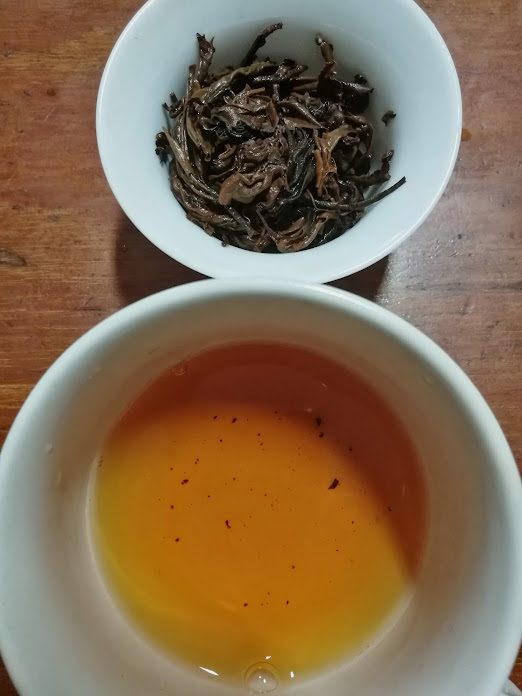
Dry leaf appearance is nice, long twisted leaves, varying in color.  Dry scent is sweet and malty, with apparent fruit range.  Just from that alone it seems similar to their standard Wild Boar black version.  I've not tried that in awhile but I did drink a good bit of it back when I last did so I'll probably attempt some comparison.  That's usually not a good idea for comparing a tea across a long period of time, so take that with a grain of salt.

It's interesting.  Malt does stand out most, not paired with as much astringency as is common to a lot of black teas, but then I've been trying milder versions of Assam this year as well.  It has a lot of depth and complexity; there is a lot going on.  There's more warm mineral range than is common in black teas.  That would be easy to miss, to interpret this as covering warm versions of wood tones, with related sweetness, and a hint of some sort of fruit, and not catch it.  It gives it an unusual depth.  The malt form isn't unfamiliar; it is that mineral-related malt that turns up in better orthodox Assam versions. 

The feel structure has an edge to it but that doesn't extend to dryness.  It's not really soft and full in the normal sense either, balanced in the middle.  There is a trace of dry edge, which only appears in black teas in this particular form, but it's limited in this.  That was a lot to experience for a relatively fast first infusion; it will be interesting to see how this unfolds.  Since intensity is pronounced and astringency and feel is a potential issue keeping that fast will work better; I'll try an infusion time of just under 10 seconds.

Second infusion:


An unusual toasted marshmallow flavor picks up a lot.  I don't remember experiencing that particular flavor in a tea before.  It's like the flavor right in between when those a light brown and are a bit scorched, so brown, and significantly toasted.  Obviously sweetness stands out, since I'm describing it as tasting like a toasted marshmallow, and malt is still present, but secondary to that flavor.  Feel softens just a little, losing some of that dry edge, maybe as a function of using a fast infusion, or it could've transitioned naturally.  The mineral and dark wood tones shift a little, but not so much.

Third infusion:


It reaches an even more pleasant balance in this round.  Toasted marshmallow is still a main flavor but the rest shifts to balance it very evenly.  It still has body, and maltiness, but astringency has dropped off to give it a smooth, full, round feel.  The rest is harder to split out due to being so evenly balanced across so much range but it seems similar.  A fruitiness might be picking up a little, a touch of dark cherry.

Fourth infusion:


Malt picks back up, again the main flavor.  Minor shifts in infusion strength would vary how the aspects come across, the relative order of intensity.  Preparing this Gongfu style has that as an advantage, that you can try the tea prepared in different ways by altering timing slightly, even if that's not the intent (and you are just inconsistent), or even if it doesn't transition naturally as much as some types.  The overall balance is what stands out.  Sweetness is good, with a fruitiness more present now than that toasted marshmallow, along with mineral base and dark wood tone.

To guess how this compares to the Wild Boar it seems more complex and more refined to me, trading out some astringency for flavor complexity.  The fruitiness seems comparable, similar to how I remember that, towards dark cherry, just not distinct enough to clearly identify as that.  I'll try a round brewed slightly stronger, but I think these have been essentially at optimum, with lots of flavor intensity and full feel character.  Even some degree of pleasant lingering aftertaste joins that.

Fifth infusion: 


Dryness does increase a little with it brewed stronger, and malt does ramp back up.  That toasted marshmallow returns stronger as more of a toasted sugar, like the browned top on a creme brulee. 

This would make an awesome breakfast tea.  It's about two full levels better than anything that finds its way into a tin of blended tea.  It would work really well prepared at different infusion strengths, and would pair well with food.  It's complex and distinctive but at the same time the character range is basic, normal, so that drinking it over and over wouldn't get old fast, compared to a tea that's pleasant in a more non-standard way.  Flavor complexity and actual flavor aspects are a bit unusual in this but general character is only novel for the light astringency and dryness balancing a soft fullness particularly well.  That dark wood tone, warm mineral, and light, non-distinct fruit all ground it in a standard range for black tea, just a much better version than typically comes up.

It's slightly closer to better orthodox Assam in style than Chinese black teas.  Those span a lot of range at this point, since better and more novel versions keep turning up from smaller producer sources.  This would probably compare really favorably to any larger plantation teas, even the best such versions.

Sixth infusion:


It's not tapering off in terms of intensity and complexity much at all, although I did brew this for around 15 seconds instead to compensate for fading a little.  It should keep going like this, with character varying for using longer and longer infusion times.  I don't think a flavor list and character description really does justice to how pleasant this comes across.  It all balances really well, and the more novel range for flavor input is all completely positive.  It couldn't be any cleaner in effect, with sweetness, feel, and the rest all integrated perfectly. 

The only limitation is that the general style is within a standard, familiar range, but that could as easily be interpreted as a strength.  I tried a couple of the best standard-type Assam versions I have yet to try not long ago, Latumoni Summer Tippy Assam, and this would compare reasonably well to those, probably more just slightly different than better or worse, but in a similar character / style range.

Seventh infusion:


Range of flavor complexity is dialing back a little, with malt and dryness picking back up, probably related to using a slightly longer infusion time, or also to the tea fading.  That warm mineral is increased in proportion to the rest again.  It seems like it has a few more positive rounds to go, it just won't be quite as pleasant as earlier.  Not far off it though; I'd essentially describe it in the same way as rounds 3-5, I'm just noticing a difference for having just tasted those. 

Conclusions:


I've pretty much said it all; it was quite good black tea.  For the price the value is really good; double that pricing rate would still seem fair to me.  It was similar in character to really good Assam, versus well above average Chinese black tea, which is probably typically priced at a slightly lower scale, but there isn't that much Assam out there on this kind of level.

I did brew it for another five or so infusions, and it could have kept going after that.  It was thinning in flavor profile and the warm mineral tone was getting a little edgier, changing in relative level and form related to the longer brewing time.  It goes without saying that this would also work well brewed Western style.  To me Gongfu brewing isn't really more messing around at this point, since I tend to brew tea like that with breakfast even when I'm in a hurry.  Character would probably vary a little based on any changes to parameters; this seemed like the kind of tea that would shift aspects a little based on altering minor factors like timing or water temperature.

About Hatvala, I'm not sure when I last mentioned they sell tea in a Saigon / Ho Chi Minh City cafe in addition to online.  It only seems to come up in discussion of where to visit in Vietnam.  I haven't been to HCMC in about 8 years, since I got further into tea and heard about this vendor, so I've not been there, but friends from the US and Indonesia did drop by not so long ago, reminding me to mention that.  They write a blog that includes pictures of that store and more on what they're up to, with some remote location photos from around Vietnam where these teas are coming from.  Vietnam is as beautiful as any country on earth, as I see it, but that's a separate and longer story.

I did meet the owners passing through Bangkok once, Geoff and Ngoc


don't take my word for it, check out the pictures (credit Hatvala blog site)


Monday, September 24, 2018

Three local Vietnamese sheng from Huyen


left to right, from Yen Bai, Ta Xua, and Ha Giang


Huyen's friend visited Bangkok a couple weeks ago so she sent some more Vietnamese sheng samples to try out.  I passed on some of what I have around to her; it's always hard to say if that's the right amount, or right mix, or if the person getting tea will relate to it.  With her I don't worry so much; she'll get it, and if she dislikes a version that would still probably be an interesting experience for her.

Someone not liking a tea wouldn't be a huge loss; it's never about going for one particular outcome.  That one guy I sent tea to in the North of Thailand (Farmerleaf samples) mentioned he and his wife liked them.  That's nice, when sharing the experience goes that way.

That recent local detox theme event got me thinking about who should be exposed to tea, or who would probably "get" it, and also who wouldn't.  It's a nice drink, probably very healthy, diverse in style, not that hard to brew, but it's still just a drink.  As I walk by the many bubble tea, matcha, or other flavored powdered tea outlets all over the city it reminds me of that one part of why I'm so obsessive; those people can do better, not just related to taste, but also to supporting their own health.

The main strength and main disappointment of that detox exploration was that so much boiled down to common sense.  Taking in a lot processed foods, sugar, artificial flavoring, and other chemicals, is not good.  Those inputs are components of relatively empty food, maybe at best not that bad for you and in significant quantity a likely health risk.  Drinking a powdered, flavored tea every other day wouldn't harm your health to an extent you might notice soon but swapping that out for real, higher quality, brewed tea would make a substantial difference over time.  Enough with the soap box speech; I've got tea to review.


Huyen's friend visiting Jip Eu in Chinatown, with the shop owners


nice being in the pictures sometimes


Huyen's description


She sent clear descriptions in with the samples, so I'll start with those:

1.  Green pu'er from the Yen Bai province [I'm skipping the diacritics; that's going to be hard to look up and add].  I bought it from the Hatvala shop.

Nice!  I've not reviewed one of their teas in awhile.  There's probably no need to keep running through how it might be "sheng" but not "pu'er" to people who respect China's exclusive right to label Yunnan teas as that.  That's kind of ironic given how the use of labels like "Apple IPhone" end up applied in actual practice there.  I'm pretty sure that I reviewed this tea before, a version from the year before, here, with that identification complicated by Hatvala not listing that tea yet early last year when I tried it (but now listed here).


2.  Super green pu'er from the Ta Xua mountain.  They have just finished it, so please keep for 10 days before drinking [it probably has been that long].  This type is not popular here so they are trying to make it by the Chinese way.

I take that to mean it's an attempt at traditional Yunnan pu'er style.


3.  Sheng pu'er from Ha Giang [sheng at least; people sometimes use the "pu'er" part only related to Yunnan].  A Tay minority's family made it.  They called it che vang (yellow tea).  It's not high quality but you can try.

Sounds interesting.  I've already tried one of these teas in the shop that day but I don't remember which; I'm guessing the third.  Onto review.


the second infusion, I think (from left Hatvala's tea, Ta Xua, and Ha Giang)


Review


I'll taste the short rinses and throw them out; kind of an odd compromise to strike for using a rinse.

Hatvala's is going to be bright and sweet, a bit earthy, with good complexity and depth.  This probably is the version I tried a year ago.

This second Ta Xua version is going to be really nice tea.  It's not that it's so clearly better than Hatvala's but it has more depth and complexity, even at this flash brewed rinse try, at least this early on.  I can definitely see where this is going but best to say more next round.  Shengs open up a lot over the first few infusions so it matters more how that works out than the rinse or actual first round.

The Ha Giang version is smoky, a bit rough, definitely not on the same level as the other two (or two levels, it may work out as).  It's probably interesting for being rustic though, different.  This is what we tried in that shop, in Jip Eu when Huyen's friend passed these on.  It's no wonder that Kiatichai just didn't say much about it.  It's interesting, for what it is, for a more local version of tea.  Someone loving or not being ok with smoke would probably make or break their impression of it; that is a main aspect.  Of course it will evolve and change later too.


First infusion


Hatvala Yen Bai:  this is familiar ground; sweet, floral, bright, somewhat complex, but a pronounced mineral layer supporting that, and moderate bitterness, which works for me.  A warm aspect could get lost in the middle of all that, something that I'd interpret different ways at different times, depending on what I was thinking about.  I'd usually say it's in the spice range but today I'm pinning it as yeasty bread dough.  It's not bad; a touch of sourness joins in with the bitterness, related to that interpretation, but that can also be seen as relating to citrus along with the floral. 

Unless I'm mistaken a tea like this won't develop or transition as much as some other styles / types of sheng will.  Making predictions on the first round is probably unwarranted, especially since I may have reviewed the prior year's version of the same tea that didn't work out that way (of course I didn't check that).


Ta Xua:  not necessarily all that far off the Yen Bai in some sense, but completely different in another.  None of the actual aspects match up, just the overall impression and the way it fits is somewhat common.  This is warmer, earthier, also floral but different, not as bright, and more complex.  It's just as clean, with bitterness also moderate.  Extracting a description of a second aspect range beyond floral is harder.  It's more towards a hardwood range, but not that, kind of not far from warm mineral too, like the smell of an iron bar.  I think what's going on is that it's combining a lot of different secondary aspects that all nearly fit together to come across as one thing.  It might be hardwood, with some mineral towards rich metal, and spice too.  The funny part is that it seems simple in presentation.  I'll let that description go and get to other aspect range, feel and such, in the next round.


Ha Giang:  that smoke really takes over.  I suspect that will drop out, to some extent, that it has been input from contact with actual smoke over processing, not a natural aspect in this tea (although I suppose that is possible).  That's not necessarily a bad thing.  If someone loved smoked teas this balance is probably close to ideal; that should stand out, but give space to the rest to also come across.  Beyond that the tea is earthy, not bitter at all, warm, reasonably clean and complex.  It's not exactly like sheng.  It lacks bitterness, and the feel is smoother, not thin but not even a bit structured as those tend to be (to have a certain astringency, phrased a different way).  I'll get back to it.


Second infusion


Hatvala Yen Bai:  I brewed these a little longer to move past the really light infusion experience; not too long, but out around 10 seconds.  This tea character shifted a lot; I seem to have been wrong about one thing already.  It went from a bit citrusy to quite lemony.  It's a nice effect; different.  This might taste the most like lemon of any sheng I've ever tried.  It's complex lemon, even, like the tang of the rind and the smooth depth of juice, just not as sour as actual lemon, which is quite acidic.  I suppose there's a potential criticism that it doesn't come across as balanced, being flavor-heavy in that direction, but it's quite pleasant, and I wouldn't guess that will stay at that level.  But what do I know.  Mouthfeel is in a normal range, and a decent amount of bitterness pairs with all that, which balances nicely (assuming one is ok with bitterness; typically a given when drinking young sheng).


Ta Xua:  fruit picked up a little in this too but the character went in a completely different direction.  Brightness and intensity diminished, and warm, complex depth stuck as the main theme.  It has plenty of flavor but it's subtle compared to the Hatvala version, some related to just being in a different range.  It's more complex, even though less intense, with warm earthy tone, rich metal, hardwood, and hint of what might seem more like a root spice now coming across, with a decent amount of subtle floral top end.  It's soft in feel, not thin, but there isn't much astringency or mouthfeel to go on about.  There is next to no bitterness, compared to typical young sheng or the Hatvala version.  It all works, it's just unconventional, and thin across some scope depending on expectations for a more standard profile.


Ha Giang:  smoke is easing up; this works better.  Warm tones give it depth, kind of out typical sheng range, towards autumn forest floor.  It's "clean" enough that all that range really works.  Add just a little mustiness or an off fungus flavor and this would come across as really flawed tea, but as it is it's just unconventional.  It's not bitter at all, or astringent, so sort of closer to the second sample than the first in character, just different in flavor range.  These last two teas would probably be better brewed for around 15 seconds, versus 10, or maybe even longer, since there isn't that balance of bitterness, astringency, and flavor intensity common to most sheng to work around.


third infusion, in order from left


Third infusion


Hatvala Yen Bai:  not so different, although I suppose citrus did ease up a little, with floral filling back in, and light mineral undertone more evident in the balance.  I think this is the tea I tried awhile back.  I like the style, but of course that depends on preference.  Bitterness is pronounced enough someone needs to be able to relate to that but to me it's just in the normal young sheng range, light compared to many.


Ta Xua:  more of the same for this version too; it's nice, complex, decently balanced, a bit unique.  It isn't transitioning enough to go on and on about it but I expect if I was just drinking it alone I'd be talking about balance of aspects present shifting.  Oddly bitterness picking up a little is actually good in this; it loses some of the "really soft" feel but comes across as better balanced and more complex.  Wood tone (some of that in autumn leaf range, some in hardwood) and warm mineral might not suit everyone but some floral tone gives it a decent balance.


Ha Giang:  smoke picked back up; different.  Floral range did too, so to me it's the best it's been.  The character drifts towards a perfume-like range, that underlying hint of acetone, or whatever that one chemical is.  It wouldn't take too much of that for it to be awful but in this case it seems to give it depth; it works in it.  It's still really soft.  Lots of the parts of this tea or the overall impression could really put people off but if someone is broad in their range of what they can appreciate it's nice.  It's clean and complex; the general "rustic" impression can just as typically pair with mustiness of some sort creeping in, which hasn't come up in this.  One part probably does remind me of a tea sold as a South Korean yellow tea version some years back, but I can't really do justice to describing how that works in detail.  It ties to a root-spice tone that's one interpretation for the mild earthiness I've been describing.


Fourth infusion


This will be it, even though these are half finished at most; I've got stuff to do, and this write-up runs long anyway.


Hatvala Yen Bai:  this might be leveling off just a little but not transitioning all that much.  There's still lots of lemon citrus, supported by a good bit of floral range, with a bright mineral base, and it's still intense.


Ta Xua:  this does keep shifting in balance, and it's better now than it had been in the first two rounds.  It's transitioning enough that it seems different.  A richness that reminds me of a the buttery flavor you can get in some oolongs joins in.  It has some light bitterness and mineral too, just not much for a young sheng.  I'd say floral is still most pronounced but it hangs back, filling in a higher range context; it's non-distinct.  That's kind of odd, since usually light, sweet floral tone is more a top end (imagined spatially) that tends to come across first in tasting experience, not a non-distinct broader tone context range.  Here the floral being somewhat complex, subtle, and warmer seems to cause that effect; it works.


Ha Giang:  again this expresses warmer tones, deeper floral range, moderate smokiness, decent warm mineral complexity, with parts that might get interpreted as wood or autumn leaf.  I like it.  It overlaps in character just a little with the second version at this point but they're also quite different.

Aspect for aspect not much matches up in these last two teas.  They share the way that soft, warm, complex range comes across, a set of aspects that's sort of like sheng but not at all typical young sheng.  If you age sheng 3 or 4 years we're talking about something else, and that's going to be a more typical fit.  But these aren't aged; the second is brand new.  They're just softer, more complex style teas.  If you taste one of these then go back to the Hatvala it really hits you; intensity, sweetness, bitterness, citrus, tighter mouth-feel.

Conclusion


That was all a cool experience.  Many thanks to Huyen for sharing those.

Two key take-aways stand out:  Vietnamese teas come in a very broad, interesting range, which includes variations on sheng.  And Huyen is a good tea friend to trade with.  To me Vietnamese black teas are just as interesting, and really the green tea range produced is much more varied and impressive for people on that page.  She sent me a good bit of one of those too, which I probably won't review right away, but it's nice this hasn't covered everything yet.

I could try to place these teas related to other versions I've been trying from Thailand and Myanmar, since I've been reviewing a lot of those lately, or of course compare them to Yunnan sheng.  It's just too much ground to cover, and I'm doing the final edit of this more than a week after the tasting notes.  Individual versions of sheng vary quite a bit, in Yunnan and beyond.  I liked these three, and maybe eventually I'll get back to that idea of sweeping comparisons.


Huyen, at that local shop awhile back