Showing posts with label Huyen Dinh. Show all posts

Sunday, June 17, 2018

Trying a 1998 Hong Kong stored sheng


This is the last tea sample passed on by Olivier Schneider, that pu'er authority who founded his own reference page (puerh.fr).


If the tea was from anyone else there would be less reference value in one sample that's not really well identified.  It's described as sheng puerh 1998 Hong Kong Storage.  The second description reference reads more like "1948;" that can't be right. 


Any tea, tasted even completely blindly, is fine for experiencing what you get from that, but it wouldn't work to assign any degree of confidence that the version might be good, or typical of a certain style or background in any way.  Based on trying those other samples this will be an interesting tea, and a positive experience, that provides insight about aging transitions within a broad but typical range.


One more qualification about that, which extends into a bit of a tangent here before the actual review:  aged sheng pu'er reviews in general tend to draw on forms of prior exposure and expectations more than other types.  Or few people write reviews of aged sheng, probably a sort of "those who know don't talk; those who talk don't know" running theme (a Tao Te Ching reference). 


To the extent discussion takes place in particular qi effect is described in detail, not just a typical range of how a tea makes you feel, but also specifics about energy patterns experienced within the body.  Also mouthfeel effects come up, learned preferences for certain types of experiences related to tightening and sweetness effects in different parts of the mouth or throat.


It doesn't necessarily diminish the importance or validity of those experiences that such preferences have to be learned, that they wouldn't be experienced as inherently positive by an untrained individual.  Full-bodied French red wines or Scotch drinking aren't less valid because those things would taste awful to someone without a lot of the right prior exposure.  It would be possible for an inexperienced tea drinker to dismiss most of that as subjective preference that's not well grounded but something would seem to be missed in that.  At times limited groups of people do learn to value experiences that aren't necessarily meaningful or positive to everyone else, as in the case of these forms of appreciation, but most typically within the context of those groups there are real, valid, meaningful grounds for those preferences. 

I drank red wine for a few years, and without a lot of specific training in the form of group indoctrination I moved from liking milder, sweeter versions into more subtle, complex styles, and I may well have been headed towards becoming a burly Cabernet drinker eventually, I just stopped before that happened.  As with tea drinkers experiencing oolongs or aged sheng as natural end points people with different inclinations in red wines might well be headed towards appreciating subtle, complex Pinot instead, or fruit-forward Bordeaux style blends, or maybe those rough-edged French reds that taste like a nail was stored in the bottle to a newer wine drinker.

In the case of art it relates to forms of meaning being carried in styles that one really needs to be familiar with to appreciate, to completely human-developed patterns of forms.  Tea styles and aspects appreciation might not be so far from that but even if so that wouldn't make them less valuable for only be valued through learned association.  It also seems possible that unlike in how art forms can match current trends and meaningful patterns, based on earlier trends, an individual would learn to appreciate some of the same aspects in tea without training, just maybe in a different form.  I was never really into art, just to be clear, but a grad-level class in aesthetics philosophy made for a confusing but interesting investigation of what it was all about.


To simplify:  I can appreciate teas having a more complex feel, and can recognize obvious physiological effects from some teas, but I don't value those to the extent many others do.  I haven't been trained to appreciate some versions over others, whether those goals are tied to conventions or to an organic natural preference curve, or both.  Sheng drinkers tend to drink sheng less for flavor than for most other types, but to some extent that's still the main page that I'm on, the main range I appreciate.  That's not to say that a pronounced aspect in another range can't stand out and make for a very interesting experience.  That occurred in trying a Lao Man E huang pian shou recently; that tea was unusually thick in feel, unique in a way not mostly based on flavor.  On to it then.


Review


First infusion:  I did taste the rinse, just to get an idea where this tea is going, and it was heavy on slate with some mustiness and char (probably as well to not even sip a few drops of that; it'll be there next round too).  This tea might not be so positive for the first couple of infusions.  The first infusion is just a little musty but it's nice how fast that is clearing up.  There's lots of depth to this tea, apparent very clearly beyond any more challenging aspects, which seem like they'll largely be faded by the next round and perhaps even more so on the next.

It reminds me a little of Liu Bao, that intense slate-mineral effect.  It's a little different in this expression because there's more depth behind it.  But then I've probably not tried higher level, fully aged Liu Bao yet, so I would be comparing apples and oranges.  The smoothness is nice.  Even for expressing a range that earthy and still being a little musty it's quite smooth.  The depth is nice too; it covers a lot of that old-furniture range of flavor, and the sweet nutty range that gets hard to describe, not so far off roasted chestnut but not exactly that.


the leaves did take awhile to unfurl, even though not compressed so much


The next infusion is what I expected; it picks up a good bit of depth, and cleans up quite a bit.  It might sound like I'm saying that the tea is "off" more than I intend.  That one range of slate-mineral flavor can easily bridge into different levels of mustiness and it's hard to pin that down on a relative scale without any mention making it sound more significant than it is.  The feel is interesting.  The tea comes across as really rich and really smooth, which will spare me talking about which parts of the mouth it impacts.  The overall experience lingers quite a bit but that relates to there being a depth to it, not one particular feel in the mouth or one distinct, limited trailing flavor.  Breaking any of those parts of the experience further would definitely be possible but somehow wouldn't seem more informative.

People tend to ask how aged sheng compares to shou, and I definitely won't have a clear and final answer to that based on trying this one tea, and little to go on based on trying more in the 10-15 year old range.  But it could work as good input; I can see how shou, this aged tea version, and Liu Bao map together better related to trying it.  I probably won't get far with explaining it though. 

In one sense this tea shares some common ground with those cheap, char-intensive droplet / tablet mini-tuo version of shou.  In a couple of others it's relatively not like those at all.  Some flavor range is common but the overall effect of dropping some charcoal into a cup of hot water is closely tied to the mini-tuo experience, and not this.  Slate mineral and subdued charcoal are main flavor aspects though, but there are layers below that.  It seems possible this tea will transition more over the next couple of rounds to move to a balance further away from that, and if it doesn't that'll make it easy to keep these notes short.


even short infusions were a bit dark


It does take another very pleasant step the next round; good.  That slate / mineral / char falls back into a nice balance, and an aspect I think of as "something I'm not familiar with" moves forward and develops.  It's not completely unrelated to "old furniture," but sweeter, better balanced, and cleaner.  This tea has already moved way past whatever any Liu Bao or shou I've ever tried can express, in terms of depth and complexity, just in a sense that's hard to describe.  Thickness escalates quickly.  It's so full in feel that it's a bit oily, in an interesting and nice way.  I get the sense it'll evolve to a place easier to describe in the next infusion, so I'll say more about that in the next round.

Next round:  maybe not; I was wrong about this getting easier to describe.  There's a depth to the experience that I can't put words, or maybe even completely grasp.  Breaking out any description of part of it doesn't cover the rest at all.  Flavors could be like roasted chestnut, or anything else I've already expressed, but the flavors-list approach drops more out than it catches.  It works to say it balances, that subtle, complex range of feel combines with flavor range that has an unusual depth and complexity, but that altogether it amounts to a sum greater than the parts.  I'd be writing poetry to describe it further than that.  You kind of just have to experience it.  I'm not saying this is some sort of heavenly transcendent experience but it is definitely one of the most interesting and positive teas I've yet to try.

It's like shou but nothing like shou, depending on which level one would mean.  In terms of flavor it's not that far off, just more complex.  Some shou I've tried were complex and smooth but not to this degree.  I'm not even sure this tea is completely where it's going to transition to, that it has went through its own version of "opening up" yet.


More of the same on the next round.  It is still transitioning, but I can't describe how.  It keeps getting cleaner and sweeter, with the slate-mineral receded to a mild supporting element very different in form.  That "old furniture" aspect also cleaned up and transitioned, not gone, but different.  A richness like roasted chestnuts remains, but the effect closest to char also smoothed out and fell into a different supporting layer.  There's an effect you get in some better Wuyi Yancha that matches how certain types of liqueur come across, sort of a perfume-like aspect, but nothing like a chemical, the nail polish remover type ranges that would make up a base for those.  All this range is subtle and well integrated.


Flavor isn't the most interesting part of the experience.  The smooth fullness also isn't.  I don't even mean the same thing by "smooth" and "full" as I typically would; kind of an extension of those instead.  The experience after tasting the tea isn't like an aftertaste, although there is some part that corresponds to that.  I don't mean a "buzz" as I've experienced with some teas either, the form I connect with some "qi" effect.  Levels of experience continue on after you swallow the tea, a mix of taste and how it feels.  Back to the poetry, it seems.


I might just leave off there and drink another half dozen infusions without the note taking.  The aspects will change, for sure, but for being so hard to describe it'll be a similar form of rambling on anyway.  I will say this:  two infusions later the balance is even nicer; the tea just keeps improving.  I can see why people might get hooked on this sort of thing.  The depth of the experience is much different than for other tea types that just taste nice, have a nice full feel, and some aftertaste effect.


maybe 15 infusions in, still a bit thick and oily


Around 10 to 12 infusions in the tea suddenly required longer infusions to produce the same intensity, and a couple more rounds later it dropped off that much more.  It was still far from finished though, but longer infusions shifted the range of aspects quite a bit.  The char came back, extracted more from the longer times.  The tea was still positive around the 15th or so infusion (where I'm tasting it now), interesting, pleasant, and oddly still quite complex, but not as nice as that range had been from rounds 5 through 12.  It definitely made for a unique experience.

I won't have much for additional conclusions, so I'll mention some closing thoughts here.  I can't place this tea related to other relatively fully aged versions, related to other teas that had spent 20 years aging under similar conditions.  I'm sure different starting points and slightly different storage conditions would change results.  As with any new range of teas it is possible to try just one "good, typical version" and get some sense of where things are headed, but it almost never works out that the variations are something that you'd expect.


More input, and an event notice (in Europe)


I talked a little to Olivier Schneider about this tea, the person who passed it on.  It doesn't shed that much light on the storage environment but it is interesting hearing him say a little about that:


This tea is a sheng (raw) puerh from 1998, mean that it was raw when he left Yunnan, with a very good Hong-Kong traditional storage, aka. wet storage. HK traditional storage is a traditional way to age puerh, made in Hong Kong and guangzhou area for long time. Because we speak about Hong-Kong "storage" many beginers think it's just a question of storing tea in the humid atmosphere of HK, but in fact it's not. HK traditional storage is like shu cha (shu cha was inspired by HK trad storage), an artificial method to age tea, but when shu cha is an industrial process which take around 6 weeks, HK trad storage is an slow and hand made process which usually take at least 15 years for a high quality product. It's really an art, like whiskey aging or cheese aging, and when it's badly done it's really terrible (with typical moldy taste), but when it's made by good house, like this one, it makese really amazingly great teas!


Surely a few details beyond that about related factors are familiar to many, even those without broad experience, but in the end trying a tea that has been through a positive version of this sort of transition is the thing. 

One thing I didn't mention in that review:  I would've believed that the tea had been stored a lot longer than 20 years.  Versions of sheng not that much younger than it that I'd tried in the past had seemed very young in comparison, not all that affected by age at all, beyond more limited related transitions occurring.  I've had limited exposure to teas being ruined by poor storage.  A Liu Bao was way off due to being stored too wet, really musty, but it sort of came back from that after sitting around for a year.

The slate-mineral and char effects that were stronger in the beginning and end of the cycle seemed to be outcomes related to that transition.  On the more positive side the smoothness and level of depth in those infusions in the middle were new to me.  Even in those earlier and later infusions when those aspects weren't necessarily positive they were still more neutral than they might sound, and the overall effect and complexity was positive in ways that was hard to describe.


To move onto another idea kind of related to this tea, but not directly related, Olivier is doing a series of tea tastings and ceramics displays in Europe over the next month or so.  My Vietnamese tea-friend Huyen might even make it to one in Paris, but I think she's still working out paperwork and travel planning.  Either way, I'll mention that schedule here, by citing a FB post, and the related link:


Before to leave Asia, choosing the teaware I will bring with me for Europe! This year there will-have two special guests I would be happy to show the thesis work during tea events: The great tea ceramics artist Emilio Jose del Pozo from Taiwan, and Xunhuan Wǎngfù , amazing cloth and Chabu designer from Norway!


credit his FB page (probably as well to just link to the contact pages here though)


Happy to see you in Europe in some days:  (full program here)

June 28 in Paris: Blang Vibration, immersive sound and tea experience
June 29 in Paris: Vietnam mountains tasting tea
June 30 in Paris: Free puerh tasting tea
June 30 in Brussels: Workshop on green puerh
July 1 in Paris: Tea and gong fu cha time
July 2-8 in Paris: Complete puerh tea education
July 11 in Waterloo: Free puerh tea tasting
July 12 in Namur: Free puerh tea tasting
June 12 in Namur: Blang Vibration, immersive sound and tea experience
July 13 in Brussels: Free puerh tea tasting
July 13 in Brussels: Puerh tea bar and surprises
July 14-15 in Brussels: Two days puerh tea education
July 21 in London: One day puerh tea education


I'm sure with that many events going on a detail or two could change, so it would be as well to check that page and check in about the planning, of course also related to seeing where an event is, and how to check in about plans to attend.

I've been very grateful to him for sharing these teas.  He's said a little more about them in discussion but not all that much, and it wasn't really framed for making up extra sections in the review posts, which are more about passing on an impression. 

It's nicer to discuss tea in person though, since you can also try some, and I hope that some of you get that chance over the next month or so.  If Huyen does make it to one in Paris that would be a nice added bonus, to get a chance to discuss a tea tradition that doesn't come up much (Vietnam's) with someone from there who has been looking into it.  Even beyond that information her enthusiasm is a bit contagious.  I've not done much with passing on contact information for her--the tea trades were never about marketing anything--but her family's gift business site may be of interest, since it does include some teas.  I think they're more standard types though, not like those local-style sheng I just reviewed, but glancing through to snag a picture I did see tuochas, so it's definitely not just Thai Nguyen green teas.

Huyen at work (credit their site)


Wednesday, June 13, 2018

Vietnamese white and sheng teas, samples from Huyen


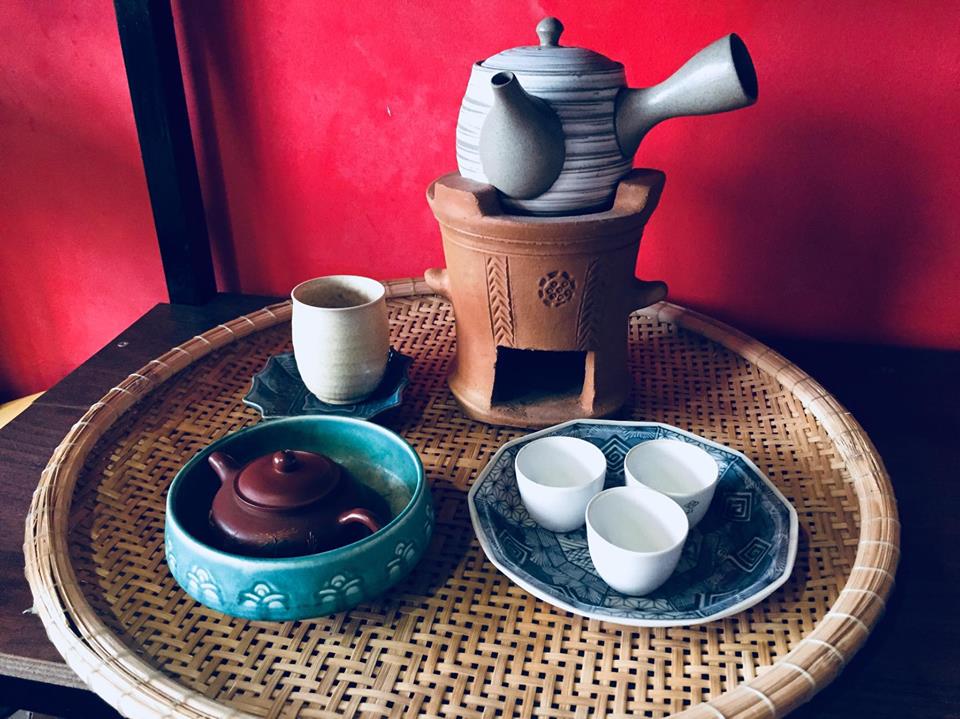
Huyen Dinh and family; well prepared for drinking tea at home in Saigon


As of the initial tasting I didn't know what these teas were.  I'd talked a little about them with Huyen when we met in the Bangkok Chinatown, when she passed them on, but I didn't catch specifics, and only the one of three I'm not describing here was labeled (as an ancient tree green tea).  My impression was that they are Vietnamese versions of sheng pu'er, but not necessarily made in exactly the same style as Yunnan pu'er.

I did talk to Huyen in mid-tasting (online, via Facebook message), and she clarified that part, as one is more or less white and the other essentially the same as sheng.  More on that along with tasting results follows.


The tea on the left turned out to be more or less a white tea, and on the right a variation of sheng.  They're not exactly the same as Chinese versions of either; locally produced Vietnamese teas made by traditional processing methods that evolved there.


The teas have a pleasant sweet, mildly earthy smell to them, floral with a light mineral scent beyond that.  And they look cool, like a cross between loose sheng pu'er and moonlight white.  Each is a bit closer to one of those styles, but maybe not exactly like those either, more like a variation of them.

Initial rinse:


I'll taste the first light infusion as well.  What's the worst that could come of skipping a rinse?  Of course I get it why rinsing and throwing that away makes sense, the two different reasons, to wash the tea, and to wake it up or start the infusion process, but I only consistently use a rinse for shou or aged sheng.  A flash rinse of most other types doesn't strip that much flavor, or make all that much difference related to starting an infusion process (the next round of water isn't any wetter), and it probably doesn't really remove that much for dust or whatever else, so it probably doesn't matter much either way.  It seems odd to me when people rinse teas like Dan Cong, when they really are throwing away some flavor, but even then I can see the justification.

The first lighter version is nicely sweet, fresh, and light.  Based on using a 10 second or so infusion time, not long for a tea that wasn't wet, it's still light but very promising.  This does taste more like a variation of a white tea than a sheng, with a good bit of bright floral range, maybe even light fruit.

The next "darker" tea is completely different (I didn't know what types were--I tasted them blind--but I'll edit in calling them white and sheng through later notes, even though that's more an approximation).  It's also sweet but not as light, with an interesting warmer spice range earthiness, nothing remotely like any black tea or shou, or even sheng, really.  It tastes as close to cardamom as any tea is going to.  Ordinarily I like the other spices better than cardamom, which just seems a bit neutral to me compared to a spice like nutmeg, but the way this comes across really works.  Both seem like very catchy teas, not challenging at all, and both are perhaps slightly different than anything I've ever tried.

It's easy to get Vietnamese tea completely wrong, to just try a few fishook style Thai Nguyen area greens of varying quality, rolled oolongs, and a snow tea and think you've got it all pegged.  Or one might even run across a number of exceptions, someone roasting that rolled oolong more, or black tea versions, a producer mimicking Japanese green tea, Oriental Beauty copies, versions of sheng, silver needle, jasmine and lotus flavored teas, etc., and think "now I've got it."  But you don't have it.  As with China or Taiwan you're never going to try the last traditional variation, never mind all of what people are experimenting with or importing for styles.


just getting started; white left, sheng right


Second infusion (first real one)


These teas are probably going to be two more infusions just opening up, getting unfolded and soaked and hitting the normal range of aspects they'll express.  The first (lighter, white tea) version is much improved, and it was already really nice.  At least one more layer of depth joins in.  It's still sweet, and mainly floral or fruity, along the lines of dried apricot.  But a subtle depth joins that, something I'll have better luck describing next round when it really comes out.  That interesting sweetness does remind me of some versions of moonlight white; it's odd that with the other tea's leaves more a mix of dark and light it looked more that part.  The tea thickened quite a bit too, and aftertaste picked up, but it's not even really "going" yet.

The complexity in the second version escalates that much more.  There's something really familiar about that set of flavors or range that I'm not placing.  A main flavor element is now close to dried hay, but with a lot of sweetness and a lot going on beyond that.  It's that fresh, warm, sweet effect of drying hay when you just bale it.  Or I guess instead the complexity might include that vegetal sweetness and also some of the warmer, richer sweet tones the bales of hay will pick up after they've been sitting and drying--curing, really--for some months. 

You might think that you don't want to drink a tea that tastes like hay but unless your preferences are far removed from mine you definitely do.  I dislike grassy green teas and this couldn't be much further from that.  Below that there is warm spice range, or maybe subdued mineral, what seems to be a couple of subtle layers of things going on.

If there's one main lesson in tasting these teas so far it's that people should try to swap teas with Huyen.  I bet very few Vietnamese people know these teas exist, probably a relatively limited subset within the set of people who like tea, maybe even a small proportion of "tea enthusiasts" there.  These are no experimental teas; I'm pretty sure that someone didn't mess around with processing variables to make these.  Over a very long period of time people did, for sure; these have to represent the better output of traditional processing, good versions of interesting traditional versions.  "Good" is always relative to expectations and preferences but these teas are good.


Third infusion


after "opening up."  this was probably one infusion later though.


The first lighter tea stays similar, very sweet and bright, just picking up more depth in terms of a bit of astringency and more feel.  It's not like a young sheng related to that, unless it's an unusually soft young sheng [and of course later it turned out it's not that].  That added feel and trace of what I'd not call bitterness but is towards that makes it seem a lot more like a sheng than it had at first.  I'd imagine that messing around with water temperature would let you adjust the character of this tea to preference, to use straight hot to bring out more of that edge, which a lot of experienced sheng drinkers would strongly prefer.  Or white tea drinkers could go a little cooler, down at 90 C or so, and they'd experience a lighter, sweeter, thinner bodied and astringency oriented version with very little compensating bitterness (or something like that).  I'd like it both ways, at this point, or maybe dialed in the middle.

Again the contrast with that second tea is amazing.  It's also a soft, light, sweet tea, not in that far a range for general character, but the flavors are so different that it almost comes as a shock.  That slightly cured hay warmth, sweetness, and vegetal character is shifting a bit to mineral, more into a desert slickrock sandstone range.  It's still light and subtle but has the kind of depth that lots of people would describe in completely different ways.  It could be seen as what I've described so far (also as spice range, etc.), or as mostly floral (just a warmer floral), or as light wood (in between balsa wood and fresh cut sweet maple).  To me it's really catchy, both that flavor range and the way a soft, sweet, complex tea pairs a hint of fullness and dryness with that.

lighter, more white tea left, darker sheng right


Huyen's input about what the teas are


I just did talk to Huyen by message (in mid tasting) and she said both are sheng.  Of course when we talked she said they didn't call tea sheng in the North of Vietnam in traditional areas, since they typically aren't familiar with what's made in Yunnan, they called it dried tea.  That does lead back to a guess they're using a style that's in between, which they've evolved on their own.  She admitted one is probably just as close to white as sheng, and that processing might not completely match Yunnan sheng pu'er traditional or modified processing steps, since they're not really shooting for that.  They make tea as they know how to make tea, and don't describe it related to a type made in the next country over.

It does make you wonder.  Both were sun dried, but how much were either heated?  I'll probably never know.

World of Tea processing chart (credit; odd their site converted into something else)


Fourth infusion


I dropped the temperature a little to shift the effect.  The lighter version just dropped back to sweeter, giving up that trace of bitterness, as I expected.  I'll probably use hotter water again, close to full boiling point, to try it that way again.  It's not normal to experiment with brewing temperature that way during an infusion cycle, of course.  But what does "normal" mean to me?  I've already offended any readers who prefer not to hear about loose process, narrowing the audience down to only who I should be talking to, or random clicks.

This lighter, closer to white version is going to express less complexity than the other; it's a simpler tea, narrower in profile and transitioning less.  But the range that's there is quite positive.  I'm going to stay with dried apricot as a main aspect description, with some depth beyond that, but it's on the sweet, light, and simple side.  That simplicity might seem like more of a flaw if it wasn't so good.

The darker tea is actually moving into a light smoky range.  It's crazy how it's a different tea each infusion.  This aspect range really does make sense for being sheng now.  I'll try both using hotter water next and the greater body and compensating bitterness will return, but I like the tea this way too.  That rich sweetness really coats your mouth after you drink it, giving that effect that it might taste a little stronger after you swallow it.  In this infusion's style that's just sweet, rich, and a bit full, but on the next round bitterness and the different feel will pair as a effect that either balances and improves the experience or throws it off a little, depending on preference.  For me it'll just be different.


sheng / white left, closer to sheng right


Fifth infusion


I did go back to hot water and used a 15 second or so infusion for these so the character should vary, slightly stronger but also just different.

This first tea probably is perfect just like this; that extra taste range and ramped up feel and aftertaste is how it should be.  It's interesting messing around with it but I'd understand someone wanting to drink their tea at an optimum every single infusion.  A touch of bitterness, very faint, remains across your tongue to offset the sweetness and light feel.  This tea is simple but great.

The pace of transition slows down for the second but it did return to the prior character, definitely better balanced.  One part of this tea reminds me of that slightly musty, smoky, mineral range earthiness in cheap tightly compressed sheng, but expressed as a mirror opposite, as that working out amazingly well and balancing.  More than that an entire other range balances that trace, sweet and earthy like a fresh cut hardwood, deep and flavorful like a sun-dried tomato, complex and balanced, as expressed by a mineral layer that reminds me of Southwestern US sandstone.  I wouldn't be surprised if others listed out any number of other interpretations.


Later infusions


I kept brewing both teas for another half dozen infusions, I just stopped taking notes.  Both transitioned to a bit more bitterness (the actual flavor; I don't mean astringency), probably related to adding infusion time to compensate for intensity falling off with that longer steep drawing out different compounds.  Both teas seemed better in the first half dozen infusions but quite nice later too, the most interesting and positive range just narrowed back a little.

As with sheng pu'er they just wouldn't stop making tea.  I would've expected that first version that was closer to a white in style to fade faster but it just became more faint; it didn't drop out.

They didn't seem exactly like sheng to me, although one was closer.  I suppose both would probably be much more approachable and positive than most versions of sheng to people who aren't on that page (who don't love sheng), and disappointing for not being a closer match to others who are.  As far as comparison with white teas go that one is just a bit different than the other range of white teas I've encountered, but then all of those span a broad continuum of styles and aspect sets anyway.  It's tempting to say it was closer to moonlight white, since that is a Yunnan version based on roughly the same plant types (I think), and I suppose that does work.  It's not exactly the same as others I've tried but then that range can vary some too.

I don't have much for conclusions; they were both nice, interesting, and quite positive.  These are the kinds of teas you'd probably want to own a few hundred grams of since they are approachable, interesting, and not something you'd probably get tired of right away, or would only want to try for the sake of novelty.  Both would vary with different preparation methods and both would probably improve over time instead of just fading.

As far as I know you can't find or buy these teas anywhere, unless you know where she got them in Northern Vietnam (Ha Giang).  It's funny mentioning those two conflicting ideas one after another, how good the teas are and that they just don't exist on the foreign market.  If the curiosity was absolutely killing you looking up Huyen and bugging her for leads might work out, but she's not a tea vendor; her family works in a corporate gift business.


Hatvala's tea areas map (credit)


More on Huyen Dinh


Speaking of bugging Huyen, I asked her for some photos to share, since she'd showed me a Vietnamese tea brewing practice and some teaware collection at home by video call.  Before I get on with showing those pictures I might mention that it's still in the planning stage but she might be attending an event held by Olivier Schneider in Paris on June 29th (with more of a mention than actual details here).  If you like pu'er and his name doesn't ring a bell you probably should click around this reference site.  Learning about tea can be seen as a separate interest from enjoying the tea itself, but at the same time you can't make informed decisions about what to try if you know very little about the types you like.

Onto some pictures from Huyen then.  She and her family really love tea; it's obvious in talking to her and from the pictures.  She describes their preparation approach as just basic, functional but not really ceremonial, but they've put some thought into how to make tea and effort into collecting gear to support that goal.


That last one is a local version of Ya Bao, the tea bud tea version that sometimes is sometimes sold as white pu'er (which I reviewed a version of here).  I don't think it's all that close to pu'er, a bit closer to a white, but what's in a name.  Huyen mentioned she thought the inconsistent level of oxidation in that version is a processing flaw, but I guess depending on how the tea tastes it may or may not be a problem.

Vietnamese teas in general are part of the reason why I write this blog.  Even I'm not in on most of what's being produced and sold for Vietnamese teas, and I've been to Vietnam and bought tea there twice, and Huyen has passed on a good number of interesting versions (a dozen or more), and I've tried most of what Hatvala sells.  It's not just that these teas are interesting and good, although they are, but also that there is a relatively complete disconnect between the local producers of these teas and the potential consumer market in "the West."  Hatvala alone bridges some of that gap, but they don't sell versions of what I just reviewed, or that Ya Bao, or most of what Huyen passed on at the end of last year.  There's just too much variety.


Huyen at one of the Chinatown shops

It goes without saying, but I don't see this as a zero-sum game.  It's not that local shops or online vendors in the States or Europe need to lose a sale every time a new person there discovers a new option.  The idea is to get people off tea bags, or even branching out from coffee, I guess. 


The nice part about exploring Vietnamese teas, as opposed to Chinese, Taiwanese, or Japanese versions, is that foreign awareness of types is nill and internal demand doesn't match up with production.  The teas are cheap, if you can get them.  And probably a bit inconsistent, I suppose.  I'm raving about them because I'm trying exceptional versions turned up and screened by a local tea enthusiast, Huyen.  I found a good, interesting, novel black tea in visiting Hanoi awhile back and I was hooked then, and I keep having that sort of experience, of new discovery of Vietnamese teas, over and over.


Even though this already went one tangent long I'll close with a couple pictures of local fruit, the kind of thing I have for breakfast, often along with some pastry or a piece of toast.

papaya, mangosteen, rambutan, longkong, and mango


lychee is my favorite though


Sunday, May 27, 2018

Meeting Huyen Dinh in the Bangkok Chinatown, and a Longjing review


with Huyen and Kittichai at Jip Eu (his Bangkok Chinatown shop)


I finally met Huyen Dinh, that one Vietnamese tea friend I did a tea swap with last year.  She's as cool as she comes across in the pictures and messages, very bright in spirit, enthusiastic about exploring lots of kinds of teas.  Her family does gift packaging (kind of a Chinese theme that carries over in Vietnam more than here), so she's building on a lot of prior exposure to a broad range of Vietnamese teas.  She passed on a few more Vietnamese tea versions so I'll say more about that part in another post.


so cheerful!

We visited Jip Eu, my favorite Chinatown shop.  As usual the owner, Kittichai, was very kind about visiting with us and sharing tea, and talking about teas from Thailand and China.  He has family in the Wuyishan and Anxi areas in Fujian; I've seen a picture of him processing tea in a small family operation within the park boundary in Wuyishan before there was even a park there.  Jip Eu has been around for 90 years or so, so that's his main background, buying and selling tea his whole life.  His wife wasn't there; kind of a shame since she's nice to visit with too.


Short visits like that tend to feel a bit rushed but it is nice visiting a shop where sitting down and trying teas for an hour is fine.  As with that shop I mentioned near the flower market, Ong Yng Choon, a lot of local tea demand seems to relate to drinking blended versions of Shui Xian, basic oolong.  It's definitely more moderate quality tea, in terms of character and cost, but blending can offset some of the rough edges that a modest version of a single-origin tea could express.


I should say more about Huyen since meeting her was the main theme.  She has a bright enthusiasm about tea and genuine nature that really works well together.  And Vietnamese tea is a much, much broader subject than most people would be aware of, a really solid grounding compared to being familiar with teas from almost any other countries.  China has a broader tradition, of course, with a bit more higher end to consider, but it's my impression that Vietnam's tea tradition is as developed as India or Japan's.


the shop from the front;  it's old school


they also sell commercially packaged teas, or different others


Huyen mentioned that people in the far North of Vietnam produce tea identical to pu'er (it's from quite near Yunnan, and the plants would probably be nearly identical to some versions there), but that they aren't familiar with pu'er.  They call it dried tea, since after a light frying step (sha-qing) and rolling the tea is dried in the sun.  I've not been completely clear on what some versions of high mountain ancient tree green teas were and she passed on another sample of one.  It's not pu'er, and it's not snow tea, but also not conventional green tea, nothing like the Thai Nguyen area "fishhook" style.  To look at it I'd think it was loose sheng.  I'll say more about that in that review post.

We talked a little about how her visit went, and Thai culture, and of course about different types of teas, and brewing.  It's odd considering people you only know online as friends, although I do, and also odd basing a real-life friendship on a short visit worth of exposure, but that's where it stands with her now.  I kept saying she should meet my kids, since they're the coolest thing to experience in Bangkok, but that'll have to wait until another time.

she visited a nearby shop after I didn't make it to, K Mui Kee


that other shop info


About Longjing and Jip Eu shop background


I bought some Longjing (Dragonwell) during that visit there.  I've been behind in checking out this Spring's teas this year, which loses something due to not being so into green teas.

Some people would have a more developed take on where this stands in relation to other Longjing than I do.  I tend to buy a fresh version once a year in the spring and that's it, and I can mostly compare year to year if it's pretty good or not, not matching up aspects.  That shop owner discussed different alternatives a little and seemed to present this one as the best version, as much as there is a best versus just preference difference.  I've lost track of his description of this tea but that almost seems as well, to just describe this Longjing version and leave off about style or region claims and other background.

That shop specializes in Wuyi Yancha sales, with Anxi Tie Kuan Yin seeming like an emphasis beyond that, and I've bought some Dan Cong there, so green tea is a little off their normal range.  But they do sell a bit of pu'er, and I did buy a compressed silver needle cake there (that one I gave to a Thai princess).  It's not as if Longjing is unfamiliar to even those large-jar lower-quality shop vendors in the Bangkok Chinatown; it's quite central to the Chinese tea tradition.  I've bought it in other shops where they keep fresh versions separate from all that, typically refrigerated since Bangkok heat isn't great for fresh green tea.

If you bought only 50 or 100 grams and planned to drink straight through it and your room temperature really is a normal room temperature, around 70 F or 25 C (funny how those two don't match; room temperature here is 25 C or about 77 F) then it probably wouldn't matter, storing in a normal cabinet would be fine.  Well sealed, of course.  Opinions vary on that point though; some say that cooler is much better, that as with food freshness good green tea is just much better stored cooler.  Others warn that even minor condensation relating from taking a tea in and out of the refrigerator is worse than the warmer storage effect.


Longjing (Dragonwell) Review:


People might interpret the color or size of the leaves in different ways but I'm not really on that page.  To me as long as it looks like Longjing and smells like Longjing the brewed tea effect can decide things from there.  I'll prepare the tea Gongfu style, using shorter infusions versus a Western approach, and of course cooler water, around 70 C.


The initial infusion is light, on the short side, but still very sweet and intense.  The flavors are bright, with that characteristic nuttiness or toasted rice main aspect, supported by fresh tasting vegetal aspect range.  It has a bit of grass to it but that complements that other more pronounced range.  I'm not a fan of most green teas because the grass and vegetables get to be too much, even brewed lightly to emphasize sweetness and offset astringency, but this balance works well for me.


On the next round this is brewed a bit stronger, still nice, still sweet and smooth due to using a low temperature, but a bit more subtle would be optimum.  A bit more green bell pepper comes through, essentially replacing the grassiness, still coupled with the distinctive toasted rice aspect.  I've heard that called either nut or toasted rice, and it can seem like either depending on how you interpret it, or I suppose maybe some people can make a clear distinction when it's more one or the other.

Intense brewed lightly (you can see the fuzz)


The tea has nice sweetness, and an intensity that doesn't describe at all as an aspect list.  It doesn't have a structured feel in the same way some other tea types do, as they affect a different part of the mouth more than others, but it feels full, and flavor is definitely drawn out long after tasting the tea.  It would be a shame to drink it when in a hurry, as I tend to drink teas with work-day breakfasts.


I notice a lot of the fine hairs on the tea surface (trichomes) that can occur when brewing green or white teas, typically seen as a good sign, that the tea is made from fresh and healthy younger leaves.  Even on the third infusion there is lots of that.


Brewing the tea quite lightly drops the aspects back into a great balance; it was nice last round but even better.  Of course what's going on with that relates to preparing this tea Gongfu style, and I think it would still be fine prepared Western style, that it's not necessarily an example of where that would clearly be a mistake.  Western style seems to not work very well for sheng pu'er and oolongs, in general, at least per my preference.


This tea is about as good as I can evaluate a Longjing to be based on remembering one version a year.  The flavors being in the right range identify that, and the overall intensity, and sweetness, and full feel and aftertaste.  Flavors aspects can shift in different ways and it could be slightly nuttier / more like toasted rice, but it's definitely in the right range for better version.  It's my understanding that would change based on how it was prepared, the frying step, and that different people might prefer different things.  A lot of that effect, a bit more frying, could indicate the processing is compensating for flaws, using that step to draw out complexity, instead of relying on the initial tea character.  Of course in saying that I've moved onto guessing, but it's based in part on the practice of re-frying green teas to wake them back up, to change character later.  This tea is definitely really fresh.


The next round is more of the same, a good thing.  I suppose I wouldn't mind a touch of the green bell pepper and underlying grass swapped out for more toasted rice but this isn't the kind of tea one would normally try and wish they were drinking something else.  Huyen raised a good point in discussion about trying teas, related to reviewing them as much as appreciating them:  trying a tea once or twice doesn't give you a full, developed impression.  People vary across different time frames, and that along with minor brewing variations and just noticing more can shift an impression of a tea.  Reviews here are meant to pass on an impression, but not a final, complete, objective interpretation.


Huyen visiting Tea Village in Pattaya, on a short Thailand tea tour


This tea's character is why I like Longjing; that intense, characteristic, fresh taste, and limited grassiness compared to most other green tea styles.  I remember trying a sample a tea friend sent, Peter Jones (of Trident bookstore in Boulder, CO; probably worth checking out), and I knew it was the right tea as soon as I opened the package, not even needing to taste it.  This Jip Eu version may or may not be quite on that level, a true competition grade tea, but towards the higher end of quality level differences become minor, and personal preference for specific characteristics is still as big a factor. 


Both are as good as the average tea drinker could appreciate, with subtle variation in the upper quality range becoming not so subtle once someone tunes into a specific tea version's aspect range more.

Thursday, November 23, 2017

Vietnamese snow tea (Ha Giang province green tea)


More about that online friend in Vietnam sending teas to try, tea shared by Huyen Dinh (which will be a tea exchange, once I get around to sending some back).

Huyen, with a cool little teapot (which is quite old)


I thought I might have tried snow tea before, a tea I picked up travelling around the Hanoi area, but that may correspond more to another version Huyen labeled as "ancient tree," from the Son La province instead.  That earlier ancient tree version reminded me of pu'er; a bit bitter, a little dry, and interesting.  Looking back at that post it seemed a little rough, from March 2015; I was still working out some basics related to both tea and blogging (and it may not have been similar; that part was just a guess).


This version was labeled as both green tea and snow tea.  There was no reference to ancient trees, as on the other sample, but I think this may be from "wild" (feral) old shan-type trees in the far North, but that really is as much a guess as anything. 


Again I'm not going to have a specific original source to share, but Huyen does work for a local gift and local-goods sales company that does sell some teas.  Maybe this one, but since it's not a conventional tea business contacting them to review specific tea versions could be a challenge.  The company is Trà Việt (their website contact here), which has gift-shop / souvenir sales locations in Hanoi, Da Nang, and Ho Chi Minh City (Saigon).  It really doesn't look like they're set up for international tea sales through a website but someone could still try out paging through an automatically translated site version to see what turns up there; there are tea gift sets on the site.

locating Ha Giang (credit Hatvala site, a different vendor)


For tasting context, at time of tasting I was well along the way of wrapping up being sick with a throat infection.  My sense of taste seemed almost completely normal again, but I was still a bit off in general then.  I passed on a Lao Ban Zhang vertical pu'er tasting today, held by the same people who did a Yiwu tasting session version (mostly Bank), because it seems like drinking 20 or 30 small cups of intense tea might not be a good step towards being finished with all that.  It's funny how when you're sick even if the illness isn't so bad there's that focus on being done with it.

Review


The tea looks whitish-grey, a bit curled, not exactly like other teas one tends to run across (although a "fish-hook" sort of style is normal for Vietnamese green teas, just not this color).  The initial infusion does taste like a green tea, sort of, but not all that close to other green tea versions.  The pronounced mineral aspect does match that in the standard Vietnamese green teas (Thai-Nguyen region green teas).


It goes without saying but I'm using water below boiling point for brewing, just not on the low side for green teas.  It might be typical to brew this using boiling point water in Vietnam, to really allow the bitterness to come out (funny how that came up again in talking about oolong brewing temperatures; I'll probably pass on more about that later).  Of course I'm really talking about the flavor being bitter, not mis-labeling astringency, as does tend to come up.  A Gongfu approach is also probably not standard, but really using Western brewing with hot water isn't going to change things entirely, it just shifts aspects balance a little.


A second infusion, also on the short side, is similar, maybe warming up a little and picking up a little depth.  Bitterness stands out, then the mineral base after that (towards flint / chalk / limestone; a lighter version).  Beyond that there is some vegetal range, along the lines of kale, and some sweetness.  That sweetness seems to bring in a trace of a richer depth, something minor, buried in with the other complexity, along the lines of sugar cane, or maybe even maple syrup.  The tea has a lot going on.  The bitterness doesn't make it an automatic favorite but if that fades just a little and other range picks up the balance could be really nice.


a bit light in the early rounds, but with plenty of flavor


On the next infusion I let it go for about 45 seconds, not intentionally checking a stronger infusion, typing an idea at the start and not paying attention.  One might wonder, how could I have developed an internal clock, and to what extent are those times ever really accurate?  It wasn't from spending years brewing tea with a timer.  I worked as a waiter (restaurant server) during an earlier life-phase, and that entails converting your consciousness into a timing device, along with picking up a few other capabilities (multi-tasking, reading people, not freaking out when you're in a hurry for hours on end).  And I used to cook, a lot, and it more or less has to become natural to access an internal timer for that.  It was natural for me to just time brewing based on estimation when I first started on loose tea, probably 9 years ago now, and by the time I became more serious about it around half that long ago I'd already been estimating timing for awhile.

This tea is nice and bitter brewed stronger; it's interesting to experience that way.  It crowds out the rest a little but there is plenty to appreciate about the range, and I think it's transitioning a little too, "warming," if that makes sense, probably moving into a light spice range as much as anything.  Flaws in this tea would be more evident brewed this strong but the balance is good, and the feel is nice, with an interesting aftertaste (quite strong, brewed stronger).  Is it hui gan?  Maybe.  I'm going to guess yes, but I suppose at some point I'll just start winging it and saying that aspect is that when I think it is, as others tend to.  I should send a little of this tea to my Chinese-Malaysian friend for a ruling.

Back to normal infusion strength the next time (four--I'll count them); the tea hasn't changed a lot but the balance of the same aspects is shifting.  The bitterness isn't dropping out but the tea is falling into a more even balance, and although it does seem to be "warming" slightly there's more added in vegetal range than something else, at this stage.  Kale may or may not sound nice in a tea; I guess it depends on how someone relates to the taste of kale.  My main natural preference is for black teas and roasted oolongs, so richer, sweeter, more cocoa / cinnamon / fruit / baked yam flavors, but I can still relate to this; I can appreciate and even like it.  The style may not be a close fit for everyone--and to some extent that's where I am--but somehow this seems like "good tea," in some odd, objective sense.  The flavors are clean, the feel is nice, aftertaste pronounced and positive, and it balances.  It is a little bitter though.

Bitterness keeps easing up in the next infusion (5) but that mineral expands to even include some metal range.  Now that does sound odd; a tea tasting like a spoon that you can taste, when you shouldn't be able to.  On the next infusion (6) the tea has softened into a more typical green tea range; the bitterness and mineral tones have faded back, leaving more vegetal character as dominant, and room for other space.  A bit of woodiness adds some depth, which does track a little towards spice, it's just not close enough to that range to really pick out one (cinnamon versus something else, etc.).  I suppose the kale is expanded too, as much green bell pepper now as kale, which probably was already evident an infusion or two ago.  This tea version definitely seems more like a traditional Vietnamese green tea than any other type but it's also clearly not identical to those.  Of course I can't speculate if that's because of a varied plant type input, growing condition, or processing step; how would I know that.


Infusion times are up around 30 seconds now just to get infusion level strength up to a normal level, and it seems to be fading, that it will require closer to a minute from here on out.  It didn't exactly fade quickly since I'm on infusion 7, and it would easily brew several more.  It hasn't changed much, but the current aspects range (in relative order) are green pepper, kale, mineral, wood, metal, and bitterness, with a good bit of depth suggesting added trace aspects beyond that, the complex range from sugar cane, with a bit more warmth seemingly related to that.

Or maybe an aspects list isn't familiar to everyone, and some strange comparison instead would help.  This tastes a bit like biting a tree branch bud.  I don't keep track of those (the tastes of different trees, or different parts of trees), but in earlier rounds it was like a more bitter version of a tree branch bud, and in later infusions just complex, and not as bitter.

I'll wrap this up for now, at least the notes part, although it will keep going.  I'm sure there will be some deep thoughts and conclusions to add in editing, but in general I liked the tea, it was interesting, and had a lot going on.  Bitterness could really put someone off, but although that's quite far from my favorite flavor-aspect range (along with the kale and green bell pepper) I still liked it.  The overall complexity made it work for me, which extended beyond flavor aspects, and the transitions made it more interesting.

Post-script


In talking to an online friend with lots of experience with Vietnamese tea he mentioned his take on bitterness in tea; he sees it as flaw related to processing that could be improved upon.  It's hard to say if that even could be the objectively correct fact of the matter, but it stands to reason that processing may be a related factor, and that leaf characteristics prior to processing are another.  My understanding of his point is basically that the same leaf could be processed differently to not be bitter.  Personally I have no idea about that, just passing it on.

Of course sheng pu'er is the main tea type I've tried that includes pronounced bitterness, not always, but it's not exactly atypical, more the opposite in younger versions.  Some people seem to be ok with sheng being bitter, and per my understanding both bitterness and astringency may not be seen as negative in green teas in Vietnam, which is why it's not a given to use slightly cooler water to offset at least the astringency part.  According to Huyen there are two schools of thought on that, and two different preferences, either using near-boiling point water (even for green tea) or water down around 80 - 85 C instead.

I hadn't intended to pass on much for sources but this tea is almost certainly from local variations of Assamica tea plant types.  Since I've just talked to a number of people involved with selling tea in Vietnam about it and that was taken as a given by all of them, that tea from this region is typically local Assamica plant types, it seems quite well established.  It would probably be identical or else closely related to the "shan" tea types listed in this reference (a plant-type study conducted in Taiwan), but that conclusion is just speculation.