|
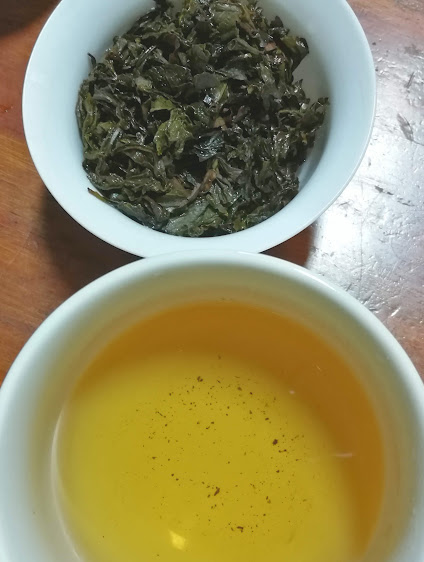
Sample #1 left, Sample #2 right
|
 |
not much to go on in these descriptions
|
I typically taste teas relatively blindly, not checking aspects description or sometimes even basic product details before reviewing them. This takes that a step further, in an interesting development proposed by Philip of
Yiwu Mountain Pu'er. I'm trying three better sheng labeled only as 2018 maocha # 1, 2, and 3, not getting to the third yet.
This blog post write-up has two additional parts to it. After that review, and after identifying what the teas really are, I cite a second review of one of the samples by someone else. A third section covers what aromatic compounds contribute to the flavors in any foods, including teas, which may shed light on differences between the two reviews. The parts link up as connected themes.
The Yiwu Mountain Pu'er samples are very young sheng, surely spring harvest material since it's not so far into summer now. It's probably a safe guess they're Yiwu; that's essentially the range that vendor sells. As for other characteristics, source type, or aspects I don't know. They smell a bit similar: rich, complex, and sweet. But I tend to start reviews with brewed tea details, since that part is more interesting.
It has been nice doing simple, straightforward tastings lately, recently trying a nice orthodox Assam, a South Korean green tea, and a Myanmar sheng. Only the last is comparable scope, and beyond that I've been mostly off sheng for a couple of weeks. I really liked the black tea cycle the week before that; it was nice to return to that familiar ground.
It's my impression that it would help to stay grounded in one type more, that if I was only drinking sheng, or black tea for that matter, that I'd stay more dialed into finer details and more familiar with the typical range. But it's also my impression that if you drink a broad range of types over a very long period of time you also adjust to variation, a higher level type of acclimation.
As for parameters it's the usual story; I've eyeballed the proportion, which did seem relatively standard, and water used is just a bit off boiling, nothing too controlled or ideal. I did use a fast rinse, one concession to convention.
Review
Sample #1 is nice; that stands out as a main initial impression. You can pick up the inclusion of bitterness from just smelling the wet leaves (or at least I think I can, even though it shouldn't work that way), so that was a concern, but the first impression is that it's smooth, sweet, complex, and balanced. That bitterness didn't stand out as pronounced. Brewing whole leaves moderates that. People tend to get the impression that young sheng can be horribly bitter (or at least I did), in part from not being used to it, but also because of drinking chopped-up medium-quality factory tea. Most whole leaf teas tends to come across as smoother and more subtle.
 |
it's become habit to start with a very light first infusion
|
 |
still unfurling
|
Floral tone is the main flavor component; common enough for sheng. Between that aspect and the taste running a bit sweet it seems like Yiwu. It's early for a full aspects description or mentioning how good the tea is but I can guess.
The clean, balanced, and distinct flavors are a good sign. The round is light, brewed fast, and not opened up yet, but the feel has some fullness to it and the aftertaste sticks around a long time. Both of those can work well as quality markers, not so much aspects I love most personally, although they do support the overall effect. They tend to show what a tea is for general type, in different ways. I'd expect this to be a little more challenging at this light stage, not as smooth as it is, since it's brand new sheng, but it works well for me.
That recent Myanmar sheng had some decent feel-structure going on, and substantial bitterness, but it also was sweet, balanced, and more drinkable than some other relatively good versions are. It's not a terrible sign that a tea doesn't need another couple of years to be drank, more just a function of type and style. Typically Yiwu shengs shouldn't be unapproachable, even brand-new versions.
Sample #2 is quite different in character; interesting. Mineral tone does a lot more in this aspect range. It's warmer, with more range in that other direction, and not quite as sweet, bright, and intense. It's still pretty good tea, as much as I can judge such things, but for whatever reasons the style is quite different. For Yiwu the first sample range is more what I'd expect; I wouldn't necessarily guess this is from there.
I like the way this mineral-forward character works out; it's not as if it's murky, or completely lacks floral range, or if the balance doesn't work. Feel is a bit less pronounced, and aftertaste extends on but not in the same way. Mineral trails into spice a little, which I'll have more to say about once the tea actually opens up, if that develops.
About that comment about being source-area typical, I never really worked through different source areas enough to get a good feel for that, which for many is the main starting point. It seems like half what I've ever experienced is Yiwu, but I needed more patterned exploration to put the rest together. Lincang, Nan Nuo, and Jing Mai I've tried a good number of versions from, but not all that many from others. Variances in specific locations within broad areas, and the input of other factors, throws off seeing one aspect set as characteristic for those anyway. I think the generalities are clear enough anyway; by that I mean it throws off me being clear on patterns, which are easier to piece together over a lot more exposure.
Second infusion
The first sample is brewing just a little darker. That doesn't mean anything to me; just passing it on, since the photo may or may not make that clear. I snapped a picture of the teas brewing; that's a good way to go long on an infusion time. These might have brewed just over 10 seconds so the timing should be fine.
 |
still brewed light, really in the right range though
|
Sample 1 has evolved a lot. For all the flavor range and intensity this picked up it might have another step to go in doing that again in the next round. Mineral range joined in a lot with the sweetness and floral range, and bitterness plays a larger role, stepping up with the other levels. Just over 10 seconds is a long infusion time for an intense sheng at a normal proportion; that could be part of it. That mineral is similar to what was going on in the other sample; odd those came out in a different order like that. Sometimes sheng can have a really bright, lighter, flinty or limestone sort of mineral range, but this isn't that. It's not warm and towards earthy range either. To tie both to other areas and tea types Taiwanese oolongs more often exhibit the former light, flintier mineral range (although that varies), and Wuyi Yancha the second earthier or heavier version. This mineral is complex, and kind of between the two, and it spans some range.
This tea is complex enough that it won't be easy to describe. I could say a lot about the parts but it's more about the way it pieces together and balances. There's still a good bit of floral tone to it. Some part is quite catchy, not so far off the sweet, rich, creamy plumeria scent. Instead of trying to list it all out I'll just mention that feel shifted too, that structure thickened, including a little more complexity of impact across all your mouth and dryness. The bitterness balances the rest well. I would expect a touch more intensity for older plant source tea, even though this tea is intense. From what I've tried of more wild-grown teas they tend to be quite aromatic, with flavors in a slightly different range, also a bit softer and more subtle. This isn't like that but the range of some aspects being pronounced within a slightly more subtle than full-throttle presentation for intensity reminded me of it.
Sample 2 didn't change as much. It's slightly warmer, still on the soft side. Mineral tone evolved a little towards a milder earthiness. This is kind of an unusual version of sheng, related to what else I've tried. Floral being present but quite restricted is unusual, the tea being really soft and subtle as those go is different, and that primary mineral aspect range is unfamiliar. There is some bitterness, at a low level that helps rather than approaching becoming a limitation. Aftertaste is unusual, in the way that mineral tone really sticks around. The unusual part is that the other normal flavor range doesn't stick around as much as those often do, and that the feel isn't thin but isn't pronounced in any way. It's an odd combination of effects, not aspects that I usually notice going together. This tea could be brewed stronger, where the other one was at the upper edge of fine for intensity level, prepared in exactly the same way.
Third infusion
I went with a 15 second infusion this time. It will be longer than optimum for the first tea but it will condense where this brewing process is going to go, and will probably be about right for the second.
 |
just slightly darker (these pictures do repeat)
|
Sample 1: not overbrewed, in one sense, but this would work better prepared lighter. That intensity is interesting, in terms of flavor, mouthfeel, and aftertaste. The different levels of aspects balance nicely, even for pushing it for infusion strength a little. Floral tone and a good bit of mineral balance a bitterness level that's significant but not a challenge at all. The description of those is close enough to last round to not go back through all that, and it will work better to brew a lighter infusion to try and further break apart what is coming across as floral and mineral range to me.
The aftertaste seems to serve as a quality marker for this tea, more so than flavor description. It's strong, and sweet, and runs back your tongue and to the rear of the mouth, maybe even down the throat a little. And it kind of doesn't stop; a minute later the tea tastes almost as strong as when you drank it, and two minutes later not diminished all that much. People speak of enjoying the way that can trail on for half an hour or however long but I tend to not focus on it. It's interesting for a few minutes, and in this tea's case still far from over then. In this context I can let it run for some minutes to appreciate the novelty but there's another tea to taste.
It works to clear your palate with water in between trying the two. This tea aftertaste is even standing up to the water, not in any hurry to move on.
Sample 2: This is a novel tea experience, I'll give it that. Mineral and warmer earth again describe the range, but it's odd actually experiencing that. It's not as sweet as the other tea, not as intense, without much of the floral range at all. It does have some fullness of feel and the aftertaste does linger but not even close to the extent the other does, and not in the same form. It's closer to the metallic taste of sucking on a penny. It's not bad, not "off" in any way. The flavors are still clean, it's subtle but with a different kind of less pronounced intensity, and it still works. It's just not familiar. For someone expecting and desiring that Yiwu sweet, floral, mineral supported, intense blast they'd be much more into that first tea. It would seem odd to me if this was a perfect match for anyone's sheng preferences, but then my own are still evolving.
I really expected both to be more bitter. Some of that might be me acclimating to bitterness as a main supporting taste, so that it just seems normal, and not even necessarily like a bad thing. They're both not teas that really need a few years to be drinkable, at all. Yiwu should be nice when young, and not overly bitter or astringent, per my other experience, so maybe it was wrong to expect more of that. That Myanmar sheng was a little stronger in that aspect, as I'm remembering it, so maybe it was just that, a "last-tea-drank" expectations carry-over.
Fourth infusion
I'll try this as more of a flash infusion, since that will work well for the first sample, and then I'll just make due with passing on how subtle the second turns out to be related to that. These teas are really kicking in, related to feeling them, the drug-like effect. Somehow I expect that #1 might be behind that more. I'm not as sensitive to that range of effects as others describe being but sensitive or not anyone would be noticing it.
Sample 1: this is how this tea should be prepared; very lightly. It's not to counter a flaw or negative aspect in the tea, but the balance is just perfect that way, and the intensity is still not diminished. This has to be a pretty good tea. I'd expect it to be more challenging in some way for being that intense but it's really not. The bitterness falls into a great level of balance, and the feel has lots of structure but it's not edgy. Mineral level could be challenging if it was just a little different but it balances well too. These aspects don't just balance, they complement each other.
That floral tone has evolved in complexity to extend as much into fruit. It's within a lot of other complex range, and not distinct enough that people would tend to interpret it in the same way. The brightness is like citrus, and another "rounder," deeper part is a little like part of some types of mango that don't tend to come up very often.
 |
not exactly like this but close
|
When I lived in Hawaii we had three different versions of mango growing at our house. One was a common type, a smaller, multi-colored, softer flesh version, good fruit but sort of most like ordinary mango. One other someone referred to as "elephant mango," an absolutely giant version I've never seen anywhere else. It was bright and citrusy, different than other types in flavor too. I suppose the citrus range in this is similar but that's not where I'm going with this.
The last type was the best mango I've ever tasted, by far. It was a little larger, not as oblong shaped as most mango are, and multi-colored, the kind that turn green, red, orange, and yellow. Was it ever good. I've bought versions here that seem related--lots of kinds of mango grow in Thailand--but nothing else was ever like that one. It doesn't work to say this "sample #1" tea expresses exactly that same flavor but it's similar.
Sample #2 doesn't work as well at this lighter infusion strength. I might go with splitting the infusion time for a last take for these notes, going longer for it. This isn't bad tea but it does pale a bit in direct comparison with the other; it would probably seem like a better version drank alone. I don't like that style as well (the individual preference part), and the quality level also doesn't seem to match up. At least it's different. If someone did want subtlety, warm mineral range, and a young sheng that wasn't bitter it could work well for them. The overall balance is fine, and the unique range effect is interesting.
 |
#1 left, #2 right
|
Fifth infusion
This will be about all the tea I want to drink in one sitting, ten small cups worth. I had a light breakfast before this session--corn flakes--or else I couldn't drink this much of these. Food counters the intensity of the drug-like effect. For people drinking tea for that effect it would make sense to skip that part but my drug use days are behind me. I drink one beer a week, typically, and drinking a large coffee makes me feel edgy and off. The leaves will be far from spent but they often tend to transition less in later rounds anyway.
Sample 1: not much to add; going with a fast infusion again (10 seconds) it's still intense, not that different, maybe fading just a little. Not fading in the sense the tea is on the way out, but in that it's time to adjust up in infusion time, and the full-blast intensity has dialed down some. It really would have worked to go very light on the first 4 infusions (probably even slightly better) and it would be at this stage after a half dozen instead. As is typical the aspect balance shifts and bitterness and mineral play a slightly larger role, with sweetness and bright floral dropping back just a little. The second part shifts into fruit a little more here, a complex expression of it, citrus and a fruit input not far off an unusual form of mango, as described in the last round.
Sample 2: going with a 20 second infusion time instead--breaking with brewing the two in the same way--helped this version. Brewed at the right intensity level that aspects set is catchier. I do like the way that pronounced, broad-range mineral tone balances with the sweetness and floral range that is there, with mild bitterness helping as opposed to being negative. I suppose if someone really disliked bitterness this tea could be better than the other, but maybe they shouldn't be drinking young sheng at all anyway.
This runs short on my subjective impression so far, doesn't it, how much I liked the teas? The first really seemed like very good tea, typical for the general Yiwu type, just a much better than average version of it, one of the best examples I have yet to try. The second was interesting, more distinctive for being different, but I didn't like it as well. To some extent it seemed not as good, in addition to that character just not matching my preference. It wasn't bad tea, and didn't seem flawed, it just didn't seem typical. Trading out normal floral range and the fruit that showed up in the first version for warmer mineral aspect wasn't as nice.
Next I'll mention what Philip said the teas are. Again that would have been cool if I could've taken a stab at what these are, wine-sommelier style, not just to pin down origin area within Yiwu but also what other inputs made them into what they are, related to growing conditions, processing choices, and so on. I just can't do that. I never did get to that level of cause / input mapping, even under the best circumstances. I've noticed some interesting differences related to more wild-grown teas, and the subject of old plant leaf sources keeps coming up, with some related differences now familiar, but those are only two parts among a set of inputs.
Philip's input on what the teas are
Maocha 2 is the maocha of Wild Spirit. These newer growth trees were grown via seeds spread amongst the forest floor and left for natural selection. This is the second year of picking and therefore there is now management on the trees and road leading to the 'garden.'
There's surely a lot more to be said about these teas, about processing input, growing conditions, plant types, lots of layers or related input. Those site product descriptions linked to fill in a bit for details. But a different interesting direction has turned up, a way to focus on the interpretation of aspects present instead. I was talking with Philip of Yiwu Mountain Tea about some of those issues, and he mentioned another recent review of the same exact tea as in Sample #1, so I'll check on that in the next section.
Philip mentioned them setting up a sample set for these different 2018 maocha versions,
listed here, including these teas:
2018 Gaoshan Gushu
2018 Gedeng Gushu
2018 Yiwu Maocha Spotlight
2018 Yiwu Wild Spirit
2018 Yiwu Early Spring Qiaomu maocha
Those two samples are the first and fourth listed. That does represent a really unusual opportunity, to try teas on that level for that price (5x15 or 75 grams listing for $36.99, on sale now for $33.71).
I was just talking to a fellow sheng enthusiast who mentioned trying to keep his habit on a very restricted budget, only buying semi-aged factory teas in the range of $35 per cake. Being on a budget is fine, just how life goes, but it would be nice to have an option to try teas outside the normal range once in awhile. Or as another friend once advised better not to; the worst thing you can do, he said, is to run across a really good example of a sheng pu'er that you like. For me it's no problem; I really could quit at any time. And it helps having a natural inclination towards oolongs and black teas, so that I can really appreciate the extra complexity and depth of sheng, but I'd never turn completely away from everything else.
Comparison with a second independent review by Philipp Aba
I'll cite the
relatively complete tasting notes from an Instagram post, from Zero-zen Artlab, with that author, Philipp Aba, also writing
the Tee Haus blog. The tea photos are very nice, artistic in theme, in a range of pleasant looking teaware photographed against rustic wood and leather backgrounds, well worth clicking over to check on that part.
Gaoshan Gushu Maocha 2018 @yiwumountaintea
Bouquet: ...buttery dense atmosphere of baked apples and pears with layers of woodsy dark forest honey and also first hints of great aging material showing within its leathery and oud / agarwood well composed subtle highlights. Within the second infusion this whole profile changes again into a very fresh and citrus like character especially of starfruit.
Liquor: Also its liquefied profile hits dense and thick notes with such a remarkable composition... ...buttery sweet sugar aspects of marshmallow (more the plant origin), hints of cotton candy followed by baked apples and pears, subtle notes of green grapes but also tiny hints of roses but more in a candy kind of version but there is also a massive herbal aspect of marigold, dandelion or even tiny not so bitter hints of gentian to it.
The aftertaste is as rich as this whole sensational session with a lingering finish. Like within its aroma a very elegant citrus fresh layer shows up within a second and each steep after that covering small marbles of forest honey with a refreshing herbal light fusion of birch leaves (and juice), hazelnut leaves, buckhorn and spruce needle... [and also including] a very subtle but lovely bourbon vanilla note...
Editing that would have reduced it to what seemed most important to me, and all the ideas and descriptions are distinct.
It's poetic, detailed, and interesting. It matches some of what I wrote. A lot of the differences can be resolved, even though at first glance the two descriptions kind of contradict.
Starting at the rougher level, both descriptions do mention both floral and fruit aspects, both citing citrus as one component. The fruit range is described differently, as different fruits, and in more detail in this other review. It doesn't help that I described the fruit as tasting like a type of mango that almost no one would have ever tried. On my first read of this second review it just seemed wrong, describing the tea as only tasting like fruit and not at all floral, but I had misread this part:
also a massive herbal aspect of marigold, dandelion or even tiny not so bitter hints of gentian to it.
This second review description doesn't mention mineral as present at all, or that there is any bitterness, both of which are relatively universal in younger sheng (with the second oddly very limited in the Sample #2 version). It does mention the pronounced aftertaste. It would be possible to move past bitterness and mineral as only the context within which the true nature of the tea is expressed. Those weren't the most interesting parts anyway.
Beyond preparation differences (using different water, or parameters) a lot of the rest might relate to the role subjectivity plays in tea experience.
I wrote a post about that two years ago, asking other bloggers and one wine maker friend for their take on the matter. That wine-oriented friend was basically saying that if a wine really is fruity one person might "get" cherry and another blueberry, and it's not necessarily that either is wrong. The same fruit aspect in a tea could be interpreted as baked apple, pear, and star fruit, or as a type of mango, even though that might seem a bit counter-intuitive.
As an engineer I want to take that straight into consideration of which taste / flavor related compounds actually are present, or aren't. I did a lot of research on that last year, that never saw the light of day as being posted, related to researching machine-"tasting" of tea. In some taste-complex foods, like in wine and tea, there really can be a lot of compounds that don't just sort of relate to those found in other foods items, they can be the same. Interpreting a mix of them is another thing.
I'll do a tangent on that next, but I think that's only part of the story. Complexity being interpreted in different ways must also relate to interpretation by the taster, to making associations beyond perceiving what is present.
Aroma compounds
This deeper dive relates in part to the difference between tastes and aromas. Tastes are a basic, more limited set (sweet, salty, bitter; probably that vary more than those unified categories imply though), and aromas are more complex sensations (which could also be referred to as tastes, or as flavors instead, depending on how concepts are being used). Aromas are carried by volatile compounds, detected in the rear nasal passages instead of by the tongue. Ordinary language use of these category concepts varies. To some extent there being correct food-science definitions beyond ordinary concept use is relevant, but it doesn't necessarily work as a final word.
If a limited set of people--eg. tea enthusiasts working within established norms--evolve different use of concepts they could be wrong in the sense of conflicting with established terminology, but right to the extent that the descriptions are functional, and are inter-subjectively accepted in a group. For example, that Zero Zen blog broke out separate categories of "bouquet" and "liquor." To the extent these are meaningful, useful category descriptions understood by a reader to me they are completely valid. It seems more common to see a category break of taste / flavor and aroma / fragrance (which is probably similar to that divide, if not the same). That split isn't always parsed in the same way, but to some extent normal use does seem somewhat consistent.
Wikipedia's short version on aroma compounds helps clarify this (sort of):
...An aroma compound, also known as an odorant, aroma, fragrance, or flavor, is a chemical compound that has a smell or odor. A chemical compound has a smell or odor when it is sufficiently volatile to be transported to the olfactory system in the upper part of the nose...
...Flavors affect both the sense of taste and smell, whereas fragrances affect only smell. Flavors tend to be naturally occurring, and fragrances tend to be synthetic.[1]
Aroma compounds can be found in food, wine, spices, floral scent, perfumes, fragrance oils, and essential oils. For example, many form biochemically during the ripening of fruits and other crops. In wines, most form as byproducts of fermentation...
I'm not certain that general concept category framing works as a last word but the divide they're specifying is clear enough anyway (beyond that odd "upper part of the nose" reference; I think description as sensation occurring in the rear of the nasal passages might be more standard). I've mentioned a different Chinese traditional distinction that doesn't map directly to these before (contrasting aroma and flavor, which does sometimes go by "liquor," or less translated "good in soup").
The list format version of these "aroma compound" types in that reference article is interesting (only a sample):
Esters
Fructone (fruity, apple-like)
Hexyl acetate (apple, floral, fruity)
Ethyl methylphenylglycidate (strawberry)
Ketones
Cyclopentadecanone (musk-ketone)[2]
Dihydrojasmone (fruity woody floral)
Oct-1-en-3-one (blood, metallic, mushroom-like)[3]
2-Acetyl-1-pyrroline (fresh bread, jasmine rice)
6-Acetyl-2,3,4,5-tetrahydropyridine (fresh bread, tortillas, popcorn)
Lactones
gamma-Decalactone intense peach flavor
gamma-Nonalactone coconut odor, popular in suntan lotions
....
A partial citation of that first category listing (different entries of it) helps explain what's going on:
It's possible that the last three compounds on that table could be present in a food, or a tea, and different people would "get" differing degrees of nail polish, fruit or rum, and then apple or pineapple. I mean that as possible intuitively, and as a thought model. I'm not a food scientist, so the claim is limited related to that set being likely to occur naturally together or not.
It sounds like I'm saying that the longer a flavor list is in any review the better, as review scope of any kind goes, that it's all likely to "really" be in there, so the reviewer who goes on and on probably really is just more sensitive. Maybe. Or maybe they're just more imaginative, and they are making leaps that aren't really justified by the aromas--flavors, if you use the concept that way--in the food or drink item.
All of this probably implies a more cut-and-dried taste experience than is actually how that works out. We must perceive sets of different compounds and related inputs in different ways, more so than the experience of tasting working as a binary-value sensory experience, related to a specific compound that maps to a specific flavor being there or not.
It is possible for a machine (compound testing) to "taste" a version of brewed tea and shed more light on it, a very complicated subject I'm going to completely set aside for now. How that works out in practice was fascinating to review (to me), but it never did fall together into a central theme as I'd hoped.
Conclusion
I'd guess that the other reviewer,
Philipp Aba, probably is more sensitive to subtle aroma / fragrance distinctions than I am. Not mentioning any bitterness or mineral aspects isn't necessarily problematic; it's normal for me to focus on a limited range in a tasting, and to let other scope drop due to that focus. I suppose it's also possible that he was more or less wrong about noticing some of those aspects.
Taste sensitivity and interpretation are two separate but related themes, not necessarily the same thing. One might see a correlation to the idea of someone being a "supertaster," which is worth doing one more short tangent on here. From the sounds of it that person would "taste better," but what that means is really more specific,
from an article by the Scientific American:
The number of taste buds varies from person to person. People who have relatively more taste buds are called supertasters. To supertasters, foods may have much stronger flavors, which often leads to supertasters having very strong likes and dislikes for different foods. Supertasters often report that foods like broccoli, cabbage, spinach, grapefruit and coffee taste very bitter. The opposite of supertasters are non-tasters. Non-tasters have very few taste buds and, to them, most food may seem bland and unexciting.
Of course this leads back to a twist: tasting, in the broader sense, relates to sensing and interpreting input from both taste buds on the tongue and receptors that are part of the olfactory system, to detecting aromas. Another part of that article mentions this relation to tasting bitterness in a compound:
Testing a person's sensitivity to a bitter chemical called 6-n-propylthiouracil (PROP) is a more definitive way to determine if he or she is a supertaster; non-tasters can't taste PROP, but supertasters can and really don't like its bitter taste! Average tasters can taste it too, but its bitter taste is not strong enough to bother them.
It's too much of a leap to speculate further but it seems at least possible that a limited ability to detect bitterness--being a "non-taster," on that scale--may help someone detect, interpret, and appreciate the other aromatic flavor range, versus that detected by the tongue. A non-taster may make a more effective tea taster, in a limited sense.
Or I suppose it's much simpler to just conclude that aptitudes, training, and final interpretations can vary.
In this test case both reviews found the sample #1 tea to be pleasant, high quality, complex, and distinctive, just described differently. With both identifying pronounced aftertaste, thick mouth-feel, floral range, and fruit, with only the last described differently, beyond the citrus component being common, the descriptions weren't as different as they first seemed.
 |
there's more to say about an upcoming tasting at this zoo; better next time
|