Showing posts sorted by relevance for query yiwu mountain pu'er. Sort by date Show all posts

Monday, January 29, 2018

Reviewing multiple year versions of Qiaomu Yiwu Mountain Pu'er


Based on talking about pu'er online with Philip Lee, owner of Yiwu Mountain Pu'er Tea, he generously offered to send some teas for review.  In this case it's partly about supporting my exploration of sheng pu'er, probably as much as getting feedback about the product or whatever promotional value there is from mentioning products here.

One aspect of pu'er that I've not explored much yet is how aging changes specific teas.  It typically takes time to gain exposure to that experience.  No matter how much you try different teas of different ages, even relatively identical versions from different years, it's very difficult to place storage conditions variations related to other factors.  You don't always know where those teas spent the prior years, and even relatively consistent annually produced teas could still vary related to minor condition variations.

Phillip sent a number of similar teas from different years (qiaomu origin pu'er from Yiwu, which refers to wild arbor trees).  These were stored and therefore aged in similar conditions, so this should be a great chance to experience aging differences more directly.  That's as good an alternative as is likely to come up, aside from owning cakes and drinking them year to year over a long time, and remembering back or reviewing notes to identify transition.  I've bought a couple of sheng cakes in the past few months but I'm still not really doing justice to that standard project approach, and may never ramp it up to a relatively ordinary level.

Since I'll be trying a number of teas from them it seems as well to mention their background and the description of this set, starting with the intro in their website:


Our Mission: provide authentic premium-quality Yiwu Mountain Tea and support the families of Yiwu

My wife's family is based in Gaoshan Village, Yiwu Mountain, Mengla county, Xishuangbanna. We currently operate a small family business in Guangzhou, selling authentic premium-quality Yiwu teas.  This website was created to help support the sales of pure Yiwu-sourced teas to the global market, as our physical location focuses on local customers... 
 
How it all began:
This business started with Mr Li Jia Cai, our father and a true local of Yiwu, who has been tending to the family tea plantations ever since he was a young boy.  As the eldest son of his immediate family, he took responsibility for selling the family tea planted by his ancestors and this helped to build his reputation for sourcing organic, high-quality tea...  To this day, most of our teas are still sourced by his local knowledge and immaculate ability to find great tea.


Sounds good; that's the kind of background one might hope to hear about.  Onto a description of this sample set (which they do also sell as a commercial product offering, not exactly in the form of samples I received, but something comparable):


It is a very accessible set of teas, especially good for those relatively new to Puer and/or Yiwu.  If you are relatively new to tea, this pack will help you learn more about specific characteristics of different Yiwu productions.  If you are a more experienced tea drinker, you will still be able to learn more about our company products, clean Guangzhou ageing, and likely experience nuances about mouthfeel, cha qi and huigan, especially when compared to blended or non-Yiwu products.

The version he sent me includes all years from 2012 to 2017, so designed to really emphasize aging as an input, with that sample set listed online including the following instead:


2017 Yiwu Qiaomu
2012 Yiwu Qiaomu
2017 Yiwu Gushu
2012 Yiwu Gushu
2015 Yiwu Huangpian
2016 Yiwu Ripe


Yiwu shou; that's different.  The versions I have aren't gushu, matching those Qiaomu samples instead.

A couple of last details before moving onto tasting notes.  Philip suggested paired tastings, which makes sense.  It is possible to taste three or four teas at the same time but even with tasting two versus only one the detail of what you pick up can fall off.  It gets to be a lot to take in.  That really also depends on practice in doing comparison tastings, and how ideal the tasting environment is for focus, related to background noise and such.  Tasting in a hurry doesn't really work either, at least not for tea that's not very straightforward or already very familiar.
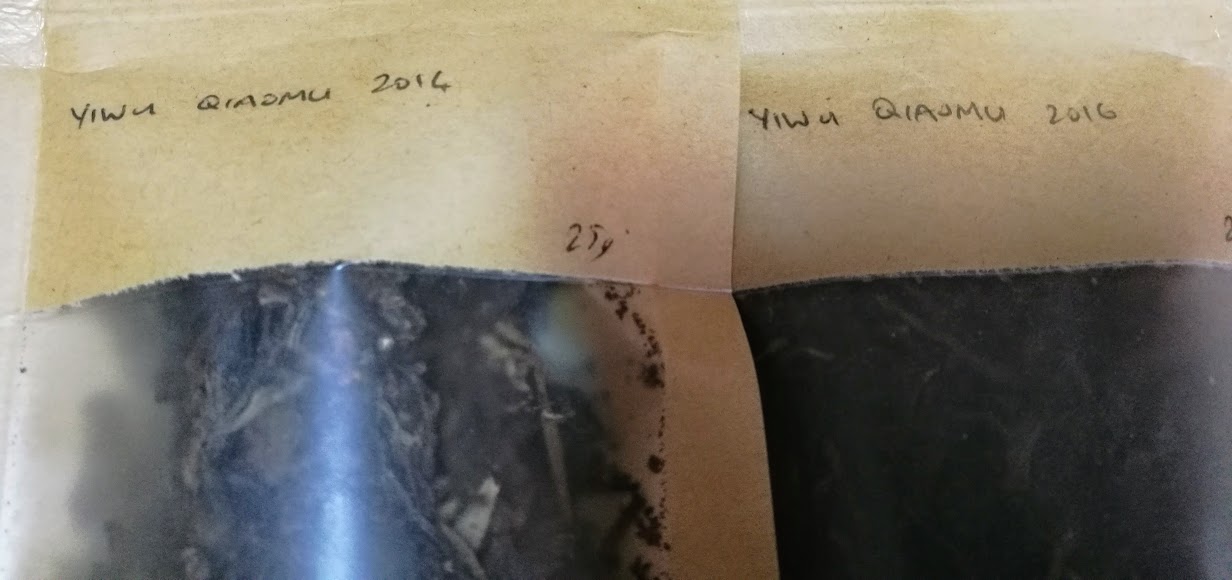


Initially it looked as if there were two 2016 sample versions, based on my interpretation of the handwriting.  The samples look like maocha, as if none of them were pressed, but in discussion with Philip the 2017 hasn't been pressed yet but all the others were.  It seems they were carefully separated back out into loose tea again for distribution as samples, probably a little more broken than an unpressed maocha would be, but it's hard to notice that difference at a glance.  Philip explained why this is possible related to the teas being hand pressed instead of machine pressed, and not as tightly compacted.


Next one might wonder if Guangzhou climate is wet or dry, related to other familiar storage locations (with more graphs related to those other areas in this post).  Here's a chart (no graph turned up right away; this format will do).


Temperature variation is interesting (or relative lack of it), but humidity is more of a concern (66 to 84 as monthly averages).  It doesn't look quite as consistently warm and damp as Malaysia but not so different than Hong Kong, still on the humid side, more humid, warmer, and more consistent than in Kunming.


Tea storage areas throughout East and SE Asia (and where I am, BKK)


That one friend I keep referring to in Wuyishan just mentioned that it's right around zero (C) there for a daily low lately; odd it seems a little cooler being so close, based on noting Fujian just slightly to the North on that map.  But local weather does depend on elevation and other factors.

Review, comparison tasting 2017 and 2016 Yiwu sheng:


2016 left, 2017 right; lots of color difference


The 2017 sheng version experience is nice; bright, intense, and complex.  The profile is as I generally expected from previous exposure to other Yiwu versions, not that I have sub-region and other variations completely mapped out.  Floral range accounts for a lot of the taste, along with a strong mineral base that links with feel and aftertaste effect range (or at least seems to).  The tea is intense while you drink it and the experience stays with you, the taste and feel not subsiding after swallowing it.

Astringency versus bitterness and feel can be an odd range of somewhat related aspects to describe for young sheng.  That full feel is essentially the astringency of the tea coming across, and the apparent tie to mineral range flavors is a typical part of the experience.  Sometimes it also relates to a taste of actual bitterness.  Not so much in this case, but the experience is complex, so it does include just a little of that too.  Sweetness and other aspect range makes it work; it balances.  I'll get back to those next levels of detailed description across other infusions.

The 2016 version experience is quite different.  There is some overlap, but a warmer, sweeter, richer range of tastes dominates.  I was concerned this initial tasting would mostly point towards a likelihood of more significant change across more years (the ages of samples extends back to 2012), but that won't be the case.  I wouldn't have expected this much change in a tea in one year.  Of course there are going to be other factors since tea producers can't make exactly the same tea year to year, for lots of reasons.


2016 left, 2017 right; slight color difference in brewed liquid as well


Before going further with similarities and differences, it occurs to me that there is a reason essentially no one gives clear, detailed, specific, meaningful review descriptions of teas (even me; the rambling on here doesn't necessarily count as an exception).  Breaking down and describing the flavors requires interpretation, and the feel and other range all the more so.  Even related to a relatively accurate, clear, complete description from an experienced, more-objective reviewer a different person with similar background and skills could easily interpret the same tea slightly differently, or perhaps even completely differently in terms of individual aspect-description sets.

I also suspect that it's a flawed premise underlying reviewing that a tea's flavors can meaningfully be reduced to 5 or so flavor elements.  That's only true for that description being objectively accurate and complete; of course it can work to pass on a very descriptive impression, especially after a reader has tried some of the same teas as a reviewer to identify how those descriptions and interpretations match up.  Enough reviewing philosophy aside; back to these teas.


The flavor range I would associate with sheng aging is apparent in the 2016 sample, or at least that's how I interpret it.  The general flavor warmth is based on an aspect range that moves from bright floral and intense mineral a little towards a root-spice effect.  It has softened and rounded out more than I'd expect possible in a year (again based on assuming a very similar starting point, which isn't a given).  That did lead to trading off the brightness and sweetness, with the mineral layer intensity also softening.

It's a character trade for one type of appeal for another, and for many this second one year older version would be more approachable, even though I expect for most young sheng drinkers the 2017 sample already is that.  I think maybe two years ago prior to more sheng exposure that would've been more true for me, that it would be easier to relate to the softer tea.  Related to trying a tuocha of Dayi pu'er I would guess is somewhat type-standard awhile back this 2017 version is very smooth and pleasant tasting, and that tea had been around for a few years already.  It drifts into a subject I won't treat here but it's a given that tightly compressed teas--like that tuocha--age relatively slower.  Of course the starting point had to be much different, since the comparison is with a very young tea (less than a year old) and a very slightly aged one, not yet into middle-age (3 years).


next infusion (2016 left); again both bright with a slight color difference


The 2017 version softens a bit on the second infusion; I'd expect it will transition a bit more over the next couple.  It's funny how softening and warming a little leads it to being so similar to the 2016 version on the first infusion.  It still does retain more mineral in the flavor, and more brightness and freshness, and pronounced floral aspect.  The aftertaste seems more pronounced for this version (in a sense I associate with hui gan, if I'm using that concept to map to an experience properly).  I wouldn't be surprised if it is actually a slightly better version of tea than the other, and that's not just an age related factor, that aspect diminishing a little.


I think it's not just the flavor difference that makes the experience so dramatic, but also the feel, and not just related to some general level of fullness or astringency, also where the tea affects your mouth.  The first you feel more in sides and rear of the mouth, and the part that lingers on, also on the rear of the tongue.  This 2016 sample feel (and to some extent taste effect, it seems) is more pronounced in the middle of your tongue.  I wouldn't naturally guess these two samples are from the exact same origin, if tasting them blind.  Of course there are lots of other factors beyond growing conditions and plant types that go into how a tea turns out, with processing as much an input as those, or even more, according to some opinions I've ran across.

I accidentally went a bit longer on that next infusion, a bit over half a minute instead of more in the 15 to 20 second range (for once I didn't go overboard with proportion, keeping it in a more normal range, or I'd be on flash infusions instead).  In general it seems to work to try the teas brewed very lightly to notice more about flavor aspects and more medium strength to focus on feel and aftertaste (just my impression; take that part for what it's worth).

The 2017 tea has softened enough in "opening up" that it's not bad at all slightly more intense, and for someone drinking the tea more to appreciate that feel and aftertaste intensity maybe this is actually optimum.  The experience of the tea is still really pronounced a minute later.  I've tried tea versions where that extends lots further, so that five minutes later it's still not really diminishing much, but this still seems significant.

To be honest it's not an aspect range I'm particularly attached to anyway.  I sort of get why people learn to appreciate it, and why that's a common theme within strands of tea culture (often regionally based, leading into a longer story).  But at the same time you have to learn to want to experience that, it seems to me, and that type of appreciation seems more a developed cultural aspect than a natural inclination, or one that develops naturally with experience.  Then again I never really got why some experienced wine drinkers love French wines that taste like a nail was stored inside the bottle, back when I was into that.  There was probably a natural preference transition going on I never did follow that interest far enough to appreciate, only moving from liking merlots and red zins into syrahs and different blends.


It would be nice if I could place that flavor range in the 2016 version better.  It tastes like storage effect to me (fermentation, but an effect that varies with conditions), a very specific warming, softening, and flavor-range shift, but one that's hard to describe.  Moving into a flavor like sassafrass is as good a description as I'll probably come up with, but it's not that simple.  Extending into warmer mineral tone is also part of it, and the flavor complexity isn't describable in tasting like one thing, or even as a set.  I'd expect that for either of these teas aged for a few more years (as in the 2012 and 2013 samples) I might still struggle with description but the transition would be so pronounced into a different range that more might come to mind.  Or I might just continue to fail to capture what I mean by "warmer mineral" aspects instead.  The one year older version kind of makes more sense brewed slightly stronger, to me, even if the feel and aftertaste don't match that range of experience in the other, or maybe because of that, because taste just intensifies but the rest still isn't as significant.

The next infusion sees both teas smoothing a bit but not transitioning much.  It seems they're going to produce a lot of consistent infusions, which is a good sign, but really also just kind of what I'd expect.  Both teas strike a really nice balance related to the prior described aspect range, and continued to do so for another half dozen rounds, with allowance for extending brewing time to keep infusion strength up.


Thai demigods; unrelated filler photo


Conclusion:


They're nice teas.  They're also just what I would have expected, and quite similar to the range experienced in that Yiwu tasting event last year (a Ding Jia Zhai village area sheng pu'er vertical tasting, to be more specific).  The difference in years (with one year of aging) is a lot more significant than I'd have expected, but trying other samples might inform if that was instead related to differences in tea versions as much as to one year of aging.  It was a good start on tasting a range of different related teas, the first time I've ever experienced such a thing to this degree, or at least in a form anything like this.

These two samples raise as many questions as they answer, and trying the others should help cover some of them.  I'm curious how aging will change the older samples, with the sequence going back to 2012.  It will be interesting to see to what degree I can separate out any year-by-year variation from that input.  I'm wondering what age / level of fermentation I'll prefer, or if it just doesn't work out that they're all different, with the variation more interesting than any one version.

Per some accounts sheng pu'er is said to typically age through a middle-age period where aspects flatten out, and then re-emerge in a different positive form later.  How that cycle times out, or even how regularly that particular pattern holds, probably relates to both the starting point for aspects and personal preference for a particular range.  Per another standard take pronounced bitterness and astringency are critical elements in brand new sheng that relate to aging potential, translating into aroma later.  This samples tasting series won't be able to fill in background related to those sorts of issues, but it will be fascinating to experience more about how one approachable, pleasant version of Yiwu sheng changes across a number of years.

Monday, March 12, 2018

Yiwu Mountain Pu'er 2013 and 2014 sheng comparison

2014 Yiwu Mountain Pu'er sample


2013 Yiwu Mountain Pu'er sample


Farmerleaf 2012 Nan Zuo sheng


Back to comparing the last two samples sent by Yiwu mountain pu'er, of samples of sheng from 2013 and 2014.  Those are part of a sample set designed to allow for exploring aging differences, relatively identical annually produced teas.  There would always be variables, but buying teas intended as very similar produced from the same source by the same people eliminates some of those.  Earlier posts compared other years, 2016 and 2017 here, and 2012 and 2015 here.

I mentioned what was in that set before but at the risk of this bordering on sales pitch--which is not really how it's intended--I'll mention it includes eight tea types, 3 sheng, 2 gushu sheng, 1 shou, and 2 black teas, so totally 160 grams for $35.  I've recommended people essentially create their own tasting set like this one through Farmerleaf before, since they sell samples, but that would tend to be Jing Mai versions instead of Yiwu.  Someone might not be so interested in black tea or shou but I wouldn't relate to that particular reservation since I love Dian Hong (Yunnan black teas), and like trying shou. 

Obviously Yunnan Sourcing is a natural resource for trying samples (while I'm mentiong vendors), but them selling a little of everything can make that more complicated, harder to sort out.

This drifts off the subject but I have tasting notes still in draft form for a really cool Myanmar version of shou I just tried.  Good shou, or at least interesting shou, is different than something that "just tastes like shou," which does also come up.


In order to add depth to this I'm comparing them to a third tea.  I don't have a 2013 or 2014 Yiwu sample on hand--I don't think; easy to lose track--so it'll just be whatever I do have that matches this age, in this case a Farmerleaf 2012 Nanzuo (Jing Mai region) sheng.  Of course lots of variables could shift this being the same sort of direct comparison (the region and local area, growing conditions, processing differences, where it spent that time, other aging factors, etc.), but it will help to place things comparing the two others against even a relatively random, somewhat-aged sheng.  Aspects like body and feel stand out better in contrast, and of course I'd just expect the flavor range to differ.

Philip recommended trying the tea in pairs, and as I commented in one earlier post that is already plenty of input to consider for tasting any tea.  In a couple of senses tasting one tea at a time works a lot better than two.  It's less to focus on, it challenges you less for switching between versions, and it allows for noticing the effect of the tea (qi, something I tend to never talk about).  As other people describe tasting teas the feel of the tea develops over a lot of exposure, a lot of sips (mouthfeel, I'm back to, off drug-like effect), and mixing types would throw off that build-up and more gradual development of awareness.


On the other side of all that once someone practices trying multiple teas it works out as easier than it is to do initially.  Comparison brings out contrasts, both broad contrasts of one type or version not being like others, and it also highlights subtle, minor variations.  It's that last part that's really the main benefit, as I see it, since tasting teas one day to the next makes for too much of a demand on experience memory to pick up very minor variations.  For example one tea could just feel a little thicker, or affect the mouth differently, and that would stand out better in a comparison.

Of course different people would reject lots of what I've just said.  It really does seem like a judgement call, or a personal way of relating to teas that could vary by person, or would really tend to shift in nature over time.  Part of the idea here is that if these two teas are nearly identical, which I would expect, it will be more to experience and consider, and some degree of contrast can be helpful.


This part goes without saying but if you have smaller tasting gaiwans, versus a larger size for drinking what for some would be a more typical amount of the tea, doing a three-way tasting is the time to go with those smaller versions.  Five or six rounds in it really starts to add up.

First infusion:


2013 left, 2014 top, Farmerleaf Nan Zuo right


I won't say too much since these will just be getting started.  The 2013 has some deeper, rich flavors.  They'll be easier to pick up next round when it opens up the rest of the way.  The 2014 is different but relatively similar, moved on from anything like bright floral into a heavy mineral and earthier range, maybe even a little towards bark spice.  

The Farmerleaf Nanzuo, Jing Mai (versus Yiwu) origin tea is going to be completely different in flavor, but the overlap might be interesting.  It's also deeper and richer, towards bark spice but a brighter version, maybe a little lighter than the other two even for being that one extra year older.


2013 left, 2014 top, Farmerleaf Nan Zuo right


Second infusion:


The 2013 Yiwu Mountain pu'er sheng is still a bit subtle.  The flavor range is nice, and there is body to the feel, but those two relatively short infusion times might not have allowed it to really show off where it's going yet.  Of course there is no challenging bitterness or astringency to consider in a tea this softened and altered by age, and the 2017 version wasn't unapproachable anyway.

The 2014 tea is quite similar, maybe with hint more of a bark-wood or autumn leaf earthy edge to it.  I suppose it's conceivable that the 2013 quieted a little in that extra year of aging but it seems more likely that's just year to year version variation, playing out in an unusual form since that a lot taste range wouldn't seem likely to have been there when both of these were produced (just a guess, really).

The 2012 Nanzuo tea is quite different.  It has developed a similar earthiness to part of what is expressed in the 2014 version, a similar warm and complex mineral range brought out by aging transition, but a primary flavor range is different.  It reminds me of root spice versus bark spice in the others, less autumn leaf and more of an aspect that's probably closest to a tisane type I'm not familiar with.  It's off towards pandan leaf a little, if that helps, but not that.

On the next round I'll let the infusion run a little longer to say more about the feel aspects and aftertaste, which will allow for more flavor review.  Bumping the intensity up over what I'd probably consider optimum (light--no need to go mediumish level to get plenty of effect) will probably help in one sense but not work as well in another.

Third infusion:


I didn't brew these strong by any means (still just under a 30 second infusion time), but that does provide plenty of infusion strength to pick up subtle differences, or feel elements.  These 2013 and 2014 Yiwu versions really are similar teas.  If anything the only difference seems to be a touch of earthiness being slightly more pronounced in the 2014 version, again due either to year to year version differences, or I guess to an extra year softening the tea that little bit further, transitioning to a smoother overall effect and a more subtle flavor balance.  A more judgmental read on that would be that the tea is instead fading away, the aspects are dropping out, and I can't really pass a clear judgement on that.  Sheng is often said to go quiet in some age range and then return in a different aspect range later anyway.  It's probably just slightly different.

Again the large difference in flavor range stands out as the main shift in the Nanzuo sheng.  It retains a full feel (with "full" really needing some more unpacking to be meaningful), and a good bit of subtle dryness, and I suppose the aftertaste may stick around a little longer.  That tisane-like unusual taste is drifting more into a woodiness, an aged hardwood effect, versus the brighter and sharper effect of a younger wood related aspect that might be more common in a younger version (less aged tea).

Those differences in effect would determine if this is a more pleasant tea to experience or not.  I'm still not as focused on feel and aftertaste elements as many sheng drinkers describe developed preferences for, and it seems quite atypical to base most judgment about a sheng on flavor, as if that's not supposed to be the point.

Fourth infusion:


I did give these teas around a minute infusion this time, not so much to test that effect as to not paying attention while messing around online.  The end effect will be the same, unintentional or not.


2013 left, 2014 middle, Farmerleaf Nan Zuo right


The 2013 tea really is more subtle than the others; even brewed out to this time and infusion strength it's still approachable.  The aspect range is nice, just on the quiet side.  Warm overall flavor range includes mineral, and an autumn floor and bark spice range.  The feel isn't exactly thick or aftertaste pronounced, especially for using a substantial brew time like that.  The way it balances and the overall effect is nice but the tea character is a little subdued across different levels.  I'm not sure if this would serve as a trigger to a sheng enthusiast that this tea is on the way out, or if it's just entering a quieter period.

The 2014 version is a lot more intense--funny how that works out.  The character isn't completely different but it has more of an edge in terms of astringency, a feel that's not exactly biting but more like one might expect from tasting actual wood or tree bark.  That darker, richer tone comes across as a slight shift towards tobacco in this, which also works as a tie-in to the extra edge it has.  In wine tasting terminology it would be called drier; the astringency has the effect of drying your mouth.  It's not really astringent in the sense of green tea or CTC black but the feel isn't completely unrelated either.  It's funny how different it is from the 2013 version, on those different levels, while still overlapping at the same time.

As expected that one unusual taste range in the Nanzuo sheng (2012 version) is much more pronounced at higher infusion strength.  I guess someone might love that, but to me it's just a little odd.  On the positive side it tastes a bit like a root-spice or less common herb, complex, a little earthy, but also light.  On the negative side that drifts into woodiness, not completely unrelated to tobacco, but maybe a little more like a balsa wood.  I guess that's not necessarily negative, as much an observation I wouldn't value my tea tasting like balsa wood.  The feel isn't as intense as the 2014 Yiwu, but with more to it than the 2013, slightly dry, with a slightly longer aftertaste experience than either of the other two.

Fifth infusion:


I'll use this for some final thoughts and move on.  These teas are still going but this adds up to 15 small cups of tea and I'm a bit over the tasting process.  The 2013 Yiwu is still nice enough, still decently balanced, but it does seem to be fading, and it would take longer infusion times just to keep it going.  In one sense this is the best of the three teas (but only in one sense), but also the least intense by far.  The 2014 Yiwu version has moved into being a bit woodier, as it had in the last round, but it's still ok, with feel and intensity balanced well prepared lightly.


I've not said much about personal preference relating to these teas, beyond that balsa wood comment.  The novelty stands out as interesting, noticing so much difference, more than an experience of really loving any one set of aspects.  They're all interesting teas, and all pleasant to drink. 

I suppose as personal preference goes I'd either like the bright, intense, sweeter effect of a younger sheng more (when bitterness or astringency doesn't make those unapproachable), or the effect of the few significantly older teas I've ran across, the way they develop completely different range of aspects, more complexity.  That's not to say I don't like these teas, maybe just that I would have initially expected to like sheng aged between four and six years more than I have in a lot of cases.  But of course I'm only trying three tea versions here; that most definitely cannot be extrapolated to anywhere near that extent.

If someone loved that unusual taste range in the Nanzuo version it would clearly be the best of the three, but I have mixed feelings about the flavor range.  It did exhibit the longest aftertaste.


I suppose 4 to 6 year old tea might just fade in that one regard, in general, and the feel could naturally thin, but I'd need to try lots more to have an opinion on that.  I would expect it to tie back to initial starting point aspects more than to other factors. 


To stay grounded related to how different sheng vary I keep trying different versions I have around, and since this tasting (since I wrote these detailed notes) I tried that 2014 Dayi 7542 again.  It's definitely not a very soft tea yet, and still a little bitter, and might be better in a couple more years.  That's probably where those expectations for liking slightly older middle-aged teas are coming from, related to drinking teas like that one.  I'm not sure if at its optimum age it would be any better than these teas in the newest year or two samples.  Maybe it would just be different, and "better" would need to tie to preference.


Related to what matches my own personal preference most better Yunnan black teas draw even to drinking any of these three versions I reviewed, to be completely honest.  They're interesting, but trading out the freshness and intensity of younger sheng versions for that earthy, richer mineral range didn't improve them, and the limited feel-aspect range of all of these might indicate they could have been better teas to begin with.  I liked the newest two versions best, I think, those 2016 and 2017 samples.  That was probably because they started out as approachable tea, so the extra freshness and intensity wasn't offset by the experience of too much bitterness and astringency.

I should add that Philip sells different versions of teas, and these aren't his older-tree better version samples, really the more ordinary grade of teas.


Closing thoughts


These samples were interesting teas, to me, well worth trying.  Experiencing that range of age transitions in the Yiwu versions was really novel.  Even the variation that seems to tie back to the teas probably not having been identical from year to year was interesting, these 2013 and 2014 versions being as different as they were in this tasting.

To me that's a lot of the appeal of sheng, the character changing slightly year to year.  It's really the next challenge after trying samples to figure out which to buy cakes of, to get a chance to experience that transition, and then onto tongs, to actually have more to drink in a decade or longer.  I have a few sheng cakes around but I've yet to really get far with any of that.

Monday, September 17, 2018

Blind tasting Yiwu maocha, and about an LP group buy


I've been through some really interesting tastings related to Yiwu Mountain Pu'er samples, across a broad range of Yiwu originated pu'er.  Initially that related to multiple year tastings, to comparing teas to notice the effects of aging versions.  The last tasting was different, a blind comparison of two very good and very different versions.  This will just be trying a single tea, the third sample in that set.

This tea is probably from Yiwu, and that's all I know.  I won't be able to identify more specific origin and processing variation details just from tasting because I'm just not there yet, but I can definitely relate what the tea is like.

Review


The dry leaf scent of this tea is really sweet and rich; that's different.  I wouldn't even guess this is sheng based on that smell.  Surely Philip didn't throw me a curve in swapping out the tea type?

I'm moderating proportion a bit, not going for the packed gaiwan effect, requiring flash infusions.  This first round is a bit light so I'll only have an initial impression.  It's sheng, but a particularly sweet and complex version of one.  Yiwu is often sweet and floral but this is something else, really floral, very sweet, and on the soft and approachable side.  Even light, as sort of a half strength version, the feel is full and creamy and the aftertaste is already pronounced.

just getting started


This tea is different.  The flavor is there, pleasant and reasonably intense, but it has lots of depth across other dimensions that overshadows that.  Other flavors beyond the floral range add complexity, including depth that seems to relate to mild spice.  For now the feel stands as much, not astringent but full and creamy.  It's odd the tea could be that smooth and still express that thick feel.  The aftertaste runs long too, again odd that comes out as much as it does in a tea this smooth, with as limited a bitterness as it has.  You definitely don't need a tolerance for bitterness to appreciate this tea.


Next infusion is more of the same, nicely complex.  Sweetness stands out, and lots of floral character.  There's a depth to the tastes that I interpret as mild spice, a warm subtle layer.  The bitterness is very limited in this tea, just enough to balance out the rest.  There's a trace of sourness too, which actually isn't negative, it integrates and comes across as pleasant.  It's like the role of that aspect in a good version of a spiced sweet pickle, just lower in level.  This compares with that in more than one sense, with the sweetness and spice also present.


The overall effect is nice, beyond the pleasant flavor profile.  It's soft and rich, not what one would expect at all in young sheng.  Somehow it doesn't seem like how age takes the edge off new sheng either; it's still bright and lively, just missing a lot of the astringency that typically comes with the type, but retaining fullness in feel and aftertaste.  The feel coats your mouth, with the flavor not diminishing much at all after you swallow the tea.  Often that pairs with bitterness; that aspect transitions to sweetness, but this is something else. 

Being this mild there is no need to use flash infusions to balance the intensity and limit those aspects, so I'll let it run a little longer and see how it comes across as a stronger version.  I guess for some this style would be too approachable; they'd miss the way that typical set works and it wouldn't seem to balance properly.  Being a natural oolong and black tea drinker I like it.

The fruitiness picks up a little on the next infusion; this is relatively fruity as sheng goes at this stage.  It's complex, not simple to separate out all that's going on, or easy to assign a more specific range to that fruit, mixing in with the rest as it does. 


The next round is more of the same, a bit fruity, complex, pleasant but unusual in aspects balance.   I'm curious what led to this character.  Is it a more oxidized version of sheng, is that why the sweetness is up and flavors cover a unique range but the feel is so smooth?  Some wild grown tea versions are mild, earthy, and complex but others can be quite bitter; plant type and processing steps seem to be equal factors in how they turn out.  Yiwu tea versions are typically approachable, even when young, not too bitter or astringent, but not typically this mild in character.  The next section covers what the vendor says about it but never does completely unravel the related inputs.


Yiwu Mountain Pu'er vendor description


Phillip said that it's this:

2018 Yiwu Maocha Spotlight

This tea has been especially selected for its outstanding attributes and drinkability as a fresh Puer.  Enjoy tasting the tea as it matures from completely fresh maocha finished processing in late March 2018.  

This single estate maocha is a premium quality from one of the most amazing terroirs in Yiwu.  This tea is outstanding in terms of it's aroma, sweetness and qi, and holds out very well over a long session.  This maocha is typically selected to be sold by or blended by vendors as part of their premium selection.  However, it is this quality that makes the tea outstanding and worth the price. 


They sell it for $21 for 50 grams; not cheap tea but it seems to be in the right range, given expectations related to what I tried.  Being atypical, unusually complex but not covering much in the range of bitterness and astringency, makes it harder to compare to other versions.

That blending idea he mentioned is interesting.  Of course no one is going to buy a tea at nearly 50 cents a gram and blend it (are they?), but the idea is still worth considering.  I drift towards trying lots more single-type teas, like this one, and experiencing and appreciating a limited set of attributes, which varies from version to version.  It certainly would be possible for vendors to apply a blending approach instead, and try to combine the strengths of different teas in different ways (and blend around gaps and flaws, seen the other way).  I run across the idea more in relation to black teas sold as blends, and what Da Hong Pao--the main Wuyi Yancha type--tends to be, but it would work for sheng too.

We never did talk more about it, Philip and I, so I don't know more about why it turned out as it did, and to some extent that doesn't matter.  He did mention something about basic Yiwu character, which would be well-traveled ground in this blog already, but his basic summary version is clear:


The Yiwu style teas don't really have a strong feel of astringency that most teas have, even when oversteeped. It's pretty well known amongst puer drinkers that if you have a preference for 'strong' (bitter/astringent) teas then Yiwu is not going to be the obvious choice. It's the sweetness, aroma and aftertaste, that stand out and any initial bitterness/astringency adds to the contrast by quickly fading for those other attributes to shine.  This overall experience is one that is heavily marketed and is what makes the good Yiwu teas have such strong reputation in the market. One might argue that this is how you can differentiate the best teas.


Placing the style in relation to trying other sheng, and about a group buy


It's kind of completely different subject but I just tried a 2007 factory sheng someone from those tasting sessions passed on, sheng in a completely different scope.  It had aged to taste a bit earthy, mostly like tobacco, which I'd assume different aged sheng drinkers would have different preference-related takes on.  I liked it.  That deep mineral effect is nice, even if centering on tobacco as such a pronounced flavor aspect could be a bit much for some.  I think it was inexpensive, with an aged 357 gram cake costing less than 100 grams of this Yiwu sheng.


I didn't get the impression that this Yiwu version I tried would be any better in 10 years, that it would make sense to age it.  More generally I have the impression that higher levels of bitterness and astringency make for a more natural starting point for aging, since that range will transition, where a mild, sweet, flavor-intensive but subtle sheng might just fade.

On the subject of rambling on about trying random things I finally took part in one the Liquid Proust sheng group buys (I just haven't tasted any yet).  The main form I wrote about some time ago, the "Sheng Olympiad," but this was a beginners' introduction set instead.  I'm not sure if that other group-buy version would've been more suitable but I love the idea of considering what someone in the role of a sheng evangelist thinks would make for a good introduction, and it'll be cool to try some different types.  That site I mentioned sells teas but these group buys are something else; you'd either have to see a post on Reddit or Steepster by him to know he was doing one or follow him on Facebook and see a post.


that 11 year old sheng had time to darken


A "tea haul" style photo would introduce that set but for whatever reasons I've come to see those as a little obnoxious, maybe just burning out on the theme from running across too many.  The set looks like a dozen samples of sheng.  One is labeled as an LBZ; that's not starting with the basics, in one sense, but trying some things across a broader range fits a different meaning of an introduction.  It's my impression he didn't choose basic, type-typical, low-medium quality standard region-profile teas as much as what he considered to be a look into different characters.  It'll be cool.


It's not simple to place this Yiwu version in relation to a moderately priced aged factory pu'er and a set covering a lot of different range.  I like better versions of Yiwu sheng; they tend to be approachable, as Philip mentioned, sweet and floral, relatively intense, with good balance and intensity and a pronounced aftertaste.  Most are fine to drink young, positive for being so intense and bright in character.  On the downside Yiwu is in high demand, so better versions tend to not be inexpensive, and inexpensive versions tend to be less intense, a bit flatter, missing some part of that aspects set.  They can be made in a more traditional style, as this Tea Mania version was, and those are slightly less drinkable initially, with more astringency, and would probably improve more with age.

I'm expecting a lot of those beginner's set samples to run into the type of trade-off that people new to sheng often complain about:  bitterness or astringency being too much, or tasting a bit like kerosene.  Usually that comes across as white cardboard or an odd expression of mineral to me but it's funny hearing it put like that.  This Yiwu I reviewed here was way towards the opposite of that, uncharacteristically smooth and easy to drink, bright and clean, sweet and complex in flavor and feel at the same time.

Tuesday, October 10, 2017

Yiwu Ding Jia Zhai pu'er vertical tasting (comparing different years)


tasting in progress


It was an interesting experience,  a vertical (multiple years) tasting of teas from Yiwu, more specifically from the Ding Jia Zhai area.  I wasn't making tasting notes so I'll keep this general, just some random impressions, after a quite detailed event summary that outlines the teas:


Puerh Tea Tasting Event - Yiwu "Ding Jia Zhai" vertical tasting - 8th October - 14.00 BKK time
งานชิมชาผูเอ่อร์ "ยี่หวู่ ติงเจียจ้าย" แบบ vertical tasting ข้ามปี วันที่ 8 ตุลาคม เวลา 14.00
รายชื่อชาดังต่อไปนี้


Yiwu Dingjiazhai 2013 ร้านชาทีดี (Teadezhang)

Yiwu Dingjiazhai 2011 Chen yuan hao

Yiwu Dingjiazhai 2008 Xi Zhi hao 

Yiwu Zhengshan 2005 Chang Yu Hao

และชาเก่าพิเศษ หนึ่งตัว (and a special old "secret" tea)


Address: The Hive Sukhumvit 69, 200m from BTS Prakanong


ค่าเข้าร่วมงาน 700 บาทต่อท่าน รวมค่าชาและสถานที่จัดงาน ขออนุญาต "งดขนมขบเคี้ยว" เพราะจะทำลายจุดประสงค์ในการชิมชา

Attendance fee 700 Baht per person inclusive of tea and the space. No snacks between the session for the best tea tasting experience.


comfortable tasting space, prior to the event (credit Ty Pip, FB group post)


I've left some Thai text versions in the notice to give a feel for what listening to a language you really don't comprehend is like; sort of a blank space.  I can catch bits, but not so much.  In case you wonder how much 700 baht is I'll save the Google search; just over $20.  I've bought a pot of tea here for about the same, in a cafe I won't name where I'm definitely not a regular, so trying five teas instead is a good value in comparison.

The event started with a glitch on my end when I went to the wrong shared work-space called "the Hive" two elevated train stops down (BTS), due to blindly following a suggestion by typing that name into Google Maps.  It's always about the little details.

Since I won't be going into what Yiwu region teas are like versus others (or certainly not Ding Jia Zhai locale teas within that) I'll cite an interview with a pu'er producer and vendor, William Osmont of Farmerleaf, giving his take on what the different main areas are like (a few of them; it's just a start):


Pu-erh tea features a wide range of tasting profiles. That diversity is due to differences in aging, processing and producing area. Just like the terroirs of wine, tea tastes different according to the genetics, location and management techniques of the tea gardens. It would take a whole book to detail the subtle variations between each mountain and their underlying factors.

Jingmai is famous in the world of tea for its orchid and honey fragrance. Some bitterness is present; astringency is more present than average. In young teas, the mouth feel is generally light and sweet. The Jingmai profile is accessible to the beginners and makes a great introduction to the world of Pu-erh tea because it has a bit of everything. In comparison, Bulang tea is generally more aggressive, featuring more bitterness; Yiwu tea is soft and mellow, with a thick mouth feel. Menkgu is renowned for its complex fragrance and sharp sweetness. 

However, there are many exceptions in each terroirs, and the result in the cup can be very different depending on the processing. 


He's based out of Jing Mai, so a bit biased towards that origin, but all of that should still be reasonable.  These teas should be relatively "soft and mellow, with a thick mouth feel," with plenty of room for variation by version based on all sorts of inputs.


(credit Ty Pip, FB group post)


How it worked out


Of course a lot of the younger versus aged sheng character one would expect to experience was a part of the experience.  Even the younger teas were relatively approachable though, not so astringent or bitter.  I had more problems initially getting into pu'er because there is a tendency for those aspects (tasting too much like taking an aspirin), but not so much across any of those we tried there. 

Yiwu Dingjiazhai 2013 ร้านชาทีดี (Teadezhang), I think this was, some intense tea


The first two teas were a lot stronger in terms of feel, aftertaste, and effect.  People refer to that last part as "qi," a drug-like effect, but I'm never completely sure what the experience is supposed to relate to.  Those two teas hit hard, definitely imparting some type of buzz.  If that continued to escalate it really would've been too much, but it worked out the other way, and later teas seemed to contribute a mellowing effect.


(credit Ty Pip, FB group post)

The other novel experience related to aftertaste, especially for the first two teas.  I've experienced that before,  most in a Golding Kuala Lumpur vendor tea sold as a Jing Mai origin gushu (old tree), here compared with a Farmerleaf version.   One of those first two teas had a pretty strong related effect, and the other was significant, but I've lost track of which was which.  When tasting water between rounds, more or less to cleanse the palate, the water had a comparable level of flavor as the tea, and was a bit sweeter than it, even though it was just plain water.  Cool!  Thaneadopol (Bank; Thais always have a name and a nickname) explained this was the hui gan effect I'd been writing about not so long before.


From there it was interesting noting the way the different storage conditions and ages changed the teas.  Different versions were stored in Hong Kong, Taiwan, or Malaysia, as I remember.  It's tough doing this without notes, but it was nice to be off the clock related to that level of reviewing.  Of course the starting point product also varied, so it wasn't just those factors.  One of the teas in the middle of the cycle had an interesting feel, more in the rear and center of the tongue, extending into the throat.  After that--in later year versions--the flavors kept shifting but the feel aspects seemed to diminish.  I was wondering if I wasn't also burning out a little from all the rounds, if that wasn't coloring perceptions.

It wasn't so much that the later, older teas seemed inferior as that intensity shifted to a softer feel and deeper flavors, and again the teas seemed more relaxing.

The special tea, and conclusions


In the end we tried a Liu Bao from the 60s. That was especially interesting for being on that page lately, for reviewing a number of Liu Bao this year, three of them recently.  It was a bit mellower than the much younger versions I've been trying, and better, really. Somehow I expected more variation yet though; the character was still similar.  A slate - like mineral aspect grounded the flavor and maybe the taste was like betel nut, a flavor element related to the type in some references.  I don't know what that tastes like, so I couldn't say. 

I guess I expected something more unusual out of a very old tea, the oldest I've ever tasted, older than myself, given the description was accurate (as I would expect that it was).  It was mellow, and complex, and the experience had some depth, without much in the way of mustiness.  I'm not sure what I expected to be different; nothing specific.

cool when I'm in the pictures (credit Ty Pip, FB group post)


Was it all what I would have expected, all of the tasting?  The idea of an experience and the experience itself are two different things, and I wouldn't have known what to expect, but I guess beyond that maybe.  It was cool experiencing that much tea, and covering that much related ground in one go, especially related to picking out aging and storage input differences.  I missed lots of the discussion for not being fluent in Thai but they would translate parts, and ask what I thought of teas, or transitions in infusions.

It was hard to frame the experience as liking some better than others.  The most interesting part was experiencing the differences, the whole experience together.  It reminded me of an idea from the movie "Pi," about the name of God being a series of numbers, the knowledge of which drove the main character crazy.  That character said it wasn't about the numbers or the sequence, but there was something more compelling about the spaces in between them.  I liked the experience of variation more than any one of the actual teas.

There's something deeper to that point, it seems, something I was just discussing with someone.  I've liked the pu'er that I've tried (only a few dozen versions, and quite a bit less counting only teas I've owned a good bit of; barely getting started).  But the general context and novelty of the type is more interesting than any one of the teas has been enjoyable in terms of aspects. Strange as it is to quote myself conversing I'll go there, since it's directly to that point:


That may end up being what is so interesting about it to me [pu'er], why trying more types and experiencing teas aging has so much appeal.  At the same time there is the opposing point that the pu'er teas I've tried were fine, easy to appreciate, but not where I am for liking teas, at least not as favorites.  It feels a bit like leading the process to try what I think I will like more in the future, but then I drink lots of types, and the experience of variety is part of it too.  

It's funny to hear people say the same so often about pu'er, about trying to like it, or thinking they should, or taking time to "get it."  For any other tea type they'd tend to just not express that range of ideas, they would just move on.  But variation is an interesting part, not to be discounted.


It's hard to really clarify the sense I meant that in.  I'm not really trying to like pu'er more than I already do, but I naturally do like experiencing different tea types.  The addition of aging and fermentation as a factor makes the type more interesting, beyond that of other tea types in that one sense, because any one tea is no longer just one thing.  Wait a few years and it changes. 

Heavily roasted Wuyi Yancha improves with a year or two of mellowing, but of course that isn't an equivalent.  I compared related 21 year old and 30 year old oolongs but they seem to mostly just get a bit more plumy, or pick up a bit of raisin aspect.  People make claims about white teas improving with aging, and I've been on that page quite a bit this year with compressed versions.  Maybe it's a limiting factor that I've only tried four versions, or that the oldest is only nine years old now, but while those white teas were interesting and pleasant they sort of didn't seem to change so much.  Or so it seems to me, compared to those pu'er.


Beyond all that it was nice finally meeting an online tea friend.  All of those guys were friendly, pleasant to spend some time with, but Bank has been something of a reference to me over some years, passing on advice about types or sources, lots of things.  It was a lot to take in, a great experience on a few different levels.

Monday, March 5, 2018

Sheng pu'er on the next level; Wang Bing and Nan Mei versions


Wang Bing Yiwu gushu 2017


Nan Mei wild tree tea 2017


Online contacts sometimes share tea with me to try or review but this is something new.  Based on discussing pu'er with one of those people whose names tend to come up related to sheng (if you've looked around more than an average amount) an online contact shared some tea that will certainly change the extent to which I've experienced sheng.


Plenty of build-up, right?  That contact is Olivier Schneider, founder and site author of puerh.fr.  He's not actually a vendor in the typical sense; there is no website to reference to look at a product line.  Although he doesn't sell tea directly he is involved with assisting others with sourcing, so more on a wholesale level, but he's not a wholesale vendor either.  His tea research I've reviewed for years past, a French site with great original background content on pu'er. 

Check these out:

that site is more like a tea encylopedia than a reference blog (puerh.fr)


The main kinds of pu'er tea

The first leaves from Wi Yu Shan, three maocha, three famous villages

Which tea to store

Where to buy good puerh in Hong Kong


It would be easy to go a bit far in pursuing the research related to trying these teas, since I'm not as familiar with all the background as I should be.  I'll read up some as I go, but in general I try to maintain focus on trying and experiencing teas and letting the supporting ideas stay in the background, as sort of a separate parallel interest.

The obvious beginner investigation of sheng would involve a summary review of some basic themes, in study and tasting:  broader locations (areas), related to more specific locations, tea age and storage related.  Then one might review back to processing and source material variations, and so on.  A recent review of multiple years of Yiwu Mountain Pu'er versions of similar teas from different years (last in this post) is a good way to explore aging effect, but the approach only covers that one tea type, from that area, ideally processed in a similar way, from a similar plant source, stored in the same place.  In other words that approach was nice for narrowing review down to that one factor, for the samples I tried, with exploring diverse teas something else altogether.


Let's cover what Olivier sent to try, to get a feel for where this is going:


Wang Bing Yiwu gushu cha 2017

Nan Mei wild tree 2017


Ban Komuen 2017 (old tree tea from the Phongsally, Laos area)

Nan Mei gushu 2015 (small production tea)

Kokang shu cha 2010 (that's Myanmar, isn't it?)

Sheng pu'er 1998 (region not mentioned, but Hong Kong storage is cited)

Hong Tai Chang 2006 Thai sheng (I might own a cake of this tea, first reviewed here, then here)

Fengqing Yesheng Hong 2017 (black tea from Lincang)


I'll get back to plenty of background disscussion and rambling on but here I'll focus more on comparison review of those first two teas.  Trying two together is partly to help place both, and also to keep this moving.  It would work better, in a different sense, to try the teas one at a time, but that would take two months at one per week, and by the end recollection of the first could have faded.  I'll probably try them younger to older, in general, and divert to trying the one black tea and shou when that seems to make sense.

I'm excited to see teas from Myanmar and Laos included, and a black tea version, and even trying a sample of a tea I might already own could be interesting.  Storage changes things, and even if that tea started out as identical it might be somewhat different now.


these teas came with notes; that never happens


Backround on teas tasted, Wang Bing gushu cha (2017) and Nan Mei wild tree (2017)


I won't really get far with background for these teas but I will mention a few places to read further.  This article from the puerh.fr site goes into background on the Wang Bing Yiwu area, with more detail on the area and more description of specific versions.

I didn't get as far reading clear background on Nan Mei area, which is in Lincang.  According to this TeaDB article on the Lincang area it's located in the Mengku / Shuangjiang subregion, but this reference in a puerh.fr page already mentioned to a tea from the Oyang producer doesn't seem to match that:   Terroir:  Yunnan, Lincang, Linxiang, Nan mei.

The TeaDB site also included an interesting post listing short impressions of lots of Lincang sheng, but that doesn't seem to reference this specific area.  It's a bit much scanning through a few dozen tea descriptions in one go in that post but interesting for being a different sort of cross-reference.  As that post indicates it doesn't work at all to try and identify two teas that should be similar based on comparable source area and description, related to them actually being nearly identical when trying them; tasting really is the thing.

About trying these two teas, I didn't expect them to necessarily be similar, but in talking to Olivier by message he clarified the opposite might be more true:

Yeah it's very interesting, two old tree young puerh, but pretty different... different region, different processing, different blend, style at the end...

Luckily the notes and already finished write-up concluded they're not identical, as follows.

Review 


The Wang Bing gushu cha sheng is pleasantly intense.  It's not bitter or unapproachable, with great sweetness and floral complexity, and with overall complexity really standing out.  That blast of feel and pronounced aftertaste effect stand out from the first infusion.  It's the kind of experience that doesn't end after tasting the tea, at all, it just keeps tapering off. 


I get a sense others have developed a deeper appreciation for that range of aspects than I've progressed to but it's definitely an extra layer to the experience.  Since I'm only trying the first infusion the tea will probably soften and deepen with a couple of further infusions, showing off it's true potential.


The character difference in the Nan Mei tea is shocking, how on a very coarse level the two teas are so similar but at the same time absolutely and completely different.  This tea is also complex, with plenty of floral range and sweetness, but much warmer in aspect range.  It's so complex that describing what's going on will relate to that challenge, getting around it.


In a sense breaking the experience down into component concepts does it an injustice; it is that whole range of experience, and converting it to fragmented concepts is like describing the impact a work of art, or music or dance performance has on you.  It's not just limited, but also traces over into absurdity. 


That said this Nan Mei tea's aspect range is further towards a spice tone, with light fall leaves, exotic root spice, and a trace of nutmeg blending to make up a complex impression those types of concept fragments won't capture.  It's a softer tea, intense in it's own right, but so much not in that other familiar sense.

Wang Bing left, Nan Mei right


Wang Bing left, Nan Mei right 


Second infusion


The Wan Bing tea brews slightly darker, maybe not so much what I'd expect based on flavor profiles, but then maybe color differences will make more sense to me later on.  I'll keep these infusions fast, with the intensity level limited, making it easier to fully experience the aspects range (a bit counter-intuitive, maybe, but to me that's how it works out).  I might try one round slightly stronger to experiment but that tends to work out as you'd expect; the extra intensity ramps up feel and aftertaste considerably, but tends to not match my preference for balance as well.

The Wan Bing tea is great.  Yiwu general aspect range is familiar (but I'll spare you the post links, this time), and better tea versions tend to be like this one, intense, bright, floral, fresh, with bitterness and mineral depth that balances well.  It's that intensity that stands out; even brewed lightly it's considerable.  It would work to spend time drinking this tea, to take a couple of sips every couple of minutes, and just stay in the experience.  That kind of effect seems relatively unique to sheng pu'er.  Lots of teas are intense and impressive in lots of different ways but this range of effects seems to extend almost beyond consciousness itself.

By that I don't mean that it's psychotropic, that the "cha qi" is drug-like, and combining two teas in one tasting offsets the ability to notice that as an input of one of them.  For some people I suppose it would be like mixing drugs, tasting two teas together.  In general I don't notice much of that effect at all from most teas anyway.

The Nan Mei is again a totally different tea experience.  It's a lot warmer, softer, and sweeter, giving up intensity and balance, but still quite pleasant in a different sense.  Usually tasting two teas together making any sense depends on them being quite similar but sometimes the contrast can be interesting too.  It's easier to "take in" two completely different tea experiences at the same time with a lot of practice in trying that.  I suppose it's also a little like watching television while you listen to music; it could work, if someone is on that page, but for many it just wouldn't make sense experiencing two related but different things at once.

The range of experience for the Nan Mei is more centered on taste.  It has a fullness to it too but with flavor complexity coming across as more primary, with the other range dialed down.  It's odd how much softer the tea is.  It has a richness to it but essentially it's like a layer or two of experience of the Wan Bing is just missing.  It would work to brew it twice as strong to let the flavor intensity build up, and the range and intensity of feel still probably wouldn't match the other tea.


Third infusion


The Wan Bing isn't changing that much but it does seem like it's softened and filled in just a little and the range of aspects has broadened.  It's odd thinking that someone might not like this tea, related to considering people saying they've not found sheng they can relate to yet.  I think it really is a developed preference, this balance of aspects, in particular seeing that slight bitterness as a positive part of an integrated whole (limited in this version).  Of course it's a much different experience than in lower quality teas, and to some extent it makes sense that someone could be into soft, sweet, and rich oolongs and black teas, or more subtle whites, and just not on this page.

It tastes just a little like taking an aspirin, sure, but in a way that really works well.  As for description I tend to leave off at saying such a tea is mostly floral but balanced, with sweetness and other flavor complexity in mineral range, with brightness and complex feel rounding out the experience.  That's as close as concepts seem to get, but it doesn't really get far in describing it.  The right person could develop "floral" quite a bit more, or the rest.


Again the Nan Mei is a completely different kind of tea.  The warmth and richness is centered much more on flavor experience, in spite of being thick and complex.  It's not bitter at all.  There's actually complexity to spice range alone, ranging from soft sassafras root type range, up through light, mild fresh wood tones (maybe even soft and sweet tree-bark), extending to complexity more like nutmeg.  It has a fullness to the feel as well, and a richness that plays off a hint of dryness, it just doesn't hit with the same overall intensity.

There are layers to both experiences that would require less direct, more poetic interpretation, which could easily just be nonsensical to a reader.  The Wan Bing is bright, intense, and fresh, and the Nan Mei is rich, full, and almost buttery in feel.  It's not exactly closely related but we just had a Thai dinner (I live in Thailand) served with a very light pandan leaf tisane, and there was something hard to capture about the aspect range of that tisane.  The flavor was nice, to the extent it had any brewed so lightly, but something was going on with richness of feel that I couldn't really pin down.  Or maybe that wasn't really feel, just a fullness in flavor range that was surprising because the tisane was brewed so lightly, so that processing the end effect seemed tricky.


These teas will keep going, for lots of infusions, and there would be transitions to talk about, but since this already passes on a lot of general impression I think I'll leave off and just experience them without taking more notes.


Wang Bing Yiwu, dry


Nan Mei, dry


Conclusions, placing the experience


But they were both really nice, and quite different.  They did have a lot to offer related to experiencing more from lots of additional infusions.

I've been stuck more on the idea of sheng aging most recently, and with these teas being from 2017 that's not central theme.  I've completed tasting notes on other teas that will get back to that, and of course related to others in this set too.

As far as liking a particular age of tea it's early to make a call but it seems that in teas that are approachable when young I do like them best right away, which is sort of not what I expected, but then that was partly based on trying teas that needed some age.  I reviewed a 7542 last year that was three years old that seemed it really needed that length of time to soften up a little in overall effect, and a two year old Tae Tea tuocha the year that seemed to needed more time.  I keep meaning to try that second one again sometime but never think to get to it.  I'll say more about which was a favorite in that Yiwu Mountain pu'er age series in another post, but I did like a relatively new Vietnamese loose sheng (or sheng-like tea, if you must).


Related to these other samples, it might be nice to just go down this list and try the next two, since Laos and other non-Yunnan sheng-like teas are a theme that keep coming up.  It would be interesting to compare the experience of a second Nan Mei version to notice terroir commonality versus other version difference. 

Again I wouldn't expect there to be enough aspects in common for paired tasting to make lots of sense.  Since I went through that theme so many times last year--it was kind of the page I was on--whether the combination of tasting two together makes sense or not (if they're similar enough for that to work well) I feel like I don't lose that much for focus in using that approach.  Tasting three teas gets to be a bit much, and even one is too much to focus on if there are distractions, but comparing two seems simple enough if that general approach is familiar.


one of the two blog mascots


I keep seeing selfies in my phone back-up photos