Showing posts with label park. Show all posts

Wednesday, August 1, 2018

Visiting Chinatown, riding bikes in Bangkok


Yaowarat, the main street


Noppadol and Kittichai, in the Jip Eu shop


the pier for the river ferry; a cool way to get to or from Chinatown


I've talked about visiting the Bangkok Chinatown before, which would definitely be a unique experience for someone who hadn't been to there.  Since we just did a lot of running around during a long holiday weekend this will do as much with picture sharing as tea, venturing into travel blog range, with a second part on going on a couple of biking outings in Bangkok.

Some prior running themes really came together in this Chinatown visit, although there are still a few loose ends to continue with.  I stopped by to pick up small tasting cups (in that earlier shop picture here), to move away from using paper cups at a later tasting event, onto something like Noppadol supplied for that recent tasting event in the Benjasiri park.


K. Muikee Tea


On the first stop I visited K. Muikee Tea, the place that Huyen visited that I didn't make it to, also a vendor Noppadol mentioned being familiar with.  I didn't have much time to sit and drink tea but I did try a Shui Xian they were already drinking; it was nice.  "Nice" covers a really broad range; it was somewhere in the middle of that, if one includes how inexpensive blended versions work out, not limiting it to single-type higher end versions.

I bought some of those white tea and shou pu'er stuffed oranges I had wanted to try.  More than I'll probably drink, since I bought the 100 gram lot or around 10, as they typically sell them, for 400 baht (around $12).  The monks at Wat Pho I share tea with should enjoy trying those too.  I talked just a little with Natapol, the owner, who seemed very nice, but I had other stops to make so didn't stay long.


white tea and shou pu'er stuffed dried oranges


teaware at that shop (K. Muikee Tea)


Huyen with Natapol in K. Muikee Tea


Then onto Jip Eu, my favorite shop.  I was surprised to see Noppadol there, already visiting.  If I were a more superstitious or spiritual-theme oriented person I'd see that as a clear sign that everything is connected, and nothing really happens by accident.  Of course I tasted a few teas with them there; that's just being polite, for as good a host as Kittichai is.  We tried some Wuyi Yancha there, Fujian oolongs, a couple interesting versions.  I missed seeing his wife on the last visit so it was nice to run across her again this time.  As always they were busy with people coming and going to deliver different teas, but that gives the place a nice feel.  It's like visiting your grandmother's house when spare aunts or cousins keep drifting in and out, or maybe more like tea tasting at a local park with joggers and a group doing yoga there, adding a pleasant busy background.

They sold those little tasting cups there (20 baht each--60 cents apiece), so I bought 30 there, more than I'll probably ever need for an event.  As I'd mentioned in another post Kittichai passed on a lot of Jin Jun Mei, a slightly aged version that I think he said they don't even sell, his own tea.  We'd just been talking about rare teas some during the tasting part of that event, about versions he tends to never mention to people because there is so little of it made or available.  A lot of what they sell are medium to slightly above that roast level better-than-average Wuyi Yancha instead.  Those volume sales, what the guys coming and going tend to be delivering, were blended versions of Shui Xian, what people tend to drink or local restaurants serve, a Chinese roasted oolong version of an English black tea blend (more or less, but that's just my take).  Those are fine, just not easy for me to appreciate being conditioned for better single-type versions now.


a different kind of tea shop, a market-stall version


Jip Eu sells lots of tea types.  Noppadol bought a ten year old sheng pu'er tuocha while we were there.  That's where I bought a silver needle cake to give to a Thai princess, to HRH Princess Sirinthorn.  Mid-range Dan Cong I've bought there (Ya Shi, or "duck shit" last) would make for a great lower cost introduction to that type.  Pleasant, type-typical, low cost Dan Cong oolong is a bit of an oxymoron; that just isn't how that works out.  Versions of that type of oolong are usually either expensive or bad, with less than average middle ground to try out.  But they do sell it there: tea selling at 550 baht for 100 grams, as I remember, maybe up to 600 now, or a bit under $20.  That might not seem inexpensive, for someone not familiar with better tea, but to put that in perspective it would make around 50 cups of tea.  One single pot of a better quality version costs that same amount in a higher end local cafe, not the kind of place I'd be a repeat visitor at, but more moderate but better tea would cost 300-400 in a cafe, for one sitting's worth.

I've been considering promoting a tea-shop open-house as an event theme, getting those shops to plan to host a more than an average number visitors over a limited period of time.  There's no space for more than a half dozen people to sit and drink tea in either of those shops, but the idea was that if a few shops joined in that would make for a great format for two or three dozen people to visit multiple places over a couple of hours, to spread the foot traffic out.


that one tea shop I'd visited way back when

I walked over to the pier to catch a ferry back home, ducking through a main market alley on the way.  In a flashback moment I saw a shop there I bought Longjing in way back when I was first starting on loose tea.  I'd been drinking Thai oolong that's in grocery stores before then, and a few other versions I'd picked up in travel, Laos, Vietnamese, and Japanese teas, from those countries, when a Chinese friend mentioned the spring's Longjing harvest was selling in local shops.


Those shops sell either loose tea sitting out open in bins (not a good way to store tea--best to avoid that), or stored in very large jars (better; worth a gamble, if you know which types are going to endure that better, like rolled oolongs, or jasmine pearls, or white teas).  Off to the back there's usually a refrigerator where they keep Longjing that's much better (perhaps the main Chinese green tea), safely removed from the effects of Bangkok heat.  I had tried their two highest quality versions that day, six years ago or so, and could tell the difference but didn't prefer either, so I bought the cheaper version.  That's how starting on loose tea tends to work out.


Another shop had teaware, and I really should have thought through that I could use a sharing pitcher and strainer for these events too.  At home I just brew directly from a gaiwan or clay pot--or infuser, for Western style--into a cup; a leaf or two might get through but it works.  I'll have to go back.  They had lots of interesting looking stuff in one in particular, but time was drawing short.  I chatted with the owner a bit and left without buying anything, and saw some interesting things on the way through the rest of the alley based market area.  Even the smells in Chinatown are interesting.


market and shops areas are along Soi Yaowarat 6; the following pictures are from there


It's worth noting the route that I took that day, since it really does work out for a short tour of Chinatown.  Hua Lampang MRT station (the subway), is just off of the lower right corner in that map capture, a block or two over from Jip Eu, with K. Muikee tea in the middle. That road is called Rama 4 road there, and switches over to being Charoen Krung road as the two meet at a 5 way intersection a bit further on.  Yaowarat, the main road, is a block "down" (South), the one that Double Dogs Tea Room is on in that capture.  All of the South of Yaowarat are small wholesale oriented shop areas, closed after 4 or 5 PM, but really interesting to wander around in the morning or afternoon.  It's kind of a shame to do a quick pass through Chinatown, as I just did, crossing over that top road and then down through the market alley to the pier, but then I have already been there lots of times.


small shops full of all sorts of thing crowd a narrow alley


probably a good place for picking up an inexpensive gaiwan or teapot


just across Yaowarat from that market soi, the street vendor foods area


Biking in Bangkok


the floating market area, part of it


We went on two biking themed outings over this past long holiday weekend in Bangkok, and in this part I'll do more with sharing pictures than talking through all that.  One place I've been hearing about for years is Bang Krachao, or "Bangkok's green lung."  One part is local neighborhood, like a suburb, another is a floating market (less "floating" than one might expect, but it is perched up on platforms on and around some canals there).  And there are bike trails out through a more natural setting, the main draw.


roasted pig, crispy pork style


lunch party

To make a long story short they don't rent bikes for young kids there, or have bikes to rent with a rear seat for a small child, so we couldn't do that part, the main reason we went there.  Some bikes did have two ordinary seats, so Kalani could've just held onto an adult the whole time, but it wasn't worth the risk to us to go that route.


It's funny we're so risk averse, considering how often I see toddlers holding onto a motorcycle handlebars, unsupported by an adult or any seatbelt, but that's just not for us.  I recently saw a video of a woman riding a motorcycle with one hand, while a toddler hung on by themselves, while looking at a smart phone with the other, and she actually took both hands off the handlebars at one point to the type out a message.  Life can seem cheap here.


That market area was nice, for what it was.  I had nice fire-grilled chicken and sticky rice for lunch.  One local vendor made really detailed Pepper Pig and Hello Kitty pancake images, drawn freehand, and Kalani snagged an inexpensive Barbie and two Pepper Pig cups, one to share with a school friend who is moving back to China (gone now; that was her last weekend).


Pepper Pig, with the pancake artist


with Kero Keropi and Hello Kitty pancakes


a spiky tropical fruit; those are nice (50 baht, around $1.60 for that pack)


battered fried bananas, a personal favorite


We also went to Rot Fai Park the next day (or Railroad Park, near Mo Chit), our favorite place for renting and riding bikes in Bangkok.  They cost next to nothing there, around $1 for a rental, and the selection is broad.  That circuit is around 3 km long (a bit over a mile and a half), through a mature park that had been a golf course in the past.  It looks less and less like one as the plant life reclaims the space.

I'm going to really miss that little girl who went with us, Olea, Kalani's short-term classmate for summer camp.  Even though she couldn't really use English--or of course Thai; she's Chinese--her bright spirit was a good match for Kalani's.  Kalani can speak some Mandarin, since she's been studying it for two years now, but I think they just didn't need to talk much to be friends.  It was nice playing with two little girls; hearing two different versions of laughter as different things struck them as funny.


three monkeys instead of two


lots of bikes to choose from


playground break at that park, in the middle of riding bikes


with Amber, her mother (left; my wife is on the right)


proof that I was actually with them; a cafe in that park


Tuesday, July 24, 2018

Holding an open tea tasting in a Bangkok park


A little over a week ago a friend and I, Sasha Abramovich, held that trial run tasting in the Benjasiri park, and this week the open version. It worked out.  I was concerned about rain and too many people showing up and neither happened.  If anything the attendee count was a little low, with 8 people actually joining the tasting, and two more women sitting nearby trying a few rounds of tea along with us (one visiting from China, as chance had it).

The way it played out was a little chaotic, as more ceremonial and theme-specific tea tastings go.  We just kept trying different things, sort of in a lighter to heavier order initially, but even that much structure gave way later.  Noppadol Ariyakura, the vendor who sells those two Lamphang teas I reviewed (with the reviews here), helped bring tea versions and also prepare them (many thanks to him for that).  That worked well for adding more variety and one more layer of discussion, but it also led to a "tasting a lot of different teas" theme, which was fine given the purpose of the event.

A group that small allowed for some other discussion too, personal introductions and such.  To place that related to other tasting themes it will work to talk around that range first, and get back to event details, like what we tried, and how water supply issues worked out.


all but me, and I didn't get a good picture of the two other women


the park background, before the tasting


one of my favorite pictures, her there 4 years ago


Keo as a 5 year old, that same day at that park


Different tea tasting themes


in a Moscow bookstore with Alexander and Dasha (left), Laos Tea "staff"

There are a broad range of intended purposes and process themes a tea tasting might relate to.  I went to an event at a local tea shop that was sort of along this line, at Seven Suns (a local cafe), about trying a broad range of teas.  Another event in Moscow trying Laos Tea products was also about mixing types and casual discussion as much as critical tasting.  That was nice, and those two Laos Tea "staff" were interesting and pleasant to talk to.


One local vertical sheng tasting related to trying different Yiwu versions of different years was the opposite.  Not only was the selection theme tighter, and the brewing process adhered to, but together that led to a more limited and controlled discussion context. It was nice though, just closer to a ceremony in terms of formality than hanging out in a tea bar or a park.  Of course tea cafes vary.


It should work to descibe theme differences more clearly as different factors.


Narrower themes work better for more detailed tasting resolution.  I keep going on about this related to comparison review:  to taste teas most effectively, in the highest resolution, covering a much narrower range is better.  "Young sheng only" is still a bit broad; the closer the types are the easier it is to focus on minor differences versus just trying different things.  Directly comparing two or more very similar teas enables picking out subtle differences in flavor range, the mouth-feel of teas, or the length and character of aftertaste aspects.  Some aspects can serve as markers for quality level, and these might stand out better through such comparison.


Tighter control of parameters helps with more complete and detailed comparison.  Water temperature, brewing time, the water used, tasting timing, should all be very uniform, if closer review is a goal.  But it may not be.  Casual conversation about subjects other than tea isn't necessarily a bad thing, it just doesn't fit well in all event themes. 


Tasting more teas over a varied range works better for a broad introduction.  It just depends on the goals.  To get people introduced to a broad range of types you have to give up focus.  Optimized brewing may or may not be a relevant factor; if half of the point is to support other discussion and conversation de-emphasizing a controlled structure may work better.


The theme may or may not focus on brewing and other tea background as subject matter.  This doesn't necessarily naturally pair with the formal / informal and narrow / broad type divides I just covered.  It would probably mean different things in each context, focusing on much more general issues if the theme is an initial introduction versus narrow type exploration.  It's possible to hold an event that's all about how to prepare tea, investigating how minor differences affect outcome, or serving as a preparation tutorial, or ceremonial aspects. 

Or it would work to push all of that into the background and focus on other aspects of the experience, or even separate discussion.  Somewhere in the middle works too; to cover that as one part of the theme.  We didn't for this; I noted when the brewing wasn't right, if I'd made a mistake, or pointed out trying varied infusion strengths a little, but that was about it.


Sasha explaining something


This event details


We tried more teas than would typically make sense at a more standard tasting, across a broader range.  Before the event I was concerned that attendance level might be too high, due to mentioning the event in a few online groups, so I brought teas that would hold up well to a loose brewing approach, or even Western style brewing.  It seemed possible that it would be necessary to split the attendees into smaller groups.  Of course I expected moderate turn-out anyway; it's just how that sort of thing often goes.

Noppadol brought a number of different teas, so that expanded range.  I'll list out most of what we tried, roughly in order, but here more split between what I brought and teas that he did instead:


2008 shou mei (aged compressed white tea)

Thai Yunnan-style black tea (an old tea tree version from Tea Side)

Lampang area Thai version of sheng pu'er

Menghai shou pu'er (2008 version from Moychay; pretty good shou)

silver needle (Noppadol provided; I don't have details for the teas he supplied)

Lapsang Souchong, a Chinese unsmoked version of a Fujian black tea

Longjing, Chinese green tea


Those might've worked better re-organized in a different order that made more sense.  Noppadol and I didn't really coordinate what we were each going to bring and brew, or plan out the event order.  Once you give up the typical structure and pacing it sort of doesn't matter as much anyway; when slightly overwhelmed by variety being able to notice a finer level of details in the teas more or less drops out.  We really did end up trying a shou and a silver needle back to back, or nearly in direct comparison; that was kind of extreme, even given the chaotic running theme.


Noppadol pouring tea; a squirrel also checked out the tasting in the tree by us


One main concern I had was about a source of hot water, and that factor also threw off uniformity of the tasting.  I brought two small thermoses of hot water, in order to have those to use as a start.  The main plan for water source was for Noppadol to bring a small gas stove, and for us to bring well-suited bottled water, but it turned out that you can't bring a stove into that park (which was not a complete surprise).  Plan B was to use hot water from a vendor, which you get from a concession stand there, as we had in the trial run a week before.  I'm guessing that was unfiltered Bangkok tap water, not unsafe to drink when boiled, but pretty far from ideal, and I definitely wouldn't live on that as a water source.

Noppadol's wife joined us (not at the event; she's not in the pictures), and she heated one round of water out in the parking area, so we switched back and forth between "local water" and spring water.  It's probably as well that we were drinking teas that were flexible about inputs like that, for the most part.  I think as chance had it white teas weren't ever brewed with that park vendor water, which was as well since you could tell the difference it made using it.  I brought a kettle (a "plan C"), but the only power outlets being located in those concession areas would make using one a bit more complicated.


Meeting people; other parts of the event


It was interesting that one guy was from Singapore, another Sweden, and two locals from the US joined.  Sasha, my friend prior to the event, is from Israel last, and his wife and Noppadol are Thais.  A Thai woman sitting next to us tried a number of teas, and a Chinese visitor did as well.  Bangkok is actually like that; people can be from all over.  I had expected some French locals to join who didn't, and a British expat friend said he might drop by.  If a good bit more people had joined the feel would've been different; it wouldn't have worked well to keep it formatted as one group trying teas together.


It was nice keeping the event theme loose; bridging into chatting about background and such, and switching back into tangents about tea processing or types.  We covered so much ground I forgot that I brought a snack to go with the tea, McVitie's Digestives, a British type of cookie that's perfect for tea tasting, very neutral but tasty and nice.


I'm not sure what works as a "lesson learned," or what I'd do differently.  Reining in the tea order or types theme to make more sense might not hurt.  It seems odd to ramp up marketing that sort of event to increase turn-out.  It didn't seem like Thais who saw the notice felt it related to them, but then based on the people I've worked with better loose tea interest isn't as common as it might be here.  Thai FB tea groups have lots of members; there must be lots of exceptions.


I'd like to try an event in a different place, and have a plan for where, but it will take until after this coming holiday weekend to check on that.  I added a survey to draw feedback about where to have a tasting in the International Tea Talk group that I'm an admin for.  It seemed like it might work to get a cafe to hold a related event (as Seven Suns once did), or even to get a few Chinatown shops involved, and set up an informal tasting tour.  At this rate I'd be helping expand tea awareness here bit by bit, but as long as the outings are pleasant and people enjoy them that's not so bad.


a nice space in the local Dusit Zoo that might also work


the animal prison theme is rough but we visit there more for open green spaces


Monday, August 28, 2017

Rou Gui from Wuyi Origin (from Cindy)


Cindy sells more than one type of Rou Gui on her website (fruit, flowery, and cinnamon; I just looked), and I'm not sure which one this is, so it will be a blind tasting of sorts.


Rou Gui translates as cinnamon, of course, but they don't all have that characteristic taste (the Wuyishan area roasted oolongs based on that plant type, to be more specific).  When they do, per my prior experience, it's not typically exactly like the spice-jar version, a little darker and earthier instead.  I just reviewed two of them in this post, one from a local shop source, and only one of them was a lot like that.  But then bark from different plants is called "cinnamon," a subject I've passed across before, and touched on in that post.  On to review then, keeping it simple for once.


Review


The tea scent is heavy on toffee, or maybe a dark caramel.  I couldn't really pick out fruit versus cinnamon beyond that.  The initial infusion was fast, a bit of a long rinse, typical of how I usually prepare such teas, not using a discarded rinse and not really try to get full infusion strength out of it the first go.

Based on first impression this is the cinnamon one.  It tastes a good bit more like cinnamon than I've noticed in her Rou Gui before, and I wouldn't say there is no fruit aspect to it but it's subdued in comparison.  The level of roast seems somewhat medium, not charred at all, but not necessarily light.  It's hard to notice that level without thinking about it, probably a good sign, that the flavors all integrate well.

This is a really nice tea; typical for what they make.  The sweetness, balance, the way it integrates, feel; it's all good, a well made tea.  It'll be easier to break it down based on a typical strength infusion though.  The second infusion will still be on the light side compared to how I would prepare some other tea types but in a more conventional range.


The cinnamon is stronger in the next infusion; no need to check with Cindy about which this is.  That one from my favorite local shop, Jip Eu, was roasted more and that really shifted the balance, slightly into the range of light "char."  It was still good tea, still decently balanced, but this is quite different for the roast level completely integrating with the character of the tea.  Again this doesn't taste like a spice-rack cinnamon.  It overlaps quite a bit with that flavor range, but it's a bit like other tree-bark spices taste too, more rich and less sweet, "darker," if that makes any sense.


And that's basically what's going on with the tea; it doesn't change all that much over the next couple of infusions, and keeps going well after those.  I could go on about feel (it's a little thick, and it seems to coat your mouth, it's nice), or aftertaste (it stays with you after drinking the tea, quite strong for half a minute, then trailing on for awhile).

With that cinnamon taking up so much of the flavor range it's almost a stretch to describe supporting aspects that join it in detail.  It's a bit complex, not really one dimensional, but that one narrow flavor range is most pronounced.  It's a good version of a typical style Rou Gui.  It might have seemed odd saying so much about fruit in the other reviews (citrus, often), but apparently that style is also available now, it's just not this version.

It seems strange to leave it at that, since so far I can sum up this review in one word:  cinnamon.  It's not like the version that goes into a cinnamon roll, so not quite that simple, but this is quite the opposite of a flavors-list review.  Sometimes the range of taste can seem narrow but not necessarily limited or simple, supported by an underlying warmer floral tone or light malt aspect.  I see malt as coming in a range of forms, although maybe not everyone is using the concept that way, as the edgy, pronounced malt in Assams that is usually coupled with astringency, or as the sweet, cocoa-like malt in Ovaltine, or as a related warm and rich but softer malted barley flavor range, more of a grain-like sweetness.  This supporting flavor range is closest to the last.

For people that are looking for subtlety or complexity in tea tastes it may not suit their preference.  For someone that loves that one aspect, looking for a Rou Gui that tastes like cinnamon, it could be ideal.  I really like fruit aspects in black tea or roasted oolongs so their version that's fruitier suits my individual preference better, but at some level that's what it comes down to, what someone happens to like.  This tea is clearly a higher quality version than the other two I reviewed in the other post I mentioned, it's just not complex in terms of expressing a lot of separate flavors range.

Two other factors could come into play, related to me as a reviewer, not the tea.  I've only tried this tea once, and I wasn't in a loud environment when tasting (for once; the two noise-makers were out), but I was feeling a bit tired, tasting it in the morning.  Not just noise or other interference but also disposition effects how we experience a tea.  I could probably expand on this description a little after a couple more tastings.  But I think this does capture the essence of it:  the tea is clean, a bit sweet, well-balanced, with integrated flavors, simple in the sense of not presenting a long flavors list, but complex in the sense of having dimensions to its character.  It's medium in roast level so that you can't notice that level without thinking about it, striking a balance that works well, and it tastes like cinnamon.


Sharing pictures (a completely unrelated tangent)


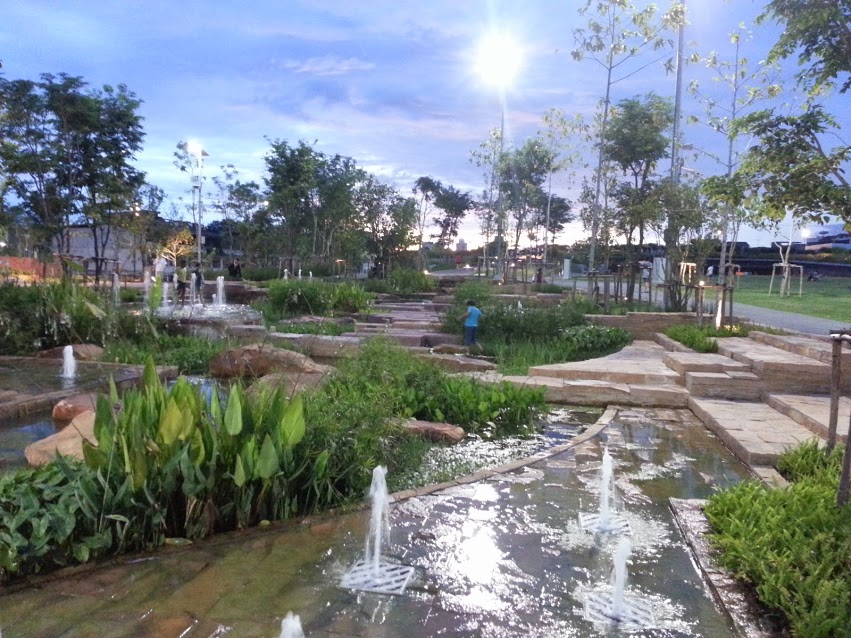
The pictures I share here are typically just my kids (beyond those of tea, or travel), but I wanted to pass on a slice-of-life set that describes my experiences here.  These are a few of the newest local park in Bangkok, the Chulalongkorn University 100 year anniversary park.  

For those of you into parks, for whatever reason, here is the main page of information about it, and another talking about green spaces in Bangkok and what the design is doing to conserve water.  A friend is a sustainable landscape design professor, and I took some landscape architecture classes way back when, so some of that seems interesting to me, but I'm mostly visiting parks to check out the kids' play areas.


not really at the park