Showing posts with label production. Show all posts

Monday, May 25, 2020

Jason McDonald on The Great Mississippi Tea Company story


Jason; all photos from their business FB page or his personal profile there


If you look into modern trends in US-based tea production Jason McDonald's name comes up, and The Great Mississippi Tea Company (also on FB).

I keep seeing interesting posts about what he's up to, and eventually asked him to explain that background, and where US tea production stands.  He tells that story so clearly and completely here that no further introduction is required.


How did you get into growing and producing tea?


I was on a trip to Savannah and was served a Charleston Tea Plantation teabag. It said “The Only Tea Garden in America” and I was intrigued. I just figured tea grew somewhere in among the corn in Iowa. I had never really given it much thought. I wager that most Americans never really think about where tea comes from—they just drink it.

When we found out it was a camellia that needed high heat, humidity, acidic soil, and ample rainfall, we figured it may work here in MS. We bought 5 plants off of Amazon and made a deal that if 1 survived by the end of the summer, we would look into tea growing. Two survived and we went into the MSU County Agent’s (Rebecca Bates) office and said, “Don’t think we are crazy but we want to grow tea.” She responded, “Well, you are in luck! I know it comes from a camellia.”

It all went from there. We ordered 60,000 plants, were on the nightly news, and met Nigel Melican [a well-regarded authority and consultant on growing tea]. By December of that year (2012), we had our first in-person visit from Nigel. We had already begun breaking ground in November. We were well on our way.


Jason and Timmy with Nigel Melican (right)


processing equipment


Where does your production stand now?  Where you are in a journey, related to where you plan or expected to go, and what you are producing?


We have a little under 7 acres planted. We plan to get to 10 acres and stop for a while. We feel like that will be a sustainable number both physically and economically. We are at year 8 so we are starting to see a break-even point on some of our investment. We haven’t been able to draw salaries yet, but it is at least paying for itself now, which is nice.

We had envisioned hundreds of acres of tea by year 11, but that just really was not sustainable without a lot of other farmers involved. That is starting to make a turn in MS and LA (Louisiana). We have a nice little group of growers starting up. You never know, we may be an up and coming new producer region in a decade’s time.

We are currently producing 250-400 lbs a year. That number grows each year as our plantings are coming in to bearing each year since we are so new. We have produced 6 award winning teas (TOTUS pre-commercial: 1st black, 1st green, 2nd green, and 1st oolong, as well as Global Tea Championship: Delta Oolong- Silver, Mississippi Queen- Silver) in 8 years. We are also featured at Fortnum & Mason’s Rare Tea Counter and Diamond Jubilee Tea Salon at their Piccadilly location in London.

So, we have really raised the standard level of US teas in a very short time.


Colonel Grey:  black tea with lavender, orange peel, sage, and bergamot


Does the style of tea you produce (or styles) relate directly to others produced in known areas?


Quite often, we are compared to Chinese and Taiwanese teas. We aren’t aiming for this on purpose, but it may happen, depending on who you ask.

Our technique of making tea absolutely does not mimic most people—or perhaps anyone at all. We use science based technology to try to best maximize the flavor and aroma compounds in the tea leaves. Although the tea world has started utilizing these sorts of “leaf hacks,” it is not at all widespread.

We like to think of ourselves as our own American Producing region with our own style. We are shaping what is to be expected of US Grown Tea.


Timothy Gipson working with tea leaves


Related to pursuing tea production in Hawaii as well as in Mississippi, are both pursuits currently active?  How does it work to cover such broad work scope at the same time?


At this time, both areas are active. The venture in Hawaii restructured and I am no longer in an ownership role, but I am still involved to some extent. They are nurturing the tea that remains planted and will begin harvesting, I imagine, in the next couple of years. That is the joy of tea plantings—once established, they can live for a hundred years or more.

Hawaii truly was a dream for tea growing. It grows year round and the conditions are just right for growing. Mississippi has a harsher climate (both cold and hot) but the right stress is good for tea flavor and aroma. However, in both places, tea can almost nativize itself after establishment. It can grow fairly unassisted for decades on end. We have run into abandoned gardens in both MS and Hawaii that have not been tended for 10 years.

I believe the most challenging pursuit in tea would be growing where tea just wouldn’t naturally grow. I have had a taste of it in Scotland. I was hired to help a group of growers troubleshoot some of their plantings. I continue to help along the way with that as well. Tea can grow anywhere in the world—the question becomes, “Are you willing to do what it takes to make sure it has what it needs?”

We chose tea as a crop because it suited our natural environment in MS. We do not have to make our natural environment suitable to tea. We get the question all the time that goes something like this, “We are in Upper Peninsula Michigan and we want to grow tea outdoors. Do you have any cold hardy plants that we can buy that won’t die in our winters?” I think people think if they find the right cultivar that it will grow, but sometimes, sadly, the answer is that tea just won’t grow where they are naturally.


with a bit of ash from a volcano eruption, per a photo comment


 A latest venture relates to tea education; can you say a little about that?


So, here is the official media bit about it:

“The US Tea Experience was created as a way to extend agri-tourism during the age of COVID-19. With more people sheltering in place and with fewer people traveling, we wanted to create something fun, informative, and entertaining. We envisioned this for an audience of all types—beginners, enthusiasts, growers, processors, merchants, and many more.

The courses will become available every 4-6 weeks through August. These courses will take the participant on the journey from the field to the cup and all the things that go into producing and enjoying a U.S. grown cup of tea.

These courses are self-guided and include different media types-- videos, audio, pdfs, podcasts, etc. Once purchased, the courses and course materials are available to you indefinitely.

The focused tea courses will feature a box that will be sent to the participant to follow along with the course. It will bring the course to life through interactive activities which will appeal to all of your senses.”

It is a way that we have devised to introduce people to tea—namely US Tea. We are starting at the very basic level with a course starting June 1. It is called US Tea Basics. It will cover topics like brewing methods, water boiling, tea types, etc. We will also have a class that goes in-depth into our black tea, Black Magnolia. It will begin to be pre-sold on June 1 as well. It has a box that will be sent with the tea and other teaching aids that will make the course interactive. I can assure you—no one has gone this in-depth with black tea as we have with the details of this course.

It is all very exciting and we  hope it brings joy to folks who are indoors more with COVID-19.


Did some of the factors related to growing tea surprise you, related to those being different from other agricultural issues?  What tools or resources helped resolve difficulties or unique challenges?


I think everywhere in the world has unique challenges for growing crops. We did have to adjust some of the traditional growing areas’ advice on planting times and germination times because we have different conditions.

Nigel Melican and MSU [with more on cultivar study here] have been great helps in all of this. However, a lot of what we have learned has truly been trial and error and keeping good notes. We tried multiple pot sizes and shapes in the nursery. We trialed various fertilizers in the nursery and field. We trialed cuttings vs seedlings. We have trialed all sorts of data points and settled on the ones that worked.

If you aren’t keeping notes and trying new things, you can’t get better at what you do. If you fail or if you succeed, you can’t trace back where you went right or wrong if you don’t have notes. We also data log every point about our processing. I can’t stress the need to take notes enough!


If someone wanted to grow and produce tea can you offer some practical advice about that, at moderate scale or a plant at home? 


You know, I don’t really know on this because the terms of hobbyist vs moderate vs large scale are so vague. Most people think we are this huge producer, but it is two guys and a field. We sometimes have one other part time, seasonal worker to help in the summers. We would be a “small grower” to some producers and a “large grower” to hobbyists. It is all very subjective.


Moderate sized grower: If you are looking to grow commercially, put in a quarter to half an acre of tea properly spaced and planted. That would give you between 1250-2500 plants. See if you can manage that before you get larger. It is way more work than you realize. We ordered 60,000 plants out the gate. Don’t do that. Ha!


Growing at home: My main pieces of advice for hobbyists/backyard growers would be to plant atleast 20 plants. If planted properly, that will only be a 25 ft long hedge that can be trained to grow 6’ wide. If you only plant a bush here or there, you will never have enough leaf to really be useful enough even for personal use. You actually need enough leaf to get a proper roll because they roll off of each other. I get questions all the time about not being able to get a good roll and I ask how much leaf they are processing and they send me a picture of a handful of leaf. Main point of advice—commit to the hobby.


Some readers might be familiar with exploration of a freeze-drying processing step you were experimenting with.  Is this still something you utilize?


I am under an NDA on this. “No Comment”

One thing I can comment on is that there is a whole new world to tea processing and some of the science based experiments that we are conducting are resulting in some interesting new discoveries in the world of tea processing. We are understanding what tea qualities and aspects truly are geographical terroir and what is processing related. We will get into some of these discoveries in our classes at The US Tea Experience.


How do you see tea awareness and demand growing in the US? 


I don’t really know. I have been at this about 8 years. When we got into tea, Teavana had just been bought by Starbucks for a ridiculous sum and Harrods was selling Big Island Tea’s teas for huge sums. Everyone was proclaiming that tea had arrived in the US. It was about to explode in the US. Upward and onward! There’s gold in them thar hills. Ha! Well, we all know how the Teavana deal turned out.

While there has been a uptick lately for tea in the US because of health related claims, I am not sure if it is a trend or a blip on the radar.

I think what works well for us, being US producers, is more the farm to table movement. People want to know and support their local farmer. There are others who appreciate the artistry of what we do as well. I am not sure if it is more this influence or the influence of more people wanting tea in the US as the question supposes. Either way, we are seeing moderate sales and growth and we run out of tea each year so those are all good things!

Tuesday, May 19, 2020

Huyen's family's trials in making Vietnamese teas


Huyen showing off a "witch's broom" home-made sheng trial sample


I've written about doing online meet-ups recently, mainly including four friends:  Suzana from India, Ralph from Germany, and Huyen from Vietnam.  This blog has included lots of mention of Huyen, from her visiting once and passing on lots of interesting and pleasant teas from Vietnam.

Her family has been making tea lately.  Vietnam is a main producer country, and they are from an area 200 km outside of Ho Chi Minh City (Saigon), so tea is around, live, growing plants.  Some of those plants are relatively mature trees.  The idea isn't to go into production as a business, just experimentation related to tea interest as tea drinkers.  This early post about Huyen's take on tea, reviewing a couple of samples, goes into some background.  This post ("Vietnamese trà chít (or trà bó)") is on that "witch's broom" tea.

This photo from that first post kind of captures what her family is like:


If I wasn't a middle-aged man I'd ask them to adopt me; no one has a vibe as genuine and positive as all of them, and that's how they always seem to be.  This picture of Huyen is one of my favorites:


That baby is a little boy now; time passes quickly.  Huyen recently shared these photos of collecting leaves for the early round of those processing trials:


some really mature tea plants growing near where they live


Their background goes a bit beyond just being typical tea enthusiasts.  Huyen's family works for (owns?) Tra Viet, a gift shop business that sells tea.  Her brother and sister-in-law are tea experts, of a sort, with her sister-in-law's case relating to success in competition in the Tea Masters organization.  I could do a post on all that, their background and other connections to tea, but this is mostly only about them trying out making a few versions of tea recently.

Huyen shows the leaves, and talks about what the teas are, how they made them, and what the end effect is like, the brewed tea character, in those meet-ups.  It has been a really interesting insight into those earlier stages of the tea production process.  I've heard a bit about how different types are made but I'm by no means well informed related to that, and having never actually made tea anything I ever learned from reading would just be academic.

I'll write out a short description of what I understood, and couple that with more input from Huyen, along with her reviewing my take, and photos.  In discussing tea with them and putting together her notes it strikes me that they tend not to describe teas in terms of flavors lists, as is common in Western tea blogs, and to a lesser degree in Western oriented tea marketing content.  I'd be speculating as to why, but I can do that.

Some people value mouth-feel and aftertaste aspects just as much as flavor (or cha qi "feel" effect); there's that.  Then flavor descriptions tend to be subjective, so you can describe the character of teas, but the flavor-list any one person outlines isn't the same list the next person would convey, even with both having appropriate prior experience.  One solution to that is to say a bit about tea character and then leave most of the experience as experiential; don't try to pin it down with analysis.  Character aspects like fresh, sweet, or intense also cover informative range, as discussing flaws also does.

Of course Huyen did say a little about these different teas in the discussions, even related to flavors, but since I wasn't really taking notes this focuses more on sharing photos and her input about processing steps, what they tried in making each.


It wouldn't really work to also cover how these trials relate to the most typical local styles, for the most part, and this doesn't attempt it.  The idea comes up that any tea plant type (variety Assamica or Sinensis, and specific cultivar beyond that) can be made into any final version of finished tea (black, white, green, sheng or shu pu'er, etc.), which is a bit too simple.  The opposite idea also comes up, that only very specific cultivars can be used to make specific types of tea, versions of one of those broad categories, and that's not exactly right either, per my understanding.

Compounds in raw leaves of different plant types vary, so different plant types are better suited for making particular finished versions.  To make a completely original version of any specific tea (eg. Longjing, Anxi Tie Guan Yin, sheng pu'er from a limited region) you would need to use the exact same plant type, and processing steps, and to make a completely original versioon to also grow those plants in that original location.  A version only grown elsewhere could be similar, and any changes to plant type input or processing would either shift the end result, a little or a lot, depending.

This will skip a lot of scope related to exactly what the plant type inputs are, and main local versions typically produced.  It's about how production trials were carried out and the end result, which is enough.  Mapping that back to see what might have been different is out of scope.  We talked about plant types a good bit in the video meet-up discussion but I wasn't really taking notes on it.


Huyen mentioned Shan plants, covered in this reference


Tea production trials


white tea:  Huyen showed a version made using the simplest production process, white tea.  The simplest version of this approach just lets the leaves dry; that's it.  Adding any heating or rolling steps (kneading the leaves), or shaping, would move away from the white tea type range.  The leaves looked colorful, and varied in color, as fresh versions of different white teas can. 

As I remember Huyen describing the tea it was subtle but very fresh and sweet.  She mentioned it transitioning, and some white teas with similar appearance can include fresh fruit or floral flavors, and then also run through savory range as infusions go by, like sun-dried tomato, with that varying as a relative input.


She added detail beyond that:

This is white tea version 1: 

Material: raw tea leaves from Shan tea trees which were grown by seeds (Vietnamese calls: chè (tea) hột (seed). 
Picking: 1 bud, 2 -3 young leaves
Processing: withering around 1,5 days and sun-dried in 2 days


Somehow I had missed that she really made two white teas; this describes the second:


This is white tea version 2: 

- Material: raw tea leaves from Shan tea trees which were grown by another variety - using tea stems to create new tea tree (Vietnamese calls chè (tea)  cành (stems)
- Picking: 1 bud and 2 young leaves 
- processing: withering 1 day and sun-dried in 3 days


You can see the different color of tea leaves from 2 varieties.


I don't remember hearing a version description related to that one.  Some white teas are a little subtle, and others are very subtle, with some of the paler white teas I've tried from Vietnam including an interesting dry mineral undertone, like limestone or flint. 

That extends to green tea range too; some versions described mainly in terms of being ancient-tree, high-mountain source teas, with no specific type offered, can seem to be in between green tea, sheng, and white tea in style.  Huyen has discussed how some Vietnamese teas are presented as "dried tea" (their translation), which does relate closest to sheng pu'er in style (per my understanding of old conversations; not the most reliable source), but may not necessarily be a direct match for a Chinese category or style of tea. 

This version from Huyen describes exactly what I'm talking about, while reviewing a related style of tea in comparison with a Thai sheng, and it mentions a separate Thai white version that looks exactly like that first white tea shown here.  This post from 2015 represents my first exposure to an "ancient source Vietnamese green tea," and this post about a "snow tea" from Vietnam (also from Huyen) is also related to that general theme.


witch's broom, multiple versions:  I reviewed a version of Vietnamese tea presented in this style before (from Somnuc, a friend from Laos, instead of Huyen), which is typically a variation of sheng.  It's not pu'er, since it's from Vietnam instead of Yunnan, so I'll just stick to sheng in further references, since "raw" isn't a regional designation.  In that post I cited the original local naming, as informed by Huyen: trà chít or trà bó.

One version (listed later) they rolled a little and allowed to oxidize, experimenting with a hybrid style, but these first two trials are just conventional sheng, per my understanding.  That would mean they are wok-fried teas that just aren't heated as long or as hot as green tea, using a more limited kill-green or sha-qing step to keep some enzymes active, enabling aging transition.

These descriptions cover how they made them, again with less for flavor-list descriptions.  Per trying two versions before--not enough for a blanket judgment, to be clear--a mineral aspect is really heavy in these teas.  That's kind of true of Vietnamese teas in general, although it can drop completely out in some oolong versions, and doesn't necessarily define or apply to all Vietnamese black teas.  Huyen did pass on her impression of both but I'd end up mixing them if I tried to convey them from memory, and I want to finish this post instead of continuing to add to it.


This is broom tea. There are 2 versions.

This one ☝️: picking 1 bud, 3-4 tea leaves (10cm) in tea stems garden.
- Processing: withering in 1 day, after that tighting it and sun-dried in 2 days. Then 
unting it (like photo you see) and sun dried continuously (not finished until now because of raining)


witch's broom, a more traditional version:  they only wok-fried this version, closest to sheng processing, with no step related to rolling or breaking up leaf cells.


This is the second one:
Material is same the first one
- Processing: withering in 1 day, tighting and sun dried in 1 day, then unting and continue to sun dried in 2 days.
- Brewing: we grill a little bit before brewing and tea color as you see
- Tasting: it is interesting about smoky smell and fresh together, little bit acrid, quite full body taste and more infusions


Unlike with conventional sheng they rolled a last trial version a little to break up the leaves slightly, and to let the tea oxidize some before the heating (wok frying) step.  If I'm matching up her discussion account with the right teas she said that the tea turned out well.


Actually, there is one more version of broom tea like the second one. The different point is after tightening we sun dried for 2 days, untying the tea to dry continuously by sun.  About processing we rolled tea leaves a little after withering.


As I remember Huyen said that she liked the effect of adding some oxidation input to the more conventional sheng style.  That would tend to add some sweetness to the tea character, and some warmth and deeper tones, a touch towards black tea range, but it could potentially also offset long-term aging potential for sheng (in general).  For samples made for testing out processing, in small quantity, that wouldn't really be relevant anyway. 

I've been trying a lot of sheng over the past five months, testing out everything I own at different ages, trying and re-trying versions (this tangent will connect).  One sub-theme that keeps coming up is that some sheng versions, many of them, are much better after a year or two of aging.  For teas stored in a dryer environment (like Kunming, where a number of my teas came from) that same fermentation level can be present after 3 to 5 years instead.  Presumably they will be trying and sharing these teas over the course of this year, but not keeping them around to try out over the following years (I would expect); but that would make for an interesting longer time-frame test.

Related to that pattern, I just retried a Kokang Myanmar sheng this morning, a 2018 version, that seemed to change character and improve a lot since trying it a number of times in 2019.  I should re-taste that along with a bit older Myanmar sheng (2016) I just picked up, to see if the pattern I described holds.  That would be a test to the extent that one can separate out one input--fermentation level related to storage conditions--from among all the others, especially the general character starting points.  I'll get back to that, but if the background is interest that recent 2016 version review post is here (a tea I bought from the Chawang Shop), and the 2019 review of the 2018 Kokang version is here.


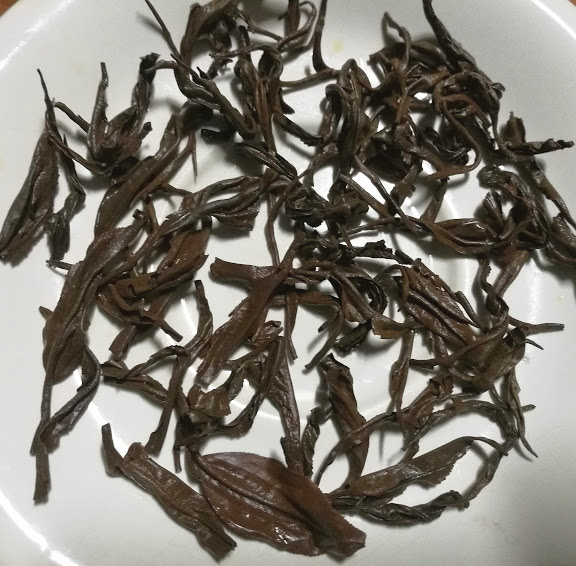
Black tea, compressed into small disks; Huyen's description:


Compressed tea: same material like broom tea
Processing: withering in 1 day, then pounding it and pressing as you see the shape. Finally, sun dried in 2 days
We also grilled it around 3 minutes before brewing it.


As we had discussed in an earlier video meet-up session that last pre-warming or light roasting step I've only ever heard of in relation to dok-cha, a Korean variation of sheng or hei cha.  Huyen's brother was familiar with that type, and said that the preparation is somewhat common to both, and to some extent tea character related to Vietnamese versions they've tried.  This is black tea; it's something else, but they're preparing it in a similar way.

They tend to always heat water with charcoal, using decorative clay stoves and varying types of pots, so it would be easy for them to use suitable gear that is already on han for that roasting step.

Huyen did pass on a relatively complete description in an in-meet-up tasting, but that will be sparse based on my recollection.  She said that it tasted like black tea (of course), with warm and sweet tones, and good complexity, but with a slightly unconventional character that unfolded in the form of more than average transition across infusion rounds.  From the sound of it the tea might have been less than fully oxidized; brewed, wet leaf would tell more of that story, since a lot of dry leaves look much darker when dry than when wet.


More pictures from the meet-ups:


Some of these might actually show those teas, but I'm not going to try to do a complete mapping.  Again it's more about showing what the discussion experience is like (again photos courtesy of Suzana Syiem).

the sign-off, a good place to start (Ralph missed that day)


even without Huyen's smile that setting looked cool


it's always nice having guests join


showing Mandarin oranges to a sweet little girl, who spoke English well


that one black tea disk


I just noticed that's Elsa on Huyen's shirt


the brewed version of the black tea disk


the rest of us mention teas sometimes too


Tuesday, August 28, 2018

Narendra Kumar Gurung on developing local tea production in Nepal


This post was originally submitted to the TChing site, published in two parts with the second here.

A farm in Nepal, photo credit the Highlanders Farmers FB page


I recently talked with Narendra Kumar Gurung about tea production in Nepal.  He has a limited history of working within that industry, following a much longer family history of growing tea.

His latest venture is to move on from growing tea and having it processed locally to conducting the processing on his own, by setting up a small processing center.  These are themes I've been discussing with others related to Assam lately, about trends in farmers and other entrepreneurs ramping up local processing and distribution skills.  There are several related goals:  to add more value to their contribution, to make better finished products, and to support more local employment and the local economy through such ventures.

This will work as a two-part series, since he has just completed a round of production that this interview won't cover, with more on how it worked out to follow.  The background of history of tea production in Nepal and where the industry stands now are interesting, described in the following.

The success of these kinds of ventures is important to resolving some of the economic development, sustainability, and tea production workers poverty alleviation issues.  This can be carried out through pushing production, value addition, and increased revenue to a more local level.  That's my interpretation, anyway.  The history and current status tell more of the story, from this small producer's perspective.  This content is in his own words, only edited slightly to adjust form.


Narendra, photo credit his FB page


1.  Could you share a little background about yourself and the family history of growing tea?  Why was there a prohibition against growing tea in Nepal at one point?

I am retired from the Japan International Cooperation Agency (JICA) in Nepal after working for 20 years [with more on that development related agency here].  I have been involved with the family tea farming since 2016. My late grandfather Ranabir Gurung had started tea farming in the 1920s while Nepal was under the oligarchic Rana's regime, when Nepal was not open to the outside world. Ran Bir Gurung used to visit Darjeeling, Silguri, and Kolkata to purchase the materials for the construction of two suspension bridges in 1930, which he covered the cost of himself, over two rivers, the Maikhola and Puwa Mai of Ilam district of Nepal.

The history mentions that in Darjeeling the tea plantations started in 1847.  About 10 to 15 years later the district magistrate of Ilam Mr. Gajaraj Singh Thapa (son in law of Rana) developed the Ilam tea garden, based on growing Chinese plant varieties.  But under the oligarchic of Rana regime tea cultivation was not allowed at the farmers level. It is said in our family that District Magistrate sent some army staff to uproot the tea saplings planted, around .025 hectare, and we can still see 10-15 bushes abound our house in Ilam which were left only for our domestic consumption. He had also purchased some shares of Palashbari Tea garden, D. West Bengal 735202, which lies in the bordering areas of Bhutan and doors in Darjeeling.

It was only after 57 years of Ranbir Gurung’s endeavors in tea cultivation, that his son (my father) Man Bahadur Gurung (85 yrs.) started the tea plantation in 1980s, which had been developed to 6 hectares as of 2000. Man Bahadur Gurung had established the tea factory in joint venture with the Vaidhya groups of Nepal.  This was one of the first of its kind in this locality that benefited numbers of tea farmers in the vicinity by allowing them to sell their green leaves locally. The basic infrastructure for tea factories (transportation and electricity) in this locality was not well developed at that time.  The situation was not congenial to operating a factory, so Man Bahadur Gurung withdrew his share from the factory sometime in 2008.

Thus, after 18 years, once again grandson of Ranbir Gurung, Narendra Kumar Gurung (myself) has ventured to establish small scale tea factory that process green leaves from our own garden and tea farmers from the surrounding areas.


view of mountains


2. To what extent has the specialty or higher quality tea industry in Nepal changed in the recent past?

There is growing trend of establishing small-scale tea processing plants, in the last ten years. About 110 mini factories are already established, with the capacity ranging from 3000 to 50,000 kilograms of processed tea per year.  These are mostly owned by tea farmers and tea farmers’ cooperatives. In these mini processing plants it is much easier to control the quality of tea produced since the green leaves are obtained from their own gardens and there is strong sense of ownership.  Subsequently the quality of produced teas is much higher. There is encouragement and a sense of competition among factory owners to make different kinds of the best specialty teas.

Beside the affordability to start this mini plant, another factor is the relatively lower scale of investment required compared to the traditional large scale of tea manufacturing plants.


3. In what way has the market for higher quality teas there changed?  How are most teas produced in Nepal sold, and to what country?

The medium and large size factory owners buy green leaves and produce in large quantity, without caring so much about the quality, and those finished teas are sold to Kolkata auction market.  The products are often subsequently sold as Darjeeling tea, misrepresented as being from a different location.

But with the introduction of Chinese mini processing plants, there is a growing trend of producing the specialty teas (white, gold, silver needle, oolong, and green tea).  Producers are more often more connected with the garden owners, with these small operations continually developing increasing skills of tea craftsmanship. Most of these teas are sold to European countries, to Korea, Japan and the US through personal connections. There is not much domestic consumption for these types of specialty teas except for Chinese tourists buying them as gift items.


4. Related to discussing tea plants, can you say a little about what types of tea you grow (var. Assamica versus Sinensis, local plant types or hybrids)? 

Almost all teas that we grow here in Nepal originated from Chinese and Assamica varieties propagated through seeds. Only few varieties are from Cambodia. There are a numbers of lines developed based on Chinese and Assamica varieties from Darjeeling’s different gardens, imported through different channels. The hill areas where my garden exists, at an elevation of 1514 meters, produce only orthodox teas based on Chinese origin teas.


5. Can you describe more specifics about tea processing techniques you are familiar with, and where they originate from? 

The tea processing technique and sequence that we follow is quite traditional, as in other places:  (1) plucking, (2) withering (3) rolling (4) fermentation (oxidation) (5) drying (6) sorting and grading and  (7) packing.

Right after my retirement from JICA in March 2016, I had an opportunity to attend training entitled, “2016 Seminar on Pollution free, Tea production Technology for Developing countries,’’ organized by Zhengzhou college of Science & Technology, Zhengzhou Fijian province of China, from April to June 19 in 2016.  This short course was an eye opener for me, encouraging me to develop the processing of tea from my garden and neighborhood farmers. I also realized that Nepal’s experiences on tea at the farmers level is just at the embryonic stage while China has more than 5000 years of tea culture and tradition.


a different type of area, but reminiscent of tiered farming in Sapa, Vietnam


6. Is there a tradition of local Nepalese tea processing and related techniques, and tea products and types?  

Tea culture is rather new in Nepalese societies.  Although at the state level the gardens were developed in 1863, that production remained only within the government scope. Only in 1971 under the out-growers schemes of the Nepal Tea Development Corporation did tea plantation production start at the farmers' level. Taking tea as local beverage also has a similar history, only consumed in the eastern part of Nepal like Ilam.  This is perhaps due to those areas adjoining to the Darjeeling area. But now gradually the milk teas (based on CTC versions) are getting popular all throughout the country.


it's jumping ahead but I'll also share pictures of the next part


7. Where does Nepalese tea production stand now?

The teas that you had mentioned trying (golden black teas, and silver needle) are very new development products, perhaps being developed only in the last ten years. The taste, aroma, and quality of Nepalese teas as whole being so different from many other teas of the world is due to the high elevation, climate with mist, monsoon rain, and quite congenial weather of Ilam, the Eastern district of Nepal.

If we just gauge the tea history of Nepal at the farmers’ level, both garden management and tea manufacturing, 45 and 25 years respectively, there have been significant leaps made.  Surely there are lots of areas of improvement to come in terms of improving quality and efficiency. One of the major challenges the Nepalese tea entrepreneurs face are the marketing of their products, along with further developing processing skills and knowhow.

As we go forward there could be lots of interaction among the tea entrepreneurs, marketers and tea consumers at the global level, while Nepalese producers at different scales of production volume further develop their craftsmanship.

My company, Highlanders Farmers Private Limited, has supported about ten (10) tea laborers through out the years in plucking, bush management and so on. One manager is fully involved to manufacture the produced tea into different types and quality levels.  There are six tea farmers within the radius of one and half kilometers from my garden who will provide their green leaves for processing in my small plant.

Narendra Kumar Gurung
(narengurung@gmail.com)

Conclusion


Again this is only part one.  Actual finished teas have been produced over the last month or two at his small start-up facility, as a first step on this new venture that was described.  A second chapter that includes a review of finished teas will add more about where things stand, and about next steps in this development.  Narendra hopes to explore more direct sales overseas, which I will say more about along with reviewing those teas in this blog.


the second part should make for an interesting story


Friday, August 10, 2018

Assam Teehaus Spring 2018 black tea review


I tried another orthodox Assam version from Maddhurjya Gogoi, that Sasha passed on when I met him a couple weeks ago (from Assam Teehaus).  I've tried a couple, and it's hard to keep track of which one is the absolute best, or how different the batches are, so I'll just go ahead and review the one I got around to writing about.  It was good tea.  "Good" means a range of different things, which is where these wordy tasting notes come in.

I just re-read a post about trying a 2017 version a month ago.  This description is pretty close in general type, just a little off on a detail or two.  I can't say if it sounds better or not; when a tea is kind of similar you really need a side-by-side tasting to help sort that out.  For some types you can base a judgement on a couple of specific attributes, which will make it clear in your memory where you thought it stood for quality level and match to preferences.  These Assam Teehaus teas are pretty good quality overall, with a limitation of being a little non-specific, of mixing a lot of aspect range instead of being as narrow in character as some types.

I haven't described the tea yet, but in a sense all the complexity that I will describe almost comes across as a blend, with some clear common aspect threads through that character.  From what Sasha and Maddhurjya mentioned this may stem from an interesting input: the teas are made from locally sourced plants, so they know the farmers and growing conditions, but a limited variety of tea plants have grown alongside each other.  The tea plant source itself isn't based on monoculture, in terms of growing alone (only tea plants), or in the other sense of being made from a very genetic-specific plant version.  The "terroir" or growing condition inputs are relatively uniform but plant genetics vary. To me that's cool, and surely is a factor that changes the end effect.


This Halmari orthodox Assam version works as a contrast to that.  As a standard plantation tea they would control growing inputs and plant type very carefully and completely, achieving a much more uniform outcome, and a narrow set of aspects.  In general that's a good thing, especially since it can correspond to an experience of aspect intensity.


More than one being better though the two types of tea are different.  That Halmari version really did express a much sharper and more pronounced form of malt, which did come across as the main flavor aspect.  Some of what the Halmari version gained in perceived intensity in a limited range it gave up in terms of losing complexity of flavor. 


For some people the softer, slightly sweeter and broader flavor range in the version I'm reviewing here would be preferable, and for others it might not be nearly as pleasant.  I think Maddhurjya's teas are improving, so while I might have said Halmari's are just better last year--beyond being different--now that's not quite as clear now.

The detailed description will fill in what I mean.

Review


The tea is really nice, complex, sweet, layered, and pleasant.  When people describe Assam as having really intense malt as a dominant aspect this isn't that; it balances a range of different aspects.  There is some malt to it but it doesn't stand out more than other sweetness, earthy aspects, and some dried fruit.  A warm mineral layer provides a base for the rest too.  Breaking all that into a more detailed description is a bit of a task.


A mild form of malt stands out as much as anything, but it integrates with the rest.  Usually that aspect pairs with an edgy astringency but this tea is soft, but with good body.  I've brewed it perfectly, for my preference for the type, using a really heavy handed proportion for Western style (probably more like 5 grams versus 2, but I didn't weigh it), and around a 2 1/2 minute steep.

nice to get back to simpler tea tasting

Next in intensity is fruit.  It's a dark, rich fruit tone that overlaps with earthiness, tamarind or fig (really dried tamarind; the "fig" is to help place that, for people who don't eat it).  Earthiness is hard to place; between a cured leather and aromatic tobacco.  The sweetness level and rich body really make it work, along with all those flavors being really clean.


I went a little shorter on the infusion time next round, to see how drinking it lighter changed it. The first thing that I noticed was that I used hotter water, shifting the flavor to add that one sort of dark toffee aspect.  That came from not prewarming the infusion device cup the first round, I think. 


It reminds me of that post on oolong brewing temperature, where a couple main themes emerged, so I'll do a tangent and talk through some of that (again related to oolong, but some ideas carry over).


Reddit's Tea subforum version (credit)

There was a split between the "always use boiling point" side and the lower temperatures you see on reference tables side, with almost everyone going with boiling point given where that took place (in the Gong Fu Cha group).  I think lower temperatures might work better for Western brewing but I agree that to get the most out of good oolongs you shouldn't do that.  Personal preference muddled there being one final conclusion, except for the "boiling point only" side.  I think using Western style brewing changes things, and I also tend not to go with that for oolongs, although it works better for rolled-style examples than for Wuyi Yancha or Dan Cong (in my opinion).


A friend made an interesting observation, that if someone is a cigarette smoker they would naturally want the most intensity they could get, which still even relates when brewing a tea very lightly, in this divide related to drawing out the one edgier aspect range.  As I take it there is a parallel in the difference between these first two black tea infusions; a slight edge showed up due to pre-warming the brewing device.  Or maybe I'm over thinking all this.


Again in this round the complexity is good, even brewed a little lighter.  The malt comes out more in this infusion, tied to different, richer mineral and earth tones.  The flavor is quite intense but the feel is still full but soft. It would be hard to screw up brewing this tea, and that rich, full flavor would go well with different kinds of food.  For tea enthusiasts into sitting and contemplating a dozen Gongfu rounds of refined, complex aspect tea that could be quite an insult to a tea, to say it's good with food, but then this style wouldn't be for everyone in a way that does seem to dove-tail with that factor.


For people moving on from lower quality loose black teas it would be perfect, and for more experienced tea drinkers it would just depend on the range they could appreciate. Not everyone drinks black tea, never mind individual styles.  I like it, but then I seem to appreciate diversity quite a bit, teas being pleasant in completely different ways.  Sometimes I do brew very subtle, complex, or sophisticated teas Gongfu style with breakfast, but more often I like something more simple that's going to work well as two or three mug-fulls brewed Western style, something I don't have to think about.

More input from Maddhujya


In the last post I mentioned some difficulties that Maddhurjya communicated having in ramping up orthodox tea production:  stable power supply, problems with rough roads, the typical difficulties with sales and marketing.  A lot of that would be common to anywhere.  He did comment on specific forms related to some of the issues in discussion, for example about the power supply:

The biggest challenge is paucity of electricity. The processing unit in our village is almost 1 km away from the Grid Transformer so we don't get proper voltage. And everyday there is power cuts for hours...... We were depending on a diesel fueled genset but unfortunately that also broke down at one point.


I asked him about the mix of different plant types.  That particular issue is interesting to me, not something that necessarily makes a difference in final outcome mapped to consumer preference until you really know a lot about it, but it's still interesting.  He mentioned the range of plant types grown at different sources they use, and which relate to this tea version:

We have TV1, TV9, Panitola 126, TiniAli 17, some wild seed variety and some vegetative clones.  The major input percentage for this tea version is Panitola 126, with Tiniali 17 and TV 1 also mixed in.


That definitely makes my review evaluation sound better, since I'd guessed a mix of plant types had been an influence on the character.  I tried to explain how I saw that to him in discussion, about how a narrow type or a broader input of sources doesn't necessarily seem better, but the outcome seems different (quoting myself this time; a bit odd, that):

Some Darjeeling and plantation Assam teas seem to have a very specific, limited aspect set output, probably through control of both narrow plant type sourcing and processing factors.  That gains something in terms of intensity and being novel, and gives something up in terms of broader aspect range and overall balance.  It's not that one is better than the other, they're just different.   To me it's not that different than a single grape wine versus a blend.  It's a trade-off; one isn't better than the other.  French people seem more inclined towards blends but Americans produce and drink both, only exploring and developing blends more recently.


Oddly I'm talking to someone about sheng just now and this all works in that discussion context too.  But enough with the tangents.

It's also hard to be clear on what differences the various processing step inputs make.  In particular Maddhuryja has been mentioning use of certain machines.  This comment doesn't shed that much light on the broad range but it does work for indirectly pointing towards some of it:

Our Taiwan rolling table is not like Indian rolling tables. The stainless steel used in the rolling table is FoodGrade Steel.  And it has copper teeth on the table to give its tight roll.


I guess these parts add up to what you'd expect for developing tea processing; there are lots of potential improvements to be made and lots of small challenges to hurdle.  The teas are quite good, and still getting better, so in that one important sense it's already working out.  They'll just need to keep making the growing, harvesting, and processing details come together, and ramp up the commercial side.

If any readers would like to play a more active role in promoting local, sustainable tea production this might be a good opportunity, by checking into buying tea from Assam Teehaus.  It's strange for a blog post to express marketing so directly, isn't it?  I think it might get by people that not only small vendors could order this tea, that anyone anywhere in the world could look up Maddhurjya and ask about picking up a kilo of it.  The numbers really wouldn't work out to buy 200 grams of tea from the opposite side of the world but as quantity increases a bit shipping is offset by lower per-unit cost.  This is all familiar ground for Yunnan Sourcing China customers, but I'm not sure how many higher quality Assam drinkers have explored this direction.


Oddly I'm going to be saying something similar related to a very small start-up tea producer in Nepal over the next two weeks.  Not the sales pitch part; the rest, about history and development status.  It's good to see sourcing options development move beyond people only saying they wish there was an alternative to multiple-resale wholesale supply chains and large corporation tea production.  Now there is.  But I don't think the pull on the demand side is enabling this to work well just yet.  Some things just take time, and sometimes multiple variables need to come together for a paradigm shift like this to happen.  It may be that small local retailers play a crucial role, even online versions of those, versus completely direct sales working out.  Time will tell.


with Kalani, dressed for a school presentation


wearing make-up for that event


posing at home beforehand