Showing posts sorted by date for query yiwu mountain pu'er. Sort by relevance Show all posts

Friday, February 13, 2026

Oolong pu'er, revisited


one of my all-time favorite teas;  it was fresh, bright, sweet, fruity, and approachable


I wrote about this theme long ago (in 2018, here).  Before posting this I'll re-read that, but it's really on a slightly different topic.  In the past people that's what people called sheng pu'er that was approachable when young (newish), or else "pulong," if it wasn't bitter and astringent.  That could have related to some oxidation occurring as a processing input, but the tea character could have worked out that way for whatever varying reasons.  Plant type material and processing varies, and climate and weather input does, and so on, so a tea could be approachable and lack challenging forms of aspect intensity for different reasons.  One other input could be that it was over-heated, so more similar to green tea, which works out in some comparable ways, but that isn't the same thing.

The main idea, as I remember it, was that sheng pu'er that is sweet, mild, floral, and fruity (often including that range) early on won't usually age as positively, and it's more suitable for drinking within a couple of years of production.  Or maybe that was just my take, which could've shifted some since then?

This is about pu'er with actual oxidation input, more specifically about a few related versions like that from Vietnam, so really "pu'er-style tea," given the Yunnan origin naming designation limitation.  That naming convention is a bit odd, to me.  Matcha isn't restricted, that name, or Oriental Beauty isn't (which is kind of politically incorrect now anyway), and limiting something like Darjeeling to that named origin area is completely different.  But I get it, and will just move on.


the 2023 (left) and 2024 versions; it may not only be extra age making one darker


Quang Tom Lao Cai origin examples


This theme comes up a good bit related to South East Asian origin sheng pu'er (or the same tea under whatever name you apply), but not as explicitly as in this case, where the vendor is open about the input.  It's written on the label (for a tea I just reviewed, from the Quang Tom producer out of Lao Cai, Vietnam):


Name: Freshly Fermented Green Tea Cake (Green Tea Series) 

Ingredients: 100% ancient Shan Tuyet tea buds, sun-dried and fermented

Storage: Store in a cool, dry place with humidity < 70%, away from direct sunlight. 

Shelf life: Suitable for long-term storage under appropriate conditions. 

Instructions for use: Take 5g of tea and brew with 250ml of boiling water (>95 degrees Celsius), steep for 30 seconds, then pour into a cup or mug to enjoy. 

Food Safety Certificate: 04/2024/NNPTNT Phone: 0961.129.186 Address: Bac Ha Town, Bac Ha District, Lao Cai Province 

Produced by: Quang Tom Cooperative, Bac Ha District, Lao Cai Province, Vietnam Production date: 06/2023 Net weight: 350g


Then again it's not really green tea (mentioned on that label), but what else would they call it?  Some South East Asian producers call it pu'er anyway, but I can see why more don't.  The most common work around is to call SE Asian "pu'er" dark tea, a reference to hei cha, and that doesn't work very well either, because pu'er may or may not be hei cha, depending on how one interprets the category breakdowns.

That reference to fermentation could just mean aging input, change related to fungus and bacteria activity since it was produced, but I'm taking this to relate to an addition of extra oxidation.  Whatever words cover those two processes in Vietnamese may not be clearly distinguished through translation, or a decade ago it was pretty common for Chinese producers to refer to oxidation as fermentation (again probably related to a translation error).

I usually use "sheng" to describe the tea type, but if they translate that on to "raw," that actual meaning, then it makes no sense.  Raw what?  The old Vietnamese name related to the sun-dried form, per some hearsay input, calling it "dried tea," which doesn't really help.  I've seen it marketed as snow tea or shan tea, but none of that is a real common type name (and per some recent input some of that is a reference to plant type range there, so I guess to some range within the Assamica variety, not processed tea type).  So green sort of works, even though it's not really that.

Related to this tea, to 2022, 2023, and 2024 versions of it that I've reviewed here and here, base flavors of honey and dried apricot stand out, with citrus or other spice range varying by version.  That makes it sound like there is some pleasant complexity, and that's true; to me the teas were quite enjoyable, complex, and well-balanced.  They are personal favorites.  They just lacked typical sheng bitterness and astringency, which for many would be giving up a lot.  For people who have only tried factory tea versions it might be hard to relate to that being a problem, but those inputs balance a lot better in higher quality, more whole leaf versions.


In discussing this with Steve of Viet Sun he raised a good point about why some might not like teas like this:


I think they are interesting. And also very easy drinking compared to traditional or semi traditional young sheng.

One of the big things people are into with puerh is the terroir inputs so making reddened puerh really takes a lot of that away. 

So you can have teas from different places that taste similar.  That kills the experience for a segment of that community.


I agree completely, even though I hadn't been thinking of it that way.  A version tasting like pear, honey, dried apricot, and citrus is distinctive, but somehow a lot of the complexity young sheng expresses does seem to get narrowed down in related versions.  It can be hard to write out the list of a half dozen distinctive flavors, as people tend to, but even without generating such a list you generally get a sense that there is a lot going on with many forms of sheng, usually seemingly accurately attributed to a narrow origin terroir input.  

Bitterness balances the rest in an interesting way, and that astringency adds depth.  There might not be more flavors expressed, so complexity could be similar in one sense, but somehow it often seems there is more going on.  It's not always completely positive, but in the better half of all cases it all is generally good.  Transitions across infusion rounds can vary more, even though that also just depends.


Farmerleaf more oxidized sheng pu'er examples


This theme comes up elsewhere, in other cases than atypical South East Asian tea processing.  Here is an online post from Farmerleaf on this subject; that I see as interesting background:


That's labeled as "Partially oxidized Puerh tea: let's try it again!," relating to a 2023 experiment.


William regularly explores and experiments with tea style variations; his channel includes lots of reference to that.  To me it's especially interesting related to descriptions of sheng and black tea processing.

Of course I'm not saying that this processing is somewhat identical (in the Farmerleaf experiment and the Quang Tom producer version).  That tea, in his video, was oxidized through a very long wither, prior to the frying (sha qing / kill green), and per discussion with Phuoc, the Quang Tom producer, at least some of the oxidation in the other Vietnamese versions occurred after that step instead, and maybe more of it.  I'm listening to that video again now as I write this; I lose track of what I've seen.

The darkening of his leaves during the frying step does look similar to the darkened Quang Tom version.  It's interesting that William mentions using a low heat to limit the charring of the leaves, in that extra dried conditioned (the withered leaves, left to rest for an extended time, weren't re-wetted).  His description goes further; it's really worth watching.  He says that roasting the tea can be included but it will simplify the tea character, so it has to be used sparingly, and that he isn't including that extra step for that batch.


I think I want to keep it that way [not pressed, as moacha] because it's an entertaining tea of course but maybe not achieve that a tea Enthusiast would would like to have every day.

He ends up saying more about how processing inputs, the frying approach, changes things than how the extra oxidation makes a difference, but that's especially interesting:


I don't Shuffle it too much because I want the steam to build up in the batch, so I will use minimum shuffling just to prevent any strong burning.  And then if we want to make a roast I think we'll try to do that a bit towards the end.  But I'm a bit scared of doing that roast because a light roast can really enhance the complexity of the tea, but on the other hand if you do it too much it also simplifies everything, so roasting is a bit like putting sugar in the tea.  It's a bit like it somehow when you smell it's more complex but the mouth feel tends to be a bit more simple... 


He never did include video content description from when it was finished, in that clip, beyond this comment:


I can smell both and you could say a new long-like fragrance so an oxidized fragrance mixed with some notes of roasting...


photo of the leaves from the product listing, probably before sun-drying


A bit of Google search turned up the product listing:


Spring 2023 Reddened Puerh tea


Processed on April 8th 2023

Ancient tea garden leaves from Nuo Gu Wan, Jingmai village

24 hour-long withering, check the video to know more

This is a continuation of an experiment we made last year. While conventional Pu-erh tea benefits from 2 to 6 hours of withering, we let these leaves on our bamboo baskets for a whole day. This leads to a reddened tea, which has to be processed carefully due to the lack of water in the leaves. After pondering the question over the length of a video, I decided against roasting the tea, and kept the temperature on the lower side during the session.


Still no aspects description there, but we can accept a customer comment as limited feedback:


Nice experiment. I was lucky to get a bag of 70g.

On then first infusion seems to be a white tea, fragrant, elegant smooth sweet thin no astringency and bitterness. With the second infusion it is showing slowly up its raw puer character . I like it very much.


Another comment mentioned the approachable nature, limited astringency and bitterness, and a hint of citrus.  


If the Quang Tom producer had used an extra roasting step that could explain the darkened leaves in the 2023 version, since they look to be charred a bit in processing.  Or maybe they also pan-fried (kill-greened) partly dried leaves, also using a long wither, and that led to some being singed a little during the frying step.  William stressed that you need to be careful to avoid over-roasting, and the related trade-offs he is cited as mentioning here.  In a limited form it might be fine, but extending those comments a little going too far it could add a flaw to the tea, not just a tradeoff, but also some actual char effect, as we more often see in roasted Wuyi Yancha oolongs.  


You really should watch his video instead of accepting my summary, if those ideas are of interest.  He goes further with background and outcome descriptions, which I could cite more of word for word to avoid mischaracterizing that or getting it wrong, but it seems better to just cross reference it here.  It's not that long a video, and it's interesting.


That earlier post on oolong pu'er (in 2018)


This tied to a past favorite sheng version that I was talking about just then (in 2018; before I had the same degree of exposure to pu'er experience, only a few years into main exploration then):


A comment about a Moychay Nan Nuo sheng relates directly to that (here on Reddit, by Jay, if he's familiar, who sells tea here):

It'll be interesting to watch it age over several years but my gut instinct is that it will fade rather quickly in BKK. The fruity flavors often indicate oolong style pu that will fade out with age.

I had framed a similar idea in that original review more as a question.

I love the fruit in it, and that overall "bright" effect.  Often when I'm drinking sheng made within the past year I'm saying this might be better in a year or two, a little less edgy, but in this case I'm not so sure.  If that brightness were to decline, as it would to some extent, the balance might be just as positive, or more so, or the tea could've been best drank when very young like this.


All that is probably as good a subject theme intro as what I've written.  That tea did die a couple of years later; it shifted to include warmer and deeper tones, and lost the brightness and fruit, most of what was positive about it.  If my tea budget had been deeper I would've re-bought that, or the next year's version, to try aging what I didn't drink right away, but I didn't.  Kind of unrelated background, I bought that tea in a shop in St. Petersburg at New Years time in 2017-18.


so many amazing sights on that Russia trip, but this captures my favorite part


the more iconic scene version


I retried that 2017 Moychay Nan Nuo in 2020, documenting where it was then, and it was fine as a 3 year old version, but as I remember from trying it since it was going quiet.

Then there is the "awkward teen years" theme to account for.  At a tasting meetup over this past weekend we tried a nice Xiaguan version from 2018 that I really like, that is good, but is at an awkward stage in its transition process (reviewed here last year).  It's missing part of the more forward, higher end flavor range and punch, and the warm flavor tones haven't completely swapped in for that brighter floral scope yet.  I still kind of like it like that, even though it is a little out of balance.  It's sort of supposed to be; aging transition makes the most sense earlier on, when it's limited, and then later, when it's more complete, but not so much in the middle.  The timing of that varies; I've tried 10 year old tea that still seems pretty fresh, stored cool and dry, but 8 years of time in Bangkok contributes a lot more transition, just not in exactly the same form.

It seems like a good place for me to add the next source of evidence, something that really brings all this into clearer focus, related to a tea I've tried over a decade of aging.  I've tried Thai versions that were somewhat approachable early on that I've experienced changing over a few years, but the starting point was never the same (really bright, sweet, and fruity, with really limited bitterness and astringency), and I haven't tried any aged longer than this last 4 year example (nearly that; it will be 4 in 4 more months).  I've probably tried a good bit that was older that had already went dead; I mean examples of the entire sequence. 

I've tried at least a couple versions of somewhat older Wawee Tea Thai sheng, but if anything their versions run a little closer to standard Yunnan style, so that really doesn't work.  Of course the same applies to Hong Tai Chang versions, if that is familiar.


Other cited input in that Tea in the Ancient World "Oolong Pu'er" post


Returning to this post section theme, I re-read that 2018 post from this blog, and it's interesting (kind of new to me too, for being that far back).  It includes input from William, again of Farmerleaf, citing him as the Bannacha owner.  His 2023 thoughts on the subject represent what he now thinks, instead of from way back when, but I'll cite part of it to get a feel for the input range:


By controlling the Sha Qing time and the wok temperature, you can make redder or greener tea, and, as long as it's not extreme, I think there's a large span of well processed tea. Then, it depends on your personal taste, what kind of aroma you prefer, and which mountain you're dealing with. I like a greener processing on Mengku tea, because it brings out the high pitched fragrance of this area. Redder tea might be good to emphasize on the body, the mouth feeling.


The subject of tea community discussion history is interesting to me (which is something of a tangent here).  It's no secret that William re-branded to Farmerleaf as a new business when moving to Yunnan; this is from the Farmerleaf "about us" page:


Farmerleaf was created in 2016; it is the continuation of our efforts to provide high-quality teas worldwide.  We started selling tea online in 2011 with www.bannacha.com which is based in France and offers mostly Pu-erh tea. We are now based in Puer city, Yunnan, in which we have our office and storehouse. We have chosen this city because it is in the center of the Pu-erh tea production areas and the region produces a wide range of white, green and black teas, it is also a good place for storing Pu-erh tea.


So some of that blog post is about discussion of this theme on Tea Chat prior to 2016, written about in 2018.  This post reviews a 2016 Jing Mai Miyun version from Farmerleaf in March of 2017; maybe I knew how it all connected in 2018, that his business had either renamed or reset, or maybe that had got by me.

It's all an interesting read, to me, that old oolong pu'er post, but it's lots of mixed input from lots of sources.  People talk about primary flavors, body / feel, and aroma varying, probably using terminology in comparable but perhaps slightly different ways.  Shah82 passes on input in an extended citation, that doesn't narrow down to a short phrase that I can pass on about this subject here.  His accounts of his experiences were always interesting.  And probably still are; after checking in on that shaving forum he had discussed tea in, Badger and Blade, the last post by Shah8 (probably the same Shah) was last Monday, on page 401 of a sheng of the day thread.

Here is what he said about "oolong pu'er" in that post citation (of Tea Chat discussion):


I will say that taste itself is highly deceptive. It depends on your water, whether you let the dry leave sit in the bowl a week or two, or any number of things. It can change with the years. The classic way people buy bad tea is by preferentially buying "approachable" flavor or aroma puerh. Which is why you see so much problematically tinkered puerh that gives a oolongly fruity or floral taste (or more red and mellow malt). 

For me, the easy way to tell, again, is to see whether that aroma *endures*. Many of these teas also will betray badness by becoming hard to drink or pointless to drink by about brew 6-8. *Few* puerh, however, are done straight processing green. A little butteriness is sought after. Or a little hongcha, or some nice smokiness. That's alright, so long as most of the underlying qualities are still there to age.


To me the rest doesn't condense down to ideas that I can simplify and clarify here.  Everyone isn't saying exactly the same things.  Intuitively the tea would become less like normal sheng for including this processing variation, and less like green tea by extension of a sort of relationship between the two types, and more like black tea.  That doesn't really work as a summary.  Bitterness and astringency decrease, and mouthfeel and flavor profile changes, in the ways described here, and in varying ways mentioned in discussions.


One interesting recurring theme was that overheated sheng, which would be much closer to green tea than oolong, could get mixed in with that category.  The typical flavor range wouldn't be the same, but the tea would be aromatic and fresh, losing bitterness and astringency (although it would retain a different kind of edge), and it wouldn't age in the same way.  Put another way it would include a different balance of main compounds than conventional sheng.  It still might seem like "oolong pu'er" to most people, but really it would be more of a hybrid matching green tea range.

I tried a version of Thai sheng from Aran tea that reminded me of this theme, reviewed here in 2020.  They called that pu'er, related to the naming convention issue I covered earlier.  It might sound like I'm saying that they don't know how to make sheng properly, which I don't intend, but even read that way they could have adjusted processing approach in the past 6 years.  I just keep repeating that the character reminds me of green tea in that review, and guess that it might not age-transition well.  I liked the tea; something in between normal sheng and green style would just be heated slightly more in pan-frying, and it could still be pleasant, novel, and fresh, as that was.


Conclusions:


So do these teas ever retain great aging potential, in any form?  I'm not sure.  The 2022 Quang Tom is still pretty good, just shifting to warmer flavor tones, which seems fine, except that I really liked the brighter, fruitier versions earlier.

How did William and Farmerleaf's versions work out?  There's a little on that in that section, a website comment, but trying such a tea fills in a lot more.

To me it's an even more interesting question if moderate aging ever works really well.  I've tried plenty of Yunnan sheng that worked well aged in the 5 to 7 year range under much cooler and drier conditions than in Bangkok.  Here is an example:  a 2021 Tea Mania Gua Feng Zhai version.

I don't keep track of any but the most common village names, and I suppose that could be one, with it presented as from an in-demand Yiwu local area.  That tea is still bright, fresh, and sweet, after five years.  That probably wouldn't be true if it had spent those years in Bangkok, where it's always 25 - 38 C (mid-70s to 100 F), and almost always 65 to 80% relative humidity.  At the coolest and driest times maybe only 60% RH, but that comes and goes fast.

Of course I'm not claiming that the Yiwu / Yunnan tea version I just mentioned was "oolong pu'er," that it was extra oxidized, or overheated in a kill-green step (so more like green tea), or that it doesn't have great aging potential (although a good number of Yiwu origin versions that I've tried didn't).  It seems likely that there is a direct opposition between versions being approachable early on, bright and sweet, highly floral or fruity, and lacking significant bitterness and astringency, or full and structured mouthfeel.  That tea had good feel at 5 years along, as I remember.  This is a mention of that, in that post:


...Spice range definitely picks up, but it's broader than the sassafras was last round...  Then that's rounded out with root spice, more like ginseng, maybe just not quite as punchy and medicinal as ginseng (which is also subtle, in a different sense).  It has changed a lot over the last three rounds [it had shifted from early pear and dried mango range on to floral scope, and then warmer spice tones].  

Of course these flavors link well with the pronounced base mineral tone, which isn't dropping out.  Feel and aftertaste are significant, but those can be more intense in some other versions.  Overall balance is the nicest part, the way it all comes together each round... 


So none of this condenses down to a simple generality, beyond that one (approachable new sheng probably won't age transition as positively, at some point).  But that is only part of a broader story, that would vary depending on why the tea is like that, and that generality could be wrong in some cases.

I think the positive complexity that we expect from sheng, as it ages / fermentation transitions over 20 years or so, wouldn't be present, across many different cases.  That last review excerpt only implies how that goes in lots of cases, mentioning warmer spice range entering in, but that related to a more standard form sheng.  I haven't clearly established that "oolong pu'er" will always just go dead, even though to me that's implied quite a bit here, with sources openly stating that.  William--again of Farmerleaf--explicitly stated that he was curious about this himself, in that video, wondering how the last experiment before that one would transition later on.


If a somewhat oxidized "oolong pu'er" example didn't balance well at 5 to 7 years along it still might not be clear if it's going dead or just in between character forms.  I would expect that I could tell the difference, from the interim aspects form, but it might not be as clear as I'd expect.  

None of this relates to that 2018 Xiaguan example, surely; the starting point must have been very different.  I could re-try the Nan Nuo version I referenced at the beginning to add more related background, but for sure it was never oxidized to the degree these Vietnamese versions are.  These are "oolong pu'er" in two different senses; that Nan Nuo one related to it being approachable, for whatever reasons, and then these Quang Tom teas are intentionally quite oxidized.  

The "somewhat green" overheated during pan-frying pu'er theme is surely a third and different thing.  One would expect that to age even more poorly than the other two types (oxidized sheng, and sheng that just happens to be approachable early on, due to mixed other inputs).  But it would be interesting to try a couple of versions to know better.


Wednesday, July 9, 2025

Legend of Tea 2024 Mengsong sheng pu'er


I'm reviewing a third tea from the Malaysian vendor I've covered not long ago, Legend of Tea.  These teas were sent for review (many thanks to them).

This theme is one I've been looking forward to, checking out a sheng pu'er version they sent.  I'm trying out reviewing it completely blind, only knowing that it's sheng, with all of the label in Chinese.  It's pretty good, but I'll let the review itself cover that.  Value is really good; I'll add more on that after I cite the vendor's description, following:


2024 Xiao Ba Wang Raw Puerh Tea

As a timeless classic from Legend of Tea, "Xiao Ba Wang" has upheld its reputation for 19 years by consistently selecting high-quality, cost-effective materials with good craftmanship to deliver premium tea at an affordable price for all to enjoy.

This year's Xiao Ba Wang is sourced from ecological tea trees in the high mountains of Mengsong Da Man Lü, this sheng Pu-erh boasts a fresh, sweet aroma complemented by the distinctive alpine forest fragrance. Its naturally refreshing profile is soft, sweet, and intricately layered, offering a gentle yet rich tea-drinking experience. Each sip reveals a long-lasting sweetness with a refreshing, full-bodied aroma that lingers delightfully.


This is listed at $25 for 200 grams, so it's moderately priced, on the low side for Western oriented in-house teas (under $50 for a standard 357 gram cake; you don't see that in the main Western outlets, unless it's for "factory tea," nothing of this general type).  

It's quite good for that price, the quality level (I try the teas before adding website content).  I'll say more about that in the review, and cite more about the listed vendor background here:


What is High Mountain Ecological Tea?

High mountain ecological tea is cultivated in pristine, pollution-free environments far from industrial influence. Grown at elevated altitudes in eco-friendly tea gardens, these tea trees thrive in an ideal natural setting, surrounded by year-round clouds and mist. The significant temperature difference between day and night enriches the tea leaves, producing a clear, sweet broth with a distinctive mountain flavor and lingering sweetness.

At first sip, the tea is sweet and soft, with a full-bodied aroma that unfolds in layers, delighting the senses and enriching the palate. The sweetness and smoothness spread gradually, leaving a deep, long-lasting impression in the throat. Xiao Ba Wang beautifully combines the freshness of nature with the warmth and precision of handmade craftsmanship, offering a unique balance of strength and softness that is truly unforgettable.


I take everything every vendor says with a grain of salt, but it would be nice if all of that were true.  The tea is good; you would expect positive results like that from this sort of source context.


Review:


#1:  a little light; that's how first infusions tend to go, when you don't stretch the timing to offset that, or use a rinse to speed that along.  So far it's nice.  Sweetness is still moderate; how that balances might be a main input to my own preference.  It's clean in presentation, no mustiness, off flavors, harsh astringency edge, and so on.  There is already some mineral tone coming out.  I'll save the flavor breakdown for the next round, but it seems nice, as if a few things will stand out, including some floral tone.


#2:  depth and complexity pick up.  Bitterness starts, but that's still moderate.  Mineral undertone is pronounced, of course in a light mineral range, nothing like in Wuyi Yancha or other roasted oolongs.  Flavor seems to include floral tones, and a creamy sort of feel is adjoined by a touch of creamy flavor.  Sounds like oolong range, doesn't it?  But the feel structure of this is sheng, and the included bitterness, even if it's not challenging.  

Warmer tones are hard to identify.  They could be interpreted as a savory edge, along the line of sundried tomato.  Or it could be interpreted as an herbal tone, even towards a green-wood edge, but to me more of a savory aspect that includes herbal range.  It's not exactly like pine, but not so far off that.

So what would this be, judging by just this?  Hard to say.  I don't have a catalog of distinct flavor profiles for broad and narrower Yunnan origins mapped out in my experiential memory.  It's not as smooth, floral, sweet, and "round" as Yiwu tends to be, but being approachable with some floral range it's not completely dis-similar.  The pine note reminds me of Jing Mai, but it's not clearly pine, to that same extent.  It's not edgy, intense, or challenging enough to be from standard larger areas like Menghai or Bulang (with intensity and complexity more the Menghai theme, and distinctive bitterness that could be paired with pleasant sweetness from Bulang).  So I don't know what it is, and probably won't.


#3:  bitterness ramps up a good bit; this is closer to where it's going to be, and may even lose some of the bitterness and challenging edge over a round or two.  But it's not really heavily astringent, or all that bitter, as more bitter versions tend to be.  That's significant, but it balances with the rest.  At this point it's the main part of the experience, so I mean balanced in the sense of still standing out most.

Sweetness isn't bad; it works.  I've become accustomed to fruity, approachable, complex South East Asian sheng versions, and this isn't that.  Aftertaste extends well beyond drinking the tea, and feel structure adds to complexity.  Flavor range isn't as distinctive as it might be.  Mineral tones stand out a lot, and some floral range, and an herbal / vegetal edge, more herbal than vegetal.  It's not unlike how ginseng root comes across; a bit vague, but also complex, with plenty going on.


#4:  more of the same; it isn't changing quickly.  Aftertaste and bitterness may both dial up slightly.  Intensity is definitely good, and again the balance and overall effect is nice, the lack of flaws.  Flavor range doesn't extend to anything so interesting, but it comes across as good tea, pleasant and intense.  

I think I'm feeling the effects already.  It just worked out that breakfast was light on carbohydrates (starch in particular), which seem to delay stomach processing of tea compounds, and protect from negative feel issues.  For me that's a good thing; I don't need to be getting stoned off tea.  But this seems to have significant effect, for people on that page.  

This may be a good quality version from an area known for being challenging, with this pronounced bitterness and feel structure only this approachable because it's whole-leaf material, and perhaps not low elevation / high fertilizer input grown.  People claim that older plant material has a greater depth to it, more mineral range, with extra aging potential, and that more wild origin material tends to pick up interesting flavor range from the environment, and to often be more approachable, while still complex, which could vary.  I suppose there's probably some truth to all that, it just doesn't help identify this tea.


#5:  still not evolving so much.  The earlier set of descriptions was already broad enough, and only the balance of the range mentioned keeps shifting.  Floral tone really isn't so pronounced, compared to the rest.  There might be some moderate fruit range evolving, along the line of grapefruit, probably a relatively sweet version of that.  Herbal / medicinal range stands out, but not as much as bitterness and the mineral base.  I'll look up what this is, out of curiosity, and leave off the notes here.  


I checked; it's from Mengsong, presented as high mountain, natural growth origin teas, maybe not forest tea, but from a diverse environment (as I interpret it; I've pasted most of the description there).  I've reviewed teas from Mengsong but again I don't memorize a matrix of origin-related character types well.  It is interesting how the flavor range I struggled with describing, saying it was a bit like pine, or maybe ginseng, possibly herbal or vegetal in some way, they describe as "distinctive mountain flavor."  That works.


Conclusions:


Just wonderful, for a tea presented as a moderately priced version (low, really, using Western outlet standards).  It's a throw-back to when Yunnan Sourcing was still trying to keep their Impressions series as a moderately priced offering.  Maybe they do release a modest quality version still, but last I checked most branded as such had moved on to higher quality, more distinctive specialization, and a higher price range, the typical $70 to 80 a cake that now represents the low end of in-house pricing.

Some of my reluctance to be open to that $80 to $140 current range is that I just don't have the budget to be buying and drinking that.  That's enough of an issue.  Then I also remember when the standard range for pretty much all cakes was $30 to 50, with some outlets pushing "white label" more exclusive pressings up closer to $1 a gram.  I tried some marketed as such, and never bought any.  To me buying a $100 tiny 100 gram cake is ridiculous.


Tea quality got better, over the last decade.  A middle of the range $100, 357 cake is now probably better than most of the range available a decade ago, or closer to that exclusive pressing version than factory teas, or the then-rarer in-house versions.  At the same time vendors working off a standard mark-up benefitted greatly from selling $120 cakes instead of $40 versions, so they embraced, or even led, the customer demand for better and better versions.  

"Gushu" was all selling for $1 a gram 5 years ago, when pricing was still going up.  Some surely was from older plant sources, but who knows, really.  Or from more natural growth gardens, as this is presented.  You could see from the pressed cake that chopped material had given way to more whole leaves, which is now more the standard form, outside of "factory tea" versions.


It's hard to place this version within the broad range.  One critique one might apply is that it was clearly high quality material, but not necessarily as distinctive as it could be.  With a bit more sweetness and floral range, or more distinctive bitterness, or other flavor range, feel, or whatever it might include, it would stand out more.  It's good though, reasonably balanced, clean, somewhat complex, and pleasant.  For this price it's probably better than it should be, and better value than you could find in the half dozen or so standard Western outlets.

It led me to looking at whatever else they sell, and a lot of the rest of their range is even more value oriented.  They tend to sell what looks like blended material pressings identified by year, by the Chinese zodiac sign that year.  To me this looks a lot like the Yunnan Sourcing standard themes.  Here's an example:


Year of Snake Raw Puerh, 357 grams, $14.82


Year of Roaster Raw Puer, 357 grams, $19.998, from 2016  (rooster; I kept the typo)


Those two cakes could change how someone is exploring sheng, or could just be extra daily drinkers to check out for someone years into the type preference.  Or they could be bad?  Low cost, low-medium quality sheng can still be positive, just not in the same ways that spending over $100 on a cake tends to work out.  You often give up aging potential.  But then you really need to try a tea aged to be completely sure how that's going to go, even after you are familiar with typical aging transition patterns.

That last one is a 2016 cake stored in Malaysia; it's hard to summarize what that might mean, if someone doesn't already know.  It's known for being a place to age tea quickly, the opposite of dry and cool Kunming storage.  9 years in Malaysia could represent a similar fermentation level to 15 in Kunming.  For a $20 standard sized cake!  That's unheard of in Western outlets, maybe beyond gambling on very mixed results through a vendor like King Tea Mall, a reseller who passes on whatever happens to turn up.

They do sell what is presented as more standard, higher quality, desirable origin specific teas.  Here is an example:


2009 NanNuo Ancient Tree Tea, $86.58 for a 357 gram cake


I've had fantastic experiences with the few Nan Nuo versions I've tried, and no average or below average results.  Here's their write-up for that tea:


NanNuo Ancient Tree Tea is a slightly domineering tea. The tea liquor entrance has a significant bitterness, which quickly dissipates and turns sweet, bitter with sweetness (just like Musang King). Since ancient times, NanNuo Mountain was a very famous ancient tea mountain. Meanwhile, there is also a key source of raw material for high-quality puer tea. There are abundant resources of ancient trees, which has made today's NanNuo Mountain a quality assurance reputation.


It's probably not that bitter at this point, 16 years later, stored in Malaysia (presumably).  But you don't have to trust their judgment, or sourcing aptitude, since they sell samples of lots of their sheng range (I didn't check if it covers this one; it doesn't, so for those more distinctive and costly cakes you would have to trust them).

For people open to gambling on an $87 cake that's an interesting option, 16 years old and from a desirable origin area.  Ordering other versions first could work, and what samples are available, to get a sense of their range.  

All of this isn't really intended as a sales pitch.  It's completely familiar background for people well into sheng exploration, or maybe not clearly thought through for people just getting started, or not yet started.  It's how you tend to evaluate new sources, and to decide what else to buy.  If a cake is in the $20 range sampling makes a lot less sense; you just try that kind of thing, and see how it goes.  Maybe not by buying a vendor's whole selection range, in case it doesn't work out; you'd mix buying a few types.  Having tea around that you don't like can be awkward.

But then if you aren't familiar with aging transition patterns that shifts things.  Some tea character / aspect starting points have plenty of potential, and some don't.  There's nothing like trying the same tea a couple times a year for 6 or 8 years to see how it is changing.  It can be awkward doing that if it seems great after 8 or 9 years, and then you run out of it, and can't buy more.  I sometimes buy a second cake of what seems most promising, then at least I'll have some after the exploration phase, even though a single cake isn't that much.

I'm not sure how this cake would age, what it would be like in 10 or 15 years.  Even more intensity might be a good sign, to build in potential for change.  They sell versions from this line going back to 2010, but those are from different identified origin areas, so not at all identical teas.  Versions from 2010 and 2011 are from Nan Nuo and Bulang, and sell for $81 and $78, which really could be a life-changing sourcing option if those are very good material teas.  

Now I wish that I could spend a few hundred dollars exploring those.  But I live in Honolulu part time on a Bangkok salary budget, and spend more on airfare than makes any sense at all, so I'll make due with what I can afford to try.  It could be interesting seeing what their lower end range is like.  One last tangent note:  they mention "dry storage" in one product description, for that 2011 tea:


The raw material selected by XiaoBaWang in 2009 is from BuLang Mountain, which is one of the six ancient tea mountains in China... Tea liquor tastes high sweetness, after 9 years of storage in the pure dry warehouse, it becomes thick and smooth, not astringent, not dry, and docile.


Dry for Malaysia is probably hot and humid for Kunming; it could all be relative.


Sunday, August 18, 2024

Hakusei white sencha


I recently did a three sample green tea comparison that didn't seem to make that much sense going in, comparing Chinese, Vietnamese, and Japanese versions.  It was what it was; I expected the Japanese sencha version to be different from the others, and it was.  In a sense it was much higher quality tea, an exceptional version even for that type range, but then also just different in character.  

Liking green tea the least of any broad category makes it tricky spelling out just how good or how desirable any versions are.  I can appreciate higher quality levels, and distinctive aspects, and can describe what I see as conventional aspect range and quality markers for different types, but personal preference stops working as a main yardstick.

I'm reviewing another even more unique sencha sample passed on for review by Peter, the owner of Tea Mania.  We've met in the past, with him visiting Thailand regularly, and having lived here at one point, and we met again here not long ago when he visited.  I bought tea from Tea Mania several times; their earlier Lucky Bee Yiwu cakes were always exceptional, and an unusually good value (and surely still are; they didn't discontinue the line).  Now they've moved into selling plenty of Japanese tea range, and gushu versions of sheng pu'er, and some other types.

I'm not sure what to expect of this.  Surely it's not white tea in the sense of a Bai Mu Dan I just wrote about.  Peter covers what it is in the website product description:


White Sencha Hakusei


Discover the unique white Sencha Hakusei, carefully harvested in the picturesque village of Hoshino in Yame, renowned for its idyllic tea gardens and crystal-clear starry nights. This tea is the result of a natural mutation that turns the leaves a delicate yellowish-white – a fascinating characteristic that makes it a true albino tea and is therefore also called golden Sencha. This special coloration is accompanied by an exceptionally high amino acid content, giving the tea a rich and deep flavor profile.

Albino tea

Tea Master Akihito Takaki recognized the uniqueness of this mutation and created his own cultivar by collecting seeds from these plants, aptly naming it Hakusei – “White Star”. This name not only reflects the color of the leaves but also pays homage to Hoshino, meaning “Star Field”, where the night sky reveals its breathtaking beauty.

In Yame, a region known for its mountain valleys, Sencha cultivation is a rarity. The lower temperatures in these valleys lead to a delayed harvest, about a month later than in lower and flatter growing areas. However, these climatic conditions endow Sencha Hakusei with an extraordinary depth and complexity of flavor. White Sencha Hakusei is thus not only a testament to Master Takaki’s innovative tea artistry but also an expression of the unique landscape and clear skies of Hoshino – a true treasure for tea enthusiasts who appreciate the extraordinary.


A bit poetic but all that kind of works in relation to how unique the experience is.  It's funny how it's a polar opposite to that Bai Mu Dan experience.

There is little to be said about value; this sells for $23 for 50 grams, so essentially 50 cents a gram (46).  It's probably accurate that no other teas are like this, and sencha in a comparable quality range might normally cost more.  It's not really aggressive pricing, if anything on the low side.  But then the experience wouldn't appeal to everyone, so it's back to that theme, how preference factors in.

It's funny considering that the Bai Mu Dan sample sold for 60 cents a gram, more per weight than this tea.  I try to keep things positive here, and let the readers read between the lines, but this is much better tea than that version.  If someone hates sencha they wouldn't like it, but it's clearly a couple of levels higher as tea quality and distinctiveness goes, at the other end of the scale.  

Related to my own personal preference I'd be just as happy drinking a fairly rustic and basic Dian Hong black tea, and I mostly drink sheng pu'er now, but it should be easy for most readers to place what that really means, how type and aspect range preferences work out.  Sometimes novel experiences can transcend that range of inputs, and to some extent that occurred while trying this tea version.


Review:


#1:  that's interesting.  You expect a blast of umami and seaweed, and it's there, but there is a lot more going on.  The umami range in this tastes a good bit like fresh soybean, which of course matches that Japanese food theme.  Sweetness is nice.  It has a depth to it.  Even the highest grade sencha leans so far into those couple of notes that the intensity can end up seeming like a drawback, as if it's too much.  The extra complexity in this works in a different way.

Mind you it tastes like seaweed too, and someone well off the Japanese tea and food preference range just wouldn't like it.  At least for me it seems to have a good bit of depth and complexity; it seems to balance in a nicer way.  From a Chinese tea drinker perspective; it's hard to know what that's really worth.  There is even warmer tone included, I guess matching some of the barley tea theme.  A lot of Japanese food and drink range combines together in this.  It goes without saying that it's clean in effect, intense, and refined; of course it would be, given those flavor aspect descriptions.


#2:  Intensity dials way up, and it was already intense.  Vegetal range shifts; this tastes more like split pea soup this round.  It's funny how a salt oriented mineral note matches with that.  This is nothing like any tea I've ever tried before; that's interesting and pleasant.  And again to me this is a lot more interesting than a tea version dialing up umami and seaweed to a level of 11 on a scale of 10.

It makes me wonder how many other people would try this and be captivated by it, or pleasantly surprised, or wouldn't like it.  I suppose people inclined towards Japanese green tea would judge it more favorably; it's not so unusual that it falls outside that general theme range.  Maybe it wouldn't challenge what they've already experienced as much as that comes across for me.

There is nothing remotely like any other white tea experience going on with this; that's not a surprise, given that it's presented as a variation of sencha.  Of course it's an unusual green tea form.


#3:  it's settling back more towards standard green tea range (high end Japanese sencha, to be clear); umami and seaweed pick up.  It sort of works better like this, balancing a lot of unusual, refined, and intense flavor inputs, now centered more on standard range.  It's quite complex.  

The savory note keeps shifting, including different range.  It tastes a little like fresh potato juice this round.  Why would anyone know what that tastes like?  When you cook potato it's normal to taste a little of it raw; it's like that, vegetal in a very unusual way, with mineral only leaning towards salt, but much more intense.


#4:  intensity dials back a bit; it might be better for that.  Of course I'm brewing this quite quickly, using unusually cool water, so it shouldn't necessarily be off the scale intense, but it kind of is.  This is an unusual presentation of tea leaf, shredded in a unique form, that's definitely an unusual mix of colors.

Umami and some seaweed stand out now, with unusually complex other vegetal range.  It's along the line of fresh soybean, but also close to sugar snap pea; that second may make for the more natural interpretation.  

So much umami!  I know I said that it's nice that this is dialed back a bit, not only straight umami and seaweed, but it's still awfully intense, and four rounds is a lot of it.  I've just experienced a month's worth of umami exposure in not so many minutes.  Maybe another round will be enough, and if I don't say anything about later transitions I can live with that.


#5:  mineral picks up a little; that's nice.  I bet this will keep changing, and that it would be quite interesting brewed in different ways, coming across quite differently.  For sure this has amazing potential as an ice brewed version, the approach where you just put a little over very fresh and clean ice cubes and then drink it later as melting ice brews it.

For anyone remotely on the Japanese green tea page this is interesting and worth trying out.  I still don't think I'd buy this; it's too far from what I like most.  But it has been awhile since I've had a completely unique, previously unknown tea experience, and this is that.

It's interesting in relation to trying a pressed version of Bai Mu Dan yesterday, an aged tea, 9 years old.  The contrast there is that it was exactly like what I'd experienced from Shou Mei and Gong Dao Bei before, with so little variation off that standard range that it was a struggle to identify any atypical distinctions (still nice though, for someone into that experience).  It's for the best that I didn't try these two white teas together.  After trying sencha along with Chinese and Vietnamese green teas a week or so ago I had enough of the radical contrast theme, which of course doesn't shed much light on anything.


This tea was pleasant, and definitely intense, refined, novel, and distinctive; a very interesting experience.  I'm sure that my brewing approach and perspective in relation to personal preferences didn't do this tea justice, that for many it would shift from quite novel, high in quality, refined, and distinctive on to absolutely fantastic.  Surely it's casting pearls before swine for me to taste and write about Japanese teas.  So it goes.


Thursday, April 14, 2022

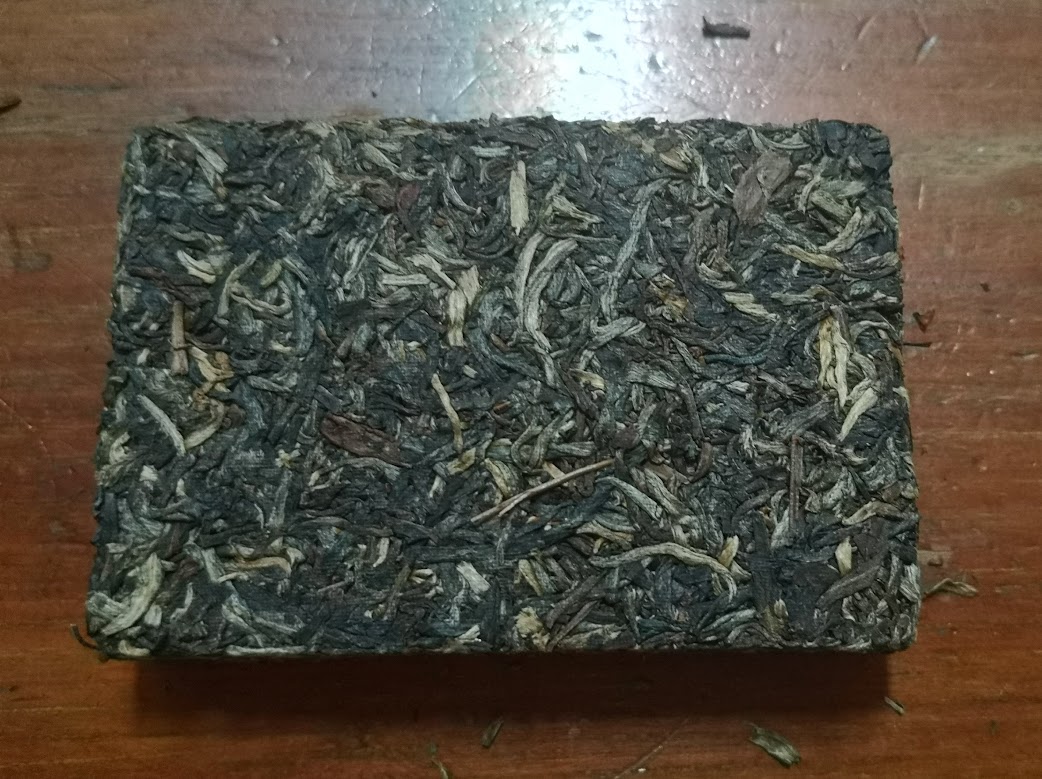
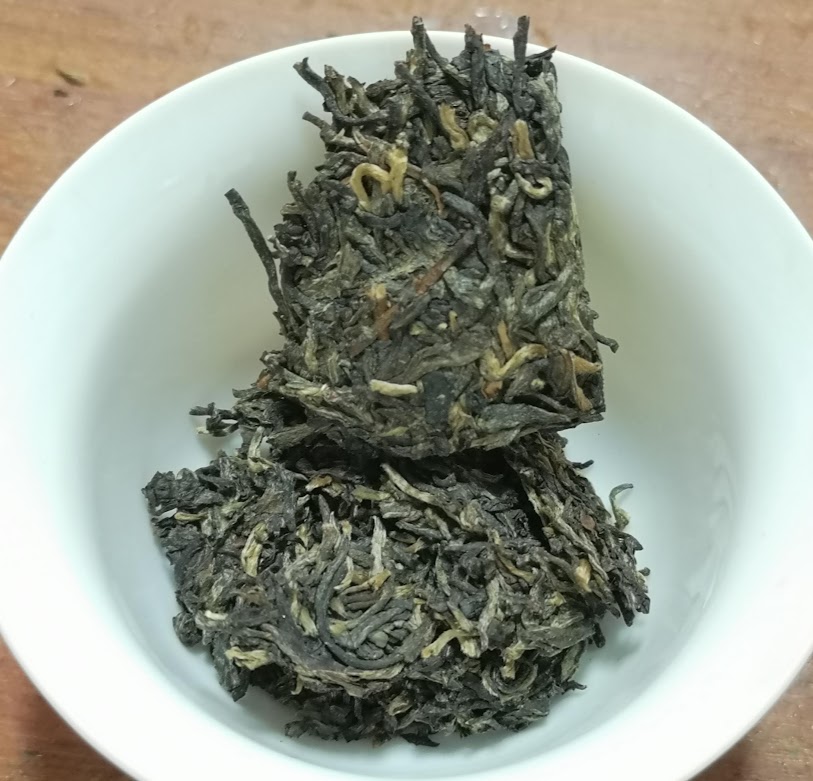
2010 Tulin (Nan Jian) Wuliangshan sheng pu'er brick


Trying another of a Chawang Shop order, with maybe two more teas to go from that.  It's this:


2010 Tulin Wuliangshan Organic Raw Puerh Brick 100g


This raw puerh brick is made of 2010 spring material from Wuliang mountain. Wuliang mountain is one of high mountains in Yunnan. Selected large-leaves and sun-dried material come from organic tea gardens. The same material were used both inside and outside this brick.

Brewed tea is aromatic, sparkish and yellow. Balanced, powerful with great floral sweet aftertaste.


I've liked a Tulin tuocha version that I keep buying in a local Chinatown shop, and that sounds interesting.  Again the dry storage issue will come up; this will be well-preserved for a 2010 tea.  It doesn't sound like it necessarily needed 15 years of moderate pace aging to be in a good range, so it might be fine now.  Or the usual could occur, that it has great potential for mellowing and shifting a few more years of mellowing here in hotter and wetter environment.  I would guess that this is about as fermented as it would be after 3 years of storage here, just getting started, but we'll see.

One might wonder how moderate cost factors in; this had been listed for $10, now out of stock.  I wouldn't expect it to be much worse based on that low pricing, as if it could only stay in their stock if it had been limited in quality in some way, or that Chawang Shop per gram pricing corresponds to their interpretation of tea quality.  It's probably just that they don't raise pricing that much year to year, which is for the best for a consumer.


Review:


First infusion:  color is a dark gold, so at least this has aged past the brighter yellow stage.  For this being 12 years old that limited degree of fermentation is amazing, or at least it would be if I hadn't experienced it in other versions, two fairly recently.  For many people that's a worst-case outcome, but I'm still sorting out if this is better or worse than it would be if it was much younger but stored wetter.  Maybe not so different, at least as far as total outcome is concerned, in the sense of added up positives and negatives.  I think the outcome is probably quite different though, a lot of small variations in what changed.

Interesting!  There's a lot going on.  A warm honey-like range stands out, and some floral tone, with a rich cured hay depth, and a warmer structure that's harder to place.  Mineral range would be a normal interpretation, and there is that too, at least.  There's an odd, warm, rich smell that a softball gives off, similar to that of a baseball, the smell of leather and cork (I think?)--it's like that.  It's odd saying that this tastes like drinking a baseball; it's more that it reminds me of that.  I guess then I'm saying that it reminds me of leather, that one range.

It would be easy to interpret that as saying that it's bad, sour, towards musty, in relation to the leather, cured hay, and cork description, but it's quite clean and pleasant.  There's a way that an aged Yiwu can gain a lot of depth and then sort of fade across a lot of range, a smooth richness that those can pick up, between floral range and something else, like cured, light wood, or some light spice.  This is like that, in relation to that depth, but the edge that remains is something else.  I interpret it as positive, because it gives the sweeter, lighter, and richer range some real punch, but it's just outside a range of what one would normally describe as astringency.  

Tons of honey comes across in the aroma, the kind of experience you get from smelling the empty cup, and that is one layer in the drinking experience.  It's really that complexity and the way it all integrates that's positive about the experience.


Second infusion:  this wasn't brewed long, not over 10 seconds, but I'd already had the impression that it was brewing fast, and this is intense.  It works "brewed strong," because the astringency is moderate, and bitterness has mostly faded, to the extent it included that.  Richer floral range picks up a lot, even a bit towards lavender.  Some of the deeper tone seems like warmer floral range, maybe chrysanthemum as a base, with some sunflowers filling in richer and sweeter tones (or what I'd imagine those to smell like; I don't have much reference to go on).  It tastes like bee's wax as a result of that input, if that helps, a flavor I find really appealing.  Feel effect and aftertaste experience are both pronounced and pleasant.

Now that I've considered that a vendor like White 2 Tea or Mei Leaf could market this under a bee's wax theme, it tastes so much like it.  "Bee's Knees Semi-aged Sheng," or something like that.  It's odd talking about this astringency level when it's not exactly in a conventional astringency range, more a fullness to feel that includes some drier range.  People would be divided on loving this or disliking it, I think.  If someone expected sheng to be either bright, intense, sweet, bitter and astringent floral range when young or warmer, deeper, complex, heavy and rich, dried fruit / camphor / aged input range when older this wouldn't fit either paradigm.  It's just something else.  I'll try a round brewed lighter, pulling timing back closer to 5 seconds, and see how that changes an aspect list.


Third infusion:  lighter, for being brewed faster.  Flavor intensity loses nothing; at a quick flash infusion this would still be quite strong.

What I've said worked better for describing what I like about the tea, now maybe I can fill in what others could see as more negative than I tend to, beyond just expecting something else, or not loving the general range.  That dry edge could be interpreted as connecting with a woodiness, or even with a touch of mustiness, although I don't see it that way related to the second.  This had to be more challenging when new, of course, and the astringency has only faded quite a bit and changed form, it's not gone.  Often I'll describe an aspect like that as similar to biting a plant stem, or tree bud.  You couldn't really experience positive feel and flavor in this range without some type of feel like that though.


Fourth infusion:  shifting a little, but it's hard to describe how.  Intense floral range still stands out, and a lot of bee's wax warm depth beyond that, with that dry edge filling out feel.  This most definitely doesn't seem anything like a low cost tuocha tea, punchy and intense, hopefully aging to be quite pleasant once all that settles out 15 years later, more where the Tulin version I've drank a bit of was.  This tea is better than it should be, related to my expectations.


Fifth infusion:  more of the same, which is good.  That floral intensity is crazy.  I suppose feel is cleaning up, not that it was off before.  The dry edge is moving more into a sappy / resinous range, which always had been part of it, I just didn't get around to expressing it that way.


Sixth infusion:  I was just thinking about a Tea Forum post about teas being flavored, about how this much floral could be interpreted as from an additive.  It seems too clean though, and too persistent, not rinsing off a bit.  And it's a 2010, sealed package (no guarantee there), super inexpensive tea, from a producer known for making solid and consistent but moderate quality tea versions.  It seems like they just used pretty good material for this.


Seventh infusion:  intensity is finally dropping so that a fast infusion (under 10 seconds) finally starts to come across as a bit light.  I like it this way, since flavor intensity is fine and aftertaste range is quite intense and pleasant.  Feel is rich now with no dry edge.  I'll try a 15 second + time and see how that goes.


Eighth infusion:  really nice this way, losing intensity but with longer time bumping that back to normal.  The list of aspects I've described shift in proportion but it's not worth going through how.


Ninth infusion:  bitterness is ramping up, as the balance of what extracts shifts with longer brewing times.  There was always some bitterness, I've just not typed out that inclusion because it's so moderate, in relation to sheng experience in general.  For a 12 year old sheng it's relatively bitter, but compared to most in the 3 to 4 year old range (not stored so dry) it's still pretty low.  I didn't mention sweetness either, even though that was pronounced, because I was focused more on floral and warm range being interesting and novel.  If I re-wrote these notes in a new tasting I'd probably include it all in a different order, and maybe stretch it out to 2000 words, if I tried to describe everything.  Better not to.


Conclusions:


My own impression is surely already clear, that I really liked it, but I wanted to find out more about this, how it was "supposed to be" in some sense, or what others thought of it.  

I found a Yunnan Sourcing listing for a 2012 version of this, theirs selling for $11.50 (over 10% more, but in terms of cost difference not much at all).  Comments about it from others who bought it mention smokiness; this might've included that too, and it just dropped out over the dozen years of aging.  Those review comments were from 2018-2020, so not so old or new compared to the 2012 to 2022 current age of that version, but towards more recent.

This 2008 Nan Jian "iron cake" (listed by Yunnan Sourcing) sounds interesting too, and still reasonable, $60 for a 400 gram version, sourced from Wuliangshan and Lincang.  Aged in Guangdong, that one says; that might offset the effect of high compression cakes aging slower, but it could probably still use another decade to transition further.  Or it might be like this, at an interesting in-between state, pleasant without entering a more fully aged range.  My friend Ralph reviewed a variation of that in his Daily Tealagraph Instagram page, but it was the 912 version (which is now sold out), and that was 902.  His notes make it clear that aging input was a significant factor, perhaps part of a transition process that's not finished yet:


The deep fruity raisin notes are obvious with some hay and tobacco notes.  Bitterness joins while sipping the first cups. A very deep and intense aroma, although it stays very clean and kind of simple at the same time like factory teas usually do. It features some mushroom flavor as well, not so different to bitter mushroom tea like reishi (ling tsi) or Chaga.

Later steeps bring out an additional flowery camphor aroma that joins the fruitiness and a "chewing gum" flavor that I can only rarely find in some 15 year old factory cakes...


Looking around further it's interesting reading comments about a 2010 version of the one I'm reviewing (sold by YS) on Steepster.  So this same tea I guess, just surely stored in a similar way, with room for slight variations in outcome.  None of the people commenting really liked it.  It sounds like they're not even describing the same tea:  smoky, hard to brew, challenging astringency, limited complexity, bitter, vegetal, sour.  

So what's that about?  Hard to be sure.  I'm sipping this right now; I know what's in the cup, and I'm not insecure about my own preference or judgment being atypical, even though everyone's take is going to be a little different.  There's not much for negatives in this.  That feel wouldn't be for everyone, but dryness coupled with sappy character and rich feel is fine, to me.  Flavor range is good; sweet, intensely floral, adding warm bee's wax for complexity, with some vegetal range, with just a hint of underlying mushroom, so light I'm only noticing it as flavors shift now.

We can't assume that the teas are identical, and they probably do vary a little, due to the storage inputs (especially that; only one review was recent, from half a year ago).  I don't want to move on to conclude that these four people could only appreciate limited range in tea (in sheng pu'er, really).  Other preference and context issues must be factoring in.  Every person mentioned low expectations related to low cost, in their notes; they may have went into this looking for what was wrong with the tea, versus what they might like.  

Not using a (standard to me) Gongfu brewing approach would give bad results for this, for example, Western brewing it.  First comment listing preparation notes mention this, from that most recent tasting:


Steep times: 45, 15, 15, 20, 45.  I drink the wash, hence why my first steep is so long. Brewed in a clay teapot. [using boiling point water, 5 grams per 100 ml]


This would be hard to drink brewed for 45 seconds, and 15 is still a bit long.  Their flavor aspect summary includes "bitter, hay, astringent, vegetal," and hay matches the best to my experience, with not listing floral range as inexplicable if their experience was the same as mine.  Which it wouldn't be, even using the same brick of tea, for brewing it completely differently.  Let's check a second review, from 4 years ago:


The risky buy of the month. It is the cheapest 100g-brick of puerh on Yunnansourcing.us and for a reason.

First, the good stuff: it smells good. The wet leaf has a complex, multi-faceted aroma that is very enjoyable. No fishy smell, no pure decay.

Now, the bad part: it needs at least 5 more years to develop because the acidic taste of the fermentation is there, ready to pounce and overpower everything else. Which is a shame, because there ARE a number of more subtle, interesting flavors. Unfortunately, the only way to bring them all on the scene together is to do super-short steeps of 5-10 secs, and avoid the boiling water. So, you end up “savoring” a weak puerh for a 2-3 steeps – after that regardless of your efforts the sourness pushes everything else in far corners of the palate...


Sourness?  It's not as unreasonable as the two different interpretations make it sound, theirs versus mine.  Concern or expectations of fishy or decayed range from an 8 year old, dry stored sheng is odd (related to the review being from 4 years old).  It's possible that they were mostly right, and for me drinking this 4 years later a lot of what they thought might drop out after 5 more years already did.  One of the other reviews was also from 4 years ago, and not completely different than that one, and the other from 7 years back, which would be a considerably less transitioned version of this tea.

They all emphasize the tea being chopped material, and it is, one going so far as to say they had trouble separating out some to brew.  Chopped material can be fine, but it is typical for more aging input to help with the astringency that results from that, the way different compounds are extracted as a result.  I'm probably drinking a much better version of this for getting to it 4 years later than those last two.

I suspect that I appreciate a broader range in sheng than all of them, that I can enjoy drinking a youngish Xiaguan or Dayi Jia Ji when I feel like it, one 5 years old or less, which would include a lot more astringency edge and bitterness than this, although for this version 7 years ago who knows.  It's not necessarily better to be open to different astringency and bitterness exposure, just a difference.  This isn't astringent though, compared to younger teas, most kinds that are within 2 or 3 years old.  

Just expecting that dry storage is going to preserve the tea might make a lot of difference; if I expected this to be transitioned to a more typical 12 year level of fermentation, under moderate humidity conditions, versus dry, I could be put off by it not being what I thought it would be.

I found this tea to be significantly better than I expected it to be, kind of the opposite of those other reviews.  I thought there would be more limited quality material concerns, that it would lack that sweetness and floral range, replaced by smokiness (which others did pick up, earlier, and in a differently stored version), or mushroom, odd mineral, etc.  It's not strange that there was no mustiness; I expected dry storage to not lead towards that result at all.  I didn't expect it to be anything like the 2008 Nan Jian version Ralph reviewed, which is considerably age-transitioned.