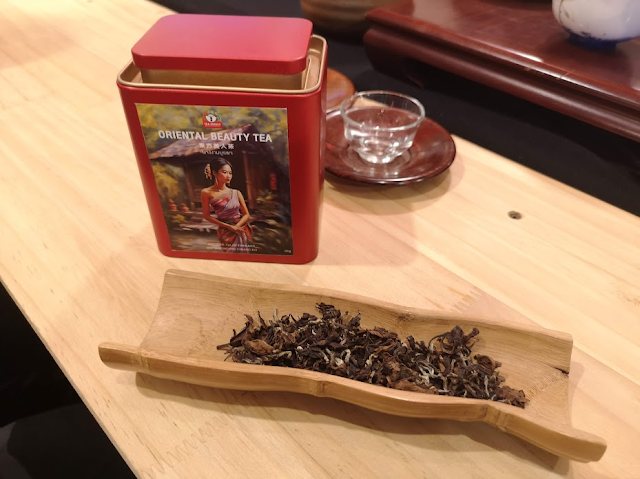
This is the longest I've went for awhile between review posts. I'll say a little about that break first and then get on with reviewing a Thai sheng "pu'er-like tea." It's a Thai version of sheng from Qing Fu Cha, presumably from the 2021 season, but I could be clearer on that.
I'm not buying much tea lately and vendors haven't been sending much. I just wrote a review for one tea a vendor sent but I'll never post that, because the tea seemed a little so-so to me. When vendors send teas if I don't like a version I won't review it, and if the review seems as negative as positive I'll let them review it and then skip posting it if they choose.
It's not like a lot gets lost in the omission; someone selling mediocre tea isn't much of a story. If it's a big name, like Yunnan Sourcing or White 2 Tea, and I've tried a number of versions and find them all lacking then that would be a story. That wouldn't happen; this other case was just a vendor reselling a decent but ordinary quality tea. Maybe I shouldn't have agreed to even try the teas, since often enough that's how that would work out. I actually thought the tea was ok; to me it would've made sense to post that review, but it can come up that vendors expect reviews to look marketing content. These posts say what I think; even if I like a vendor they content isn't hype.
The reason for not buying tea lately is mostly what one would expect, that my tea budget is limited. I ran into a high expense paying to get teas through customs at the end of last year, and my wife spent a lot on a temporary boarding school venture, that I've not went into here. So I adjust to drinking what I already had, which was a number of types (per my wife's take more than ever should have stacked up, which doesn't seem to decrease much while I drink it for months). I could've did more with reviewing samples I have around, or about how some sheng is aging, but it was nice to just go on break from reviewing instead. Writing about doing some online meetups was enough. I've been meaning to get into opinion pieces more, and venture off the subject of tea, which I have yet to get far with.
On a personal update, I just had the covid vaccine the day before yesterday (when doing the tasting and draft), the Astrazeneka version. It's too much tangent to cover, that background on local pandemic status. I think my sense of taste is relatively normal, related to that input, but it's at least possible that I'll miss more than I'm aware of, since I'm not yet symptom-free from vaccine side-effects. And there's the usual noise and chaos around the house, and the tea didn't rest (from shipping within Bangkok), so maybe it would shine a little more under different circumstances.
 |
the story I could tell is about a nasty Delta variant related third wave in Thailand |
Review
First infusion: this is brewed light, after a short rinse, my typical process. The flavor is a little unusual.
In discussing tea with someone recently I was reminded that I don't use as consistent a split in terminology between taste (tongue based distinction of sweetness, bitterness, sourness and some other mineral range tied to detecting both salts and minerals) and aroma (aromatic volatile compound based sensation detected in the rear nasal passages). The actual experience of the two tends to mix to become one experience, and you can sort of "split them apart" in defining and describing experience, but I don't use one set of standard terms to do so here. There are only a limited range of terms used, but those vary. Taste and flavor can be used inconsistently, but aroma is standard enough, it's just not always separated out. Flavor might be used to define both ranges or only aroma; that would vary too.
Anyway, there is a woody sort of earthy tone to this, and a cool root-spice oriented theme, with sweetness that might be in dried fruit range, but it's all so light that I'll describe it more next round. It's not atypical for feel and flavor aspects to shift quite a bit over the first two rounds, so it's even possible that one I'm noticing for this being so light won't be a main character aspect after one more round.
 |
not really focusing in on the photography aspect this time |
Second infusion: interesting! I wanted to go far enough with infusion time to be certain to get a clear read, but not far enough to be describing overbrewed tea, so I went with around 10 seconds, a few longer than I would ordinarily see as a likely optimum, but not enough to ruin it. Sure enough this is a little strong. Astringency is notable; that stands out first in the experience, along with a bitterness level that's really moderate as young sheng goes. Astringency is limited as young sheng range goes, to be clear, but still significant. Flavor is nice. Some base mineral probably rounds out tongue-based input related to that, a warmer tone version.
Other aromatic input is interesting. Floral tone is part of it, and dried fruit, and a warm and somewhat non-distinct range that might be best described as woodiness. It points towards a familiar tobacco range common to some inferior quality sheng, but it's not nearly as pronounced as that tends to be in more "tastes like a cigar smells" versions. To me it works. I could imagine someone being put off by part of that, or the overall balance, but I like it. It's clean and comes across as balanced and well-made tea. I suspect that it might be atypical in ways that could affect aging transition potential but I'll say more about that and other causation as the review continues. All meaningless guesses, probably, but that's how tea blogs can go.
 |
probably a bit oxidized; I didn't get into that |
Third infusion: it's good, relatively speaking. Intensity is a bit light but what is present is fine. There's a catchy root spice aspect that works with the rest. A mild and subdued fruit range is pleasant, just hard to identify. It's not so far from some dried longan I ate not long ago. That fruit version of those was amazing, so tasty it was hard to stop eating it, and a good sized bag of it wasn't around long. Longan flavor is what makes those Chinese ice based mixed-bean deserts so appealing, I think made from simmering dried longan for a good while, versus being processed from a fresh version.
Light bitterness and moderate sweetness both balance well. Lacking flaws, sourness, mustiness, smoke, odd flavors, works well, but it's hard to appreciate as a range of aspects that aren't present.
Fourth infusion: I went a little light on timing; it's easy to shift that when the proportion has a range of 8 seconds or so being optimum. This has lost enough intensity that up to 12 seconds is probably good now, and within a round or two 15 might work well. Commenting that here isn't about identifying good brewing practice or settling on an optimum, I wanted to make a point about how the balance of what you experience shifts with brewed tea intensity.
It's possible that someone could appreciate a broad range, and for many tea types stronger, more medium, and lighter infusions would all be quite enjoyable in different ways. Here I'm saying that brewing this tea for 7-8 seconds on a fourth infusion instead of 12 shifts what comes across. The tea seems a little thinner, and flavor profile seems to shift. I suppose it's instead that what comes across in what proportion shifts.
The base mineral tone stays strong, and sweetness is present but slightly reduced, with bitterness probably dropping out even more. Other aromatic compound range diminishes even more, what people might see as "the flavor."
I never will be able to fully place this related to other "wild" teas, or address aging potential, but saying a little wouldn't hurt. Related to the second, more challenging teas in terms of a higher level of bitterness and a certain style of astringency seem to have a high potential of transitioning well. Sometimes that relates to needing a full 15 years to really get there, the Xiaguan / factory tea case. In more moderate cases you get a sense that a sheng might be better after 3 or 4 years of aging, and then sometimes you wait and experience that to be exactly the case.
This seems quite drinkable now, not really challenging, but also not like the fresh, smooth, mild, and flavor intense sheng versions that more or less need to be drank right away because they'll lose appeal rather than gain it.
The wild or forest tea theme is a funny thing. I was just reading a Matcha's blog post about that. The strange part in that post was that he was splitting forest tea as completely separate from wild tea, as two completely different things. Of course the subjects would overlap, and the idea there seemed to be that plant genetics are central to discussing both. The implied claim is that some tea plants are very conventional in type but are growing in relatively natural conditions (the "forest" case), and that other plant types are not one of the main Assamica versions used to make tea, or not a part of the continuum of standard types (the "wild" teas). I think that mostly works.
The only problem with it is that marketing separation of the types seems to be drawn on as a good source of making a distinction (implied in that post), and per my experience vendors aren't identifying and operating based on a great grasp of underlying inputs and consistent use of terminology. Wild / forest / ancient tree sources would be used as equivalent, just based on a personal convention by the vendor staff. Using "forest" or similar description, or just framing, for a tea that "seems like sheng," that seems to be based on a typical Assamica version input, would work, and then splitting off what seems different as "wild." Maybe that was a main point. Calling "wild sheng" more of a tisane might be a bit strong but in at least some sense that works too; it can definitely be quite different.

Fifth infusion: better, for brewing time being more optimum, out around 15 seconds now. It's not unusual for some sheng types to be so intense that they just drop into a more normal tea intensity range by the fifth infusion, not really thinning. It's tempting to try to tie that initial limited intensity and faster than average transition to causes but I really would be guessing, and probably guessing wrong.
That root spice aspect has moved into an autumn leaf range. I suppose it's tied to the woodiness and earlier trace of tobacco, which I'm not really getting now. I mean the fragrant, sweet, complex smell you find in a pile of mixed fallen leaves. I often help my wife's mother sweep up leaves in our driveway, which come from a broad range of tropical plants, or flowering vines, palms, whatever is around, and it's interesting how that scent can be more complex than a tea experience ever is. It should be; something like 20 kinds of plant leaves are mixing in those piles, and they're actively fermenting and drying from fresh leaf versions, with rain adding a random moisture input.
This tea will keep transitioning, and a couple more interesting minor shifts in aspects will occur. How the rounds work out in count and later character is also part of the story. I just don't feel like filling all that in, so I'll move on to some concluding thoughts instead, adding some about how the next half dozen rounds went in the conclusions.
I usually leave out most discussion of processing and leaf input, since what do I know, but that mix of colors could easily relate to differing leaf type material and a good bit of oxidation input, compared to that typically not being the case for sheng.
Conclusions:
This seems to be a kind of tea that could be taken in two different ways. It could be presented and interpreted as a unique style but average quality "local tea," pleasant but limited in complexity, intensity, and refinement. Or with a bit more spin that novelty and quality level could be played up, and this could be regarded as a uniquely positive and very pleasant version.
It's pretty good tea; that doesn't change, but the relative judgement could. I get the sense that style expectations and interest in novelty both factor into all that, of course along with subjective preference. It is a little odd how it ends up interpreting the exact same tea as of moderate quality or instead as highly desirable, in both cases a bit non-standard, but framed completely differently.
Then there's the paradigm of someone being a real high-level expert passing on an objective opinion "from on high" that truly places a version. Obviously I'm not claiming to be such an authority; I started this post by saying that I'm not drinking that much new tea lately, and I've never had a tea budget enabling access to purchase $150-200 cakes, which is just standard good tea range to some. I've tried lots of South East Asian teas, probably as much range as anyone else, but I'm not sure what that should mean.
I doubt this version could pass for anything like those higher quality Yunnan versions, which of course would be a range, not one single thing. Where it stands in relation to what Western facing vendors sell as $80-90 standard above average quality tea is more of reasonable question. This I did buy for about $20 for 100 grams, implying a claim that it falls around that category (more like $70 for a 357 gram cake, but really selling the tea within a Thai market could change things a bit). It could be a little high related to only quality level, but then there's not much similar to be had, so supply and demand balance is hard to call.
It's interesting considering how I place this related to gushu in general, or "wild" teas. Even though this has been has a really slow year for reviewing teas I have written about multiple teas presented as "wild / ancient tree / forest grown," two from China and one from Laos (from Yongde, Mannuo, and Phongsaly). It doesn't really work to map out consistent patterns among them. It's tempting to do so, but I'd likely just be identifying what many of the first half dozen I had tried years back were like, later using confirmation bias to reinforce that the rest tend to also be like that, and seeing others that weren't as exceptions.
If I did that, and again this seems to be stating generalities based on random patterns within my own experience, not in general, I would say that more wild tea versions tend to be less bitter than standard Yunnan versions, and less astringent, more likely to express a range of novel fruity or spice flavor range, versus more standard Yunnan versions more frequently being floral. Intensity tends to be lower, especially related to flavor and astringency. Take it for what it's worth. Some "wild" versions exhibit a really odd sourness, seemingly tied to atypical plant genetics (or it really could be due to processing flaws, or just not drying it enough initially), but normal variation range is something else.
Pegging quality of this version is also problematic, splitting that off from style. At one point I thought I could identify markers related to quality (and typical gushu character), but now I don't think that. I do think that conventions related to standard patterns of styles come up, so when people claim that a tea version is objectively however good they judge one to be, they're not necessarily wrong, they are just basing that on common conventions that they take to be universal. Which may be relatively universal, within a broad set of opinions, related to large groups of producers, vendors, and enthusiasts. True objectivity is something else though, or rather one might say that a more robust version of objectivity would be grounded differently. Gushu I've tried (teas presented as such) seemed to have a pronounced mineral base, and the mineral range I've described in this--as a warm tone--was more pronounced than it would've seemed if I'd kept repeating description of it. If it would've transitioned I would have; then there would have been something new to say.
This tea "brewed out" relatively fast, and never really was very intense, not a great sign. Plenty of sheng is so powerful that very short infusions still leave it as an intense experience early on (at a high proportion, which I sort of take to be standard, even though it's really probably not). For starting out really intense and being brewed fast across rounds 10 infusions in a version may still have plenty to offer, and might only fade after a dozen or more. This isn't like that; by 8 or 9 rounds I was stretching it to get decent intensity, and the character didn't stay as positive. It did keep producing reasonably flavorful tea well past 10 rounds, but it was kind of a limited range experience, with some base mineral, higher astringency from adding infusion time, and more subdued earthy tones, like cedar wood or something such.
To an extent that sort of "staying power" also relates to how positive the stretched rounds come across. A really good Wuyi Yancha might be turning thin at 8 or 9 rounds too (they typically would be, depending on brewing approach), but character might seem quite positive across longer and longer infused or "stretched" rounds. This version kept brewing tea, it just didn't have a lot of pronounced positive character to carry over.
This could easily be an autumn harvest tea; that would add up [see following late edit; it is, but what that means is probably different in the tropics, because there is no true "Spring"]. It would explain why intensity wasn't pronounced early on, or across an infusion cycle, both in terms of how much individual aspects came across and what flavor was present. I really don't care if a sheng version is called gushu or not, unless there is some particular adjoining reason why a vendor would get that right, and not so much even then. In a related online "Shopee" sales page there is a description about that part:
...Pick the tops of tea from the ancient wild Assam (古樹茶) tea trees, aged between 500 and 1000 years old. The average tea leaves used to make this tea lot are about 700 years old.
Gu Hua tea is a tea that is harvested during the fall. But there is something more special than general autumn tea. The harvest time for Gu Hua tea is from the end of the rainy season to the beginning of winter. which is a short harvesting period
during this time corresponds to the period when the rice is ripe It is when the flowers in the valley are fragrant. and the fields are golden That's why we call the tea collected during this short period of time as the Valley Flower Tea (Gu Hua Tea)....
On the seasons and "winter" theme here the annual low temperature in Bangkok doesn't fall much below 25 C, or 77 F. I woke up at 5 AM once half a year ago to go running at 70 F; that was nice, that bitter cold snap. It's cooler at elevation in the North but it's not really winter; Thais just say "cool season."
Related to plant age claims--which of course could be accurate, or probably much more likely not--I talked to someone not long ago who was surprised about an aged tea type being "faked," and it seemed odd that such a thing would seem odd. The first time I visited China a local IT vendor guide described how they made fake eggs there, actually in the shell, with a white part and yolk. If anything can be duplicated in China then it is, and it's not as if things are so different here in Thailand. To be fair it's hard to tell how old a tea plant really is, and vendors often cite ages for the oldest plants in the area as the material type it's from, even though of course that makes little sense.
Here's what the vendor said about origin:
Gu hua cha is from Wawee mountain, while the other 2 are from Mae Salong.
That kind of rings a bell since I've drank a lot of Thai tea but it's still not especially meaningful. Mea Salong is where the oolong plantations are, with a reference on both areas here, where my friend Alex Phanganovich has been living (or contact, if you prefer to use that association designation sparingly).
The tea is nice; that's the thing. Maybe I wouldn't be so clear on that conclusion if I'd had narrower expectations, for it to be some certain way, but within a context of lacking specific expectations I like it. 100 grams might be enough to get plenty of experience of it but if I had bought a full cake's worth I might not be upset. It would be a cool tea to share with others, since there's a novelty appeal to it. That relates to both flavor and background, and it helps that although it's not intense (or probably suitable for long aging) it is pleasant to drink. And it probably will bump a little in intensity once it picks up some rest time, when I try it in a quieter atmosphere (if the kids ever go out of the house again), when I'm not soldiering through a covid vaccine recovery.
I never really did mention the main likely cause for it being how it is, at least that seems to stand out in leaf and liquid appearance, a likely high degree of oxidation for sheng. It wouldn't clarify much if I had. It would probably be like this is, a bit mild, sweet, less bitter and astringent, warm in tone, with floral aroma range dropped back, lacking as much aging potential. But don't take my word for that; check out this Farmerleaf video on making sheng ("pu'er;" his versions are mostly from Jing Mai, Yunnan, where he lives), which I'm too lazy to rewatch and time-stamp the reference to William saying exactly that.
The next version from this vendor that I'll review is something else again, what they call Bai Hao Mei Ren, and describe as such:
It seems like oriental beauty, but the leaves that we bought to produce is young leaf, and fully hand made. Normally Dong Fang Mei Ren [OB, which is also called Bai Hao sometimes] is made from summer leaves, and bug bitten, but for this version we used spring leaves.
 |
grilling for the 4th of July recently (Keo gets so tall now) |
 |
a better angle of Keo, who pulls off the pandemic look much better than me |