Monday, February 19, 2024

Mao Feng material white tea and Wang Put Tan Thai shou mei


Thai Wang Put Tan white left, Huang Shan right


An online contact has been describing positive experiences in exploring Chinese teas for awhile, Dylan Conroy, of the small online vending outlet, The Sweetest Dew.  This post is mostly a tea review, but to me that backstory is also interesting, so let's go into that first.

He explores culture and tea, which he sells, but the balance seems to relate more to exploration than profit.  That's not completely unheard of.

We have been discussing Qimen; that has been his previous main focus, in another area.  His "About Me" sales site section probably explains it better than my memory of earlier discussion:


"Some call him the Qimen Jesus, some others "the maofeng guy", but he prefers Dylan. Yup, simple ol' Dylan from Brooklyn...

I studied Mao Feng in Huang Shan, Yan Cha in Wuyi Shan and now Bi Luo Chun in Suzhou. This focused approach to finding teas not only allows me to find the best teas of each category, but to gain a deep understanding of the tea as I do...

The Sweetest Dew is not just a way to sell tea, it's a record of my journey in tea, in China and in Life. 


He is also on Instagram and YouTube. 

He sent this white tea version and also Qimen to try, which I'll get to later.  I'm comparison reviewing this version described here along with a Thai white tea version:


Huang Shan Mao Feng White Tea


This white tea is made with the traditional Mao Feng cultivar. It is subtle and but still has the vegetal nuttiness of a Mao Feng Green tea. The body is soft and fuzzy showing that the drying was done very well. This tea is honestly on par with Fu Ding Shou Meis. 

This is a new tea so we don't know how the flavors will develop as it ages. You can be one of the first to try it. 


It lists for 913 baht for 50 grams, a bit under $30 (there must be a way to change that listed currency).  That's a bit for white tea, but if it's exceptional that's still fair, and since I'm writing this after trying it I can confirm that it definitely is unique and very positive.  Dylan is helping a friend / local contact by selling her tea as well, with her story on a different page:


Hello! I am Jing, a post-80s generation, and my current job is to share the good tea from my hometown. I was born in a mountain village in She County, Huangshan, Anhui. My hometown is a very beautiful place, with a forest coverage rate of 80%, and the environment and soil are both beautiful. It is very suitable for the growth of tea trees. My family also has several acres of tea mountains. I have grown up smelling the fragrance of tea and drinking tea in tea mountains and tea factories since I was a child, so I have a strong affection for tea... 

The subtle taste and aroma of the tea leaves in each tea mountain are different. I like to use a cup of tea to feel the charm of a mountain. If you also like to drink tea, then taste the fresh fragrance of the vegetation thousands of miles away from my tea.


That sounds nice, that area, background, and perspective.  

On with describing the tea then, along with a Thai white version that my friend Huyen shared with me a couple of weeks ago while visiting from Vietnam.  It's from the Wang Put Than plantation, one of the main half dozen producers, maybe, or else maybe I just keep hearing about them even though they're not that, in relation to production volume. They market themselves as a producer who also emphasizes tea tourism, visiting their plantation, and maybe they do that well enough that their name keeps coming up.


Review:


Thai Wang Put Tan shou mei (2021):  subtle; that can happen.  I gave this a 20 second or so infusion time but it's not a lot of leaf, maybe only 4 grams or so.  I'll bump timing next round.  These teas can't really overbrew, for sure.

It's hard to isolate much more for flavors or character; not all that much is coming through just yet.  It seems pleasant, sweet, creamy, with rich flavors, maybe including a touch of caramel or toffee.  What does come across is nice, this just needs to be brewed stronger.


Huang Shan Mao Feng material Chinese white:  that offers a little more.  A light vegetal range gives it some intensity, just not much yet, combined with sweet floral tones.  A bit of spice joins the rest, in the general cinnamon range.  The vegetal range isn't heavy, like celery or green bean or the like, more a scent of fresh tree leaves in the spring.


Wang Put Tan, round 2:  an interesting range of flavors pick up.  A creaminess comes across, but that's not a main flavor.  There is cinnamon spice in this too, but it's also more a supporting aspect.  That flavor that stands out is probably really a set.  One main part is along the line of root beer, that root spice input.  Sweetness does take on a pleasant character, like light toffee.  

It's evident from the leaf color that this is considerably more oxidized, and that comes out in that slight warm tone.  It's all fairly subtle still, even for the 50 or so second infusion time, but it's quite pleasant.


Huang Shan white:  now this really hits, not so different than last round but at double the intensity.  That same list kind of works:  sweetness, vague fresh floral range, some degree of vegetal input, but a light and pleasant version of that, maybe towards fennel, sweet, light, and fresh.  There isn't a heavy spice input but a touch of cinnamon balances the rest, or that really could be a different spice input that only reminds me of cinnamon, that is somewhat similar.  

These are so different that it's odd asking which is better, but why not go there.  Preference would dictate that kind of judgment, or someone could ask a different question, which seems like a higher quality version within the style it's made in.  Perhaps for both this Chinese tea edges out the other Thai version.  The higher intensity is more pleasant, and additional complexity, and more novel flavor aspect set.  I can try to isolate feel and aftertaste more in a next round, since these also tie in to overall effect and to quality level.  

The Thai tea is still nice, just not quite as complex, intense, and interesting as the other.  This Chinese version bridging so much varying flavor aspect range is really novel, and it all integrates well.


Wang Put Tan, #3:  creaminess stands out again; that part is pleasant.  Warm flavor tones are also nice.  Intensity is a limitation though; even for using a 45-50 second infusion time this doesn't taste like all that much.  What is there, a bit of toffee, a hint of spice, and maybe some other warm tone adding context, is fine, it's good. Feel is fine, just not thick or pronounced. 


Huang Shan white:  vegetal range shifts, the green leaf effect.  It still tastes a little like fennel, but a faint edge picks up.  It would be bitterness if it was much stronger, so it's really not that, as we tend to typically perceive flavors, even if it is actually that.  It's like the scent of a dried oak or maple leaf, which are of course things we tend to not actually eat or taste.  It's quite good.  There is still the rest there, some limited spice, good sweetness, non-distinct floral range. Both of these aren't full in feel like oolongs more often are but not thin either. Overall balance is good. 


Conclusions / later rounds:


I tried both for a few more rounds, brewing a couple more quite strong.  The Thai version stayed remarkably similar, not changing much at all.  The Chinese white was quite positive for a couple of more infusions, and picked up a woody aspect note that wasn't really negative, it balanced ok with the rest.

I am evaluating the Huang Shan version much more positively here in the aspects list description, and the quality just seemed that much better.  And novelty; this was a style experiment, it seemed, trying out making white tea from green tea producing material, and to me it went well.  Probably this Chinese tea is selling for at least twice the cost of the Thai version (although I didn't see a sales listing for it), and for the most part that would seem fair to me, it really is a bit different.

What about commentary on that broad divide in oxidation level, or probably earlier aging input, or later aging potential?  The Chinese version was probably made in a much lighter style, not allowed to oxidize much at all during processing.  It suited the material; the outcome was quite positive.  Probably the opposite was true for the Thai tea, and they let it wither for a good bit longer, to draw out an oxidation input.  I liked that tea too, which does seem to be within the general range of shou mei, so maybe both decisions were appropriate.

I doubt that the three years of prior aging (the 2021 origin date for the Thai tea) had caused all or even most of that oxidation level difference.  Teas can age pretty fast in Thailand, in a hot and humid place, but I'd guess they made it to intentionally have a running start on browning, and changing to warmer toned character.  Once tea versions pick up a touch of cinnamon, as that had, that seems really nice.  

The minor differences in intensity and complexity were something else; I would guess that material quality factored in, that the producer who made the Chinese white was starting with better leaf material.  And it seems that quite simple processing led to a positive result.

Aging either wouldn't seem to make sense, for two different reasons. The Thai tea lacks intensity, and aging typically swaps out early intensity and fresh flavors for more warmth and depth. The Huang Shan version is very pleasant bright and fresh like that; it would seem a shame to give that up. 

I like white teas, even though in the past I've been critical of versions that lack flavor intensity and complexity.  If the bit that's there is positive you can always push the tea, brew it hot, and for a bit longer, or bump proportion, and if there just isn't much to offer even that won't work.  The Thai version was good, and the other didn't need to be stretched.

It would be nice if I could push a step further, and compare both of these to the same material being produced as different styles, as Jing mentioned in her intro part that I cited.  I've tried Mao Feng green tea but I'm definitely not the right person for that.  

It's interesting looking back on that section and seeing the claim that this white tea is on par with Fuding shou mei versions.  It's a good bit better than most of the standard commercial versions I've tried, but really it would need to be evaluated against a higher tier version range, not what ends up being pressed and sold as cakes that cost very little, the white tea equivalent of factory pu'er (which can be ok; I don't mean that as a slur).  It's good, but I'm not familiar with how it would compare to well above average quality versions, since I'm not familiar with boutique production Fuding shou mei.


Sunday, February 11, 2024

Are slimming tea products unethical?


It seems strange asking and answering this question; all of this was sorted out and overdone years ago, and has went quiet since.  A new producer brings it all up again.


I'll start with the short answer, or at least my take:  yes, slimming tea products are unethical.  

At least in the most common form they occur in.  Exceptions are possible; that's a lot of what I'm discussing here.


The main theme is using "real tea," or just other herbal ingredients, to serve as a laxative and diuretic, to cause people to lose water weight and speed up bowel movement processing.  Both will cause a temporary weight loss effect, but neither is "slimming" in the sense of helping someone lose body fat, the main intended meaning.  Both are relatively unhealthy, since maintaining normal digestion and appropriate hydration level is more optimum, and adjusting and disrupting these is less healthy.

What about a stimulant effect; couldn't that help with weight loss?  Yes, to a limited extent.  Caffeine already is a stimulant, present in every kind of "real tea," camellia sinensis based versions, and adding more of that, or that plus some other stimulant, is probably not a good idea.  It doesn't really work to speed up metabolism to lose weight anyway; it's far superior to adjust diet inputs, to ingest less calories.


I can easily enough explain why that is.  I run a good bit, 10 km / 6.4 miles per outing, three times a week (typically), for a total of 20 miles or 30 km per week.  According to a tracking app that burns about 600 calories per outing, towards 2000 per week; that's a good start.  But it's not hard at all to eat an extra 600 calories per day, and certainly not 300, working back to a weekly average.  Revving up metabolism an equivalent amount through stimulants lands on the same result, that it's not helpful unless daily dietary intake and expenditure balance.  

If medium-high exercise for three hours a week "only" burns up an additional 2000 calories, or about that, stacking an extra stimulant on top of ingesting caffeine would need to make a significant difference--and have potentially significant negative side effects--to achieve the same outcome.  Then eating or otherwise consuming an extra 300 calories per day would be easy; it's not that much.  Two cans of Coke is close to that (278); you could just drink that input daily.


So as I see it people creating, marketing, and selling "slimming tea" versions are more or less selling snake oil.  At best the products wouldn't do much, and at worst laxative and diuretic effect or stimulant input would be quite negative.  

Caffeine is already a diuretic too, beyond being a stimulant, so ordinary tea already covers that.  People's experience of side effects vary, so not everyone would agree with that, and it requires a significant daily dose to cause that effect (water loss), but a daily recommended limit of 400 mg of caffeine will cause water loss for most people.  Taking even more diuretic is not a good idea; temporarily losing water weight isn't helpful.

Some people might feel that they retain too much water, and feel bloated, so it would be good for them.  An easy way to offset this is to limit intake of compounds that cause increased water retention, particularly salt (sodium).  Or drinking more tea could help, and adding a bit more caffeine, which is a bit counter-intuitive, since that's ingesting more water as well.  Tea is said to contain between 25 and 40 mg of caffeine per a standard 8 ounce cup (250 ml, more or less), so brewed a bit strong it might take 10 cups to ingest that standard daily limit of 400 mg, the same as in four cups of coffee (on average).  80 ounces of tea is well over 2 quarts / liters; depending on the diuretic effect experienced someone might not need to add more water to compensate, but given how it can speed up water loss some people would.

I'm not claiming that maxing out caffeine intake is definitely a good idea, to speed up metabolism and get diuretic effect to really kick in.  I typically drink about 8 grams worth of tea a day, intentionally keeping that moderate, which I expect might amount to around 240 mg total (maybe less), down to 220 or less since extraction rate isn't 100%.  Long term effects are impossible to predict, so to me practicing moderation makes sense, related to essentially everything we consume.

Back to the specific starting point, the ethics issue.


A new slimming tea product


It's this product, last discussed by the developers in this tea group post:


Oddly that post is about discussing potential product names, and they've already set up the vending page with the product name and some marketing content, so that seems odd, and perhaps not completely genuine.

What is it they're discussing, or selling?  That's not clear yet.  They've implied it's based on pu'er tea, but there are no product details out yet.  Maybe that plus a diuretic and laxative, the most conventional earlier form.  Maybe something else.  It seems unlikely that they might incorporate a formerly unknown herbal input that really helps with weight loss, but I suppose it's not inconceivable.


About that, I wrote not so long ago about how brewing ground up papaya seeds extracts a compound that suppresses fat digestion.  That's not so far off the theme of an earlier supplement that did the same, which was embraced and then universally rejected for changing the consistency of the subject's stool in a negative way, making it loose and oily.  That's covered in the Mayo Clinic's summary of Orlistat functions, benefits, and side effects.  This problem stands out:


These side effects include:

Stomach pain or upset stomach

Oily discharge from the anus...


Yeah, no.  

For sure other compounds and herbs out there support weight loss, but there is no magic fix, or it would already be on the market.  Interfering with digestion is an interesting twist, seemingly more promising than stimulant effect, if an input version didn't have such problematic side effects.  Hunger suppression, the effect underpinning the latest Ozempic / Semaglutide craze, is also promising.


Since we can't evaluate or critique the weight loss effect or mechanism of their product, which may or may not exist in a final form yet, let's at least consider something seemingly similar, a pu'er based weight loss support product that adds herbs to support that function, Purasana Pu'er Tea Fat Burner.

Ingredients:  Pu-erh tea (Camellia sinensis), peppermint (Mentha piperata), hibiscus flower (Hibiscus sabdariffa), goldenrod (Solidago virgaurea), rosemary (Rosmarinus officinalis)


They claim that goldenrod and rosemary are the "effective ingredients," in that sales page content, or sort of just imply that.  If rosemary made a lot of difference for weight loss people would already be making tea from that.  I have before, many times; it's pleasant.  I didn't lose weight drinking it.

According to this reference goldenrod, which can refer to differing plant types, is a set of flowering plants used as an herb tea / tisane in early US colonial times.  Wikipedia mentions this background and these uses:


Traditional medicine

Solidago virgaurea is used in a traditional kidney tonic by practitioners of herbal medicine to counter inflammation and irritation caused by bacterial infections or kidney stones.[43][44] Goldenrod is also used in some formulas for cleansing of the kidney or bladder during a healing fast, in conjunction with potassium broth and specific juices.[44] Some Native American cultures traditionally chew the leaves to relieve sore throats, and the roots to relieve toothaches.[28]

Medicinal exploration

In various assessments by the European Medicines Agency with respect to Solidago virgaurea, non-clinical data shows diuretic, anti-inflammatory, antioxidant, analgesic and spasmolytic, antibacterial, antifungal, anticancer and immunomodulatory activity...


So it could be quite helpful in different uses, but is probably being utilized here as a diuretic.  Note that weight loss is not included in this substantial list of potential benefits.  Maybe another reference can add to that, like this Mount Sinai hospital database record:


Medicinal Uses and Indications

Goldenrod may act as a diuretic, meaning it flushes water from the body by increasing urine output. It may also reduce inflammation. However, it has not really been studied in humans.

Goldenrod is sometimes suggested for the following conditions:

Arthritis and gout

Allergies

Colds and flu

Inflammation of the bladder or urinary tract

Kidney stones

Eczema (applied to the skin)

Minor wounds (applied to the skin)


In that first Wikipedia citation they stated that "non-clinical data shows diuretic, anti-inflammatory, antioxidant..." (properties / benefits), aligning these two inputs.  It's probably good for you, but that second source warns against taking it with any other compounds that have a diuretic effect, since it has such a strong related effect itself.


Diuretics (water pills): Goldenrod may make diuretics stronger, raising the risk of dehydration.

...Other drugs: Due to its diuretic action, goldenrod may interact with any medication that is processed through the kidneys and urine.


So Purasana Puerh Tea Fat Burner seems unlikely to actually help with burning fat, since pu'er and those other common herbs don't support that (most likely, to a significant degree), but it will cause water weight loss.


But first let's back up a bit; maybe rosemary really can support weight loss, and I'm just unaware of that.  I had just set that aside as clearly absurd, but let's check, here:  Therapeutic effects of rosemary (Rosmarinus officinalis L.) and its active constituents on nervous system disorders


Rosemary (Rosmarinus officinalis L.) is an evergreen bushy shrub which grows along the Mediterranean Sea, and sub-Himalayan areas. In folk medicine, it has been used as an antispasmodic, mild analgesic, to cure intercostal neuralgia, headaches, migraine, insomnia emotional upset, and depression. Different investigations have highlighted rosemary neuropharmacological properties as their main topics. 

Rosemary has significant antimicrobial, anti-inflammatory, anti-oxidant, anti-apoptotic, anti-tumorigenic, antinociceptive, and neuroprotective properties. Furthermore, it shows important clinical effects on mood, learning, memory, pain, anxiety, and sleep. The aim of the current work is to review the potential neuropharmacological effects of different rosemary extracts and its active constituents on nervous system disorders, their relevant mechanisms and its preclinical application to recall the therapeutic potential of this herb and more directions of future research projects...


The focus of the following research review isn't on all potential health benefits, but this summary and the following outline of context doesn't list weight loss as any traditionally observed potential benefit:


Rosemary, Rosmarinus officinalis L. (Labiatae) has been used in folk medicine to alleviate several diseases including headache, dysmenorrhea, stomachache, epilepsy, rheumatic pain, spasms, nervous agitation, improvement of memory, hysteria, depression, as well as physical and mental fatigue (5, 6)... . 

Recently, noticeable scientific interest is focused on the beneficial therapeutic properties of different kinds of rosemary extracts and its main constituents, such as carnosic acid, carnosol, rosmarinic acid, etc. A large number of studies either on animal models or cultured cells indicate the wide range medicinal properties of rosemary and its compounds such as anti-inflammatory (8, 9), anti-oxidant (10), antinociceptive (11), neuroprotective (12), antidepressant, anti-hysteric, ameliorative of memory and mental fatigue (13-15) (Figure 1)...


Why was it added to a weight loss support product then?  Who knows, but it sounds positive enough, related to so many other effects.  Maybe it helps prevent the pu'er from wrecking your stomach.  That only makes sense if it's sheng pu'er, since shou is the least impactful type of tea, and one other point that comes up in a later source indicates shou might be a better match for this kind of product.

That's a dozen or so very positive effects, from these two herbs.  Would you really recognize all these benefits?  Probably not, based on minute dosage inputs of these and pu'er along with two other herbs.  If the diuretic effect of goldenrod is strong enough that plus caffeine may have an impact.


Back to ethics


Is it really unethical to sell these products based on health claims that seem dubious at best?  I think so, but it's a judgement call.

Drinking only pu'er, without any herbs, could support weight loss, if someone was replacing drinking soda, but that's not part of any "slimming tea" product claims.  Water works for that.

What if there was more to it?  What if they, the two younger American-Chinese business founders, were in on some sort of specialized knowledge?  That is part of the claim, outlined in this earlier link:


Hey Pu'er Tea Club members,

I’m Erik, and together with my sister Angela, we’re embarking on a fascinating journey inspired by our family's deep-rooted connection to tea.

Growing up, our family's move from China to the U.S. greatly influenced our perspective on tea. It became more than a beverage; it was a bridge between cultures and eras. Our dad has spent years researching the health aspects of tea, particularly focusing on a compound in Pu'er tea known as theabrownin. His findings even made their way into the Nature Journal, an awesome achievement!

This sparked in us a desire to explore how we could blend our love for traditional Pu'er tea with modern health concepts. While we're in the early stages of conceptualizing a venture around this idea, our primary goal is to learn and grow within this space...


So could they be identifying a health benefit from a known compound, theabrownin, present in high levels in some pu'er (mostly shou, it seems), and then creating a product around that?  Maybe, but probably not, since if that's all that is happening someone could just drink the pu'er, any similar range version.  

As a related aside, it's not uncommon for research in some countries to be sponsored by commercial interests, for paid support to lead directly to health claims findings that can be used for marketing.  Even if that hadn't been the starting point context anyone can drink pu'er, and for sure this will end up being another tea and herbs blend, with either laxative or diuretic properties, or both.  Or it would be nice if that's not the case.


Let's consider what theabrownin is all about anyway.  Google search brings up this study as the first result:   Theabrownin modulates the gut microbiome and serum metabolome in aging mice induced by D-galactose


Theabrownin (TB) is a complex oxidized polyphenol formed during the microbial fermentation of Pu-erh tea. It offers some health benefits such as weight loss, blood glucose reduction, and oxidation resistance; however, the anti-aging effect and the related mechanism have not yet been explored. In this study, symptoms of aging were induced in mice using D-galactose. Morris water maze test, hematoxylin-eosin staining, 16S rDNA high-throughput sequencing, and UHPLC-QE-MS metabolomics were used to reveal the anti-aging effects and potential mechanism of TB...


So they just throw it out there that of course it supports weight loss, but they're on to reviewing anti-aging potential in that work.  Maybe that's why I look so young (but I drink young sheng the most?).  The background is clear on what they're looking into, but the part about it relating to ripe or shou pu'er isn't promising to me though, as a sheng drinker:


Pu-erh tea is a traditional, historically famous tea from Yunnan, China, made from sun-dried green tea of large-leaf tea trees (Camellia sinensis var. assamica) by microbial solid-state fermentation (Liang et al., 2005, Zhao et al., 2010). It has a unique flavor, full-bodied aroma, outstanding aging aroma, and is a bright red soup with a mellow taste. TB is one of the essential active ingredients of Pu-erh tea. The content of TB in Pu-erh ripe tea can reach 16.86%, which is the primary color substance of Pu-erh ripe tea and plays a decisive role in its quality and function (Qin et al., 2009)...


[in later conclusions]...Drinking Pu-erh ripe tea can produce a variety of metabolic changes in the human body that are linked to the intestinal flora. Therefore, it is suggested that drinking pu-erh tea may change and adjust the structure of intestinal flora (Qasim, Aziz, Rasheed, Gul, & Khan, 2016)...


The linked claims here seem clear enough:  shou pu'er supports healthy digestion function, which carries over to a range of benefits, all the way to supporting longevity and mental health in later life.  How this ties to weight loss isn't clear in this paper; maybe that's a completely unrelated additional positive effect.  Maybe well-aged sheng could mirror this compound inclusion and final effect; that would all be the subject of another study.  

One more aside, they were using Dayi shou for the tests; nice.  Some aged CNNP / Zhong Cha would also be pleasant, but it's good that it worked using a newer version "(label No.7262, batch No.1801, produced on July 5, 2018)."  With that published in February 2022 it had probably had a few years to lose that early funky character, which I can't imagine changes the weight loss or anti-aging effects.


It's not inconceivable that some mix of shou pu'er and herbs could provide some new set of inputs and effects, even though I've been skeptical of that being remotely possible in this discussion.  It would really only be possible to question or dismiss any specific set of claims based on product information and review of related effects from ingredient inputs.

If those entrepreneurs turned up some supposedly traditional Chinese tea and herb blend recipe said to cause weight loss I would still be skeptical, but that couldn't be automatically dismissed.  The Indian Ayurvedic tradition seems to draw on those themes in a parallel way, on a mix of herb inputs or foods accomplishing what any one alone does not cause.  That does seem to be what Traditional Chinese Medicine was always about, combining a range of supporting inputs, not this one-to-one cause and effect sort of sequence that we focus on more in "the West," in terms of supplements, medicine, and other health inputs.

The only claim and background communicated so far relates to modern, relatively Western-style research study, and from the little I've reviewed, or that they have mentioned.  It only relates to drinking fermented / shou pu'er, somewhat explicitly, but even that is indirect.  Even if shou does happen to cause weight loss drinking Dayi already covers that, or any standard source brand.  If this new product is just shou pu'er with extra herbs to function as a diuretic and laxative it will follow the prior pattern, and won't be worth much consideration.

I hope that it's not that, that they create something novel, interesting, and useful.


Monday, February 5, 2024

Tracking heart rate while running in Bangkok heat


I'm not sure who a run training update would be interesting for or helpful to, which is why I don't write these very often.  I'm not sharing results on Strava or anything like that either, racing, or running with friends, so I just keep doing it to exercise, as my own thing.

Trying out tracking heart rate is the newest thing.  I suppose what seemed like a minor injury back in October or so had been the newest thing earlier; I never knew what to make of that.  A knee issue seemed inconsistent, as if tendons were sore in different places, maybe moving around because the real cause of the problem was elsewhere, a glute or hip stabilizer muscle issue.  Who knows what it was.

After resolving that through rest and time off, and building moderate intensity weekly mileage back up, to about 30 km per week now, I tried out using a very basic heart rate monitor.  

It's not so uncommon for people to use low heartrate training as a main approach, to calculate some relative low-intensity optimum, and then instead of running miles or km at a set pace to keep heart rate consistent.  That was never the plan; I was mostly just curious what it was.  It seemed interesting to be able to see how heart rate varied with pace, and effort level, and if heat stress seemed to be affecting that factor.  Then later maybe it could be a factor in changing approach.

It all worked out as one might expect; a very moderate running pace corresponds to 130 to 135 bpm, and running at higher intensity and a faster pace tops out around 145 to 150.  It seems that related to pace the window spanning the two is not that far apart.  It takes me a lot of effort to run 6 minute kilometers now, even though I had trained to run some of them between 5:30 and 5:45 a year ago.  That was in Honolulu, Hawaii, where it's cooler, with some elevation change on my normal route.  There I could run the 11th and 12th consecutive kilometers at 5:45 on a warm afternoon along a flat course, and in slightly warmer local Bangkok weather now that would be hard.


running alternate intensity 10k at 30 C (86 F)


These both show a new form that I'm trying out, running an easy 5k followed without break by a higher effort, faster 5k.

There isn't all that much training theory behind that.  It combines easing into a session and sustaining some higher intensity running.  The humidity and temperature shift how that kind of thing goes; at a hotter and more humid time maintaining "low" heart rate (135) even at the moderate pace wouldn't work.  It's essentially always in the mid to upper 80s F / upper 20s C in Bangkok, unless you run at 6 AM, and since I'm not a morning person I just try to avoid the low 90s / low to mid 30s C.  I can show how that goes in another stats capture, but I'll add a little about how this workout version shown in graphs feels first.

Running at 135 bpm is fairly relaxed, if it's only 29-30 C, mid-80s F.  I don't know if that's a good or a bad thing; it's my impression that pacing depends on a base level of conditioning, which I'm not qualified to interpret.  It's probably not good or bad, instead just where you are at the time.

Running between 145 and 150 bmp isn't so stressful, but that's as far as I'd want to push it, and sustaining that general level for 5k seems like enough.  In the past I would feel a slight breakdown of my normal equilibrium, energy level, and breathing rate, right towards the end of what I had trained to easily do, and that often related to running 10k in about 1:01 to 1:02, a minute or two faster than using this approach.  That kind of minor difference stands out a lot; running a 30 minute 5k and a 32 minute pace is completely different.  That's the difference between a 6 minute km and a 6:25; it's vast.

I can switch the units, in case someone reading this runs at min / mile:  that's a 9:40 versus 10:20 mile pace (6 to 6:25 min / km).  Again whether that is fast or slow depends on someone's conditioning level.  Anyone routinely training in much cooler weather probably wouldn't tolerate the heat input part of it well, running at 85 to 90 degrees F, regardless of their normal pace.


I always thought it would be easier to train to run faster, much earlier on.  I could break 20 minute 5k race times in high school cross country, and I wasn't all that good a runner, and didn't train that much.  It turns out that running a 4 minute km / 6:26 mile isn't easy to do at age 55, without prior "training up" to that fitness level.  

I had been experimenting with running shorter intervals faster when that odd injury came up, which is probably no coincidence, so in order to avoid that experience I'll have to forego that most natural training approach to drop those times.  If I add some weight training I might become more durable, but I'm not eager to expand training range like that.  I had been walking and swimming more a year or so ago when I managed to push both intensity and volume past where it is now; maybe those really did help with recovery, muscle training, or general conditioning level.


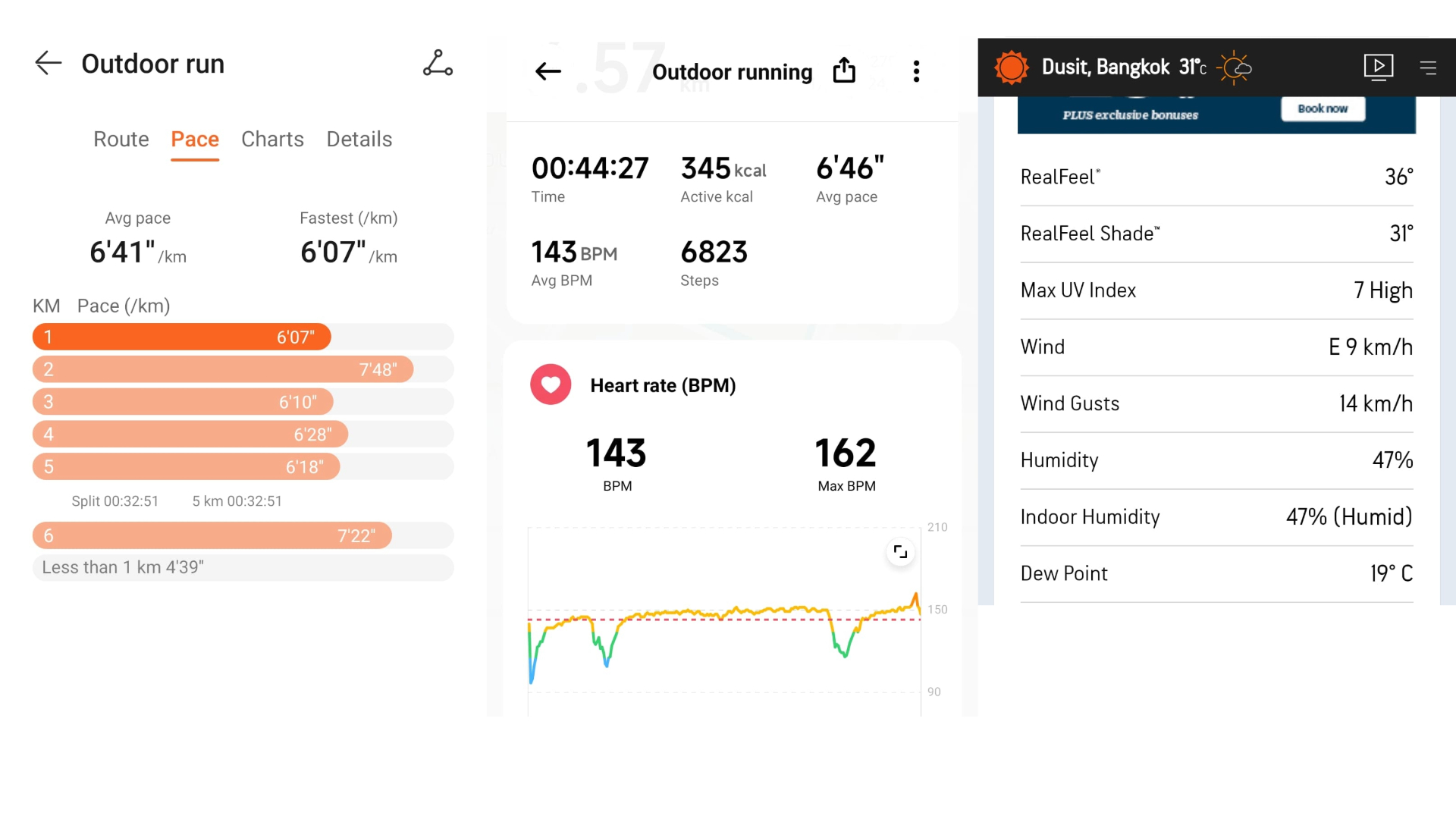
heat impact example; running 7+ k at 31 C (88 F), in the mid-day sun


The other question I had related to the impact of running when it's hotter, when it's not in the mid 80s, but around 90 instead.  A recent outing tested that:


It really wasn't that hot; on that first run it was 30 C, 86 F, and on this second it was 31, 88 F.  The first was in the evening, after dark, and this was in mid-day sun, running between noon and 1 PM, and it really makes a difference.  Of course it does, as humidity level and breeze does (or lack of it), but I mean that you can have a completely different kind of experience, not that it's a noticeable slight change.  

47% humidity is on the dry side for here; I suppose that helped, but running in direct mid-day sunlight was a more problematic negative input.  Those temperatures I've cited are some central Bangkok measurement; I was probably experiencing a broader gap where I actually was, out on a running track / sidewalk environment.

On one running course I complete two 5k laps, with no second warm stretch, and on this route I do either 2 or 3 3.7 km segments, with a warm stretch after 1 km.  On that second heart rate dip (above, during km 6) I was walking to rest, to drop my heart rate, which had been pegged at or near 150 the whole time.  I think that tied to heat stress input, but I haven't fully sorted out other possible variables.  It's easy to write off having any rough outing as heat input, but there's probably more to it.


a track / path around the local royal palace


that running path at night, lit up for some holiday or memorial theme


what it looks like in the daytime


One might wonder, how is this informative or actionable, beyond prompting me to try out that split-pace approach?  I suppose it's not.  I could've felt that the second run described here wasn't going as well without a heart rate stat filling that part in, that I was hot.  I was averaging 6:15 km paces, just not on the two one-km splits with a stretch and walking break, so it wasn't really fast or slow, but it was taking effort to do that.  The second 5k of that earlier run was slightly faster, right on 6 minutes / km instead, at significantly lower heart rate, just below 145 average instead of close to 150.  You can feel that difference.

It's a different thing running against conditioning level versus pushing heat stress tolerance.  You feel a bit tired after an hour of medium intensity running, but that heat stress stays with you, even when only enduring 40 minutes worth of it.  I won't do hour long outings when the heat is getting to me; I could back way off a normal pace and tolerate it better (maybe; I never really try running 7 minute km pace), but it's habit to just stay in a normal pace range and call it a day early.  If I feel off I'll run 6:30 kilometers but beyond that I tend to just pack it in.


Trying out tracking heart rate was only ever about sorting out these patterns, which I had already experienced without tracking that.  I can run a 6 minute km, or 6:30, by feel, even with outdoor temperature input factoring in.  It's odd that the one is such a fast pace for me and other slow; that distribution could be broader.  I think with less heat-stress for running context, actually running when it's below 80 F / 27 C, I could train differently, and make better progress.


In Honolulu now, a daytime high of 78, breezy, with a chance of light rain.  Perfect!


the view running around Diamondhead; pretty nice