Showing posts with label William Osmont. Show all posts

Saturday, February 8, 2025

Farmerleaf Na Lang Laos sheng pu'er


This is the sheng pu'er version I talked about, I think, that I tried with William and cited in the last post about meeting him, a Spring 2024 Na Lang from Laos.

Since I've already introduced this tea I'm going to strip down these tasting notes to what it seemed like to me, removing a lot of the speculation or tangents.  I'll add a little back in with the conclusions, but this will work well kept shorter, without the usual rambling on.  This is William's site description (part of it):


Spring 2024, medium-big trees from forested gardens (listing for $140 per 357 gram cake)

Na Lang village, Nyot Ou District, Laos

A powerful Yiwu-style tea with great endurance 


This is typically the kind of tea you would find in Gua Feng Zhai for twice the price. The point of this tea is not the fragrance, but the good thickness in the soup and the deep Huigan. 

Considering the renown of Yiwu tea, and the high prices its tea fetch, it is not surprising that many tea traders cross the border to Laos and source tea from Nyot Ou district. As a result, most of the tea made in Nyot Ou is bought by tea producers from Yiwu.

Tea grows in the forests of Nyot Ou district along two valleys. The Southern valley is connected to Gua Feng Zhai village through a small road. The environment in which tea grows is similar in Eastern Yiwu and in the two tea producing valleys of Nyot Ou District. Ancient tea trees grow along more recently established gardens in the forests.
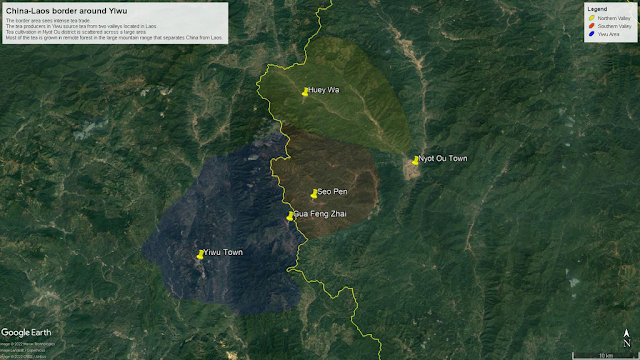

from the Farmerleaf site product page


That's a common, well-known theme, that lots of tea from lots of places goes back to China to become pu'er.  I skipped the "pu'er-like tea" limitation earlier, the admission that the type is a regionally limited designation, only applying to teas from Yunnan.  That's a bit absurd, isn't it, given that context, that any tea from Laos, Vietnam, or Myanmar (and less from Thailand) that crosses the border, and is mis-represented in terms of origin, sort of is and also isn't pu'er?  And a very considerable volume of tea undergoes this transition, far more than is ever sold as Laos tea.

It's the best of both worlds for Chinese producers and vendors; they can dismiss those origin area teas as separate and inferior, and then buy them and resell those same teas as the upgraded local version, simply by blending and then mis-labeling them.  Let's move on to how this tea is.

I never do address whether this is like Yiwu or not, a claim made in this description.  I've experienced relatively consistent character in trying a reasonable amount of Yiwu, but it's my impression that I've not experienced a lot more than I've tried, especially related to distinctive versions and higher quality levels.  So I'll just describe what I am experiencing.


I think it makes sense for vendors to never mention much about flavor range.  It would vary over time, and even more so in relation to varying interpretations.  In this review I mention it seeming to taste different when trying this same tea two different times, and I speculate about why that is, real factors that could've changed what I experienced, not just the interpretation.  

William's description doesn't even include a general flavor reference, like "floral," and again I see that as reasonable.  To some it would seem floral, and to others fruity, and different factors could change the compound inputs that these are based on.  It's fine as long as a description can pass on enough range description to draw interest, or inform in some other way.


Review:


First infusion:  a little light, but that's a good way to start, brewing the first round fast to get an initial sense, and letting the second be more typical of the rest.  Flavor is good; quite catchy.  There's a pine-like aspect that others could interpret related to other vegetal range, but only a little.  A fruity tone is something else, on towards juicyfruit gum, or back in the range of natural flavors not really tied to just one, but not so far off tangerine.  Feel is nice; it has some structure, already, but that doesn't seem to track towards being unapproachable.

I've already tried this tea, so this isn't the blind tasting approach I typically use.  I know where this is going, and this tea version is pretty exceptional.  I'll fill in more of an aspects list next round.  

It's completely whole leaf material, not too compressed, so it would be easy to drink it unbroken, but I used some from the parts that had already split off in this tasting, more broken material.  Maybe that's not ideal, but I suppose it's a normal real-life experience form.  I hadn't thought it through getting it ready; depending on how focused in I am I might use the broken material also in the wrapper or carefully separate off some relatively whole leaves.


Second infusion:  that catchy fruit related tone really pops in a stronger round.  Bitterness and astringency really ramp up too; those would be more moderate if someone was more careful about not breaking the leaves.  

The bit of pine, or however that vegetal edge is interpreted, integrates wonderfully with the sweetness, bitterness, fruit tone, and background floral range.  

Intensity is good; I supposed based on what I said in the post about talking with William I should comment on that.  It's not by way of harsh aspects being dominant either; in better quality cakes strong sweetness, bitterness, feel, and positive flavors really stand out.  This is really clean in overall effect; it's not as if young sheng tends to be murky, or to taste like a cinderblock, as comes up more with Liu Bao, but there can be an emergent sort of impression of clarity and cleanness, or lack of that.  

This doesn't seem completely identical to when I first tried it with William.  It was exceptional then, and it is now, but minor inputs can vary, shifting the outcome.  I'm using water from a hot water dispenser and filtration system, so it's not at full boiling point; that changes things.  It's a different version of water.  This leaf is little more broken, as I've mentioned.  We drank this tea in the middle of trying a half dozen versions; that can affect impression and memory.  It seemed to include more bright floral range in that tasting, leaning towards bright citrus, and it probably did, based on those differences. 


Third infusion:  the tone seems to be warming.  It had warmth and depth before, but it's evolving to include a lot of that.  The leaf color is mixed, including some darker range, making me wonder if somehow oxidation level didn't vary a little in this initially.  How?  I'll add more about one thing William said in the conclusions, that might have entered in.

I personally love that effect, when sweetness, flavor complexity, and slight warmth gives a young sheng a much more approachable character.  I suppose people could be mixed on how they relate to that input and effect.  

I'm not doing justice to what I take to be a fruit tone.  It's not so far off dried mango, which surely isn't all one thing, since there are lots of kinds of mangos.  That one flavor input is positive, but it's how it integrates with the rest that works well.  It's intense and refined enough, which can be hard to place within the entire sheng range, or in relation to higher quality versions, or typical Yiwu styles. 

I didn't mention that the intensity carries over to aftertaste experience.  That almost goes without saying, but not completely.


Fourth infusion:  now that warm, sweet aspect tastes more like dried apricot to me, so much so that I'm questioning my earlier interpretations.  It's a lot like apricot, a pretty direct match.  It's quite delicious.  There is plenty of astringency and bitterness to balance it, but it's a quite approachable tea, at the same time.  Someone being more careful than I was to not break the leaves would moderate those parts just a little.

Intensity is so good, and flavors so fresh and bright, that it seems this will go on forever.  It won't; based on trying an earlier cycle this will make a lot of infusions, using the high proportion that's my default, but eventually flavors will thin and bitterness will play a different role.  It's great while it lasts though, which is for awhile.  The bitterness and sweetness stays in your mouth after you drink it, along with that fruit flavor, adding some extra exposure to appreciate.


Fifth infusion:  it's not transitioning all that much, which is as well, because I'm running out of patience for making these notes anyway.  Feel might become richer; that's an interesting shift, for this stage.  It has had pretty good feel structure for this whole cycle, but it gains just a little richness, towards a pleasant sappy feel.  To me that one interesting and positive fruit note integrating with the rest well is the main story, with other range playing a supporting role.  


Conclusions:


It's good, very intense, refined, pleasant, interesting, well-balanced, and so on.  I can't place it in relation to Yiwu range, but this probably is the best Laos sheng I've ever tried, and it might be about the 15th version I've tried.  The warm fruit range was interesting.  Floral tones are often dominant, across a lot of sheng range.  Versions can transition quite a bit, aging over even 9 months or so, but this was quite warm and fruity, and a year of aging input wouldn't cause that.

Back to that oxidation input issue:  William had said that if a producer backs off the kill-green completeness even a little (if I'm remembering this part right) that the stems can not be as fully fixed (compounds inactivated).  Then these can turn redder, more oxidized, as the tea dries, shifting the final character.  Maybe that happened in this?  It would explain the darker colors in some of the material, and also those heavier tones, the fruit range versus the floral, and warmth.

That's all just speculation.  The tea is really nice, the main thing.

Is it worth $140 a cake?  Sure, if someone is open to paying that for it.  It's novel, so there isn't any one established market supply and demand based pricing level.  It could be $500 or 1000, if people are open to paying that.  

There's a general expectation that quality level and range of related experiences out there are the competing factors; there are ways to buy a lot of Yiwu versions, and some other Laos teas, just none that I've tried like this.  If somewhat equivalent versions really do tend to cost $280 instead then maybe this is a great value.  I'm not buying any teas that cost over $100 per cake, so I'm just not part of the whole community, in one sense.  That's about budget limitation, not idealism.  If my tea budget was much different I'd buy this, for sure, but I certainly don't experience that as a regret.  My life balance is something to be thankful for, not to focus on regrets over.

Beyond those concerns the tea character is really interesting and positive.  I've really appreciated the opportunity to try this, and to have some to drink, since William shared a fair amount, not just a sample.  Many thanks to him!


Thursday, February 6, 2025

Meeting William Osmont of Farmerleaf


trying khao soy, a favorite Northern Thai curry noodle dish


Typically meeting someone and having tea with them isn't a novel enough theme to write about, but this was especially interesting.  I've talked online with William for years; he was active in tea forum and group discussions since prior to when I started blogging, over 11 years ago.  Here's an interview post with him from 2017.  I had bought Farmerleaf tea more at one point, and regularly reviewed versions, but have moved on to other sources.

Let's start there, and get the awkward part out of the way.  What I've said online about Farmerleaf could be taken as meaning that they had been a good value source for pu'er, and for good black tea, Dian Hong, my favorite black tea style, but now aren't, having increased pricing over the years.  Part of that is what I've said; all pu'er vendors have increased pricing quite a bit over the last decade, and Farmerleaf is no different.  Their cakes were selling for $40 or 50 8 or 9 years ago, and now it's $90 to 120, for a basic quality range.  So how is it still a good value?

They've improved quality of what they sell over that time (per my impression, but then maybe I'm not the right person to know).  It's a natural shift, for vendors to cater to whatever demand the market provides, and that pattern holds for other vendors too.  Yunnan Sourcing Impression cakes, their in-house benchmark tea line, shifted from $40 versions to around the $100 range over that timeframe, presented as better quality tea.  They're surely better now, not as much "generic" blends, onto better quality, more carefully created and exceptional versions.  Prices for everything have increased, not just tea, but especially for above average sheng pu'er.

My focus on budget as a primary constraint relates to my own tea budget being tight, all the time.  I work in Thailand, in a Thai company, and my salary matches the cost of living here.  I now live part-time in Honolulu, where my kids go to school, and that has stretched that SE Asian income to the breaking point.  So I've been buying teas from Vietnam and Thailand more lately, at exceptional value for buying directly from small producers, or from Viet Sun, which is transitioning through the same theme, sourcing better teas over time, and then increasing pricing range.  

Farmerleaf teas are surely a decent value, if spending around $100 on cakes seems fine (357 gram standard sized versions).  William passed on some samples; I'll have lots more to say about that theme in more detail, and the rest of this makes a short start into it.

Back to more about William then.  It was also great to meet his wife and son; they're both wonderful.  But this is mostly about our discussion about tea, so more of what he said.  Of course his wife is also a tea producer and expert, and she offered some input too, but this will be more about him, not really attributing any input to her, even though she did offer some.  


His tea preferences


This part was especially interesting to me; what would he look for and value in teas?  Would it relate to a certain style or flavor preference, or for some other aspect?  In a word:  intensity.  Intensity can mean strong flavors, but it can also relate to fullness of feel, both of which tend to carry over to aftertaste expression, to sweetness and bitterness being present at significant levels, and to depth, covering some range.  According to William you can make processing adjustments to vary tea character but you can't get mediocre material to express intensity.  You can brew teas strong to push them, or drink it extra young, and so on, but the material only has so much to offer.  All that seems to work.

What are the limitations of this primary focus?  This part is more speculation.  There's no reason why you couldn't look for one primary characteristic and also appreciate others, and for sure William is doing that.  Beyond intensity the flavor range expressed varies, depth is really kind of a different thing, and balance is something else, how it all comes together.  My impression is that none of this is lost on William, even though he really loves sheng intensity, and sees it as a main quality marker.

Who doesn't?  We've talked before about how this may be a big part of why other tea types lose appeal once someone switches over to sheng pu'er preference.  I've said this over and over again, mostly while reviewing oolongs.  Those can be fantastic but you feel that lack of intensity, even though you can stay open to those other styles of tea, and tea experiences.  Somehow the depth and comfort of black tea remains very desirable, to me, and I can still appreciate all the other tea range, even green tea, my least favorite, but I keep coming back to craving sheng, and mostly drink young sheng.  Flavors are intense, mouthfeel is intense, and even though I don't "get" cha qi, body feel, to the extent some describe it that's part of it too.


Tea processing


I won't do this part justice, but we talked some about the processing steps and variations that lead to positive sheng and black tea character, and aspects.  Until I get some real life exposure to processing tea leaves I'll never have much to add about this, and even conveying what others say will be of limited usefulness, since I won't be able to interpret it very well.  Of course I've been hearing from tea producers for a decade about processing steps, and their own unique approaches, opportunities (from working with distinctive tea material), or challenges.

For sheng it's all pretty much what you'd already expect.  One interesting tangent was about more-oxidized South East Asian sheng versions.  I've speculated over and over that Thai and Vietnamese producers may be oxidizing tea more to change the character, which can offset bitterness and astringency, but which comes at a cost in terms of aging potential.  That's kind of a loaded concept, aging potential, bringing in a lot of other moving parts, and preference factors.  Aged sheng is a different kind of thing, and our discussion focused more on parts related to younger / newer versions.  It's possible that Thai and other producers wouldn't even need to try to let tea rest / wither to increase oxidation input, that they may just not get to it quickly, and the heat and humidity might start to change the tea fast.

William didn't even need to try one of my favorite Thai sheng versions to notice that the color was quite dark for a year-old version (golden, instead of light gold).  Some producers mention using a long withering process to add oxidation, and William discussed that a bit, how it works in practice.

It was all too much to convey here in detail.  Finer points of what can vary in pu'er and black tea processing were fascinating to hear about.  As I see it as a tea consumer we are kind of off the hook when it comes to that level of mapping anyway.  In the end we need to be able to find and buy teas we like, and then appreciate them, but the parts entering in before that are a bit academic, potentially interesting, or even informative, but not a main concern.  It really wouldn't work for producers and then vendors to map out slight variations in processing inputs to help consumers filter what they might like best using that input.  There are too many variables.  Knowing that a Shai Hong is a bit less oxidized is a good example of how very limited information might be interesting and helpful.  

It may help to know more about the different inputs to buy better teas, beyond that level.  Patterns in aspects or sources of teas could make more sense.  Or to seek out better value?  That part is always tricky.  What we value others tend to value, then the market pushes up pricing level.  It can help exploring new tea range, staying one step ahead of that deeper part of the demand curve, but drinking some so-so or bad tea enters in, along with trying very novel forms, and some exceptional versions.  

The last range I tried that was really novel, beyond the Thai and Vietnamese teas being exceptional in slightly unique ways, related to Georgian tea, and before that Indonesian versions, then before that Nepal teas.  Getting hooked on pu'er messed up that shifting exploration theme a bit; the other material and styles can't match pu'er intensity, or even complexity.  For where I am personally the exploration phase has tapered off some, and I get to what I get to, but I'll skip including more tangent about that here.


What we tried


We started with some teas I had brought, to see what he made of them.  His take was mixed; of course he is accustomed to trying some pretty good range.  It's not that he is biased towards narrow Yunnan styles, but if Thai teas are pretty good, based on pretty good material, and not quite standard processing, there are aspects and outcomes to appreciate but it's all not ideal.  The best Yunnan versions are drawing on a much more developed background.

We tried a decent sheng version of his earlier on, one that represented the lower end of his quality range.  This ties back to that earlier theme of value, and what the trade-offs would be if he was trying to keep closer to the earlier, lower sheng pricing range.  It was good, it just lacked a bit of intensity, and the character lacked depth.  It wasn't flawed, and also not thin or uninteresting, but a little towards that.  

A shou version was better, placed within that range, but I don't really love shou as much.  It's nice trying good versions of it, but I've been doing that, for awhile.  They just sit in my tea storage, when I come by that, and I drink that when I fast (not eat for five days at a time), because it's easier on your stomach.

A Laos sheng version was exceptional (I think maybe this one).  I might've tried about as much Laos tea as almost anyone, or at least anyone not in Laos, or not selling Laos tea.  I first visited a Laos coffee and tea farm before this blog even started, a few years before; it was one of the earlier teas I tried after Thai oolongs.  I've written about countless teas from Anna and Kinnari Tea, and have tried plenty of samples from a friend there (thanks to Somnuc), and some of a somewhat newish production venture.  

This version probably surpassed them all.  Intensity was good, of course, and flavor range was quite positive, sweet and floral, almost towards a citrusy edge, but not quite onto lemon or orange.  The tea was very balanced and refined, with fantastic clean character, depth, and complexity.  I guess this is the kind of exceptional tea that you can only buy if you can go past that $120 per cake range I'd mentioned (it's $140, if it is that one).  Is that a good value?  It would cost a lot more if it was from nearby Yiwu, essentially just across the border.  Since this specific version is essentially impossible to find there is no market price for it.  Related to quality it was amazing; I guess that part works out.

Maybe we had tried more; it went on and on.  Hours and hours into tasting it all kind of runs together, and it was fascinating hearing William's take on philosophy, and the state of the US, about China, and whatever else we talked about.

William and I are both pro-China in two different senses.  He can almost be an expat resident patriot, at this point, and he is sold on the overall positive balance of Chinese culture and life in China.  I'll just cite one example of that discussion, not so much about local Chinese patriotism, but about a misconception about China in "the West."  We talked about social credit scoring, about how China really did experiment with the systems that we are familiar with and critical of in other countries, particularly in the US.  His take is that those experiments didn't lead to a pervasive system that really does control people, or even continue to monitor them, and it was largely dropped because the earlier start wasn't promising.  

Of course China is really keeping an eye on its citizens, but then so is the US, and to some extent so is Thailand.  Maybe the form and related restrictions vary in the three places, and in the US it's possible there are less restrictions (maybe not enough, across some scope), but it's not as if people in China can't do or say a lot of things.  Being anti-government might not go over well, but according to William most people are ok with most of the government policies and everyday living status.  They don't see themselves as oppressed.  That mirrors talking to a Chinese friend, one of my daughter's former classmates (who of course is from China); they don't see the differences there as so significant.

As with here in Thailand much lower crime rates and far fewer problems with drug epidemics, gang violence, and homelessness frees people, to a greater extent.  I can walk around almost anywhere in Bangkok at any time of the day or night.  I've not tested that out by walking in remote or poorer parts in the middle of the night (but I have in the evening), and I suppose eventually that might go badly, but in essence there are no "no go" zones.  In visiting China three times in the past I felt pretty safe there too.  Of course there is relatively little meaning in that; input related to living in a city for 17 years and visiting tourist areas for two or three weeks are relatively opposite things.  

It's a very developed, modern country, from what I've seen, not really any different than anywhere else, beyond everywhere you travel feeling just a little different.  William commented that the old-style look of the food-street restaurants in my favorite Bangkok strip of those isn't how China looks almost anywhere now, the steel tables, plastic chairs, and bright white fluorescent lighting, common across SE Asia.  They've moved on.  I like that about Bangkok; losing that part would kind of be a shame.  Of course there are a broad range of restaurant themes here.

It was fascinating hearing about a two-tier election system in France, about how they use two voting stages to let people vote for diverse parties initially, then do a second and final selection process based around coalitions that form after the first round.  I don't think this could work as a fix for the two-party limitation in the US, but it's interesting hearing about a different country using a different process, that leads to more diversity in party options.


Conclusions, take-aways


It was too much to summarize to just a few simple conclusions, but this writing already points towards a few.  We talked more about social media themes, and tea vendor approaches, but it didn't condense to points that would stand alone well in summary form here.  

Everyone who has had even limited exposure to William's take on the internet, in very informative Youtube videos on tea processing background, already knew that he is a true tea enthusiast.  Here's an interesting example of that, in his own online content, comparing tea versions and asking if gushu versions are really worth it.  His own "tea geek" interest and perspective takes a relatively narrow form, as I see it, but then that's typically how that goes.  You'd need to limit scope to go that deep, and a Yunnan producer and vendor should be an expert on pu'er and Yunnan black tea.  


Here's another very different video on perspective on the Covid experience that stood out to me, him conveying a philosophical view of how we relate within society, and what those kinds of traumatic broad events mean.  We covered some philosophy in discussion too; of course I'll spare you an account of that.

I really thought that William would be a little quirkier; if anything that was a little disappointing.  He's a bit out there, don't get me wrong, but for being a French pu'er expert he falls a little short of really being eccentric (no offense intended to Olivier; he's fine too).  He's even completely relatable; all for the best, I guess.  Sometimes it's hard for people so far down the path of exploring tea to stay open to a range of different perspectives, but it's nice when they can, and he's pretty open to people experiencing teas in different ways.

To me one potential pitfall of sheng pu'er exploration is people "chasing the dragon" related to quality and diversity concerns; there's always more to seek out and experience.  There is more intensity, complexity, refinement, novel flavor sets, trendy origin areas, unique styles, and so on to try.  That's fine, as long as all the comparisons and next steps don't lead to a FOMO based experience of gaps, and chasing status, instead of focus on appreciation of that experience.  

It wouldn't be the vendor or producers' fault if people approached their tea interest in a problematic way, and I see William as appreciating a good bit of range, not steering others to always try more and spend more.  Any more than any other vendor, I guess.  The tea experience promotes itself, once you get started.  

In beginner online group discussion I usually recommend people might start on oolong and black tea first, to avoid pu'er early on, and stay out of the deep end of the pool related to that more intense cycle of exploration.  Bitterness requires some acclimation anyway, for young sheng, but it's also a lot to take on sorting out the range of styles, origins, sources, storage themes, and varying experiences.  Once someone goes there they probably should cycle through some Farmerleaf tea at some point, and saying more in reviews about samples will add detail to why I think that.


Thursday, April 27, 2017

Interview with William Osmont of Farmerleaf, a Yunnan tea producer


William weighing harvested tea


Originally posted in two parts on TChing here and here.

Related to writing a tea blog and helping run a Facebook tea group I talk to lots of interesting people about the subject, recently including William Osmont of Farmerleaf.  I’ve reviewed some very nice teas from them, different Yunnan Dian Hong black tea versions (here and here), a Moonlight white, and of course pu’er.

This article is about his background with producing tea, and about typical questions that come up related to that area, about sub-regional variations, production and sourcing issues, and pu’er aging / fermentation.  In particular vendor marketing claims about Yunnan tea tree ages have been a source of controversy, related to some being disputed on social media, and William offers his opinions on the effect of tea tree age on tea character and about identifying tree ages.


How did you get started on an interest in tea?  


It all started on a sunny afternoon in French Provence.  With two friends, we were hanging out in the streets of our little town, and we stumbled upon a newly opened tea shop. We tried different flavored teas, and I really loved the different tastes. I hadn’t paid much attention to tea so far. I drank flavored tea for a couple of months and then got into Darjeeling, Chinese green tea, African black tea… until I tried a 1998 ripe Pu-erh tea. I clearly remember that first session with Pu-erh tea, and from that time, I knew I would dedicate my life to this beverage.

After high school, I went to Yunnan for a year, in pursuit of better teas. That was the best year of my life, I was 19 and free to explore. I studied Chinese in Kunming for six months and then moved to the South of Yunnan, in Xishuangbanna. I would visit one or two tea mountain every week, learning about the taste of tea and the different processing method.

One day, as I was visiting Jingmai, I met a beautiful Dai girl named Yubai, who had only started her own tea factory that year. We fell in love, and she is now my wife.

In a fair deal with my parents, I would return to Europe and go to university after one year. I was really interested in biology and ecology. I wanted to go back to China as often as possible and start something in tea. In 2012, I opened an online tea shop (www.bannacha.com) in which I sold mainly Pu-erh teas from farmers I had met. A large part of it was made by my girlfriend in Jingmai. This little website allowed me to put a foot into the tea business and I am really grateful to the customers who trusted us for all those years. The profits allowed my girlfriend and me to meet every summer holiday in China, strengthening our love and expanding our tea network in Yunnan.

I graduated in 2016 and obtained a master’s degree in agricultural development. Yubai and I are now married, and we live in Yunnan for good. We have started our Pu-erh brand Jing Yu Tian Xiang, which we retail in China and abroad. We’ve also opened a new website: www.farmer-leaf.com, on which we sell a wider range of Yunnan teas from our tea factory as well as from other farmers.

Yu Bai processing tea


What do you see as the main differences in selling tea based out of Europe and from China?


Being based in China helps a lot with sourcing. As you know, building and nurturing relationships in the Middle Kingdom is extremely important, and it’s all the more convenient to be present all year-round.

Being based in a tea mountain in Yunnan is a great opportunity to understand the technicalities of tea production, and how the farmers make their choices in terms of agricultural practices. Some aspects of tea can only be understood by having a long term presence in a tea mountain.  Understanding the details of tea processing requires making dozens of trials, sharing tips with fellow tea producers and experimenting.

Being online-based, the distance with the tea consumers doesn’t affect the relationship, we exchange emails with our customers every day.  It is always great to receive feedback and questions. Our objective is to bring the tea lovers closer to the tea gardens. In 2017, we have decided to close the distance by running a Youtube channel. Some tea fellows even visit us in Jingmai, and it’s a pleasure to take them around our tea gardens.


What are some differences between Western tea enthusiast based tea traditions and the original Chinese traditions, or modern practices?  


The way tea is brewed in China varies widely, depending on the province and the interest of the tea drinkers. The most common way is to brew tea in a large glass, what is sometimes called “Grandpa-style” in the West.

Just like in the West, Gongfu brewing is reserved to the “hardcore” tea lovers and the professionals. It is more prevalent in Yunnan, Fujian and Guangdong, because these provinces have a long history of tea drinking. In the last decades, China has experienced a revival of the tea culture; this is a luxury few could afford in the past. Gongfu-brewing spreads along with high quality leaves, just like in the West.


Your website mentions producing pu’er; do you also actually make any other types of teas?  Do you produce shou / shu?  


Yubai, my wife, has run a small tea factory in Jingmai since 2011. We now operate it together and produce white, oolong and Pu-erh tea. Our teas are hand-processed, which mean we cook the leaves in a wok instead of using a machine. That allows a finer control over tea quality and opens more possibilities. We’re developing a line of semi-oxidized tea that is unique in Jingmai, and we’re always trying to improve our Pu-erh tea processing.

We do not produce Shu Pu-erh; the extra fermentation process involved requires special skills, big infrastructure and a lot of tea. Usually, the large factory productions consist in batches of dozens of tons. Nowadays, it is possible to ferment the tea in micro-batches (as low as 100kg), we’re considering making such a production, but it still has to be outsourced. A lot of the fermented Pu-erh tea is made in Menghai , Southern Yunnan.


Can you share a short summary of the character differences in teas within different pu’er producing areas?  


Pu-erh tea features a wide range of tasting profiles. That diversity is due to differences in aging, processing and producing area. Just like the terroirs of wine, tea tastes different according to the genetics, location and management techniques of the tea gardens. It would take a whole book to detail the subtle variations between each mountain and their underlying factors.

Jingmai is famous in the world of tea for its orchid and honey fragrance. Some bitterness is present; astringency is more present than average. In young teas, the mouth feel is generally light and sweet. The Jingmai profile is accessible to the beginners and makes a great introduction to the world of Pu-erh tea because it has a bit of everything. In comparison, Bulang tea is generally more aggressive, featuring more bitterness; Yiwu tea is soft and mellow, with a thick mouth feel. Menkgu is renowned for its complex fragrance and sharp sweetness.

However, there are many exceptions in each terroirs, and the result in the cup can be very different depending on the processing. In Jingmai, old-growth tea that received a high-temperature kill-green process will feature the typical high-pitched orchid fragrance, with fast-changing bitterness and a light body; while tea that went through a low temperature kill-green process will have a thicker body, more sweetness and a honey-like aroma. There’s a lot of possibilities in-between.

Some tea gardens are known to produce more bitter leaves, while others grow particularly fragrant leaves. It is indirectly influenced by the soil type, garden design and agricultural techniques. For example, tea that grows on sandy soil will receive less water and nutrients than tea grown on clay soil, and that will influence the physiology of the tea tree and therefore the taste of its leaves.


What tea aspects indicate that a pu’er will age well, or what types of teas it would make more sense to not age?  One sometimes hears that in the original Chinese tea culture pu’er wasn’t intended to be aged to improve it; any thoughts on that?


Good Huigan (sweet and fresh feeling in the throat) will be sustained through the years, and this is one of the main criteria on which pu-erh tea is evaluated.

Make sure the tea you aged doesn’t taste like green tea or isn’t too red when young. This degree of greenness depends on the way the kill-green process was done. An overly green or red pu-erh tea can be very enjoyable when young, and be disappointing after years of aging.

The big tea factory blends are generally intended to be aged, they are not suitable for immediate drinking. Blends can be a safe choice for long term aging, even though they rarely contain high-quality material.

Bitterness tones down with age, but it doesn’t mean bitter teas will necessarily give a better tea once aged. For example, Yiwu tea generally has no bitterness, but it’s a sought after terroir for long term storage, this kind of tea can be unimpressive when young and turn into great sweet and complex teas after a couple of years of aging.

The Pu-erh tea culture is constantly changing; in its most current form, it is considered this tea can be enjoyed young, as it was consumed in Yunnan, and aged, as it was consumed in Guangdong. The Tibetan way of drinking it with Yak butter, doesn’t seem to have spread much. In a pre-industrial context of smallholders, it was technically much easier to produce Pu-erh tea than other types of teas. When made in small quantity, the only piece of equipment required is a wok. Sun-drying was used to dry tea, just like it was used to dry fruits, corn or cabbage.

The tea culture has been shaped through the constraints of production and logistics. People like wet-stored tea in Guangdong because that is the way tea would turn out in those conditions. Some tea lovers in the West build “pumidors”, while I have never found one in China. It is beautiful to see the tea culture evolve as tea spreads throughout the world.


2011 Jing Mai gushu (old tree) sheng pu'er


What is the local (Yunnan) understanding of ideal and problematic pu’er storage conditions?  Is environment humidity the primary concern?


In Yunnan, few people actively control humidity; they typically store the tea cakes in their bamboo wraps in cardboard boxes. When stored in large quantity, the air flow is somewhat limited, which is believed to preserve the fragrance of tea. Some tea professionals limit the air exchange further by wrapping the boxes with plastic sheets.  This technique makes sense as long as the leaves are not vacuum sealed. The aging process does require oxygen to occur, but the air contained inside the box should be enough for decades. A minority advocates for a complete removal of oxygen, this slows down the oxidation process and the tea profile evolves in a very different way.

Aging is the result of enzyme activity, called “enzymatic browning” in the food industry, and the action of micro-organisms. The relative importance of each in the aging process depends on humidity. In wet environments, microorganisms take a large role in tea oxidation, while in dry environments, their action is negligible. This probably explains the difference in taste profile that we can observe between wet and dry-stored teas.


What is the difference between using tea from just one plant to make tea versus mixing it?  Per input related to other tea types (eg. Dan Cong) the range of characteristics would be narrower; is this the same?


Pu-erh tea Single tree productions have been popular for a couple of years. Since only one or a handful of trees are harvested, the result in the cup varies widely. Some can have a very good throat-feel; others can be bitter and astringent, or sweet and fragrant… A big part of the appeal is to have the picture of the big tree and the feeling of tasting something very old. Self-suggestion can go a long way to make your session enjoyable, even though such productions wouldn’t necessarily perform better than a standard “gushu” harvest in a blind tasting.

Such productions are valuable by their limited quantity; you can hardly get more than a kilogram of dry tea from a single ancient tree. They can feature traits that are unexpected in their area of production and tend to change less along the infusions than standard productions that involve thousands of trees.


How much tea (leaf weight and dry weight) can an individual tea tree produce?


It really depends on the size of the tree, frequency of harvest, varietal, nutrients availability, water, sunlight, pest and disease, pruning method… It can go anywhere between 500g and 5kg of fresh leaves per year (about 120g to 1.2kg of dry tea). Some trees are picked three times a year, while other are picked thirty times.

What is your impression of how tea tree age affects pu’er quality or characteristics?


The leaves harvested from ancient gardens tend to have a better Huigan (sweet and fresh feeling in the throat), they can feature more pronounced bitterness that turns quickly into sweetness. They have an oily mouth feel that can remind of chicken soup. Their fragrance can be more complex than tea made from young plantations. Old-growth tea can generally be brewed more times than young plantations tea.

These differences can also be noticed when comparing young and older tea plantations. A lot of great tea comes from 50+ year-old tea plantations.

[Editor's note:  this does match a recent direct review comparison of two of his teas, one from old tree sources and the other from younger plants]


It’s important to keep in mind that the age of the trees is only one factor among others that makes good tea. The agricultural techniques and the location of the gardens (including altitude, soil, environment…) will have a large impact on the taste of tea. Some young plantations produce excellent tea, while some old tea gardens are not highly praised.


To what extent can tea tree ages be identified?


Following some heated debates on the internet, I have looked into the questions. Interestingly, I have found published scientific articles that discuss the age of specific trees. At best, the circumference of the trunks is measured, and this is only loosely correlated to the age of the tree. According to farmers and experts I interviewed, growth rate of the trunk varies widely, depending on soil fertility and genetics. In some cases, we can know the age of the tea gardens from historical records, but not the age of specific trees.

The tree ring counting method does not seem to be used in the case of the tea trees.

Some vendors use the age of the trees as a selling point, but I would rather recommend using the size of the trees, which is easier to confirm.