Showing posts with label bitter. Show all posts

Sunday, April 24, 2022

2014 Bada sheng pu'er from Chawang Shop


I'm kind of over the Chinese character labels


It's especially interesting trying these Chawang Shop teas since I don't remember what I thought sounded interesting it's been so long since ordering these, some months back now.  At least they're well rested, thanks in part to a covid-inspired break from tea, and a slow reviewing pace.  

I guess this version I'm reviewing sounded interesting:


2014 Chawangpu "Lao Yu" Xiao Bing Cha 200g

Lao Yu (老妪) : old woman

Material for this cake came from a small Bulang minority village in Bada mountain. This village have very small quantity of tea trees that grow in the forest. Trees are relative old, but farmers cut the branches when trees get too tall. Tea trees are kept at easy-picking height because the tea is picked and made by old women in this village. They follow ancient ways to produce tea. Many of them make tea only for themself. 

We selected and bought good materials from different families. They picked one bud and two leaves. This tea is nice example of old-time puer tea and traditions of Bulang minority.

2014 cake is a bit different with previous year. We keep nearly one year loose leaves "maocha" in Menghai town and pressed in Jan. 2015. Stone pressed in small tea factory. 

Taste of this tea is full, strong with bitterness, huigan is fast and sweet. 

Production date : March, 2014

Harvest Area : Bada, Menghai


It was really the overlap between sounding interesting, not costing much, and tying to a varying age theme that I was looking for, and this matched all of those.  The appeal implicit in that description would either come across or it wouldn't.  It's interesting considering that Bulang is both an area and an ethnic group, with a bit more on that here.

The subject of "middle aged pu'er" comes up a lot, something I've discussed recently in talking about storage conditions and aging inputs.  This will probably be young pu'er instead, although with 8 years of age it could be on the medium side instead, if it were stored in a warmer and wetter place (like Bangkok; it's over 90 F now at 10 AM, maybe a bit over 30 C, but it feels warmer for being soaking wet for humidity level, 63%).

I won't repeat much of all that about storage and transitions; this will just be about trying the tea.


Review:


First infusion:  it is nice, as the description called it.  Warm tones stand out, but there's a brightness to this too.  The warmth comes as underlying mineral, with brighter range harder to define as a light infusion.  Bitterness will ramp up with intensity, I think, but a sweetness while you drink it and afterwards both stand out.  The feel is not so astringent but includes a dryness.  

I've been starting to think that dryness is a main aspect related to dry storage, teas losing a harsher astringency edge, and softening, but heading towards an interim dryness instead of richness or fullness.  A limited range of wood tones might correspond too.  Or it could just be at a medium level based on a certain range of starting points you would get there, paired with other aspects depending on that set of inputs.

It's catchy, pleasant.  The warmth with moderate bitterness and long sweetness afterwards are all nice.


Second infusion:  intensity really ramped up, even for that infusion time being moderate.  I went with a maxed out proportion this time, noticing that it was a bit much for moderating intensity through brewing time variation, but I couldn't stop myself.  

Bitterness is significant; this is one of the most bitter teas I've drank in awhile.  It's an aspect range that I tend to not seek out, so I miss the most extreme examples entirely, but I can still relate to it.  As expected aging transition took a bit of edge off the character but definitely didn't get far through adjusting range.  It's kind of floral, the main flavor range, but there's a sort of bubble-gum fruit character too.  Warm mineral input is intense, along with bitterness, giving those a depth.


Third infusion:  I'm more or less trying a flash infusion; this is opened up and started already.  Vegetal flavor range increases, a plant stem / green wood sort of input that seems to tie to the bitterness.  There's still a cool floral range and harder to place fruit aspect, with warmer range giving this depth.  It packs a punch; bitterness hits hard, and even the sweetness afterwards is intense, with some bitterness joining that part too.  Feel develops a bit more sappiness, a fuller range of impact all across your tongue, with the sweetness moving towards the back as you experience it.  

I don't know how far I'll get in trying rounds without taking a break, at least for water.  For weather this hot it should be part of the tasting set-up.
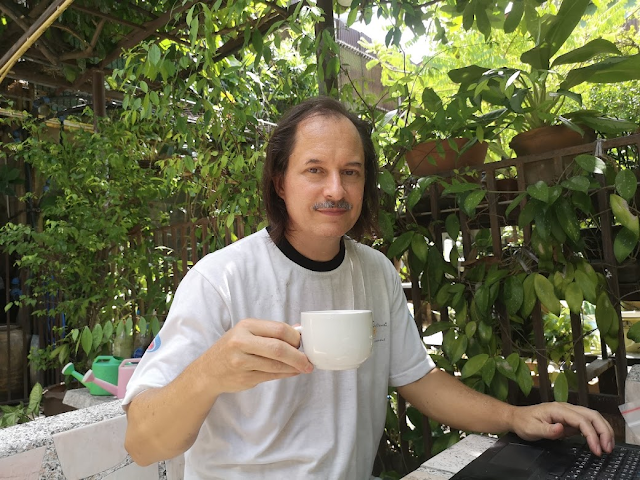


Fourth infusion:  a spice range develops, extending from the earlier warm tones.  Green vegetal input and somewhat non-distinct floral range are still present, with bitterness and sweetness dominant.   Someone looking for that sweet-bitter smack in the palate would love this tea.  Astringency is nice at this stage; dryness has eased up, with more depth and richness replacing it.  I don't want to say that the bitterness is too much for me but it's kind of like that; it would help to love it more, not just as an integrated part but as a dominant main aspect.

Kalani joined and tried a few drops, after the round was finished, and spit it back out.  It's an acquired taste.  She also took a photo for me, so that one can not follow the standard form.


Fifth infusion:  lesson learned about moderating proportion; even brewed fast this intensity is off the scale.  Not everything is those mild semi-aged or more character neutral versions I drink more of.  No significant change; I'll go do a break, drink some water, eat a little of whatever is on the table in the house, and try a couple more rounds, before it's off to some play area.


Sixth infusion:  I didn't realize that my head was spinning quite that much until I took a break and laid down.  I don't keep track of which "cha qi" is the good version, but drinking this on an empty stomach seems like a bad idea.  And I didn't; for breakfast I ate fresh pineapple, banana, and some traditional Thai baked good (that's hard to describe), but all that is lower on offsetting that drug-like impact than a bowl of cereal or toast and jam.  At most I'll drink two more rounds.

It's warming, settling into a nice range.  I suppose if this was much "younger" and bitterness was lower I'd guess it might've oxidized a little, for that warm tone matching how that input can go, but it had to evolve there through aging input, or the bitterness should've moderated more if they had let it oxidize during processing, not "fixing" it fast enough.  Just guesses, really.

I do like this tea but overall intensity and feel intensity are a bit much.  In a few more years this could moderate a bit, and be easier to relate to for me.  Maybe in another decade it would be really nice, stored somewhere it will actually transition, but for owning a half sized cake I'll probably never know, even if I just try this a couple of times a year.


Seventh infusion:  I rarely mention how much tea volume I'm really drinking, and don't emphasize parameters, but the .7 liter thermos I'm using is pretty much empty.  This had to be something like 6 grams of tea, brewed in a 100 ml gaiwan, using water not far off full boiling point.  Backing off that proportion would have made more sense.

I'm not doing justice to describing the complexity in terms of part of this flavor range being warm and part being bright, leaning towards fruit.  Warmth I've described as in mineral range, or towards spice, but aromatic wood is starting to apply more, cedar or something such.  Fruit is more onto dried Chinese date now, jujube, maybe with a bit of longan character.  Yesterday, and often really, I had a mixed Chinese and ice bean desert, one of my favorite Chinese-Thai food experiences, this time in Chinatown.  The range is not separate from that.


my wife (right) and her friend with me in the Bangkok Chinatown


Eighth infusion:  I took the cat inside to cool off in the middle of brewing a round, and diluted that--then brewed too strong--using the trick of doing an immediate flash infusion to combine with the other.  This is really catchy.  Floral tones are picking up, it seems.  It had always expressed a lot of nice floral range but it develops more richness (and intensity, the single word that describes this tea experience best).  A Bangkok summer day is ramping up here too, onto 95 F / maybe 35 C, so hot; it kind of works as a set, a lot of intense experience at the same time.


Conclusions:


I like this tea but it needs a couple of years to settle to a range I can identify with better, or maybe 4 or 5.  I think astringency probably did moderate in the 8 years since it was produced but if bitterness eased up it must've really been something earlier on.  It's nice that the other character and flavor is positive, but it's all just so intense.

I got blasted on this tea and stayed blasted.  It can be hard to separate that effect from heat impact, but it seemed like both.  To stick with and extend that theme I went for an 8 km run at around noon, in mid-90s (upper 30s C) temperature, which really sets the tone for the rest of the day, themed around recovering.  After the usual couple of hours of fighting with the kids about doing whatever I think we will go to a water park; it's so hot that only that or being in AC makes sense.  I'm not so sure how climbing 30 flights worth of stairs to do slides over and over will go.


that outing went well, except for one scraped knee


It seems a little abbreviated, placing these conclusions.  If I remember right I tried a Bada origin version that was nothing like this from Chawang Shop a few years back (reviewed here).  Scanning through that it included bitterness, as a three year old version, but not like this.  It comes up that tea tree varietals vary, a subject that it's hard to delve into much.  I don't know what caused that difference, or if one of these is more origin-typical than the other, or if both represent styles that should mean something to me, related to processing themes or other inputs.  It's all a work in progress, learning from multiple varied experiences, and it's not settling towards conclusions just yet, more the opposite.

This was an interesting experience.  There seems limited risk of this tea fading to become bland and uninteresting if I leave it sit awhile.  I have one tea left in that set to try, and they sent no samples this order (so much for the theme of tea bloggers being "bought off" by free tea for promotional benefit).  They're on their own page there at that outlet; I like that.  Apparent bone dry storage isn't a theme that everyone else would appreciate, but to me it kind of works out, trying teas that are feel-transitioned some after 8 years but probably not so different than they started out.


Sunday, October 13, 2019

Tea Side 2018 Thai "bitter leaf" sheng, 2019 steamed green


sheng left, green right (kind of similar though)


These two teas don't pair as closely in style as they might, following my own convention of trying very similar teas together, but it should work.  I just started dabbling in green tea again, and beyond adjustment for brewing temperature difference the character won't be completely separate.

It might be closer if this was a pan-fried green, versus being steamed, processed as sheng and Longjing green teas are instead of the main heating approach used for Japanese teas.  That difference should be interesting though, [as it turns out it was, since the green tea was nothing I would've expected].

Vendor descriptions:

2018 Bitter Leaf Raw Pu-erh Tea

Raw pu-erh tea made from Thai bitter leaf tea tree material.

This sheng does not resemble Bulang, nor Lao Man Er, nor other Chinese regions. But that is how I describe the organoleptic properties... The bitterness is so edible, soft. Without citrus notes - closer to the fragrant fresh wormwood. Now, if we add more sweet wildflowers and a drop of vanilla to this fragrant bitterness, then we get this sheng.

Many puerh producers seek to collect the harvest from sweet trees. And we, of course, understand them in this - everyone loves sweet tea, it is easy to sell, etc. But we are convinced that bitter-leaf pu-erh is seriously undervalued for two main reasons:

It has a powerful fragrant Huygan. That is not just a returning sweetness but a very fragrant sweet aftertaste.  It has a very potent relaxing and sedative Qi effect...


This is being sold for $70 for a 200 gram cake, so presented as above average quality tea related to the pricing.


Steamed old tree source green tea:

For this tea, we used Japanese traditional technology for steamed green tea but adapted it to the specifics of the material from old trees. It took several experiments to figure out the optimum steaming depth in order to remove the astringency of a powerful pu-erh leaf but to preserve the freshness and aroma of light and delicate green tea...

The aroma is sweet, appleish and floral. On the palate is a beautiful, whole and full-bodied mix of fruity-floral tropical notes. In the foreground are apples, plumeria and a bouquet of garden flowers. The finish is sweet and oily. The infusion is light, transparent, with a light green tint.


Sounds good; we'll see.  I never do add or read these vendor descriptions until the editing step, and giving this a quick scan later that sounds about right, essentially how I described it.

This tea version sells for $10 for 50 grams; reasonable enough if it really is a novel and high quality version of green tea.

Review:

sheng left; interesting brewed color difference


2018 "bitterleaf" ancient tree Thai sheng:  this definitely does have some bitterness to it; it's just getting started and it could already pass for a good version of Myanmar sheng.  The tree / plant types there must vary, because although most I've tried were on the bitter side the last sheng that I tried from Kokang wasn't.  This tea is pleasant; bitterness stands out but sweetness balances that.  Flavors are clean and feel has some thickness to it.  That range might even include some dried fruit.  Waiting a round for a more complete break-down makes sense.

2019 Spring 2019 steamed green from ancient trees in Thailand:  I didn't expect that to be like Japanese green teas, and it's not, but I also didn't expect how it is.  The flavors are warm and floral, with a bit of dried fruit supporting that, along the line of dried persimmon or even peach.  So much for concern over this being overly vegetal.

Green teas are never rich and warm in flavor and tone like this.  From the color it doesn't look like they've let it oxidize to warm the tone and shift character; it turned out that way via other causes.  Feel is on the soft side but with pretty good fullness.  It gives up aftertaste range in comparison with the sheng, but then that's how that would go.

Second infusion


2018 bitterleaf Thai sheng:  flavor warms a little. The bitterness is really nice, paired with a lot of residual sweetness.  Astringency isn't part of that; the feel is full and rich but not rough in any way.  It's just bitter.  Mineral undertones support that, warm versions of them, and subtle floral range rounds out the experience, trailing over into mild dried fruit range.  At some point splitting out flavor range over different levels gets to be guesswork and imagination, but to go there the fruit covers hints of nectarine and tangerine.

2019 steamed Thai green:  I really didn't expect this to stand up to the other tea as well, to be anywhere near as pleasant, on a few different levels.  Of course bitterness, feel, and aftertaste aren't comparable but the flavor range is great, the feel isn't thin at all, and overall experience complexity is good.  It's not vegetal, not grassy, like vegetables, and so on.  A faint trace of bitterness and some degree of residual sweetness adds complexity; both are more typical of sheng range, and not as pronounced as in this other sheng version, but they match up well against more modest quality sheng version character.  Warm mineral plays more of a role in this infusion, and it does seem to be swapping out some floral and fruit range for wood tone or mild vegetable, more like tree branch bud at this point.

Third infusion


2018 sheng:  I've been giving this around a 10 second infusion, based on also brewing the other version at the same time.  At this proportion it would work well faster too, using 6 seconds or so, not quite a flash infusion but a quick one.  It's not bad like this but there's more than enough intensity, so it just depends on preference for that level.

Lighter probably would be better.  Bitterness is still pleasant but it is a little strong.  The warm supporting tones, covering underlying mineral range, floral tones, and dried fruit, are pleasant, but the overall balance would probably work better quite light.  This might be shifting from dried fruit to include more wood tone as well, cured hardwood or something such, or closer to tree bark, maybe even a little towards tobacco.  It will be easier to split that out using a lighter infusion.

2019 steamed Thai green:  the overall effect isn't coming across in describing flavor as a list.  It's a bit creamy, with an interesting rich, full character.  Warm floral along the line of rose petal stands out now, with warm fruit range still around dried persimmon.  There is still a touch of flavor edge and mild astringency along the lines of tree bud tip or flower petal or stem, but not much, so it works to give it balance.  Sweetness level is nice; it balances all that. 

Fourth infusion:


2018 "bitterleaf" Thai sheng:  this is still bitter and plenty intense but it does balance better brewed faster, using a 5-6 second infusion time.  It's still cool the way that sweetness kicks in while you still drink the tea, and gets a lot stronger after you swallow it.  This has about as much residual sweetness (hui gan) as sheng ever tends to.  Other supporting range is still transitioning a little but not too far off where it was in the last round, mixing earlier floral and fruit flavors in with developing warm wood tone, probably closest to tree bark.

2019 steamed Thai green:  this hasn't transitioned much.  Maybe that rose petal floral tone is really closer to lavender, which could relate to me getting it wrong earlier instead of that changing.  Lavender tends to have a strong, rich, sweet smell, even when the scent isn't strong, and this is like that.  Again including some bitterness and trailing aftertaste gives this nice complexity.  It has less feel structure than the sheng while you drink it; it feels a little full but not in the same way.

Fifth infusion:


2018 "bitterleaf" Thai sheng:  not too much transition to speak of; the balance of earlier aspects may be shifting a little, but not in any way that changes much.  Bitterness might be tapering off just a little, with other range filling in more, balancing against that more.  Again a wood tone is picking up, more even in level against floral and other flavor range.

2019 steamed Thai green:  it's nice how this is working out well being brewed using parameters pretty close to those for sheng.  I'm using slightly cooler water, nowhere near 70 C, probably closer to what the parameter tables list for oolong brewing, 85.  Given this feel is soft, with just a touch of astringency edge, it would probably still be fine brewed just off boiling point, or even at it.  I don't think it would be better, or probably as good, but it seems likely that would work.

This hasn't changed much either.  Creaminess is really nice, along with rich, sweet flavor complexity.  Floral tone stands out the most but it would work to interpret part of the brighter note as a hint of citrus, probably closest to tangerine.  Most of the flavor range is warmer and richer, but that brighter range contributes too, giving it nice complexity.  That may be what green teas tend to lack, beyond tasting vegetal, like grass or vegetables; they usually don't cover this range of complexity, for flavors or feel aspects, or including as much trailing sweetness aftertaste as this does.  A lot of sheng drinkers would like this better if some of the bitterness in the other sheng version added to all that, but that is subjective.

interesting color difference, for a year and a half of aging


The next infusion wasn't so different (the sixth); I'll skip the separate description.  Bitterness drops off in the sheng, and picks up in the green tea version, seemingly a function of going longer on the infusion time.  The green is finally picking up just a trace of vegetable tone, along the line of kale.  From here more of that will occur, as infusion times run longer to keep up intensity aspect proportions will shift as a result.  Both teas are still quite pleasant but not quite as nice as in the earlier cycle.

Conclusions


In trying a Longjing from Yunnan recently I was surprised that it included so much intensity, complexity, and sweetness, as this green tea version also did.  That tea started out with more of the characteristic nutty / toasted rice flavor aspect, then shifted more to floral, mineral undertone, and other flavor, much closer to this version.  Both were as good as any green teas I've yet to try, lacking the vegetable range flavors and astringency that I don't care for in green teas.  This version was probably a little more novel, not quite as intense in flavor but with more unusual character, with a lot going on.  This might be the fruitiest green tea I've tried, and possibly the creamiest in feel.

This sheng was nice.  Bitterness did stand out, matching the billing.  Astringency didn't, at all; interesting it could be that bitter without including much of that.  Feel structure was more complex than in the green tea version though, with good trailing sweetness in both, but a much stronger related effect in the sheng.  This sheng was a relatively high quality version, but the novel character stood out more than that.  Bitterness in young sheng is normal; that particular form of bitterness and the aspect range coupled with it is not.

It was interesting that the color showed as much aging as it did for the sheng, but then a year and a half enables more transition here in Thailand than in cooler, dryer climates.