Showing posts with label shai hong. Show all posts

Sunday, September 22, 2024

Ai Lao and Yiwu Yunnan black teas (Dian Hong)


Ai Lao left, Yiwu right, in all photos


I'm reviewing two Yunnan black teas from Tea Tracks, sent by the owner Jan to share and for review (many thanks).  Since Dian Hong means Yunnan black (/ red) tea in a sense these are definitely Dian Hong, but people also use that as a more limited style designation.  To me they're both Dian Hong.

Then Shai Hong, which means sun-dried black / red tea, is more or less a subset of that, or overlapping category, often used to identify versions that are backed off in oxidation level just a little, and more suitable for aging transition, deepening in flavor over a few years of storage time.  This post isn't mostly about all that; just mentioning it.

These are really nice.  I'll skip saying more and cite the vendor descriptions, what they are:


Yi Wu Black 易武晒红  (19.62 Euro for 100 grams, $21.92)


This Dianhong sun dried black tea is from Yi Wu, mainly know for it's Puerh teas. In Chinese this variation of black tea is called Shai Hong 晒红 (sun-dried red) as it is dried in the sun during processing. The tea has a great texture and a clean, a bit malty aroma. It can be brewed many times. For us it's the perfect breakfast tea.

Taste:  Full round body, a bit malty taste 

Origin:  Yi Wu, Xishuangbanna, Yunnan, China

Harvest:  Spring 2023


Ai Lao Wild Black 哀牢红  (19.62 Euro for 100 grams, $21.92)


This black tea comes from wild trees that grow in a protected forest near Ai Lao Shan. This tea has a clean taste with notes of berries. It's amazing to see what a fragrance and flavour this tea can produce without any flavouring.

It was a bit tricky to take a good picture of the cake. It's really that dark.

This tea has been pressed into 100g cakes.

Trees:  Wild tea trees growing in a protected forest

Origin:  Ai Lao Shan, Xishuangbanna, Yunnan, China

Harvest:  Spring 2023


the color difference is really something


separated out for brewing


Review:


Ai Lao:  tartness stands out first.  I dislike most tartness in black teas, but in some versions it can balance with the rest in pleasant ways.  The rest of this does integrate well with it, and is pleasant.  There are plenty of other layers to experience.  Sweetness is good, and general tone is quite rich.  

There's a typical malty sort of black tea base flavor, even leaning just a little towards that one orthodox Assam malt flavor aspect, and decent fruit tones beyond that.   Mineral is nice, a pleasant supporting aspect.  There are warm mineral tones, and also a touch that's a little sharper that's almost towards salt, giving it a savory edge.  It works well with the sweetness, fruit, and other complexity.

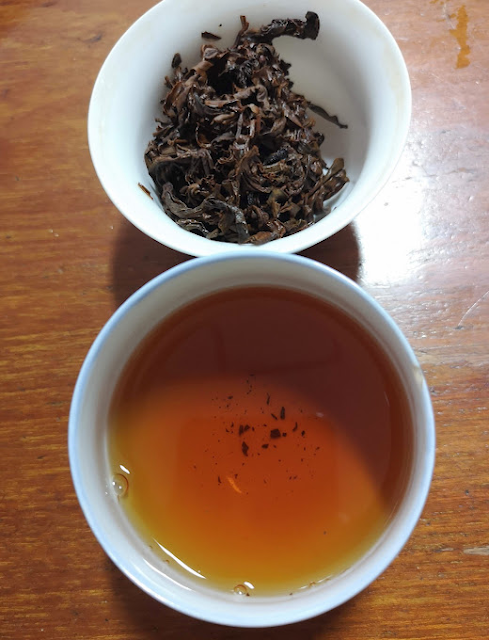
It's odd that this dry leaf is so much darker in appearance and then the brewed tea is lighter.  There may be meaning in that, but I don't know what it is if so.  When I first saw the dry versions I thought maybe the Yiwu was oxidized less, but for it brewing to a darker, redder liquid I'm not so sure.


Yiwu:  that is interesting.  A pronounced mineral range also stands out in this, also leaning a little towards salt.  Maybe there's something going on with my palate?  It's possible.  I had oatmeal for breakfast, along with two fried eggs, and some longkong and banana, with the banana mixed with chocolate protein powder, milk, and ice to make a smoothie.  A bit much, but a normal range; it shouldn't have thrown things off.

The aspect I described as malt in the other is a little drier in effect here, or so it comes across (nothing like Assam, but a short step towards that).  Feel structure is still fine, and sweetness provides a nice balance.  Both of these were brewed a little long; I went with lower proportion to stretch a large sample to two rounds, and they're probably about 6 grams worth (just a guess), so it's strange that is a low proportion, for me.  I tend to max out what the gaiwan will hold more often.  Brewing them longer related to not commenting that they'd really open up and brew next round, but it's hard to dial that in to an optimum level, the slowish start for all compressed teas.

These are compressed as tea cakes; that's interesting.  Or rather they're chunks that indicate that shape.  I suppose I should say something about aging potential along the way, or input, if these aren't relatively new.  Aging black tea doesn't change all that much, but if a version is oxidized less to begin with, as Yunnan Shai Hong style tends to be, then initially subdued flavors can pick up more over 2 or 3 more years, and then it seems to level off some.  Or maybe that's all wrong; it's just my current understanding.  I retried a pressed Shai Hong brick I bought 7 or so years ago not long ago; it might've changed some, but it seems pretty similar to me to how it was back then. 

It would be easier to blind guess sheng inputs based on a version being 1 to 3 years old, since that pattern is more familiar, but starting points vary a lot for those, as can occur some in black tea, so it would still be guesswork.


Ai Lao #2:  brewed faster and lighter; it's interesting how much difference that makes.  There is still plenty of intensity to appreciate, it's just on the light side.  Tartness fades back to a more even and integrated part of the rest; it's not at all objectionable at this level of input.  It's hard to describe the dried fruit input that I didn't put words to last round; maybe along the line of dried tamarind, or really it could be complex, a few different flavor aspects mixing.  Rich feel is nice, for it being a bit light.

It's hard to describe why this captures why I love simple black teas so much, even though this isn't any more interesting or complex than a lot of other range.  There's just something simple, balanced, and pleasant about it.  

That simplicity is actually misleading; there are a few layers of aspect range going into making this experience have depth, so it's actually not simple in aspect range.  It comes across as integrated, and less intense than sheng pu'er experience, and also less refined than higher end oolong, so I guess to me that leads to an effect related to simplicity, even though the complexity and balance is making it pleasant.


Yiwu:  a spice note picks up in this.  Fruit is still more dominant, but it's interesting the way the two ranges play off each other.  Then warmer mineral tones and that malt-like depth balance nicely, just not exactly malt, that one aspect.  Somehow I expected the other version to be more intense and complex, and for this one to have good depth but to be subdued, and in a sense that's reversed.  The fruit seems to shift towards a berry-like range, maybe in between dried blueberry and dried dark cherry, a nice range.  There is a touch of tartness in this, if you look for it, but it's a minor supporting aspect, not the main flavor as in round one for the Ai Lao version, which dropped back to a contributing aspect in the second infusion.

I suppose I like this one more, at this point, but these are both pretty good.  They're good enough that it makes me start thinking about optimums, about how they relate to a quite ideal range, or how they could be even better.  To me Dian Hong isn't really about that, the aspects matching a certain style form, and reaching towards an experienced aspects optimum.  It's great because pleasantness and depth carry the experience, regardless of what aspects are included or not so pronounced.  It makes more sense to go on about most preferred or more ideal narrow sheng pu'er types, or oolong variations, what the best Mi Lan Xiang Dan Cong is like, related to a range of styles of those, and so on.

Related to that perspective I'll continue on with describing aspects, and leave off with comparison to some type-typical or ideal form, or aspects set.  I should look up the age of these during this tasting, and try to guess more about that input.  Maybe after next round.


Ai Lao #3:  not so different.  It's a little subtle but complexity and depth is still really nice.  I brewed these for about 20 seconds, using what to me is a moderate proportion, again probably about 6 grams (which I don't weigh out), and it would work to push them harder, brewing them for over 30 seconds.

Balance of flavors is nice.  It's complex but hard to break down as a list.  I already have, and I don't suppose it has transitioned, but it's even harder to sort out those aspects now (fruit tone, warm mineral, a mild malt-like aspect).  I could relate to someone interpreting this as floral range; somewhat mixed and vague dried fruit and warm floral tones could be similar.  Feel is rich and aftertaste is fine for this tea type; they add in an experience of additional complexity.  I wouldn't judge this to include tartness in this round, brewed this way; that did fade.


Yiwu:  again there's a catchy interplay between a dried berry or fruit range and a spice note that's hard to identify, with other warmer depth really making it all balance nicely.  That warm tone, maybe covering both malt and spice, is more pronounced in this than the other version (any equivalent range; most of the actual flavors sets don't overlap directly).  The other version is pleasant, but that bump in depth, complexity, and intensity sets this apart.  Some of that you could compensate for by brewing the first a bit stronger, but it can only change character so much.

I will try these brewed for about a minute, which will probably just be normal intensity range, for them covering so much ground already in this infusion cycle.


Ai Lao #4:  a very pleasant minty aspect joins in; that's nice!  Not like drinking Red Jade, if I remember that Taiwanese black tea theme correctly, but just a hint of wintergreen, that works well with the rest.  The other intensity might be fading a bit.  That's for more forward flavor aspects; the depth is the same, the rich feel, warm mineral tones, and underlying base complexity.  This can probably be stretched for one more intense round and then it really will be on the way out.  Using longer infusions can do that, and black teas can brew out a little faster than I'm accustomed to with sheng.


Yiwu:  this is fading slightly too.  Probably as much from the power of suggestion I'm noticing a trace of mint in this too, when I probably wouldn't have if I hadn't just experienced that in the first.  To me it tastes like tea berry, which is in between berry and mild mint.  

I suppose that's a flavor that not so many people would be familiar with, since it's not something people actually consume.  I remember mentioning that flavor to my mother once, and she asked if those are even safe to eat.  I think they are, but the texture is so strange that someone might enjoy tasting them but you wouldn't keep eating them.  It's been a life's mission to pick, process, and dry teaberry leaves, since I've heard that they can be oxidized, and I may get to that soon, since I'll visit my family back in Pennsylvania in a week, for a few weeks.  I'll probably stop reviewing teas for a month.


These did brew a few more pleasant rounds, but there wasn't much more to say about them, no interesting later transitions.


Conclusions:


I did look through the product descriptions, and add them here.  Both are from Spring 2023; they've had a year and a half to settle, and change character some, but probably not much.  They both might be ever so slightly better within another year and a half, but I bet they're pretty much where they're going to be now, and it's not certain that they'll improve with a little more age.

The vendor descriptions, Jan's, say that the Yiwu is standard Dian Hong /  Shai Hong, which I've already mentioned, and that the Ai Lao includes a berry-like flavor aspect.  It was interesting how one version of fruit came out more in the Ai Lao in early rounds, which I described as seeming more like tamarind, then a different range stood out more for the Yiwu later on, which I did describe as berry.  These flavor descriptions are interpretations; if I keep trying the same teas a few times I would adjust what I notice, and how I describe it.

I guess that I liked the Yiwu better, but these are both pretty good.  I didn't explicitly say it yet here but Dian Hong is my favorite black tea type, so to me they were especially pleasant.  Others who love a bit of integrated tartness as a supporting aspect could like the Ai Lao more, but that didn't really last past the first two rounds.  For these being moderate in price someone could buy both, and see for themselves how they map to their preference.  

Related to that value the 20 cent a gram range (22) is quite fair for these; they are exceptional.  Someone could try another dozen Dian Hong / Shai Hong versions that all cost 15 cents / gram instead and find one that's comparable, but the lower quality half would fall well short of matching these, or even the average, most likely.  They're still basic character teas, in one sense, but this flavor complexity, character depth, balance, and lack of flaws can be hard to fully appreciate for what it is.

In an odd way that's what really works well with Dian Hong; if you take away some of the interesting flavor range, or general complexity, intensity, rich feel, etc. these would still be good.  Inexpensive, more lower-medium quality Dian Hong is still quite pleasant.  These are above average though.


Re-reading this during editing I've left out commenting on a couple of points.  Why was that Ai Lao so dark in leaf appearance, and why did it transition so much, changing from intense, including more fruit range, then onto being more subtle?  Wild origin tea versions can often be made from variations of conventional Assamica plants.  The purple leaf versions were this, a naturally occurring variation that ends up containing different compounds and tasting quite different.  Some wild material inputs aren't even Camellia Sinensis, or it can be hard to be sure, and accounts can vary about that.  I don't worry too much about it; the aspects are the thing.  

I own a Thai sheng ("pu'er-like tea") cake that's quite odd, not even close, and that's a little different, on a couple of levels.  You wonder what's in that, if drinking a lot would be a problem, and it's more sour than almost any tea I've tried, along the lines of that one fermented Japanese tea version (Goishi cha).  This black tea is just normal tea, but it's possible that plant genetics have drifted some over time.  

Check out how dark this purple leaf sheng pu'er version appeared (on the right, reviewed here):


I doubt this was purple leaf tea (an Assamica variation); that tastes different, in a distinctive way, often including some sourness, and a distinct grape-like fruit flavor.  The point was that maybe it's a slight variation from conventional Assamica plant genetics.

In talking to Jan he mentioned that one of these Dian Hong he likes to brew Western style.  To me it goes without saying that these would be fine brewed that way, probably not really inferior, just different.  It is as well to say it though.  I tend to brew better Dian Hong Gongfu style out of habit, and then I would drink it made that other way sometimes if I owned a good bit of it.  It really doesn't take me much extra time to brew 8 to 10 Gongfu infusions (these cycled through faster since I used slightly less than I often do, really maxing out proportion), but there is something nice about brewing two rounds in a basket infuser and being done with it, downing a couple of mugs worth.  

Of course the aspect variations, the transition, I described over four rounds would all combine, which can be better that way in some cases.  To me it makes sense to keep infusion temperature pretty hot for Gongfu brewing of all types, at or near boiling, and then people could experiment with how they prefer black teas prepared, which may vary by type range, related to brewing temperature.


Saturday, April 15, 2023

Wawee Tea compressed Thai shai hong (Yunnan style sun-dried black tea)


these images are from trying it back in Bangkok


This is a tea I received just prior to leaving Thailand, that I'm only now getting around to writing about, nearly a month after first tasting it.  It's good.  This particular style of tea has aging potential, so in a sense the experienced aspects are subdued, or maybe not even optimized, related to processing leaving potential for positive future change.  It will work well to say more about that along with the tasting notes.

The producer FB page is here and main website is here.  I've been writing about other versions, mostly sheng, so this post isn't really about introducing them or that other range.  This tea is sold out, a post there said, pretty early on after it was pressed, so it's as well to contact them directly if interested in versions, to see what is still around, or order what is about to be listed.  This production area is in the north, in the general Chiang Rai area, which I've written quite a bit about over the last year and a half.


Review:


First infusion:  brewed a bit long to skip the part about saying the next round will tell more.  There's a tartness to this I may not have noticed as much before.  At one time I really disliked tartness in black  red teas, but like some other flavor range I've come to accept it better with more exposure, and inclusion in positive and balanced versions that it worked out ok in.  

Overall this tea is nice.  Tartness isn't an optimum flavor range inclusion for me, but the rest balances ok with it, and decent sweetness and good complexity compensate.  One part hints towards a malty range, not like dry and aggressive Assam, but covering a bit of the flavor in those.  I suppose there's a faint touch of cocoa in this, and a little of the mineral edge that's distinctive in Ceylon, that one profile range that really marks those out.  There's some fruit; I'll describe it better across more rounds.


Second infusion:  I more or less flash-brewed this round, to get a feel for the opposite extreme, brewed very light.  Color is still intense, the deep red, and feel and base of flavors is normal, but the higher end / forward flavor range is quite thin, as one might expect.  It's funny how it has so much feel and base complexity, but also doesn't taste like much, more lacking aromatic range than the mineral tones that come across through tongue-based sensation.  It even includes a good bit of mouthfeel, not really dry or heavy, but it coats your mouth well, and links to an aftertaste experience.  Maybe this is a good black tea for a sheng drinker.  I'll do more of a flavor list review letting this infuse for a bit over 10 seconds next time.


Third infusion:  that flavor list then:  tartness, warm mineral tones, that bit of malt, dried fruit range, along the line of tamarind, but not clearly defined.  In a sense this isn't matching what I led into about it being subtle, but I mean that the sweetest, most aromatic, warm-toned, chocolate, cocoa, and warm floral range that fully oxidized and oven-dried versions doesn't come through.  

With shai hong, which tend to be oxidized a bit less, it seems like backing off that complete expression of black tea range, the full oxidation input, allows for sweetness and depth to increase over a few years, but at a cost, related to drinking it this young.  This tea was produced a year ago, but just pressed recently, in the last two months.


Fourth infusion:  it's improving across rounds; that's nice.  Slight dryness eases up, and tartness, with more warmth, depth, and complexity evolving.  Range towards cocoa / cacao is increasing, but it will never fully develop as a main theme, per trying this plenty of times already.  Complexity is positive in this; there's a lot going on, just not all of it, or maybe even most of it, across the forward flavor range.  It has depth.  It's not the sweetest kind of black tea, but I really do think an impression of that would increase within a couple more years of storage.  That might mostly be because some other aspect range settles, more that that it actually tastes much sweeter, but what we really pick up is a final balance, how it all comes together.  Add a touch of salt to any tea, just less than you can readily identify, and a lot of the balance changes, it doesn't just taste slightly salty.  But don't take my word for that, try it.


Fifth infusion:  more of the same; this isn't really going to keep changing across rounds, as sheng versions tend to.  It's fine, pleasant to enjoy now, but it will probably be more interesting, and come across as more pleasant and complex, after it ages for a couple of years.  I'd expect that increase in positive character to even back out fairly quickly, as aging some other types goes, and that after 4 or 5 more years it would just fade, not changing so much and improving.  But then this is fairly tightly compressed, so maybe that time-frame will extend as a result, and this will only be at it's early peak in that 4 or 5 years, and after a decade it will just taper off, versus that long.  I bought it to drink though, to have some black tea around, so if there's any left after 2 or 3 more years there won't be much.


Conclusion:


This may seem to imply that this tea needs to age transition more than I see as necessary.  It will improve, I think, but it's nice now, just not in the sweetest and most aromatic form, compared to fully oxidized oven dried versions.  Sweetness is fine but I think the effect of that will increase, maybe as much from other range changing and the overall profile shifting.  

I really do like extra sweet, sweet potato, roasted yam, and cacao flavor intensive Dian Hong just a little more, but this will move to a space closer to my main preferences over a few years (I think), if it sticks around.  I wouldn't have brought it to Honolulu this time if I had planned to just set it aside; I'll drink some, maybe a good bit, or even most of this.

I had considered doing a comparison tasting with an aged shai hong version (there's one set aside and getting to on the older side at home), or trying it with more conventional black tea, but those ranges might be familiar to many, and I'm out of the habit of reviewing entirely lately.  I can write a separate review of a sample from Wawee Tea later and refer back to this.


the corner I write in now is worst-case for degree of clutter


the view outside, Waikiki


jungle hiking recently; conflicting approaches to posing


happy Easter!


a modest egg decorating session


Wednesday, September 23, 2020

Aged oolong

 First published by TChing here:  https://tching.com/2020/09/aged-oolongs/

I recently reviewed two aged Taiwanese rolled oolongs, a bit out of normal context for those being 6 years old (2014).  Aged oolong tends to typically relate to rolled oolong versions that are 15 years old or older.  It will be simpler to cover a few different paradigms here, since there is a notable exception related to that.


Ali Shan left, Dong Ding right (slightly more roasted)


slightly aged Wuyi Yancha:  heavily roasted Wuyi Yancha, Fujian "rock oolongs," are often sold after only a year or two of aging, to diminish the roast-flavor input.  Why not just roast them less?  One reason is because for some starting points going with an upper medium level roast and then resting the tea can be seen as an optimum preparation, getting the best results.  A second reason is less positive:  this category of oolongs is often over-roasted to cover up flaws (eg. off flavors resulting from incorrect processing).  

Usually these aren’t sold as decade+ aged teas, but further changes are seen as positive for in the range of 5 to 7 years, and older versions would be in demand related to novelty.  There is a parallel style of well-roasted Tie Guan Yin (Anxi, China rolled oolong), but I suspect that's also most often employed to cover flaws, for example to compensate for last year's tea flattening a bit in flavor profile.


medium level rolled oolong aging:  this isn't commonly encountered, but since I just reviewed teas in this range I can describe results.  Those teas lost their higher-end, "sharpest" flavor aspects, and picked up deeper, richer range, and a smoother character.  I'm not sure I wouldn't have like both better as new teas (Ali Shan and Dong Ding versions), because those are quite approachable to begin with.  It was interesting though.  I've tried seven year old Oriental Beauty before and it just seemed a little different than they tend to be initially, but preferences vary enough that maybe others would experience aspect difference that grounds a high level of appeal.


that Alishan and Dong Ding, with roast or oxidation both darkening leaves and brewed tea


well-aged rolled oolongs:  after 15 years or so of appropriate storage rolled oolongs pick up a plum-like flavor aspect, and again gain depth, with most pronounced "higher end" range having long since dropped out, for example light floral tones.  Such tea can be interesting to experience, related to just being different.  Some people claim to pick up a lot of "feel aspect" cha-qi effect from different teas, and maybe that would be a valid positive change for these teas.  I reviewed 21 and 30 year old versions in this post, and the mustiness in the older one--most likely due to storage condition problems--made it harder to appreciate.


I forgot about trying a 40 year old Tie Guan Yin awhile back, covered here


It's not only sheng pu'er and hei cha that are described as improving with age; black and white teas are also mentioned as changing and improving.  Even green tea could potentially change in a way regarded as positive.  

This post on other compressed tea forms might shed light on some of that, even though the shape and form isn't necessarily a closely connected input, changing form mostly helps with making storage more convenient.  This post on shai hong (sun-dried Yunnan black tea) covers one main factor related to aging potential for black teas.  This shai hong version was 2 or 3 years old when I first tried it, and is at least 5 now, and it was different and better when I last tried it a few months ago.  This review of four different white teas of different ages is a bit all over the map but it may shed a little light on how character might change.  Or maybe not; you need to pin down variables better to get to that result.


nine year old shou mei, at least supposedly.  it can darken faster than that.


It complicates things that many versions might go through phases where the changes are less positive, emerging to a different character range later on.  Also tea drinkers tend to like what they expect to like, so just lacking that paradigm could throw off appreciation.


Tuesday, January 14, 2020

Phongsaly Laos Tea old tree black tea


almost looks green in the photo, but light brown in real life


Not much intro for this tea version; I've reviewed sheng, black, and green teas from this Phongsaly Lao Tea producer (many thanks for sharing those for review).  It's supposedly old-plant, natural growth sourced tea, and it probably really is.  I take age claims with a grain of salt but those stand at 400 year old plant source estimates.  Sure, maybe, probably not but who knows. 

There isn't a website outlet to cite more details from, so this is just coiled style black tea, not unheard of from China, but a bit novel.  I do wonder about details but how it comes across is kind of the main point, and brewing it informs that.


compressed black tea (from their FB page photos); something different


Review:


First infusion:  a bit muted yet; I often do a short first infusion round for teas to let the start slow, to see how it'll go using that as much as a rinse, as I did this time (around 10 seconds).   The tea was a bit compressed, coiled into rings along the line of bi luo chun (a green tea type), so it will express more next round.  What is present is promising; sweet, complex, and clean flavored, just quite subtle as of yet.  A mild malt stands out, a version close to cocoa, not the Assam more dry-mineral type version.  Maybe actual cocoa and floral fills in beyond that, or it could be a light but rich fruit; it should be more evident next round.


Second infusion:  I didn't increase timing; the proportion is set for Gongfu preparation, and I think the flavor subtlety related to it opening up instead.  More of the same.  This tea is good, based on what it is expressing, but it seems that close to really developing a lot more complexity.  Clean flavored light malt, a bit towards cocoa, and underlying mineral works well, but moderate sweetness and only implications of other flavor complexity limits the experience.

Everything hinted at, which occurs in very subtle form, is very positive, it's just hardly there.  At this light level pinning down those aspects is a venture in free-association, using imagination as much as actual interpretation.  Cleanness saves the experience; this really lacks any negative character too.  Astringency isn't non-existent, but it has a soft, balanced body, with only a hint of dryness.  Even aftertaste carries over a little.  Beyond that at this round it's malt (in between Assam and Ovaltine), cocoa, towards aromatic wood (mahogany range; something dark), and maybe a hint of rose and dried tamarind.  That last part is more of a guess.


Third infusion:  wood picks up a little, a shift towards redwood instead of dark wood.  Cocoa might bump just a touch too.  If this were sweeter it would probably seem more like dark chocolate; that level being moderate keeps a natural overall interpretation closer to the wood and malt.  Mineral range helps the rest; I haven't really stressed that.  It's not exactly in slate range but towards that, in a warmer tone.

It might not sound pleasant, but to me it is.  Add just a little sweetness and a touch of dried fruit and this would be a really exceptional black tea, per my preference, but as it is it still really works.  The cleanness, balance, and novelty is nice.  It's not so far off orthodox Assam versions that stray from a more standard profile, at least related to one that's good, well-balanced, just not as distinct and complex in flavor as those get.  More body / astringency / dryness would ruin the effect, on the other side of expressing how this might be different.

I'll be clearer about how my own preference factors in:  I like Assam versions in the range I just described, but really love Dian Hong (Yunnan black teas) that are sweeter and more complex in flavor.  I think the other black tea I tried from this producer is an example of that general style.  That's not to say that I don't like this, but I do like the other version and general style better.

If this was comparable to sun-dried versions of Yunnan black tea, shai hong, there is a chance that it could pick up more flavor complexity with a limited degree of aging, over the next year or two, or maybe even more after 3 or 4.  Maybe not too (it does seem unlikely), but the subtle flavor profile reminds me of how things work out with young versions of those.


Fourth infusion:  the feel is even nicer; it picked up a touch more "juiciness."  Flavor range stayed towards cocoa, moving off the malt and wood a little, which I do like better than the round before last.  It is interesting how complex and balanced this is, with flavor range being a bit subtle, just like how brand new shai hong works out.  For people with a lot of exposure to versions of shai hong at least that comparison will fill in what I mean about the rest (maybe; all this is bit subjective).


consistent, strong infusions, just light as flavor intensity goes


Fifth infusion:  this tea isn't even close to being finished.  Part of that relates to using a high proportion even for Gongfu preparation (who knows the number of grams; I'd just be guessing).  Compression made a difference too; it probably wasn't really fully infusing the first two rounds.  And then it's just how the tea type and character go.  It's not really developing though; if anything it has just faded ever so slightly from how it was last round.  It will probably brew three more pleasant rounds that just taper off a bit.


Conclusions:


This would be an interesting tea to buy two packages of, one to drink now and one to try in a year and a half.  Aging teas only makes sense in some cases but this may be one of them.  In a lot of cases versions just pick up a depth and subtlety, with more pronounced, fresh, and intense flavors rounding off (or aspects like bitterness, potentially less pleasant elements, which this doesn't include).  Shai hong is a notable exception.  Flavor actually intensifies for that tea type, and shifts, in addition to adding the depth. 

If I'm completely wrong and this just fades it would be a waste, because an even more subtle version of this wouldn't work as well.  It would still be that much more novel; not all that much old-tree natural-growth Laos tea is going around, outside of Northern Laos, and almost none of that is aged.

I suppose it is a little disappointing liking the style of the other black tea from them better, but it is nice liking this enough to use the notes for a post.  The clean nature and overall effect really worked.  Even on the sixth infusion, after the notes stop here, the tea is clean, complex beyond lacking flavor intensity, and well-balanced.  You would never know it was a tea that had already produced five positive infusions.  Often woodiness ramps up in late infusions, for a lot of tea types, even beyond blacks, but in this that faded over the first three, with cocoa and mild malt picking up.

In some cases some teas do better brewed Western style.  I'm not sure that's how this would go, just pointing that out for completeness.  It was consistent enough across rounds that I'm guessing it wouldn't vary much, not better than the way I made it instead.  Even at a more moderate, conventional Western proportion this would probably still make three good rounds of tea.

Thursday, May 30, 2019

2018 YS Drunk on Red, Yunnan sun-dried black (shai hong)


The idea of which teas transition positively when aging came up in a Yunnan Sourcing group post (right, there are vendor-specific FB groups now, not just pages).  This subject overlaps a good bit with the theme of which teas are sold as compressed versions, which I recently wrote about, it just wasn't the main point of that post.

No surprises in what is mentioned there for types:  compressed tea versions include sheng and shu pu'er, various hei cha, white teas (shou mei being most familiar), and in some cases pressed black teas and oolongs.  For the last I've seen the most of Wuyi Yancha pressed, like this one, but even types as uncommon as gaba oolong.  And tisanes (herb teas, to some); that's a little different, since usually that just extends to adding chrysanthemum to sheng in a blend or making cakes from tea-plant flowers.

The Yunnan Sourcing product description about that aging factor explains background well:


This is a blend of black tea from both the Mengku and Feng Qing area of Lincang.  Both Autumn harvested black teas processed with sun-drying technique (晒红) .  The tea is picked, wilted, fried, bruised by rolling, wet withered, and then finally sun-dried in it's final stage (much like raw pu-erh mao cha).  

When sun-drying is applied in the final stage as opposed to heat-drying, the result is a black tea that is more subtle when young, but ages very well over the coming years.  Younger sun-dried black teas also tend to steep longer and display more character in the middle to later steeps. 

This is a strong black tea with plenty of depth and complexity that will age wonderfully, developing honey sweetness and earthy spice character after just a few years.


I like that projection; it would be interesting to give it a couple of years to rest and check back in on that "earthy spice character."  This and what I've said doesn't mention "shai hong" yet, which per my understanding just refers sun-dried black tea from Yunnan, what this is.  This video contains lots more interesting details on processing, from Farmerleaf, a Yunnan based tea vendor and producer.

As I expressed in that post discussion sometimes the level of tartness isn't appealing to me in this type of tea.  I don't know that tartness is any sort of quality marker (a negative version of one), and I'm not implying that it is, it's just not a flavor aspect I prefer in Yunnan black teas.  It's not notable in most loose versions but it comes up in some.


Review


It's a little tart.  I think this will still be quite pleasant for me since that's moderate, but it's already not in my favorite range for Yunnan blacks in the first sip.  It has other aspect range I do like, other type-typical flavors and character, so I'll back up and just describe it as that set.


Tartness stands out as much as any other single flavor component, but beyond that there's a rich complexity.  Part would be described as a fruitier version of hardwood, like cherry wood, or per an alternate description like a warm and sweet version of leather (but I'd go with the wood).  Sweetness makes it work.  The feel is reasonable, not thin, and a little mouth-watering, with just a hint of dryness to it.  Since the character will probably shift a little on the second infusion it's as well to pick things back up there, and to not pass judgment on that tartness too quickly.


It isn't much different, but it picks up some depth.  Tartness probably does fade slightly, swapped out for a bit more warm tone.  The cherry hardwood aspect now contains a hint of tree bark, which actually works well, it's still very clean in effect.

One might wonder why I feel ok with mentioning so many wood-type and forest scent references, which is easy to explain; I grew up in rural Western Pennsylvania, splitting firewood as a child, like Abraham Lincoln did.  Good times!  Oddly none of us was ever injured doing that, but we did experience a near-miss once doing some logging work, which is kind of a different theme.  A large log rolled over the leg of my sister, who was probably about 6 to 8 at the time.  She was fine, and it worked as a prompt to reconsider workplace safety concerns.

this could be at my parents' or sister's house, or maybe it was


On the next round the warmth starts to lean towards a spice tone but doesn't really remind me of one.  The sweetness and complexity might be interpreted as including cocoa; that works a little better.  It's hard to clearly define what's included in the complex flavor but I'd also accept rose (warm, rich floral tone) as a reasonable interpretation.

Even though this is complex across a decent amount of flavor range, which would sound like it spans quite a bit of scope, the moderate degree of potential aging transition relates to this possibly picking up more flavor depth later.  It could gain more warm, sweet tone like molasses, or just take on a slightly richer character that's hard to define.  It's not thin in flavor or feel experience but there's room for additional depth, if that makes sense.  Oven-dried versions tend to be slightly more intense when young, then to fade instead.

I went with the same relatively fast infusion time the next round, around 10 seconds, but this would work brewed even faster for the proportion I'm using, which really could be lower.  This is typically how I prefer this type of black tea, so I don't mean it's a mistake to use this approach, just that different ones tend to give comparable results.  In some rare cases using a more Western (hybrid) or completely Western approach works better (much lower proportion and 3 to 4 minute infusion time instead), but as often it just doesn't change things that much for using Gongfu brewing instead.  The character can change slightly but not necessarily for the better or worse.  Of course in the final evaluation better or worse maps to preference (as I see things), not to some objectively best approach.


It's even better the third round; it may well improve again for one more and then level off (somehow guessing about the next steps has become a habit, even though that sort of makes no sense; I'll know soon enough).  Tartness has faded to a slight background element; I don't dislike it so much that I have any problem with that.  To help place that it's similar to how I relate to smoky sheng, or grassy green teas; those aren't aspects I tend to like.  A hint of smoke in the right context in a sheng can improve it, and grassiness in a green tea paired with other range can work really well too.  I tend to like green teas the least because of that and other factors, and prefer Longjing for being more towards toasted rice or nuts, maybe with mild vegetal character beyond that.

There's a set of typical flavors that comes up in Yunnan black teas that varies a good bit in range but still seems familiar in different forms, and this expresses that.  A different type includes a lot of molasses sweetness and is more towards a warm spice or cocoa, and another is more like a roasted yam or sweet potato.  This version sticks to what seems like cherry hardwood to me, coupled with warm floral aspect, and rich earthy range that's clean and subdued but integrates well.  Probably not many people would taste this and think "tree bark," but regardless of interpretation it's hard to completely place.  Luckily the experience is the thing, not the degree of accuracy in describing it.


This is just as good the next round, maybe slightly more subtle but the effect and balance lose nothing.  As one might imagine using half this much tea and ten times as much water, and a three minute infusion time versus multiple 10 or so seconds of several, all of these infusions would have been combined.  In some cases that works better.  With this softening and deepening a little in tone this really does seem more like cocoa to me, and the tartness is now gone, transitioned away.  It's a little odd that I like it much better than the first infusion but that can happen. 

To me Gongfu brewing is nice not just for optimizing the experience, which in some cases holds true, but for extending it, for giving you a look at different layers of aspects within the same tea.  And a longer, more complex experience; brewing two large mugs of this would work well for with a work-day breakfast but it's also nice tasting it over a half an hour instead (or much longer, if one is also writing).

More of the same the next round; this tea will keep going like this.  The character will shift a good bit related to using longer infusion times to draw out intensity but now (at around 6 or so?) using a 15 second infusion still resulted in a less intense but still flavorful result.  For as mild as this tea is it would work well to brew it "grandpa-style," to add a little to a tea bottle and just let it sit, and then refill it and brew it again that way.  Green teas tend to last a little longer that way, to brew more rounds, but I don't like them as well made that way.  Light oolongs tend to last well too, and work ok made that way, but to really optimize those teas I prefer using a Gongfu approach.  For inexpensive, moderate quality versions (like a cheap Tie Guan Yin I picked up in China, but haven't tried yet) it tends to matter less, and preferred brewing form might matter more than minor outcome variation.


Conclusions


Nice tea; I won't say much more about that part, since the notes covered that.  The value is exceptional since this sells for $7 for 100 grams; adding one to an order would hardly change the total, and giving it away if you don't like it doesn't add much cost.  I did want to ramble about the aging factor a little, if it really makes a difference.

The one way someone would know if aging improves shai hong versions, sun-dried Yunnan black teas, is by actually trying it.  It doesn't help to just try an older version since then you wouldn't know the starting point.  "Older" here is relative anyway; per common discussion input people claim they pick up depth over a few years, not necessarily that 10 year old versions are much different and better.  Maybe that's possible, it just tends to not get discussed much.  I'm skeptical that would make much sense, but if someone really loved the idea they would also find a reason to love the tea.

I have sat aside versions of shai hong for over a year and checked back, and tried to compare character from review description, and they really did seem to improve.  Not so often that I've mapped out typical change patterns, of course, maybe only a couple of times when it happened to work out that way.

I've tried a compressed version that was a few years old that I really liked, which sort of started me on this interest (this one, reviewed two years ago).  I still have the last half of that brick; it would be interesting to check back in on it.  Looking back it was 2 years old then, so 4 now (and obviously long since sold out; that's how such things go).


Tsenz shai hong, reviewed in that post, photo credit here


I've since tried a couple of versions of this same thing from Moychay, which weren't necessarily different than this Drunk on Red version.  Looking back at that main review the cost was identical and review description matched; funny it worked out that way.  It would be interesting to me to know if that tartness (in both) would transition to fade over time, and I guess I could store this tea for a year and a half or so and then I'd know.  Given the low cost and limited size buying a version to drink and one to stash would seem to make sense.

Friday, March 29, 2019

Comparing Yunnan Dian Hong with Chiang Rai Thai black tea


Farmerleaf Jing Mai Dian Hong left, Thai Chiang Rai version right


Aphiwat Kokhue contacted me though Facebook recently to talk about Thai local teas.  I love that sort of thing, hearing about unusual tea versions from people working locally in production or sales, especially related to Thailand.  Or across South-East Asia, really, and to a similar extent elsewhere too.  Part of my interest in the subject of tea relates to taking related discussion and networking too far (like helping start a Facebook group).

It can be awkward if I agree to try a tea from someone for a review and then don't like it, or if it just seems really unexceptional.  But that usually goes the other way, and it sort of just is whatever it is, more typically positive and a bit unusual.

This post is mostly just a review, not about the story behind that tea.  I might get around to saying more about that part, and it would be interesting given how distinctive the tea turned out to be.  But for now I'll just credit who that contact was, Aphiwat Kokhue Aphiwat (probably only the first two names--funny it works that way on that Facebook profile), based out of the business ไร่ชา 720 (Tea Plantation 720).   The brand name is cited as Gaw Khee Cha instead on the label.  I can only translate the third of those words from my knowledge of Thai and I doubt that would be helpful to many readers.  That listed Facebook page location is getting pretty far out there in the Chiang Rai area; that's probably where they really are located.


credit their referenced Facebook business page


I don't know for sure that this tea is made from those young, conventional farming style plants in that photo.  There would be older local plant source teas around, they just may or may not be in that area.  I can't tell from photos if a tree is a tea plant or not, not without cross-referencing and some degree of uncertainty even if it's a close-up of the leaves, but pictures in their page do show what look to be older source tea plants:


At any rate I'd need more input from Aphiwat to know more about the background of the tea that he sent.  I suspect this wasn't from young tea plants, but it's as well I don't add to that, since that's a wild guess even compared to the typical baseless speculation here.  I can describe how it was brewed though, and probably will get around to discussing it more with him, and maybe trying later tea versions.  It's guesswork buying tea off chance online contacts who mention producing it, since there is no way to know what would show up if you did, but trying a version narrows things down a little, and the tea was pretty good.

It's odd leaving it at that, since I have talked to Aphiwat some, in spite of there being a language divide.  We didn't talk about ourselves but per his profile he has kids, and as a parent that one factor means a lot to me.  I respect people who take on that really important burden, although in a different sense I also respect people for not choosing that path.  Per the photos in his profile he is a Thai local in a completely different ethnic sense, part of a native Thai community, referred to as from a hill tribe.  That expression includes no negative judgement or connotation, not in my use here or in general in Thailand, it just describes background.  It's an interesting background story, to me, which means more to me personally than it makes sense to go into.


I reviewed it along with a Farmerleaf version I just bought, listed here as Spring 2018 Jingmai Sun-Dried Black -- Short oxidation (which of course is a reference to an area in Yunnan).  I can definitely judge how much I like a tea without direct comparison as an aid but that does help isolate where aspects stand in relation to another, and doubles the review pace, in a sense.

Here is some of their product description (William's, surely, who posts really interesting tea production background on Youtube worth checking out, with this discussion of Yunnan black tea styles and a video on black tea processing especially relevant to this scope):


Natural Tea Gardens from the top of Jingmai Mountain
Picked on April 11th, third flush
Processed in our tea factory, experimental
Loose leaf Yunnan sun-dried black tea

...As far as black tea goes, these leaves can be considered lightly oxidized. The tea soup feels very vivid and has an interesting depth in the mouth. The fragrance is complex and keeps coming out as the session goes.


Their black teas vary but I always like them, so I wasn't worried about that part.  The role of the Farmerleaf version in this was to serve as a positive benchmark.


Review


The Farmerleaf version is a little light the first round. Character that does show is nice, sweet, rich, and complex, but a description will work better next round. Earthiness might be centered on a sweet version of leather in this round, not bad, but adding complexity to that would help.

The Thai tea is also too light to review, but interesting. Sweetness is less, with an unusual wood tone incorporated, more in the range of sawdust. The main basic flavors are rich, earthy, and sweet but there is also a trace of sourness. It will make a lot of difference if that part passes or develops.


Farmerleaf tea left, Chiang Rai black right


The Farmerleaf version did add a good bit of complexity and depth on the next round. This complex profile could be interpreted in lots of ways, as including cocoa, dark wood, leather, and spice, towards cinnamon but more a root spice, or else a range. Even a little dark cherry wouldn't be a stretch.

The Thai tea version is more complex too, and better balanced. That hint of sourness has largely faded, transitioning to other range. It's woody in a different sense than the other tea, not an aromatic dark wood but more an aged hickory or oak lumber, so like a newly built barn. There isn't the same level of cocoa or spice or sweetness, but the balance and character works. The earthy depth is filled in more with a clean version of forest floor.


On the third infusion more of the same for the Farmerleaf version. With just a little more cocoa or fruit this would be great, but it's quite pleasant as it is.  The flavors are clean and the overall effect is balanced and positive. Feel is pleasant, just coming across as a little thin to me for being on sheng range for so long, with the same true for aftertaste. Those don't tend to have this catchy and easy to drink character, but this gives up complexity.

Fruit is developing in the Thai version; it's different and better. The specific fruit range isn't familiar, towards a warm version  of berry, which could be interpreted as blackberry, extending into roasted sweet potato. It's completely clean in this range, not sour or muddled at all. The wood tone is onto how a fall forest smells, more like damp sticks, but a clean version of that.

On the next infusion the teas were about the same so I skipped a round of description (three, for the Farmerleaf version; it's staying consistent, which works). It would be possible to brew this Western style, of course, to change proportion and timing to brew 2 or 3 rounds instead. I'm using between 15 and 20 second infusion times, strong for other teas but it works for these, mild and approachable as they are.


Farmerleaf left, Chiang Rai Thai black right


The Thai tea is shifting a bit. That fruit is a little towards grape now, but an earthy and sweet version of it, like Welches grape juice, with a touch more earthy range. It remind me of the fruit taste from a local grape plant version at my great grandfather's house. That dark purple grape version was unique and pleasant, thick skinned with a lot of seeds, with a very rich grape flavor. On the next infusion this Thai tea version flavor deepened just a little, with some of that grape flavor moving into raisin instead.  Both teas brewed more rounds but I left off the notes at that point since they were mostly just fading.


checking out a late round brewed strong, to see what that changes (not much)


Halfway through I had been ready to conclude that the Farmerleaf tea is good but could be slightly more intense across some flavor range, and the Thai tea wasn't on the same quality level but had some redeeming character.

The first part still works, but in light of this Thai black tea transitioning positively across late rounds it's better than that, and even more unique. It's probably a couple slight processing shifts away from being really exceptional tea, but it's nice as it is. It had been about as good as orthodox Assams tend to ever be (in my limited experience), but with that late round positive transition complexity it's at the top end of that scale instead.  It's seems possible that the Farmerleaf version might have lost some intensity over roughly a year of storage; sun-dried black tea versions are said to gain depth and range and oven-dried versions are supposed to be best after a couple months of rest, and then just fade after that.

Of course preference for aspects shifts interpretation. That Gaw Khee Cha version was earthy in a range that not everyone might love, especially before it transitioned to show more pronounced fruit, but even that part worked well for me. The Farmerleaf is more standard for decent Dian Hong character, which to me is not trivial since I love those teas. It was less novel (to me, having tried some of their Dian Hong and others in the past) but it might appeal to more people.

This experience reminded me of trying a Phongsaly, Laos area black tea version passed on by Somnuc Amnousinh not so long ago.   That tea was distinctive, with a trace of rough edge, but much better than more standard type teas for having more unique positive range, higher in quality than such locally produced teas might typically be.  I remember thinking when I tried that tea that I wouldn't really mind drinking a kilogram worth of it, and I think this Thai tea could work as a much better version of a black tea daily drinker than any grocery store in the world sells.


Right at the last moment Aphiwat got back to me with more detail on what the tea actually is; just in time (or just after I hit "publish," but an edit before anyone reads this is the same thing).  He claimed that the tea plants (trees) are estimated as 700 years old, sourced from a growing area of approximately 1200 meters in elevation.

I might have said what I only implied; there is no way this seemed remotely close to being made from young-plant source farm grown Chinese or Taiwanese (variety Sinensis) plants, and more the opposite of that whole set of factors.  The size of the leaves alone almost settles it.  One could take that 700 year old estimate with a grain of salt, since per my understanding it's only hearsay, but the sources are almost certainly from older tea trees growing in a relatively natural conditions.  It seems to go a bit far to claim that there's just something about the end result from that type of starting point that stands out, but at the same time that's exactly it.


that Laos version; you should try these teas