I wanted to pass on an impression of a Thai Royal Project Jin Xuan that I mostly bought for staff in my office to drink. This was one of the teas I started out on, along with light oolong made from the #17 hybrid from Taiwan (Bai Lu, although it's often incorrectly referenced as Ruan Zhi). I like the tea, so part of the point is explaining why I keep saying Taiwanese versions are better, both to defend Thai teas and also put that in proper context.
The main reason I say that: better versions from Taiwan are better, a whole level above this one. That generalization is based on years of trying every Thai oolong I could find, from all different types of producers and from different types of end sources. But there aren't that many Thai tea growers, per my understanding, and there are an even more limited number of central tea processors, which is why the oolongs seem so consistent. I'll skip ahead to reviewing in detail and add more about that origin and general quality level comparison there.
Review
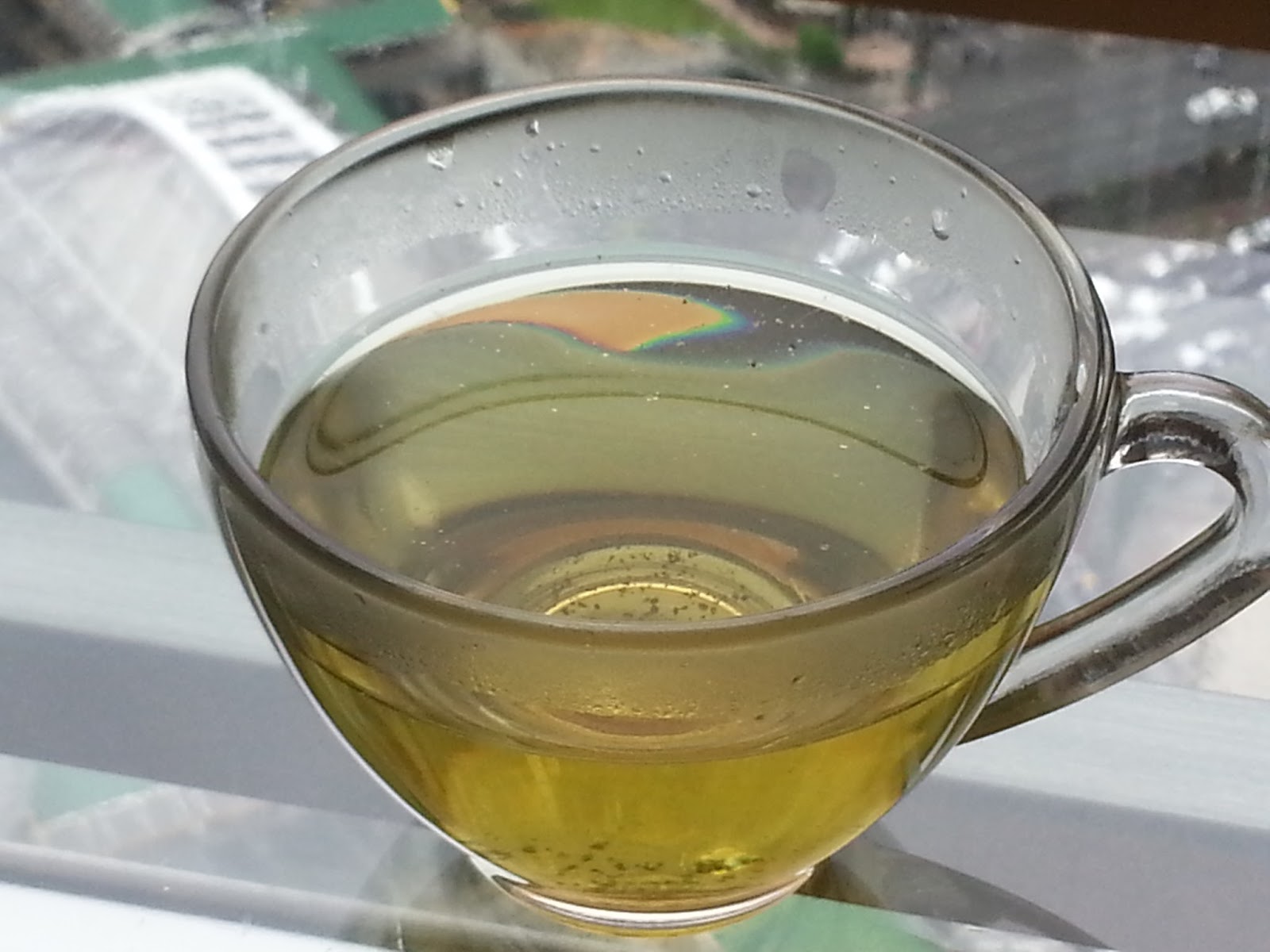
The tea is bright in character, sweet and fresh, floral and a little vegetal. I'm brewing it Gongfu style in a gaiwan this time and I could swear it turned out a little better prepared Western style in the past week, just a little brighter. It's a bit creamy, in feel and in a butteriness coming across, but all that range can be more pronounced than it is in this version.
There is a characteristic taste of Taiwanese oolongs that comes across, although that was much more pronounced and positive in this other oolong version from there, a Shan Lin Xi version from the Lin Hua Tai shop in Taipei. I guess to put labels to it the flavor range is a combination of mineral undertone, floral higher end, and a touch of different brighter mineral tone, all combined with good sweetness. A typical feel for Taiwanese oolongs is a bit full, with lingering aftertaste also normal enough.
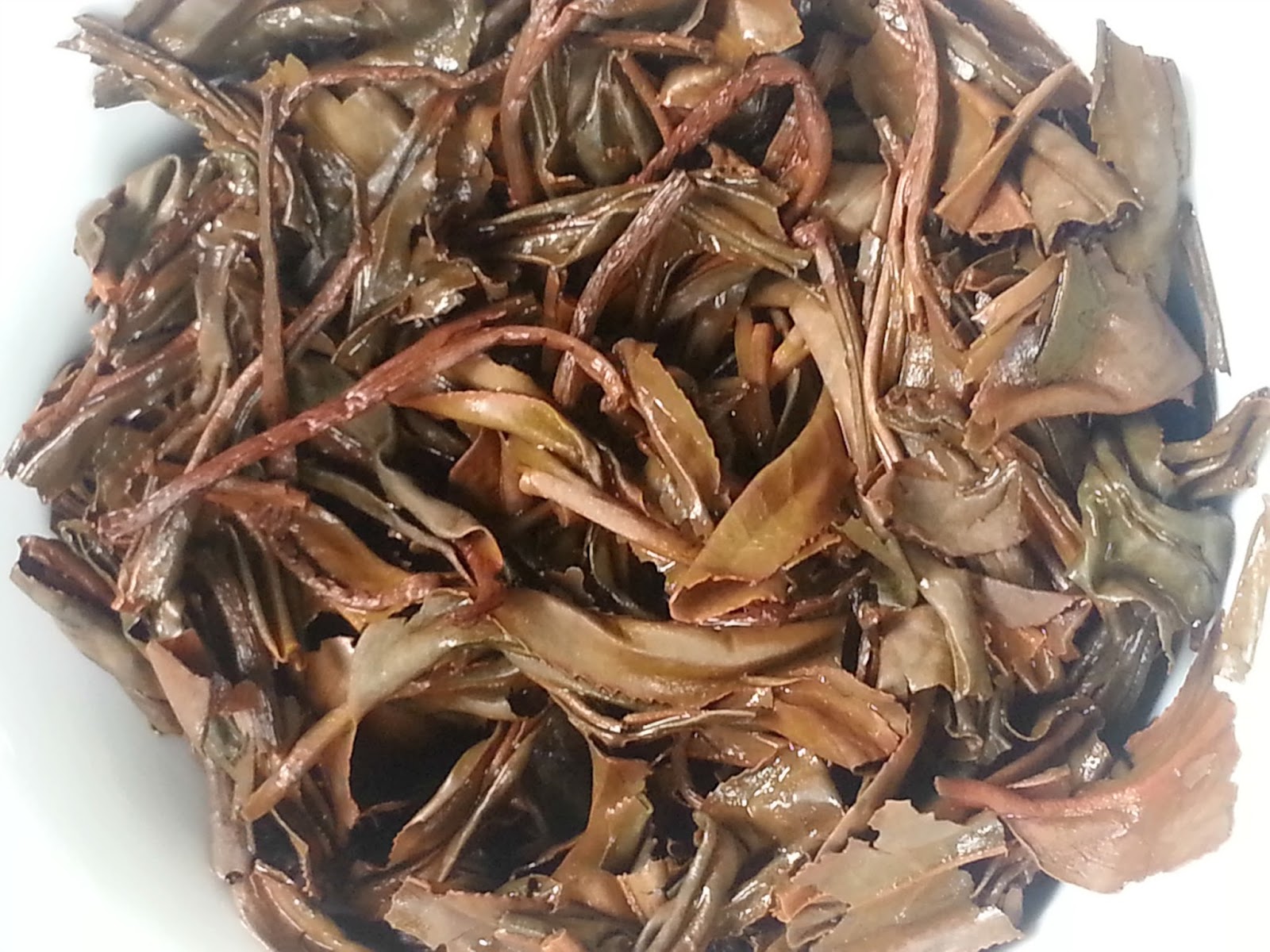
brewed lighter, with leaves in gaiwan
Some light oolongs express even more pronounced floral aspects, with this one extending a moderate degree of that into other vegetable range, not far from fresh green bean (uncooked). The sweetness is almost like that in very fresh snap peas or green peas, which are nothing at all like a frozen version. That better earlier session version seemed to emphasize flowers more. I might have backed off the water temperature just a little then; sometimes I do that, but I'm brewing it this time using just below boiling point water. Or maybe I just liked that overall effect better; usually Gongfu brewing works out the same or better but not always. At a guess it was the effect of those things together; backing off water temperature works better, and the lower proportion and longer brewing time also did.
Other
So that was it; basic stuff as reviews go. It was nice but it could have been a little brighter, a little more floral, a little creamier, or could have expressed a bit more mineral tone. The level of sweetness was fine, and the flavors were quite clean in effect. I didn't notice pronounced aftertaste, and the feel wasn't particularly full, but it wasn't thin in effect either. This is all how Thai oolongs tend to go. They start to express some nice attributes but then you realize you've had Taiwanese versions in a relatively identical style that expressed them much better. Part of that could relate to the hearsay-based idea that the best Thai oolongs are shipped to Taiwan to be sold as "counterfeit" teas from there. Given that I've tried so many versions from so many sources it's hard for me to imagine there is another whole quality level out there that I didn't get to but I suppose it's conceivable.
To me they are a great beginner's tea, or could work as a nice, inexpensive daily drinker. I just had that tea with lunch, with duck noodle soup, and it works better with something lighter and less earthy, maybe with a pastry, or with apple pie and ice cream, or even with a ham and cheese sandwich. As for pairing with Thai foods it would be fine with anything that's not too spicy or not too far in any other direction for strong flavor, like herb and garlic roasted fish. For spicy food something like sweetened bael fruit "tea" (tisane infusion) might be better, or really water pairs better with any kinds of foods than it's often given credit for.
It would work really well as a blending tea, but blending makes more sense with black teas, to me (adding flowers, or mixing a tea with spices, making masala chai and such). This tea cost 100 baht, around $3, for 100 grams, so not very much at all. I've seen closely related versions (or maybe this one) selling in online Western vending outlets for around double that. That's typical for here though, although sometimes other versions can cost somewhere around 350 baht for 200 grams (around $10), or still not much at all. #17 / Bai Lu isn't so different from this but the character does vary just a little, usually lighter on the creaminess, with a bit more influence in a mild earthiness leaning towards a spice aspect. It's probably better than it sounds; I don't mean it tastes like actual earth, or "forest floor," or cork, it's just a little warmer, with spice range moving towards nutmeg that typically stays non-distinct.
Thai oolongs at Central Embassy Mall grocery store
There are Royal Project stores in different places here; this was from one in the Future Park mall, way on the North side of town, almost up to Ayutayah. They sell different versions of Royal Project oolongs and other teas though, and this version is the one I've liked the best, the one that comes either in octagonal shaped boxes (see an image of those) or red or gold foil packaging. I've seen shops selling this version in both the main Bangkok airport (Suvarnibhumi; good luck finding it though, over by domestic departures), and in the Chiang Mai airport, and in the Central Embassy grocery store, but it's also sold in lots of places. I can't remember if the Royal Project store in the Paradise Park mall had it (I think it didn't) but there are two other tea shops there that would carry something similar enough.
One might wonder, why review it here at all, only to say that it's a mediocre tea that's not on the same level as the other few dozen teas that I've reviewed this year. Partly because I don't think I have reviewed one exactly like it, and it's a basic staple here in Thailand. I did review a similarly sourced Royal Project black tea not so long ago, tied to the same general idea, describing the local teas landscape, what an ordinary quality level Thai tea is like. There are some better examples of black teas and oolongs out there; they're just not so easy to come by. I've had the best luck with Tea Side as a source, an online vendor. Winter harvest versions of oolong tend to work well for my individual preference, warmer and a shorter step closer towards a spice aspect. Jin Xuan based black teas can be very nice, or they can be not so good, it just depends.
I had all but put this general type aside by the time I started this blog, but seeing them in a grocery store was part of my own introduction to decent loose tea years back. Part of mentioning them again relates to recently writing an article for an expat site / forum on where to buy tea in Bangkok, and to a lesser extent Thailand in general, which I was thinking of sharing here. It would make sense to describe this tea first related to that, to set the general range for local basics. I could link to where that is already posted but they edited down the details of mentioning most specific locations, which would be helpful to readers here, and without that there isn't nearly as much point. Shops here are like anywhere else, they come in a range of different types, but it works best to describe those general types related to specific incarnations.
The tea is ok; I'll probably drink it once a week until the staff here gets around to finishing it.
I've been drinking some Dan Cong relatively recently so I decided to start with these teas before moving on to oolong samples sent by Cindy (from Wuyi Origin, their brand name). Of course I've been drinking Wuyi Yancha too (Wuyishan oolong), but I decide what to review next by way of immediate impulse, the same way I pick what to drink with breakfast. I already said plenty about Cindy and the source in the last post so I'll skip that part, and ramble on about other things instead before the review.
An online friend passed through town recently and gave me some samples of other Dan Cong, after visiting a few tea regions in China. He's a vendor, but with regionally limited business scope, and I don't think it would matter if I mention his business here, so I'll skip that part. The samples were interesting; one a maocha, a tea that isn't completely finished, so interesting related to that. Two others were quite good, and one a bit off, so it made for an interesting refresher for the type. Of course trying only exceptionally good versions also makes for a pleasant reminder or initial introduction, but it's informative in a different sense to try teas across a range of quality.
I had planned to try one of his samples along with one of Cindy's, since I've been on the page of doing comparisons, and it helps to point out differences in body and minor aspects. After thinking it through I really don't want to write a half dozen different reviews of Cindy's teas, since that would get repetitive, both for me to do and for readers, so trying two of Cindy's together resolves that.
Most people reading a tea blog would be quite familiar with these teas. Mi Lan Xiang is honey orchid aroma Dan Cong (oolong from the Chaozhou area), although those tend to taste a lot like peach sometimes. Ya Shi is duck shit (just a funny name; no connection to actual duck shit), and those can be harder to pin down in terms of a characteristic flavor element. They tend to be warmer, fuller, with more going on, and more subtle, maybe bridging ranges of floral, fruit, and spice instead of coming across as one or two main flavors. Per only trying a few they do tend to taste like one thing, it's just not as easy to say what that is related to it being just like a honey orchid flower or peach. They're more complex, heavier on aroma than flavor.
Related to a recent online discussion about flavor being identified as taste (what the tongue does) versus aroma (related to sensors in the lower rear of the nasal passages, where most subtle distinctions in flavors are identified) I'm not using "aroma" in a conventional sense here. I think I covered what I mean by that in the last post, about how Chinese producers tend to use the term as a distinction within the range of what we would call aroma based flavor. You can read back to that last post to reference it, or just read past it here; it's not critical to the explanation.
As to tasting process a blogger friend--who I only know online; maybe should I be saying "acquaintance" until I meet these people?--has been considering if long term effects of caffeine are getting to him. I've had some problems with comparison tasting adding up related to caffeine intake, so I'm going with small gaiwans for this, which probably should have been an obvious step for tasting multiple teas all along.
On to these version specifics in tasting then.
Review
Skipping the appearance and scent parts, the initial infusion--more a rinse that I didn't discard--shows the characters to be like that expectations summary I just covered. The Mi Lan Xiang is bright, sweet, intense, and complex, mostly in the range of peach with a good bit of supporting floral tone. The Ya Shi (I should probably just say "duck shit" instead, since it's catchy) is warm, full, complex, and aromatic, and won't be so easy to describe in terms of two or three main flavor elements. I won't even start on that until the first real infusion.
The Mi Lan is the same but more pronounced in aspects intensity at the normal infusion strength. It's brewed to a medium level of infusion concentration to me, but people might well tend to drink Dan Cong either on the lighter side compared to some other types, or on the much lighter side, and this could be in between those ranges. The peach really ramps up in intensity. It's interesting the way that the astringency (which is moderate, but one of the main defining aspects) seems to mimic the way that peach skin comes across, the separate flavor of that from ripe flesh. It trails into that unripe fruit range, with a slight bite of an unusual type of astringency, nothing like that found in black teas or sheng pu'er. But it's in great balance, not negative, even if it would be a matter of preference deciding if that added or took away from the effect of the other aspects.
The roast is not heavy but you can notice it, a bit of caramel or light toffee in the back, or really not exactly that but in that range. Maybe if you fire-roasted a peach and it picked up a brown-sugar to cooked fruit tone that's closer to what I mean, although of course there is no smoke aspect in this tea, so the "fire" part might just be for descriptive color. With some allowance for preferences varying this is more or less exactly how this tea should taste, to me. It's tempting to try and put it on a scale of good to unbelievably good but I would need more experience with very high end Dan Cong to reference against. It's a lot better than typical generalist specialty versions would be, teas typically sold in the $15 dollars per 50 grams range, described as great examples that are really just not that bad, only in the general range of type-correct. I suppose there is always room for improvement but it's quite good.
The Duck Shit version is warm, complex, and subtle; a totally different kind of experience. It's also aromatic, not pronounced in terms of flavor, although there is plenty going on with that, as much as in a broad range that covers sensation trailing off into sensory ranges that you sense but don't fully capture.
I'm having trouble assigning specific flavors to the experience, but it has to come to that if I'm going to review it; it would be strange doing a tea review and never getting there. The main range is floral, but not in the same sense as bright, sweet, pronounced flowers, so I suppose just an earthier, richer, more subtle flower range. Tropical flowers here seem to be bright, sweet, and intense, the different orchids, plumeria, and such, more like wildflowers back in the US. This tea's range is on the opposite side of all that. It's not far from how I'd imagine a sunflower to be, but I can't think of a flower type I actually have smelled that's a close match, something warm and complex. It's towards chrysanthemum but not that, with more depth and richness than that flower blended with chamomile, but in that general range.
With all the complexity it wouldn't be wrong to say it also tastes like some warm, subtle, earthy but light fruit, maybe in the range of dried longan. But the flavor range is well integrated, so it doesn't come across as tasting like a few different things. I'll keep tasting, since that complexity may well also related to extension into mineral and spice ranges.
Ya Shi left, Mi Lan Xiang right
On the next infusion I probably went a touch longer on the time--not long at all though, around half a minute--and the strength and astringency of the Mi Lan Xiang picked up. It would be more conventional to use slightly hotter water and go with really fast infusions instead, ten seconds, and the astringency would be light along with the flavors being less pronounced too. This was brewed at 80 C; I tend to like teas prepared a little cooler than some if offsetting astringency is a concern. It's really about personal preference more than one approach being objectively best, or at least that's my take. It would've balanced better brewed for ten seconds less but it's still nice, but at this strength the astringency starts to pick up enough to be more pronounced than the flavors. Nothing like a young sheng, not that type or on that level, I mean related to the balance per what I like to experience.
This same infusion time worked better for the duck shit; without astringency as much of an input at all, not even to the extent of filling in structure. The flavors just intensify and the feel thickens a little. It comes across as richer, almost buttery, just in a completely different sense than for Jin Xuan oolongs. I tried a decent one of those I bought for the staff at the office, a Thai version, so related to me always going on about how mediocre Thai oolongs are I was going to review that and put the record straight. But that tea is not on this quality level, not even close. It may be two full levels down, but for what it is drinking that tea makes for a nice experience, good as a "daily drinker," as people tend to say, as something to have with lunch.
The sweetness and rich flavor changes for this duck shit version, a little, more towards a lightly browned butter effect, which isn't so far from a really light caramel. Someone that absolutely prefers intense floral aspects might not appreciate that but the complexity, fullness of flavor and other range, and the way it all balances makes for a cool effect. It's a good tea. Again I can't map it to best of the best; it's about as good as the best duck shit Dan Cong I've tried, more or less, but I haven't put effort into exploring the highest range. Or expense, more to the point; better Dan Cong moves to $1 a gram or beyond much faster than most other tea types.
Ya Shi left, Mi Lan Xiang right
On the next infusion I went more like 15 seconds for the Mi Lan Xiang and around 30 for the duck shit; brewing and tasting different teas at the same time can go like that. The balance is back to great for the Mi Lan version; the flavor is plenty intense, quite sweet, nicely complex, and the astringency level compliments the tea instead of taking away from it. If someone absolutely loves soft teas instead something like the duck shit version might work better, or another style of tea altogether might, or possibly just a different version. Then again it's hard to imagine someone not liking these teas.
The duck shit version aspects haven't changed. I've tried a version before where the aromatic / complex effect cost the tea in terms of flavor complexity but this one strikes a nice balance, covering a lot of range but still offering up plenty to taste as flavor. It's definitely warmer than the Mi Lan, and richer, in one sense, but perhaps less intense for being more complex. It makes consider how level of roast comes into play, but I really won't venture much about that, since I don't know. The Mi Lan brews darker but the brewed leaves look about the same; I'd guess it's roasted a bit more but that isn't much in the way of an informed guess. With Wuyi Yancha it's possible to tell that medium to darker / heavier roasting occurred because the teas taste more or less charred, slightly toasted in a normal sense if not a bit burnt in cases where it goes too far. It's not possible to pick up anything like that effect in these two teas.
I could keep going for a couple more infusions to talk about transitions, or to pin down a few more flavor aspects, or to stretch this out to some vague, potentially invalid analogy (astringency effect like biting a tree bud, etc.), but I'll skip all that. The teas aren't close to finished but not transitioning a lot.
I will try to mention which I like better, but that's hard to say too. They're both great for what they are expressing, for being so different in type. In different senses I like both best. I think they work really well for tasting two teas that don't overlap all that much in character together, for comparison tasting related to contrast instead of shared range. Usually the opposite works much better, picking out finer levels of aspects related to them sharing common ground, and I may well have missed some levels of range for going against that. This said next to nothing about "feel" aspects, for example, and when two teas share a lot in taste range and that differs your attention tends to drift there (or didn't get that far with taste description, really).
My final assessment: two more great teas from Cindy. Someone that has been drinking the best of the best Dan Cong available for some time might disagree, and these could seem quite ordinary to them, but that's how tea tends to go. I would expect that for someone only exposed to a conventional, typical-supplier quality range of Dan Cong these two teas would be a step up in quality instead, teas that they would really enjoy. For someone only exposed to so-so versions or new to the type they could open a whole new world. I've tried Dan Cong sold as relatively higher end versions--at upper medium level pricing--that wasn't nearly this good. It will be interesting to look around at other reviews and see what other people think, if I get around to that.
Just when I've been feeling a bit burned out on trying different teas, tea research themes, discussion, moderating a tea group, and writing about tea Cindy Chen sent some of my Wuyishan favorites. Her teas are always some of the best I ever get around to trying. I think one of her Rou Gui versions and this wild version of Lapsang Souchong may be the two teas I've liked the most of any. Of course that relates more to a preference match than them being outrageously good teas (I like fruit aspects in teas more than floral tones), but they are exceptional, so I picked one of those to try first.
Tea Explorer photo (credit Jeff Fuchs' Tea and Mountain Journal, from this post)
I remember reading one account of Jeff Fuchs meeting Cindy, himself a familiar name in tea. His own tea movie is coming out right about now (the Tea Explorer documentary, click to a newer post than this citation to check on that, per that post first airing on television on July 23rd, so worth looking into right away). His Tea and Mountain site post introduction of Cindy:
...She is in the midst of tea production season and the shift work (fresh tea leaves are impatient fellows) has left its mark on her. She is blearly eyed, clearly ripped on tea, but still as generous and welcoming as a family member... On this morning Cindy uses a simple white ceramic gai wan or flared cup vessel for ease of examining colour and rapid fire infusions. Rapid fire they are, but with Cindy every serving is something fresh and perfect, though she in all of her modesty claims that she is “only someone who knows tea a little.” Cindy is made of tea it seems. Rampant energy, talking of nothing else, she knows tea from the soil to the very skin of the leaf and through the various stages it is a subject that is part of her. Her entire family for generations has produced Rock teas...
Cindy! and tea (my favorite picture of her)
That's her, to me, a bright spirit, kind and humble, while working from a different level of knowledge and experience; something of a tea saint. That whole passage / article is well worth a read, and that documentary covers part of the living history of tea through the mountains of the great tea road.
Pre-review review review (it's like a stutter)
I never read other reviews of teas before I try them, but I thought to mix it up I'd try that. If this tea is like the version I tried last year it should be quite fruity as Lapsang Souchong goes, more in the citrus range, with amazing complexity and great balance of aspects beyond that. From one of those Steepster reviews I just cited, for the same tea I'm about to try (the only one posted for this year's version so far):
Initial taste is a cacophony of fruits. It’s syrupy like fruit punch mix. Important to note, there is no chemical, or artificial taste. The tea soup is viscous. It feels oil like on the tongue. Taste develops into an intense sugarcane, fruity sweetness There’s also a bit of citrus taste in the finish. More shaddock, than, say, lemon. This citrus flavor also comes through on the lips. The finish starts off sweet. That sweetness is joined by an undertone of citrus, and a cool sensation towards the back of the mouth.
I had to look shaddock up; that's another name for pomelo, a type of grapefruit--or similar to a grapefruit, maybe that goes--that's common in Asia. It's less descriptive than it might seem because there are lots of versions of pomelo, some sweet, some quite sour, some with white-ish flesh (fruit), others more yellow (not exactly yellow; tan, like dried wheat), or red. Red versions are usually sweet but some yellow ones are too. As an aside, apparently there are lots of different versions of oranges, grapefruit, bananas, pineapple, and mangos, lots of tropical fruits out there, because we eat different versions of all of those here (even different types of lychee, my favorite).
That's fine for an aside; I'll get on with tasting.
Review
On first sip this tea really meets the expectations. I totally get what that guy was saying about grapefruit; there is lots of citrus in this but it's not in a typical range for orange. Then again there are lots of types of oranges too. I'm not going to have much luck pinning down which type of pomelo this reminds me of but it's not bitter, and has some sweetness, so I suppose closer to a red version.
There is great complexity, it's just not so simple to unpack what's going on. Saying "mineral" works in general for most kinds of tea but it doesn't describe much. I wouldn't say the tea is woody but there is an earthiness that's hard to spell out, nothing like wood or peat, not tobacco, out towards cinnamon or dark wood but not so close to either. The thickness, complexity, and balance makes the tea exceptional.
the tea works well at different strengths
More of the same the next infusion; the balance has transitioned some, but I'll have trouble filling in how, or more specifics. A citrus element is still the most pronounced aspect but other complexity ramps up. It's interesting the way the mild malt range identifies this tea as black tea but there is very little astringency along with that, just enough structure to give it a fuller feel.
It could be wrong but I get a sense that stopping short of full oxidation allowed the tea to retain some degree of freshness and vegetal range, just not in any sense of any other tea that's coming to mind. It's coming across mostly as citrus in terms of flavor, which is really unique, not so much related to her teas but I've not experienced the same degree in other similar versions.
That vegetal range I'm trying to describe is almost below the range of flavor, more exhibited in the feel and general effect of the tea, a hint of the experience of tasting a fresh tea bud or the top of a green wheat plant. Right, tasting those things just doesn't ever come up. But if it did there would be a sweet, mild, complex flavor involved that is vegetal but not in the sense of tasting anything like any vegetables. I suppose some version of an edible flower might be as close as one might get, but who is familiar with the taste of different edible flowers.
There might be a bit of a straightforward floral aspect to this, one that's just not so simple to tease out for the rest of the complexity. There's a lot going on in the tea, but at the same time the effect is that it's simple, clear and direct, and very clean in effect. It's the kind of tea some people might not get, it might not match their preferences, and for them it would just taste strange. But for others this would be an eye-opening experience, exactly the way tea should taste in a better world than this one. I love fruit aspects in black teas or roasted oolongs so to me it's perfect.
On the next infusion things aren't changing much; the citrus is still wonderfully pronounced, maybe back to closer to where it was on the first infusion in terms of balance though. Just a trace of woodiness is creeping in; I suppose that will be more pronounced in the next infusion, and will be a significant part of the profile after that. That mild malt tone ties this tea to the other better Lapsang Souchong that I've tried but it's quite different, except for last year's version of the same thing. Someone else probably could pin down a floral aspect, more than just saying it's there, and floral. The sweetness really makes it work well, although it would still be ok if that was less pronounced.
I never really did address the complexity in the tea, to spell that out. I get the sense different reviewers would pass on all sorts of different lists related to this tea. So far I've covered citrus, malt, floral, earthiness and vegetal, in the sense an edible flower is that (not so clearly defined, some of those). That fruit tone might extend into something warmer and deeper, along the lines of a dried longan. The earthiness I was struggling to pin down is not that far from cocoa. It would be interesting to hear reads from a couple of my favorite bloggers that tend to extend tasting all the way into the range of imagination.
I never said much about the feel or structure of this tea, the way the "body" aspect worked out. As with most Chinese black teas it's on the softer side, to the extent that it didn't vary in character that much depending on the infusion strength. It works well brewed relatively lightly but is fine brewed stronger. It's hard to completely pin down what the "full feel" aspect range means so I just skip that here.
On the next infusion the tea just thins, but the citrus stays pronounced. It loses a little for giving up some complexity and fullness but it's still the same amazing tea, four infusions in. It did make another couple of nice infusions but there isn't much more to say for description. I was brewing it on the stronger side, related to how light I prepare some teas, since it worked well at different intensities and those flavors were amazing experienced at higher intensity, but the tea really could brew closer to ten infusions if someone liked it prepared lightly instead. Or a standard Western brewing process would work; the results probably wouldn't change that much for this particular tea, and then it might be back to three or so. I wouldn't prepare this tea Western style but there's really no reason not to, if someone was more on that page.
Conclusion, and about related tea pricing
This is again one of the best teas I've ever tried. I'm sure that relates as much to me preferring fruit aspects in teas as much as anything else, but it's also clearly an exceptional tea, not all that similar to any other version I've tried of any others.
A friend just mentioned checking out the Wuyi Origin website, specifically about how much he liked those teas, and we discussed pricing. That's a subject I normally don't even touch on, more taboo than other taboo subjects for tea bloggers, especially since I consider Cindy a friend (online friend, if that matters, but I will get around to visiting). I'm not good with observing taboo restrictions so I'll pass on some thoughts.
Some of their prices are higher than they were last year. I suspect the higher demand for winning some local tea competitions is driving up the prices of some oolongs, the main tea types from Wuyishan. Per my guess--given that I can't really judge the range of what a lot of other vendors sell--the most costly products on their site are still in the normal retail range, and still a good value for the quality level. It's easy to see a tea selling for $10-15 for 50 grams on one site as a better value than another described as identical for $15-20 on a second but it really just depends. The latter could really be a much better value, while the former might not be worth that, if it's mediocre tea, or might not even be all that pleasant to drink if the source choice is random.
A lot of her teas are probably still slightly underpriced, per my guess.
There may be some confusion over what teas would sell for in China versus in "the West," the US or Europe, and although I can't completely do the subject justice I've been to China a couple of times (and twice that if you count Hong Kong, but that's different), so I'll venture a guess. The selling prices are not so different than in those other places. Demand for tea is high, and awareness related to tea is better (although the average person isn't a "tea enthusiast," per my take, but that concept wouldn't transfer over directly). It probably is possible to get great deals on the lower end for inexpensive, low to medium quality teas, especially if someone was interested in putting effort in, visiting wholesale markets, or chasing down more direct sourcing there. But retail of better teas doesn't relate to selling them for any less, per my limited experience, with some exceptions for what "better" tends to mean, and for different types of sources using different supply chains.
this is really in Seoul, in 2012; my old Google Photo back-ups are patchy
It's important to keep in mind that personal preference is more a factor in how much you'll like a tea than it being a good deal, related to fair market value, or to what another vendor would charge for the same teas. If you look through those Steepster reviews anyone that mentions cost or value there only does so related to saying that the tea was inexpensive when considered against comparable versions. If they happened to not prefer a tea style they might not have felt that way; it can be tricky sorting out objective quality level and other factors that go into liking teas.
It would take some doing to sort through all the range of products they make and sell (having family that lives in Chaozhou making Dan Cong adds to that range), but I'd bet some are both unique offerings and great values. I've not tried her white teas yet but those stood out for looking interesting.
Take all that for what it's worth; I can only share one person's opinion, and I'm biased. Check out a related Steepster discussion thread too for a broader take, and see what those people say about them. They don't know her, and aren't having free samples sent to them.
Singing Head, Shoulder, Knees and Toes (not about tea)