Showing posts sorted by relevance for query hatvala jasmine black. Sort by date Show all posts

Tuesday, May 23, 2017

Hatvala jasmine black tea from Vietnam (Ha Giang / Ha Noi)


I first tried jasmine black tea in Indonesia, a common commercial tea alternative there (with a little about one version here).  I was surprised by how much I liked it.  Among other flavored teas I'll drink Earl Grey and that's about it (although I did like a coconut flavored version of black tea; I guess there's room for exceptions).  This version should be much better than that grocery store tea in Indonesia, given the quality of other Hatvala teas I've tried in the past (including this Earl Grey).


jasmine teas from Indonesia (Indonesian blog photo credit)


I'll say a little about Hatvala first (general site link, or where they sell this tea), but I've introduced them before in other reviews (like this one, about an oolong and black tea).  They seek out and sell interesting, better versions of Vietnamese tea.  On a trip to Hanoi and out in the country I found some interesting teas but did a little better through Hatvala (by mail) after hearing about them online.  As "Western" vendors go What-Cha carries their teas (link to one of my favorites, a Red Buffalo roasted oolong).  Hatvala also sells teas directly, but using that Western source might be a good way to try a couple.


You can go to Vietnam and all but miss that they drink anything but green tea, with most coming from the Thai Nguyen region (per my understanding; I'm no authority on Vietnamese teas).  Decent black tea is around, and oolong also isn't incredibly rare, but you might miss it.  As with anywhere turning up better quality versions is also an issue.  Their ordinary versions of green tea are fine, a bit heavy on mineral aspects, but prepared properly they can balance nicely.


It's odd that in Vietnam they tend to drink green tea prepared with boiling point water, served in a pot so that brewing time isn't controlled.  They seem to like the high level of astringency that results from both of those brewing choices.  Other better Vietnamese teas are a completely different thing, but I'll get back to this flavored version.

Vietnamese tea isn't as simple a subject as you might think (credit Hatvala)

Review


On first taste this already seemed like one of the best flavored teas I've ever tried.  It's floral, of course, but maybe almost as fruity.  At any rate there's a lot of complexity in flavors experience, even if I am completely wrong about that fruit part.


One of the main flavors would have to be jasmine, wouldn't it?  It comes across completely differently than in green tea, which is why those inexpensive, commercial jasmine black teas in Indonesia worked so well for me.  Jasmine green tea can be nice, in a sense (with everything depending on preference), for that sweet floral nature being so intense.  I find that intensity to even be independent of flavor level that's present, to some degree, as just how the aspect characters mix, merging with the fresh, brighter flavors in green tea.  But it is easy for the flavors intensity to become a bit much in green versions.  Combining it with black tea strikes a completely different balance.


To some extent this does just taste like black tea mixed with that particular flower, but the sum is also somehow greater than the parts, so description will be a challenge.  It comes across as more complex than that.  Getting the level of jasmine right would be a critical factor, and this really works for jasmine being moderate.  It combines naturally with the black tea flavors, not seeming to override them, not as sweet and powerful as can be typical is in green tea versions (although of course those would vary in style).  The Hatvala owner said a little about what the tea is and how it's made as follows:


For the black jasmine tea we are currently using a wild black tea produced in a small factory in Fin Ho, Ha Giang province.  All of the jasmine teas are scented in the West Lake area of Hanoi using locally, naturally grown jasmine blossoms.  Blending is done by an old lady (she is approaching 80 years old) and her family.  They have been blending jasmine and lotus teas in this area for many years.  The jasmine season in the north of Vietnam is May to September and it has a stronger fragrance than the year round jasmine available in the south,

Blending is by layering freshly picked jasmine blossoms during the afternoon, layering it with the tea and leaving overnight as the blossoms open.  For the black tea this is repeated a total of four times (normally three for green tea).  Rule of thumb estimate is that by the end of the process approximately 2 kg of jasmine flowers are used for each kg of tea.


Lets try more flavors-list separation on the second infusion.  I'm brewing this tea Gongfu style even though it's not the most natural choice, it's just what I'm used to these days.  It's really a variation of those two main approaches, with the proportion a bit light and times drawn out a little as Gongfu brewing goes, so as much in between.  I had used Western style adjusted towards Gongfu style a lot in the past and I suppose I've ended up not far from that, just using the other equipment, a gaiwan in this case.  These aren't supposed to be objectively better versions of technique I'm describing, not necessarily a progressive learning curve, just the page I'm on.  This tea would be fine brewed Western style, and it worked out similarly using that approach the second time I tried it.


brewing in a gaiwan


The tea balances being earthy and sweet very well.  The flavor is not subdued but well-matched.  I could swear I'm picking up fruit, beyond the floral tone and earthiness of a black tea, surely from the tea.  It's not easy to identify.  It's not so far from roasted sweet potato but not exactly that, a little towards dark cherry but maybe not exactly that either.  The easier description is to just include them all as a list, to say the tea tastes like earthiness from black tea, a soft version of malt--it's not astringent, a typical pairing of one flavor range of malt and one feel element--and maybe including dark wood tones, then also jasmine, just a softer and balanced version of that, roasted sweet potato, and dark cherry.

in Seoul (mentioned here)


Part of the sweetness and complexity also reminds me a little of a bark or root spice, not one I'm familiar with.  This is back to that idea that when you walk through a traditional spice market lots of unfamiliar smells mix, many sweet, earthy and complex in ways you could hardly imagine.  It doesn't come up for me so often but it's the kind of experience that leaves a lasting impression on you.  Old style markets here tend to smell like fish sitting out on ice on an open table, and for good reason.  To put a name to that spice aspect it's along the lines of sassafras.


The tea is perhaps fading a little on the third infusion, or since I'm not paying close attention to times it could just be that.  I think either way it will probably go a couple more good infusions by stepping up times more.  I'm probably drinking this on the light side related to how lots of people might take black tea, but then I'd expect that to work as a generality about preference shifts, that people might tend to prefer tea brewed lighter across all types after gaining more exposure.  That's just me speculating, of course.  At any rate the balance is still great.  To me this works really well brewed lightly because it still has a nice feel to it, not as full and rich as some other types, but it's definitely not thin, and the flavors work well.


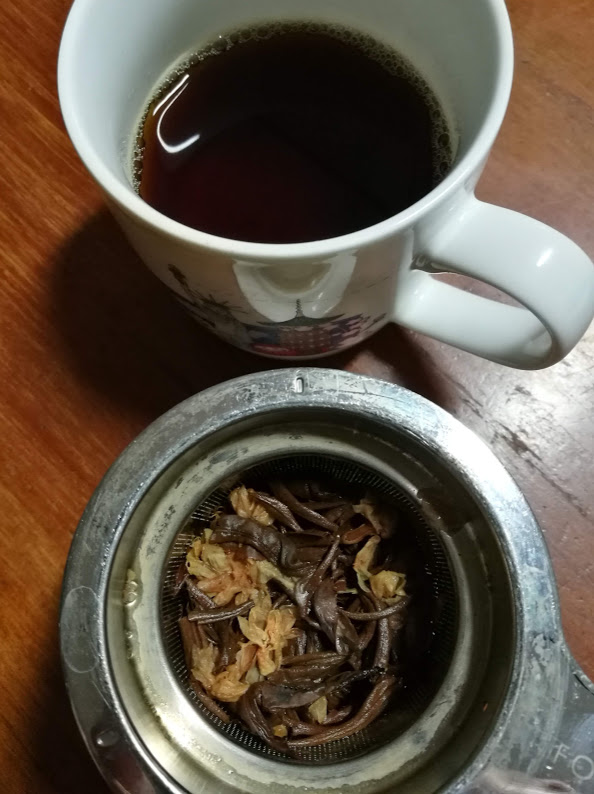
brewed leaves


I'm going to try and explain the part that can't be explained; good luck to me in pulling that off.  There was synergy between the jasmine flavor and black tea even in the much lower quality Indonesian commercial versions.  They weren't doing so bad with balance but they weren't on this level for success in that.  This is a bit of an aside but a friend living there said he experienced health issues related to drinking a lot of that tea, which may well have been processed with a chemical that didn't agree with him.  Due to talking with the Hatvala owner I am completely convinced this tea is natural, untouched by chemicals, and probably sourced to be relatively safely grown.  But that's my personal belief; guarantees about that sort of thing are difficult to assess, and here in Thailand that eve relates to accepting organic certifications.


In good Earl Grey the orange flavor (bergamot essence) and black tea combine well; the flavors compliment each other.  Per my current preference this works better.  Novelty might be part of that.  If you'd only ever tried so-so tea-bag versions of Earl Grey and then ran across a much better example it could seem like a different experience, and I think I'm there now with this tea.  Bergamot is a natural companion to black tea, with sweetness and complexity combining into one profile range with it, and depending on preference this is just as good or better.  With Earl Grey it seems the two fit more naturally into a black tea/base bergamot/high tone pairing, and does something similar, but with jasmine on the lighter side those black tea flavors just blend with floral.


jasmine garland in a local grocery store complex


A bit of an aside:  the smell of actual jasmine flowers can be on the intense side.  People use jasmine to make a garland here in Thailand, like a small version of a lei.  Basic versions are inexpensive, costing 10 baht (35 cents, give or take), and the larger version in the photo cost about a dollar instead.  They're even sold by people walking around at traffic stop lights.  The garlands are used for religious purposes, as a symbolic offering to a Buddha statue, or just as an air freshener.  If you put one of those in a bus it can add a nice background scent but in a taxi it's way too strong.


Around the sixth infusion this thins a lot.  The balance is still ok, with the jasmine fading at the same rate as the tea.  For a light oolong this would brew more times but it held up well for what it is.  It's a sign of good quality if the character stays positive throughout the cycle and this tea did.

General impression:  I loved the tea.  It's not as sophisticated and aspect-layered as some other versions of plain black teas, lacking some structure and complexity compared to better Dian Hong.  But that's splitting hairs, comparing it to some of the best black teas made.  Even for being more straightforward on those levels to me this might have eclipsed Earl Grey in expressing the highest potential of flavored black tea.

Monday, December 17, 2018

Moychay jasmine sun-dried black tea


It's a little odd to be reviewing a tea that shows up on the site as "not available," (an archived product), but it seems like they rotate those products so a related version would come back later.  The point isn't just to promote marketing for what they're selling anyway, more about talking about teas, on my end.  They sent this tea as a sample but that was back towards the beginning of the year; I've been turning up what I've lost track of lately.

For me there are only a couple of flavored teas I tend to like; Earl Grey and jasmine black.  Monsoon in Thailand did a coconut flavored black tea that was unusually good that I tried awhile back too (3 year ago; the time just flies).  And then there's masala chai, but that's getting into a different subject, a spice and tea blend.

from checking that Monsoon coconut tea post; they were so cute


Hatvala makes the best version of jasmine black tea that I've tried, hands down (at least until this version, and experiencing it unfolded in two parts).  On first take in just looking at this tea it seems amazing they used a black tea of this quality.  Of course it's the taste of a tea (and mouthfeel, and body) that makes it good or bad, not the appearance, but you can sort of get a sense.  I'll say more about that difference in inputs and results in a review section, which actually covers trying the tea twice.

Review


I brewed this tea Western style, during a work-day breakfast that didn't allow time for normal process Gongfu brewing or making any notes.  I will brew teas Gongfu style even if I am eating a quick breakfast; there's a trick to that.  It's possible if you use two different cups and just keep the tea brewing, rotating the cups to allow some of the heat to dissipate off.  Seems like a lot of messing around?  Some teas perform better made Gongfu style, and once you get used to those extra steps it's still extra work but they feel natural, and don't take up much time.  Since for black teas the outcome difference in preparation approach is lessened I just tried out Western style instead, at least at first.

The tea was a bit more subtle than I expected.  I guessed that was probably because it's a sun-dried black, which tend to be a bit more subdued, and it is that.  They pick up more complexity, or at least have the potential for it, because they can develop over a couple of years after processing.  It's not just theory; I've actually re-tasted the same teas and have experienced it.  It's a bit odd making a floral blend out of this type of tea since aging it wouldn't seem to come up but it's not as if those really need the time to get to some higher potential; they just pick up a bit more depth and complexity.

Onto a flavors list, before saying more about a style comparison between this tea and Hatvala's (or more a contrast, as it works out).  You pick up black tea and floral, in the jasmine range (mild jasmine though; absolutely nothing like the floral blast more typical in green teas).  I had trouble sorting out a flavor list for the black tea beyond that.  It might've been a bit earthy, possibly in the range of light spice.  Working from a subtle flavor profile with floral range added it was hard to tease out if there was any floral aspect coming from the tea itself, or if a subdued fruit input might be.  A touch of citrus does seem present.

I really think a Gongfu approach would work better for this tea to have more of a go at moderating intensity.  One could try out variations to confirm that but I'd guess that using water at full boiling point might work well since the tea is so subtle, in order to ramp up flavor and draw out a bit more of an edge.  For a lot of black teas just below that works as well or better, in order to preserve the same flavor profile but keep sweetness without maximizing astringency.  With no significant astringency that drops out as a factor.

I did try it a second time prepared Gongfu style, but somehow it makes more sense to compare my impression of it with another favorite jasmine black before getting to that.


In comparison with Hatvala's jasmine black version


This is different, contrasting styles of comparable teas.  I might say first that I first tried jasmine black tea as a typical commercial product in Indonesia, a form of grocery-store tea (which I mention here in talking about trying out Christmas themed blends, but never did review in a standard form).  I liked those.  It was obvious the quality was limited, for both the tea and what they did to get to that flavor input, but it meshed.  A friend living in Indonesia mentioned having health problems he traced back to drinking that same product, a skin condition as a side-effect.  At a guess that was a reaction to some ingredient used in drawing out the jasmine flavor, a solvent of some sort, versus being some other type of contaminant, but of course that's just a guess.

Hatvala's version is much better than that.  They started with a pretty good black tea I'm familiar with, their Wild Boar (Vietnamese tea; their black teas vary enough that generalities about them tend not to apply).  Then they added jasmine flavor by layering the tea with a lot of jasmine flowers, repeating that process until the added flavoring was strong.  It really works.  Their description of that is interesting:


that Hatvala version (credit their site)

...Black Jasmine requires four kilograms of flowers to make each kilogram of tea. Flowers and tea are blended over a five day period in Hanoi using unopened blossoms collected from gardens in the city’s West Lake area.


To me it's not all that different than the effect of Earl Grey, even thought the floral range is completely, absolutely different than bergamot citrus as an addition.  It adds complexity to the black tea in a way that complements it.


This Moychay version used a much milder tea base, with a good bit less astringency.  In one sense it might be better tea but more than that it's just different in style.  And they've mixed dried jasmine flowers with the tea, a completely different approach.  Oddly actually adding the flowers ends up providing a much milder jasmine input, probably related to how much flower it took for that other process to lend that flavor.  Still this really works, even better brewed a different way, as described in the following.

Trying the tea brewed Gongfu style


I hadn't expected this preparation approach variation to make much difference before brewing it Western style but concluded the opposite afterwards.

It's much different; this really is much better.  That jasmine ramps up quite a bit, and the black tea picks up intensity as well.  I went with a long first infusion (based on using a moderate proportion for Gongfu style, for me, half filled with dry leaf, 2/3rds full after expansion); brewed for just over 30 seconds.  I think 20 seconds would maintain the same intensity from here out, probably increased again after a couple more.  Since there is no astringency to factor in level of intensity is up to preference, not "brewing around" aspects like that.

The effect of the jasmine is completely different; that's interesting.  It's sweet, floral (of course), and creamy.  It tastes warmer than jasmine tends to, towards rose or something such, probably due to the way the black tea flavor mixes, not so much something about the flower.  The earthiness of the tea works well; even that softness and subltety of using a sun-dried black makes lots of sense when the balance is better.  A lot of Yunnan blacks might sweep aside a lot of the jasmine effect for intensity (Sergey, the Moychay owner, mentioned that this tea is from Jing Mai after I did that first tasting).

That's a bit bold, using a known-area black tea for a blend.  A skeptic would say they did it to cover a flaw in the tea, but if so I've not picked up yet what the flaw was.  It was subtle, made Western style, but that resolved a good bit using a different approach, and sun-dried blacks run a bit subtle.  They can pick up depth and complexity, and to a limited extent intensity, by aging for a year or two (or maybe longer; I'm not clear on how that progression tapers off, and when), but they're still not as intense as oven-dried teas made for consumption within half a year or so.


The aspect set and effect is similar on the next round, but the taste is still surprising.  It has a clean, sweet intensity, a creamy feel, supported by a lot of earthy complexity, and it all kind of comes as a shock when you first sip it.  The sweetness and flavor hits you first but the depth is right there too.  It's an odd feeling, getting a bit overloaded by a tea that's on the subtle side.  Malt or grain range is giving this experience depth but prepared a little stronger the way that floral comes across stands out.  Mild spice is there too (cinnamon range) but it's subtle.  Some citrus present is a bit subtle too; it layers in with the floral tone.

It's appealing for having that pronounced "higher end" aspect (the jasmine flower, just a soft version of it), which trails into more and more subtle supporting aspects, all of which integrate in a way that balances and makes sense.  It really is a shame to brew this tea Western style.  I wonder why that is; you'd think the jasmine would really need a longer infusion time than tea leaves to extract.

The effect isn't really different on this next round but the aspects have shifted.  It's pretty close to tea-berry, it seems to me, that effect of mint joining an unusual version of fruit.  It's a shame I can't really describe what tea-berry is like but for those who have experienced it there's nothing more to say.  I've ran across the idea that you can brew those leaves (of that plant, a relative of mint, that makes a berry that's really not a berry), and that it can even oxidize.  It would be nice if a reader could check that out and get back to me.

The tea is the best it's been this second round, and it was already nice before.  I'll have to change that assessment related to the Hatvala version from this being a reasonable second as a favorite to drawing even, to being just as good but quite different.  For a blast of floral tone and pleasant black tea earthy intensity it's not even close to that Vietnamese version but for people into plain teas the subtlety, complexity, depth, and balance of this version would probably be preferable.

On the next round cinnamon does pick up a little, approaching the floral range aspect intensity; it might be slightly better yet, or maybe just different.  It seems a little fruitier too, adding a bit of apple to the mix.  It's a type of apple flavor that's unfamiliar, one of those strains that no longer gets produced, crowded out by Fuji, Macintosh and the rest.  I interpret citrus (along the line of orange peel) as a mild supporting aspect across these infusions but that might just be a matter of interpretation.


Conclusions, other thoughts


For anyone drinking Twinings flavored or blended teas--who probably wouldn't be reading this blog in the first place--this tea would be a revelation, an amazing step up in quality level.  Then again decent Tie Kuan Yin light oolong probably would be too, or Dan Cong in general, the whole starting point range of better teas.  For someone looking for that flavor rush Earl Grey gives you the Hatvala style jasmine black would be better.  This tea would appeal to people who don't drink flavored or blended teas at all (kind of a strange target demographic for a blend, when you put it that way; a blend for people who tend to not like blends).

Since this tea isn't listed I have no idea what it had cost.  In one sense it doesn't matter--costing more or less doesn't change what it brews to become--but in others it does.  Really that seemed more relevant based on how much I liked it brewed Western style, if it could compete as a moderate priced "daily drinker" or not for value.  Brewed Gongfu style this turned out so well that it stands up to good plain teas in quality and level of appeal; it's just different.

Sergey said they'll probably add another similar version after a spring production.  Even for people who normally wouldn't even consider trying a floral blended tea checking that out might make for a unique positive experience.  I drank a round at the very end cold-brewed, sat in the refrigerator overnight to make one more infusion, and it was really nice cold too.  Even though it would work it's way too good a tea to be drank just as iced tea, it seems to me.


they grow up so fast; just three years after that earlier photo


this kid too


Monday, May 23, 2016

Review of a Thai jasmine black tea

I didn't really like the tea, but I'll review it since the tea brings up some interesting related discussion.  Tea blog reviews are generally positive, with some exceptions, and there is a story to be told about bad tea too, maybe more story in some cases.  One could get the impression that most tea is very nice, that it's just a matter of finding that set of trusted suppliers to only buy tea versions that you like, and there could be something to that.  But for me gambling on tea that might not be good is part of it all.

At any rate, the related website is here, and the Facebook page is here, for Doi Dhamma Tea.  I can't really endorse other teas I didn't try but their lightly oxidized oolongs are probably pretty good but not great, since that describes most Thai oolongs I've tried.


Background:


We visited a beach in the South of Thailand not long ago (nice down there), and I found this tea in a mall shop on the way back.  The tea is from the North of Thailand, as essentially all tea here seems to be, unless it's from China.  I tried a sample of white tea from Thailand in the shop, the first example I've ever seen of such a thing (besides one or two silver needle-types, but this wasn't that).  But I didn't really like that white tea either.  It looked interesting, like a bit of a broken-up version of a Bai Mu Dan, not completely unlike that White Beauty from Toba Wangi in Indonesia, but nowhere near as good.  Since they were kind enough to offer samples I wanted to also buy some, and a jasmine black tea looked and smelled ok, and the cost was relatively insignificant, so I bought that.


I almost tried a jasmine black tea from Hatvala (a Vietnamese tea supplier) that probably would have been much nicer, but in discussing floral blends with the owner last year I mentioned not really liking jasmine green tea, so he didn't send a sample.  Later in the year I tried jasmine black tea in Indonesia, ordinary commercial tea grades of it, and liked that much better than typical jasmine green teas.  To be fair some green tea versions do manage a flavor balance much better than others.


Surely it's just personal preference but the balance of that unusual level of floral sweetness in jasmine flowers, which can have a bit of nail-polish remover overtone to it, seems to work better with black tea for me.  Maybe it's just that green teas can already have vegetal-aspect and astringency issues, although they needn't, and it usually doesn't work for me to add that particular taste element to that mix.

At any rate it seemed a safe bet, that even if the black tea wasn't a great version or the jasmine wasn't well balanced the tea would still be ok.  The cost was so low it wasn't much of a gamble (150 baht / $5 for what looked to be 50 grams of tea, but then foreign language labeling doesn't help with
identifying product details).


Review:


Even prior to tasting the brewed tea it looked off, the wrong color.  Black tea should be reddish, or even a darker reddish if brewed strong, but this was gold, in the range of a mid-oxidized oolong.  The taste wasn't bad related to the jasmine input, just not completely positive, but it seemed that it would have worked out much better coupled with a true black tea, one that is fully oxidized.  The jasmine aspect wasn't perfectly balanced but not awful, not "off" in ways it can be, especially when it's too intense.


Upon reflection part of what I didn't like was related to expectations, and the tea is better if one thinks of it as a jasmine oolong, even though that doesn't seem to make a lot of sense.  The effect is typical of oolongs, a bit smooth, with a medium body.  Related to taste the jasmine could be interpreted as crowding out the rest of the profile rather than letting it blend together, but it does taste natural, just a bit strong for my preference in balance.  I think this was what I really liked about the jasmine black teas I've tried, that the extra astringency and fuller flavor of black tea balances that slightly intense and unusual input of jasmine better, even aside from issues of getting flavors levels tuned properly.  It sounds harsh describing that jasmine range as "nail polish remover," probably not necessarily like that when done well, but it's definitely different.  I don't love floral teas in general but I've liked osmanthus oolong versions a little better.


not fully oxidized, not a black tea

I was curious about how the tea would stand as an oolong without the jasmine but that taste wasn't subtle enough to make it easy to mentally subtract the effect.  At a guess it wouldn't make for a really good oolong without the jasmine either, not really surprising given that they were attempting black tea processing and just missed it, since the processing steps aren't necessarily identical.  Come to think of it maybe I should try roasting this.


I tried mixing it with a real black tea, a version I bought a lot of from Hatvala last year (their Wild Boar), and it was much better.  I was a bit shocked to taste two different tea types mixed together at first, essentially blending oolong, black tea, and a floral component, although again it's probably not really a true oolong in terms of conventional processing.  But once I moved past that mild "tea blending abomination" feeling from mixing tea types and let expectations settle the experience was much more positive.  I still think I would prefer a true black tea as a base, not the blend of two types, but the mix worked better than I thought it would.  I was only left to consider if I liked it better than the Wild Boar black tea alone--maybe not a necessary question--and I probably don't.


Gambling on teas; like kissing frogs to find a prince (except that would make me the princess)


Why not just order good quality, well-described tea from trusted sources, or sources one would be likely to trust, which could be discarded as options if they don't work out?  I try tea for different reasons, for the experience of exceptional teas, and also just to try new things.  And I really like finding something nice I would have never had a chance to try if I only played it safer.  Such cases are rare.  It's a lot more typical to find really ordinary teas, or badly flawed versions, or teas that are interesting but not good.


I once bought a nice black tea in a grocery store in Siem Reap, Cambodia that came across as a little rough but with an interesting character, a bit smoky, with some sweetness and an unusual flavor profile.  It cost next to nothing, and it should have been awful given where I'd bought it, but it was interesting, and nice, not the same as any other tea I've tried.


Related to Thai tea options, I've already mentioned my own favorite Thai tea vendors, with Tea Side standing out as finding the most unusual teas, and some of the best.  The Tea Village shop and online store does a good job of finding good or decent teas, really almost offered as two different sets, with a divide in pricing and product descriptions relatively clearly identifying which are decent basics and which are more interesting.  For physical shops I've tried nice versions from the Monsoon shop in Chiang Mai, and their owner has been chasing sustainable local teas and experimenting with natural flavored blends, and it's a good place to try what a local Assamica black tea is like (maybe what you'd expect, if you have really good imagination and intuition).  Beyond that any mall shop could have great teas tucked away but they would seem much more likely not to.


But all that is too easy, just going with what you know (after a few years of searching).  I'm still tempted by teas I see in lots of places, even in gas stations.  "Ordinary" Thai teas can turn up there, "ordinary" meaning decent Jin Xuan lighter oolongs, perfect as a gateway to better teas but typically nothing exceptional.  Or at least that's how it worked out for me, with those.  Now I'm a bit spoiled by exposure and preference development, and that level that one can find in grocery stores just doesn't cut it, certainly also true of tea in gas stations.  


Great teas are a completely different subject, with nothing to do with all this, except the part about curated versions, back to what those few Thai vendors carry, and all three vendors know which teas are which.  There is very little tea produced in Thailand on that next level and random luck usually won't cause your path to cross those better examples, not even in huge local markets, although maybe there, at least in the North.  Or at least that's generally true; there's a tea shop in the Chiang Mai airport that sells versions from local producers, and there's probably a few hidden gems in there.  It would take someone time and effort to find them, even with the staff providing tastes of brewed samples, and it would probably really help to speak Thai to communicate with them.

sea view in Samui island; a decent place to make sand castles


Personal preference also complicates all this.  There's a good chance that someone else might spit that Cambodian black tea that I liked back out based on differences in what they like.  The Tea Side vendor didn't seem to be as blown away with one of the black tea version samples he provided as I was (their Jin Xuan based black tea--crazy how good).


I'll keep gambling, and the rare exceptional finds will make it worth keeping that up.  Or at least it will except to my wife, who has had it with the tea reserves piling up at our house, and really doesn't care if a tea is next to free and interesting looking.  In the meantime if anyone reading this in Bangkok would really love to try a moderately oxidized black tea / jasmine blend we should talk.

Thursday, August 20, 2026

Fortnum and Mason Rose Pouchong


I'm reviewing a rose pouchong tea from Fortnum and Mason.  There are a couple of interesting layers to this experience, beyond the tea, since pouchong is an interesting type reference, and this was given to me by a Thai monk.  

I can explain how that second part works.  I've mentioned giving monks tea a lot here, and it usually goes that way, that you would give a monk tea, not the other way around.  But it makes sense.


How can a monk give away tea?


I've mentioned giving monks tea fairly frequently, a few times in the past 2 or 3 months.  If people end up giving them a lot of any one thing, like that, it could seem inappropriate for them to stockpile tea, even though for a tea enthusiast that's a best case scenario.  Giving some away to visitors is appropriate, and keeping a moderate supply.  

People also end up giving monks things they're not supposed to have, like a fruit basket.  There's no rule against keeping tea around, but monks can't store food, because they are required to go out on alms rounds daily and live off that food input, and not keep "leftovers."  It's not the worst thing to give them fruit, not a violation of a norm, because they can eat some that day, and pass it on to another visitor, or temple staff.  

There aren't a lot of staff at a temple, like in a billionaire's house complex, but depending on the temple context they may need extra security, office workers, cleaners, etc.  We just had a memorial service event at Wat Pho, a main Thai Bangkok temple, that functions as both a tourism destination and a functional temple, for memorials, funerals (not many; dedicated temples tend to specialize in that), and marriages.  I was married there, and I ordained there, 19 years or so ago.  


That temple is typically the #1 Bangkok tourism destination on Trip Advisor; it's not just a tourism attraction, it's a main one, in a city that draws almost as many visitors as anywhere else in the world.  More might go to Paris, but that's about it.


I recently gave that monk two kinds of tea, after passing on some other tea a month or two prior, and it was probably adding up, what different people had offered.  Hopefully he didn't give it to me to balance the scales, in some way, as friends would return a favor, because I'm not at all concerned about that, and I have a lot of tea around.  Monks can't buy things, so I give tea to a few that I know, because they can't eat anything after noon, and it would be nice to have a beverage option then.  It's just that.


What is pouchong?


Pouchong is baozhong, a type of lightly oxidized oolong from Taiwan.  I had forgotten that, that it's the old name for that type.  This seems nothing like Bao Zhong, instead like a mild black tea.  That's fine though; when oolong types are relatively more oxidized the line blurs, since black teas can also be relatively less oxidized (within a narrow range).  Oddly they're calling it black tea, on the label, at the same time they reference a name for a type of oolong, which might be explained in the following additional background.

This one tastes like a mild and flavorful black tea, in terms of flavor profile.  That's positive.  I'm writing this after taking notes; it's interesting to consider if a bias towards thinking that it's black tea changed anything.  The dried leaves are dark, and the wetted leaves are brown; it's as oxidized as black tea, regardless of what they want to call it, or which processing steps led to that.  So it's really more of a naming and type anomaly; this is functionally black tea.

They could have been referencing an older use of the named type.  This is an excerpt from Tea, It's History and Mystery, by Joseph Walsh, from 1892:


That was in the "souchong" black tea book section; it had been black tea back then, or at least so it seems from this reference.  This is probably what they are referencing, a traditional type name, not the older name variation for a type of Taiwanese oolong.


Review:


First infusion:  it might work better to use a very small amount, 2 or 3 grams, and then brew it for 5 minutes, more or less as the tin label recommended.  I used 4 or 5 grams, and it will brew 2 or 3 times using this kind of hybrid Western approach.  It's "designed" for infusion all at one time, so that might not be ideal; we'll see how it goes.

The flavor is a little light, but it's fine, the range works.  Of course it tastes like flowers and black tea.  Like rose, I guess?  It literally is rose.  The quality of the black tea is pretty good, better than I would have expected.  It's not as if everything that finds its way into a tin is bad, that's just a generality that probably applies more often than it doesn't.  The more flavored a tea is the less the tea input quality would matter, so it might tend to be worse.  Earl Grey versions usually use some pretty so-so black tea as a base.

It's hard to identify much beyond general black tea range and rose.  It's a warm toned black tea, as those tend to be, but it lacks the malty edge of Assam.  It might taste a little like unsmoked Lapsang Souchong.  I still don't know what this is; it might even be that.  Or maybe Keemun / Qimen.  Let's check with Google how that should be:


Qimen black tea, commonly known as Keemun, is a famous Chinese black tea originating from Qimen County in Anhui Province. First produced in 1875, it is prized for its gentle, low-astringent taste with distinct notes of unsweetened cocoa, dried fruit, and a subtle, aromatic smokiness.


Maybe this does include cacao and dried fruit; it's hard to tell, with this much floral input.  That's a good guess.  The range of whatever it does include is positive, and it integrates well with the rest.  Tea quality is good; feel is decent, and aftertaste contributes depth, even though it's mostly floral (the rose).  

It's good tea, in a limited sense.  For a mass produced tin tea it's quite good, for specialty tea range presented as an exceptional version just kind of ordinary, or maybe not on a high level.  Complexity and intensity could be limited, which doesn't matter in this form, because the flower input is covering that.


Second infusion:  I let this go a bit over 5 minutes, to really extract the rest.  There is no astringency edge to work around, or any other unpleasant range, so it should be fine strong.  Or medium; the last should've probably been stronger for brewing about 5 grams for around 4 minutes.  

I didn't mention that this would work well with milk and sugar, but you would need to dial up intensity for that to make sense, and I'm already brewing what should be a really strong version.  It would be strange trying to brew 6 to 8 grams in a 300 ml infuser; at some level it might not fit in a basket.

Floral range really kicks this time.  It even picks up a bit of dry edge to the feel; it's pushed as far as it could be, without things going badly.  This is strong enough to stand up to milk and sugar, but it definitely doesn't need it.  Sweetness level is nice.  

It's cool how there is nothing actually sweet in this in terms of carbohydrate input, but it's sweet.  It lacks that artificial sweet range in stevia and diet drinks; this could really work for some people trying to control caloric intake.  A teaspoon or two of sugar isn't a lot of calories anyway (16 calories in 4 grams, a teaspoon), which makes it all the more odd that sodas contain so much (140 calories in a can of Coke; 8 teaspoons worth).

This is much better than I expected.  I've had pretty good floral blends before, and jasmine black tea is my personal favorite, so I guess it makes sense that I like this.


I'm still not unpacking a new flavor list.  It's not that far off jasmine black tea, but of course this is rose.  Maybe it includes cacao, or maybe that's not a great interpretation.  If there is dried fruit it's not so far off Chinese date, or that plus dried apricot.  The dry, warm, rich input that picked up could seem like malt, if you are looking for that, or autumn leaf might work better.

It might have worked better to brew 2/3rds as much for 6 or 7 minutes, maybe 3 grams or so, and that's it.  But as a specialty tea enthusiast I am biased towards experiencing some transition across rounds, even when it doesn't change anything, or isn't completely positive.


plenty of company for this tasting


Conclusions:


This is a great tea to have on hand for something easy to brew and drink when you are in a hurry, or don't feel like going through much effort.

So how much would this cost?  19 British pounds for 100 grams, or $26.  Is that a good value?  Not compared to what I've been buying at Chinatown locally; I just bought 100 grams of wild origin Chinese black tea for $15, a version that's slightly better.  But for this mass-produced range, selling on a Western market or webpage, it's probably normal, and ok.  


The one Vietnamese jasmine black tea I've tried versions of, from Hatvala, here, sells for $18.25 for 100 grams, and it's probably slightly better (relatively objectively, although preference always factors in).  But then they offer free worldwide shipping on $80 or over, so you'd be looking to build up an order to that amount, from anywhere but within Vietnam, where local post service is probably cheap.  

Fortnum and Mason, through their webpage sales outlet, don't ship to Thailand, so that's not even an option to buy direct from them.  I've never seen this in Bangkok, so it would probably come down to using an Amazon or Ebay outlet, which again might add significant shipping.  

I'd recommend buying the Hatvala tea over this anyway.  More oxidized / red oolong through them has been exceptional in the past, and trying a few other teas would be a great experience.  $80 sounds like a lot, but that could be months worth of tea.  That doesn't change that this was pretty good; I'm saying that you could probably get slightly better tea for less, using a different kind of source.


Thursday, April 30, 2020

Tropical fruit flavored "wild" Assamica Thai oolong


named after the river that runs past Bangkok


Visiting with a friend awhile back the owner of Monsoon, who made this tea, stopped by and shared some samples with us.  It's the second time that I've met Kenneth Rimdahl (that owner); he seems like a really nice guy.  He talks about the forest-friendly theme here.

I could be clearer on the "Assamica" part in this title.  Old, wild-growing tea plants in the North of Thailand are exclusively Assamica variety, per my understanding, but my understanding wouldn't always be accurate.  There are so many tangents to get to in this post, along with the review itself, that I'll not dwell further on it here, or say more about the wild and "forest friendly" aspects.


Kenneth in white; Sasha (right) hasn't been mentioned here for awhile


I've written a little about that in this post, which related to meeting Kenneth the second time.  In that post I downplay the overall impact making a limited amount of tea from wild sources will have on the industry, but if the impact is still positive that's a good thing, and it sets up a basis for expanding that over time.  This post relates to meeting him in my favorite Chinatown shop prior to that, and we did talk about that background there. 

Of course wild sourced tea is a very positive theme; old tea plants really are growing in a natural fashion in different places (organically, in a biodiverse environment), and the tea from such plants tends to be mild in character (low astringency), intense in flavor, and very pleasant.  It's hard to not notice that the tin presentation, the container, contradicts the conservation theme, but this isn't a critique of how it all works taken together.


three years ago; the time flies


On the subject of tangents, I wanted to also share which flavored teas I've liked best in this post.  It's a subject that doesn't come up often here, not for a couple of years in any post, and one I tend to discredit or downplay.  But to be clear I think there's nothing wrong with people liking all sorts of different teas (even Lipton tea bags), and flavored teas can be interesting in diverse.  To me natural, better-quality, loose-leaf versions are more interesting, in general, but citing some exceptions helps place my take on all that.


I think this is lychee and mango


Review


The first infusion is really fruity; it tastes like lychee and mango. Taste is clean, more natural in effect than flavored teas would generally be. A bright citrus aspect is a bit lemony but mango often includes something like that naturally, and lychee isn't far off that range either. Lychee is my overall favorite tropical fruit, and mango might be a close second. It's hard to get much read on the tea itself in a light first infusion.


More of the same on the second infusion, brewed for close to 20 seconds, a bit strong as other tea types go, for this proportion. Flavor is really clean; aroma is pleasant. Sweetness and other aspect balance is good. It's still hard to pin down what the tea itself is like beyond the flavoring but it integrates well. It's a light oolong, not dissimilar to a Jin Xuan, but since this should be Assamica it should be quite different.

Normally I'd only only provisionally like any blend or flavored tea, it could be fine for what it is, but this works as an exception. It's good.


Vegetal range is picking up as fruit drops off but this is still sweeter and fruitier than a plain light oolong. It's not vegetal in the sense of green beans or pepper picking up, more a floral range with just a trace of green wood. For as clean and pleasant as this is it had to be fine plain, but I get it why a lot of people would prefer it flavored. I'd have to try a plain version to know which seems better.

A touch of butteriness picks up; that might have been what reminded me of Jin Xuan, even though I didn't notice it in the last round.


The fruit flavor is hanging in there, two thirds dropped out, or so, but still a main component. The overall effect is still really nice, bright, sweet, fresh, and complex. These flavors must be extracts of some kind; there's no way chemicals would taste this natural. I should ask Kenneth but probably won't; blog posts take forever with Q & A back and forth as an input.  I'll do an interview post later if I get to it.

It's hard to do much with evaluating this as an Assamica based oolong, in part due to the flavoring layer input. It's clean, with good complexity and feel, a lot like a well above average Thai oolong.  This other post covers trying two of the very rare Assamica based oolongs I've ever had that worked really well, versions from Hatvala from Vietnam.  But those were more-oxidized in style, a completely different thing (what people often call "red oolong," a popular but less common style imported from Taiwan).


Later rounds:  3 more rounds stayed pleasant and well-balanced, with fruit tones fading and woody flavor picking up.  Even after 8 or so infusions the tea was still quite pleasant; interesting an added flavor would hang in there that long, even if greatly diminished.  I put the leaves in the refrigerator with lukewarm water after those rounds, to cold brew for an extra infusion; they still weren't done yet.

It would seem more conventional for people to brew this Western style, of course, for people more into flavored teas to just brew 2 or 3 rounds in a teapot or some infuser instead.  That would work.

I really liked it.  The color shows it's a very lightly oxidized oolong, which is either a good or bad thing, depending on how that suites the final tea aspects and character, and for this it worked really well.


Other flavored teas


There's nothing necessarily wrong with flavored teas, or liking flavored teas, but inexpensive, low-quality versions are often more a gateway to better tea than a final preference destination.  Artificially flavored, low quality tea based versions aren't like this blend, closer to how flavoring gas-station coffee with those artificially flavored non-dairy creamer cups comes across (which can be ok, for a road-trip caffeine fix).

I'll list a few flavored tea versions I've really liked, with these exceptions intended to fill in what I think represents the best of this category.


Earl Grey:  no need to go to far with describing this; bergamot essential oil (citrus) blended black tea should be familiar.  If not go try some.  Twinings loose version isn't too bad, but even better versions than theirs can be really nice.  I've reviewed a good bit of Earl Grey here but none of those reviews shed any more light on what it is, or how it is.  An interesting version from the Cordon Bleu cooking school was really maxed out for that orange citrus flavor, right at the balance point for being too much.  That seemed like a natural place to set that level, upon drinking it.  I think they stopped making it though; a later search about it didn't turn it up.


Monsoon coconut flavored black tea:  this really stuck with me (that post was from 2005).  This same producer made a relatively natural version (per my understanding) that worked really well as a winter / Christmas seasonal theme experience.  Some extracted, essential oil version of coconut really captured the flavor of toasted coconut (presumably it was that), combined with what seemed like a pretty decent black tea.  I'll drink that again someday.


Jasmine black tea:  my overall favorite flavored tea, probably.  To me jasmine works much better with black tea than green, and balances and complements it even better than bergamot essential oil.  A bad version might seem off, but even Indonesian grocery store versions were good.  Hatvala, a Vietnamese vendor, makes my favorite that I've tried (reviewed here), but Moychay also produced a really exceptional example.  It's hard to describe further than just saying that this particular floral range and good black tea work really well together, even better than it sounds.


the cacao nibs on the lower right; they work better ground a bit more, like coffee


Chocolate flavored tea:  I've not done much with this popular flavored tea sub-theme (maybe well represented by David's Tea selection).  Two Christmas themed blends, based mostly on a masala chai base, did use cacao nibs and actual chocolate.  Both masala chai and Christmas blends are promising directions for blends that aren't really typical of flavor-added teas.  The most basic version of the latter is something along the lines of black tea, orange peel, cinnamon, and mint, or just a twist on a masala chai recipe, maybe adding pine needles or something such.  Cacao husks would be a good way to add real chocolate flavor to any tea, probably as well balanced with a mild black version as any (the nibs, the actual "bean," can be hard to infuse).


fruit peels dried for one of those Christmas blends


That seems like a good place to leave off.  Blending other flavors into teas is promising, it's just that drinking single-type, narrow-origin, high-quality plain versions of teas is even more promising.  None of those blends or flavored tea posts are from the last two years; I've just not been exploring that lately.  I made a mostly herbal version of masala chai that worked well when I was sick last year; that's an exception (and tried chen pi then, from looking that up, tea stuffed in an orange / tangerine peel).  I really like masala chai, it just takes some messing around to make a version, and I don't get to it often.

Wednesday, September 27, 2017

More direct tea producer sourcing


This is an edited section of a very long write-up about Tea Advice for Beginners (which other perspective and reference link sections in that), converted for posting by TChing, but similar to that original post section.

The general theme is more direct vendor sourcing options, how to buy tea that hasn't been bought and sold through an extensive wholesale sourcing chain.  Why not do that?  Each step adds cost but not value, and potentially limits the accurate information any one vendor in the chain has about the product.  You can still buy mediocre, over-priced, or falsely advertised tea directly from a tea producer, of course, so the same type of buyer-beware concerns still apply.

About shipping costs:  it probably wouldn't make sense to buy only 100-200 grams of tea from any overseas source, related to product pricing typically being lower but shipping higher.  Since shopping-cart style sites often show final pricing and shipping costs before check-out it might be possible to get an estimate of that before ordering.

To be clear, I'm advocating that people also support local physical shop options, since if you don't give some of your business to them you may lose that valuable resource.

Vendor sources


not making any claims is one way to avoid false claims (White2Tea)

Pu'er:  pu'er is mainly sold as either "factory tea" or as less mass-produced commissioned production versions (which is not an exhaustive list).  The main producer of factory pu'er is Tae Tea (also referred to as Dayi or Menghai), but with the focus here on sources I won't be going further into description of either category, or getting into tea claims and counterfeit tea issues.


A friend once described one main pu'er source, Yunnan Sourcing--now with a US branch--as the Wal-Mart of tea, which I think he meant in a good way, as saying the value is good and quality consistent.  They sell both types, their own commissioned versions and lots of factory teas.   White2Tea is more or less the other main pu'er vendor that sells their own teas, not described by origin per a marketing strategy that is a bit complicated to go into.


there are lots of online sources for fake pu'er

Farmerleaf:  This is a vendor and pu'er cake producer based out of Yunnan, that also resells other tea types.  I've reviewed some of their teas, and liked them, but to be honest my own pu'er experience is limited enough that I'm not the best person to put quality levels on a scale or judge regional type characteristics effectively.  Now that I think of it for the most part that goes for all tea types, and for taking advice about teas in general, from anyone.


Cindy with tea


Wuyi Origin:  an online friend, Cindy Chen, is a tea farmer in Wuyishan who now sells teas directly (the oolong type from there, Wuyi Yancha, and black teas, and some white, etc.).  They're not just any teas, but local award winning quality teas, much better versions than tend to turn up in tea shops, at least per my own experience.  There must be other examples of a real tea farmer setting up a direct sales site but it wouldn't come up often.


Hatvala:  As a Vietnam based reseller of local small-producer tea sources this isn't direct sales, just more direct.  It's a bit subjective but per my take their teas are great.  They also commission production of great jasmine black tea, Earl Grey, and lotus flower infused teas, a local type.


Kinnari Tea is a similar (but different) type of vendor selling local farmer-produced teas from Laos.  Their business back-story and the differences in relation to Hatvala are fascinating, but all too much to cover here.  Related reviews of teas sold by both in other posts tell parts of that story.


Gopaldhara and Toba Wangi are two other direct producers (in Darjeeling, India and Indonesia, respectively) that represent both options and limitations in buying tea directly.  Gopaldhara sells tea directly in India, and through other supporting external suppliers in all other locations, through various supply chains.  It's worth noting that large plantations anywhere will produce and sell a variety of teas, related to different local growing areas experiencing different micro-climates, and growing different tea plant types, etc.  Toba Wangi is a smaller producer in Indonesia that does sell teas directly (good teas, I might add), but mainly relies on other vendors and other types of supply outlets, and few of their products probably ever make it out of Asia.


101 tea plantation is an example of a main Thai producer that also sells tea directly.  Per my understanding there are only a half dozen main tea producers in Thailand, and although end customers wouldn't typically know it small online vendors are mostly selling comparable products from those few sources.


I've recently been reviewing Assam (Indian tea) from a small co-op producer (Assamica Agro), and there are good stories to pass on about Nepal tea sources that I also skipped (with one related source mentioned in this post).  That's far from an exhaustive list, more a sample of some of my favorite examples, selected to include a few source types and countries.