Showing posts with label Diamondhead. Show all posts

Saturday, May 11, 2024

Run training update from Honolulu, Hawaii; lessons learned


Running has went well while living back in Honolulu; it's a beautiful place to be outside, and the weather is perfect for it.  At least compared to back in Bangkok it is, where it's always way too hot.

This update isn't meant to be informative related to training approach for experienced runners.  I'll still include some "lessons learned" related to experiences at the end, but many runners have been through a lot more training scope than I have.

I've looked into what I might be doing differently if I was training more seriously before, watching the typical training theory videos, which would go better if I was 20 years younger, or on steroids / hormone replacement.  At 55 I need to work around limited recovery capacity.  I'm up to running 37 km / 23 miles per week recently, so related to volume that's not bad, but I'm not running as fast as I was a year ago, so intensity (speed) has needed to drop out, at least until I can work back up to that.


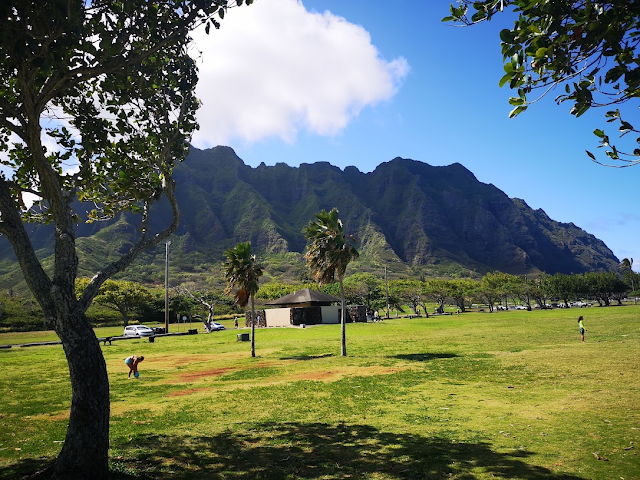
Some general and aesthetic background first:  I live at the Eastern edge of Waikiki, near Diamondhead, and run around Diamondhead three times a week, then out and back the Ala Wai canal after that.  It's beautiful there.  It was a stretch moving up to that weekly volume, but it works out.


view from the Diamondhead hill, on a really early outing


the opposite side of the run, the end of the Ala Wai canal, after circling that volcano


there really are a lot of rainbows here


Back to running progress


That's what run pacing looks like recently, if anything on the fast side.  I brought a watch that tracks heart rate but lost the charging cord on the trip, so I let that part of tracking stats go.  It was interesting varying running intensity but I can feel how that's going, and more typical challenges are pulling together motivation, effort level, sorting through stiffness, and breathing.  

That initial 10 minute km--in the stats / picture--is from walking over to the park (I start it at home since that phone has no active SIM card in it), then a short stretch, with a second warm stretch after a warmup run.  It takes doing loosening up.

A typical route looks like this:


I usually run the 12 1/2 km route, doing the canal out and back; that's slightly longer, going through that other neighborhood area.  There are two hill sections on the route and I'll usually walk a little at the top of the first steeper one, or sometimes both.  Frequency looks like this:


I wasn't running that far at the beginning of April, the current 12 km, and switching over took some doing.  Sometimes I walk a good bit, hike, ride a bike, or swim, and I've been ice skating twice in the past month, and mixing activities can tax training recovery.


Lessons learned


All well and good, but what do I understand differently now after this experience?  I ran an equivalent amount last May, but still my impression of it has changed a little.

Effort required to run at a relatively normal pace, for me, that 6 minutes per km (9 1/2 minute miles), stays on the high side.  I could be clearer as to why.  It seems like it's hard to improve conditioning without varying training intensity, doing faster shorter interval running, so that the normal pace feels more moderate.  That risks injury for me, if I don't take that slow, and for whatever reasons my interest has been to increase training distance instead.  I'm really running to stay in shape, and to experience it, not to train for fast race times.  I don't race.


I haven't fallen into a clear routine for timing, related to exactly when I run, and I think that throws off making improvements.  Early morning is most pleasant, but I'm not a morning person, and that requires running without ingesting any caffeine first.  I need to also eat when I drink tea to protect my stomach, or at least that's how I see it, so I can't run too early if I have a light breakfast.  Sometimes I run in the afternoon instead.

It's interesting how relative effort related to body tension and breathing forms works out.  For pushing it for distance increase it's hard to fully recover, and carrying leg and body tension from not being completely recovered seems to add a lot of extra work (and adds a few minor aches, of course).  It's odd how the two things inter-relate, experience of tension and effort level required to run.  I've experimented with shifting posture, relaxing my shoulders, and using different hand positioning to help with relaxation while running, but I would expect that what works for anyone is a bit individual.

Often I'll experience a very stable, slow form of breathing that only evolves as I fully relax, usually after 6 km.  I might push that pace to as fast as 6 minutes per kilometer, but often that's not fully sustainable, and I'll alternate a faster and rougher breathing pattern.  I don't know what that means, but it seems the faster and shallower form might relate to my body clearing lactic acid or carbon dioxide faster, or maybe I just need more oxygen.

Related to that running theme of muscle and soft tissue recovery, very light activity, like swimming or walking, seems to speed that process up.  Youtube running channel content producers always claim that slow "recovery runs" work better than rest days, and it seems that might be right.


I think I could push it a little harder.  I'm concerned about injury, since I've experienced three very minor injuries in the 5 1/2 years I've been running.  Those issues were nothing that required much treatment, all just extended extra soreness in a tendon or ligament, but taking a month or more off running definitely throws off progress.

It's not just that; part of the running experience is about enjoying it, relatively speaking.  Focusing and leaning into the pace over a shorter run, for example for 45 minutes, isn't so bad, but pushing it doesn't work well with longer hour and a half range runs.  I could emphasize the divide that's already happening in these runs, starting slower, and changing pace at the mid-point / 6 km mark, but part of the conditioning input that's not as clear in the stats listing is about grinding out two uphill sections early on.  Leaning into the hill climbs is a little rough but also kind of pleasant.

To offer others advice, for people regularly doing shorter runs or always at a moderate pace, it worked well for me earlier this year to divide a run into an initial slower pace then a later faster one.  It was odd how close the two were in terms of actual running speed, both essentially right around 6 min / km or 9 1/2 min / mile, but easing off a normal pace just a little made it feel much less intense.  In a sense that's like using the first 5k of a 10k / 6+ mile run as a long warm-up, which is probably not ideal for maximizing training effect, but it took the sting out of working up to normal effort level several times a week.


some of that is heat stress, running back in Bangkok


she is hardly ever in the social media photos


light hikes can be nice here, very scenic


Wednesday, April 3, 2024

Things to do in Honolulu, Hawaii


the main part, doing things with family (I'm not actually conservative, as implied)


As I've mentioned in at least one post that I'm back in Honolulu, this time for 2+ months until the end of the kids' school year.  Job hunting never did work out, so I'm still working remotely in an IT job based in Bangkok.  The kids do well, and schooling goes ok, so the main themes are on track.

This is really about what we've been doing, what a Spring Break is like when you take your local kids to do outdoor activities in the local area.  I guess it overlaps a good bit with what a tourist would do, just without the emphasis on spending thousands of dollars in a week, which just isn't an option.  There is a zoo, aquarium, and museums around, with two great versions related to art and science (Honolulu Museum of Art and the Bishop museum), but this doesn't go into that, even though we covered it all last year.  

Let's go with a few examples to clarify what tourist oriented themes we don't get to:


luaus:  I've never experienced this, even though I spent two years in grad school here, and two other short spans living here recently.  I suppose the food would overlap with what I have already tried, roasted pig and such, then there would be hula or fire dancing.  It's not completely separate from a dinner show at the Polynesian Cultural Center, which I have experienced.


PCC:  this is a theme park based around demonstrating old forms of traditions in Polynesia, in Hawaii and other "local" islands like Guam, Samoa, Fiji and so on.  It's ran by Mormons.  I don't see it as necessarily authentic, but surely most of the show themes tie back to actual cultural history.  In Trip Advisor review comments people either love the experience or hate it, tipped towards people liking it based on self-selection, mostly people on that page going there.


awhile back


Disney / other venues:  I have no idea what a small local Disney outlet is all about.  It's nothing like the full scale Disneyland or Disney World versions, but I don't what it is like.


we did go to a local water park recently, Wet and Wild


whale watching, other boat tours:  we wouldn't go on a boat or take any tours; we are poor locals.  We did go on a whale watching boat tour once, and it was pretty cool, since we saw humpback whales breaching.  You don't need to take a tour to snorkel, although going in the wrong place you will just see the sandy beachfront bottom.


What we have been doing:


Hanauma Bay:  a main draw on Oahu, a nature preserve with great snorkeling.  It's a little sad that high tourist visitation in the past, combined with use of sunscreens with ingredients that harmed living coral, has impacted the ecological health of this area.  They offset that now by requiring use of reef-safe sunscreen and closing the area for two days a week to let it recover, and limiting visitor count.  A good alternative right in Waikiki is Queen's beach, beside the old film screen framework across from the zoo and Kapiolani park (the beach in the local pictures here).


monk seals joined us, sunning on the beach nearby


hikes:  we've did three in the past three weeks, a waterfall hike outside of the city and two ridgeline hike variations at the near edge of the city, one out of St. Louis Heights and the other out of the Manoa valley.  Those last two are essentially the same place.  Manoa falls is the main local hike, along with walking up Diamondhead (volcano crater).  

The great part about local hikes is that you can take a bus for a half an hour or so and be at the foot of a trail, where it's a 45 minute commute for us to get to most local places back in Bangkok, still another 45 minute commute further to completely leave the city.  

Tropical forests are great, the look and feel.  To me ridgelines have an even nicer energy to them, along with great views and pleasant sunny and breezy weather.


Lulumahu falls; a nice spot, but the trail route is a bit confusing


Beaches, Waikiki and others:  some are crowded and not so great, but towards the edges crowds thin and some parts are really nice.  I was seeing sea turtles on most of the early snorkeling outings.  

From our house we can walk over to the nearest nice beach for snorkeling in under 10 minutes (Queen's beach, but it's really just the end of the Waikiki area).  My kids are learning to surf, with my wife trading homemade Thai food for lessons from a neighbor who is an instructor.  It all works out.


the beach near our house, the one edge of Waikiki


mountain view from a North shore beach


12 years ago, in the same place


running:  I'm back to running around Diamondhead, in much cooler weather than I could hope for in the cool season back in Bangkok, down to 21 C or so, in the 60s F.  I've been too busy with the kids to lean into training, so I've only ran that loop three times.  It seems that with any degree of consistency I could train for cardio improvement easily, with working through heat exhaustion dropped out.


including a walk to a park and stretch; the real pace was a little faster


12 years ago, at the local zoo, with Diamondhead in the background


local parks:  parks are parks, to an extent, but the feel of them here is a little nicer.  The weather is ideal, cool, sunny, and breezy, and the tropical theme makes it all look like a postcard.  

Kalani has been playing volleyball in a park league so we've been practicing for that in the nearest park, and I've been to a couple of her practices, and two games (drifting off the vacation outing theme).  We just bought Keoni a new bike, and he has already started biking around the large local park (Kapiolani), and will move on to wherever else through city streets.  

The parks are mostly for locals to have outdoor space access, for events or picnics and such, with tennis courts there, and with a concert venue (Waikiki Shell) and local event area (Kapiolani Park Bandstand), but tourists might also like walking through to see what's around.  There are two good shave-ice places on the north and northwest side of that park (Monsarrat and Shimazu), and local food and fast food options just up Kapiolani road on the west side. 


There is a magical sort of feel to all of Hawaii that you can only really experience if you slow things down and tune into it, and get at least a little space from malls, hotel spaces, traffic, tours, and crowded beaches.  Tourists rushing around to check off a list of things to do might miss it.  

If necessary visitors should schedule in time to walk along a less crowded beach (they're better on the east side of the island, but the edges of Waikiki are close enough), watch a sunset, or to spend an extra half an hour eating a lunch in a park.  Or a waterfall or ridgeline hike is fine, you just need to remember to take a few deep breaths and experience the environment, instead of only the noise in your own head.  

If you have kids getting that break and extra space may seem impossible, but then it's all the more important to guide them to appreciate and love the feel of the environment, instead of just shouting and stomping through it.


Friday, July 21, 2023

Adapting to running in heat, related to training in Bangkok


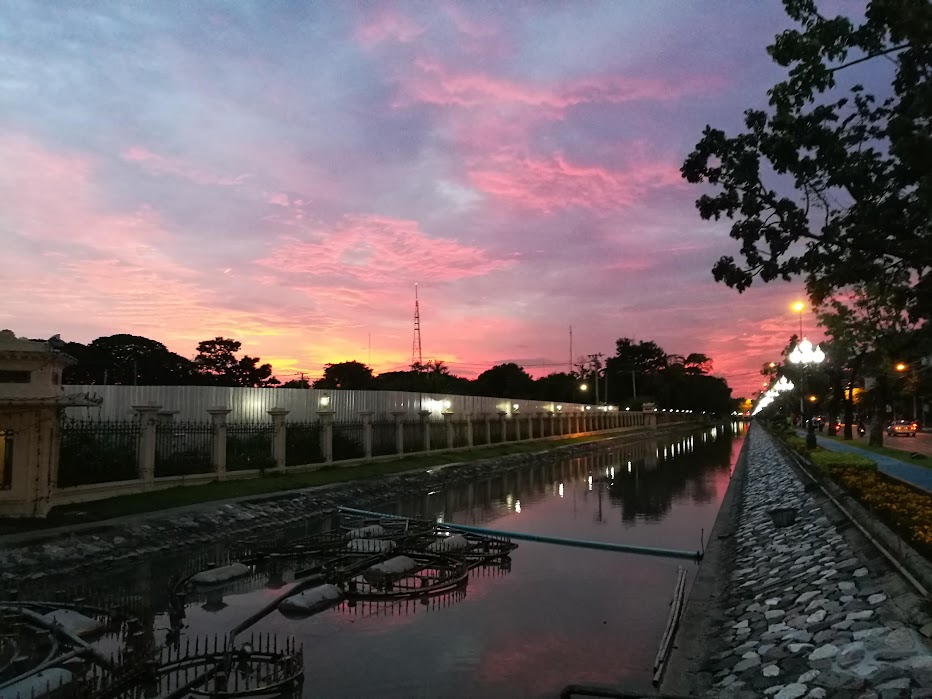
my local running route, a track around the nearby Royal palace


I saw a text content post about how to approach running in heat recently, from a favorite Youtube video channel source, Believe in the Runwith that post here.  

Their advice was all pretty standard stuff, but definitely good advice, about running in clothing that wicks moisture well, wearing light colors, running in the morning or evening to miss the hottest time of day, wetting clothing or a hat (which makes all the difference for desert hiking), and even running in the rain.  Other points were perhaps less practical but still worth considering, like trying to run in the shade.  There's a sidewalk beside the running or biking track where I run and I do switch over sometimes if one part is better shaded, which varies based on direction of the sun.


that sidewalk under repair (left) has been mostly completed since


I've written status updates about my training, last about running longer distances in Honolulu a couple of months ago, bumping my local route from 7 km to 12.  Heat wasn't much of an issue there; it could get up to 88 F or so (31 C), but with generally lower humidity and an ever-present breeze even running in the mid-day sun felt fine.


From running in Bangkok I had some ideas to add to that Believe in the Run content I mentioned, commented there as follows:


I've been running in Bangkok, as hot and humid as anywhere, and a couple of extra points come to mind. You need to stay on top of electrolyte replacement, not just after a run, but as a supplement routine based on estimated extra demand. Heat can be treated as another conditioned tolerance, like running at altitude, so adding exposure to the hottest times can help, just in moderation, building up. Easing pace helps, but you condition to an amount of exposure, with distance and time going together. 

There's one unique feel to learn to recognize, the early stage of heat stroke. It's not unlike normal fatigue but not the same. Your energy level might not drop that much, and breathing speed up a little, but beyond those you can feel when it's enough. Running relaxed helps tolerance.


From seeing videos about this topic recently (it's the peak of the Northern latitudes summer) I've been considering the subject, which really hit home moving from Honolulu to Bangkok again a bit over a month ago.  For the first two weeks I was just re-acclimating to the heat, conditioning to be able to run here again, building up tolerance and distance.  To some extent that's ongoing; lots of days I'll quit after 4 miles (6 km), instead of running the usual 6+ miles / 10 km, if I'm out in mid-day and the heat is getting to me.

Of course for people tracking heart rate--which I don't do, even though that makes sense--there's a decent chance that heat stress would spike that, so it would be easy to see when the effect is kicking in.  I still think it would be best to monitor internal feel, since how you react to heat stress as an input seems to vary a good bit outing to outing.  Heart rate monitoring alone might not protect you, and noticing impact in other ways could help.

When I was younger I would hike in the desert in Utah on vacation when it would get up to 115 F (46 C); the rules and effect is different during hiking, when it's much easier to moderate intensity.  You could carry large bottles or jugs of water frozen, to drink cold water, and to carry a cool pack, I just didn't because I was camping on those outings, of course without bringing a freezer.  That Believe in the Run article mentioned that trick, that you can bring ice, and it can cool you through body contact through a pocket.

It's a lot more of a balancing act when running than when hiking.  Intuitively running slower would help, but it only helps so much, and you have to be acclimated for that to work in Bangkok heat and humidity.  It's a relatively cool and cloudy day outside now and it's 90 F, for example, 32 C, and if it happened to be sunny it would've been more like 35 C in mid-afternoon, on towards upper 90s.  Checking the next day it's now 86 F at 9 AM (30 C), with the daytime low above the 25 C (78 F) version of room temperature here, even though it's the rainy season, not hot out by local standards.


it is nice running that route at sunset, when it works out like that


my old Diamondhead loop (Honolulu) route at sunset; a bit nicer


I run when it fits my schedule, versus a cool time of the day, and it's odd how often that's at noon, on a lunch break.  I'm not a morning person so before work is out, and I can't run right after eating, so evening time gets limited by dinner plans.  When you have kids your schedule just isn't your own to dictate, period, and what everyone else is doing factors in.


So what else did I miss in that comment?  It's a bit of a false parallel comparing heat training to altitude conditioning, even though in part that works.  Extra red blood cells aren't going to help you, and there's a limit to your body acclimating to operate at a higher internal temperature.  "Running relaxed" is a funny subject theme, one I was just considering out on my last run.  You can shift how your body reacts to the experience with practice, slowing breathing pace and reducing internal tension, even without cutting pace.  

There wasn't that much "how to" in those comments.  It would help to not run "out and back" routes when time or distance exposure issues aren't clearly determined; it would seem odd to run half of an 8 mile route here and end up taking a taxi back.  I run two versions of local repeating long loops so it doesn't come up, here.

Replacing electrolytes becomes critical when it's hot; there's a lot more about levels and approach to get to.  That's familiar ground from dabbling in fasting over the past year, and something that I've just seen an interesting reference for in a Reddit running group post, here:


...some people have done some research to see what electrolytes the average person loses in sweat.  SaltStick claims:

"The average persons sweats a salt ratio of 220 Sodium to 63 Potassium to 16 Calcium to 8 Magnesium."

That's a ratio of:

Magnesium: 1x; Calcium: 2x; Potassium: 7.875x; Sodium: 27.5x


That goes on to compare a large number of electrolyte supplements, and I suppose many drink versions, based on those forms of replacement being universally accepted in running circles.  A Reddit fasting sub reference takes a different approach, and explains daily requirements and varying approaches for using other mineral replacement forms, for example using potassium based salt substitute mixed with water.  In fasting circles people focus only on replacing sodium, potassium, and magnesium, generally, but a friend once mentioned that calcium level falling out of balance with those others could be a problem.

To me it makes more sense to try to guess about extra demand and add that back into your diet gradually, day to day, than to try to immediately replace an estimate of exactly what a long run just expended.  I take magnesium and calcium as supplement pills, and use a potassium based salt replacement, at times drinking that and salt mixed into water, after longer outings.  Using that approach your electrolyte levels can stay a bit high, beyond that periodic dip, but as long as you drink plenty of water overshooting intake wouldn't be a problem, because your kidneys could keep removing the excess.  Staying very hydrated is critical anyway; I try to gradually restore water balance over each day as well, versus drinking a lot just before or during a run.  I do try to consider when I'm going to run and drink half a liter or so of extra water a half an hour before an outing, just to be on the safe side.  

Even though I'm often running 10 km (6 miles) in extreme heat and humidity I don't drink water while out; I hydrate before going out and drink immediately after.  That's about as far as I think that approach would work, under those conditions; for quite long runs drinking water while running would be necessary, and adding electrolyte supplements.  Per following running social media content, like that Youtube channel, lots of runners tend to love adding extra products and gear to their routines, varying drinks and energy gels, or more recently a "legionnaire's hat" for extra shade around your neck.  I'm definitely in the other group, not buying or collecting any extra stuff or using much for supplements.  I've developed a running shoe habit; that's about it.


another favorite running channel, Kofuzi's


missing my new addition and favorite pair; this includes my son and daughter's shoes


my favorite shoes, ACIS Novablast 3, but I really like the New Balance 1080 too


One important part of adapting to running in the heat is liking it.  If you absolutely hate the experience it would be natural to avoid it, and it all would never click.  Relaxing would be harder.  In discussing heat acclimation, in travel or expat threads, I often mention that a big part of adapting to heat, in general, is to keep experiencing it.  Living out all of your daily routine in cold air conditioning will then relate to struggling with the change when you go outside.  Going for a walk is perfect light contact, or working outside, or just being exposed to indoor natural temperatures.  It's crazy to me how so many of the aspects of daily life that we've dropped out seem relatively ideal for maintaining good body mobility, activities like hanging out laundry to dry.

It can help to reset AC temps higher, which would also save on a utility bill, setting that to 26 to 28 C here instead of 22 (closer to 80 than 70 F).  For many that would defeat the purpose; my wife (who is Thai) would much rather sleep at 22 C than 26 (closer to 70 than 80 F), and for her limiting cooling to 25 already is a compromise.


How would someone develop a love for being really hot, which is almost objectively a negative state of being?  I don't see it as so different than adjusting to the experience of running, which doesn't come naturally to most people.  You can walk first, then run slowly, and later even higher levels of exertion become pleasant, on some level, and then you crave it (in general, or maybe even when it's hot).  No one craves running in the mid 30s C / mid 90s F, in high humidity, when the early phase of heat stroke experience enters in before long, but it can normalize as an internal experience, more than it might seem possible.  

Just as that higher degree of exertion, just the running, feels unpleasant without acclimation if you never experience heat exposure in any positive context of course it's going to seem bad.  Outdoor childhood play can lead to acclimation early on, but it would be harder to identify with later on.  For the longest time my Thai family was happy that I didn't die on runs out on hot afternoons; it's also a cultural convention here in Bangkok that you should avoid the heat.  Only in a few cases did I experience hitting a wall on runs, experiencing part of what they were concerned about, significant physical distress.


where we live in Honolulu, from Diamondhead; lots of nice running routes


Tuesday, May 2, 2023

Running status update; increasing distance and intensity


Diamondhead, the local volcano I run around


As I see it I'm still a beginner runner, so passing on status is still about communicating how moderately developed training goes, and routine changes in that experience.  But I am up to running 15 to 20 miles per week.  My typical route is around Diamondhead, the iconic local Honolulu volcano, a 5 mile distance, with two significant hill climb sections.

Why communicate this?  Ego, I guess, the usual answer, to brag about progress.  But for people thinking of getting into running, or ramping up light training, it may be helpful.  I'm not training for races, to be clear on context, but eventually I could run one.  I just tried out extending my daily run from 8 km to 12 (5 miles to 7 1/2), so I could run a 10k easily enough, or even a half marathon (21 km), but I would have to add even longer runs to prepare for that longer race version.  For now it's not about that social exposure or the experience of testing my conditioning in a time trial.


all metric; I'm definitely not running 6 minute miles


For the longest time, for years, I kept individual run distance or weekly total very limited, at 2 miles per run, doing that three times per week.  I would add extra intensity, fast 800 meter section at the end, instead of ever adding distance.  After a couple of years I doubled that run length, but after disruption from a mild injury I dropped that, only really extending length again a year or so ago (but it's easy to lose track; maybe it was further back).  

The point here is that running for exercise can take a lot of different forms.  My earlier practice replicated what treadmill experience is like, 20 or so minutes on a set course, with potential to change intensity instead of ever adding distance.

A main challenge is increasing either distance, intensity, or frequency at my age, 54, since recovery time is a concern.  I can gradually increase demands if I'm only running about every other day, 3 to 4 times per week, but I can't foresee how getting up to a 40 or 50 mile weekly distance would ever be possible (standard marathon training, according to some).  Maybe with another year or two of gradual increase, but that pace of slow change can be hard to relate to.  But I have already experienced slow transition, over the past year, building up to 10 km runs over months, when that had been closer to a weekly total.


A hill climb input has been interesting, and challenging, changing things in relation to only running flat local routes back in Bangkok, for the 5 months prior.  I lived in Honolulu in Sept. and Oct. 2022, so this local route I started doing back then, but it was new to me.  Adjusting to that demand, normalizing the experience, and increasing pacing took weeks during this stay.  


the view on the ocean side of Diamondhead, nice and relaxing


I guess I'm recommending patience then, gradual increase in new demands.  Prior to moving back here, in March, I seemed right at the cusp of adding "speed work," a different kind of input, while experimenting with longer distance and more runs per week.  The hill experience has replaced that; I didn't get back to running shorter intervals faster just yet.

I've experienced mild injuries twice in 4 1/2 years of running, nothing too severe, but that's why I've been avoiding quicker changes in demands.  Swimming, hiking, and doing a good bit of walking here have been nice for mixing up activity exposure, which seems to help with running recovery instead of offsetting it.


Subjective experience change across the longer term experience have been interesting; I find I like running more and more, as it becomes more familiar.  Pushing the pace to put in faster than average outing times isn't so unpleasant, but my normal range has been limited, spanning 45 to 47 minutes for that nearly 8 km route.  That works out to 9 1/2 minute miles, or a half hour 5k pace, not so fast.

I was always concerned that if I ran with any sort of time tracking--I run with a phone app minding the pace now, and announcing it by km, not a version of sports watch--that I would see half the outings as failures, as slower than average, but with times in such a narrow range it kind of doesn't matter.  I run a little slower when I go out in early mornings, not being a morning person, but it's cool being out there then, so I don't mind.  Adding a short walking section at the top of the most difficult hill actually speeded up the times; I can run a little closer to failure point knowing that a 20 second recovery walk will follow that.


Where is this going, one might wonder.  Sure it can relate to "getting in shape," but with what final limit, or goal?  It's a bit abstract, but when I was younger I ran cross country and track, and ran 10k road races in the 42 to 44 minute time-frame.  It would be nice to be able to replicate that.  I was really training more for 5k distances then, and if I could run a 19 minute 5k that would match that capability.  I wasn't much of a natural distance runner, or a competitive high school racer; 17 minutes would be an ok time, much faster.  Since flat course, daily runs of 10k were at a one hour pace two months ago, which I ran 3 or 4 times a week, I could surely run at least close to a 45 minute 10k now, if not faster.  I'm just not doing races or any work-out based time trials to find out.

As with other parts of my life right now I don't know where it's headed.  I'll return to Bangkok, and to flat route running, within the next month or so.  How quickly I return to Honolulu depends on job hunting progress; maybe in July, or maybe towards the end of August, when my kids return to school.  I'm working remotely now at my Bangkok job, and it would make sense to experience that employment in local form for awhile.

If I did run a 42 or 44 minute 10k race, or decent half marathon time, I'm not sure if I'd taper off training.  Time demands versus return factor in; I'm staying in great shape for spending 3 or 4 hours a week on the hobby, including limited transit time and showering (walking a half a block to the local park).  I'm not sure that I need to be this fit for the next 20 years, that it would be helpful.


I'm not the right person to pass on first person experience with running training, because I'm just not advanced enough, but watching videos on the subject has been interesting.  I'll share some random ideas I've encountered, most of which don't draw on my own exposure all that much.  A last post about running mentions some of those video sources, but once you watch a few running videos on Youtube the algorithm will keep mentioning them, as with any subject.  I had switched over to 10k distance in February in that writing, 3 months ago, but pace isn't so different then, just a little faster, with two hill sections added to the route.


Running with different types of training shoes:  pretty much everyone further along in experience--passing on advice in videos--just assumes that people are going to own a number of different shoes for different purposes, for running longer distances or faster, shorter training sessions, for racing, with more cushioning for slower "recovery runs," and so on.  I don't recover well while running, but I get what they mean.  

I happen to own two pair, related to really wanting to try out a specific shoe, and liking the idea of alternating to offset impact (shoes really do seem to affect running form and experience just a little).  I don't have any further useful advice to add; watching a lot of review videos fills in the rest, but fair warning, it makes you want to buy any number of extra pairs.


Asics Novablast 3; pretty nice


In the reviews and commentary once in awhile sources will mention what they recommend to people asking about owning just one shoe, and they're kind about not being negative about that, but reading between the lines this marks out one divide in their minds between newbies and more serious runners.  That's fine, really; you do need to become more serious if the goal is to put in good marathon times, not so much related to buying a lot of gear, but some of that would enter in.


Training theory:  I'm not relying on much of that, but again the easily accessible and broadly oriented videos on Youtube help pass on starting points, if not more advanced and comprehensive advice.  An example:  it's best to push on to running one longer outing once a week, or week and a half, since this conditions you better than repeating the same distance over and over, or doing medium lengths plus speed work or hill climbs, or whatever else.  What "long" means would vary by person, but the 10 to 15 mile range is often referenced, and there's no reason there would need to be much of a limit.  Recovering from a 15+ mile run would seem problematic, but it seems people trained to endure routine longer distances can run "slowly" for an extended time.  

Other parts about calculating specific workout paces is fascinating, based on current maximum oxygen use capacity, heart rate, lactic threshold (how fast your body can clear carbon dioxide and lactic acid), and whatever else.  Again, watch the videos.  

The minimum "buy-in" to try out these ideas would be a sports oriented tracking watch, to keep pace clearly identified, and to monitor heart rate, main input.  There are different versions of these, so relative cost would surely vary, depending on functionality.  If I was training for a race time goal I'd be into that, but I'm not, I'm just taking fitness pursuit to an odd place.  Of course use of very functional shoes comes into play, and some recovery devices (eg. foam roller), and bumping clothing functionality comes up.  I would experience a completely different cost to run if I were going out in cooler temperate weather to run; being based in the tropics simplifies all that quite a bit.


Effect on daily life:  surely it's just better, right, more energy, increased fitness, and athletic capability?  Kind of, but I've also been describing consistently trying to increase physical demands week to week, keeping that level stable when I'm normalizing the last increase.  I've been a bit sore for a lot of the past 4 1/2 years, and pushing it more over the last year adds extra fatigue.  It's not as bad as one might expect, because if you increase it all too fast you'd be injured, so natural limits enter in, at least in middle age.  I prioritize getting decent sleep more than ever; that takes extra time.  

I don't do much to add to recovery, not using any special devices (I had a foam roller and lost it), not getting massages (although Bangkok is the ideal place for that), or eating much for supplements or special diet, and definitely not longer run energy gels for fuel intake.  Again racing would change things, training for a specific goal, instead of just to get in shape, to progress capability.


Nutrition:  an extension of the last concerns, which I'm not quite on to needing to address with special inputs, but I'm getting there.  I don't normally eat nearly enough protein to sustain vigorous exercise, the recovery part, so I've taken up addressing that on a day to day basis.  My own solutions are easy:  add protein powder drinks (a limited supplement), eat extra eggs when I notice intake drops, drink a little milk (not much), and from time to time eat a good bit of veggie protein, making up large lentil soup or chili batches or whatever else.  I take a multi-vitamin, and supplement potassium and magnesium a little, really an outcome from experimenting with fasting.  

I'm not trying to add calories, or eat any certain amount of fat, or adjust carb inputs.  I eat a lot of nuts as snack food, which is partly about that being a healthy input, and just about liking them.  Dropping out most junk food isn't related, more an outcome of seeing a high cholesterol score last health check, which may or may not be so bad in relation to proportion of good to bad cholesterol type, but still I'm trying to become healthier.  One might expect that I would become thinner, especially for experimenting with fasting a few times, but not really noticeably so.  Swimming seems to tone me up a little, and that change stands out more.


with family


In closing running interest has transitioned to a much more extensive and interesting pursuit, even for staying limited in scope in some ways.  I'm curious about my heart-rate status related to exertion, but running by effort level seems fine, for what I'm doing.

I'll keep going, bumping distance and speed over the next months, trying out new training directions.  It's going to feel like a setback going back into Bangkok heat, but at least we're leading into the rainy season now, which is hot and rainy instead of really hot.  If enough changes I'll check in here about it.