 |
my local running route, a track around the nearby Royal palace |
I saw a text content post about how to approach running in heat recently, from a favorite Youtube video channel source, Believe in the Run, with that post here.
Their advice was all pretty standard stuff, but definitely good advice, about running in clothing that wicks moisture well, wearing light colors, running in the morning or evening to miss the hottest time of day, wetting clothing or a hat (which makes all the difference for desert hiking), and even running in the rain. Other points were perhaps less practical but still worth considering, like trying to run in the shade. There's a sidewalk beside the running or biking track where I run and I do switch over sometimes if one part is better shaded, which varies based on direction of the sun.
 |
that sidewalk under repair (left) has been mostly completed since |
I've written status updates about my training, last about running longer distances in Honolulu a couple of months ago, bumping my local route from 7 km to 12. Heat wasn't much of an issue there; it could get up to 88 F or so (31 C), but with generally lower humidity and an ever-present breeze even running in the mid-day sun felt fine.
From running in Bangkok I had some ideas to add to that Believe in the Run content I mentioned, commented there as follows:
I've been running in Bangkok, as hot and humid as anywhere, and a couple of extra points come to mind. You need to stay on top of electrolyte replacement, not just after a run, but as a supplement routine based on estimated extra demand. Heat can be treated as another conditioned tolerance, like running at altitude, so adding exposure to the hottest times can help, just in moderation, building up. Easing pace helps, but you condition to an amount of exposure, with distance and time going together.
There's one unique feel to learn to recognize, the early stage of heat stroke. It's not unlike normal fatigue but not the same. Your energy level might not drop that much, and breathing speed up a little, but beyond those you can feel when it's enough. Running relaxed helps tolerance.
From seeing videos about this topic recently (it's the peak of the Northern latitudes summer) I've been considering the subject, which really hit home moving from Honolulu to Bangkok again a bit over a month ago. For the first two weeks I was just re-acclimating to the heat, conditioning to be able to run here again, building up tolerance and distance. To some extent that's ongoing; lots of days I'll quit after 4 miles (6 km), instead of running the usual 6+ miles / 10 km, if I'm out in mid-day and the heat is getting to me.
Of course for people tracking heart rate--which I don't do, even though that makes sense--there's a decent chance that heat stress would spike that, so it would be easy to see when the effect is kicking in. I still think it would be best to monitor internal feel, since how you react to heat stress as an input seems to vary a good bit outing to outing. Heart rate monitoring alone might not protect you, and noticing impact in other ways could help.
When I was younger I would hike in the desert in Utah on vacation when it would get up to 115 F (46 C); the rules and effect is different during hiking, when it's much easier to moderate intensity. You could carry large bottles or jugs of water frozen, to drink cold water, and to carry a cool pack, I just didn't because I was camping on those outings, of course without bringing a freezer. That Believe in the Run article mentioned that trick, that you can bring ice, and it can cool you through body contact through a pocket.
It's a lot more of a balancing act when running than when hiking. Intuitively running slower would help, but it only helps so much, and you have to be acclimated for that to work in Bangkok heat and humidity. It's a relatively cool and cloudy day outside now and it's 90 F, for example, 32 C, and if it happened to be sunny it would've been more like 35 C in mid-afternoon, on towards upper 90s. Checking the next day it's now 86 F at 9 AM (30 C), with the daytime low above the 25 C (78 F) version of room temperature here, even though it's the rainy season, not hot out by local standards.
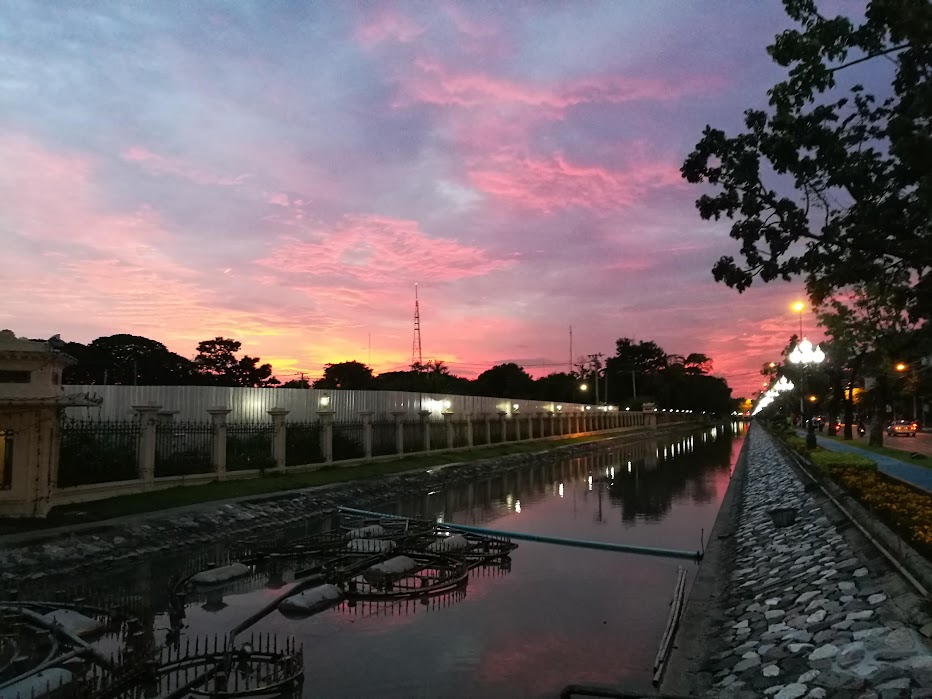 |
it is nice running that route at sunset, when it works out like that |
 |
my old Diamondhead loop (Honolulu) route at sunset; a bit nicer |
I run when it fits my schedule, versus a cool time of the day, and it's odd how often that's at noon, on a lunch break. I'm not a morning person so before work is out, and I can't run right after eating, so evening time gets limited by dinner plans. When you have kids your schedule just isn't your own to dictate, period, and what everyone else is doing factors in.
So what else did I miss in that comment? It's a bit of a false parallel comparing heat training to altitude conditioning, even though in part that works. Extra red blood cells aren't going to help you, and there's a limit to your body acclimating to operate at a higher internal temperature. "Running relaxed" is a funny subject theme, one I was just considering out on my last run. You can shift how your body reacts to the experience with practice, slowing breathing pace and reducing internal tension, even without cutting pace.
There wasn't that much "how to" in those comments. It would help to not run "out and back" routes when time or distance exposure issues aren't clearly determined; it would seem odd to run half of an 8 mile route here and end up taking a taxi back. I run two versions of local repeating long loops so it doesn't come up, here.
Replacing electrolytes becomes critical when it's hot; there's a lot more about levels and approach to get to. That's familiar ground from dabbling in fasting over the past year, and something that I've just seen an interesting reference for in a Reddit running group post, here:
...some people have done some research to see what electrolytes the average person loses in sweat. SaltStick claims:
"The average persons sweats a salt ratio of 220 Sodium to 63 Potassium to 16 Calcium to 8 Magnesium."
That's a ratio of:
Magnesium: 1x; Calcium: 2x; Potassium: 7.875x; Sodium: 27.5x
That goes on to compare a large number of electrolyte supplements, and I suppose many drink versions, based on those forms of replacement being universally accepted in running circles. A Reddit fasting sub reference takes a different approach, and explains daily requirements and varying approaches for using other mineral replacement forms, for example using potassium based salt substitute mixed with water. In fasting circles people focus only on replacing sodium, potassium, and magnesium, generally, but a friend once mentioned that calcium level falling out of balance with those others could be a problem.
To me it makes more sense to try to guess about extra demand and add that back into your diet gradually, day to day, than to try to immediately replace an estimate of exactly what a long run just expended. I take magnesium and calcium as supplement pills, and use a potassium based salt replacement, at times drinking that and salt mixed into water, after longer outings. Using that approach your electrolyte levels can stay a bit high, beyond that periodic dip, but as long as you drink plenty of water overshooting intake wouldn't be a problem, because your kidneys could keep removing the excess. Staying very hydrated is critical anyway; I try to gradually restore water balance over each day as well, versus drinking a lot just before or during a run. I do try to consider when I'm going to run and drink half a liter or so of extra water a half an hour before an outing, just to be on the safe side.
Even though I'm often running 10 km (6 miles) in extreme heat and humidity I don't drink water while out; I hydrate before going out and drink immediately after. That's about as far as I think that approach would work, under those conditions; for quite long runs drinking water while running would be necessary, and adding electrolyte supplements. Per following running social media content, like that Youtube channel, lots of runners tend to love adding extra products and gear to their routines, varying drinks and energy gels, or more recently a "legionnaire's hat" for extra shade around your neck. I'm definitely in the other group, not buying or collecting any extra stuff or using much for supplements. I've developed a running shoe habit; that's about it.
 |
another favorite running channel, Kofuzi's |
 |
missing my new addition and favorite pair; this includes my son and daughter's shoes |
 |
my favorite shoes, ACIS Novablast 3, but I really like the New Balance 1080 too |
One important part of adapting to running in the heat is liking it. If you absolutely hate the experience it would be natural to avoid it, and it all would never click. Relaxing would be harder. In discussing heat acclimation, in travel or expat threads, I often mention that a big part of adapting to heat, in general, is to keep experiencing it. Living out all of your daily routine in cold air conditioning will then relate to struggling with the change when you go outside. Going for a walk is perfect light contact, or working outside, or just being exposed to indoor natural temperatures. It's crazy to me how so many of the aspects of daily life that we've dropped out seem relatively ideal for maintaining good body mobility, activities like hanging out laundry to dry.
It can help to reset AC temps higher, which would also save on a utility bill, setting that to 26 to 28 C here instead of 22 (closer to 80 than 70 F). For many that would defeat the purpose; my wife (who is Thai) would much rather sleep at 22 C than 26 (closer to 70 than 80 F), and for her limiting cooling to 25 already is a compromise.
How would someone develop a love for being really hot, which is almost objectively a negative state of being? I don't see it as so different than adjusting to the experience of running, which doesn't come naturally to most people. You can walk first, then run slowly, and later even higher levels of exertion become pleasant, on some level, and then you crave it (in general, or maybe even when it's hot). No one craves running in the mid 30s C / mid 90s F, in high humidity, when the early phase of heat stroke experience enters in before long, but it can normalize as an internal experience, more than it might seem possible.
Just as that higher degree of exertion, just the running, feels unpleasant without acclimation if you never experience heat exposure in any positive context of course it's going to seem bad. Outdoor childhood play can lead to acclimation early on, but it would be harder to identify with later on. For the longest time my Thai family was happy that I didn't die on runs out on hot afternoons; it's also a cultural convention here in Bangkok that you should avoid the heat. Only in a few cases did I experience hitting a wall on runs, experiencing part of what they were concerned about, significant physical distress.
 |
where we live in Honolulu, from Diamondhead; lots of nice running routes |


