Showing posts with label da xue shan. Show all posts

Wednesday, June 25, 2025

2018 Reunion Xiaguan 500 gram Da Xue Shan tea ball


In visiting that favorite local Bangkok Chinatown shop not long ago, Jip Eu, they mentioned having a novel version of Xiaguan product that we'd never covered in discussion.  It's a 500 gram  / half kilo ball of tea, not a tuocha or a cake, something else instead.  It's 2018 Reunion Da Xue Shan origin tea, a special production version, seemingly intended for gift-giving, now called gifting.

Why did I never hear of this, since I've bought lots of Xiaguan tuochas there before, and two versions of an older Xiaguan cake from them?  That shop works out like that.  They have different amounts of one-off teas around, and that one might've seemed like something appropriate for giving someone as a gift, versus what a sheng drinker might buy for themselves.  They even offered to let me try it after I bought it, if I was going to buy it for myself, so at least I'd have a chance to taste it, assuming I might be giving it away.


packaging was a bit extensive


extensive


The information I have on it comes from them (Jip Eu) passing on a Xiaguan site listing, which of course has been automatically translated at some point.  It says this:


Mid-Autumn Festival: Drink “Reunion Tuan Tea”

Original by Cheng Nuanru | P u’er Tea Circle

September 24, 2018

The Mid-Autumn Festival, also known as Moon Night, Autumn Festival, Mid-Autumn Day, Festival of the Eighth Month, Moon-Chasing Festival, Moon-Watching Festival, Moon-Worship Festival, Daughter’s Festival, or the Reunion Festival, is a traditional Chinese celebration...

...The 2018 Xiaguan raw Pu’er “Reunion Tuan Tea” is made from early spring big-leaf tea trees from Daxueshan, Mengku, Lincang in Yunnan Province.

It’s crafted using Xiaguan’s century-old traditional handmade techniques.


If you reverse image search it, or search using terms (which doesn't seem to work), you can find this Dragon Tea House listing.  It includes almost no information about the tea, not a good sign.  At least it seems highly unlikely that someone is pressing a 500 gram ball of tea to pass off as a counterfeit of a moderately priced real version.

I'll skip mentioning the shop cost here; that might change over time.  They tend to sell older sheng on the low side of the standard range, and for some teas there isn't a lot of standard range to work with.  I found one example of someone selling this online (that listing), for $84, and it cost less than that.


Expectations related to aging transition and potential are interesting; a 2018 Xiaguan version shouldn't be ready yet, typically.  But then this may not have standard Xiaguan character, the rough edges, harsh intensity, and barnyard range character.  I'll say more about potential issues with it coming straight out of a storage space in the review notes.


Review:


#1:  on the light side; I didn't use a rinse, so this is just getting started.  Flavor range is interesting, smooth and layered.  Tones are warm, maybe even beyond what I'd expect for a 7 year old version.  It will be clearer next round though.


#2:  it's in an interesting place for being in between where it was and where it's headed for fermentation input and result.  It's intense, but without the typical Xiaguan barnyard flavors, which must relate to a different source origin.  This clearly wasn't light, flavorful, approachable, and sweet as boutique sheng can be earlier on; it still has a lot of power, and some bitterness and astringency.

The flavors are hard to break down to a list.  Mineral stands out, but as usual I see that as more of a base for the rest.  Earthiness could relate to wood or even dried mushroom.  That sounds worse than I would intend; it's complex and balanced, not overpowered by some off flavor, but it's not really centered on floral range, or the like.  Sometimes sheng can loosen up and shift a good bit over the next few infusions; the next one or two might tell a different story.  I'll have to keep infusion times short to keep intensity in check; this is a strong tea.


#3:  it might be musty tones that I'm picking up, possibly as much from a storage conditions input as the tea itself.  Jip Eu's storage is surely very hot and humid (all of Bangkok is), and relatively tightly sealed, so that tea straight from there has picked up some significant mustiness.  That usually fades, but it takes time, a month or two.  I'm not sure if the conditions and that input are a bad thing, neutral, or actually good.  Adding more air exchange to their storage area would resolve that in one sense, but that may cost the tea stored there intensity, removing more of what gives it flavor.  For well-sealed teas it wouldn't matter (sealed oolongs stored there); I mean for sheng, left open enough to access some air contact.  This was stored in what I take to be a muslin cotton bag, inside a box, with no plastic wrapper or bag layer, as is more common.  It would've contacted external scents all the more for that.

Flavor is still kind of clean; it's a bit of a contradiction.  There is that one edge, but beyond that nothing off, earthy, musty, or so on.  It's not really vegetal, at least not as much as is common with sheng still going through the first half or so of its aging cycle.  I'd have expected some residual floral range, but there's not much, and it hasn't transitioned to the standard dried fruit, medicinal herb, camphor, and incense spice ranges.  But it seems to have potential to develop in lots of directions.  There is a lot going on, a lot of complexity and intensity, I'm just failing to describe it.


#4:  it's cleaning up; a good sign.  It's not overly musty, not exactly tasting as if it had been in an attic or basement, but it had been in a storage area that should resemble attic background scent range.  The flavor could seem to imply either aged hardwood, in an unusual vegetal range, or on to rich dried fruit, or medicinal herb, or all of those things, maybe even including some incense spice.  I think I'm trying it right between it's early character and the aged version.  It certainly didn't "go quiet," as people describe as one possible outcome, but it's covering range that doesn't necessarily make sense together.

Some might read this as a negative assessment, but to me the opposite is implied.  It's in a great to place to develop into very interesting and positive range over the next 7 or 8 years.  Sure that could seem like awhile, but time passes quickly.  That would be a rushed version of the process, for a tea like this to be essentially ready at around 15 years into aging.  The hot and humid storage input has definitely rushed things along.

As I keep tasting it tobacco would be a reasonable interpretation, I suppose tasting like a cigar instead of cigarette or chewing tobacco.  That ties to this being anchored in earlier vegetal character and now moving on to richer, transitioned, warmer tones.  I would guess that in just 5 years it won't taste a lot like tobacco, mushroom, or attic, that it will have moved on to whatever other transitioned range instead.  There is still no "barnyard" range developing; it doesn't really taste like leather, cured hay, aged wood, or smoke.


#5:  it keeps getting better.  Sweetness picks up, and that distinctive mustiness is fading.  I think with two months of aging it will be less of an input, and I could tell better where this is going, but it's so far from it's final more-fermented form that it would only be so informative.  I think this tea is going to be wonderful in a half dozen years, and maybe fully at its peak in another 10.  It might be fine to drink through it in 7 or 8, close enough, but then it's always a judgment call finishing tea right before it's fully ready.  I might need to buy another of these, to own a full kilogram, to be able to keep sampling and also have plenty later on.


#6:  there might be more story to tell over the next half dozen infusions, but lots of round by round notes will be too much.  This still tastes in between cured and aged wood, and like tobacco, with complexity that is hard to place filling in from there.  It's not really bitter and astringent in relation to younger sheng range but there is some bitterness and astringency remaining; this started out as really intense tea.  It has lots of potential to keep changing.


#7:  sappiness of feel ramps up, and to some extent a related flavor.  It leans a little more towards pine now.  I suppose brewing a dried pine cone might taste like this.  It's interesting that this keeps changing, but one might expect that, given the earlier intensity.


#8:  more of the same, more minor transition.  It's definitely not losing intensity.  I'll cut off the note-taking here; a minor transition or two won't change much.


Conclusions:


I liked it.  The in-between fermentation ranges issue and mustiness from being direct from storage did stand out, related to how it is right now.  In terms of only how the experience is right now the 2006 tuocha version I tried not long ago is a good bit better.  It's harder to place longer term potential though; I think this might be good even before the general 20 year old age range, which doesn't come up for another 13 years.  In another 7 it might be in a good place, related to hot and humid conditions rushing that process, even though a more final form will probably level off in another 10 or so.

That raises a couple of questions.  Would it better if you stored it in a cooler and dryer place for 20 years, or 25, instead of rushing the process over 14 years here, or maybe on towards 20?  Maybe.  To be clear everywhere but Malaysia is a considerably cooler and dryer place, including Hong Kong.  Taiwan and Guangdong get mentioned as places with moderate storage conditions, which some describe as ideal, but then that interpretation mixes in some marketing spin.

One might also question if this storage settling period I've been mentioning, a month or two to drop out a lot of initial mustiness, is different than the version relating to letting a tea rest after shipping.  I see it as different and unrelated, but it may overlap more than I know, and correcting for storage conditions input may often be a part of that other rest period.  People rest sheng that has been shipped for a few weeks, or a month, to let it settle from being shipped, with variations in humidity and temperature said to throw off character a little, temporarily.  It's usually described as it seeming a little flat, losing some intensity, which comes back when it normalizes to more standard conditions.  This is about a mustiness fading instead.


Everyone has their own take on how storage issues work out, and since preferences also vary the conclusions are never completely identical.  I just saw a Reddit post about a guy storing tea in a wooden cabinet, without any plastic or mylar coverage of the cakes, just in the paper, all mixed together, at whatever temperature and humidity he lived at, in the Midwest of the US.  That's probably fine, but for some others it wouldn't be, maybe for different reasons.  

It makes a lot of difference if you are drinking through cakes in a couple of years, or a few, or holding onto them for a decade or longer.  I might use individual wrapping to limit air contact instead, the ziplock style bags cakes come in or the like, but that's not a critique, just a statement about personal approach.  If you open the cakes from time to time that's already plenty of air exchange, and probably even if you leave them sort of sealed for a few years it's still enough.  Mylar or multi-layer packaging restricts any air exposure better, but ziplock or the other light plastic wrappings, similar to food wraps, would allow for plenty of contact.  

According to the author of the Late Steeps blog--a great reference--air contact related to tea being sealed in mylar allows enough oxygen contact / exchange to support bacteria and fungus to thrive, one related consideration.  Who really knows, but it's interesting to consider.  Again all of these considerations really only kick in if you aren't actually drinking the tea at all, not even getting it out a couple times a year to check on it.


the chunk that came off in one pu'er knife stroke; it's nice that it's easy to access


Monday, July 29, 2024

Ori Puer Lab 215 Da Xue Shan sheng pu'er


I'm reviewing a sheng pu'er that I initially knew nothing about, except production date, from an unusual source.  Stephen Liu--maybe a nickname of sorts, since he uses two different names in FB?--is the head of the largest Thai Facebook tea group, with 67,000 members, and the founder of a Thai FB tea marketplace group, and he writes a blog about tea background.  He is a main authority on tea in Thailand.

I saw him giving a presentation at the recent tea expo in Central Embassy, at the Tea Atlas event.  I brought teas for two people to try, who I had met at the event the first time I visited, and didn't see either there, so I passed on some to him.  We've crossed paths online for years, so it was an odd real-life intro, sharing tea out of the blue, but it's nice to give tea to people who can appreciate it, even if they don't really like that style best.  I've been into Vietnamese teas lately; it was those.  He shared back even more tea, which is likely to be better, at least in a sense, this 200 gram cake of sheng pu'er that I'm reviewing.

I could look up more about what he has done, and who he is in relation to tea, but essentially he's a name that comes up whenever local tea themes develop.  He sells tea (I think), gets involved with functions, like that one, does some touring, and so on.  There must be plenty of academic connection to cover as well.  This write-up ran long, looking up related types for area background, and turning up a related version from the year before, so I'll skip looking into more background, on him or the tea, and get back to that later if there is more to say.


I looking up what Da Xue Shan is--which Google lens translation mentions--this listing came up first, for a 2023 Daxueshan Old Tree Pu-erh (Gu Shu Sheng Cha - cake 200 g), selling for 64 Euro for a 200 gram cake, or $70:


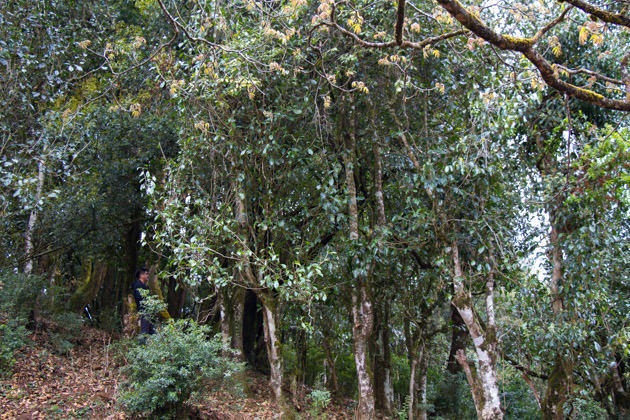
Da Xue Shan 大雪山 is a mountain located in Lincang Region of Southwest Yunnan. The peak (3430 m) of the mountain is covered by snow all year round. Hence its name the Big Snow Mountain. Wild tea (Ye Sheng Cha 野生茶, often called as Shan Cha 山茶 by Yunnan farmers, ) grows at the altitude around 2000-2300 m in the mountain. Although growing in the very high altitude, it germinates earlier than other common teas. In the end of March, the tea is well ready for harvesting. The Daxueshan wild tea is famous for its wild orchid flavor and mild mellow taste. Local farmers are of Li Su race which is a rare minority group in Yunnan. 


There is at least one review of a version from that local origin in a review here, but they're not much of a standard reference.  I'm not sure this version that I'm reviewing is wild origin tea; it could be, or maybe not.


I looked up a Yunnan Sourcing related area listing to get more description of it, and another related tea version, 2015 Spring "Da Xue Shan" Wild Arbor Raw Pu-erh Tea Cake:


A powerful first flush of Spring 2015 tea from 50-80 year old trees growing in Da Xue Shan area of Lincang (45 km west of Lincang City). 

Da Xue Shan aka "Big Snow Mountain" is a high altitude area and perfect for growing tea.  The neighboring "Da Xue Shan Reserve" is home to some of the oldest tea trees in Yunnan as well as Yunnan's own Black snub-nosed monkey.

...The tea is very strong in taste and aroma.  It is both bitter and astringent with a lasting huigan and somewhat over-powering cha qi.


That tea was selling for $38.50 per 357 gram cake; it's interesting that the two examples vary so much in price, with both described as wild origin tea. 

Another example from there, 2018 Yunnan Sourcing "Big Snow Mountain" Old Arbor Raw Pu-erh Tea Cake, sells for $130.  

The pricing is going to tie to quality, and to whatever other factors influence producer selling price.  I tend to take these "old arbor" / gushu claims with a grain of salt; vendors might tie selling points back to expectations per related areas, or producers might present teas as something they're not.  In general I'd trust Yunnan Sourcing more than most sources, but in the end, to me, it's about how the tea comes across when you brew it, what the character is like.  

It would be nice if the teas were grown in the forest; there's a lower chance of pesticide use in that context, and less reliance on chemical fertilizers.  That second point wouldn't necessarily change much related to risk, I wouldn't expect, but character should be better from more naturally grown teas.  There's a harshness to low elevation grown, plantation, mono-culture produced teas that were forced to produce a lot of material, harvested at volumes that are hard for the plants to sustain.


Looking further I found a 2023 example of this same tea, the same producer and formula number (215), through a familiar Western facing China based vendor, Teasenz.  It was selling for 29 Euros or $31.50 for a 150 gram cake, and they had also carried a 250 gram cake, which is unusual, the producer making two different sizes:


2023 Oripuerlab Da Xue Shan 215 Raw Pu Erh


This is a typical raw pu erh that has a light and soft taste, yet packed with intense refreshing floral aroma. The mouth-watering honey sweetness and accessible flavour makes it one of the best teas for the beginning raw pu erh tea drinker, while the complex aroma will be loved by advanced drinkers.

Lingcang, Mengku (2250m)

The 215 Da Xue Shan series, has been produced by Oripuerlab since 2013, and due to the popularity, these cakes have become part of the factory's annual production. This cake has consistently sold out for many years in a row, and this year will be no exception.


They forgot to mention strong bitterness and high overall intensity, if the 2023 is like the 2024 (based on trying it before looking up background), but to some extent all that still works.  They're from different years, but I can't imagine that they're opposites in terms of general character.  This doesn't mention plant age or the wild arbor theme directly, but growing the tea at 2250 meters in elevation implies that it's not from a standard low elevation, high production plantation.


Review:


#1:  bitterness is really pronounced; that can happen.  Floral range is positive, and promising, but this is brewed a bit too strong.  One challenge going into this was that a lot of sheng isn't really ideal for drinking within a few months of being made.  Not everything needs a decade and a half of transition, but some is much better for settling for a couple of years.  I can brew this lighter in following rounds, and that will offset this intensity, and bitterness, but it's still going to be a bit extreme.

This reminds me of trying a tea from a local shop again, from Ju Jen shop in the Paradise Park mall (in Bangkok), the Lincang version reviewed here.  That post said that it was from 2021, so three years old now, and it has settled to a nice aspect balance.  Three years ago I would imagine it would've been a bit much, too high in bitterness level, and a little intense.  This may follow the same pattern, as clearly possessing some positive aspects and character early on, being of good quality, but not quite ready in terms of an optimum.  If someone loves really high intensity and bitterness of course that's just wrong, and it's perfect when young, brand new.


#2:  easier to relate to brewed much lighter.  This flavor profile seems to remind me of that tea [as it should have, at least being from the same broad area, Lincang].  Pronounced bitterness and floral range are pretty common themes though.  It's quite drinkable made this way, brewed light, but a year or two of limited transition would make it more approachable, and enable drinking it at more of a range of infusion strengths.  

Quality seems pretty good for this.  Intensity is a bit much, and the bitterness is really something, but those aren't flaws.  Feel is fine; it has good structure.  One part of the flavor is a bright fruit note; that is nice.  It's almost lemon citrus, or at least in that range.  To me it adds a pleasant complexity, but then I always do love a bit of fruit in sheng.


#3:  warmth picks up; that's nice.  Mineral is quite strong in this, in a dry mineral range, like limestone, or something such.  It could just be my imagination since it's so early in but I swear that I can feel this tea already, the drug-like effect.  I mostly had fruit and yogurt for breakfast and that doesn't tend to offset sheng stomach impact or feel (cha qi / drug-like feel), so maybe it is real.  I really can't relate to people drinking sheng to get a buzz, but to each their own.  I'd be using drugs if I wanted drug-like effect.

Of course aftertaste experience is pronounced in this; that goes along with saying that it's intense, quite bitter, heavy on mineral, and complex in flavor range.  It's pleasant, if someone is ok with high degree of bitterness and somewhat heavy astringency, and wants intensity to be dialed way up.  Per my own preferences I think I'd love this more in about two years, after it has mellowed out a bit.  In really dry storage maybe in 4 or 5 more years, but here in Bangkok sheng changes fast.


#4:  fruit continues to evolve, with most of the flavor range in this still relating more to bitterness, mineral, and floral range.  That catchy set of bitterness, sweetness, floral flavor, and a hint of fruit is familiar enough; that works.  Aftertaste switching from bitterness to sweetness is a common theme, hui gan.  I was just thinking that it was a shame that the Ju Jen cake was so small, and almost finished, produced at half this size (100 grams, where this is 200).  That's more of a sample.  

This sheng version will probably only get better over the next few years, and I probably wouldn't hold onto more for longer, to check how it is in a decade or longer.  I suppose if it doesn't cost too much setting aside a cake would probably give good results, in another 15 years.  Or maybe it would make sense at an intermediate transition point, between 5 and 10 years, but that's hard to judge.


#5:  astringency and mineral eases up a little; the balance is more approachable.  This is still on the edgy side, a bit dry in feel, and quite bitter, so only people well acclimated to that range would like it at this stage.  Again in a couple of years that may shift; intensity will still be fine, but tones could warm a little and that challenging bitterness and feel could smooth back out.


#6:  it continues to settle well.  Over more infusions it should carry on with a slow transition to warmer tones, maybe expressing just a little more fruit, and easing up on bitterness and astringency.  It won't make it to an especially drinkable when young range, so all that is relative. 


Conclusions, additional background:


Really nice tea; I like it.  It's a bit intense at this young age, but it should mellow and be more approachable fast, over the next year or two.  For people into sky-high intensity, pronounced sweetness and bitterness, and heavy floral range this is perfect right now.

I asked Stephen if he sells this and he said that he doesn't, that it's a version he likes that he owns a lot of.  That's so nice!  This would be an ideal tea to own many cakes of; I can't imagine that it wouldn't be better and better over any length of time, even 25 more years.  And it should drink quite well over the next few years, as a younger version that doesn't need more complete aging to be pleasant.

Many thanks again to Stephen for sharing this!


Tuesday, August 6, 2019

Chawang Shop 2012 Mengku Daxueshan


darkening but not that far along


plain labeling, more how that used to go for commissioned teas


a little better look, but wet leaves tell more of the story


Two posts back I'd mentioned a Chawang Shop order set was down to two teas to try (I think it's really 3; the list isn't that long but I keep losing track).  They're all so interesting that I'm essentially reviewing every tea, not usually how that would work out.

Whether a vendor sends teas for review or if I buy them--which gets treated in much the same way, beyond mentioning that difference--I review what I like and what is interesting to me, whatever it makes sense to pass on.  This rounds out two earlier posts on semi-aged sheng, not exactly my favorite theme for sheng character related to what to drink but interesting to explore. 

The theme for purchasing versions was obvious enough: not only do I get to try teas at this middle state to experience where a transition would be I also get to keep checking that, and then drink some of it later when aged.  Eventually I really should purchase more of the versions that seemed to work out the best, but I'll see about that later.

I keep citing this to reference it myself


Review:


This version is nowhere near as well-preserved as that 2008 Yiwu brick had been; the aging is apparent in the color, even though it's 4 years younger.  But the rest of the experience is the thing.

just getting started; color seems to show limited age input


A thickness to the feel of the tea hits you just as fast as any of the flavor; that's nice.  Flavor range is perhaps a little subdued, as I've went on and on about for those last two posts, but for this being the first round and with expectations dialed down for where this is in an aging cycle it's just fine, plenty intense.  Aging related flavors are emerging, darker mineral tones, subtle dried fruit, what could be aromatic spice, or at least towards that.  Some of the warm supporting earthiness resembles roasted chestnut.  Bitterness hasn't completely transitioned away but this version of it is mild and soft, complimenting the rest.  Of course it will probably change in ways lots of people, and me, would see as positive over another few years but it's fine as it is.

All that is just a first impression; I'm not onto the second round yet.

On the second infusion wood tone picks up; in between green wood and a more cured version, or maybe spanning the two.  The flavor, thick feel, and aftertaste are all complex though; it's not a simple taste experience or at all limited to that range.  All that supporting flavor aspect list I mentioned shifted a bit too.  Warm mineral still serves as a base for the rest, and a trace of bitterness rounds out the experience, but a different subtle expression of dried fruit kicks in, and the flavor tied to roasted chestnut seemed to transition to that green and cured wood.  More cured hardwood, but there's a touch of vegetal character in this, surely some of the pre-transition range hanging in there.  The spice range isn't as pronounced as it could be but it's quite interesting and supports the rest well.


Those same aspects are all present on the third infusion but the balance of them has shifted.  Bitterness is fading already, and there wasn't much of it to drop out.  What remains kind of helps the rest of the balance, but I'd imagine it wouldn't hang in there through so much additional aging, at least not in the wetter and hotter environment the tea cake is in now.  Probably being in a dry and cool place allowed this to retain more youth than it otherwise would have; staying here for some years it might've already been gone, along with the more vegetal part of that wood range.

Wood is probably more of the flavor in this now; some of the rest just dialed back.  That pleasant, thick feel and notable aftertaste round out this experience nicely.  It's not nearly as subtle as those last three versions I'd just reviewed, across any of the dimensions.  I like the tea now but the potential is intriguing; it's not so much rough edges that would need to smooth out as interesting character change that might come up.

Maybe this will develop a lot of spice and fruit over 5 years and become wonderful; maybe wood will shift from green and cured hardwood to the latter along with tobacco flavors, and it won't be that interesting to me.  It doesn't seem likely it will fade to nothing given that intensity is this positive so late through the aging transition, but again that's just a guess, not based on all that much.  For it to be this interesting, positive in character, and pleasant now seems a great sign.


On the fourth infusion a pleasant spice range picks back up.  I'm guessing that slight changes in timing--that I'm not intentionally causing--are shifting how this comes across.  As a flash infusion the flavor range won't be the same as using a more standard 8 second or so version, or brewed longer.  There's lots to this feel and aftertaste range even though infusion time and strength is moderate.

Sweetness is nice in this; that's a part that I missed in those last three sheng versions, how that makes a tea balance.  Someone just commented on a Reddit post discussion about how no teas seem sweet to them, in relation to how sugar is sweet.  Of course it's a description for how different compounds come across in a similar way, mostly amino acids, per input from two very good sources.

That spice is in a different form now, closer to a mild and sweet root spice, where before it was more towards a warmer, earthier aromatic bark spice.  I'm up against personal limits in being more specific; I went through a very long phase of drinking quite varied tisanes, and odd versions of both came up, but I didn't retain those as a catalog of sense memories to refer back to.  Wood tones are dialed back now as well; instead of being dominant they balance with that spice.  It's nice how it's a quite different experience four rounds in.  Interesting and positive transitions and brewing a high number of pleasant infusions are both great signs for quality in tea, although I don't necessarily see the opposite as a clear indication of a flaw or of a lower quality version--it just varies.

I'll try this as a fast infusion to judge how that changes things, then try a longer one, and then 6 infusions in they cycle will be towards the latter half.


Brewed quite light doesn't change much (now on round 5).  Flavor intensity is still good; the thick feel and aftertaste don't change.  That root spice aspect could as easily be interpreted as including dried fruit now, but then that's also true of the last round, maybe just evolved a little further in this.  It would most similar to a dried longan, maybe; now what is that similar to in Western terms?  Dried pear is close enough, but dried longan really is closer.

I think I do feel teas more related to drinking them in a more quiet environment; the kids are out at a Mandarin lesson now (one of them; my daughter joins for a play session held at that local Chinese-Thai school).  It's the same school she attended pre-school at, Sitabur, which for Bangkok locals is not far from Sam Yan, kind of the middle of nowhere in an old part of town.  It's undergoing urban renewal, that area, although without violent crime as an issue at all, so the form of decay and renewal is different.  They don't do that here; they're not so into drugs, there's pick-pocketing and purse snatching but no mugging, and people usually only kill each other for personal reasons.


On round 6 I let the tea brew longer, more like 15 seconds, long enough to get a feel where that heads.  It doesn't change much but the feel thickens even more, and flavor experience shifts some.  Earthier range aspects stand out more; warm mineral, and back to the wood tones.  The milder fruit and root spice range gets crowded out a bit.  Since it would be natural to go with longer infusions from around this point on those factors would mix, and the character would change related to using that longer time, even if intensity level was maintained.

I'm not going to do notes on infusions up to 10 or so rounds though; this is long enough as it is, and how that plays out matters but the basic story is already told.  Some people feel that infusion count is critical to judging tea quality but I kind of don't; it's one factor that matches together with others related to that, but to me it doesn't work as a single clear marker.  I get it why people see it as such; the typical correspondence is there, and a tea brewing half as many positive rounds gives up a lot.  It would be normal for me to ramble on in another dozen sentences about how I see quality as a sum of different factors coming together, and positive overall balance, but I'll skip the detailed version of that this time.


still quite green, the wet leaves


2008 Yiwu leaves were further along, just moderately aged for 11 years old


I did drink a good number more infusions from this, and they did vary some.  That same underlying wood tone and very positive feel remained, into a really high infusion count (potential quality marker:  check).

Conclusions, other thoughts


Pretty good tea; I didn't mention that for value this seems fantastic (check that price; it's unbelievable).  Being at this age it's not as simple to sort out all the related factors (storage input versus original character, general quality level, typical location character, how it will be when more aged / fermented), but it's at least obvious that it's quite decent tea.

As far as fermentation level goes this seems to be slightly behind the two 2011 Tea Mania versions I just tried related to darkened leaf color and still having a bit of vegetal nature, close to on par with that 2008 Yiwu brick, but somehow it's more intense than all three.  I'll skip the part about saying more about how cool and dry Kunming storage location slowed the transition, since I've been going on about that.  The character works better as a result of not being overly subtle, also due to the pleasant thick feel, and appropriate levels of sweetness and bitterness.  I see it as having even more aging potential than those three, but then again that's a guess, and based more on intensity than a specific character difference, which I should be able to interpret.

Unlike in the case of the two semi-aged Tea Mania samples I just reviewed I own a 357 gram cake of this, so I can find out how it will be later, just by waiting.  Unlike with some other past semi-aged range sheng versions the good potential in this works well right now too.

I tried looking up notes on earlier reviews to see how the character might have changed but of course it would be impossible to extract out subjective interpretation from any account.  All the same there is no Steepster set of comments or review for that.  That brought up a couple of tangents I'll hold off on mentioning here since they connect better to another subject I've been writing about, about tea value and another version that's not similar but related in some ways.

Someone mentioned in a comment recently about appreciating a somewhat aged sheng related to being stored on the dry side and retaining a vegetal character.  That's what I keep talking about me looking forward to dropping out, right?  Hopefully how the subjective parts of these impressions fit together is already clear.  Someone else might really love this tea version just as it is and to me it shows great potential to improve a lot over the next few years, or 5.  I like it now but I think it will become much better, per my preference.


Kalani at her new school, the third day


Kalani at her new school, second day, adjusting fast


first day at a new school; rough seeing her go through that


Thursday, February 7, 2019

Liquid Proust Sheng Olympiad; Crimson Lotus Wildwood and Hojo Da Xue Shan


Crimson Lotus Wildwood version left, Hojo Da Xue Shan right


I'm finally trying the first samples of a Liquid Proust Sheng Olympiad set, nearly two years after writing about Andrew Richardson setting up what seem close to group buys.  I've written a lot about trying a Liquid Proust introductory sheng set over the last few months but that theme was different.  Background on the teas from vendor descriptions appears in a second section here.

Again I don't know if trying these two teas together really makes any sense.  At this point it's as much about compressing tasting days and write-ups as much as it is about the comparison being functional.  I must have half a year worth of tea around to write about, if I keep an aggressive pace, and I will buy more within that time-frame.  I'd best keep it all moving.  It will help place the two teas related to each other, since my impression of both won't be mediated by difference in time or any potential other conditions (variance in myself or any other factor).

Review

just getting started; CL left, Hojo right


2018 Wildwood maocha Crimson Lotus tea (both are 2018):  the tea is nice.  A nice moderate form of bitterness stands out that balances well with a pronounced level of sweetness.  The character isn't so far from Yiwu related to how those match up, and the floral tone is comparable, I just doubt this is actually Yiwu.  I don't know why I guess that it's not; intuition.  A spoiler related to the later vendor description details:  they never do say where the tea is from.

There's a touch of mineral tone that doesn't match normal Yiwu range (as much as there is one; teas from that broad area can vary a lot), a heavy mineral in between rocks and iron bar, or maybe complex across the range of both.  In much higher proportion it might come across as tasting like kerosene but a trace of it like this seems different, more like an unusual rock-mineral.

It's not "old tree" sourced tea, it doesn't seem, based on overall effect (it could be more intense, the feel could be more structured, and the aftertaste more extended).  But then wild-grown teas vary in ways that sometimes doesn't oppose that but is different, which confuses things.  Those tend to express flavor across different ranges, and to be a bit softer. 


2018 Da Xue Shan wild maocha from Hojo:  that bitterness edge in the other tea is missing, there is less sweetness, and the flavor range is completely different.  So much for combined tasting making any sense.  A strange flavor aspect stands out, one I'm probably going to have trouble placing.  It's earthy, in an odd way, like an old shed might smell, or a cave.  It's not necessarily overly musty (this is a 2018 tea) but the flavor is pulled in an odd direction by some input.  It's comparable to the aspect "space" where the mineral is in the other profile (which probably does contain a bit of wood as an aspect, to be clear).  I suppose comparing this flavor aspect to some type of fungus might work better; it's not exactly right, but at least recognizable.  Beyond that an earthiness resembles damp forest floor. 

The tea is probably better than those aspects sound, but hopefully it will improve through later infusions.  It's normal for some sheng versions to transition a good bit over the first couple of rounds, to "get to" where they are going.

Second infusion

CL left, Hojo right


Crimson Lotus Wildwood:  intense sweetness still stands out as a main aspect.  Mineral is still grounding the experience but the flavors have "cleaned up" a bit.  The character is nice since flavors weren't overly musty or earthy to begin with.  The iron bar effect and one earth-range aspect mostly cleared out, moving on to tasting more like rocks across that range.  Floral range matches up with the sweetness; the two things seem to connect.  The tea is nice; the thickness, intensity, sweetness, and aftertaste all work.  Sometimes floral range can be different (it always varies); I mean here in the sense that it's closer to on even footing with other flavor range versus standing out as primary.  I could try to guess the flower type but I'd probably be wrong; one that's bright and sweet.  It's not rich like lavender, maybe not so far from orchid.


Hojo Da Xue Shan:  this did transition, just not how I expected.  It picked up vegetal range; that doesn't tend to come up in sheng so much.  It's in between green pepper and green beans, which would be normal enough for a green tea.  In comparison with the other tea this seems really soft, maybe even a bit thin, and lacking in sweetness.  It's really not that bad, it just lacks the intensity of the other tea, and the floral tone that is relatively characteristic of a lot of sheng.  This taste range is odd for the general category.  I'll see how it transitions next round.

Third infusion


Wildwood:  more of the same.  I let this run a little long; it's easy to brew tea for over 10 seconds instead of just over 5 for doing other things.  That will work for describing it brewed stronger (just a little), then back to a short infusion next time.  That change picks up the mouthfeel and intensity a good bit; the aftertaste is really pronounced now.  The tea still works well a little stronger, but for being this intense a fast infusion would be nicer.  That bitterness edge doesn't really throw off the experience but the flavor will stand out more with that moderated in proportion brewed half as long.


Da Xue Shan:  this still tastes mostly like vegetable but at least the balance is shifting to moderate that.  It's definitely heaviest on green bell pepper.  It has some feel structure to it, and the aftertaste ramps up being a little stronger, and for infusing better a couple of rounds in.  It's not bad tea, it's just unconventional, not necessarily in a positive way related to flavor aspect.  It's not "good" sheng either, to take the unconventional step of offering a broad judgment.  The typical markers for better versions stand out a lot more in the Crimson Lotus version:  sweetness, mineral undertone, overall intensity, feel-structure, and pronounced aftertaste.

I hope this isn't priced higher than the other tea.  If I were reviewing this tea alone I'd probably not publish a review, since I tend to say more about teas that are interesting for being good than trying to warn off people about teas, or explain how tea versions seem to not be above average in different ways.  At least the flavors are clean, with some sweetness, and the feel is fine, just slightly thin.  It's not bitter at all; there's that. 

If someone was really opposed to bitterness they might like this tea better than the other.  They probably wouldn't be drinking all that much young sheng then, since both of these are below average for the level of that aspect.  Put a different way the other version is more conventional for that range related to teas people tend to prefer to drink when young (not aged).


Fourth infusion


Wildwood:  this does work better brewed around 5 seconds; the balance is better.  Flavor and sweetness isn't diminished much at all but the bitterness drops back.  Feel and aftertaste drop back a little too but they're more than pronounced enough anyway.  The same description from earlier works; sweetness, floral flavors, underlying mineral, a moderate level of bitterness that works, etc.  Without that trace of earthiness towards an odd version of wood or kerosene, and mineral more in the range of iron bar, this reminds me more of a conventional Yiwu character, as much as I'm aware of one.  It's just not quite as floral, sweet, and intense as well-above-average versions of those.


Da Xue Shan:  this doesn't work as well brewed lighter, for a similar reason that the other is better instead; the flavor range stands out more.  The green pepper aspect--which now includes a bit of wood range, more than a faint trace of that before--is transitioning to include a bit of cooked broccoli now.  I guess if someone preferred soft, approachable sheng that tastes a good bit like a green tea this could be perfect.  The negative tone this review probably brings across likely relates to me not really liking green teas.  Of course maybe someone else could hear "green bell pepper," along with almost no bitterness and soft feel, and think that sounds positive.


Fifth infusion


Wildwood:  warmth picks up a little; that comes across as the mineral range changing, but it could be interpreted in different ways.  It also seems like the woodiness, that earthy range, increased a little, and the floral and sweetness dropped back.  It's still pleasant, it just seems to be moving towards a wood-tone that's often present in a lot of teas in later rounds.  It's a little early for that but it is still a minor shift at this level.  It's also possible that it will cross through a different range before the flavors get to that "brewed out" level (eg. it could transition to come across as mild spice instead).  For now it seems closer to wood, or dry autumn forest floor.  It works with the earlier sweetness, intensity, bitterness, and floral tone.

Da Xue Shan:  warmth picks up in this too, in a range that's comparable, more wood or a touch of autumn forest floor.  In this version it's an improvement for swapping out some vegetable taste for that, where for the other it's not quite as pleasant as the earlier aspects set.  It will be interesting to see where these are headed, related to those transitions.  I'll do an one more round, and deal with my nerves feeling a bit jangled for the next 2 or 3 hours.  It is possible to taste the tea and then pour it out instead of drinking it, I just normally don't do that.  It seems disrespectful.


Sixth infusion


I let these go a bit over 10 seconds since intensity is tapering off.  The brewing parameter recommendations by some vendors to add 5 seconds to every round seem completely off to me, but adjusting time less than that does come up.  It would depend on the starting-point proportion.  It would still make sense to use a lower one than I tend to, and the teas would transition faster for being brewed longer each round (if trying to achieve the same infusion strength).


Wildwood:  I like where this has headed, the way that warm mineral and earthiness swapped in for a lot of the sweetness and floral range.  It's not better, or maybe not even as good as it was, depending on preference, but it's still nice.  The mineral is like desert slick-rock, seemingly with a bit of iron in it.  The earthy warmth is towards redwood, just not quite as aromatic; it lacks that one particular high-note.  The balance is what really works, how well it all works together.  It's unusual that this shifted from going more towards autumn forest floor (earthy) to warm mineral tone but changing brewing parameters a little could change the effect on its own, and the tea had already been transitioning.


Da Xue Shan:  Green bean seemed to pick back up; at least it's transitioning.  Again I'd be inclined to cut this review section out entirely if not for two different factors:  this is unusual, kind of so-so in an interesting way, and I really wanted to pass on a full description of how the Sheng Olympiad set worked out.

I have no idea why this tastes so much like vegetables, why it's a lot closer to a green tea in flavor range.  One guess is obvious:  they heated it too much, shifting compounds to make it into a green tea.  I'm not saying that has to be it, just passing on a thought I would expect would occur to many.  If that's accurate there's a good chance this lost most of its aging potential in that step too. 

Sheng transitions positively with age, they ferment, because the compounds present relate to limiting the temperature of the heating step, and due to use of sun-drying versus oven drying.  Green tea will change too, especially if given air exposure and stored in an environment with a good bit of humidity, just not in the same way.  I've never heard of anyone trying to check that by storing green tea exactly like sheng though; if it sticks around it's sealed in a package.  Aging green tea is very unconventional but not unheard of.

All of this leads me back to an idea that connects, about Hojo being an outlier reference for recommending that sheng should be stored sealed (at least packaged, but per my impression well-isolated from air).  I covered that in this post on sheng storage.  It's not fair to summarize it to this extent, but the ideas link in an obvious way:  if they're selling sheng that's processed more as a green tea of course it would hold up better sealed, because it wouldn't ferment properly under any conditions.  I'm not offering that as speculation, again just connecting some dots.  Probably most of the sheng they sell really is conventional in character and processing steps used.  It would make no sense that they would able to source sheng for being flawed in one particular way, all processed incorrectly, closer to green tea in nature, even if they wanted to.

Since so many factors contribute to final sheng character I'm not even claiming that the heating step was responsible for this tea tasting like green bell pepper, broccoli, and green beans.  I have no idea what caused that.  Flavors vary related to using different plant types, or related to growing conditions, plant age, soil type, minor differences in processing steps, etc.  I may never be able to taste a tea and map it all out with any degree of likelihood.  It would be nice if I could just describe a tea accurately, and it's hard to make any claim related to that.  Maybe I'm doing ok with that, or maybe not.


In conclusion, the Crimson Lotus tea seemed a lot better to me, and more conventional.  There's probably no need to add a summary to that; in what sense must have been clear enough in the descriptions.  This Hojo tea wasn't as bad as I probably made it sound.  It was just not a good match for my personal preference since I don't like green tea, and it resembled one.  At least it wasn't grassy but vegetable related flavors stood out most, with limited feel-complexity and aftertaste.

Vendor information


Why not include what the two vendors offer as descriptions?

Crimson Lotus 2018 Spring "Wildwood" Sheng / Raw Puerh:


The tea in this cake is a single origin, full garden blend. There are young and old trees in the garden and this tea blends all the trees. The material itself is full bodied and thick in the mouth but soft in presentation. There is minimal bitterness and astringency, but if you push it you get a floral experience reminiscent of orchids. The overall character of this tea is on the savory and vegetal side but there is a wild essence that makes it interesting...


growing conditions, the actual location (credit Crimson Lotus site)


I did like it, and I guess that description works, it's just not a perfect match for my interpretation.  Blending versions (by plant type, not so much location) would account for the pleasant overall balance and moderate bitterness and astringency.  It did have enough of both to strike a pleasant balance though; it's not as if none of both is better.  I'm not certain this tea would do well related to long-term aging but that's a long story I'm not going to start into, and what I say about such things would just be a guess anyway.


They account for not even passing on the broadest level of regional designation as follows:

The only way the farmers would take us to see this garden is if we promised not to tell anyone where it is. We will respect their wishes and keep it's location a secret. 


That kind of works, but the counties (main sub-regions) in Yunnan are really big places.  It seems possible that broad area name wouldn't add to the appeal so it was easy to leave it out given that context, along with specifics.  It seems like people overdo it with emphasizing those regions anyway; character in teas varies across that type of generality, and although it's not completely wrong to base expectations on broad area source sheng character also varies by lots of factors.

As to cost, a 200 gram cake sells for $75.  That's a bit, $138 for the equivalent of a 357 gram cake.  It was pretty good, but people tend to pay more or less related to origin, to some extent.  A $150 Yiwu cake is expensive as those go but not at all unheard of, maybe quite justified for quality (almost a separate concern), but for teas from lower demand areas both tea quality and the back-story would have some ground to cover to help that make sense.  For even higher demand areas a tea would more or less have to be fake to sell for only $150. 

Given I've just said that areas as an input are overvalued it makes sense to judge this related to how good it is instead, and that's not so easy to do at a summary level.  It's pretty good tea; that price doesn't necessarily stand out for being wrong, at least.


Hojo 2018 Da Xue Shan maocha:


Hojo wild tea tree (may relate to this version; credit their related web page)


There's a great summary and background description of this Lincang growing area here, in a puerh.fr reference, and a more general (broader area) TeaDB post about Lincang here.  There's too much to cover between the detailed tasting review and including two vendor descriptions so I won't follow that theme further here.

The vendor description (an excerpt):

With every sipping, the refreshing sweet floral scent is emerging slowly in my mouth. I enjoy its flavour which gently unfold on my palate and not rushing out swiftly. This is the type of tea I love to drink daily.  The flavour of Da Xue Shan Wild Raw Pu-erh Tea is like spring flowers, with trace hint of grapes and green apples flavour. If you love the refreshing floral flavour, mao-cha is a good choice...


I wasn't really getting that.  They do explain why the tea might be mild in character, in two parts, which is interesting:

This wild tea is excellent in taste. But it tends to gives milder flavour. It is because the genuine wild tea is grown under the shaded area in the forest. Due to lack of sunshine, the flavour tends to be lighter. On the other hand, human-planted “wild tea” tends to give strong flavour as those trees are directly exposed to much sunshine...


That "wild" reference can mean different things but I have noticed a general trend for more natural-growth teas to on the mild side related to astringency, bitterness, and to some extent even flavor intensity in general.  They tend to make up for it by having an interesting flavor profile (in better cases), which varies by lots of factors I'm never completely clear on, so to a limited degree I'm kind of with him on this point.  And then there's a part about processing:

Last year we have learned from the process of Huo Cao Shan raw pu-erh tea that the longer withering makes the flavour of tea becomes more floral and sweet. So, we applied the same technique on Da Xue Shan wild raw pu-erh tea. We decided not to process the tea on the same day it was plucked. Instead, we let the fresh tealeaf withered overnight and pan-frying was conducted the next day. Thanks to the longer withering, tea has light enzymatic oxidation and developed sweet flavour. It gives very soft and long-lasting aftertaste...


So this really is an intentionally more-oxidized version of sheng.  It's odd that it brewed much lighter than the Crimson Lotus version then, a pale yellow brewed-liquid that's light as typical sheng goes.  And that it tastes like green tea.  I wouldn't necessarily expect a slightly more oxidized sheng to become "more floral and sweet" but that step would soften the nature of the aspects, dropping back astringency and bitterness, swapping out some flavors for warmer tones.  Conventionally processed sheng can be really sweet with no oxidation at all, and very floral, but the overall intensity sometimes comes at a cost if bitterness and astringency offset those.  Of course then aging can transition that.

Back on that subject of sheng that won't age as well ("oolong pu'er," as I've seen it expressed, and written about) one guess was that increasing oxidation level (letting leaves wither longer) might be a reason for why mild and approachable sheng versions fade with age instead of improving.  The theory is that compounds that might make the tea harder to relate to initially (think Xiaguan tuochas) could transition with some oxidation, trading out long-term aging potential. 

That wasn't accepted as the main factor by most in that one discussion I'm referring to (that took place in Tea Chat some time ago), related to some bright, sweet, approachable sheng being ready to drink young.  Another theory is that using oven-drying versus sun-drying causes related changes (in final character; as to why I never really got that part sorted out).  It seems to me that sheng versions vary a lot by lots of different factors:  growing conditions have already come up here, and oxidation / length of withering step, but plant type gets folded in (and that seems right), and degree of heating in a sha qing step must also be a factor.

I'm not completely clear on whether long-wither / higher oxidation relates to making tea that's better to drink right away, and not age.  Maybe that's right, and it came up in that discussion as a potential factor.


Of course that vendor description doesn't mention that they think it tastes more like a green tea, quite vegetal.  Typically I'll try to give vendor descriptions the benefit of a doubt and write differences off to varying interpretation but this tea just isn't that floral or fruity, to me.  It's my impression that people's sense of taste can vary, based on starting to get a cold, or being tired, or eating something that alters the tasting process, so passing on a single-tasting based description as a final, objective take doesn't work.  But in this case that second sheng version seemed pretty normal to me, and matched the other vendor's take fairly well, even though those tend to be general in product descriptions.  As they should be; teas will change based on lots of factors, even with limited aging, and interpretations varying is natural.


Pricing for this second tea is only listed on a pre-order article, not the main one cited, appearing here:

100g  (100g x 1)       JPY3,900
200g (100g x 2)    JPY7,600
600g  (100g x 6)      JPY22,500
1000g (100g x 10)  JPY31,200


3,900 Japanese Yen equals 35.55 United States Dollar; this same tea had been going for around $120 per 357 gram pressed cake equivalent.  I wouldn't buy a cake of it for $35 myself but that really relates to not liking green tea all that much.  It was novel though, and not really bad tea; limited as quality markers go but not flawed.  It's hard for me to imagine but someone could really be on that page for character.


I've seen a Hojo price list before (they don't run an online shop with product prices) and their teas mostly averaged around $.50 to .75 per gram, across a range of types.  I think part of why that runs well above a standard average--beyond high quality and rareness in teas justifying that, which I haven't tried enough of their teas to judge; only one other appears in a review in this blog--is that they run physical shops, and seem to sell tea online as a secondary related business.  Shops often sell teas for more, especially if the location makes that necessary (eg. a Manhattan, NYC based business isn't going to compete with internet pricing; they couldn't).

Their main shop (or only physical shop?) is in Kuala Lumpur, which would experience lower overhead burden than NYC, but South East Asia retail space and general pricing doesn't work out as you might expect.  Mall-space rent can be costly, and for lots of products here in Thailand you pay more than in the US.  That mostly has to do with high import taxes, to be fair, but the general point remains that one might expect everything to cost a lot less in "developing" countries, and it's not always like that.  If import taxes in Malaysia are anything like in Thailand the base cost of that tea is doubling just by moving the tea between countries, aside from shipping.


To get back to this specific context they're still selling a sheng cake I didn't care for, that I expect many would judge to not really even be typical of sheng character in general, for well over $100 (or equivalent; that maps pre-ordered loose tea cost up to a 357 standard size version).  Someone would have to judge this tea quite differently than I did for that to make any sense. 


Even without truly loving both of these teas this made for a very interesting tasting experience.  At least the one I cared for less was novel, and the other matched my preferences and seemed like generally good tea.  Related to trying teas in a mixed-type set, of experiencing the "Sheng Olympiad," I'm definitely not disappointed.