Showing posts with label Xiaguan. Show all posts

Wednesday, June 25, 2025

2018 Reunion Xiaguan 500 gram Da Xue Shan tea ball


In visiting that favorite local Bangkok Chinatown shop not long ago, Jip Eu, they mentioned having a novel version of Xiaguan product that we'd never covered in discussion.  It's a 500 gram  / half kilo ball of tea, not a tuocha or a cake, something else instead.  It's 2018 Reunion Da Xue Shan origin tea, a special production version, seemingly intended for gift-giving, now called gifting.

Why did I never hear of this, since I've bought lots of Xiaguan tuochas there before, and two versions of an older Xiaguan cake from them?  That shop works out like that.  They have different amounts of one-off teas around, and that one might've seemed like something appropriate for giving someone as a gift, versus what a sheng drinker might buy for themselves.  They even offered to let me try it after I bought it, if I was going to buy it for myself, so at least I'd have a chance to taste it, assuming I might be giving it away.


packaging was a bit extensive


extensive


The information I have on it comes from them (Jip Eu) passing on a Xiaguan site listing, which of course has been automatically translated at some point.  It says this:


Mid-Autumn Festival: Drink “Reunion Tuan Tea”

Original by Cheng Nuanru | P u’er Tea Circle

September 24, 2018

The Mid-Autumn Festival, also known as Moon Night, Autumn Festival, Mid-Autumn Day, Festival of the Eighth Month, Moon-Chasing Festival, Moon-Watching Festival, Moon-Worship Festival, Daughter’s Festival, or the Reunion Festival, is a traditional Chinese celebration...

...The 2018 Xiaguan raw Pu’er “Reunion Tuan Tea” is made from early spring big-leaf tea trees from Daxueshan, Mengku, Lincang in Yunnan Province.

It’s crafted using Xiaguan’s century-old traditional handmade techniques.


If you reverse image search it, or search using terms (which doesn't seem to work), you can find this Dragon Tea House listing.  It includes almost no information about the tea, not a good sign.  At least it seems highly unlikely that someone is pressing a 500 gram ball of tea to pass off as a counterfeit of a moderately priced real version.

I'll skip mentioning the shop cost here; that might change over time.  They tend to sell older sheng on the low side of the standard range, and for some teas there isn't a lot of standard range to work with.  I found one example of someone selling this online (that listing), for $84, and it cost less than that.


Expectations related to aging transition and potential are interesting; a 2018 Xiaguan version shouldn't be ready yet, typically.  But then this may not have standard Xiaguan character, the rough edges, harsh intensity, and barnyard range character.  I'll say more about potential issues with it coming straight out of a storage space in the review notes.


Review:


#1:  on the light side; I didn't use a rinse, so this is just getting started.  Flavor range is interesting, smooth and layered.  Tones are warm, maybe even beyond what I'd expect for a 7 year old version.  It will be clearer next round though.


#2:  it's in an interesting place for being in between where it was and where it's headed for fermentation input and result.  It's intense, but without the typical Xiaguan barnyard flavors, which must relate to a different source origin.  This clearly wasn't light, flavorful, approachable, and sweet as boutique sheng can be earlier on; it still has a lot of power, and some bitterness and astringency.

The flavors are hard to break down to a list.  Mineral stands out, but as usual I see that as more of a base for the rest.  Earthiness could relate to wood or even dried mushroom.  That sounds worse than I would intend; it's complex and balanced, not overpowered by some off flavor, but it's not really centered on floral range, or the like.  Sometimes sheng can loosen up and shift a good bit over the next few infusions; the next one or two might tell a different story.  I'll have to keep infusion times short to keep intensity in check; this is a strong tea.


#3:  it might be musty tones that I'm picking up, possibly as much from a storage conditions input as the tea itself.  Jip Eu's storage is surely very hot and humid (all of Bangkok is), and relatively tightly sealed, so that tea straight from there has picked up some significant mustiness.  That usually fades, but it takes time, a month or two.  I'm not sure if the conditions and that input are a bad thing, neutral, or actually good.  Adding more air exchange to their storage area would resolve that in one sense, but that may cost the tea stored there intensity, removing more of what gives it flavor.  For well-sealed teas it wouldn't matter (sealed oolongs stored there); I mean for sheng, left open enough to access some air contact.  This was stored in what I take to be a muslin cotton bag, inside a box, with no plastic wrapper or bag layer, as is more common.  It would've contacted external scents all the more for that.

Flavor is still kind of clean; it's a bit of a contradiction.  There is that one edge, but beyond that nothing off, earthy, musty, or so on.  It's not really vegetal, at least not as much as is common with sheng still going through the first half or so of its aging cycle.  I'd have expected some residual floral range, but there's not much, and it hasn't transitioned to the standard dried fruit, medicinal herb, camphor, and incense spice ranges.  But it seems to have potential to develop in lots of directions.  There is a lot going on, a lot of complexity and intensity, I'm just failing to describe it.


#4:  it's cleaning up; a good sign.  It's not overly musty, not exactly tasting as if it had been in an attic or basement, but it had been in a storage area that should resemble attic background scent range.  The flavor could seem to imply either aged hardwood, in an unusual vegetal range, or on to rich dried fruit, or medicinal herb, or all of those things, maybe even including some incense spice.  I think I'm trying it right between it's early character and the aged version.  It certainly didn't "go quiet," as people describe as one possible outcome, but it's covering range that doesn't necessarily make sense together.

Some might read this as a negative assessment, but to me the opposite is implied.  It's in a great to place to develop into very interesting and positive range over the next 7 or 8 years.  Sure that could seem like awhile, but time passes quickly.  That would be a rushed version of the process, for a tea like this to be essentially ready at around 15 years into aging.  The hot and humid storage input has definitely rushed things along.

As I keep tasting it tobacco would be a reasonable interpretation, I suppose tasting like a cigar instead of cigarette or chewing tobacco.  That ties to this being anchored in earlier vegetal character and now moving on to richer, transitioned, warmer tones.  I would guess that in just 5 years it won't taste a lot like tobacco, mushroom, or attic, that it will have moved on to whatever other transitioned range instead.  There is still no "barnyard" range developing; it doesn't really taste like leather, cured hay, aged wood, or smoke.


#5:  it keeps getting better.  Sweetness picks up, and that distinctive mustiness is fading.  I think with two months of aging it will be less of an input, and I could tell better where this is going, but it's so far from it's final more-fermented form that it would only be so informative.  I think this tea is going to be wonderful in a half dozen years, and maybe fully at its peak in another 10.  It might be fine to drink through it in 7 or 8, close enough, but then it's always a judgment call finishing tea right before it's fully ready.  I might need to buy another of these, to own a full kilogram, to be able to keep sampling and also have plenty later on.


#6:  there might be more story to tell over the next half dozen infusions, but lots of round by round notes will be too much.  This still tastes in between cured and aged wood, and like tobacco, with complexity that is hard to place filling in from there.  It's not really bitter and astringent in relation to younger sheng range but there is some bitterness and astringency remaining; this started out as really intense tea.  It has lots of potential to keep changing.


#7:  sappiness of feel ramps up, and to some extent a related flavor.  It leans a little more towards pine now.  I suppose brewing a dried pine cone might taste like this.  It's interesting that this keeps changing, but one might expect that, given the earlier intensity.


#8:  more of the same, more minor transition.  It's definitely not losing intensity.  I'll cut off the note-taking here; a minor transition or two won't change much.


Conclusions:


I liked it.  The in-between fermentation ranges issue and mustiness from being direct from storage did stand out, related to how it is right now.  In terms of only how the experience is right now the 2006 tuocha version I tried not long ago is a good bit better.  It's harder to place longer term potential though; I think this might be good even before the general 20 year old age range, which doesn't come up for another 13 years.  In another 7 it might be in a good place, related to hot and humid conditions rushing that process, even though a more final form will probably level off in another 10 or so.

That raises a couple of questions.  Would it better if you stored it in a cooler and dryer place for 20 years, or 25, instead of rushing the process over 14 years here, or maybe on towards 20?  Maybe.  To be clear everywhere but Malaysia is a considerably cooler and dryer place, including Hong Kong.  Taiwan and Guangdong get mentioned as places with moderate storage conditions, which some describe as ideal, but then that interpretation mixes in some marketing spin.

One might also question if this storage settling period I've been mentioning, a month or two to drop out a lot of initial mustiness, is different than the version relating to letting a tea rest after shipping.  I see it as different and unrelated, but it may overlap more than I know, and correcting for storage conditions input may often be a part of that other rest period.  People rest sheng that has been shipped for a few weeks, or a month, to let it settle from being shipped, with variations in humidity and temperature said to throw off character a little, temporarily.  It's usually described as it seeming a little flat, losing some intensity, which comes back when it normalizes to more standard conditions.  This is about a mustiness fading instead.


Everyone has their own take on how storage issues work out, and since preferences also vary the conclusions are never completely identical.  I just saw a Reddit post about a guy storing tea in a wooden cabinet, without any plastic or mylar coverage of the cakes, just in the paper, all mixed together, at whatever temperature and humidity he lived at, in the Midwest of the US.  That's probably fine, but for some others it wouldn't be, maybe for different reasons.  

It makes a lot of difference if you are drinking through cakes in a couple of years, or a few, or holding onto them for a decade or longer.  I might use individual wrapping to limit air contact instead, the ziplock style bags cakes come in or the like, but that's not a critique, just a statement about personal approach.  If you open the cakes from time to time that's already plenty of air exchange, and probably even if you leave them sort of sealed for a few years it's still enough.  Mylar or multi-layer packaging restricts any air exposure better, but ziplock or the other light plastic wrappings, similar to food wraps, would allow for plenty of contact.  

According to the author of the Late Steeps blog--a great reference--air contact related to tea being sealed in mylar allows enough oxygen contact / exchange to support bacteria and fungus to thrive, one related consideration.  Who really knows, but it's interesting to consider.  Again all of these considerations really only kick in if you aren't actually drinking the tea at all, not even getting it out a couple times a year to check on it.


the chunk that came off in one pu'er knife stroke; it's nice that it's easy to access


Monday, June 16, 2025

2006 Xiaguan FT Te Ji sheng pu'er tuocha


On a recent visit to my favorite local Bangkok Chinatown shop, Jip Eu, the owner, Kittichai, gave me a Xiaguan tuocha.  They'll often pass on a sample of something interesting, but I don't remember them giving me that much tea like that (100 grams; not so much, but a significant amount).  It's very kind of him.  I suppose it's partly in thanks for me writing here about them, and steering some business there, which to me is about helping others find decent tea, not really about benefitting me.  I typically mention other shop options as well, as I did in the last post, discussing how Sen Xing Fa--another nearby shop--is set up better for doing extensive tasting.


I probably found what it was, more or less by chance.  A King Tea Mall listing looks exactly the same, down to all the numbers listed, and Chinese text (as far as I can tell).  Of course there is also Google Lens translation, but that helps less than one might imagine.  It's probably this:

2006 XiaGuan "FT-Te Ji" (Special Grade) Tuo 100g Puerh Sheng Cha Raw Tea

Listing for $26 for a 100 gram tuocha there.  That probably is market rate now.  You can buy the newer ones, that need another 15 or 20 years to age more, for more like $10, but someone holding onto it to cover that part costs you, with varying storage conditions inputs giving different results.  Then it's probably also an above average quality version, outlined in detail by that King Tea Mall listing:


Description:

The 2006 XiaGuan "FT-Te Ji" Tuo is part of the esteemed "Te Ji" series, denoting "Special Grade" in Chinese. This line of Puerh Sheng Cha, initiated in 2003 by XiaGuan, aimed to exceed the quality standards set by the JiaJi tuo cha. Renowned as "TeTuo" ("特沱"), an abbreviation of "TeJiTuoCha," this series underwent an official renaming in 2016, underscoring its prestige.

Distinctive Features:

The wrapper bears the trademark design of a "Pine tree and Crane," emblematic of the series' heritage and superior quality.

Variants of the "Te Ji" series include the general version and a higher-quality variant distinguished by a red-eyed crane.

The "FT" (Fly to Taiwan) version employs slightly superior tea materials, featuring more young buds and tiny leaves.


I had thought FT stood for "for Taiwan," but that doesn't change much either way.  This shop, Jip Eu, doesn't carry this tea anymore, per my understanding since they've sold out of a large batch they would've bought back in 2006 or so.  I do keep buying another 2012 Xiaguan tuo version there, which they still sell.


Review:


first infusion (after a rinse):  flavors are nice, subdued, clean (as this range of tea goes), interesting and pleasant.  The distinctive flavor that reminds me of aged horse saddle leather is there.  Harsh edges have largely aged off it, in those 19 years.  That would have to do with the hot and humid storage here; that wouldn't be true of the exact same tea stored in a cool and dry area.  


second infusion:  feel is thick, oily, and viscous.  I really do like that odd earthy range of flavors, especially in a version that's closer to ready to drink than I usually try.  I re-tried a 2012 Xiaguan tuo (from Jip Eu, the one that they still do sell) over the past week and it's close enough to enjoy, but not this far along for fermentation transition.  Beyond the leather--or at least what I interpret as leather--there is good depth of other range, mineral content, towards medicinal dried herb, and a little towards dried longan or tamarind fruit, it's just not overly fruity.  Feel is pleasant and the overall effect isn't harsh at all.


third infusion:  it reminds me a little of smoke, brewed a little stronger.  Often if a tea has contacted smoke that input will come out strongest right away, and keep fading.  This might well just be a natural related flavor, which does kind of match with the rest.  I'm not sure if this is a positive transition or not, related to my own experience just now.  I'm open to teas tasting like smoke, natural (inherent) or added, and it does match the other barnyard scope, but it's not necessarily better for including it.  Or worse either, as I see it, so just different.


fourth infusion:  quite balanced at this level; everything I've mentioned is still going on.  It's got decent intensity, of course.  I'm brewing this using a moderate infusion proportion too, for me, maybe only 7 grams in 100 ml gaiwan, versus the more typical 9 or so (typical for me).  Mind you not everyone would like this; to others it could be harsh, or off-putting.  The 2012 was more so, with so much of the earlier rough edges standing out.  I had my daughter Kalani taste it, and to her it was awful.  She asked why anyone would drink that.  I liked that version too (yesterday, I guess it was), but it wasn't quite ready, maybe by those extra 6 years.


her, posing


It's hot as Hades here, trying this tea in Bangkok at noon.  I should at least turn a fan on, but I've not even done that.  It was so nice living in Honolulu where the temperature is between 75 and 80 F all the time, maybe 25 to 28 C, and now it's back to 30s / around 90 F all the time.


fifth infusion:  the complex balance of flavors keeps shifting, the proportion, but the range isn't changing.  Smoke isn't gone but it was only a main flavor input for that one infusion.  Sweetness is nice for this; to me that one input helps tie all the rest together.  Feel is nice, and intensity, and aftertaste expression.  Layers of leather, barnyard flavor, medicinal herb, and some dried fruit really complement each other.  But only for people who like aged Xiaguan, of course, and it's hard to imagine someone preferring newish, untransitioned versions.


sixth infusion:  not different.  I might even drop taking notes here.  There probably will be some degree of interesting change as this wraps up, around infusions 10 to 12, or it could be pleasant and interesting up to 15 rounds or so.  Intensity is high enough for this that I'm using short infusion timing, 5 seconds or so, which will enable it lasting longer than if I was soaking it for longer.


Seeing a Tiger Balm pack of balm on the table reminds me how someone might interpret this as including quite a bit of camphor.  I suppose that it does, as people use that term.  I've never been completely comfortable isolating that as a description very often, but it's there.  Food range makes more sense to me; you get chances to eat those things, and it associates more naturally as a flavor.  Something like smoke is familiar enough from foods that this connection often makes sense too.  

Then I just can't remember specific floral ranges or incense spices.  Maybe this tastes a lot like one of them, and I wouldn't know.  Interpreting it as including incense spice would make sense too, but it would be helpful to be familiar with a half dozen of those, to break it down to that next level.


seventh infusion, comparison tasting with a Dayi (8582):  I was re-trying a standard Dayi cake with breakfast, not to see if it was ready, because it wouldn't be, from 2016 (9 years old).  It's pretty far along for spending that time here in Bangkok, but it needs at least another half dozen years, and it will level off closer to where it will be in another 10.  I keep trying the teas to see the transition patterns, because they're interesting.  It's not even about education or learning, it's just interesting.

The Dayi tea is harsher; it's not there yet for age transition.  It includes a green wood component, and a harsher form of astringency.  This is much better than it was two years ago when I first bought it (reviewed here then), becoming more pleasant.  Positive warm-toned flavors are developing.  

It's interesting how that "barnyard" range stands out in the Xiaguan.  It's not just that it's further along for transition, and it is that; the basic flavor range is also different.  There's a nice sappy effect that goes along with that, crossing over from flavor to feel.  I'm not sure what I expected this comparison to highlight.  The flavor and other character differences are interesting, but not informative.  It was sitting on the table beside me doing the tasting, so it seemed as well to try both and mention it.


This stopped short of guessing where the Xiaguan stands in terms of being relatively fully age transitioned, fermented, or how it might change over some of the following years.  19 years of transition in Bangkok storage is a lot, but it will keep changing over the next decade, probably mostly for the better.  It's definitely not going to run out of intensity.  Most of the green wood type flavor range and harsh-edged feel is gone, so it's fine to drink now, but it might still be a good bit better later.  I'd have to try it in another half dozen years to know.  I suppose that I probably will mostly set it aside to see.


Benchmark reference:  Liquid Proust now carries a similar Xiaguan tuo


I remembered seeing a mention of a Liquid Proust (vendor) Xiaguan tuo of about the same age, and that will help set what a market rate is for this.  Here is his listing:


2006 Xiaguan FT7653-6 100g, THB 1,016.95 (around $30)


Out of all the storage I've had there was always the Yang Qing Hao and Wistaria house notes that couldn't be rivaled. Then comes along this 2006 Xiaguan random tuo that has been pushed in warm and humid conditions in Taiwan. The depth of the tea with the smoke notes that are matured into something new with the puerh... it's a treat that I will miss dearly. This might be one of those extremely lucky finds.


Per the comments it's the aging conditions that give the tea great value, and the one Hong Kong shop that James of Tea DB keeps mentioning, Yee On tea, carries something similar for about double that cost, so $60.  

So market value is somewhere between $30 and 60?  That's a good bit for a Xiaguan tuo.  Next one would need to compare storage inputs to determine if the one I've just reviewed is really as good, or better, and personal preference would enter in so much in making that determination that it really wouldn't work, as an objective finding.


Thai minor deity tea cups, in the MBK mall; something different


Saturday, January 25, 2025

Teas from my favorite Bangkok Chinatown shop; about meetups


meeting the Jip Eu owner, Kittichai, with those friends today


Later today, at time of first writing a draft, I plan to visit my favorite Chinatown tea shop for the second week in a row, Jip Eu, meeting friends there.  Last week I met Huyen and Seth there, and it was just great, as always.  The owners feel like family, and we always drink lots of teas and talk about their background.  

Kittichai, the owner, has half a century of experience in vending and producing tea, since the family shop is something like 80 years old, and he's from a tea producing family in China.  That last time Seth could even talk to him in Mandarin, which seemed to work a little better than English, which also works.  We tried a black tea I brought then, Thai tea in a Dian Hong style, and from them Lapsang Souchong (a great, high quality unsmoked version), and an Anxi black tea, and maybe one more I'm forgetting.  We usually try a sheng pu'er, or some oolong, and probably did then.

Of course I'm not saying that everyone would typically have the same kind of experience there.  They wouldn't.  They're not set up to sit and try sample after sample of tea with visitors, as shops more oriented towards tourist visitors might be, like Sen Xing Fa.  Value is better for what they sell though; that staff support level and extra expense gets built back into pricing.  Everything always gets built back into pricing; if a vendor offers free shipping that's not exactly free, and if you see a lot of marketing for a vendor, or if packaging is elaborate, you're the one paying for that, in the end.  

In Jip Eu they would be happy to discuss teas and offer options, just not typically tasting tea after tea, instead whatever they have open.  Sen Xing Fa sells some of their teas from large jar storage, which is not really ideal, but it does help with keeping sample portions available.


Jip Eu specializes in low-medium quality Wuyi Yancha sales, Shui Xian blends, what people tend to call Da Hong Pao in other places.  Then they also carry really nice Wuyi Yancha, and lots of other range.  I bought pretty good jasmine pearl white tea the last time, a gift for monks I know.  I'd drink that too, but I'm more a sheng pu'er drinker, so I'd get to it slowly.  I have a tin of jasmine green tea at home that I'll finish within the next few years, at this rate.

I bought decent Dan Cong today, again for monks I know.  They can't buy tea for themselves, and no one else knows about the theme to include it with offerings, so I'll periodically give them some tea.  One monk just helped us organize a memorial service for a cousin who passed on a few months ago, and another taught Keoni and Kalani meditation last summer when they were here; they play an active role in our lives.

The sheng range in Jip Eu is limited but it's a great place to pick up a Xiaguan tuo, or even a well-aged Xiaguan cake.  I try different teas every time I'm in there so it's hard to keep track of all that they sell, maybe even for them.  These teas I'm reviewing aren't necessarily indicative of that range, beyond the likelihood that quality level and character is a bit random.  Some of what they sell is quite good, and a good value, but since it all varies it helps to be careful and selective there.  I've tried their 100 gram folded paper packs of Shui Xian that were great before, well above average, and bought lots for gifts just then, but the last versions I bought were back in the range one would expect, pretty decent, but not unusually good.

I'll include a review of two of their teas, samples, and then add a section about the outings there at the end, framed around photos.  The owner mentioned that they sell online through Shoppee now, of course with product range much more limited on that online shop.  Something like the Dan Cong version I bought would be on there (the one in the hexagonal shaped box).  I've bought a couple of tins of their Dan Cong before, when I was doing more with oolong, so I'm confident that it's quite good as tea sold in that way goes.


Review:


Jin Guan Yin rock tea:  interesting!  We just tried a well-roasted, fall harvest, Taiwanese rolled oolong at a gathering with friends a few days ago, and this is pretty similar.  Roast level comes across first, but that's a much different experience than with Wuyi Yancha, where well-roasted tea tastes a bit charred.  This integrates.  It has vegetal undertones too; this isn't highly oxidized oolong, still at a moderate level.  

The final effect is pleasant; it balances.  There's a nutty sort of range, which I'll probably describe differently as rounds pass.  It could also be interpreted as bread-like, towards fresh sourdough or homemade bread.


Tie Guan Yin (I'm pretty sure it was that):  it's interesting how that general style theme, low-medium oxidation and high-medium roast, come together for a similar style but different result.  There's more floral range in this, but it's possible that the oxidation level is slightly higher, since part of the tone is warmer.  

The other version must express some floral range, it's just not evolving clearly early on.  In this it really comes across.  Thickness and fullness is also nice, especially for this being a fast early round.  This should have pretty good intensity and balance, I'd expect.


JGY #2:  even more intense roasted oriented aspects emerge.  Then it's a little odd how that contrasts with a "greener" base of flavors, but this is one typical style of roasted oolong that comes up.  I might like versions that balance higher oxidation input better, but that's preference oriented, not objectively better.  Maybe that would be a common preference.  

Some spice range seems to emerge, it's just hard to identify.  I think underlying floral tone is a part of this too, and mineral base.  There's a good bit going on.  Balance is fine, it could just integrate slightly better, related to that opposition between oxidation and roast level I mentioned, only an opposition if someone sees it that way.  That Taiwanese oolong example was pretty similar (the one we had tried at a recent tasting); again this is one conventional style.


TGY:  richer, creamier, fuller, more balanced, and more floral.  I'd imagine a lot of people would like this more, and I do.  It's interesting how creamy this is; that tends to be associated with Jin Xuan (a cultivar and oolong type).  It's both a flavor and feel input.  It includes some of the same warm roast range as the other version, but it balances better with the rest.  Tones are slightly warmer, even though that's not clear from the aspect labels I've mentioned (floral, versus spice range / towards fresh bread).  


JGY #3:  I'm going to cut this short, since I'm running late for an appointment to meet friends.  They are part of that new set of friends from a meetup with Seth and Huyen.  I brewed this round much stronger, distracted by a phone call, but that can help with identifying some parts of the character.

It's still pleasant brewed on the strong side.  Roast input really hits, and the rest picks up a lot of thickness, a much fuller feel.  Mineral is quite intense but not unpleasant.  There are no flaws that make this objectionable.  People may not like this character form, the way these aspects balance, but that's not the same thing.  An inky flavor emerges from the strong roast, towards mineral, also towards the char that can come up in Wuyi Yancha.  But it stops short of tasting like char; this is an upper-medium level roast, for sure, but not really high level.  

It's pretty good tea; the quality level and expressed character is fine.  It's just that people would divide over how they take this style.  That's true of every tea type, but maybe all the more so for this.


TGY:  this is also pleasant brewed strong.  It's nice how oolongs give you that leeway, that you can brew them quite light or quite strong, and it's down to your preference which is better, but they don't become harsh.  Shou pu'er is like that.  Sheng pu'er isn't; if you brewed any remotely young version this strong you'd have to dilute it.  I tend to do that by brewing a flash infusion and mixing them, not adding water, but it's not so different.

The balance is nice in this.  That roast input connects better with other warmer tone range, and the floral input, and mineral depth.  Greater thickness of feel shifts the overall experience, it's just not related to flavor balance.  Somehow the inky sort of flavor, between mineral and char, doesn't apply to this, even though the roast level is similar.  I think that's from how light vegetal flavor is offset by incrementally higher roast level in the other (both are upper-medium, but that level is a little higher).


JGY, #4:  brewed lighter, to see how that changes things, in the middle of a transition curve.  It comes across as much sweeter; it's better.  It's still intense and full, so it just balances better.  That slightly aggressive roast level is tapering off, letting the rest fall into a more natural balance.  It wasn't completely out of balance before, but this is better.  This matches what Tea Mania had sought out as a relatively good version of Taiwanese roasted oolong (the one I tried with friends); it's pretty good, as quality level goes.  Some of my reservations about style are resolved as well, as this transitions to be better balanced.


TGY:  also sweeter and lighter, but that roast edge still comes across clearly.  Overall effect is quite pleasant.  The aspects I keep describing work well together.  This is a little better than Thai versions of rolled oolongs ever tend to be, although surely some are this good now.  It's clean, well balanced, rich in feel, with good sweetness, and a positive flavor balance.  Warm floral range stands out most, then mineral base, and warm tones, towards spice, but not like Rou Gui or Oriental Beauty expressing oolong.  It's more an incense spice, like sandalwood.  It's nice.

These are far from finished but I'm off to meet people in Chinatown now, in this shop.


Recent meetups:


So many!  I'll skip the two I've already covered in posts, meeting Huyen and Seth at their tea tasting, and at a local Central World mall tea sales pop-up market, and touch on the rest, by commenting on photos.  The point will be the experience, aspects that make them interesting, in ways others could also explore, but of course the personal connections were the best part.  

I mentioned visiting that shop today, but I didn't mention what we tried:  an old Mengku sheng pu'er, a younger Xigui version (which I had reviewed here), Rou Gui (rock oolong / Wuyi Yancha), a medium roast level Anxi Tie Guan Yin oolong, and Thai and Vietnamese sheng versions I brought for comparison.  I was a little underwhelmed by the Thai and Vietnamese teas; the Thai version had a green tea edge, and the Vietnamese one was ok, more like sheng, but not as catchy as it might be in relation to expressing positive flavor aspects.  It was good, but not great, and not overly interesting.


I had mentioned this shop visit before, with Huyen and Seth


tea meetup at home


I might add a little about what we tried at home, in that more medium sized gathering.  We started with two of my favorite teas from Aphiwat, a Thai producer, a Thai version of sheng and Dian Hong style tea.  That was about sharing my favorites, and it matched a staggered start time, letting people running earlier try those.  We later also tried a Hong Tai Chang sheng from 2005 or so, that Thai producer that related to Chinese producers making tea here (but that back-story might include some mythology at this point).  And a Taiwanese more-roasted but lightly oxidized oolong, the one I compared these teas to.  We also tried a benchmark version of Xiaguan cake, maybe from 2006, and finally a Lao Ban Zhang sheng pu'er version, something I don't re-try very often.

It's never enough, until it's too much, and we didn't quite there in the time we had.  It can be nice trying teas in a mapped-out way that makes sense, working from lighter to heavier, exploring styles in a planned way, maybe moving from more basic to more refined range, but just trying what people find interesting in no particular order can be nice too.

There isn't much for "lessons learned" related to having friends over, or visiting that Chinatown shop.  It's asking a lot of shop owners to just host a tasting, basically, but if you know them they're often pretty flexible about that.  Of course it's only reasonable to buy some tea at the end.  Beyond giving tea to monks I can always stock up on an extra Xiaguan tuo, or the like.

It was interesting brewing tea for 8 people, all those versions, in the one gathering.  I used a larger sized gaiwan, 200 ml, maybe, and combined or "stacked" multiple infusions to pour decent sized cups.  It's nice having small, comfortable cups for that purpose, like these:


I'll probably take it easy with the tea meetups for a week or two; it's been hectic.  The current air pollution problem in Bangkok has caused our cat to lose her voice, so I've added a trip to the vet to these tea meetups, and a memorial service outing.  That was visually interesting too:


another temple area; there is so much to see there, in Wat Pho


a nice teaware display in that temple


Monday, November 13, 2023

Comparing 2006 and 2012 Xiaguan tuochas


Why compare 9 year old and 17 year old Xiaguan tuochas, when the 17 year old version might still need another half dozen years to age-transition to be optimum?  It's more appropriate than those 4 to 6 year old aging snapshot reviews I've done in the past.  At least these are closing in on ready, one 6 years ahead of the other.

I visited my favorite Bangkok Chinatown shop recently, Jip Eu, and asked what other Xiaguan tuochas they have, since I've bought a number of these 2012 versions.  It's funny how that goes in there; if you don't ask it would never come up.  Kittichai, the owner, said that he doesn't have very many 2006 versions left so he's not selling them, but he did sell me one.  I bet that's still more of a count than when a tea enthusiast says that he or she only has a little left.  He mentioned the grade name but I forgot that.

We tried the tea together there then, since he had another open, and I had time to visit.  It's good.  It's a little musty; their storage seems a bit extra enclosed, so inclined to add a slight musty edge of flavor to the teas.  That fades after some months, stored elsewhere.  I'm not sure if it's so much of a bad thing because hot, humid, and enclosed conditions age / ferment sheng fast, so a decade can seem like 15 years of transition, and balancing more positive or neutral flavor input may not work out.  

Hot and humid enclosed conditions cause a funkiness to come up everywhere.  It's just awful for a room full of books here at our house; it basically ruins them, fermenting even that.  Anyway, on with trying these two teas.  Or I should mention that their shop is here, on Maps, with a page here on FB.


you can't tell much from this appearance


2012 left, in all photos, not that these look so different


Review:


2012:  it's good, but there's still quite a bit of green wood range bite to it, leaning towards leather, with warmer tones included, but mainly green wood.  I brewed these for awhile to skip the part about waiting for them to become wetted (on towards 30 seconds), and I'm paying the price for that.  This will drink more normally infused for 10 to 15 seconds; I'll skip more description until next round.


2006:  interesting!  It has a lot more depth to it, warmer tones, a brandy-like or aged leather sort of range flavor.  Is this really ready, fermented enough that it would be a standard practice to drink it at this time?  Yes and no.  17 years is getting there but for a lot of people they would want almost any Xiaguan tuo to be pretty far along the line for aging and fermentation level.  But this spent most of that time in Bangkok, so it's more like a 20+ year old version stored anywhere else.  

I think as rounds continue I'll say more about musty notes coming and going from that wet storage input, but brewed a little too strong it's hard to be clear on that.  It definitely also has a cement block character, which I guess isn't too bad, but it's not really positive.  It's a little challenging; let's see how a lighter infusion works out.  That's after drinking a lot of water to clear the effect of these; it would've been prudent to discard the last half of each infusion to enable getting through an extra round or two later on but I didn't, since I'm not so into wasting tea.


2012, second infusion:  a coffee note stands out in this; that's odd.  These were brewed pretty fast, in the 10 second range, but they're still too strong.  A couple of flash infusions should work well until they moderate intensity some.  Backing off a high proportion would've made sense.  I actually like this, but it is challenging.  It tastes a bit like horse saddle, with so much mineral that it seems to even include salt.  It's clean enough that I think this has great aging potential, that none of these flavors seem to represent flaws.  

I really don't like the heavy mushroom effect in some Xiaguan tuos, and smoke seems to be a component that should fade, but some seem to include what comes across as a natural flavor towards smoke range, and maybe that doesn't fade as much.  Some Xiaguan mini iron cakes I have, from around this time / age, include more dried fruit range, and are even cleaner and sweeter than this.  This is fine though, especially to age, but I might drink this from time to time just to have this range of experience, even though it is a little harsh.  I already own a few of these, and just bought two more.


2006:  this is more a balance one would look for, much smoother, with more depth, and less harsh edges.  It still has them, just less of them.  There is a storage related flavor--or what I take to be storage related--that's not ideal, a sort of basement range smell / taste.  That's normal for teas stored in Bangkok, in very closed environments (or maybe particular to Jip Eu's storage, but I take it to relate to putting any tea anywhere in a hot and humid and tightly enclosed space for many years).  That will fade over months and years, per my prior experiences, maybe not really mostly dropping out until 1 1/2 to 2 years, if it has limited air exposure.  

It's interesting that I contradict myself, in relation to what I just wrote in an intro while editing.  That musty edge will be quite faded in about 3 months but it could be very hard to detect, so effectively gone, in more than a year.

By limited air exposure I mean that I store my teas getting too much air exposure, typically in ziplock or multi-layer bags inside a plastic storage container, but I open and close that regularly to get tea out.  I use 3 of them, one for samples and what I'm drinking straight through, so I don't open the others every day, and one for longer storage I open much less often.  To me that's still pushing it on the "extra air contact" side; they're all opened all the time.  These I won't put in a ziplock bag; the cardboard case and paper wrapper will be enough containment.

There's a hint of sourness in this too; that's odd.  I guess damp storage could lead there, especially related to oolongs that aren't sealed well, but it doesn't tend to come up in sheng much.  I'll try to see how much remains next round, and do more with comparing flavors between each.  After drinking more water, again; these are intense enough that drinking them with food might make sense, having something like a butter cookie to help moderate the experience.


2012, third infusion:  that's better, brewed lighter and softened a bit by early rounds development, but it's still really intense.  The tones are generally warm; this has progressed a lot for fermentation transition, since I started drinking tuos from this batch a half a dozen or so years ago.  A good bit of green wood remains but warmer tones are on equal footing with that now, towards leather, or well-aged wood.  Mineral base is really strong, again more in a warm range than lighter, which wouldn't have been true a few years ago.  

Mouthfeel / astringency level is a little challenging; this is not smooth and mellow.  It's not like a Dayi cake in it's first half dozen years of life, before edgy and sharper / greener range transitions to warmer tones, and astringency is really rough, but in its own different way it hits as hard as a six year old 7542 cake.  It's a Xiaguan tuo; it's not messing around related to intensity.


2006:  maybe the first round that's conventionally drinkable, among all of them, with that last one of this version borderline.  A brandy-like character is developing; I bet that will pick up over the next 10 years, and that this will be fantastic as a 27 year old tea.  And only maturing that fast due to rushed wet storage fermentation rate.  Both that sourness and the basement / cement block range have mostly dropped out, just like that.  Early rounds tend to have that effect with some challenging versions of sheng, that rough edges can sort of burn off fast.  Those things are still shaping its character, but in a much more subtle, secondary effect way.  Now a rich and full feel also includes a decent amount of dryness, which is hard to place.  It's almost like the odd mouthfeel reaction from taking an aspirin.

Which reminds me, I've made it almost through three rounds without mentioning bitterness.  These are bitter; no doubt about that.  In a sense that goes without saying, as the assumed base context.  But they're not really bitter at all compared to all that young sheng I've been drinking, so it seems quite moderate to me.  It's not moderate at all, in a more balanced and objective sense; it's still a significant part of the experience.  It just seems mild to me related to a conditioning bias, to normal younger sheng.

It's going to be hard to get these to compare well as set of two flavor lists, one natural approach.  Overall effect is really dominant, how that intense feel comes across, base mineral tone shifting context, how flavors impact experiences like bitterness and sweetness (there is sweetness to comment on, I just haven't).  If a dominant flavor reminds me of brown sugar, for example, then talking about sweetness makes sense, and if one seems to resemble aged leather, or cement block, discussing mineral tones or seemingly related feel might tie in more.  Bitterness and astringency might connect with green wood flavor tone, and so on.


2012 fourth infusion:  this round's infusion looking a little darker than the other's brings to mind a question:  why does this seem to be the same age, or even older, related to leaf color and brewed leaf appearance?  Just not flavor and feel character; that's not as progressed.  I'm not sure.  These two cups are not the exact same shape, and this one is taller and narrower, and it might only be that.  I divided my cup collection between here and Honolulu and I tend to use these two different shape cups together, so there is one of each mixed sets in both countries.  Maybe there's something else I'm missing going on.

This is finally on the light side, for infusion strength (as very powerful sheng goes; an oolong drinker might spit this back out).  Let's do a flavor list:  some green wood, integrated with the rest; warm tones resembling leather, but a little towards very aged wood; warm mineral base; bitterness; sweetness, not so pronounced but it balances the rest.  From there alternate interpretations of all of that range is possible.  Maybe those warm tones really include fallen autumn leaf.  The bitterness and mineral include a bit of a chalky nature, along with warmer range, which is more like artesian well.  An alternate interpretation cutting across these ranges could see this as tasting like copper, like sucking a penny.  Altogether it's interesting and complex, but a few more years of aging wouldn't hurt, mellowing character and deepening flavors.


2006:  I keep refilling water to clear my palate, now in between teas in addition to rounds.  I'm going to be hydrated after this.  People speak of how they like the experience of flavor and feel building as they progress through rounds.  They're talking about not drinking the water, and letting a milder character tea experience build up over time.  Intensity is an issue here, a concern, not something to be appreciated and embraced.  If this was a 17 year old, wet-stored, standard Yiwu version I'd be trying to get it to extend intensity as much as possible.  Here I'm brewing it light and still working through the intensity.

This is finally on the too-light side, four infusions in, using near flash brewing.  I can finally brew these for over 10 seconds, maybe around 15, and experience them without intensity issues.  I'll do this version's flavor list next round, since it's going to work better at normal intensity.  Actually you can often split apart flavors better when a tea is brewed wispy light (this isn't that, but it's light), but I'm not in the habit of experiencing tea that way, so for me it's not ideal.


probably enough of the nearly identical photos


2012, fifth infusion:  maybe I'll take a break after this; powering through 10 cups of these teas is a lot.  Where some teas would be tapering off after this point I think these are just finally reaching their main character range.

A touch of sourness picks up in this; brewing it slightly stronger shifts the aspects range.  Green wood stands out more brewed a little stronger.  It's hard to describe what I would mean by calling this still clean in effect.  It could have a chalkier, dryer feel, or off flavor range (which I guess that touch of sourness is an example of, but I mean as a dominant aspect).  Sweetness is good in this, and bitterness level is where it should be; it all balances as it should for a sheng of this type, and Xiaguan character, at this age level / fermentation level.  Some Xiaguan versions aren't like that, not that I'm an expert in that scope.  I have another example in between these age ranges that I could've compared these to that's just not very good, so I left it out.  No way I'd try drinking three Xiaguan tuocha versions at the same time anyway.


2006:  nice!  Relatively speaking, if you like the type range.  Onto that flavor list:  a brandy-like effect stands out, tying to warm and rich flavor tones, to tree bark or spice range.  It has an almost medicinal quality to it, connecting with a root-spice range that reminds you of a Chinatown herbal medicine shop. I think most people would cite camphor as a main aspect, and that does fit.  The feel is interesting, rich and full, a bit smooth, but with some residual dryness.  I get the sense that at 17 years old this still needs another half dozen years to even get into that final aged range, and maybe a decade to enter a more optimum range.  So the other might need 15 more years?  These teas do lend themselves to an aging long game.

That flavor list derailed, let's keep going:  leather joins the brandy, tree bark, spice and camphor.  Sweet and rich tones might include dried fruit, along the lines of tamarind, but not that, maybe more like dried longan, but not as catchy and pleasant as dried longan, as a secondary input.  Bitterness is quite moderate, but included, and sweetness does couple with the range more at this stage.  Sourness is almost entirely gone in this round, hard to make out.  Then for any of that range alternative interpretations might work, and someone could really see leather or autumn leaf as a part I'm not describing as that.

Off to take a break.  Maybe one more round in a half an hour will turn up different final thoughts.  These teas are only halfway through an infusion cycle, but brewing 15 grams of Xiaguan sheng at one time is just a bad idea.  I should be more flexible about shifting brewing approach, and drop the proportion when it makes sense to.


2012, sixth infusion:  not bad at all; as good as it's been.  The warm tones I've been describing ramp up while the green wood settles to a lower input level.  It balances better.


2006:  this too; the slight mustiness / sourness is still present but it fades, and that brandy or cognac note shines through more.  It tastes cleaner.  I'll go one more round even though I expect to just repeat these results.


the darkening from aging is apparent


2012, seventh infusion:  again the best this has been.  It should have a few more solid rounds before it tapers off much at all.  This isn't the kind of tea that is suitable for comparison tasting; it's too strong for that, and the infusion cycle is such that the first half dozen rounds are it just settling out a bit.  The mineral depth, warmth, and flavor range is much improved, and overall balance.  This seems to include a bit more toffee sweetness than it had in the earlier stages.  

It's still hard to describe though; lighter and darker wood, spice, leather, and dried fruit tones mix, maybe including camphor, in ways that different people would interpret differently.  Using slightly different water temperature or different mineral profile water would probably change results more than for most teas, because it's complex and prone to a lot of transition across rounds.  


2006:  an aged effect picks up in this, an old book or furniture flavor.  That's odd, isn't it, that the general effect wasn't as noticeable for so many earlier rounds?  An effect I was describing as related to brandy or cognac seemed to transition to that.  It's tempting to say that it's because it's cleaner in character now, but that's sort of it but really not.  Seemingly the earlier "cement block / basement" range also changed to that, with that camphor / cognac range shifting more to aromatic wood preservative oil range, something like a linseed oil, I guess, or whatever is going on with really old furniture preservatives.  I suppose it's better, for sourness and slight dry feel dropping out, but to me it's more just different.  It's interesting.

There would be more such transitions to follow, over the next half a dozen rounds.  But my patience for taking notes is worn out, so I'll skip that.


Conclusions:


Kind of what I expected, I guess.  I had tried that 2006 version within the last week, so it was just about focusing in more, and experiencing more rounds.  I'm not at all surprised that an 11 year old version seems quite young yet; I try that tea from time to time, when I feel like having something challenging.

I guess I'll put them both away and try the 2012 version a couple times a year for that purpose, and then mention here how they've changed in another 3 or 4 years, if I'm still writing this.  I think that older version will be so nice in another 5 or 6 years, or given how this process goes maybe 10.


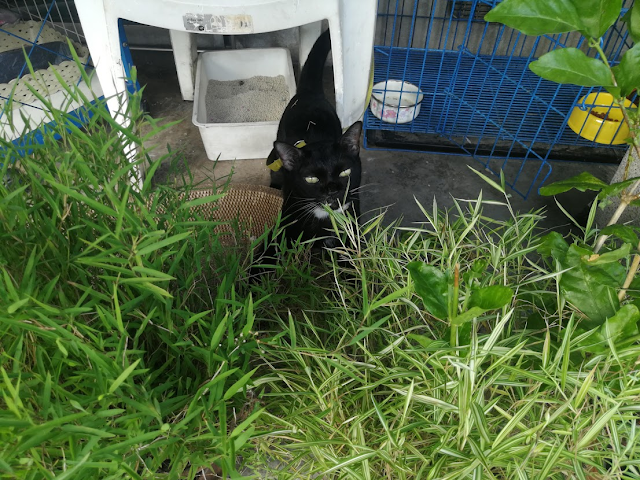
Happy, my favorite local shop cat, has edible plants to snack on, maybe a type of bamboo


Saturday, August 19, 2023

Tea meetup at a Bangkok Chinatown shop, Jip Eu


I've let the subject of tea tastings go for quite awhile, aside from holding one in Honolulu this year.  But a Bankgok Tea Tasting theme Facebook group I started has seen more members join this year than ever before, so it made sense to try to meet some of them.  I was going to my favorite Bangkok Chinatown shop to replace an aged sheng cake (Xiaguan) anyway, so I announced the visit as a meetup in that group.

Four others met with me for a pleasant tasting session there; their participation made the event work.  Writing about it is in part about communicating more to them about what we tried, what the teas were, and leads for buying similar teas.  Of course my main thanks go to Kittichai and his wife, the Jip Eu shop owners, for serving as the actual hosts; he was kind enough to share samples of several teas for us, and to keep pouring rounds for two hours.  For me it's always like visiting an aunt and uncle there, which makes buying good tea at great value all the more pleasant.


Conversation points


This is mainly about the teas, adding more about what they are, and reference links, but I wanted to also pass on the feel of discussion, even though I'll cite very little of it.  It's always interesting starting out with what people already like and experience of teas.  A good lead on visiting shops in Little India came up, but I've lost track of those details; maybe at the very back of Phahurat Market?  There's more on that area here.

Brief discussion of willow herb came up, aka Ivan Chay, a rare tisane type that can be oxidized.  I've tried some really nice versions of those, mostly from Moychay, and other novel and pleasant pressed mixed tisane bars.  It would be more odd that willow herb and tisane blends never caught on if decent tea wasn't also slow to gain acceptance.

From there lots of short tangents related to the teas we tried came up, so I'll skip on to that.


What we tried


2006 CNNP (/ Zhongcha) 8001 sheng pu'er:  later I was thinking about how the tasting theme went from heavy to light and back to heavy, kind of unusual.  I think maybe we had stopped by in the middle of two others trying this aged sheng pu'er, which is characteristic for one style (a bit heavy, earthy, slightly rough-edged for being this far through fermentation, definitely intense).  

Readers may think back to trying 17 year old sheng pu'er versions that seemed pretty fresh to them, still including bitterness, not fully transitioning from earlier slightly harsh range onto milder earthiness.  Storage input plays a big role, along with the initial starting point; Bangkok is as hot and humid as anywhere, pretty close to Malaysian storage.  It's not exactly like 20+ years in Hong Kong or Taiwan, but at least fermentation level is equivalent to that.  

I own part of a cake of this tea, reviewed here.  Note that I reviewed that 4 years ago, when it was 13 years old; those extra years of transition since have made a lot of difference.  Of the three more-aged versions--leaving out a Dayi purple label version in this discussion--I might like the CNNP the least, and see it as least refined, with heavy earth aspects that can come across as rough edges.  I've tried it in the last month or so, part of a normal routine of checking in, and it's good, but the other two I like better.  I have a spare cake of that Dayi sheng (reviewed here in 2020; it's better now too), but the Xiaguan runs a bit low.


silver needle style tea, from Fuding:  it came up that the range was a bit heavy, and Kittichai was nice to help switch theme back to the opposite extreme, brewing a pleasant silver needle version.  I didn't catch much for details; maybe this was partly aged, or maybe not.  My guess is that a slightly higher degree of initial oxidation than might be typical for the type added depth and heavier flavors, but both inputs (that and aging) could lead there, probably in slightly different forms.  It was really nice.  

It's hard to do a flavor-list review here by memory; plenty of mineral base stood out, it seemed quite floral, and there was at least one more aspect in there.  We weren't discussing teas in tea-tasting form, offering rounds of input about flavors and other experience, although more of that came up related to another version.


2022 Thai sheng (pu'er-like tea):  I brought some newish Thai sheng (not pu'er, to most, since that's a Yunnan-restricted designation), it seemed like a good time to try that, moving on to heavier but not exactly heavy range.  That shop specializes in Wuyi Yancha (Fujian rock oolong), and Kittichai has family roots in Wuyishan and Anxi, so trying Tie Guan Yin would also make sense.  We just didn't get to either.  To me Tie Guan Yin isn't the most interesting range, even though it can be pleasant, and it takes a lot of doing to get far with Wuyi Yancha, since you need prior exposure to place any given version, and to see how closely it matches your preference related to all the rest.  True of lots of tea types, I suppose, but with sheng my personal favorite we went ahead and tried a Thai version.

It was nice, fresh and sweet, intense, of course including plenty of bitterness.  There is a characteristic flavor range Thai sheng tends to cover, which I'd mostly describe as floral, but it seems possible that I'm missing one or two aspect descriptions that really pegs it.  I cover the source and reference a review in a later part about vendor background.  

It was fairly well received; people are often exposed mainly to young factory sheng versions instead, which can be a little more undrinkable.  Or to moderately aged versions, not onto optimum transition level yet, or to aged versions that don't express the full potential of the type range.  I suppose the CNNP version might've been guilty of that, but style and aspects relate to personal preference, and lots of aged sheng isn't "refined."


2006 Xiaguan 8653 sheng pu'er (full size cake):  this is what I was there to buy, and Kittichai offered us some to try.  I thought it was good.  It was better received by everyone joining.  To me it tasted a bit like aged leather, but another participant added that it covers a lot of the same scent range from smelling cigars in cedar storage, both the aromatic wood smell and the tobacco, which smells nothing like a burning cigar while in storage.  That really is it.  

I had tried the tea last about 3 days ago (after initially reviewing it last year), and it's much more refined than it had been just 6 months ago.  It has turned a corner in the aging cycle.  I bet in about 2 more years it will be really special, so that I should probably be buying a few of these, but my budget is fairly locked down these days, with the moving back and forth between Bangkok and Honolulu.


after a year more than half is gone; I'm drinking more than just to check on it


Vendor references


I wanted to add a few vendor references before this ran too long, related to what we tried.  Of course Jip Eu themselves are a great reference; all but one of those teas is from there.


Qing Fu Cha:  the owner of this online business, selling Thai sheng and Taiwanese oolong, joined with us.  I've tried some of their Thai sheng before (reviewed here) and it was quite nice, although I'll also mention other fantastic options for other versions.  Their FB page is here, and it's probably possible to find their teas in an online outlet shop, which Google search would identify if so.


Aphiwat:  a small local tea producer, selling Thai sheng, the source for that tea I brought (reviewed here last year, compared to one from Vietnam and to a version from Moychay).  I just ordered some from him today, which I suppose is tea blogger code for either that source's tea completely matched my preference or quality and value makes lots of sense, especially when I'm also listing other good source options here.  

An earlier review of a pressed cake version tells that story.  If I could live on only one tea version right now it would his, or Wawee Tea's.  I drank a 150 gram small cake in that first two-month stay in Honolulu, when my kids first started school there, and repeated that with another Thai tea I mention next on the next stay.


Wawee Tea:  a well-respected Thai sheng producer, who I wrote about here.  I've liked different things I tried from them, but one particular new version last year I couldn't stop myself from all but finishing in short order, almost a whole cake's worth in under two months.  

Mind you new sheng or the Thai sheng profile range isn't for everyone; Kittichai, the owner of Jip Eu, kind of gets it but doesn't love it like I do.  I don't think most versions are suitable for aging, and they would be fine, and a little different, a year or two later, but it's as well to burn straight through them.  You absolutely have to be ok with bitterness mixed with sweetness, and I definitely wasn't for the first half dozen years of trying sheng versions over and over.  Then it clicked.  I don't think there's any need to rush that, to see it as some higher form of preference; if you like it then you like it, and it's fine if you don't.


two of the teas I'm describing, compared with one from Vietnam


Moychay's Thai forest-origin initiative:  I might as well add a third exceptional source, related to Thai sheng I absolutely loved last year, this one, with more background on the source here.  It's possible that it's not quite as close a match to my preference as the other two versions, but in a way that's not fair, given that it was their initial production of the type, past early trials (or I suppose this maocha version was, but they're from about the same time).  

I bet they're right there with the other two producers already.  Wawee Tea has been a producer for decades, I think, and there are reviews in this blog of Aphiwat's teas from 2019.  My guess is that material quality is covered in their case too, that terroir and plant-type issues are dialed in.  All three versions were so similar, in such a narrow related style range, that it would take someone with plenty of exposure to notice differences and have a preference.  


those three teas


One thing I want to repeat to make it crystal clear:  the style of all three matches my own main preference; I don't mean to imply that these are better than teas from elsewhere, especially Yunnan, or even from Myanmar, Laos, and Vietnam, for that matter.  

Of course versions from the most valued narrow origin areas in Yunnan are superior in a few different ways, beyond better aging potential.  But if your preference matches mine something will really click when you first try a really good example, and your whole tea preference will shift a little.  If it's a first encounter with a tea with bitterness as a main aspect that probably won't happen, which is fine.


That Xiaguan cake must have been relatively undrinkable 17 years ago, when first produced.  Some other sheng versions hit an atypical fermentation transition "sweet spot" in the middle instead, softening and gaining depth without needing that decade and a half to be approachable.  But these two polar opposites seem the norm, to me, that sheng is often best within 2 years of being produced, or even right away, or only after nearly 20 years of very appropriate storage conditions input, or longer.  It was nice that we could experience that much of that range in just three versions in this outing.