Showing posts with label gongfucha. Show all posts

Saturday, February 8, 2025

Farmerleaf Na Lang Laos sheng pu'er


This is the sheng pu'er version I talked about, I think, that I tried with William and cited in the last post about meeting him, a Spring 2024 Na Lang from Laos.

Since I've already introduced this tea I'm going to strip down these tasting notes to what it seemed like to me, removing a lot of the speculation or tangents.  I'll add a little back in with the conclusions, but this will work well kept shorter, without the usual rambling on.  This is William's site description (part of it):


Spring 2024, medium-big trees from forested gardens (listing for $140 per 357 gram cake)

Na Lang village, Nyot Ou District, Laos

A powerful Yiwu-style tea with great endurance 


This is typically the kind of tea you would find in Gua Feng Zhai for twice the price. The point of this tea is not the fragrance, but the good thickness in the soup and the deep Huigan. 

Considering the renown of Yiwu tea, and the high prices its tea fetch, it is not surprising that many tea traders cross the border to Laos and source tea from Nyot Ou district. As a result, most of the tea made in Nyot Ou is bought by tea producers from Yiwu.

Tea grows in the forests of Nyot Ou district along two valleys. The Southern valley is connected to Gua Feng Zhai village through a small road. The environment in which tea grows is similar in Eastern Yiwu and in the two tea producing valleys of Nyot Ou District. Ancient tea trees grow along more recently established gardens in the forests.
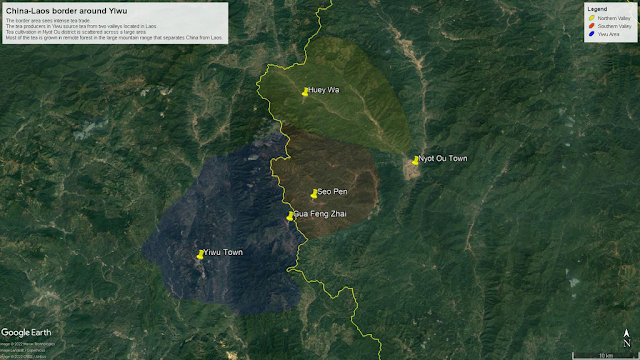

from the Farmerleaf site product page


That's a common, well-known theme, that lots of tea from lots of places goes back to China to become pu'er.  I skipped the "pu'er-like tea" limitation earlier, the admission that the type is a regionally limited designation, only applying to teas from Yunnan.  That's a bit absurd, isn't it, given that context, that any tea from Laos, Vietnam, or Myanmar (and less from Thailand) that crosses the border, and is mis-represented in terms of origin, sort of is and also isn't pu'er?  And a very considerable volume of tea undergoes this transition, far more than is ever sold as Laos tea.

It's the best of both worlds for Chinese producers and vendors; they can dismiss those origin area teas as separate and inferior, and then buy them and resell those same teas as the upgraded local version, simply by blending and then mis-labeling them.  Let's move on to how this tea is.

I never do address whether this is like Yiwu or not, a claim made in this description.  I've experienced relatively consistent character in trying a reasonable amount of Yiwu, but it's my impression that I've not experienced a lot more than I've tried, especially related to distinctive versions and higher quality levels.  So I'll just describe what I am experiencing.


I think it makes sense for vendors to never mention much about flavor range.  It would vary over time, and even more so in relation to varying interpretations.  In this review I mention it seeming to taste different when trying this same tea two different times, and I speculate about why that is, real factors that could've changed what I experienced, not just the interpretation.  

William's description doesn't even include a general flavor reference, like "floral," and again I see that as reasonable.  To some it would seem floral, and to others fruity, and different factors could change the compound inputs that these are based on.  It's fine as long as a description can pass on enough range description to draw interest, or inform in some other way.


Review:


First infusion:  a little light, but that's a good way to start, brewing the first round fast to get an initial sense, and letting the second be more typical of the rest.  Flavor is good; quite catchy.  There's a pine-like aspect that others could interpret related to other vegetal range, but only a little.  A fruity tone is something else, on towards juicyfruit gum, or back in the range of natural flavors not really tied to just one, but not so far off tangerine.  Feel is nice; it has some structure, already, but that doesn't seem to track towards being unapproachable.

I've already tried this tea, so this isn't the blind tasting approach I typically use.  I know where this is going, and this tea version is pretty exceptional.  I'll fill in more of an aspects list next round.  

It's completely whole leaf material, not too compressed, so it would be easy to drink it unbroken, but I used some from the parts that had already split off in this tasting, more broken material.  Maybe that's not ideal, but I suppose it's a normal real-life experience form.  I hadn't thought it through getting it ready; depending on how focused in I am I might use the broken material also in the wrapper or carefully separate off some relatively whole leaves.


Second infusion:  that catchy fruit related tone really pops in a stronger round.  Bitterness and astringency really ramp up too; those would be more moderate if someone was more careful about not breaking the leaves.  

The bit of pine, or however that vegetal edge is interpreted, integrates wonderfully with the sweetness, bitterness, fruit tone, and background floral range.  

Intensity is good; I supposed based on what I said in the post about talking with William I should comment on that.  It's not by way of harsh aspects being dominant either; in better quality cakes strong sweetness, bitterness, feel, and positive flavors really stand out.  This is really clean in overall effect; it's not as if young sheng tends to be murky, or to taste like a cinderblock, as comes up more with Liu Bao, but there can be an emergent sort of impression of clarity and cleanness, or lack of that.  

This doesn't seem completely identical to when I first tried it with William.  It was exceptional then, and it is now, but minor inputs can vary, shifting the outcome.  I'm using water from a hot water dispenser and filtration system, so it's not at full boiling point; that changes things.  It's a different version of water.  This leaf is little more broken, as I've mentioned.  We drank this tea in the middle of trying a half dozen versions; that can affect impression and memory.  It seemed to include more bright floral range in that tasting, leaning towards bright citrus, and it probably did, based on those differences. 


Third infusion:  the tone seems to be warming.  It had warmth and depth before, but it's evolving to include a lot of that.  The leaf color is mixed, including some darker range, making me wonder if somehow oxidation level didn't vary a little in this initially.  How?  I'll add more about one thing William said in the conclusions, that might have entered in.

I personally love that effect, when sweetness, flavor complexity, and slight warmth gives a young sheng a much more approachable character.  I suppose people could be mixed on how they relate to that input and effect.  

I'm not doing justice to what I take to be a fruit tone.  It's not so far off dried mango, which surely isn't all one thing, since there are lots of kinds of mangos.  That one flavor input is positive, but it's how it integrates with the rest that works well.  It's intense and refined enough, which can be hard to place within the entire sheng range, or in relation to higher quality versions, or typical Yiwu styles. 

I didn't mention that the intensity carries over to aftertaste experience.  That almost goes without saying, but not completely.


Fourth infusion:  now that warm, sweet aspect tastes more like dried apricot to me, so much so that I'm questioning my earlier interpretations.  It's a lot like apricot, a pretty direct match.  It's quite delicious.  There is plenty of astringency and bitterness to balance it, but it's a quite approachable tea, at the same time.  Someone being more careful than I was to not break the leaves would moderate those parts just a little.

Intensity is so good, and flavors so fresh and bright, that it seems this will go on forever.  It won't; based on trying an earlier cycle this will make a lot of infusions, using the high proportion that's my default, but eventually flavors will thin and bitterness will play a different role.  It's great while it lasts though, which is for awhile.  The bitterness and sweetness stays in your mouth after you drink it, along with that fruit flavor, adding some extra exposure to appreciate.


Fifth infusion:  it's not transitioning all that much, which is as well, because I'm running out of patience for making these notes anyway.  Feel might become richer; that's an interesting shift, for this stage.  It has had pretty good feel structure for this whole cycle, but it gains just a little richness, towards a pleasant sappy feel.  To me that one interesting and positive fruit note integrating with the rest well is the main story, with other range playing a supporting role.  


Conclusions:


It's good, very intense, refined, pleasant, interesting, well-balanced, and so on.  I can't place it in relation to Yiwu range, but this probably is the best Laos sheng I've ever tried, and it might be about the 15th version I've tried.  The warm fruit range was interesting.  Floral tones are often dominant, across a lot of sheng range.  Versions can transition quite a bit, aging over even 9 months or so, but this was quite warm and fruity, and a year of aging input wouldn't cause that.

Back to that oxidation input issue:  William had said that if a producer backs off the kill-green completeness even a little (if I'm remembering this part right) that the stems can not be as fully fixed (compounds inactivated).  Then these can turn redder, more oxidized, as the tea dries, shifting the final character.  Maybe that happened in this?  It would explain the darker colors in some of the material, and also those heavier tones, the fruit range versus the floral, and warmth.

That's all just speculation.  The tea is really nice, the main thing.

Is it worth $140 a cake?  Sure, if someone is open to paying that for it.  It's novel, so there isn't any one established market supply and demand based pricing level.  It could be $500 or 1000, if people are open to paying that.  

There's a general expectation that quality level and range of related experiences out there are the competing factors; there are ways to buy a lot of Yiwu versions, and some other Laos teas, just none that I've tried like this.  If somewhat equivalent versions really do tend to cost $280 instead then maybe this is a great value.  I'm not buying any teas that cost over $100 per cake, so I'm just not part of the whole community, in one sense.  That's about budget limitation, not idealism.  If my tea budget was much different I'd buy this, for sure, but I certainly don't experience that as a regret.  My life balance is something to be thankful for, not to focus on regrets over.

Beyond those concerns the tea character is really interesting and positive.  I've really appreciated the opportunity to try this, and to have some to drink, since William shared a fair amount, not just a sample.  Many thanks to him!


Friday, January 31, 2025

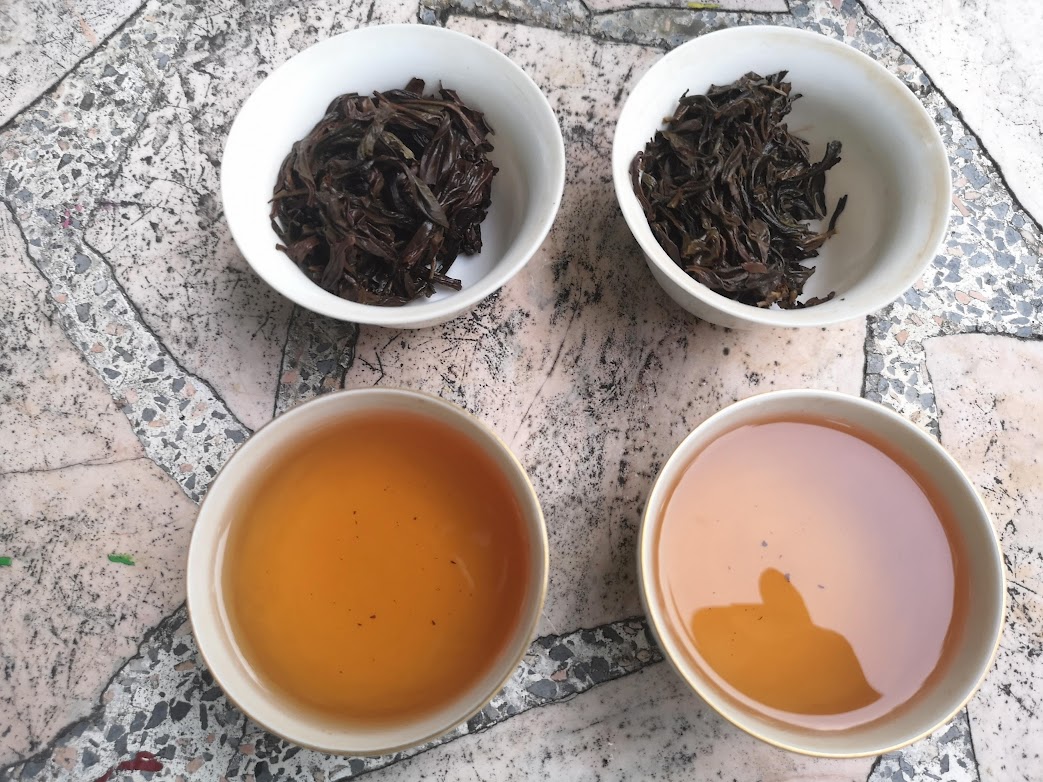
Ginger flower and honey orchid fragrance Dan Cong


honey orchid left, in all photos


This reviews two more Dan Cong from an ITea World sample set, sent by them for review. The last two were exceptional (orchid and magnolia fragrance versions).

One is the most commonly sold Dan Cong type, Mi Lan Xiang, or honey orchid fragrance (or aroma).  The other version, ginger flower fragrance, I've probably never tried. Their site description of that set follows:


iTeaworld 2024 Christmas Gift Sampler: Fenghuang Dancong Oolong Tea  ($109.90 for 100 grams)


Fenghuang Dancong Oolong Tea:  Huang Zhi Fragrance, Orchid Fragrance, Honey Orchid Fragrance, Magnolia Fragrance, Ginger Flower Fragrance, Osmanthus Aroma, Cinnamon Fragrance, Almond Fragrance, Night-scented Stock, Jasmine Fragrance


I might add a note on their brewing advice, before touching on the subject of value.  They recommend using Gongfu brewing, of course, starting at 6 to 8 seconds, and moving to 10 to 15 seconds, for up to 10 infusions.  That's fine, but I would brew these quite a bit longer, and only get about 6 to 8 rounds out of them.  If I was using a proportion of 8 or 9 grams I'd probably roughly match their parameters, but to me 8 seconds isn't long enough at 5 grams to 100 ml.  That's about preference, not really an optimum.  I'm a sheng pu'er drinker; I can't be brewing teas really light like that, but it is one common form of preference.  It might even work slightly better to isolate flavor aspects, even though that's counter-intuitive.

Is just over a dollar a gram justified for these?  I tend to state over and over that I just won't buy tea at a dollar a gram.  I probably wouldn't buy these.  But for what they are, the quality of the four versions I've now tried, that's about right.  At least they offer sales that could cut that back a little, 20% off if you spend over $100, so it seems this would drop automatically, at least now.  If these really cost 80-some that's a pretty good value.

It feels odd saying that.  Who spends over 80 cents a gram on tea?  People who don't care what the cost is, or who get hooked on types and quality levels of teas that they just can't get for less.  It's better not to do that.  This is where I usually say that other range of similar tea, for this type, isn't as good, in a sense, but it's interesting and pleasant enough that it doesn't matter, it's fine.  With Dan Cong you kind of take a hit.

I will say this:  I just bought decent Dan Cong for a gift at $20 per 100 grams.  It won't be this good, and this range of different DC versions doesn't turn up.  I bought that in a Bangkok Chinatown, and you can't match value or that version offering on the internet, oddly.  I didn't try that exact version I bought, to be clear, but I've bought Dan Cong from that shop three times, I think it was, so you can kind of get a sense of what they sell from that kind of history.  Upper medium quality Dan Cong can be really nice, if you can find it.  Online sources wouldn't sell that for less than $40, but it's still 40 cents a gram instead of 80+.  Other Chinatown shops here would probably sell lower quality Dan Cong for more; it was an exception, even for here.

These might all be that little bit better, or at least the first 4 were.  Maybe the honey orchid, Mi Lan Xiang, wasn't quite on the level of the others, but they were all pretty far up there for quality.  So I guess if you really feel that you need to experience what pretty good Dan Cong is like this is reasonable (given the other versions are like the first four, and I expect that there could be some quality variation).


Review:


Honey orchid:  that's nice.  I didn't use an extended first round for these to bump infusion strength to a normal level, so I'll be trying them light for a first infusion.  Character is good; these aspects are nice.  Tone is a little warm; it seems that oxidation level is balanced really nicely, probably supported with very moderate roast input, that is hard to fully place.  It all integrates.  Flavor is floral, of course, hinting a bit towards ripe peach.  The warmth comes across as a touch of cinnamon, at least so far.  Astringency hasn't emerged yet, but being on the light side that would be moderate.  It's a great start.

One might wonder if this seems really familiar, for this being the name for Mi Lan Xiang, the most common form of Dan Cong.  I guess so.  Those still vary a good bit, and this is a novel and positive version of one.


Ginger flower fragrance:  I guess that tastes a lot like ginger flower?  There is a light spice edge to it; it's really interesting.  The general tone is sweet, like jasmine, not even all that far from jasmine.  Again the moderate warmth works really well for this.  Floral tones are plenty bright and intense, and then it's grounded by warmer floral range, and what could seem like a bit of spice.  

This is so fragrant that it's perfume-like.  No tea this good is artificial, I don't think; I mean that volatile compounds give it a positive effect, what I often call liqueur-like, when the flavor context is slightly different.  It'll be interesting trying both slightly stronger.


Honey orchid #2:  I brewed these for about 15 seconds, or just over, not a long infusion time, but plenty for this proportion, for "only" using 5 grams.  Flavor is great.  Intensity picks up a good bit, but it stays in a similar flavor range.  A richness picks up, a thicker feel.  Astringency also does, but it's not sharp or edgy, only tied to that fuller feel.  Flavor definitely includes a lot of warm floral tone and some peach, and again I read the warmer part as being like cinnamon, just not exactly that.  

Ordinarily I'd be brewing 8 or so grams of this, drawing out even more intensity, even for using slightly cut back infusion times.  As long as you keep infusion timing out around 20 seconds that intensity would still be there.  There is no sharp edge to worry about; may as well push this tea a little.  Refinement and balance are great.  There could be a little more depth, and a little more pop, with aftertaste carrying over a little more, so I'm not saying that this is an ideal version, but it's pretty good.  It's definitely in the right range.


Ginger flower:  that ginger edge really comes out; it actually tastes more like ginger this round.  Maybe I was expecting that to be less of a literal description, or maybe ginger flowers also smell like ginger toot.  The sweetness is again like jasmine, with more warmth.  Where the other includes warm tone that's towards cinnamon this is really aromatic incense spice range instead, a set that I don't have clear enough memory of to distinguish between (frankincense, sandalwood, etc.).  

Feel seems a little thicker, and aftertaste does carry over just a little more.  It seems natural to push these just a little harder next round, infusing them for just over 20 seconds, to see what comes of that.  There's nothing negative to work around, so it will be down to trading off maxing out intensity for having them brew less rounds.


Honey orchid #3:  it's funny how someone unfamiliar with this tea type range could be absolutely blown away by this tea version, the strong floral tone, touch of fruit, sweetness, richness, depth, overall intensity, the way it all balances, and so on, and then the other version amps a lot of that up just a little.  Good Dan Cong is really something. 

"Good" is so relative; above average quality versions just tend to be like this, but from how people describe even versions they take to be positive many aren't.  That characteristic astringency edge people describe needing to brew around is a quality issue.  I suspect that low elevation, monoculture grown versions are pushed too hard with chemical fertilizers, leading to that, but of course that's just a guess.

Aftertaste does seem to pick up a little, for adding just a little more infusion strength.  Feel is generally good, it just seems less noteworthy with the other being a little richer.  Maybe the flavor being relatively familiar does cost it a bit in terms of novelty, but it's not as if I'm drinking Mi Lan Xiang versions all the time.  It's been awhile.


Ginger flower:  that's as far as this should be pushed for infusion strength, or maybe this is tipped a little over a natural optimum.  You know when something is enough when it's too much.  The ginger type flavor is still novel and positive, and other floral range is nice, but that jasmine sort of floral note is a little too strong in this.  

Could that flavor have been bumped by contact with actual jasmine flowers?  Sure, it's possible.  I'd guess that's not an input, but the effect would be like this.  It wouldn't draw out that much ginger flavor though.  And the supporting incense spice range warmth is really interesting and pleasant.  This is just how good Dan Cong goes; it's a little surprising that tea can be like that.  If added flavoring could be this clean, balanced, and positive I'd probably drink flavored teas.  Good Wuyi Yancha can be a bit surprising too, but not as much across this floral and fruit range, typically.  That liqueur-like effect can be really strong in some types of those though.


Honey orchid #4:  the feel isn't necessarily thicker or richer, but somehow it picked up a syrupy effect; the texture changed.  That's nice.  Intensity and complexity are good, and depth, but somewhere in that set is the closest thing to a limitation this tea has.  It could hit harder.  I suppose it could be slightly more intense and complex, and could express a little more depth.  It feels like splitting hairs saying that.  Someone could buy a dozen Mi Lan Xiang versions and not get one this good.  But there's a magic that happens when it's all dialed way up, and this quite good, but maybe just short of magical.

This is part of why I feel like chasing quality level optimums is a bad thing, to be clear.  If you need every new and different next experience to be better than all the last you set yourself up for disappointment instead of enjoyment.  This is already so good.  I'm just trying to place it, for people who are really on that page, into Dan Cong.  It would make for a bad goal trying to top this tea, and an expensive one, probably requiring some hit and miss, but it would be possible.


Ginger flower:  at just the right infusion strength this gets pretty close to magical.  The way all those flavors I keep describing come together, with the rich feel, warmth, depth, aftertaste trailing on--it works.  I suppose that ginger and floral mix, not so far off jasmine range, may not appeal to everyone, or that incense spice undertone people might see as less positive than I do.  To me it all really integrates.  I don't think it was a happy accident that made this tea turn out this good; I suspect that whoever made it really knew what they were doing.

That reminds me, in the last meetup at my favorite Bangkok Chinatown shop the owner, Kittichai, was describing how oolong is harder to make than sheng pu'er (in his opinion).  He said that to make sheng the material plays a lot of the role, and if you get the simpler standard steps right it will turn out as well as the material allows.  But oolong is different; there are more steps, more inputs, and more judgment required.  That matches my understanding too, even though I have zero experience with processing tea myself.  The timing for every step needs to be carefully determined, not according to a recipe, but in relation to the material and the conditions, related to how compounds are changing just then.  It's the same for withering, bruising, and oxidation, on to fixing, then later roasting; variable after variable requires tea maker input.

It seems funny saying that since over and over I've said that South East Asian sheng is typically just a little off Yunnan versions, probably related to processing differences.  Some of that could be intentional; people seem to draw out withering or add a limited oxidation step to offset the final bitterness and astringency, the harshness.  In Yunnan if the material is a bit aggressive after processing it just is; you age it some to offset that, not change the processing inputs.  What do I know anyway; I'm just a tea drinker.


Fifth infusion:  in order to not repeat those same aspect lists I'll just combine thoughts in one note for this round, and end this note-taking.

The honey orchid version has levelled off related to changes, not necessarily fading, but maybe giving up a little intensity.  It's quite pleasant like this, and not changed, but a next round would need to be infused longer to get this far.

That ginger tone is always surprising in the other version, when you first taste it each round.  And it being supported by so much floral and spice range is really something.  I suppose the feel could be a little thicker, but there's so much novel and well-balanced range that it's really splitting hairs to point out where it's weakest.


Conclusions:


These are much better than the earlier tasting sets from ITea World.  If you go back and read the wild origin material posts I did those teas are positive, mostly, but they're not complex, intense, balanced, and refined like this, none of them.  Then again this is Dan Cong (and they also cost more); that would be like trying sheng pu'er and saying that other type range just doesn't match it for intensity.  Of course not.  Just across that one dimension these aren't as full-throttle intense as the ordinary range sheng pu'er versions I often have with breakfast.  But across almost every other dimension the aspects really stand out.  

I suppose that only applies if someone loves floral-oriented teas with some fruit and spice range to add depth.  If someone loves green tea or hei cha, and not that range, these may not work as well for them.  To me the appeal seems relatively universal in form, but in practice personal preference isn't exactly like that.  People like whatever they like.


Sunday, September 15, 2024

Comparing exceptional Vietnamese and Taiwanese white teas


Vietnamese tea left, Taiwanese right, in all photos


I'm comparison reviewing Vietnamese and Taiwanese white teas, a Lai Chau Deep Forest White, from 2024, from Viet Sun, and a Lishan Taiwanese White, from 2022, from Tea Mania.

After getting a bit bogged down in describing how medium level aging concerns work out for sheng pu'er in a last post I want to keep this simple.  It will be about what I think of the experienced aspects, not about aging, trueness to type, regional background differences, or anything else beyond what is in the cups.  One of these is two years old, and one is from this year, and I won't really speculate on whatever difference that might have made.

There's some risk I'll like one more than the other, then maybe I'll complicate this talking about varying preferences for aspects, but I don't want to take that sort of theme very far either.  Writing a simple review would be nice.  As usual vendor page citations say what they are:


Lai Châu Deep Forest White Spring 2024  ($29 per 100 grams)


A beautiful and unique tea from ancient non-Sinensis varietal tea trees growing wild at altitudes of 2200-2500m in Phong Thổ, Lai Châu. The people living and making tea in this area are of the Dao ethnicity.

The raw leaves used to make this tea take on shades of red, purple and green with a glossy look and every tree produces leaves with a different appearance. You can also find leaves that look different on individual trees. Picking the leaves to make this tea requires a long walk into the forest and climbing up very tall tea trees. This is only possible on days with good weather.

This tea brews up into a clear golden soup. The fragrance and flavor is stone fruit fruity and floral with cane sugar, orchid and mountain forest notes. This tea has a lingering “purple effect” common in many wild varietal white teas like this and a strong but relaxing qi. No bitterness or astringency.

I like to brew this one at 90C for the first few steeps and then gradually increase to 100C during later steeps.


Interesting, that this isn't from Camelia Sinensis.  It definitely tastes unique.  For once my flavor description of it is pretty close to Steve's.  Very similar descriptions can relate to slightly different interpretations of the same flavors, but this matches better than usual.  

I don't know about the relaxing qi; I tried it along with another tea.  I suppose it was nice not getting blasted as I do when comparing sheng versions, but that experience is nice in a different sense too.


Lishan White (25 CHF / $29.44 for 50 grams)


This white tea is also an absolute rarity and we were only able to get hold of a few grams. The tea leaves come from Qingxin bushes which grow on the Lishan. The tea has an abundance of pleasant aromas with a floral and full-bodied character. The high altitude results in a much more intense and complex aroma which is normally not found in a white tea.

Harvest: Summer 2022

Taste: Full-bodied and complex

Terroir: Lishan, Taiwan

Preparation: Per serving approx. 2g, temperature approx. 75°C,  time 1 – 2 minutes


There are a few things to unpack there.  I'd brew it hotter; why not?  It really is one of the most unique white teas I've tried, maybe even more novel than this Vietnamese version, although both were absolutely different than any versions I remember trying before.  

60 cents a gram is a bit much, but then this tea probably is a type that barely even exists.  And it's unusually high in quality level, pleasant to experience, and from a high demand production area, where above average oolongs would command a decent price.  That price seems reasonable.


Review:


Lai Chau Deep Forest White:  the dry leaf scent is very deep, rich, sweet, and fruity.  Brewed it doesn't match that dry scent intensity; I may need to go a little longer on the next round.  I did brew these for 20-some seconds, so a bit, but I can push them for 30 to 40, given proportion is a little lower than I usually use.

Sweetness and fruit is evident in this.  It's complex; it tastes a bit like peach or apricot, but there's a lot more going on than that.  It might include grape as well, but not the modern grocery store grape range, more like the older Concord type used to make juice in the past.  Or I think that was a broad type range; I'm not completely caught up on types of grapes.  Mineral range includes a touch of savory quality, and significant sweetness makes it all balance well.


Lishan White:  I was concerned this might just be too subtle to hold its own but the opposite occurred instead; there's a strong spice range in this that's more intense than all of the character of the other.  It includes cinnamon, but it may extend beyond cinnamon.  Sweetness is pleasant; that works.  Beyond that there is other range but it's hard to identify at this stage, maybe a few minor supporting themes.  I'll push both a little harder and try to add more breakdown.


Lai Chai #2:  that picks up a lot of warmth and depth.  Flavors are so complex that it's hard to get it to separate out as a list of impressions.  There's a lot of fruit, all mixing together as one theme.  Again one part is in between peach and apricot, and grape doesn't stand out as much, but a hint of citrus does.  Warm tones are along the line of dry autumn leaf.  Sweetness is good, and feel is rich enough that it adds to the experience of overall complexity.  It would be a shame to swap out those brighter tones by aging this but it has enough depth already that it might work well to; that might increase further.

It's strange how when I try a little later, after tasting the other, when it's quite cool, the grape flavor comes back.  It tastes like grape bubblegum, more than actual grapes, like the old Hubba-Bubba version, or something such.


Lishan:  it's crazy tasting this much spice in a white tea.  This could actually include some cinnamon (it doesn't; I mean the impression is that clear and strong).  Feel might be even a little richer and fuller than for the other version, kind of velvety.  Sweetness level is comparable for the two, high enough to add to overall complexity, and a good level to support the balance.

It's strange how complex this comes across, even though the set of flavors is kind of bundled within a limited range.  There might be a general floral range beyond the spice, and a touch of fruit.  Warm tones are a main part of the overall balance, that spice range, and some mineral, with floral and fruit brighter.  Then as a secondary supporting input the floral and fruit range is less distinct, but it still plays a pronounced role in the overall impression.  Spice seems to include a hint of fennel seed, other warmer, towards-savory range.  These are some pretty interesting teas.


Lai Chau, #3:  there's a depth to this that's hard to describe.  I probably mean different things by that when I say it about different teas; that probably doesn't help.  There's a good bit of fruit, shifting now to warmer tones, but other deeper warm range really picks up, from the earlier mineral base and autumn leaf aspects.  It gives up some higher end, sweeter and more forward notes related to that shift, but it's pleasant.


Lishan:  this stays more consistent, evolving less.  I suppose there may be a shift to slightly warmer tones, brought on by round transition, and probably going slightly longer on the infusion time, but it's not so different than earlier.  It's interesting how flavor complexity and fullness of feel work together to make this seem complex.  That's true of the other tea version too, but in a different way, and a different sense.  

This includes fullness of feel more like oolong range can express.  There's a bright, sweet floral and mineral oriented note--a flavor set, I guess--that seems to tie it together with local origin oolong flavor range.  The other tea might be more complex, in terms of covering more flavor scope, and other aspect range, but this has a good bit more depth.  Some warmer range fills in complexity, and it comes across as quite refined.

They both brewed a few more pleasant rounds, but I left off taking notes here.


Conclusions:


These are both unusually good.  I kind of didn't expect that, since I didn't read the descriptions before trying them.  The Vietnamese version shows that interesting character in dry leaf scent, so much fruit, but the Lishan version doesn't as much.  It's interesting considering how they seem in light of those descriptions.  

The Vietnamese version does seem novel enough that it makes sense that's it's different plant type, but it doesn't include any of the sourness edge that can come up in those, even purple leaf versions, which I think are just a variant of Assamica.  Purple tea can taste a little like grapes, sometimes.

The Lishan version was really unique, complex, and refined.  White teas can lack flavor complexity and intensity, but these didn't.  Feel structure is often quite limited, but the Lishan version even covered that.  Both expressed so much depth that I didn't necessarily miss the intensity and edge that I usually experience drinking sheng more often.  

Someone could have drank a lot of more standard form Chinese white teas in the past, and like them, and feel that either of these really opened a door on new experience range for them.


Saturday, August 24, 2024

2022 Yiwu gushu sheng pu'er and 2023 Gedeng arbor sheng


I'm reviewing two more sheng pu'er from Tea Mania, a Yiwu and a Gedeng version.  Yiwu needs no introduction, and Gedeng isn't familiar, so I'll refer to the site descriptions for background (for both):


Yiwu Gushu 2022 ($100 for 200 grams)


For this bingcha tea leaves of up to 300 year old tea trees (gushu) from Yiwu were used and made into a bingcha. A certain similarity to the very-popular Lucky Bee can’t be denied. In addition to the typical Yiwu aroma, there is a well known depth and clarity from the gushu leaves and a hint of camphor.

Who are Tea Masters Panda and Yang Ming?

Tea Masters Panda and Yang Ming are good friends and experts when it comes to Pu-erh. Yang Ming is a local tea farmer of Yiwu and descendants from a family with a long tradition in Pu-erh making. Incidentally, our popular Lucky Bee teas are from Yang Ming’s tea fields. 


I guess 50 cents a gram sounds reasonable for this type and quality of tea.  It's beyond what I would spend on tea, but it seemed pretty good to me (I always add the descriptions after making notes).  The only description here is a little like Lucky Bee, that character is standard for Yiwu, and it includes a hint of camphor.  I didn't notice the camphor, but it did seem like normal Yiwu range to me.


Gedeng Arbor Pu-erh (note the listed version is 2020, and I've reviewed 2023) $83 for 357 gram cake 


Tea Master Panda has graciously shared with us a prized gem from his personal collection: the Gedeng Arbor Pu-erh tea. Known for its profound and rich aroma, this tea, meticulously preserved, stands as a unique treasure for tea aficionados.

Arbor tea

The Gedeng Arbor Pu-erh tea is crafted from leaves harvested from Arbor tea trees, some of which are up to 100 years old, in the Gedeng region. These leaves are pressed into bingcha using traditional granite stones. While there is some resemblance to other teas of the six old tea mountains, the Gedeng Arbor Pu-erh is more herbal and full-bodied. In addition to this typical Gedeng aroma, there is a depth and clarity, along with a hint of camphor.


This makes comparison with a listed item tricky, because this is a 2020 version instead of 2023, the sample that I tried.  I specifically mention in these notes that this tea is in a good place now, and I wouldn't hold onto it for another year or two if I owned it, I'd just drink it.  I'm sure that it's fine as a 4 year old version, maybe better in a limited sense, and the starting point may have been somewhat similar, that year's version.  Those are all still just guesses though.

Maybe the one unusual flavor note I keep mentioning, or set of them, is a "typical Gedeng aroma."  Again I'm not so sure about the camphor.  It seems like the kind of thing that people end up looking for, and finding often enough, and then I don't.  Once in a long while something will taste like camphor to me but that's rare.  In talking to another friend recently about this particular aspect he guessed that maybe people tend to place what seems like pine flavor as camphor, related to expecting it, while others use a different interpretation related to not expecting it.  Who knows.

If this was identical to the 2023 version then 23 cents a gram (what that works out to) would be a pretty good price for that tea.  There is a running "older is better" understanding when it comes to sheng, that a few years of age are better than none or one, and 20 years is better than 10, but to me the first comparison doesn't always work.  Some teas that are approachable and pleasant right away only lose positive character, even after as short a time as two years (over that first year there is change, but typically not a complete shift).  

The 2022 Yiwu was considerably more age-transitioned (changed by fermentation, really) than the 2023 Gedeng; two more years could change a lot.  I'm not implying any particular conclusion here, just talking around how the inputs and outputs work out.  

Preference also factors in; there would be people who tend to always love 3 or 4 year old sheng versus new, 1, or 2 year old versions, and also the opposite, in relation to more approachable character sheng.


small discs again; Yiwu is on the left in all photos


Review: 


Yiwu, #1:  these are really on their second infusion; I let the discs soak for one minute first, then tore them into pieces, then this is a second round, brewed for another minute.  It's not optimum, since it will brew tea that had wetted first too strong, and not start in on the core of what is still compressed, but it's one way to jump-start the process.  

Doing a lot of messing around with partially soaking them and using a pu'er knife to separate them apart is another way, or just brewing the outer part in early rounds and the inner tea only after a half dozen infusions.

Character is warmer than I expected; this is two year old tea, but it has shifted a good bit in that time (I expect; surely this didn't start out slightly oxidized).  Rate of change depends on storage conditions; I guess this wasn't stored in a very cool and dry place, which is probably more optimum.  Better than here too, in Bangkok, where teas and people living here end up being heated and steamed, living daily life at 90 F / 30 C and 70% RH.  Living again and storing teas back in Honolulu would be good, dropping that temperature a little.

It's floral, I guess.  It has decent complexity; there's really a few things going on.  Floral range is part of that, maybe even complex floral range, then most of warmer tones might relate to a mineral layer.  There's often a catchy sweet note in Yiwu, which is generally floral, that I might be able to place more clearly than that, and this has that distinctive flavor aspect, or set.  It's a sort of brightness, that stands out in a complex and refined character.  

There's nothing challenging about this tea, as expected; there is a little bitterness, but not much, and astringency is moderate.


Gedeng:  there's a pronounced fruit note in this.  It reminds me of experiences with Nannuo versions before, how that has stood out in some of them.  Maybe not identical to this but pretty similar.  It has decent complexity too, and just a hint more edge to the feel, but it's also quite approachable.  Again there's very limited bitterness, but some, which is nice for balancing the rest.  For an oolong drinker maybe that's a medium level; I mean for sheng of this age that input is limited.  It's too early to call, on the first infusion that's strong enough to make notes on, but at this stage I really like this version better, for how that one note makes it more unique, standing out in a background of other floral and mineral range.

These will only brew a more conventional round next time; this was while they were still opening up, saturating all of the leaf material, or at least most of it.


Yiwu, #2:  evolving a little, gaining complexity, but not so different.  The depth in this is nice.  Flavor range is fine too, and feel, and aftertaste is positive, but there's another emergent range of it having depth that is something else.  I suppose a mineral base is a part of that, one main thing contributing to it.  It's nice the way that bright and sweet notes, and good complexity, integrate well with warmer and deeper mineral tones.  It seems pretty good.


Gedeng:  this has evolved too, again in the same direction it had been expressing last round.  That one note is really nice, a bright fruit tone.  I could try to describe it in relation to fruit flavors but it's not going to completely work.  It's also mixing with floral range, and a mineral base, and it's not striking me as closely related to one fruit flavor.  Still let's go there.

As far as I know there is no such thing as dried mangosteen, but if there was this might taste like that.  You eat that fruit by chewing the fruit part off from an attached seed; there is no way to pull it apart.  There's a brightness, sweetness, and complexity to this fruit tone, like that.  It's not so far off some forms of dried mango, just not exactly that either.  

Mango isn't just one thing, because there are lots of versions of it, as with apples, and they vary just as much, or maybe more.  I absolutely love my favorite versions of mango but I tend to see the most common ones here more, which aren't as nice.  Then there is the holy grail of versions, something absolutely fantastic that you run across somewhere, and almost never get to see again.  I'm not saying that this tastes like the best possible mango, just going on a tangent there.


Yiwu #3:  I'm brewing both of these a bit stronger than I typically would, because both are approachable and can handle it, and I want to clear through the issue of some not being saturated yet.

Being brewed just a bit stronger than I typically would warmth and mineral range comes out a bit more.  Brewed more lightly the sweeter floral range would stand out more.  I'll try a fast round next time to check on that.  Of course I'm not still brewing these for a minute; I mean that using a 20-some second infusion time makes them stronger than I would usually prepare most sheng.

Again complex floral range stands out most, and warm mineral depth, with sweetness seeming to tie to honey flavor, that warmth.  It's pleasant; it all integrates quite well.  If this is some $1 a gram version, as it probably is, it's in the right character range to demand a high price, I just wouldn't buy teas priced like that [editing note:  it's not, the price is lower than that].  On a relatively open tea budget it could make sense; this is complex, refined, free of any flaws, and sort of on the unique side, except for being one of the most familiar broad origin ranges (there must be many local area distinctions with Yiwu, that I'm not familiar with).


Gedeng:  it evolves a bit.  That one note I've described as similar to a warm dried tropical fruit is changing, more into spice range now.  I've tried to explain what I've meant by "root spice" recently, and it's not unrelated to that.  Like sassafras root, related to root beer; let's leave it at that.  

When you drink a lot of tisanes over a long period of time lots of others come up.  Not if you are using Yogi tea producer sources and such, I mean if you can search a little broader and deeper.  There are bark spices that are out there that are sweet, complex, unique, and distinctive, way beyond cinnamon.  I went through over a decade of exploring tisanes, before I ever got into tea, over a decade ago now, so most of the names of the more interesting types I've long since forgotten.  Sage was my overall favorite; I guess that could work as a recommendation.

It's interesting comparing these two in terms of in reference to my own preference.  I really like that one distinctive note in this Gedeng tea, and it's quite pleasant how it's evolving, and how it integrates with a promising, complex, and refined base of other flavors.  In some abstract sense maybe the Yiwu is better tea, it really has depth and refinement going for it, but this adds an extra touch of interesting character.  Then I suppose others might dislike that flavor instead, and would find it off-putting.  It's funny how preference works out.


Yiwu #4:  I'm blasted from all this tea already; brewing it strong to get it to fully infuse really caught up to me.  I ate a couple of cookies to settle my stomach and slow the drug-like effect input but I'll need to take a break after this.  I suppose all that is good for someone into "cha qi" drug-like effect.  It's not really my thing.

Sweetness level seemed to drop in relation to comparing this to the taste of cookies (oatmeal with cream); that's natural enough.  After drinking some water as a reset it's more back to normal.  The effect is different for brewing these faster and lighter, not much over 10 seconds that last round.  The bright and sweet tone doesn't come out as much as I'd expect, and it's all a bit muted.  At least 15 seconds would be better, maybe even 20 again.


Gedeng:  intensity seems higher for this one, either related to this transition phase, or just how that one dominant note seems to carry the rest.  Again it's a main input that is really a bit complex, and is shifting in form across the rounds.  A catchy floral tone stands out now too, on the same level for comparative intensity.  A hint of vegetal input may be creeping in, like a light green wood tone.  It's odd that all that is changing while the Yiwu just went a bit quieter.  

These are one year apart in production date, Spring 2022 for the other, 2023 for this.  The leaf color is much darker for the Yiwu.  That's how things would go, that a version being one year old enables some transition, and two twice as much, but stored dryer that Yiwu wouldn't have changed nearly as much.  

For some sheng versions they're so intense and approachable right away that a few months rest might be helpful but they're really good new.  I bet both of these were just fine within a month of being produced.  Then a relative optimum for the first year or two of transition could be harder to place, but more challenging versions than these would be better after 2 or 3, while these may not be improving.  I like where the Gedeng version is at right now, and the Yiwu is fine, interesting for including so much depth and complexity, but I don't think hanging around for another year or two would be favorable for either.  They're good now.  

Of course it's partly a guess but I don't think there was ever a challenging range for these that needed to settle out, harsh astringency or over the top bitterness (which some people like; the stronger the better).  I just reviewed a Lincang version that was a good example of that; it was fine for people who love getting blasted by bitterness, but for me another year or two of rest will probably improve it, or maybe 3 or 4 in that case.


Yiwu, #5:  these I brewed for much longer, more like a minute, not because that makes sense, but because I was answering a message online.  It will be interesting to see what a stronger infusion turns up in them.  For positive flavor and body / feel experience it's not optimum, but sometimes flaws can be more identifiable if a tea is brewed stronger.  Or it's just a different perspective on the same tea.

Mineral is so strong in this, and a range in between wood and spice stands out.  It's actually not bad, brewed too strong like this.  It has great depth, and the balance still works.  It seems to imply that it will shift towards a vegetal range in later rounds, but that's ok too.  Nothing else like a distinct flaw turns up.  Of course warmth picks up brewing it like this, feel gets heavier, and sweetness is more moderate.  All that is a normal shift related to higher infusion strength.


Gedeng:  a green wood tone is a little too strong in this; it doesn't work quite as well.  I suppose an overbrewed round is more about seeing how it will go anyway.  That one vegetal range is a little harsh, but nothing else seems like a flaw.


Yiwu, #6:  back to sweet, lighter, more balanced, full in feel, and refined this round.  There is a vegetal note creeping in, maybe to both of these.  Someone brewing these lighter could be experiencing the same general transition level (between rounds transition) at 7 or 8 infusions along, or more; trying to get the discs / coins to open up and brewing a round extra strong really speeded things up.  Carefully separated tea from a tea cake brews better; it is what it is.  

This is fine at this round though; character is nice, balance of aspects is good.  The broad floral range input is even less distinct, now combined with warm mineral and some vegetal range picking up.  Sweetness comes across as more limited.  It still seems refined though.


Gedeng:  of course it's much better, brewed appropriately.  It's harder to place how the fruit that had transitioned to spice range is coming across now, which always had been mixed with floral range, and underlying mineral.  It all integrates.  Feel is nice; it's picking up a liqueur-like quality, that matches with some of the aromatic flavor range, or seems to.  

It can be hard separating preference from quality level determination in this.  I really like this style and set of aspects, and it seems like pretty good tea, but the two kinds of impressions mix.

I think I'll leave off taking notes here.  For pushing these teas a bit hard the transitions from here would represent more of what would typically occur in the 8th or 9th rounds, or maybe 10th or 11th if someone brews tea lightly, which isn't going to be as positive as earlier rounds for these teas.  I wouldn't say that I've botched the brewing for these, but limitations enter in related to brewing tea discs, as with dragonballs.  

That could be positive instead of negative for using a grandpa-style approach; the tea would really hang in there for lots of rounds brewed while left in a tea bottle or jar.  To me it would kind of be a shame to brew these teas this way, for being as good as they are, but if someone had a good bit of them and liked that approach then it would be fine.


Conclusions:


It's all already kind of there in the review notes part, but I can add some summary.  I liked the Gedeng version more.  It was interesting and distinctive, and the novel flavor aspect--a set of flavors, that transitioned--really worked for me.

The Yiwu was good too.  In some ways as far as quality markers go (aspects I see as identifying how good a tea is), overall balance, complexity, and depth it may have been a little better.  The Gedeng version was pretty good too though; it didn't have flaws, or thin spots in character.  I probably liked it more for being a year younger, for not transitioning as much.

Other people would already love Yiwu character, and would get hooked on minor character aspects that probably do actually tie to the gushu / plant age theme.  I'd probably just buy the Lucky Bee version instead, the newest one they sell, which seems to be 2022.  It's $53 for a standard 357 gram cake, 15 cents a gram instead of 50.  Or as I've mentioned before Tea Mania sells a sampler set; that's one way to see how you think it all works out for their types, quality level, match to preference, and value.  Then there's always the complication of meeting a cut-off level for free shipping, but most people don't have a problem with sorting out what else to add to a cart, it's the opposite that's more problematic, narrowing that down.


I've been trying different pu'er lately this year, back into broader range exploration.  One of the nice things about Tea Mania was always that value stood out, that the teas were always really good for the selling price.  I tend to avoid 50 cent to $1 a gram products but this really applies to everything I've been trying from them.  It's all pretty good tea, especially related to how that compares to the price.  I've been trying some teas selling for more that weren't as good.  In these reviews I tend to not dwell so much on value, only implying that it's a concern when it comes up.  Personal value really relates to match to preference, in the end, more than an objective quality level, so it can be hard to say that a tea isn't worth it.  

You can sometimes identify a market price, sort of, but a version has to be a really standard form or type to enable that.  It might've come up as implied in the vendor description that this one version was standard, pleasant, good quality gushu Yiwu, as if it could be compared to a norm.  I don't think they meant it that way, though; I think it was more a limited comment about flavor profile.  

It doesn't work well to taste a tea and peg an objective quality level, degree of match to standard type, typical market price, and comparison of that version to other vendors' alternatives.  Maybe some people can do some of that.  I comment on some of those things, not all of them, but I generally keep it a bit limited and vague because you can only go so far with it.


Wednesday, July 31, 2024

Tea Mania Jing Mai and Mansa gushu sheng pu'er (2021)


I met Peter of Tea Mania recently, visiting Bangkok, and he passed on some samples (thanks much for that!).  I've already reviewed two very nice Baozhong (light Taiwanese oolongs).  These should be just great.

Tea Mania was the main outlet I bought tea from for a few years, but I tend to cycle through sources, as much about transitioning what I like as moving up in some sense.  It's not as if I've mastered Chinese sheng, or that Thai and Vietnamese versions are better (what I've been on since), just routine exploration.

These are large coins; it will take some doing getting them started brewing.  To me this shape works better than dragonballs, which are still coming unfurled 3 or 4 infusions in, even if you pull them apart.  Tea separated from a cake tends to infuse more evenly, and get wet faster, but these will be fine.


A problem came up in checking on the vendor's descriptions of them, adding whatever background that does, because the Jing Mai seems to be sold out.


Jing Mai arbor 2021 is listed for CHF 56 ($63 USD), for a 200 gram cake, but it's probably not that, since the site seems to be using gushu and arbor as two different type designations.


Jing Mai 2017 gushu lists for 85 CHF ($96) for a 250 gram cake, but that's four years older.


Citing background from those wouldn't be relevant, and it's hard to use them to get a feel for likely price range.  The first works out to 31 cents per gram, and the second 38.  7 years old is kind of an odd range, not at all young and far from fully aged, but some teas could be exceptional right in the middle, and if it seems better to wait out a half-dozen years to more full transition you're already halfway there.  

Review notes here will add a bit more implied background on aging patterns, but it really depends on the tea, the age, and the storage conditions, how it all matches together.


MANSA GUSHU SPRING 2021  (70 CHF for 100 grams, $79, 80 cents a gram)


Together with our friends, the Tea Masters Yang Ming and Panda, we went to the search for the ideal Mansa Gushu tea leaves. These leaves have been processed in Yang Mings tea manufactory to 100g Bingcha... 

For Mansa Gushu Spring 2021 used tea leaves from up to 300 years old tea trees in Mansa. We were already very pleased with this tea a few years ago but we were unable to produce them at that time... The tea trees in Mansa are partly shaded and partly at the blazing sun. This special condition results in a particularly balanced aroma. The shaded tea leaves are particularly flowery in the aroma, while the sun-kissed tea leaves provide a strong Cha Qi.


This description references them drawing on local expert help for sourcing and processing.  There is an interview with Panda on their site, as additional background.


Review:


Jing Mai and Mansa, round 1:  still almost too light to say much about.  It's fine; more notes when infusion strength picks up.  These are going to take a couple of more rounds for the tea to get separated; I'll give them over 30 seconds to keep that part moving.


Jing Mai, Mansa #2:  better, just not there yet.  You can pull these kinds of pressed shapes apart, once slightly wetted.  Maybe that will help.  I could add a little about the character but not that much is coming through yet; only the outer layer of them is brewing.  These seem warmer in range than I'd expected, but then 3 years is a good bit of initial transition time.


Jing Mai #3:  good intensity, maybe a little too much; that's how this would go, that I would brew them too long once they get started.  It's odd these will be on the fourth round before I get standard infusion strength notes.  Tones are definitely warm; these have transitioned through the entire early round of shift, as I see it.  They're not in a bad place; this is a decent transition / fermentation level for drinking lots of sheng, really before a standard medium aged range starts, or on the early side of that, depending on how one sees it.  I've tried really dry stored sheng that were like this after 5 to 7 years, or longer; they've already changed.

Floral range stands out, but it's deeper and warmer than it would've been over the first couple of years.  Sometimes there's a pine note in Jing Mai, but I'm not placing that in this.  Warmth stands out, warm mineral, and warm wood or aromatic spice, maybe closer to sandalwood than any typical cured wood range.  One part leans towards fruit, maybe Chinese date, dried jujube.  To be clear this is nothing like the earthy, woody, leathery range you sometimes run across.  It's warm in tone but floral range and a hint of fruit and spice fill in complexity, not wood tones.


Mansa:  because the aging input had a similar effect on them these share a lot of common ground, which is interesting.  The warmth is the same, even some of the related flavor range.  They're not identical but the same description would work for this one, it would just apply in a different way.  The next round should support making more distinctions.  

Bitterness and astringency edge has faded in these, although it still supports effect of complexity.  That's the positive part and trade-off of drinking sheng aged a few years; it mellows and deepens, but some of the bright, intense, fresh tones are positive, and those fade to warmer range, along with more challenging aspects dropping back.  I just reviewed a Da Xue Shan (Lincang) version that's all but brand new yesterday, experiencing the opposite, just getting blasted by intensity and fresh floral range, and a high degree of bitterness.  

The question here is about an optimum, about when these showed the best character, but there are two problems with assessing that.  It depends on preference; there is no one level.  And I'm only trying them now, so I don't know exactly what they were like 1 to 3 years ago.  Of course I'd only be projecting about how they'll continue to change, but I can guess at that.


Jing Mai #4:  a really pleasant fruitiness stands out more now, not really like the dried fruit tone before, but it connects with that, extending it.  It's like a more natural and better version of Froot Loops.  Warmth shifts from woody aromatic spice tones to root spice.  

It's all better; no wonder, for the tea finally brewing normally, at a conventional infusion strength.  Feel works; it has decent structure, but it's not too much.  Aftertaste isn't as pronounced as it might be but it supports complexity.


Mansa:  it's strange how this is quite similar to the other tea, but not exactly the same.  There is some fruit present, it just didn't ramp up as much, so warm floral tones seem to fill in more.  The warm range seems to still relate more to an aromatic spice input, not moving to root spice.  Feel is a little more structured, maybe even a little dryer.  It's probably not that much less sweet but the different flavor range supports that interpretation less, so it seems so.

The time has passed for appreciating these as young sheng, but they're both nice like this.


Jing Mai #5:  bitterness picks up; interesting.  It had really been moderate up until this point.


Mansa:  depth and complexity picks up for this version.  It deserves more of a flavor list than I'm going to be able to pass on.  Spice notes escalate, and warm tones not far off fruit range also increase.  There's still a pronounced floral base, and plenty of mineral.


Jing Mai #6:  this is really hitting its stride, and it was already pretty nice the last couple of rounds.  I suppose interpretations would vary related to flavor aspects, but to me this nicely combines floral range, root spice, and fruit range that's actually complex, more than one input.  The warmth is at a nice level, and bitterness is quite moderate, which works in that balance.  Sweetness is fine; I'm not mentioning it much since the warm tones emphasize other complexity, where lighter floral range would come across as sweeter.


Mansa:  the feel of this is a bit richer; it's hard to completely place what that contributes.  Overall effect is that it's slightly more refined.  Rather than flavors standing out as a few interesting notes this integrates it better, making it harder to break down.  It also includes some warm floral range, other warm spice tone, and some degree of fruit, but it's all a bit different.  Fruit is really secondary, as a limited dried fruit input; it would be natural to leave that off the list.  But to me it plays a role in how it comes across.  It might along the line of dried pear, rich and deep, but a bit subtle in form.


Jing Mai #7:  it's still transitioning a bit, onto more of a liqueur-like range.  I'm not sure that it's more positive but it's at least exceptional in a different way.  Most of the Jing Mai tea I've ever tried was pretty good but in between refined and high quality and a bit rougher and basic, and this at least leans towards the former, or maybe it is that.  

Maybe there's something to all that "gushu" nonsense.  Or just as likely better quality tea is just better quality tea, grown under more favorable conditions, using appropriate plant types, processed well, and so on.  Of course if someone transplants large fields of this same plant to low elevation, monoculture growing conditions, and boosts production using lots of chemical fertilizers, and pesticides to protect the material, then makes it in a high volume factory, it wouldn't be as good. 

There's a catchy flavor range to this, mostly related to a root spice aspect.  That alone makes it positive and distinctive, but the quality across the other aspect range really balances that.


Mansa:  warmth, balance, and structure come across more in this, the way layers of the inputs combine in a well-integrated way.  I suppose the first appeals to me just a little more (the Jing Mai version); it's easy to get hooked by a couple of positive aspects supported by positive character across the whole range.  It might be that these other aspects or character relate to quality markers, that in some abstract sense this is actually better tea.

It's tempting to say that the extra structure and depth of this might enable it to continue to age better, but I really don't know.  For as approachable and positive as this is holding onto it for another decade might not make sense.  A little more complexity across feel range helps it come across better in one way.  A touch of dryness to that structure could seem positive or off-putting to people, depending on preference.


It's probably as well to drop the note-taking here.  I'm sure there are a couple of extra changes to follow; these have been evolving positively, and will probably hold up well in late rounds.  It's just a lot to type out and read, and most of the story was covered in the first seven rounds.  It's interesting and novel when a new aspect shows up late, or balance really holds up well, but teas don't tend to improve a lot in the last half of an infusion sequence, they might just change some.


Conclusions:


All in all these were quite good.  But how good?  Is the now-standard $100 per cake range justified, applied to higher end in-house versions (so right at 28 cents a gram), or are they even better than that?  That mixes a few different themes, about quality in relation to style, aspects, and value, which ties back to different things, including demand for teas from local areas.  These probably are better than a lot of teas selling in that range, and standard outlets like Yunnan Sourcing and Farmerleaf have probably pushed standard pricing above $100 since I've been paying attention to them.  

I could never relate to any pricing anywhere near $1 a gram, but then others are out there appreciating better teas than I ever get to, subtle differences that I probably wouldn't pick up on.  I'm not even caught up on making distinctions between teas (standard quality levels) ranging between 25 cents a gram and then up to more like 40 (which equates to $143 a 357 gram cake).  It will be interesting seeing pricing for these, and reading the vendor description, while editing these post notes.


So of course I did see that, and added the details earlier; these might've sold for just under 40 cents a gram (for the Jing Mai, which is not currently listed) and 79 cents a gram for the Mansa, getting up there.  People buying sheng know where they stand on their own budget and spending, which is kind of more directly related than the quality in relation to price.  I think the quality is fine for these, although to me approaching $1 a gram would be out in relation to my own spending, no matter what I thought of any tea.

I feel like I'm not really committing to much of a judgement here, saying that "quality is fine," and style matches Yunnan standard forms, which isn't always the case for South-East Asian versions, or even usually how that goes.  These aren't really one-dimensional levels of one theme that are easy to evaluate and summarize.  The described aspects imply a broader story, but there are lots of parts to that story.

It complicates things that these are partly aged sheng, and it complicates things even more buying older versions, like the 2017 Jing Mai listed.  Storage input seems fine, not wet or dry, more kind of medium, but if you buy relatively new sheng you know what you are getting for transition level; they're not transitioned yet.  It's positive that these are ready to drink right now, and potentially negative that someone might've liked them more younger, edgier, and more intense, with brighter floral range instead of these warmer tones.

There are 2012 versions listed; that changes things even more.  This JING MAI GUSHU 2012, a 357 gram cake, lists for $169.  Given how much these samples have transitioned a dozen years would be pretty far along for these teas.

It's a concern that they don't sell samples of these, so that relates to risking the better part of $200 on 50 cent a gram tea that you probably would like, but may not love.  Their slogan "tea for nerds from nerds" comes to mind; it would help to work at a $150k per year IT job to be out buying $200 cakes that you may not love, or $100 150 gram versions.  Something like this would help with that:


PUER SAMPLER PANDA MANIA (8 grams each of 7 teas, 56 grams, for $34) 

Jing Mai Gushu

Mansa Gushu

Mengsong Dragon Balls

Bulang Gushu

Yiwu Gushu

Yiwu Lucky Bee

Bangwai Gushu


It would be hard to stop there, to order just that.  I looked up the free shipping threshold and it's at 100 CHF, $112.  Those Lucky Bee (Yiwu) cakes were always really nice, and a great value, and they're 45 CHF ($51).  

This is why it's as well to not hear too much about too many sources; it's always one more $100+ order to try something that sounds good.  At least with conventional quality level sheng if it's pretty good then value is fine, and you'll have tea around to drink that ages well, but at "gushu" pricing of 40 to 50 cents a gram, or more, purchases run through more of your tea budget.

These teas were good, and this is where I'd be ordering from to get this style range, since quality, consistency, and value have always been good through them.  I wouldn't be ordering anything priced at 90 cents per gram, but in general based on what I've tried it's mostly all safe bets.  Complete match to local origin standard flavor profile is something else; I don't keep up well with tracking that.  I just blind-tasted a Lincang (more broad area) version and commented that it tasted like Lincang, but that's an exception.


family outing in the Bangkok Chinatown


meditation practice