Showing posts with label wild. Show all posts

Sunday, September 15, 2024

Comparing exceptional Vietnamese and Taiwanese white teas


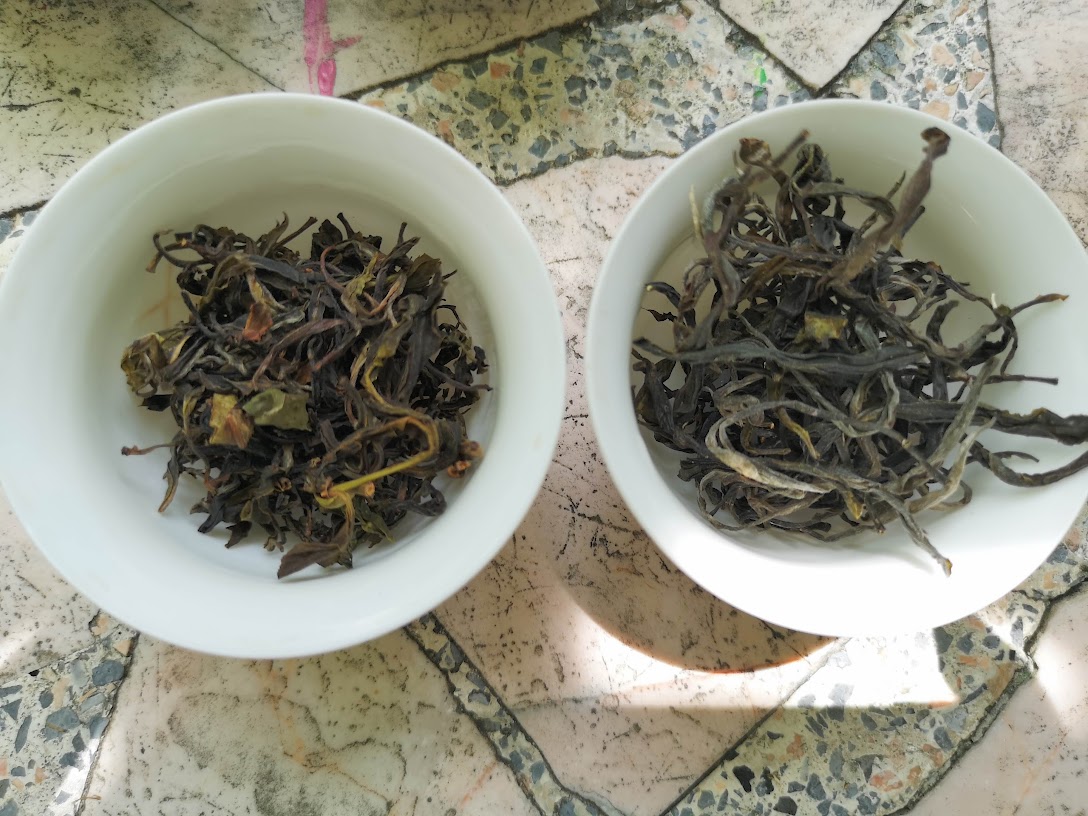
Vietnamese tea left, Taiwanese right, in all photos


I'm comparison reviewing Vietnamese and Taiwanese white teas, a Lai Chau Deep Forest White, from 2024, from Viet Sun, and a Lishan Taiwanese White, from 2022, from Tea Mania.

After getting a bit bogged down in describing how medium level aging concerns work out for sheng pu'er in a last post I want to keep this simple.  It will be about what I think of the experienced aspects, not about aging, trueness to type, regional background differences, or anything else beyond what is in the cups.  One of these is two years old, and one is from this year, and I won't really speculate on whatever difference that might have made.

There's some risk I'll like one more than the other, then maybe I'll complicate this talking about varying preferences for aspects, but I don't want to take that sort of theme very far either.  Writing a simple review would be nice.  As usual vendor page citations say what they are:


Lai Châu Deep Forest White Spring 2024  ($29 per 100 grams)


A beautiful and unique tea from ancient non-Sinensis varietal tea trees growing wild at altitudes of 2200-2500m in Phong Thổ, Lai Châu. The people living and making tea in this area are of the Dao ethnicity.

The raw leaves used to make this tea take on shades of red, purple and green with a glossy look and every tree produces leaves with a different appearance. You can also find leaves that look different on individual trees. Picking the leaves to make this tea requires a long walk into the forest and climbing up very tall tea trees. This is only possible on days with good weather.

This tea brews up into a clear golden soup. The fragrance and flavor is stone fruit fruity and floral with cane sugar, orchid and mountain forest notes. This tea has a lingering “purple effect” common in many wild varietal white teas like this and a strong but relaxing qi. No bitterness or astringency.

I like to brew this one at 90C for the first few steeps and then gradually increase to 100C during later steeps.


Interesting, that this isn't from Camelia Sinensis.  It definitely tastes unique.  For once my flavor description of it is pretty close to Steve's.  Very similar descriptions can relate to slightly different interpretations of the same flavors, but this matches better than usual.  

I don't know about the relaxing qi; I tried it along with another tea.  I suppose it was nice not getting blasted as I do when comparing sheng versions, but that experience is nice in a different sense too.


Lishan White (25 CHF / $29.44 for 50 grams)


This white tea is also an absolute rarity and we were only able to get hold of a few grams. The tea leaves come from Qingxin bushes which grow on the Lishan. The tea has an abundance of pleasant aromas with a floral and full-bodied character. The high altitude results in a much more intense and complex aroma which is normally not found in a white tea.

Harvest: Summer 2022

Taste: Full-bodied and complex

Terroir: Lishan, Taiwan

Preparation: Per serving approx. 2g, temperature approx. 75°C,  time 1 – 2 minutes


There are a few things to unpack there.  I'd brew it hotter; why not?  It really is one of the most unique white teas I've tried, maybe even more novel than this Vietnamese version, although both were absolutely different than any versions I remember trying before.  

60 cents a gram is a bit much, but then this tea probably is a type that barely even exists.  And it's unusually high in quality level, pleasant to experience, and from a high demand production area, where above average oolongs would command a decent price.  That price seems reasonable.


Review:


Lai Chau Deep Forest White:  the dry leaf scent is very deep, rich, sweet, and fruity.  Brewed it doesn't match that dry scent intensity; I may need to go a little longer on the next round.  I did brew these for 20-some seconds, so a bit, but I can push them for 30 to 40, given proportion is a little lower than I usually use.

Sweetness and fruit is evident in this.  It's complex; it tastes a bit like peach or apricot, but there's a lot more going on than that.  It might include grape as well, but not the modern grocery store grape range, more like the older Concord type used to make juice in the past.  Or I think that was a broad type range; I'm not completely caught up on types of grapes.  Mineral range includes a touch of savory quality, and significant sweetness makes it all balance well.


Lishan White:  I was concerned this might just be too subtle to hold its own but the opposite occurred instead; there's a strong spice range in this that's more intense than all of the character of the other.  It includes cinnamon, but it may extend beyond cinnamon.  Sweetness is pleasant; that works.  Beyond that there is other range but it's hard to identify at this stage, maybe a few minor supporting themes.  I'll push both a little harder and try to add more breakdown.


Lai Chai #2:  that picks up a lot of warmth and depth.  Flavors are so complex that it's hard to get it to separate out as a list of impressions.  There's a lot of fruit, all mixing together as one theme.  Again one part is in between peach and apricot, and grape doesn't stand out as much, but a hint of citrus does.  Warm tones are along the line of dry autumn leaf.  Sweetness is good, and feel is rich enough that it adds to the experience of overall complexity.  It would be a shame to swap out those brighter tones by aging this but it has enough depth already that it might work well to; that might increase further.

It's strange how when I try a little later, after tasting the other, when it's quite cool, the grape flavor comes back.  It tastes like grape bubblegum, more than actual grapes, like the old Hubba-Bubba version, or something such.


Lishan:  it's crazy tasting this much spice in a white tea.  This could actually include some cinnamon (it doesn't; I mean the impression is that clear and strong).  Feel might be even a little richer and fuller than for the other version, kind of velvety.  Sweetness level is comparable for the two, high enough to add to overall complexity, and a good level to support the balance.

It's strange how complex this comes across, even though the set of flavors is kind of bundled within a limited range.  There might be a general floral range beyond the spice, and a touch of fruit.  Warm tones are a main part of the overall balance, that spice range, and some mineral, with floral and fruit brighter.  Then as a secondary supporting input the floral and fruit range is less distinct, but it still plays a pronounced role in the overall impression.  Spice seems to include a hint of fennel seed, other warmer, towards-savory range.  These are some pretty interesting teas.


Lai Chau, #3:  there's a depth to this that's hard to describe.  I probably mean different things by that when I say it about different teas; that probably doesn't help.  There's a good bit of fruit, shifting now to warmer tones, but other deeper warm range really picks up, from the earlier mineral base and autumn leaf aspects.  It gives up some higher end, sweeter and more forward notes related to that shift, but it's pleasant.


Lishan:  this stays more consistent, evolving less.  I suppose there may be a shift to slightly warmer tones, brought on by round transition, and probably going slightly longer on the infusion time, but it's not so different than earlier.  It's interesting how flavor complexity and fullness of feel work together to make this seem complex.  That's true of the other tea version too, but in a different way, and a different sense.  

This includes fullness of feel more like oolong range can express.  There's a bright, sweet floral and mineral oriented note--a flavor set, I guess--that seems to tie it together with local origin oolong flavor range.  The other tea might be more complex, in terms of covering more flavor scope, and other aspect range, but this has a good bit more depth.  Some warmer range fills in complexity, and it comes across as quite refined.

They both brewed a few more pleasant rounds, but I left off taking notes here.


Conclusions:


These are both unusually good.  I kind of didn't expect that, since I didn't read the descriptions before trying them.  The Vietnamese version shows that interesting character in dry leaf scent, so much fruit, but the Lishan version doesn't as much.  It's interesting considering how they seem in light of those descriptions.  

The Vietnamese version does seem novel enough that it makes sense that's it's different plant type, but it doesn't include any of the sourness edge that can come up in those, even purple leaf versions, which I think are just a variant of Assamica.  Purple tea can taste a little like grapes, sometimes.

The Lishan version was really unique, complex, and refined.  White teas can lack flavor complexity and intensity, but these didn't.  Feel structure is often quite limited, but the Lishan version even covered that.  Both expressed so much depth that I didn't necessarily miss the intensity and edge that I usually experience drinking sheng more often.  

Someone could have drank a lot of more standard form Chinese white teas in the past, and like them, and feel that either of these really opened a door on new experience range for them.


Monday, August 12, 2024

Comparing green teas from Vietnam, China, and Japan


This is all a bit much.  A recent comparison of three different sheng versions also was, but to me the results were interesting, and they helped place some general themes that were playing out.  I'm trying something even less narrow and reasonable in range this time, trying three different green teas together.

Why is this a problem?  For one reason because I'm just getting over a flu.  Yesterday was one of few days I skipped drinking tea, and while sick for a few days before that I would sometimes split drinking a version over two days (twice).

For more standard reasons because of the range of styles and aspects.  Of course the Japanese tea (a sencha) is going to cover mostly umami and vegetal flavors, including seaweed, and the other two won't.  Both of the others are "wild origin" green versions, so trying them together would make more sense.  

But I wanted to check on to what extent this broad-scope approach could provide input about the entire range.  Is there more to it about Japanese green differences than just that flavor range?  Does some particular rough edge or off flavors identify a lower quality level for either of the others?  Did a factor like limited oxidation input seem to come up for any?  Probably more than I addressed, actually; this doesn't speculate about that.  Is this a hit or a miss for another ITea World version?  Most of theirs have been pretty decent, but some less so than others.

I'll add information about the teas after tasting, during editing, the usual process.


Viet Sun Lai Châu Deep Forest Green Spring 2024 ($23 for 100 grams)


The tea trees in this area are growing to heights of 10+ meters in the deep forest at 2200m+ in elevation. The rich biodiversity and natural growing conditions really make their way into the cup.

This tea brews up slowly into a rich, clear golden soup. The flavor is unique and complex. Reminds me of forest flower honey, herbs, strawberry or raspberry and wild grasses with a lot of umami. There are some similarities to Japanese green teas.

Just a touch of astringency, no bitterness, thick mouthfeel, rich huigan and relaxing qi... 

Another interesting aspect of this tea is the aging potential. I have tried teas from past years and they get sweeter and richer over time. The honey notes become more prominent as well.


ITea World Chinese Shan Ye Wild Green Tea ($25 for 40 grams)


There is no text description, so this picture will do.  

Related to value this already looks pretty bad for the ITea World product comparison, since I'll jump ahead and say that I liked the Viet Sun version better, and this costs slightly more for 40 grams of it than 100 grams of the Vietnamese version.  It is very novel in style, and supply and demand factors can be complicated, but that's a pretty one-sided comparison.  

It expressed one very minor flaw early in rounds, which I'll get around to explaining, and people could see that differently, perhaps as not a flaw at all.  It would be possible to see a limitation in intensity, present in the Viet Sun version, as a significant flaw instead, which I sort of didn't, since it's so easy to correct for that with brewing approach.

That vendor asked me to mention a "summer sale," which normally I don't do, but it seems like a nice balancing point to saying this particular tea isn't worth it.  There are details on their website.  The strength of this vendor has been offering pretty decent sample sets, at good value, with a relatively low free shipping threshold, if I remember right.  I wouldn't buy a lot of any of their teas without exploring them through samples first, but some are pretty good, novel and a good value.  Some basics match conventional styles well, this particular tea just isn't shooting for that.

This is probably a good vendor option for first exploring medium quality teas, or for a gift related to the same purpose.  Later on if someone is seeking out even higher quality, or best of best value, then often two different other kinds of vendors cover those better.  Or Viet Sun and Tea Mania are pretty solid across a broad range; it doesn't have to just be one part of that.


Tea Mania HANDPICKED HONYAMA SENCHA  ($32 for 50 grams)


Honyama (also known as Tamakawa) is considered by connoisseurs of Japanese Sencha teas as one of the top growing areas. In Honyama, where the Abe River springs, are ideal conditions for top quality tea. The nights are clear and cool and the morning misty. The narrow valleys also ensure natural shading of the tea fields. So it is not surprising that the tea leaves in this area are about one month later ready for harvest compared to tea from the low-lying areas near Shizuoka city.

The tea leaves for this handpicked Honyama Sencha where manually harvested by Mr. Shoten’s family. Therefore, the leaves are longer and more intact compared to does harvest by machines. Also, the stems get less damaged as they are picked at the plant’s natural breaking point. Thus, the tea leaves get less oxidized and taste even more refreshing.

It’s said that tea from Honyama was Shogun Tokugawa’s favorite tea. After tasting this tea we strongly believe this lore.


To me a lot of story line in marketing content is often a red flag; I'd rather buy the tea itself than the story.  For sure this is great quality Japanese green tea though, and it would mean a lot more to people on that page than it does to me (the tea quality; the story could go either way).  

People on that page would be better at brewing them than I am too; I really botched that in this tasting.  I got some sense of the tea but didn't experience it in optimum form.  Doing a lot of things at one time can be tricky, and I was already hazy as could be for only being most of the way recovered from a flu.

This cost $64 for 100 grams instead of $23 for the Viet Sun version; is it that much better?  That's kind of not even the right question, I don't think.  It's a completely different style of tea.  I wouldn't be the one to know but at a guess this is still probably pretty decent value, because it's not an ordinary range green tea version, it's a distinctive, good quality Japanese green tea.  I don't really love that but I get it; it's an in-demand style range.


Review:


Viet Sun Lai Chau Deep Forest Green, 2024:  it's interesting how some of the flavor range is still evolving and some stands out so much right away.  There's plenty of umami in this; that won't be a complete difference.  I'm a little concerned that the lack of sweetness and missing part of a normal flavor profile may relate to my palate.  These findings will be of limited value if I'm missing part of a sense of taste, which really could be the case.  I stopped being quite sick a few days ago but this illness just won't end.


ITea World Shan Ye Wild Green Tea:  vegetal range is so strong in this, maybe mostly centered on green beans, but also including a green vegetable range along the line of kale.  It wouldn't be surprising if this is a close match for a leafy vegetable I'm not familiar with.  From there a really strong mineral layer stands out, so strong that it might extend to taste a little like tobacco, or even a hint of ash.  It's not positive.  

The darker color leaf and liquid suggests this may have oxidized a little, but who knows.  It definitely includes quite a bit of bud content, the only version of the three to do so.  I'll need to keep brewing times limited for this to be approachable.


Tea Mania Honyama Sencha (Yabukita plant type):  that's too strong to drink.  All three were brewed for the same time, with one light, one a bit strong, and this one undrinkable.  Apparently there's a learning curve for Japanese green tea I need to go back through; it's been a number of years.  I can try to dilute it a little to get a sense of it but essentially it's better luck next round.  I used half as much leaf for this version as the other two, by appearance, recognizing that it would be a lot more dense, but I missed getting that right by a lot.

Even diluted there's not much to add; it's promising, but not ok to drink in this form.  This probably won't stand up to brewing using water this hot either, which is far too hot for normal green tea, unless someone is on the page of brewing them around 90 C or so.  I'll drop the temperature for all three, and will stick with flash infusions for this.

Using hot water can be ok for some green tea types (not full boiling point, maybe, but not so far off that); it just depends.  Preference factors in too, but also some won't extract objectionable range compounds and aspects all that fast, so you can carry on using fast infusion times to limit that.  Typically Japanese green teas aren't regarded as suitable for this approach.  Peter of Tea Mania sent two versions of sencha, or maybe the other was "white sencha," whatever that would be; maybe I'll get back to trying this again with approach dialed in.  After botching it a few more rounds here though, even after adjustments.


Viet Sun #2:  not intense enough; this needed to brew longer.  It's odd that the other two are way too strong, with the sencha at what looks to be a higher proportion, then this is still too light.  I'll do more of a flavor list next round.  What comes across is pleasant; light floral range, decent sweetness, no overpowering umami, astringency, or pronounced vegetal range.


ITea World Shan Ye:  that one mineral note leans more towards ash; that's a little off-putting.  The rest is nice, pleasant and interesting.  These are a bit light to base a developed opinion on but without that one note they seem kind of equivalent, and with it considered the Vietnamese tea is better.


Tea Mania sencha:  drinkable; at least it's that close to optimally brewed.  There's the intense, pronounced umami that people seek out.  It tastes like seaweed, with some floral range entering in beyond that.  I think this is a range of tea that you have to acclimate to like, or it would be like that for most.  I've drank some sencha, some hundreds of grams worth, but nothing like most of the rest of the tea types I prefer more, kgs of pu'er, oolong of different types, and black teas.

The things people would center in on as most desirable in this style and type range wouldn't be completely familiar to me; I'd be guessing.  Of course pronounced umami is part of that, and other flavor complexity, aftertaste experience, mineral layer input, and so on.  But I mean that often very limited parts of an aspect set can work as quality markers, as identifiers between good and very good versions, with typical flaws as the opposite side of those considerations.  

When I scan through sencha reviews in a place My Japanese Green Tea blog I can't help but think "what's all this, brother?"  Or at least that's it framed within one of Keoni's favorite meme forms.


Vietnamese #3:  it was extra messing around but I brewed this using much hotter water than the other two.  Not for too long, but enough that it seemed it would extract well.  This is pleasant but still subtle.  That's interesting; for other tea types that could come up, and could be normal, but a subtle version of green tea is odd.  I had tried the 2023 version and don't remember that as part of the experience.

The aspects that are there are quite positive; this is my favorite of the three.  You would just need to push this a little harder to get intensity back into a normal range, using slightly hotter water, or longer infusion time.  Aspect set would vary depending on which approach you took.  Again there is some floral range to this, and limited vegetal scope, but I suppose some.  It's near a neutral sugar-snap pea input, versus green beans or seaweed, much heavier and more dominant range.  Sweetness is pretty good, and tone is light.  I don't mean intensity, I mean brightness versus warmth of flavors; it's "bright."  

If I just liked green tea more I'd really like this more.  As it is I could still drink a good bit of it.


Chinese Shan Ye:  I never will have any idea why there's an ashy sort of limited intensity edge to this.  It also includes a malty sort of character; that part is nice, and unique.  Tone is much warmer than for the first.  Feel is thicker; there's more to it on that one level.  Floral range is less bright and sweet than for the Vietnamese version, I guess in a wildflower sort of range, but possibly more complex, with more happening along that line.  Vegetal range is more towards cured hay, tying in with or just being an alternative interpretation of what I've described as malty (Ovaltine malty, not like Assam).

With the absolute slightest change of that one flavor note not being present this would come across much differently.  It's barely perceptible now anyway, having faded over the rounds, but at least related to how I see teas there are some flavor inputs that can disproportionately shift a general impression.  A hint of cacao or cherry in a black tea can change everything, and a touch of tartness can cause an opposite less favorable impression.  In green teas a little extra kale flavor can really throw things off, and a bright floral note can shift it all the other way.  That smoke could be ok if it wasn't as close to ash range.  It's all but gone anyway in this round, and should be clear in the next.


Sencha:  it's interesting trying a much stronger tea in this version.  This proportion is wrong; this should be made from half as much leaf.  But it's brewed fast using quite cool water, so it's still not optimum but it's fine.  Everything it expresses is intense:  umami, some seaweed, floral range, sweetness, and now an increased mineral layer.  As a sheng drinker I should see that as somewhat positive; why shouldn't it be intense?  And I do, but the umami takes some getting used to.  

20 years ago I really couldn't relate to seaweed much at all (beyond eating a good bit of sushi eons ago, but I'll leave that part out), and gradually over the years it just kept coming up living in Bangkok.  My wife ate mostly Japanese food when pregnant with Keoni, 16 years ago.  She said the he was "ordering it," essentially.  That was right after spending two years in Hawaii, and people love it there too.  

But half the time I have ramen I hand over the pressed square of it to Kalani, who loves it, even though that form is mild and pleasant.  This is a level more intense, for seaweed related flavor input, but it's still ok.  I suppose it's still odd to me that people choose to have this experience, that they pay extra for it being so pronounced.  Then again the sheng pu'er I drink often tastes like taking an aspirin, and that took me a half dozen years of routine exposure to prefer.


Viet Sun Vietnamese #4:  this should be enough notes, and plenty of tea.  I've thrown out the last of most rounds, to keep this manageable, but I've also drank most of 9 small cups of tea so far.  

Bright floral, good sweetness, limited and pleasant vegetal range, again like sugar snap pea.  There's probably more going on with this related to round-to-round transition that I'm missing; brewing approach has been a little rough.  Feel could be thicker and richer but it's fine like this to me; there's no need for all the parts to be intense.  Someone looking for "quality markers" might see it as falling short but to me the balance works.  Intensity is a little limited, but it's easy to adjust brewing to dial that up.  Not much comes across as a flaw in this, to me, although again limited intensity could be seen that way.  And it's distinctive enough, even if the other two are more novel, looked at one way.  It's my favorite of the three.


ITea World Shan Ye:  that warm rich tone comes across more like toasted rice than cured hay or malt, this round.  That's familiar ground, closer to Longjing style.  If all the earlier infusions had been more similar to this one, varying some but not so different, this would've been better.  Again it's probably possible to dial in more optimum results by tweaking brewing.  For good Longjing you don't need to do that, of course; you can brew it at full boiling point, or much cooler, and not letting it get too strong is about the only limitation to work around.  

That one minor aspect really threw off the first few rounds, for me.  This is still pretty good though, and brewed Western style after a quick rinse it may have been much better.


Tea Mania sencha:  as described in the last two rounds again.  Even though Longjing is my favorite green tea type, and I've just described the Shan Ye version of settling near that typical character, I can still see the appeal in this.  It's clearly better tea, in a few senses.  It's more intense and complex, and a bit sweeter, with no significant flaws.  Even the strong umami and seaweed flavor I don't hate.  I suppose floral range has drawn closer to seaweed, so now it balances both.  If you aren't accustomed to that flavor then even at a lower level it really stands out.  I've eaten ramen with seaweed a few times in the past month, mostly going off miso soup lately, but I definitely don't seek out that range of experience (the seaweed part).

It's odd drinking and reviewing a sencha and going on and on about placing umami and seaweed flavor.  Surely most people know what they're getting into, and are there for that.

This is probably complete heresy but to me sencha works better with food than drank alone.  That reminds me of a critique of a whiskey version saying that's it's ok but it's better mixed with Coke.  Surely the quality level is so good in this version that plenty of people would appreciate it in a completely different way than I can.


Conclusions:


To me really late rounds transitions aren't much of the main story but a couple were interesting.  The ITea World tea tasted a good bit like fennel seed in the last couple of rounds, beyond those.  The sencha picked up an unusual vegetal character, which reminded me of the taste when you bite a watermelon seed.  Then the Viet Sun tea stayed pretty much the same.

I'm not sure how well that post worked related to judging teas across the main criteria I often use:  related to writing out an aspects set, in comparison with my own personal preference, as being true to type for a known version, or placed in relation to some objective quality level.  

The Vietnamese tea represented a standard, general wild-origin green tea type well enough, but there isn't a narrow character range expectation for that.  The Japanese green tea was probably the only one that could be judged against pre-determined type expectations, but I don't have the proper background to dial that in to finer level comparison.  It seemed really good quality to me, but then I don't love sencha.

The Chinese green tea was perhaps the most novel, and it was one very minor flaw away from being much better than I judged it to be.  If it had only had a hint of smoke included instead of what came across as a touch of ash flavor.  I suspect plenty of local producer teas can pick up just a little smoke flavor from incidental contact in being around the processing environment, where fire is used for heating.  It had been a lot more common for sheng pu'er versions in the past.  I have no idea why that inclusion took an unconventional form this time.


It's always interesting reviewing green teas, as my least favorite main category version.  I don't like any of these quite as much as Hinyang Maojian and Himjian versions I tried not so long ago; those were something else.  But then I wouldn't buy those to drink either, pretty much no matter what they cost.  Somehow I crave some good Longjing once in awhile and that's about it.


On a personal note suffering is what I've been up to, with that flu not the worst of it.  I wasn't on this flight; the rest of my family is back in Honolulu again.  I'll visit before too long, and until then some cats and I hold down the fort in Bangkok.

Eye, my wife, had a uniquely rough week.  She went through a flu too, and an injury related to slipping and falling that last week (hence the extra equipment).  She's tough as nails though; she was more concerned about the kids playing too many video games than the beating life had put on her just then.


Saturday, July 13, 2024

Trying wild origin tea versions, white and oolong (Wuyi Yancha style)


I'm trying two more wild origin teas from ITea World, probably the last of that set I'll get to.  There is a green version but that's my least favorite kind, and reviewing it tends to boiling down to mentioning a few aspects, beyond some vague talking around quality level.

That tea was from this set:

Chinese Wild Tea Sampler: 5 Flavors for $5 with Free Shipping


That's it, not much at all for 25 grams of interesting tea.  Their marketing oriented descriptions:

Wild White Tea:  Plucked wild in Fuding, our Bai Mu Dan white tea features downy silver needles releasing a dewy floral bouquet mingled with sun-ripened fruits and meadow sweetness. Each sip delivers a mellow, soothing creaminess.


Wild Oolong Tea:  Hailing from a Wuyi Mountain tea family, our artisan has over 15 years of expertise in handcrafting traditional-style Wuyi Rock Tea and black tea, having learned the art from a young age by apprenticing with family members.


They seem a bit like that, with less to go on there about what the oolong is like.


Looking around that site the white tea lists for $20-some for 40 grams, and the oolong is around $30 for 40 grams (I'm seeing pricing in Thai baht, initially, so the pricing listing isn't exact).  $25 and 30 it is, switching that over.  I never do really evaluate value later in this post, since that gets speculative anyway, trying to fold together issues related to demand per type, quality level, novelty, and then likely final preference.  

Pricing over 50 cents a gram is getting up there, but for some specialty tea range that's still normal.  I tend to try to buy teas that are more like 20 to 30 cents a gram, or less, but then I also buy relatively directly from producers.  I usually drink sheng pu'er or black tea, with some better oolong and rarer white tea range running a little higher in cost.  

I guess the pricing is probably ok, but more direct comparison with similar versions would tell more of that story.  Then when you are considering novel wild-origin teas it can be harder to find similar products, of any kind or at any price level.


Review:


white, #1:  that's nice.  It's smooth, sweet, rich, and distinctive.  An unusual and pleasant flavor profile may be the story of this tea.  It seems to include a bit of mint, and then warmer depth offsets that, giving it complexity.  The mint is like wintergreen mint, or at least the artificial flavor represented as that, very mild in comparison with something like peppermint.  One part is vegetal, a little like fennel.  It might be easier to break down the rest next round.


oolong:  that's catchy too.  I'm not noticing a distinct familiar Wuyi Yancha style this fits into, which is probably just as well.  The warm tones and good balance seems to relate to this being a bit more oxidized and roasted than a modern lighter style that I'm more familiar with.  When it all works this other range can be even nicer.  Of course mineral tones are part of it, as a base for the rest.  From there it's complex, but hard to really break down.  One part may be closest to warm spice, and another range like dark wood.  Sweetness might tie to something like toffee.


white, #2:  the fennel part picked up most, which works.  It shifts to warmer tones, off fresh fennel into fennel seed range a bit.  It's harder to notice a mint background note but it still seems to be there.  Complexity seems pretty good; it's hard to communicate how that works based only on a couple of flavor descriptions.  Part of a warmer base also seems to relate to autumn leaf range.  To me that can be expressed differently, as dry, light, sweet tones or instead as wetter, heavier range, relating to fresh dry leaves or wet versions.  This is the first case, dry, light, and sweet, and also complex.


oolong #2:  this warms and deepens.  It includes that one peach-like note that can be distinctive in Dan Cong; interesting seeing that stand out this much in a Wuyi Yancha version.  I suppose interpreted differently it's just floral, but to me clearly peach.  It's so pronounced that at this round it seems like a pretty good Dan Cong version, which is not a bad range to fall into.  

It lacks the rough edge that often adjoins those, the harsh astringency, but in my experience that seems to tie to quality level in Dan Cong, and to some extent probably also to growing elevation.  Most likely the connection is a bit incidental, and cheaper higher volume production, low elevation farmed Dan Cong is not processed quite as well, with plants stressed with fertilizer input to get the most out of them, and higher elevation sources are harvest less, and allowed to grow more naturally.  All just guesses, of course.

The sweetness carries over as a pleasant aftertaste.  It could extend a little longer; as a quality level marker--if taken that way--this suggests that this is upper medium quality range, with room for improvement.


white, #3:  creaminess picks up; that's an interesting shift.  I hadn't even mentioned it before; I suppose that it had factored in.  Trying this a little lighter probably shifts what comes across.  I suppose it's worth noting again that I write all this before I see any vendor description; it's interesting that creaminess is mentioned by them and also stands out.

It still works to describe this as like fennel with a hint of mint, with warmer but sweet complexity along the line of autumn leaf.  It's transitioning though; within a round or two a different description will probably work better.


oolong:  still pretty close to a Mi Lan Xiang Dan Cong that happens to taste a lot like peach, with some supporting floral range and warm tones.  It's fairly clean too, with good sweetness; all the other aspects indicate this is a little better than just "upper medium quality level."  Maybe not some elevated "best of the best range," but then it's not even matching a standard type that its origin relates to anyway.

This reminds me of one of Cindy's Wuyishan origin teas, from Wuyi Origin, tasting a lot like peach one year, when it normally might've included that but certainly didn't typically include such a pronounced aspect.  Terroir inputs can vary some year to year, and of course by narrow location.  

I looked at the vendor page for more description, since there wasn't much flavor breakdown in that initial sampler-summary version:


...tea exhibits a rich floral and fruity aroma that infuses the water. Upon sipping, the floral and fruity notes rise, filling the nose with their fragrance.The flavor is robust and refreshing, with a pronounced sweetness that stimulates the salivary glands and leaves a clear, crisp aftertaste. The enduring sweetness provides a lingering, delightful aftertaste that is truly memorable.


Heavy on marketing spin but that actually kind of works.  They might've mentioned peach.


white, #4:  there is another shift; that creaminess has edged towards creamsicle, which I guess relates to citrus picking up a little.  This will probably eventually transition to warmer tones, or at least heavier vegetal range, but I'll probably leave off taking notes here.  8 infusions is a lot for my patience, and the short quiet window on a Saturday morning for tasting will end before too long.  

This tea exceeded my expectations; I expected some positive character from it, but it's normal for a lot of white tea range to come across as much thinner, and more limited, not as complex or intense.  Beyond including that the flavor set is interesting, integrated, and positive.  I've not mentioned much for feel structure but it's not thin either.  Aftertaste expression is there but limited, which I don't see as that much of a limitation; it can vary in different tea versions.


oolong:  not that much transition, maybe just a slight shift in earlier aspects balance.  Dominant warm peach flavor works especially well for me, so that's fine.  

This is definitely a tea that a Dan Cong lover could appreciate, even they had adjusted to expect higher quality range.  Feel range is pretty good; it could be a little thicker, but it's fine.  Aftertaste is positive; it trails on afterwards nicely.  Complexity is good; warm toffee range fills in depth beyond the peach and supporting floral range.  

There's not that much mineral base, as lots of Wuyi Yancha oolongs go; I suppose that could be interpreted as a limitation.  Really it not being fully type-typical is either a main weakness or else a good thing, since the range expressed is so nice.  Someone splitting hairs could say that the feel structure not being full enough is a limitation, since it's not well-balanced by that input, but to me that's not really even a flaw in this, never mind a significant one.  It's quite good, and the "wild origin" description leads me to expect something a little off the standard range.  More natural growing conditions can often lend to novel flavor inputs entering in, as has occurred with both these teas.


These seem particularly well made.  Starting with good material is one thing, but teas need to be processed skillfully to bring out a well-balanced character.  There's a synchronicity that comes with all of it coming together in an amazing way, how the best of the best standard versions come across, and I'm not saying that these are there, because they're quite good but not that fantastic.  There are essentially no flaws to point out in either though, just a limitation here or there, an aspect range that could be dialed up a little.

For the white tea that comes with the general style; it usually doesn't match the complexity, intensity, and full feel and aftertaste expression of many other tea types.  For that tea it being so positive, complex, novel, and pleasant to experience is enough.  

The Wuyi Yancha could pass for pretty good Mi Lan Xiang Dan Cong, even with oxidation and roast level appropriate for that, better than most tend to be, which to me is generally a good thing, just maybe a little unusual related to the trueness to type theme.


Not from this tasting, instead from drinking some random sheng pu'er yesterday, I wanted to mention something relating to this teaware.  You don't need to spend much to use functional, pleasant teaware.  I buy these 100 ml, plain, white gaiwans in a Chinatown shop, selling there for around $3, but $10 might be more typical from other sources.  These cups I buy at a Japanese ceramics outlet shop, for around $1 each.  It's like the Ross Dress for Less theme, I think; they sell extra versions from large batch local production.

Then I use two so that I can pour the tea from one to the other to cool it.  I tend to use an extra to re-hydrate some goji berries every morning, eating those as a supplement.  I think it's a good source of beta carotene, what vitamin A is derived from, and supposedly it contains anti-aging related compounds.  I'm not really endorsing that, just explaining why my daily tea setup uses three cups.


Sunday, June 30, 2024

Vietnamese Ha Giang black tea and Tua Chua sheng


This is kind of an unusual tasting theme; Steve from Viet Sun sent some extra samples with my last order and wrote sheng instead of black tea on the Ha Giang version, so I'm comparison tasting across tea types.  I can taste two completely different teas together; it still works.

It can be interesting tasting contrasting teas, to see how it goes, and this makes more sense than it seems in retrospect, related to these teas' styles.  A flavor description or two will drop out doing that, for trying to cover diverse tasting range, and there is no comparison baseline for finer effects, eg. noticing that one has a thicker feel or more aftertaste expression.


Hà Giang Black Spring 2024  ($20 for 100 grams)


This tea was produced from old and ancient trees growing at 1200-1300m in elevation in the Cao Bồ commune area of Hà Giang.

Cao Bồ is about an hour and a half drive from Hà Giang city.

This is a tippy tea harvested with a 1 bud-1-2 leaves standard so you can expect a highly fragrant brew. 

A cocoa and warming spice, honey fragrance emerges after the first rinse. Complex warming spice, honey, malty cocoa flavor with nice minerality. Rich mouthfeel and lingering sweetness in the throat. Nice clear headed and energizing qi effect with a rich, lingering effect in the mouth and throat.


Tủa Chùa Spring 2024  ($53 for 190 gram cake)


A tea from the most sought after gardens in the most sought after tea area in Vietnam, Tủa Chùa in Điện Biên province. This area can be difficult to source tea from due to the high local and international demand but we were lucky enough to get a bit.

This area has some of the biggest tea trees in Vietnam and many are allowed to grow tall. This area is close to Laos and has a different climate than many other tea areas in Vietnam giving teas from here a unique profile. The weather here in spring is typically hot, dry and sunny and this year especially so. It only rained for a couple of days during March and April and the tea output was reduced drastically compared to previous years. This dry weather resulted in a drop in the amount of harvestable leaves but an increase in strength.

This area is known for its signature orchid/ citrus flower fragrance with a citrus, deep forest almost tobacco range of flavor. This tea brews up quickly into a rich golden brew. This tea is very high intensity in every aspect. Medium bitterness and astringency with heavy sweetness. Expect a strong qi and a rich floral huigan that will start to build after a few cups.


Steve had mentioned that tea from this area was especially well-regarded, as this mentions.


Review:


Ha Giang black tea:  flavor includes plenty of cacao initially; that's nice.  It seems there are significant fruit tones too, which will probably develop further, or I suppose could transition away as other aspects enter in.  This early I can't compare it from memory to the other I recently reviewed.  For once I really have used a lower proportion to make getting through 5 or 6 rounds possible (5 or 6 grams instead of 9, maybe); I'll need to brew both for a bit longer next round to compensate, for 20 seconds or more instead of 10 to 15.


Tua Chua:  this does express a good bit of floral range right away.  Another part reminds me of melon.  Bitterness has yet to get started; the whole effect should shift by next round, as intensity really ramps up.


Ha Giang black 2:  malt picked up quite a bit.  I often make a distinction between the dryer, mineral intensive malt found in Assam and the typically sweeter, milder, richer malt tone in malted milk balls, or in some Chinese teas.  This includes both.  Cacao is also pronounced, and an underlying fruit tone comes across, harder to identify now for malt standing out more.  Feel structure is full but not at all rough or challenging.  Aftertaste experience enters in after you swallow.  

For someone seeking out a complex, rich, and mellow black tea this is perfect, a little milder in tone than the 2023 Lao Cai I've been drinking.  Per my personal preference the 2024 Lao Cai is just amazing; it has a bit more astringency edge but complexity and intensity really stand out.  For anyone really into black teas the final choice might be clear enough; buy both.  100 grams isn't that much, so it might be back to decision mode about which to buy 250 grams of instead.


Tua Chua:  really intense floral range enters in; this is perfume-like.  No need to worry about it being too subtle, having problems with intensity standing out in comparison with a flavorful black tea.  For anyone into isolating and describing floral range I'm sure this flavor profile would make for a list, for 3 or more individual aspects.  For me it will have to stand at "complex and intense floral range."

Feel is relatively soft and full, and bitterness is present but limited.  This has good intensity but not that sheng edge, the challenging forms of those.  It is one of the most floral intensive tea experiences I've ever had though, for sure.


Ha Giang #3:  not transitioning so much.  The fruit seems to be emerging more, along the line of dried dark cherry.  It's also a little like the bael fruit tisane that's popular in Thailand, which would be familiar to less people.  Feel structure is still rich and full, but lacking much of an astringency edge.  To me that's as good a thing as it is neutral, but I suppose for drinking this with some foods it could come across a little light.  Cacao is still nice in this, like a bit of dark chocolate edge.


Tua Chua:  intense floral range, again.  Bitterness expression picks up brewing this a little stronger, lending it more of an expected balance for sheng experience.  It's on the opposite side of average bitterness, very light.  For someone who isn't a sheng drinker that would probably still seem moderate, in comparison with oolongs typically including essentially none of that, but in comparison with most young sheng it's hardly there at all.  

This would surely be a great place for people not yet fully adapted to sheng to get started.  The rest of the range would never seem all that sweet or floral in comparison, so it might relate to setting a problematic form of baseline, but it's definitely approachable.  I was going to say all this related to another Vietnamese sheng I've been drinking, but I'll return to that theme in another post.


Ha Giang 4:  for all the more these are transitioning I think I'll end note taking here.  Warm tones pick up.  It's divided between a warm mineral range and other scope that could be harder to place, like a faint edge of coffee, or slight roast input.  It's odd that held off until round 4 to show up.  I brewed this a little long; it seems likely that pushing this tea would change the effect and aspect character, as just happened.  Later round infusions can be different for the earlier flavors dropping out, and a different set entering as you brew teas longer; I suppose that's part of what it is.  

It's no less pleasant, just different.  Brewed stronger to draw out more of that this might work better with food, standing up to a rich breakfast food like a chocolate croissant.


Tua Chua:  sweet, rich, complex, and very floral, kind of the same.  That floral range is so broad that it could be seeming to be extended by tones that are actually fruity instead.  It might taste a little like dried longan.  A warm depth to this also adds to the experience of complexity, rich flavor like a butter cookie.  

I suppose for match to preference it's down to how much one appreciates that range, and relates to the lack of bitterness and astringency edge, here replaced by a depth and fullness.  People more into oolong might love this more than many sheng drinkers, who can actually like that intense bitterness that can define a tea experience positively, in some cases, for some people.  I like softer and flavorful teas, even though through an extensive degree of acclimation I can appreciate a broad range of sheng.  

Sometimes I'll even crave drinking some 10 or 12 year old Xiaguan tuo tea, a full 15 years before it's relatively age-transitioned, and ready to drink per a more conventional preference, which can be a little rough.  That aging transition speed is only true for storage in very hot and humid conditions; in more moderate input storage 30 years would be more appropriate for that general style.


Both of these teas were very nice.  It's kind of nice drinking teas that I really like without being blown away or challenged by placing them.  These are what they are; rich, sweet, complex, and not edgy or challenging at all.  There are no flaws to unpack, and not all that much for limitations, beyond aspects that aren't present, normal astringency range for both types.  

Both brewed a few more really nice rounds, even though I was pushing the leaf harder than usual using longer timing to compensate for a lower proportion.  Neither expressed any remotely negative aspect range through the whole transition cycle.  They're solid.


A family photo sending off a visiting aunt at the airport.  I hate airports and goodbyes, but it's a nice picture of everyone.


Friday, June 28, 2024

Lao Cai Vietnamese and Nanning Chinese wild origin black teas


Vietnamese tea left, in all photos


I'm reviewing the second wild material tea from ITea World in comparison with a version from Viet Sun.  Citing their descriptions will fill in more about that origin, but it is whatever it is.

It's a challenging context for the Chinese tea version, because the 2023 Lao Cai version has been one of my favorite teas.  It's complex, well-balanced, intense, and positive across flavor and other aspects.  A wild origin material hei cha from ITea World was pleasant but atypical in hei cha style, like a smoked version of Liu Bao, sort of.


Chinese Wild Black Tea  ($25 for 40 grams)


Indulge in our Chinese Wild Black Tea. Using a non-smoked Zheng Shan Xiao Zhong process, this tea boasts a rich floral aroma and a thick, smooth taste. It leaves a refreshing sensation under the tongue and a clear, lingering throat note. The aftertaste is deep and lasting, with a prolonged sweetness that brings joy


At 60 cents a gram that pricing is a little aggressive but that's how it can go with rare and desirable forms of tea.  There probably isn't any easy way to buy something similar, or maybe there are no close alternatives at all.


Lào Cai Black Spring 2024  ($19 for 100 grams)


A buddy hồng trà from medium, old and ancient trees growing at 1200-1500m in Y Tý, Lào Cai.

A fruity, honey cacao fragrance emerges upon first infusion. This tea brews up quickly into a rich crimson golden soup. The flavors I pick up are fruit jam, chicory, malt, cacao, honey with warming spices. This tea has a chicory dark chocolate bitterness with a rich lingering effect in the throat and an uplifting, focused qi.

Medium oxidation, medium rolling time/ pressure, lower than average air drying temp/ longer drying time. A great option for a morning pick me up or any time when you need a burst of clear headed energy.


At $19 for 100 grams this costs one third the per-unit weight of the other version. (or the ITea World site sells an 80 gram version for $42.50, working out to 54 cents, probably a more fair comparison).  

Again that's not so atypical for more direct from producer sales from Vietnam, versus China or another highest demand origin, like Japan or Taiwan.  If it's identical to the 2023 version that's more than fair, a great value.


Review:


Lao Cai Vietnamese:  pretty similar to the 2023 version.  It's so close that I'm probably not going to be able to do separation justice from memory.  I drank that tea yesterday, so it's not a distant memory, but this is similar.  Berry or dried dark cherry range might be a little stronger; a warm-toned edge might stand out just a little more.  This might include a bit more cacao; it's fairly pronounced.  Astringency effect is different but this is the first round, and that probably will shift some.  

The tea is great; that's the same.  I own a lot of the 2023 version and it's not enough.  I keep giving it away to people I care about, so that they can have the experience too, but I'll try to mostly hold onto it from here.


Daming Mountain, Shanglin County, Nanning wild black tea:  that's really novel, and quite pleasant.  Flavor is pretty intense, warm, sweet, complex, and unusual.  Feel is giving up a lot in terms of fullness, but then again it's early, and I expect feel to shift for both.  This tastes like dried elderberry, or rather as that would taste, if I'd ever had it.  I ate a lot of elderberry pies as a child but never experienced that berry dry, even though since it grew wild locally we could've just kept picking it, and then dried it.  It would've been a shame to not make it all into pies though, so my Mom did.

There is a very faint musty input in this, hard to place that it's so subtle, connecting with warm mineral tone.  From here that could develop, but I'd expect it to drop out instead.  Feel is rich and smooth, just not as structured and full as the other.  

In tasting between the two it includes mineral that ties to feel that's more astringent, causing a slight mouth puckering effect.  That comes across as fullness of feel initially, not remotely as a flaw, but in tasting between the two the effect is that it seems more "rustic," less refined.  But also better, in a few senses, more intense, with more flavor complexity, not just hitting a narrow range of a few flavor inputs.  It will be interesting seeing how both evolve.

Based only on the first round the Vietnamese version takes it, but that's only according to my own preference.  In a way this Chinese version is more novel and more refined, so people might value that more than the additional complexity and intensity.


Lao Cai 2:  that's so good!  This is clearly more complex, layered, and refined than the earlier 2023 version, I think.  I don't feel badly about owning quite a bit of the other instead of this one; they're both similar, and both great.  A brandy-like effect comes across in the flavor profile, tying to the cherry range more than the cacao.  The feel is just wonderful, full, structured, rich, and not rough at all.  It's velvety, not light.  A clean, sweet aftertaste effect carries over.  I can easily recommend that anyone buys as much of this as they feel comfortable deciding on.

It would be possible to interpret this flavor as including tartness, in which case the berry range might seem more like cranberry than dark cherry.  I'm not a fan of tartness in black tea, actually a bit sensitive to that, and it's so moderate (limited) in this I don't interpret it that way.  The feel including a bit of astringency edge I see as normal, positive black tea experience.  Framed in positive terms it represents complex and full structure; framed negatively it's dryness instead.


Nanning:  this filled in as well; flavor complexity filled in what seemed like a thin spot before, and feel structure is richer and fuller.  It's crazy that both these teas are this good.  I thought the 2023 Lao Cai version would be an unfair starting point for comparison for me loving it so much, then this next year's is better, and the Chinese tea holds its own.  

This tastes like Christmas; I can even explain why.  Elderberry has shifted to taste more like teaberry, a flavor that won't ring a bell to many.  It's a mix of berry flavor and mint, which balances really well with a lighter cacao tone than the other includes.  

I suppose that if someone felt that a medium degree of feel structure is needed to balance warm, rich, complex flavors that could still seem like a gap for this version.  Or the opposite could occur in judgement, and the lightness could make this seem more refined.  To me they both work, just in different ways.

It looks like I'm brewing a bit more of the Vietnamese tea, because it expanded more.  The tightly twisted leaves in this version have expanded, but not as much.  I'm not at all concerned that it might be an unfair test of them; there isn't that much difference.


Lao Cai #3:  the same, not changing.  Warm mineral supports rich dried cherry, cacao, and range that could be interpreted as tartness, with a pleasant brandy-like effect setting context.  I see this as more refined than rustic, or maybe those concepts add nothing to practical description.  The feel is great, full and rich, with pleasant structure, but still smooth.  I could drink this tea most of the time and wouldn't tire of it, even though I'm mainly a sheng pu'er drinker.  It would be great drank alone or with food, lots better than necessary for a daily drinker, but it could serve that role well in this style.


Nanning:  not evolving too much; maybe flavor complexity is tying together better, and feel keeps evening out to not include thinness across a feel range that's impossible to describe.  This flavor set is novel and pleasant.  

Maybe the other is more standard, more typical, and that would serve it better as an input one might be open to repeating countless times.  Maybe this one is more novel, and that would come across better as a unique experience, something to savor or share.  Who knows about all that; it would just depend on the subjective impression one gets from either.  

This tea being lighter in feel, to the extent that could be interpreted as a gap, makes it a less suitable pairing with food, but for some that could be regarded as a strength, for it to be a more refined stand-alone experience.  A black tea drinker might miss the extra feel structure but an oolong drinker could prefer this version for being rich and full enough as it is.  Either of these would be pretty flexible about range of potential brewing approaches; they would both be great brewed Western style, and could work out brewed "grandpa style," left in contact with water in a tea bottle.


Lao Cai #4:  last round; I'm off to yet another pressing errand.  Dried dark cherry is stronger than ever in this, supported nicely by cacao.  That could taste like a Christmas theme, couldn't it?  I think this might be a perfect tea to get someone new to better tea started, and also one someone almost the entire way through an experience curve would love.  That's the magic of a range of different black teas, that anyone could appreciate them.  

To put it in perspective that hint of feel structure and dryness isn't completely unlike Assam, but it's at a fraction of the proportion that tends to occur in the best quality versions of those.  Those are malty instead, used in a different sense than one would mean related to describing Ovaltine, or the malt in a milkshake.  It would work to say this tastes like malt too, but to me fruit and cacao stands out more.


Nanning:  it's interesting how flavor intensity, complexity, and fullness of feel structure keep gradually ramping up in this.  It matches the other.  That one especially catchy flavor aspect range people might describe differently.  Here I've pegged it as elderberry, then teaberry, referencing a brandy-like quality, with cacao as a secondary input.  As usual that wouldn't be a universal interpretation; if I tried this a couple of more times I might vary it.  It works as a well-grounded and descriptive initial impression.


Conclusions:


This gets a little strange, because I want to conclude that both are very positive, simply unique in different ways.  Then I preferred the version that costs one third as much as the other, aligning value and my own personal preference with that one.

It is still fair to say that they're simply two different types of tea.  The Chinese version is a bit more refined, subtle and distinctive in a different way, and unique in terms of flavor profile.  It evolved positively across rounds; later in the tasting they were more equivalent.  The Vietnamese tea also has a very positive flavor profile, and higher intensity of flavor, with more intense feel structure and aftertaste, all in a positive range.  For someone really into mild feel and refined flavored black tea they could like the Chinese version better, but to me that feel structure in the Vietnamese version was so moderate that I don't see it as a negative factor at all.

As I mentioned earlier there's often an option to get better value teas from origins outside of the highest demand areas, from places like Vietnam, Thailand, Georgia, Nepal, or even Indonesia.  Then it just depends on the sales channel too.


The ITea World vendor stands out in relation to offering a lot of standard type or more unique and interesting versions as samples or sample sets; potential customers should probably make the most of this option range.  Then if a version introduced through this approach really stands out as a match to preference ordering more volume of it would be a clearly defined option.  For having a tight tea budget I tend to react quite a bit to per-volume sales value, but for many others spending $25 on high quality tea that you can drink a significant number of times would already be acceptable value.


The Viet Sun source is where I've been buying tea for the past couple of years.  For tea enthusiasts there shouldn't be a need to add to that; the meaning should already be clear.  Teas are good, value is good, and the styles are positive, distinctive, and interesting.  

Often new or newish vendors will sell teas at great value for a relatively long initial period, build up following and demand, and then will often suddenly shift that pricing structure, turning over a lot of customers who are attracted by value, but continuing to build on sales volume by marketing to attract others.  Whether or not Viet Sun follows this pattern value is pretty good now, and products are high in quality and distinctive; it's a good time to explore what they sell.  

The only downside is that many people don't buy $100 worth of tea at a time (really!), and their free international shipping threshold is set at $88.  It's a great option for people who are already focused quite a bit on tea experience, but for people just considering expanding out from drinking $15 per tin mass produced teas it may seem like a bit of a step.


Friday, June 21, 2024

Son La and Giang Pang Vietnamese spring 2024 sheng


Reviewing two more very pleasant spring maocha Vietnamese sheng versions, "pu'er-style" teas from Viet Sun.  The last two were very nice, and these might be even better.

Tasting context is a little unusual; I'm trying them at mid-day on a hot Bangkok afternoon.  It must be around 35 C out, or in the upper 90s F.  Heat acclimation is one goal, and also getting out of the house, where my kids are playing video games, and shouting a bit.  I can turn on the room AC in a different part of the house or use outdoor space to get some distance from the noise.


Steve / Viet Sun's descriptions of these:


Sơn La Wild Tree Spring 2024 ($28 per 100 grams)


A very interesting tea from a newly discovered high mountain tea area west of Tà Xùa, Sơn La.

This tea is made from wild growing non-Sinensis varietal trees growing at 2300-2500m. The leaves and stems are bright green with a light purple hue.

The dry leaf has a nutty, raisin, earthy fragrance and brews up slowly into a rich golden soup. This is a gentle tea with a minimal bitterness and no astringency. I get notes of raisins, nuts, green vegetables, tree resin, forest leaves and honey. Long sweet finish and a relaxing qi.

This varietal has thick, hearty leaves so I like to brew a large amount of leaves and do long steeps at 95-100C. I recommend setting aside at least 30 min to fully enjoy this one as it starts off light and usually starts hitting it's stride around the 3rd or 4th steep for me.


Giàng Pằng "1 Big Tree" Spring 24 (had been $31 per 100 grams, now sold out)


A batch made from one really big tree in Lềnh’s father’s garden processed by Steve.

This tea brews up into a rich green golden soup. Heavily floral and vegetal with the characteristic melon/ plum leathery character that is prevalent in good teas from Giàng Pằng. This is a strong tea that goes many rounds with a deep huigan and energizing qi.

This tea performs best over a longer session with many infusions. Set aside 30-60 minutes to fully enjoy this one!


It's strange that Son La version seemed so conventional to me, and not so different than others I've tried.  It's possible that one flavor note in another tea I love also relates to it not being ordinary Assamica.  Often wild and atypical plant material versions have an odd sourness to them, as purple leaf versions can, just across different flavor scope, but what I'm talking about relates to deeper fruit tones instead.

In reading those descriptions I'm sure that I didn't get the most out of them in this tasting related to stopping in the middle.  My wife insisted on doing an errand on short notice, and I only got back to trying them the next day.  Teas don't hold up well here stored at hot and then warm room temperatures overnight; they were ok for drinking a few more rounds, but nothing like the day before.

I have the rest of 100 grams of each to keep drinking, but for others that second version is sold out, understandable since it was just one batch.  It was really lovely too; what Steve calls "the characteristic melon/ plum leathery character that is prevalent in good teas from Giàng Pằng" was just like that, and it was very pleasant.  Both were; readers might want to consider picking up some of the other, and have a look at the tea cakes too.  

And their "Other Category / Uncommon Teas;" I'm not sure what I'll be trying related to which samples Steve sent, or didn't send, but it's worth a look.  And of course their black teas.  Ordinarily I stop well short of explicit marketing but I've ordered teas three times from Steve over the past year or so for a good reason.  It's as well if the word doesn't get out too much, the favorite source gatekeeping theme, but with readership here limited it's fine to talk about it.


Review:


Son La:  bright, fresh, sweet, and complex, even for still opening up.  I gave both a 20+ second infusion time to speed that along but a rinse step seems to work better, I just don't do that.  This flavor profile is familiar, for drinking a lot of Steve's teas.  Honey stands out, and what would most likely be interpreted as floral range, but light fruit also kind of works.  Floral range is hard for me to break down, but fruit might be in between yellow watermelon and lighter citrus.  

There's one deep honey / floral / fruit note that I'm really stuck on now as a personal favorite that's in this, probably a catchy set of flavors, that complement each other.  Bitterness and astringency are very moderate, but then these are just getting started.


Giang Pang:  deeper, warmer flavors; that's interesting.  At first it strikes you as like plum, but then it seems there's more to it than that.  Again non-distinct floral tones could work as a description, but I should probably leave off to the next round to guess a longer set of descriptions.

As a reminder I never read the vendor descriptions before writing the review notes; that plum tone Steve also mentioned does really stand out.


Son La #2:  some limited bitterness and more fullness of feel joined in, right on schedule.  The same set of flavors is present.  This isn't so different than the 2023 Son La cake I just bought another version of, a tea that I've drank a half cake of; not the same, but as I remember with some common ground.  Re-ordering that is a good sign for expression of preference; it's quite good.  This may lean towards that other favorite tea I just ordered in relation to that one flavor set, rich honey, warm floral, and fruit tone that is hard to describe.  It's towards dried apricot, but not quite that.  I suppose if someone was "looking for" some kind of light herbal edge that might be there too, balancing the rest, something light like lemongrass, or holy basil.  

General tone is pretty bright; I guess preference for or against that might determine relation to preference.  I think I'm kind of preference-neutral about that; warmer or lighter and brighter tone ranges can be fine for me.


Giang Pang:  this has more depth; it has filled in some flavor range.  It might be a little more subtle.  Both are fine for sweetness, clean nature, intensity, and complexity though.  It's definitely warmer in tone / flavor range.  Both are pretty sweet, as young sheng goes, or any sheng, really.  Bitterness isn't a main factor for either, maybe just a little more for balance in the other.

Breaking this down to flavor aspects could be tricky.  It includes sweetness, also like honey, and some non-distinct floral tone, and maybe fruit.  Then that's what I said about the other, but they're quite different.  A warmer fruit tone here might resemble dried orange peel, shifting to be more complex than the early plum, and a very light spice range input might be like clove.  I'll brew both stronger and see if that helps with determination.  Often trying infusions quite light works better for that, for some reason, but it's still worth a try.


Son La 3:  not transitioning much.  Richness of feel stands out even more, and mineral edge almost includes a touch of salt.  Those are both positive things, to be clear, at least as I'm taking them.  Feel gains depth and body.  Aftertaste experience is positive, but it could be even more pronounced.  It's odd this isn't more bitter, but then that's also normal for more wild-origin new sheng.  [Later edit:  not so odd at all if it's either not Assamica or a mix of plants including other range; more strange that this is so close to conventional sheng character instead.]


Giang Pang:  greater depth in this stands out, even though that's a subtle higher-level emergent description.  The feel is nice and rich, and aftertaste trails slightly stronger.  Flavors are less intense and complex, and definitely warmer in tone.  

For this being on the subtle side I think a lot of interpretations could work.  One might go on about a mineral input; that's there, and is pronounced.  Warm honey and floral range stand out the most, to me, but interpretation as a dried fruit is possible, not just dried orange peel, but maybe onto something like dried mango.  This does taste like dried mango, now that I think that.  Then I think people more oriented towards spice descriptions might go in different directions with interpretation.  To me it's a touch of clove, but it could seem like other things.


Son La 4:  fruit range might extend a little, along the former lines; I bet that I could describe that differently over a few more infusions.  I'm going to have to go though; my wife is going to have me go to the orthodontist with the kids soon.  It's funny how that mineral shifts form too; that's kind of novel.  Saying it tastes like salt isn't the best description, but there's something novel about what that part contributes.


Giang Pang:  this main fruit tone is evolving too, and the general intensity along with it.  It's still towards dried mango or dried orange peel, but it's somehow shifted in form or balance.  Maybe I can try a few more rounds later in the day and shed more light on these changes.


I didn't get around to trying more rounds until the next day, and as I said teas don't hold up well for that in hot places.  I have tried both again since, and as is typical it has shifted my impression of both.  I think both are a good bit softer in feel and more moderate in intensity than more typical young sheng.  It probably seemed more normal for trying both together.  

Pushing the Son La version a little I could draw out more flavor complexity, towards that raisin range Steve described.  Both are mild enough that it would work to brew them hotter (although using full boiling point water is normal), at a higher proportion, or longer, to see what input shift changes what outcome.  The Giang Pang version expressed even more fruit tones, brewed a bit stronger, some rounds in.  These both might be perfect for people who find sheng too bitter, astringent, and aggressive.


Conclusions


Both are relatively great teas, everything I would've hoped that they would be, even the diversity of character.  It can be hard to remember back but as I recall I like both more than the earlier two I'd reviewed.  

That may not be the most objective conclusion, because this range is what I love most in sheng just now, either bright floral or rich fruit flavors, good complexity and depth, teas being approachable, full in feel, quite sweet, even rich and sweet like honey, and not bitter.  For some not including a typical amount of bitterness, a more standard taste mineral base, and astringency would ruin the effect; fair enough.


I've not mentioned that these were probably oxidized more than is typical, which is a recurring discussion theme in describing a lot of South East Asian sheng.  Maybe they were, maybe not; probably a little.  I get the sense that hot weather tends to make that happen faster, so that even when it's not quite pronounced it's an input.  It would cost versions aging potential, and I'm not sure these would be great in another 15 to 20 years.  

Someone would be crazy to not just drink them, I think.  That cake Huyen gave me in January is down to two sessions worth, a tiny chunk, and I've ordered more from that producer.  The 2023 Son La cake I bought from Steve is half gone, and it would be all but drank if I hadn't left it behind during those three months in Honolulu.  I re-ordered it anyway; I'll finish it this year.  

All of these cakes could pick up depth and even more sweetness over a year or two, so it's not as if the clock is ticking, but I doubt keeping them around for 3 or 4 years would be the best idea.  Or maybe it would be, but I might never find that out.


Running related tangent


That heat acclimation seemed to help a lot with running later that day; on my second run back here in the Bangkok heat it was comfortable enough to run 10 km (6 1/2 miles in freedom units).  My energy level was great, with no aches and pains, and breathing nice and slow.  Even with apparent heat stress showing up in my heart rate it wasn't uncomfortable at all:


I've never experienced any plateau of running at 160 bpm heart rate, and that felt normal.  I suspect it became normal during hill climbs in Honolulu, going uphill around Diamondhead, but I wasn't monitoring heart rate then.  Oddly that rate dropped sharply when I slowed the pace, but then my splits stayed relatively the same, bumping from 6:30 to 6:45:


Not really my normal pace, which is more like 6:20 / km, or lower for a flat course run, but for running in low-30s C / over 90 F that's fine.

The strange part is that I ran almost as fast a pace at a 160 bpm heart rate as later at 125-130, slowing just a little.  In Honolulu I would really be able to relax and run smoother and faster at around 7-8 km, out and back the Ala Wai canal, but even so this seemed extreme.  I thought the device might be having problems sensing input through sweat, but it seemed certain of the consistent results.


ice skating with the kids; that makes more sense here