Sunday, July 6, 2025

Legend of Tea (Malaysia vendor) Wuyi Yancha; Tie Luo Han and Shi Ru Xiang


This source seems especially interesting to me for breaking new ground, related to what I've experienced.  

There are some good tea shops and online sources in Thailand, but in general that's limited.  Related to Malaysia, our neighbor to the south, I'm much less familiar.  The tea tradition is definitely more developed there, with closer ties to Chinese culture retaining that interest.  Malaysia is known for storage conditions, for a place to age sheng pu'er in hot and humid environment.  An online friend there, an older Chinese guy, drinks Liu Bao, which seems to be popular.  Beyond that there must be lots of local themes and preferences I'm not clear on.

I've talked to people in Malaysia before, and joined at least one online meetup centered on that regional theme.  But it never became as clear to me as the tea landscape in places like Thailand, Vietnam, and Laos, or even Myanmar.

Of course the potential for developed, high quality sourcing that also relates to low cost sales is interesting.  Maybe that's only an unrealistic dream; these teas sell for near Western rates back in China, so the highest quality, highest demand versions aren't traveling somewhere else to be sold for less than in the domestic market.  More moderate quality, limited demand, local style teas probably can be bought for relatively little back in China, but I'm probably going to run across some similar themes as in the Western market, that what is known of and demanded everywhere, including in China, is what is being brought out to sell to the Malaysian market.  All the same the potential will be interesting, and the results.

Two other factors enter in.  One is that I've been drinking mostly sheng pu'er for the last half dozen years or so, so that's most familiar to me.  I can still pass on an informed impression of other range, like the Wuyi Yancha I'll try now, but I can probably no longer pin down a difference between a typical 30-40 cent per gram version and a 60-70 cent per gram version (to the extent that framing even makes sense; it kind of doesn't).

Tying in with that sheng pu'er production styles and origin range can be a bit broad, and themes and source areas might narrow back related to high-demand, known Wuyi Yancha types.  This idea that there might be some exception to be had out there, in a market like Malaysia's, might work better with sheng pu'er.  Or with Liu Bao, but that's complicated by other factors.  As with many people I can tell if a Liu Bao is above average in quality or not, and can add a little about style, but again I fall short of being able to break down other levels of factors as I can with sheng.  And I'm no sheng expert either, to be clear, I just drink that type of tea more.

These are normal retail range oolongs, selling for the 60 and 70 cents per gram range.  In lots of reviews I might overstate how my own budget tends to not extend to that range, as if that's somehow a relevant milestone for teas being costly or not.  I was just in a Bangkok Chinatown shop, my favorite one, Jip Eu, and they said that Wuyi Yancha demand stays high and the highest quality, most sought after versions retain a high value and selling cost.  This shop does sell relatively inexpensive Rou Gui versions, which should be familiar ground for Wuyi Yancha drinkers.  Those can be great, and it's not so unusual for quality range and production volume to make pricing vary for that type range.

I'll add the vendor descriptions after the review notes and get on with this.


Wu Yi Cliff Tea | Shi Ru Xiang RM298.00 ($70 USD, for 8x12 or 96 grams)


Shi Ru Xiang blends milky and fruity notes, with a lingering fragrance in a cooled cup. The tea liquor is rich and smooth, sweet on the palate, and finishes with a gentle mineral hint. Its tightly rolled, glossy leaves are thick and full, reflecting high-quality craftsmanship. With a long history dating back to the Song Dynasty as a tribute tea, it is still honored today — the stone inscription “Shiru Retains Its Fragrance” remains at the entrance of Jiulongke, a testament to its legacy.


In talking to the vendor later this tea type is Qi Dan, or at least that's the name it goes by in Western tea circles.  That and Bei Dou are the two main, most original Da Hong Pao related tea types, both genetically related to those original plant versions (7 of them, was it?).  It would be crazy to not reference what it is given that pedigree, in "the West," but in different markets naming conventions can vary.  

It's also appropriate to mention that Da Hong Pao is often used to represent a style of tea now, not necessarily a single genetic origin type, and most are blends, often medium level roasted.  Really higher end single plant type versions tend to be made in lighter styles instead, to let the positive character of the material shine through, not adjusting that through a processing input like roasting.


Tie Luo Han  RM248.00 ($59 USD, again for 96 grams)


One of the traditional four precious Wuyi rock teas. It is asexual, shrub-type, medium-leaf, and mid-season species, with a diploid chromosome set. Originally from Huiyuan Rock in Wuyishan City, Fujian Province, specifically within the Ghost Cave, also known as Fengke Pit, it grows in a narrow strip along a small stream flanked by steep cliffs. The primary distribution is in the "rocky mountain" areas of Wuyishan.

Tie Luo Han tea has green-brown leaves with a gem-like luster. Its aroma is rich and lasting, and the liquor is clear and bright, presenting a deep orange-yellow color. The taste is smooth, thick, and sweet, with a strong rock rhyme, offering a fresh and sweet aftertaste that lingers.


Review:


Tie Luo Han:  I brewed this as 8 grams, the entire sample, and of course for others accustomed to a different approach brewing half instead, 4, would make more sense.  16 grams is too much for a comparison tasting, but it's normal for me to "brew heavy," compensating with fast infusion times.

This is exceptional; that stands out right away.  It's a heavier style, roasted more, probably with significant oxidation level input, but to me if it balances well that matches a classic form, better than modern lighter styles.  Depending on the material character it can be just great, and it works well for this.  Depth stands out, and it includes that aromatic, liqueur (brandy or cognac) related character.  Mineral tones are very pronounced.

Beyond that the rich flavor range might be harder to break apart.  It could seem to relate to bark spice range, or medicinal herbs.  It tips a little towards light roast coffee character, perhaps related to a roast input being common to both.  Floral range is definitely included, in a heavy, warm, and sweet scope.  That bark spice isn't a close match for Rou Gui's cinnamon character but it's not completely different either.


Shi Ru Xiang:  much lighter.  This really is creamy; that's an interesting effect, in combination with standard Wuyi Yancha range, the rich mineral base, and warm floral tones.  The general quality level of these does match with some pretty high expectations.

Floral range stands out a lot more, without the heavier mineral tone and warmer spice or dark aromatic wood base being so much of the balance in the other (mahogany, teak, or the like, which I guess I didn't get around to writing in those notes).  Aftertaste is more pronounced in this version, which occurs in an odd way, so that you get a sense of a very strong aromatic range while you drink it, that carries over as the same kind of note after swallowing.  Rich feel integrates with that; all of it seems to connect, in an interesting and pleasant way.

I won't be saying much more about value here, because at some level good tea is either worth more or it's not to someone on that page, but these make for an interesting experience that might justify spending more.  There are good relatively direct sources out there, of course with Wuyi Origin my favorite example, since a close friend is an owner of that family business (Cindy!), and it's hard to compete with their value, but styles and types also vary.  For someone with a narrow focus on limiting cost, on value in that sense, the pu'er range might fare better, since 60 to 70 cent per gram tea is on the high side across most types range.  But these are really good, and distinctive, relating to high demand types; it's all that background that makes spending more potentially make sense.


TLH #2:  roast input is even stronger, and cinnamon stands out even more.  Or really that last input or aspect is bark spice integrated with aromatic wood tones, or maybe incense spice, but cinnamon is definitely a part of that.  That one aromatic range I spoke of, like brandy or cognac, is really pronounced in this.  To me that serves as a "quality marker," one interesting and desirable aspect that separates better versions.  But then every desirable aspect is also a factor, and every limitation and flaw, so I don't mean to over-emphasize that.

Aftertaste experience is strong in this too, the way that rich, heavy, balanced character carries over.  It's also very refined, making the rest balance and work all the better.  What about a limitation; what could be different, or better, to turn all this around?  Preference for another style would potentially seem most negative, but that's something else.  I get it why the lighter styles are common and popular now.  Maybe this is really more classic range, as I take it, and maybe that's wrong, but either way it has a different kind of appeal.  Along a related line I suppose someone wanting this to be lighter, to express more rich floral range and less heavy mineral, spice, and tropical wood tone would make sense.  The floral range is there, but this style emphasizes the rest.


SRX:  again it's creamy, floral, balanced, and refined.  This is surely the best Wuyi Yancha I've tried since regularly tasting Cindy's teas awhile back, some years ago.  It's harder to say if this version is better than the first version.  The styles are just quite different.

I hadn't mentioned caramel before, and that input seems to help tie the creamy range together with the mineral and rich floral range.  But then caramel is warm, sweet, and creamy, so in a sense it's just a restatement of the rest.  I don't notice more to add that I didn't already express.


TLH #3:  I drank water between rounds to clear my palate, and it was funny how strong that "rock taste" was while drinking water.  Sheng pu'er drinkers are familiar with a related effect, of tasting sweetness when drinking water in between rounds, as the aftereffect slowly clears.

This isn't really transitioning yet, and I don't want to keep repeating the same description.  It will probably shift some, after another 3 or 4 rounds, but related to using a lot of tea, flash brewing, and this being so good it won't fade or shift quickly.  Integration of the parts and balance stand out, and overall intensity.  This is a really novel experience.  As a sheng drinker you adjust to "giving up" intensity when drinking other tea types, but for some it's just a different kind of intensity balance.


SRX:  this is similar; it's not really different, perhaps maybe only evolving to integrate a little better, with intensity picking up, even though it was already integrated and intense before.  It might seem a little warmer in tone; maybe I let it brew slightly longer?  

It would kind of make sense to brew half as much dry tea material for these.  You don't need to push them to get intensity out of them, and being able to refine results by adjusting timing, instead of just doing fast brews, might give you another input to work with.

It's skipping part of the job but I'll leave off taking notes here.  Six cups of these is already a lot, and my attention span is diminished by the neighbors literally tearing down one of their buildings just now, in a house complex we live right beside.  I bet that's not going to go quickly; they're a week into it, but it's a large building.

In later rounds the teas held up well, but the heavier roast level input in the Tie Luo Han fell out of the same well-integrated balance toward the end, standing out more.  The Shi Ru Xiang stayed consistent, transitioning some, but holding up well to a long infusion count.


Conclusions:


These teas have been fantastic.  The quality level is beyond the range of what I can easily critique, and styles are varied, distinctive, and quite pleasant.  They've exceeded my expectations.  But just how good are they, compared to the rest of what is out there, and how good is the value, since the cost is considerable?

They're good enough that it's hard to say.  I think plenty of curator vendors would sell similar quality and style products for more like $1 a gram instead, but that doesn't help narrow it down.  The best possible value, most direct sources online might sell equivalent versions for a little less, but not that much less, given how good these are.

It would help if I'd been drinking really good Wuyi Yancha more often for the past half dozen years.  I do keep checking in with that range, as vendors pass on samples, or a local shop does.  I drink far lower quality versions from time to time, as I buy them for local monks and get a pack for myself.

Maybe more than the quality being at the absolute highest level, which is hard to judge, because there is always room for some incremental improvement--a slightly thicker feel, longer finish, etc.--these stand out more for being two very interesting variations.  The Tie Luo Han is made in a more roasted, and probably more oxidized style, which I take to be an older classic variation.  It's possible the extra processing was used to cover up a flaw that might be hard to detect now, but probably it was just a style choice, how that producer wanted to make it.  

The other version is something I probably have never tried before; it doesn't ring a bell.  That's harder to place, but since it was so pleasant that the unfamiliarity seemed to be a good thing.

It might seem like I'm less critical of selling price for these than I typically am, given the 60 to 70 cent per gram range.  The quality and distinctiveness was one part of that, and the high-demand general type.  My expectations tend to shift depending on origin location as well, to a limited sense in terms of production and where a vendor is located, and Malaysia I can't really place.  Tea sold out of the US tends to be expensive, and local options in Thailand often cost a lot less, but then some things you buy here aren't like that.  At the higher quality end tea sales are somewhat inconsistent here (in Bangkok, and Thailand in general).

All in all they seemed fine for what people interested in these types and open to this price range would be looking for.  It will be interesting trying other teas from them that represent a different kind of value, selling at a lower cost price-point.


new family members, kittens!


Friday, July 4, 2025

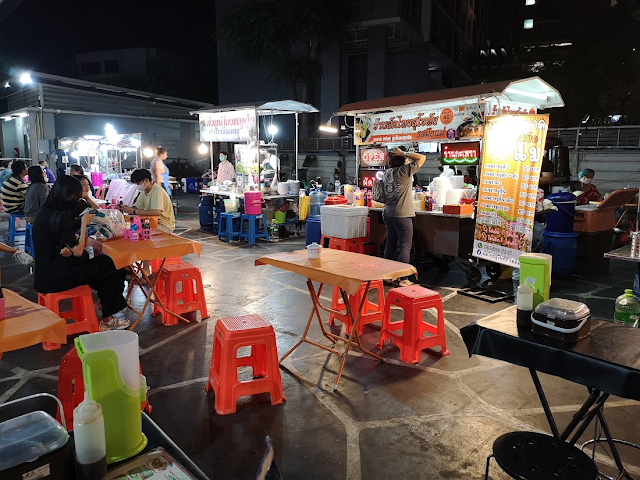
Bangkok street food and food court options


this is out in Isaan instead, but the theme comes up a lot in Bangkok


just a market alley, not all that food related, but there would be stalls and shops in there


This discussion comes up over and over in social media groups, so I'll add some thoughts here beyond what fits in a typical post comment.  Some of the background context does get expressed in some threads, but usually it's just a list of personal favorites.  That's fine, but there are dozens of places that repeat, and what turns up in any given post is sort of random.

Let's start with categories, and more on to my own favorite examples of each after.


Street food versus food courts and markets:


True street food is vendor's cart on a sidewalk, which is everywhere in Bangkok.  Food from these places can be fine, but it does add some risk of foodborne illness, since those vendors don't have a kitchen or refrigeration to work with, for sanitation.  Some things seem safe in general; I'll buy cut fruit from them, and roti, and in general whatever is cooked in front of you is better than what is sitting already cooked.  Meats can be ok, but that is sitting out in Bangkok heat without a lot of refrigeration, so a problem could also occur.

Food courts can be a better option for Thai basic foods because they have those extra facilities, and because the types of foods overlap.  There are food courts everywhere, in most office buildings, shopping centers, malls, and in local markets.  The one in Terminal 21 (in Asok) is popular among tourists, but really it's nothing special, it's just presented slightly better than usual.  The Central World version is fine (but I was just in there and many options are 200 baht or so, way too much for food court foods), or in any other mall really.  Older or out of the way mall areas can be even better.  The food court in the Paradise Park mall is great, or The Mall in Bang Kae.  I'm not suggesting that anyone drive an hour or more across the city to go to a special food court; the idea is that different places can be good.


the Terminal 21 food court (credit the GoTouchTheSky page)


Local markets are an exceptional option; these tend to host busy food court areas, the informal outdoor versions, which often work out as local favorites, sometimes selling novel options.  Basics can be great at these too; my own favorite is Isaan fermented sausage with sticky rice, which pairs well with som tum, Thai papaya salad.  There's a nice local market in our area, on Rachawat road in Dusit, but it has a row of food shops instead of a market section, which isn't so different, but it's not the same.


a standard street market, the fruit section


a much bigger pineapple section at the Ta Lat Thai wholesale fruit market section


I just attended a local fair, with a market that was a nice variation of these.  Fair food includes grilled meats, Thai basics (like som tum), fruit, smoothies, novel desert or snack items (like battered fried bananas, or blended rice fried into sweet disc shapes), and just about anything else.  Grilled shrimp might be fine from such a place, or a seafood omelette; it just depends.  They were selling fried bugs there; I guess that's fine for a novelty, for something unusual to try, but I've not tried that.


that fair was based on a Squid Game 3 theme; strange


there was some food at this street art themed fair, not far from the Grand Palace area


Night markets would always include this sort of food shop / open food court space.  Many are geared towards foreign tourists, but in some places they're there mostly for locals.  Another favorite is in a completely local area, Bang Son, I think that is, beside train tracks (here), with one section as a food market and the other as a food court sort of theme, just on tables set up in an open space.  My daughter loves a crepe place there, and there's a shwarma / wrap place, but most is standard Thai food, chicken and rice, rice noodle soup, and so on.  Again it might be anti-climactic traveling across Bangkok to see a railroad market and food shop section; you would probably pass a half dozen similar places along the way.


that Bang Son railroad market place


local places carry a lot of Thai desserts and snacks, like this version


night market sort of shops space beside Victory Monument


I don't really have other favorites for night markets, but there is one outside the Central Rama 9 mall, another beside the Paradise Park mall, and a range of different related areas beside Chatuchak market in the Mo Chit area.  One of those is famous for being a top tier fresh food and fruit market, but since I don't go there it's not so easy to turn up a location link.  I go to a great place beside the Sam Sen railway stop, where fruit options and low pricing can be on par with wholesale markets, but then if your luck or timing is bad there might not be much there at any given time.


there is a good tea shop beside the Paradise Park food court, Ju Jen


People sometimes comment in discussions that most office buildings have food courts in them, and this isn't an exaggeration.  In the office building I worked in prior to the current one there was a food court in the basement, and two in adjacent buildings, with large local versions across and down the street.  Not so much in the building I'm in now; there is mostly just one main one in the basement.

We would go to two different food courts when visiting Chula university, to a pet hospital there (we have cats), but who knows how many of those there are on that large campus area.  There are relatively few places where anyone off the street isn't welcome, in any kind of area.  One other food court inside Chula seems to be mostly for students, somehow, but it would probably still work out to have lunch there, people just seem not to.  


Food street / local shop areas:


Some places collect lots of options together, that aren't exactly a local market or fair.  Ban That Tong road is our favorite example of this sort of thing; it's a row of over a kilometer of densely packed food shops, beside the Chulalongkorn university, near the Sam Yan area.  Our favorites are Cheng Shim Ei, a Chinese iced desert place that sells barbecue and crispy pork, and duck, with noodles or rice, a congee place, and a great khao soy place, northern Thai mild curry, typically served with chicken.  All of those are near the Stadium One building, near the Lotus on Rama 1 road.


at the Cheng Shim Ei shop with favorite friends who visited


But there are many examples of these, all over the place.  A row of different types of food shops near Siam One, in the Siam BTS area, is trendy and popular with younger people, a place to see and be seen as well as to eat.  It's behind the Siam One mall / shops area, so more or less a short block away from the BTS station.  Different food themes would be available there, including very standard hot pot and Korean barbecue variations.  

Thais eat lots of rice noodle soups, similar to Vietnamese pho, that are just not the same.  Fried chicken variations can be popular, or odd desert and snack themes, like a toasted bread place.  Japanese food is very popular across Bangkok, but Ban That Tong is more Chinese and Thai oriented, while the Siam One area emphasizes novel modern informal establishments.


Street food, in more detail


You can find almost anything as street food, but some common themes repeat.  It wouldn't be typical for someone to cook pad Thai, fried noodles, from a food cart, but they could.  Grilled meats is a common theme, or fried chicken.  Some places sell variations of the basic rice noodle soup that's a main staple.  Roti is my favorite (like a snack version of an Indian fried bread sheet); it comes as a plain sweetened version (tamada), or with egg and banana.

For many since food court areas are similar, or market related shop spaces, there is no reason to eat most of what is offered on sidewalks.  Bangkok has been removing such places, or went through a wave of restrictions maybe 8 years ago, but only long term locals would notice what is missing.


It almost doesn't make sense to ask where street food is good in Bangkok.  It varies by vendor.  To me market spaces, food courts, or food shop areas tend to have a more consistent theme or quality level, in specific areas.


Other favorites


My two standard favorite food shop or market basics are chicken and rice or crispy pork and rice, or barbecue pork if they have that instead.  Or it's really about what looks good.  A plain grilled chicken can be great, if a vendor is making a nice looking version of that.  Add some sticky rice (kao neow) and that's a nice lunch.

Lots of food shops, market stalls, or even street vendors sell just one kind of thing, and often that can be nice, across a lot of range.  We always buy fried chicken from a place in that market in Rachawat road (in Dusit, near Sam Sen).  A khao soy place will often sell just that (Nothern mild curry noodle soup).  Some local restaurants are the opposite, particularly if they are a Western theme / Western oriented place, and they'll sell a bit of lots of things.  Sara Jane's in Sathorn, near the Empire Tower, is an example of this (right beside a local food court area I'd mentioned separately).

It might sound like going local is the best way to go, to get great value on great quality food that sells for next to nothing, 40 to 60 baht a dish, a bit over $1.  That's it, but Thai chain restaurants can be ok too, basic ramen places (Hachiban / #8 ramen is nice), interpretations of Japanese food (like Ya Yoi), or fusion options, like the Pepper Lunch Japanese interpretation of Korean barbecue (sort of), selling meats with rice and corn.

Thais would have their own favorite shops, and would drive by plenty of other places to get dishes that are exceptional there.  We have a favorite duck noodle place (never mind where; it's too far out), and pork ball with rice noodle place (not far from the UN building, further along that road towards the river).


Tourist places tend to be among the worst options for decent local foods, oddly.  Beside Wat Pho, where we visit often, there isn't much at all, and there's nothing exceptional about the options in the Khao San road or Phra Arthit areas, beside each other in the old part of town.  True local areas are generally better.  

Tourist food shops tend to focus on coffee shop themes and bad interpretations of pizza.  Real local food shops would only be a block or two away, so wandering around a little might resolve this gap.  Not so much near Wat Pho; I'm not sure why it works out like that.  I was just in a radna place yesterday only 3 blocks or so away from Wat Pho, so I guess that could work as an exception, but no one would ever find that place without knowing exactly where it is.  I don't like that dish; it's basically the large noodles served fried with kale in pad see ew, often with fried pork, but with gravy, which I like less.


that one local food option I still haven't tried


Tea Side Dongfang Mei Ren white and Gui Fei


Two more teas from Tea Side, following an exceptional example of small-batch shu pu'er.  They're probably the best online source for specialty Thai teas, but then it helps that it's hard to think of a second example.  I can think of others, but there is no other Western-facing, sales portal based, broad selection, high quality tea outlet.  For value their range varies more, but then supply and demand can work out like that.  If they're selling something that barely exists the cost might end up being whatever it happens to be.  If there is no market rate to reference you can't really identify a typical price in relation to a quality level.

That is how I tend to define value, as price in relation to quality level.  Another related distinction that comes up is teas I can afford in comparison to versions that I feel I can't.  I cut off price per gram fairly low, as tea enthusiasts go, because I'm living off a Thai salary (a professional manager's version, but still), and I'm raising kids, in Honolulu at that.  I don't buy 50 cent or $1 per gram teas, ever.  Even a quite-standard 30-35 cent a gram range I avoid.  If you live in South East Asia and know the ins and outs of local tea sourcing you can still drink pleasant, good quality, interesting teas while spending less, but for others seeking out what's online in the Western market that's not the same.  Your own trade-off would fall wherever it happens to.

I've tried their Gui Fei before, and it was exceptional.  I've never tried another version of Gui Fei from Thailand, but even if I had the quality level of theirs would make for a really high bar to clear.  It's described, and in my understanding actually is, a rolled variation of Oriental Beauty.

Both of these are variations of Oriental Beauty.  That name is sometimes avoided by vendors now, as it is missing on these labels, because "oriental" is now typically regarded as pejorative, as negative and insulting, like "indians" is in relation to Native Americans.  I'm not sure that's fair.  It's an old term, that had been used for a long time to simply mean "Asian."  Then racist connotations were eventually paired with the general Asian theme and image, but I'm not sure the term Oriental played much of a role in that.  Either way it was largely swept aside.  What could be the problem, since this happens all the time, routine changes in language use?

Business names in the East and West were using that term, and some of them can't switch off it as easily.  A main Bangkok hotel is called the Oriental, a central landmark, and they're not going to change that name.  I've been here in "the orient" since that changeover occurred, about 15 years ago, and people here still aren't clear on the change. Political correctness is an American theme; it doesn't apply in Thailand.  And their primary language is Thai, so keeping up with changes in English use isn't necessarily a priority for them. 

For that tea type it already had a few names, so that doesn't matter.  Many vendors went with something like Eastern Beauty, or the Chinese name would work, Dongfang Mei Ren.  I think there was another name too, Bai Hao, but this could get complicated in relation to Bai Hao Yin Zhen, silver needle white tea.

Anyway, these teas are quite familiar, except for the hybrid theme of the Dongfang Mei Ren being white tea.  That's a name for the Taiwanese oolong style (which has been produced in Thailand for awhile as well).  We'll see how that works out in the tasting notes.  I'll add vendor descriptions and links after the tasting, not that it would change much reading that first.  I'd probably notice exactly what the vendor did for flavors, if I did read that first, where my interpretation will be similar but different if I didn't.  He might say the white version tastes like raspberry, then I might try it and mention another fruit tone instead, when really either make for a decent interpretation.


Let's check the vendor listings to see what Tea Side has to add.


2024 Dongfang Meiren White Tea ($17.80 for 50 grams; sounds fine)


This Dong Fang Mei Ren is unusual—it’s made without roasting, in the style of white tea. Just the sun, just the bitten leaves—only hardcore!

[I edited out a part about cold-brewing it, but that approach would work].

Hot brews reveal an equally delicate infusion, with a distinct honey profile and a subtle melody of fruit caramel. There’s also a light aroma of teakwood, reminiscent of sheng pu-erh. But honey takes center stage here—rich, unfiltered, and in full bloom...

Like a true white tea, the liquor starts off pale, almost colorless, and gradually deepens into amber—another trait that sets it apart from classic Dong Fang Mei Ren Oolong.


It's made out of TRES #17 Ruan Zhi (plant type), also sometimes called Bai Lu, and the other version is as well.  Interesting!


2024 Gui Fei Premium Oolong Tea  ($16 for 50 grams; again not bad for this tea quality)


I can confidently say this is one of the most powerful classic Gui Fei oolongs we’ve ever sold.

By “classic,” I mean: pure, well-bitten material (easy to recognize by its flavor intensity, profile, and steeped leaves); oxidized more than light oolongs but without crossing into “red water” territory.

Tasting Notes

Rinsed leaves explode with a fruity mix, led by a bright strawberry note on a dense honey background. The tea is fresh, and its melody reminds me of wild Thai honey.

The sharp honey note, the one that always present in well-bitten material, is absolutely mind-blowing here. You’ll recognize it instantly as soon as you start inhaling the aroma.

The long-lasting aftertaste deserves special mentioning, it brings caramel and chocolate candy tones plus that velvety honey sensation on the palate.

Excellent endurance to multiple infusions, as expected from premium quality. The liquor is smooth, soft, and sweet.


It was pretty good.  I had trouble breaking down the flavors, because it was pretty complex, and the two together were a lot to take in, but then again interpretations always vary anyway.


Review:


DFMR #1:  it's just great, pretty much what I expected.  It's a little light because I don't usually add time to the first infusion to account for the leaves just getting wet, trying it light first, and I tried to back off my typical 8 or 9 grams per 100 ml gaiwan proportion, which is often a little excessive, going with 6 or 7 instead.  For a combined tasting I won't get to the end of the story as it is, trying 5 or 6 rounds, then not passing on how the next few go.  [After going through a session this might be half the packages instead, 7.5 or 8 grams, by the looks of it].

Flavors are in typical DFMR / OB range, including cinnamon and plenty of warm fruit, with this also quite bright, covering warm dried fruit and lighter citrus tones.  Sometimes people associate muscatel with OB too, beyond that being linked to types of Darjeeling more often, and I guess that works too.  Complexity is good, sweetness is great, and feel is a bit rich even for it being so light.  It's hard to pin down exactly how this is different from a regular oolong version.  

It is a little light (in flavor character range), but then those don't absolutely have to be one oxidation level step away from black tea, as they often are.  By appearance and some character range oxidation level is backed off in this, but then the warm tones tell the opposite story.  It's hard to say.


Gui Fe:  much darker in appearance; this may be oxidized more and also roasted, where the other may not be roasted at all, or at least not much.  The flavor range overlaps some but it's quite different.  A warm liqueur-like character emerges right away.  It doesn't taste like cognac or brandy, but there's a part of that experience that carries over, an aromatic range theme.  Maybe that is partly related to taste too.  Then spice tone leans towards cinnamon, as in the other tea, but it's not as clearly that, not definitely and distinctly cinnamon.

Roast input is interesting.  It doesn't come across as char, at all, but it seems like that input is pronounced.  I checked again and this is a 2024 tea.  If they had roasted this a bit too much a bit of char effect would come across, and then it might be better drinking it 2 or 3 years later after that had settled.  In a year a tea could still change but it seems likely that they've nailed the roast input, that it never tasted burnt in the slightest.  Maybe it did settle quite a bit though; who knows.

So we have spice, not exactly cinnamon, but close, a liqueur-like aromatic effect, which I've not described well in terms of seeming most associated flavor, and there's more going on than that.  Sweetness and brightness doesn't match the other tea, but there is enough sweetness in this to balance the rest.  It definitely doesn't come across as savory, but I might still decide that's part of it.  I'll add more flavor list for both as I go.


DFMR #2:   intensity bumps way up; I brewed this for nearly 30 seconds related to typing during that time, longer than it needed.  It can be nice trying a tea strong to see it from a different angle.  These teas would be quite pleasant brewed light, medium, or strong, just shifting character depending on that brewing time.  To me "light" would be 10 seconds at a moderate proportion, and heavy is about this, 30 seconds or so.

Warm tones stand out a lot more, the cinnamon versus fresher and lighter dried fruit and citrus.  It might switch back brewed light in a next round.  Dried fruit range is close to dried apricot, with citrus folding in along with that, maybe tangerine peel zest.  It might taste less like cinnamon and more like warm mineral, but it's still quite clean, balanced, and refined.  For mouthfeel being this full, without significant astringency coming into play, the extra intensity relates to a heavier feel along your tongue.  Aftertaste is more pronounced too, brewed stronger, but it's kind of a medium intensity effect in a sense.  Or rather it's not necessarily strong, as sheng pu'er can be, at times stronger after you swallow than while tasting, but it does linger in duration.  It's quite pleasant.


Gui Fei:  this is a bit too strong; the extra intensity in it doesn't work as well with that long infusion time.  It's standard practice to use stronger infusions to sort out flaws, part of why the standard approach to black tea tasting in places like India and Sri Lanka, plantation taste testing, overbrews teas, in comparison with typical drinking preferences.  A bit of sourness stands out in this, made this way; I suppose that could be considered a flaw.  If it balances quite well with the rest brewed more conventionally then it's not much of one, but if it stays in the balance at a significant level then it is.  It's still good though; I'm not saying that.

The rest of the flavors are similar, but it seems as well to describe this more at an optimum, using a 15 second or so infusion time, and covering a more complete list next round.  It goes without saying that these are the kinds of teas you don't throw out the last of while tasting, rushing to get to the next round.  I typically don't, even for lower quality or less favorable teas, since I see it as disrespectful to the tea, but for this anyone would have the same reaction, and would drink the last drops.


DFMR #3:  this really shines, brewed appropriately.  Brighter citrus returns.  This does seem closer to a muscatel designation than ever, even if I can never be sure I'm using that term right.  It seems to correspond to a limited range of description of citrus tone, one that I explored quite a bit in drinking dozens of Darjeeling versions.  Still, it's hard to say.  Food flavors make it so easy because you try variations from time to time, and right there it is.

Brightness and lightness are pleasant in this.  Maybe that's a big part of the difference from this being designated as oolong.  In theory it should've also been exposed to less of a kneading / bruising step, I think, but then less might be more related to me guessing about processing.  I don't make tea.

Cinnamon isn't evolving away, dropping out, but fruit dominates the experience at this round, and place in the transition cycle.  It might be a little harder to place brewed lighter but the effect is still as intense.


Gui Fei:  it balances much better.  Either that sourness was either an effect of overbrewing the tea or it was the kind of flavor range that shows up early and drops out, as harsh edges can with sheng pu'er (if it has them).  It's quite pleasant.  Spice range is there but hard to isolate.  That could be some type of incense related spice instead of cinnamon, maybe sandalwood.  I think the fruit range is next, but again it's not framed in a distinct way, not easy to pin down.  It all integrates.  Roast / warm mineral tone input is there too, and mouthfeel corresponds to what one might expect of that, not really dry, but full in a different sense than the other, with the beginnings of what would seem like structure if it was stronger.

I think a bark spice might work as a decent interpretation, just not exactly cinnamon.  Many years ago I went on a decade or two long tisane exploration phase, and encountered other barks used as tisanes then, that span a really interesting and pleasant range.  I just can't remember any names of those, and certainly can't place an association with one.


DFMR #4:  this might be a good place to leave off, because this runs long.  I don't want to type 2000 words and readers wouldn't want to read that either.  I'll only mention transitions and close this.

It might be getting slightly better, picking up depth and balancing better, but that's about it for changes.  That's a great sign, because some other Thai OB I've tried can be pleasant, generally not quite this good, but tending to die early related to intensity, not making many good rounds.  If this is still improving rather than fading the infusion count cycle should run long enough.  Cinnamon and warmer tone stand out more this round; that's probably from me adding more time than last time, not from a transition change.


GF:  liqueur-like character is really pleasant in this, but then that's not new.  What I'm interpreting as either bark spice or incense spice--kind of repeating myself in that, since those incense spices probably are bark material based, or at least derived from aromatic woods--is as significant as before, and it makes this really stand out.  I can't imagine anyone being put off by that, but some may feel more connection with it than others, a closer match to preference.

It's interesting considering if the first really is more of a warm weather tea, for being brighter in tone and flavor, and if the second would be more suitable for drinking when it's cool out.  Maybe.  It's hot as could be now, where I am, maybe close to 90 F (around 30 C), and humid as well, since I'm in Bangkok.  Both are fine for me, but then it's a normal weather experience for me.  Maybe that's part of why I like relatively young sheng though, with a brighter character, and cooler / cooling effect.

I shouldn't be dabbling in Traditional Chinese Medicine related commentary either; I know almost nothing about that.


The teas have been great.  I'd highly recommend both.  I suppose that I liked the Dongfang Mei Ren white a little more, the opposite of what I'd expected.  It wasn't really that the second didn't meet my expectations, just that the first stood out more than I expected.  

Producers can make a version of Oriental Beauty with positive flavor range often enough, but the flavors expressing that degree of novelty, refinement, and intensity isn't typical.  Cinnamon and citrus flavors balancing like that is what seems to me to be a primary appeal of Oriental Beauty style teas.  

The intensity mentioned in the Tea Side description of the Gui Fei was nice.  As a sheng drinker oolongs can tend to be a little too soft and subtle, at times, with most white teas all the more so.  Both of these expressed good intensity, but the Gui Fei might have hit a little harder in the sense of covering deeper and heavier range, with the DFMR lighter and brighter.