Showing posts with label Suzana Syiem. Show all posts

Tuesday, May 19, 2020

Huyen's family's trials in making Vietnamese teas


Huyen showing off a "witch's broom" home-made sheng trial sample


I've written about doing online meet-ups recently, mainly including four friends:  Suzana from India, Ralph from Germany, and Huyen from Vietnam.  This blog has included lots of mention of Huyen, from her visiting once and passing on lots of interesting and pleasant teas from Vietnam.

Her family has been making tea lately.  Vietnam is a main producer country, and they are from an area 200 km outside of Ho Chi Minh City (Saigon), so tea is around, live, growing plants.  Some of those plants are relatively mature trees.  The idea isn't to go into production as a business, just experimentation related to tea interest as tea drinkers.  This early post about Huyen's take on tea, reviewing a couple of samples, goes into some background.  This post ("Vietnamese trà chít (or trà bó)") is on that "witch's broom" tea.

This photo from that first post kind of captures what her family is like:


If I wasn't a middle-aged man I'd ask them to adopt me; no one has a vibe as genuine and positive as all of them, and that's how they always seem to be.  This picture of Huyen is one of my favorites:


That baby is a little boy now; time passes quickly.  Huyen recently shared these photos of collecting leaves for the early round of those processing trials:


some really mature tea plants growing near where they live


Their background goes a bit beyond just being typical tea enthusiasts.  Huyen's family works for (owns?) Tra Viet, a gift shop business that sells tea.  Her brother and sister-in-law are tea experts, of a sort, with her sister-in-law's case relating to success in competition in the Tea Masters organization.  I could do a post on all that, their background and other connections to tea, but this is mostly only about them trying out making a few versions of tea recently.

Huyen shows the leaves, and talks about what the teas are, how they made them, and what the end effect is like, the brewed tea character, in those meet-ups.  It has been a really interesting insight into those earlier stages of the tea production process.  I've heard a bit about how different types are made but I'm by no means well informed related to that, and having never actually made tea anything I ever learned from reading would just be academic.

I'll write out a short description of what I understood, and couple that with more input from Huyen, along with her reviewing my take, and photos.  In discussing tea with them and putting together her notes it strikes me that they tend not to describe teas in terms of flavors lists, as is common in Western tea blogs, and to a lesser degree in Western oriented tea marketing content.  I'd be speculating as to why, but I can do that.

Some people value mouth-feel and aftertaste aspects just as much as flavor (or cha qi "feel" effect); there's that.  Then flavor descriptions tend to be subjective, so you can describe the character of teas, but the flavor-list any one person outlines isn't the same list the next person would convey, even with both having appropriate prior experience.  One solution to that is to say a bit about tea character and then leave most of the experience as experiential; don't try to pin it down with analysis.  Character aspects like fresh, sweet, or intense also cover informative range, as discussing flaws also does.

Of course Huyen did say a little about these different teas in the discussions, even related to flavors, but since I wasn't really taking notes this focuses more on sharing photos and her input about processing steps, what they tried in making each.


It wouldn't really work to also cover how these trials relate to the most typical local styles, for the most part, and this doesn't attempt it.  The idea comes up that any tea plant type (variety Assamica or Sinensis, and specific cultivar beyond that) can be made into any final version of finished tea (black, white, green, sheng or shu pu'er, etc.), which is a bit too simple.  The opposite idea also comes up, that only very specific cultivars can be used to make specific types of tea, versions of one of those broad categories, and that's not exactly right either, per my understanding.

Compounds in raw leaves of different plant types vary, so different plant types are better suited for making particular finished versions.  To make a completely original version of any specific tea (eg. Longjing, Anxi Tie Guan Yin, sheng pu'er from a limited region) you would need to use the exact same plant type, and processing steps, and to make a completely original versioon to also grow those plants in that original location.  A version only grown elsewhere could be similar, and any changes to plant type input or processing would either shift the end result, a little or a lot, depending.

This will skip a lot of scope related to exactly what the plant type inputs are, and main local versions typically produced.  It's about how production trials were carried out and the end result, which is enough.  Mapping that back to see what might have been different is out of scope.  We talked about plant types a good bit in the video meet-up discussion but I wasn't really taking notes on it.


Huyen mentioned Shan plants, covered in this reference


Tea production trials


white tea:  Huyen showed a version made using the simplest production process, white tea.  The simplest version of this approach just lets the leaves dry; that's it.  Adding any heating or rolling steps (kneading the leaves), or shaping, would move away from the white tea type range.  The leaves looked colorful, and varied in color, as fresh versions of different white teas can. 

As I remember Huyen describing the tea it was subtle but very fresh and sweet.  She mentioned it transitioning, and some white teas with similar appearance can include fresh fruit or floral flavors, and then also run through savory range as infusions go by, like sun-dried tomato, with that varying as a relative input.


She added detail beyond that:

This is white tea version 1: 

Material: raw tea leaves from Shan tea trees which were grown by seeds (Vietnamese calls: chè (tea) hột (seed). 
Picking: 1 bud, 2 -3 young leaves
Processing: withering around 1,5 days and sun-dried in 2 days


Somehow I had missed that she really made two white teas; this describes the second:


This is white tea version 2: 

- Material: raw tea leaves from Shan tea trees which were grown by another variety - using tea stems to create new tea tree (Vietnamese calls chè (tea)  cành (stems)
- Picking: 1 bud and 2 young leaves 
- processing: withering 1 day and sun-dried in 3 days


You can see the different color of tea leaves from 2 varieties.


I don't remember hearing a version description related to that one.  Some white teas are a little subtle, and others are very subtle, with some of the paler white teas I've tried from Vietnam including an interesting dry mineral undertone, like limestone or flint. 

That extends to green tea range too; some versions described mainly in terms of being ancient-tree, high-mountain source teas, with no specific type offered, can seem to be in between green tea, sheng, and white tea in style.  Huyen has discussed how some Vietnamese teas are presented as "dried tea" (their translation), which does relate closest to sheng pu'er in style (per my understanding of old conversations; not the most reliable source), but may not necessarily be a direct match for a Chinese category or style of tea. 

This version from Huyen describes exactly what I'm talking about, while reviewing a related style of tea in comparison with a Thai sheng, and it mentions a separate Thai white version that looks exactly like that first white tea shown here.  This post from 2015 represents my first exposure to an "ancient source Vietnamese green tea," and this post about a "snow tea" from Vietnam (also from Huyen) is also related to that general theme.


witch's broom, multiple versions:  I reviewed a version of Vietnamese tea presented in this style before (from Somnuc, a friend from Laos, instead of Huyen), which is typically a variation of sheng.  It's not pu'er, since it's from Vietnam instead of Yunnan, so I'll just stick to sheng in further references, since "raw" isn't a regional designation.  In that post I cited the original local naming, as informed by Huyen: trà chít or trà bó.

One version (listed later) they rolled a little and allowed to oxidize, experimenting with a hybrid style, but these first two trials are just conventional sheng, per my understanding.  That would mean they are wok-fried teas that just aren't heated as long or as hot as green tea, using a more limited kill-green or sha-qing step to keep some enzymes active, enabling aging transition.

These descriptions cover how they made them, again with less for flavor-list descriptions.  Per trying two versions before--not enough for a blanket judgment, to be clear--a mineral aspect is really heavy in these teas.  That's kind of true of Vietnamese teas in general, although it can drop completely out in some oolong versions, and doesn't necessarily define or apply to all Vietnamese black teas.  Huyen did pass on her impression of both but I'd end up mixing them if I tried to convey them from memory, and I want to finish this post instead of continuing to add to it.


This is broom tea. There are 2 versions.

This one ☝️: picking 1 bud, 3-4 tea leaves (10cm) in tea stems garden.
- Processing: withering in 1 day, after that tighting it and sun-dried in 2 days. Then 
unting it (like photo you see) and sun dried continuously (not finished until now because of raining)


witch's broom, a more traditional version:  they only wok-fried this version, closest to sheng processing, with no step related to rolling or breaking up leaf cells.


This is the second one:
Material is same the first one
- Processing: withering in 1 day, tighting and sun dried in 1 day, then unting and continue to sun dried in 2 days.
- Brewing: we grill a little bit before brewing and tea color as you see
- Tasting: it is interesting about smoky smell and fresh together, little bit acrid, quite full body taste and more infusions


Unlike with conventional sheng they rolled a last trial version a little to break up the leaves slightly, and to let the tea oxidize some before the heating (wok frying) step.  If I'm matching up her discussion account with the right teas she said that the tea turned out well.


Actually, there is one more version of broom tea like the second one. The different point is after tightening we sun dried for 2 days, untying the tea to dry continuously by sun.  About processing we rolled tea leaves a little after withering.


As I remember Huyen said that she liked the effect of adding some oxidation input to the more conventional sheng style.  That would tend to add some sweetness to the tea character, and some warmth and deeper tones, a touch towards black tea range, but it could potentially also offset long-term aging potential for sheng (in general).  For samples made for testing out processing, in small quantity, that wouldn't really be relevant anyway. 

I've been trying a lot of sheng over the past five months, testing out everything I own at different ages, trying and re-trying versions (this tangent will connect).  One sub-theme that keeps coming up is that some sheng versions, many of them, are much better after a year or two of aging.  For teas stored in a dryer environment (like Kunming, where a number of my teas came from) that same fermentation level can be present after 3 to 5 years instead.  Presumably they will be trying and sharing these teas over the course of this year, but not keeping them around to try out over the following years (I would expect); but that would make for an interesting longer time-frame test.

Related to that pattern, I just retried a Kokang Myanmar sheng this morning, a 2018 version, that seemed to change character and improve a lot since trying it a number of times in 2019.  I should re-taste that along with a bit older Myanmar sheng (2016) I just picked up, to see if the pattern I described holds.  That would be a test to the extent that one can separate out one input--fermentation level related to storage conditions--from among all the others, especially the general character starting points.  I'll get back to that, but if the background is interest that recent 2016 version review post is here (a tea I bought from the Chawang Shop), and the 2019 review of the 2018 Kokang version is here.


Black tea, compressed into small disks; Huyen's description:


Compressed tea: same material like broom tea
Processing: withering in 1 day, then pounding it and pressing as you see the shape. Finally, sun dried in 2 days
We also grilled it around 3 minutes before brewing it.


As we had discussed in an earlier video meet-up session that last pre-warming or light roasting step I've only ever heard of in relation to dok-cha, a Korean variation of sheng or hei cha.  Huyen's brother was familiar with that type, and said that the preparation is somewhat common to both, and to some extent tea character related to Vietnamese versions they've tried.  This is black tea; it's something else, but they're preparing it in a similar way.

They tend to always heat water with charcoal, using decorative clay stoves and varying types of pots, so it would be easy for them to use suitable gear that is already on han for that roasting step.

Huyen did pass on a relatively complete description in an in-meet-up tasting, but that will be sparse based on my recollection.  She said that it tasted like black tea (of course), with warm and sweet tones, and good complexity, but with a slightly unconventional character that unfolded in the form of more than average transition across infusion rounds.  From the sound of it the tea might have been less than fully oxidized; brewed, wet leaf would tell more of that story, since a lot of dry leaves look much darker when dry than when wet.


More pictures from the meet-ups:


Some of these might actually show those teas, but I'm not going to try to do a complete mapping.  Again it's more about showing what the discussion experience is like (again photos courtesy of Suzana Syiem).

the sign-off, a good place to start (Ralph missed that day)


even without Huyen's smile that setting looked cool


it's always nice having guests join


showing Mandarin oranges to a sweet little girl, who spoke English well


that one black tea disk


I just noticed that's Elsa on Huyen's shirt


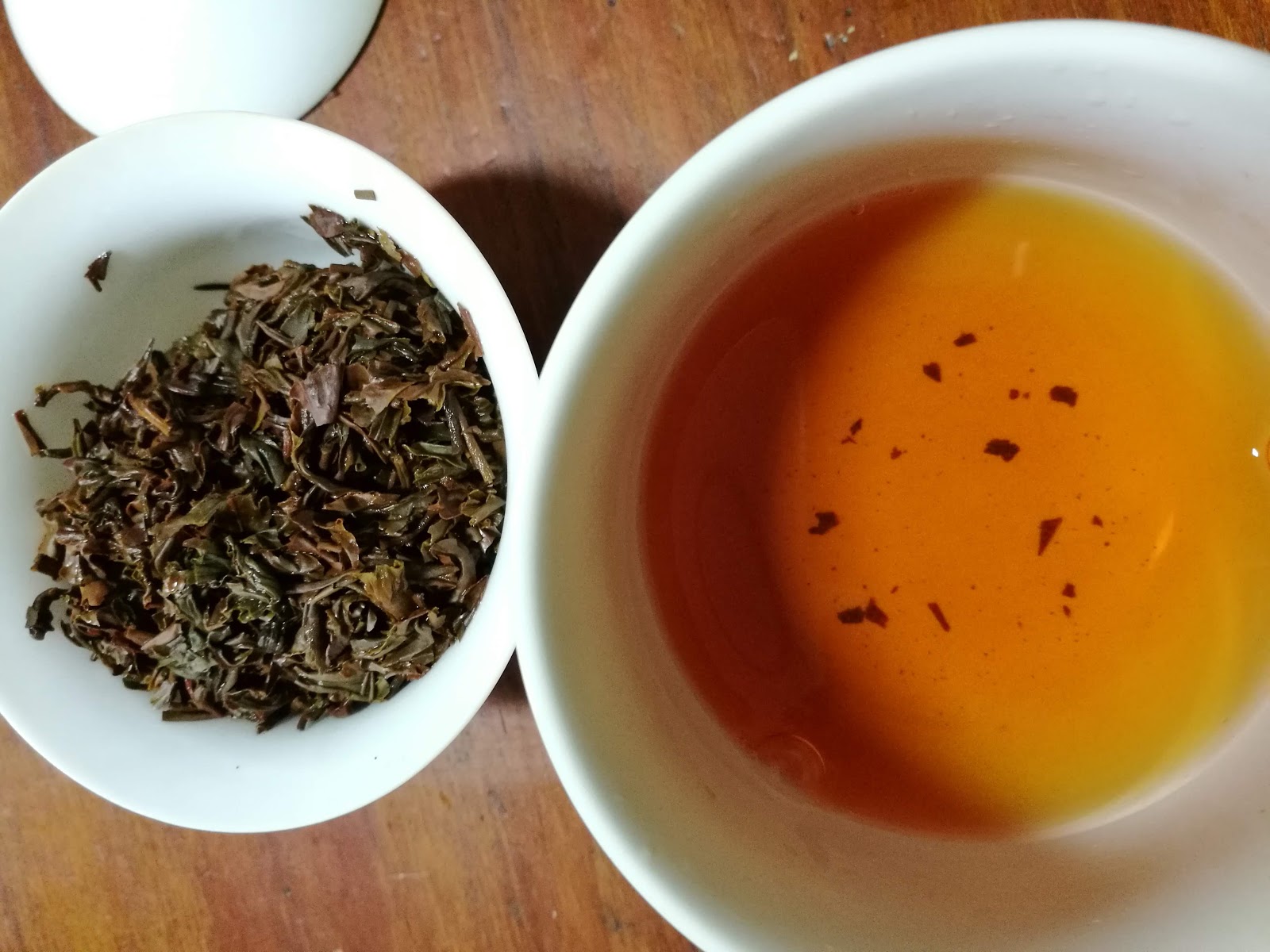
the brewed version of the black tea disk


the rest of us mention teas sometimes too


Wednesday, November 28, 2018

Making masala chai from a packaged spice blend


An Indian friend visited awhile back, Suzana Syiem, and passed on some interesting tea, and some Indian snacks, and masala chai spice mix, which is what I'm writing about here.

I usually make masala chai once the weather gets a little cool; it seems to help me pretend that it's winter, even if it's still hotter than a US fall out (or summer, in most places).  There was just a touch of chill in the air a couple weeks ago but it didn't amount to much; it wasn't down below 25 C / 77 F even in the very early mornings.  It warmed back up and I'd missed my chance.  Now that it's past Thanksgiving, and Loy Krathong, I'm making masala chai anyway, even though it's not cool at all. 

Later edit:  it was down to 24.5 C this morning, around 75 F, positively chilly for Bangkok, finally!

Looking at the blend ingredients it's not like the versions of masala chai I make every year, from-scratch versions.  Those include cardamom, cinnamon, clove, and ginger.  Per my understanding star anise and black pepper are also relatively standard spice additions but I typically leave them out.


That package label shows the ingredients in this:  fennel seeds are listed first, with clove at the end.  Cassia is related to cinnamon, per my understanding (and Wikipedia's take) more often sold as cinnamon.  This blend version won't be like what I've been preparing.  It's a powdered spice blend, which is completely fine, only an issue related to storage conditions and storage time after you open it.  Recipes and some individuals recommend grinding or crushing fresh spices with a mortar and pestle right before use, which of course would be a little better, but powdered spices work too, especially when they're fresh.

I'll keep this explanation of brewing process and tea description short.  I simmered the spice mix along with a Thai version of CTC black tea I bought for blending (around a year ago; I don't get to that much), and threw a couple of Lipton tea bags in to shift the black tea character.  My wife picks those up in hotels when they're in the room and such, and they tend to just sit around.  That Thai black tea isn't astringent at all but it is a bit woody for flavor aspect, not typical of CTC teas in general.  Malt doesn't really stand out either, or mineral undertone, mostly just the mild wood tones.

kind of an odd look while it simmers, before adding milk


not ideal as black tea goes but it works well enough


I added some cloves to bump up that spice flavor range, really the only adjustment.  I also added a small dash of salt since I like the way that evens the balance.  It wouldn't take much of that to be way too much.  Instead of carefully measuring it all so that I could duplicate and adjust amounts later I sort of just dumped it in; one and a half very small spoons of the spice, a spoon half the size of a teaspoon, and unmeasured black tea.  It's possible to adjust the intensity a lot by adding more milk at the end, a factor that doesn't come up in almost any other teas I prepare, maybe just the orange Thai spiced (artificially flavored) black teas I've been drinking more of recently.

It would be possible to simmer the milk with the tea or to not, to just boil it with water.  I added the milk at the end to get some of that effect since boiling it does seem to change the taste a bit.  I'm not sure it matters much how long you simmer tea made like this since it's ground tea with powdered spice.  It boiled around 10 to 15 minutes and I think adding another 10 minutes probably wouldn't have changed much.  For more-whole spices it would make sense to give it a longer infusion, maybe by simmering a little, leaving it sit, re-boiling, then leaving it sit.  Or simmering for awhile; it probably wouldn't matter which.


after a bit of simmering


palm sugar; the shapes it comes in vary


Sweetener is the only other factor.  Using white sugar would seem normal.  Oddly we don't keep white sugar at the house all the time; funny how that works out.  I used up all we had that was nicked from hotel room tea and coffee set-ups with that Thai tea I had been making. 


Often we will have palm sugar around; that's a good alternative, not so different than brown sugar, just not exactly like that.  That seems to be the same thing referred to as jaggery I've seen in discussions about making masala chai online.  Since we're out of both I went with honey.  I love honey on toast but I'd as soon just use white sugar in a tea like this, but it sort of doesn't matter.


Skipping to how it turned out:  it was nice.  It was much different than what I was used to, the quite-different spice blend version, but it was good.  I didn't like it as well for it being less familiar, but it was hard to split out the impact of the blend balance not being optimized from that factor, just dumping it all in at no set ratio.  The other masala chai versions I'm used to have a lot of kick from the ginger and clove standing out and this was a lot milder.  Fennel seed was hard to identify as a separate flavor since it all integrated.

I'm guessing that using two thirds as much spice and half as much tea for the same amount of water would've turned out better.  It's hard to judge how much tea went into it since both the tea leaves and spices expand a lot simmering but it looked like way too much for two large mugs of tea produced at the end.  After drinking both my nerves were a bit jolted too.  I think beyond that factor, ingesting too much tea at one time, the flavors would balance better not made really strong.  All the same it worked well enough.

my son made breakfast again (bacon needed another sear, otherwise very nice)


when people ask about how to get dosed on caffeine this will come to mind


I usually make a Christmas blend around this time, and a version last year was based on a modification of masala chai (adding white chocolate and a touch of bitter orange marmalade).  I'm not sure if I'll get around to that or not.  Throwing some peppermint and a touch of chocolate into a black tea could count as one, maybe along with some orange peel for balance. 

It would be nice to be back in the States since pine needle would be a great input for one, and I could walk outside in lots of places and collect that.  Per past experiments I suspect dried pine needle might work best (versus just brewing it fresh then), but that would easy to arrange, laying it out for a bit, or speeding that up by putting the needles in a very low temperature oven for half an hour.


making a chocolate covered cherry themed Christmas blend


I bought some Christmas decorations today (when writing the draft); maybe finding our tiny artificial tree in storage and putting up some lights and the rest will make it seem more natural to get back to that theme.  Cooler weather wouldn't hurt but there's nothing to be done about that.  It's typically cool for about a week at the end of December but it's also not consistent.  Even though it never really seems like we re-create a US version of the holiday, missing the weather, not doing decorations justice, or hearing much of the songs, my kids appreciate how much we do manage to observe, so we'll make what we can of it.


awhile back; like a plastic version of that Charlie Brown Christmas tree


in Murmansk last year; odd to go to Russia to experience more of that holiday


Monday, September 10, 2018

Shillong, Meghalaya Indian black tea from Suzana Syiem


I met an online friend from India not so long ago, Suzana Syiem, someone I'd been talking to for awhile.  It's nice when you meet someone you only knew online and it feels really natural, as if you'd been friends for a long time, with no strange alignment of perspectives to work past.  It's not necessarily a deal breaker when it goes the other way, since different people can approach things in relatively different ways and still find common ground.


should be cool to experiment with


I passed on some tea samples and she gave me a few different things, an Indian snack and food item, and a commercial masala spice blend (I'll be talking about that later), and this really interesting looking tea.  I'll get back to saying more about that origin, from the Meghalaya region outside of Shillong.


Review


I don't usually start reviews with the dry leaf scent but why not.  It's interesting, sweet and complex, with a bit of earthiness but more along the lines of a dried fruit, like raisin or grape.  It doesn't smell that much different than I'd expect a second flush darjeeling to. 


There is a trace of mustiness to the scent; it'll be interesting to see how that plays out.  I could swear Suzana recommended brewing the tea Gongfu style so I will.  There's enough to check later how Western brewing works out, and for black teas it tends to usually not make much difference.  For a few types a Gongfu approach really is different but for more the results are about the same.

About water temperature, some people would use full boiling point for this, but I'd think dropping down to 90 -95 C instead would be a more common approach, and would work better.  I'm using a water filter and dispenser system that never maintains full boiling point temperature so I'm erring on the side of a bit off that for all teas.


On first taste:  wow!  This tea is much different than I expected, a lot more complex.  There is sweet fruit there, and an earthy range that's common to a lot of black teas, towards malt, but a hint of smoke as well, and probably a couple other things I missed on the first sip.  It's not really exactly like any tea I've ever tried.  That part is nice; different is good.

just getting started


The complexity is really something.  It has a few main layers working.  As far as the effect being musty it seems like it might clean up a little on the next infusion but it's not really off, it just could be cleaner in effect.  That part comes across as a bit of damp wood, or like the scent of those those fungus that grow on the side of trees.  The flavor is more bright and clean than murky though; that part relates to one flavor layer, more earthy in an unusual way than musty.  It's all hard to pin down.  There's so much fruit that separating it out as distinct types is an issue; it does seem like a rich version of citrus, with a little grape, not so far off muskatel, or really that probably is a good description.  The smoke is just smoke.

Since this description seems a little chaotic I'll try again in clearer fashion the next round, brewing that fast, since intensity is only going to be an issue if I let it go too long.


I'm seeing why she would recommend to brew this Gongfu style.  It shifts a good bit; it would be a shame to let this soak for 4 minutes and not experience that (although the results would probably be nice that way too).  Earthiness picks up, the malt, and the smoke stays even, or maybe drops off a little.  The complexity related to damp wood or fungus drops back; it's that little bit cleaner, not that it was as musty as seemed possible from the dry leaf smell.  The fruit integrates into the earthy range on this round more.  I suppose it still does include some citrus and grape but that joins in more with the malt and deeper mineral base.  It picks up a bit of resinous character, like pine needle, or pine pitch really, that is common in buds-heavy better versions of Assam.

It has a lot of aftertaste compared to other black teas; it's not at all gone after you drink it.  As I keep saying in sheng reviews I'm not overly attached to that, but beyond getting to experience that one extra aspect it adds to the overall impression of complexity.  The real story of this tea is how it manages to balance with so much going on.  It totally works.  I suppose it would work just as well or maybe better if the proportions shifted in different ways, if the fruit stood out more, or if the feel was lighter, and so on.  For having this much intensity across a broad range of aspects and expressing so much that's positive without flaws turning up it's great.  And I suspect it will seem a good bit different on the third infusion, so there's that extra level, it seems to transition quite a bit.


even a bit light it's still really intense


On the next round the citrus really did kick in for some reason.  It's intense, in the range of dried orange peel.  It tastes as much like orange peel as those tea-stuffed tangerine peels I've been trying (I think those were tangerines, maybe mandarin oranges instead).  It's really strange that this tea could jump in citrus aspect level like that over one round.  Teas shift aspects and transition but not usually like that, with one part that hardly stands out emerging to that degree.  Malt picked up too, along with that pine resin, and other earthiness dropped out; the smoke and other damp wood earthiness is more or less gone.  It's almost like I'm drinking a different tea.  Suzana really hooked me up.

Astringency ramped up a little too.  I didn't change the length of infusion times--I don't think; I'm not measuring that--but I might have let it run a few more seconds.  The tea might have just fully hit stride for brewing, picked up the infusion pace on it's own.  Being a chopped leaf tea changes things, and it's not typical to use a black tea version of one for brewing Gongfu style in a packed gaiwan.  At least backing off the proportion and using 15 to 20 second times versus really short infusions would seem more conventional for this tea version.


The next infusion was just a quick in an out; the intensity is fine at this level, and it moderates astringency being lighter.  The character seems to have stopped shifting; it's as it was last round, just lighter.

I'm tempted to guess at where this stands related to other Indian teas I've tried, but it's really just overlapping in character with others from here and there.  It's not like Assam or Darjeeling, and not really "in between" the two in some way, although in very rough terms that would sort of work to make that claim.  Those are the only two areas in India that I've tried tea from, with the exception of the Lochan's teas, from the Doke plantation (which are nice, and seem to draw on experimentation with different styles).

The intensity, pronounced malt, and pine resin aspect remind me of Assam.  Citrus can occur in those, and does, but the fruit complexity is more like Darjeelings can be.  Really Darjeeling covers a lot of range; I'd be discussing this in comparison with second flush here, which is really still a broad scope.  They use different tea types to make those, and grow them under different conditions, with variation in processing making a lot of difference.  It doesn't work to say "second flush Darjeeling is like ___," although including a muscatel aspect would be really standard.  The better Darjeeling versions express a subtlety, complexity, and narrow, distinct character that this moves away from a little. 

I'm definitely not saying this reminds me of a tea-type blend versus a single-plant type, as I've mentioned in a recent Assam review.  It just covers a good bit of aspect range.  If a tea isn't made from one distinct plant type, sourced from within a narrow growing region, the mix can come across in a way that rounds off distinctive, separate aspects.  This isn't like that.  It's my impression the broad set of flavors occurs in this as a natural result of tea character, not because it's made from different plant types, or from versions grown across a broad area.

Of course a lot of that is guessing.  I'd love to hear back others' impressions about these themes but that's not how this blogging practice seems to work.

the leaves kept on expanding; different


On the next infusion I transferred the tea to a larger gaiwan; it expanded more than I expected it to, probably more tightly twisted than I thought it would be, even for being broken leaves.  The smokiness picked back up a little; interesting.  Mineral too; it's still heavy in citrus but with a different balance.  On the infusion after I let it go long due to getting a phone call; astringency picked up, and woodiness, but the character isn't changing as much as I'd expect for this many rounds out of a black tea, it's staying a lot like it had been.


Conclusions, tea area research


This tea is really interesting; I'm glad I have enough left to try it a good number of times, to mess around with approach.  I've always known that there are lots of different areas and styles of tea in India I've not made it to (beyond falap; I'll get to their version of bamboo pu'er eventually too), and it's nice to try one.


credit the India Tea Association


Interesting; lots of places there produce tea that I've not tried yet.  Upon looking closer Shillong isn't listed as one of them, on that map.


It can be difficult to compare the two map references, since the areas aren't familiar to me, but that first map lists Guwahati as an auction center within Assam that more or less marks the Southern extent of that growing area (and region), with Shillong well South of that.  Never mind.

Some of the history of the area I looked up turned up an interesting reference (from Wikipedia):


Shillong was capital for composite Assam during the British regime and later till a separate State of Meghalaya was formed. David Scott, the British civil servant of the East India Company, was the Agent of the Governor-General North East Frontier. 

During the First Anglo-Burmese War the British authorities felt the need for a road to connect Sylhet and Assam. The route was to traverse across the Khasi and Jaintia Hills. David Scott overcame the difficulties his administration faced from the opposition of the Khasi Syiems – their chiefs and people. Impressed by the favourable cool climate of Khasi Hills, they negotiated with the Syiem of Sohra in 1829 for a sanatorium for the British. Thus began the consolidation of British interests in the Khasi-Jaintia Hills.

A serious uprising by the Khasis against foreign occupation of their land followed. It began early in 1829 and continued till January 1833. Eventually the Khasi confederate chiefs were no match against the military might of the British. David Scott negotiated for the surrender of the leader of the Khasi resistance, Tirot Sing Syiem...


Shillong (credit:  Windrider24584 at English Wikipedia) 


Maybe some of Suzana's ancestors tried to cast those nasty British imperialists out, a half a century after my American ancestors did just that.

The rest is interesting, but there is no mention of tea.  Climate is covered, which sounds cool but mild enough to grow lots of different things.  Some random ideas from that article:  the Shillong area was referred to as "the Scotland of the East," in a good sense, with literacy rates well over 90%, and Christianity as the main religion.

I won't be able to find out much about typical local tea styles but it was nice reading around about different growing areas.  A familiar Indian tea vendor does mention some background of the Meghalaya growing area:


When prospectors sent by the East India Company explored the country for potential tea growing, Meghalaya too was considered an option. But the Khasi ruler of the time refused to allow migrant labor to be brought in. Tea is a labor-intensive commodity and with insufficient labor available, Meghalaya dropped off the plans. 

In the 70s, the Tea Board of India sent a delegation to explore tea growing in Meghalaya. They found it immensely favorable and tea plants from both Assam and Darjeeling were brought. Three regions were earmarked for tea – Umsning in Ri–Bhoi district, Tebronggre in West Garo Hills and Riangdo in the West Khasi Hills. Assam variants are now growing in the lower altitude places in Garo while Darjeeling style teas are growing higher – altitudes of 3000-5,500 ft can be found here. 

The government has set up its own brand, “Meg-Tea” that is available in green and black orthodox versions. Elsewhere in the state, 20 farmers from Mawlyngot village set up a cooperative to market their green, black and white teas under the name “Urlong Tea”.  On the ouskirts of Shillong, the 90s saw the beginnings of yet another estate – LaKyrsiew...


Suzana might know which of these cooperative sources this is from, or it could be something else, but that doesn't seem to change much since none are familiar to me.  Regardless of the rest of that background it was a really interesting and pleasant tea, on the unique side.