Showing posts with label Tea Atlas. Show all posts

Wednesday, January 22, 2025

Tea booth event in a Bangkok mall


it has been great seeing more of Huyen and Seth


Last year I wrote about attending what seemed to be the first dedicated tea convention / expo event in Bangkok, a Tea Atlas event (the branding name), held in Central Embassy.  It was packed with a good representation of everything related to specialty tea in Bangkok.  Not every vendor, cafe, or shop, but an extensive representative set of them.


Then the next couple Taste of Tea events, seemingly connected to an earlier tea shop brand, were kind of different.  These were just booths set up in a mall, with focus more on bubble tea and matcha drink sales.  That's fine, there's nothing wrong with that, but it's not the same thing, not really a move towards higher quality tea awareness and acceptance.

This event was a bit in the middle, limited in size, and covering both scopes.  A vendor we had just met in that recent Vietnamese tasting was there, the Qing Fu Cha owner, Charlie (I think; he might have more than one nickname, maybe also Yee?).  Thais always have a formal name and a nickname, so the multiple names theme is universal here.  

It was nice checking out the first day of that event, in the Central World Mall, more or less the main mall in Bangkok, and visiting that vendor's booth to try some of his tea.  We tried a Jing Mai pu'er and a Thai version of Oriental Beauty oolong; both were nice, type-typical and pretty good.  It was also nice meeting a few people from that tea tasting.


From there other vendors sold interesting versions of different forms of tea.  Araksa Tea Room (cafe) had a booth, which I didn't spend much time at, but that name comes up as providing a nice cafe space.  Two others sold novelty iced or tea and milk blends, based on better quality original style teas, which isn't normal for that theme.  Bubble tea is usually just ordinary black tea, as a base.  Some of the drinks were clearly distinctive; a Da Hong Pao and a Taiwanese oolong example stood out, from two different booths.


What does this mean?  I really don't know.  Maybe that kind of theme will catch on, or maybe it won't.  Maybe they'll diversify back into a more original form of those teas, or maybe they'll shift product form and sell novel flavored versions instead.  I suppose it's still interesting to see, instead of just matcha, bubble tea, and "Thai tea," the orange colored, flavored version.

It might seem like there should be another couple of points to touch on, about what else was there, and other possible directions local tea themes could take.  Really joining that event was more for seeing Huyen, Seth, and the others I'd just met, more than about those teas.  

I'm not sure what could've been there that would have been so personally interesting for me.  Even if the types matched what I love most in teas, like distinctive and intense Thai sheng, or rich and complex Thai versions of Dian Hong style black tea, I'm not sure if it would've changed much.  I have that tea at home, in lots of versions, especially if you count stocking up on somewhat related Vietnamese versions.

If this is what Taste of Tea is and will be it's ok.  It would be nice to see a real tea expo instead, producers gathering to share what they've been working on, and importers or foreign producers there covering what neighboring countries are up to, Laos and Myanmar tea and such.  Short of that this is good, trying some novel iced teas.  I think it's worth swinging by to check it out.  Matcha and Japanese teas tend to get better representation, but since I'm not into that I tend to not notice it as much.


For where I am in tea experience now meeting others into tea is more interesting than the actual tea.  In one sense, to me, that relates to burning out on over a decade of tea types and quality level exploration.  It's a little tiresome.  But that doesn't make it any less interesting or relevant for others who are new to it, or only a few years in.  Part of what I'm expressing is that it would be nice for them to have easier access to the rest of the range too.

I can be clearer.  Nearly a decade ago I went to a Seven Suns tea tasting, highlighting a broad range of tea types, mostly Chinese, or maybe all Chinese, in a shop in Ekamai that's now gone.  It was 8 years ago; I looked it up.  That business founder was trying to set up something that didn't exist yet, true specialty tea awareness and appreciation in Bangkok.  He was a nice guy, and I'm sure still is.  I'm not sure we can conclude that he failed; that business morphed into focus on sales of matcha, which was practical, and in demand.  Specialty tea awareness and demand has gradually expanded here; it just took time. 


Then it's odd to expect that lots of other vendors should keep repeating that pattern, making it stick where it didn't work out for them.  But there are Thai teas at a high quality level out there, that could support an even more interesting experience than that one; I've tried them.  And surely I've only tried a fraction of what exists.  There are online Thai tea groups with thousands of members, tea cafes and shops have a following, and these tea events I'm writing about draw visitors.

It would be sad if it takes another ten years for what I'm describing to come about, a variation of Taste of Tea focused not only on what is readily available, vendors already interested in this form of promotion, but instead on the best of what exists.  The Tea Atlas function was a little closer; maybe it will repeat again this summer.  To be clear two of these vendors were really breaking new ground with high quality cold tea drinks, based on traditional styles, and Qing Fu Cha is a solid vendor option, so I'm expressing that the overall volume and range was limited instead.  No producers were represented, for example, there was no Taetea booth, and so on.

I've heard the point made that low tea demand benefits us tea consumers, because it keeps pricing in check, and availability open.  I'm not so sure.  When demand increases quickly that does lead to rapid pricing expansion, but it also seems like gradual shifts in demand could see the production side respond.  Pu'er cake prices doubled in the last half dozen years; maybe that's a good example of the first case.  And limited Japanese tea production leads to that tea pricing staying high.  

Then again maybe it's easier to argue for the opposite of the point I'm trying to make here; economics is a strange theme.  Anyway, I'd like for more others to have access to interesting tea experiences, even if it relates to me shifting what I focus on and buy, as has occurred continually over my past anyway.  

This Taste of Tea event runs through the 30th; maybe stopping by there is a good starting point for that.  Even when searching I don't see an event notice on social media for this; strange.  This is Qing Fu Cha's event notice version, but there's not much to know; information booths in Central World know where it is in there, and everyone knows where Central World is.
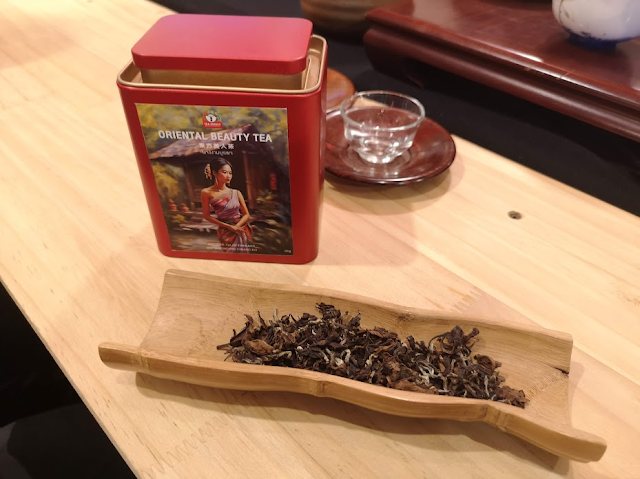

Thai Oriental Beauty is not bad, but then it's all relative


Monday, July 1, 2024

Thai tea expo / function in Bangkok Central Embassy


I checked out a local Thai tea event at one of many Bangkok malls, at Central Embassy, at the Open House area on the 6th floor.  It's the first such function I've ever been to in Thailand, beyond there being a few tea related booths at coffee and tea related events.  It was nice.

A series of special presentations is one part of that; a tea expert of some sort was presenting about Gongfu brewing and aged Shui Xian, it seemed.  I didn't catch that much of that; the point is pointing out that it extends beyond sales booths.  For people considering visiting they may want to check out that schedule and get in there; it all only runs for another 6 days.  There is also plenty to see and experience from the vendor booths.


The sales booths were fine, representing a broader range of tea vending than one might ordinarily hear of.  They were split between producer booths and other types of vendors, cafes and such.  I talked to the Taetea booth staff, to Emerald Thai Tea (a local producer who make different kinds, including some older plant pu'er), and to another specialty producer who makes a lot of types of teas in the North (Sawan Bondin).  I tried some teas at all three booths; that's a nice part of such an event, that people hosting sales booths are happy to share small cups of tea and talk about the products and background.

An old tea friend had a display there, Danitha / Pop of Chai Jin, a Japanese tea sales and ceremonial brewing themed place.  Zhennan is a familiar local cafe that had a booth, but I missed them being at the booth when I went by.  There were others; Pop was talking to another small shop owner who I've met before, Eastern Tea Concept, that I also said hi to.


So what would be the best draw there for people who are really into tea, or just curious to explore further?  Probably mostly just seeing the range, in case some of it really matches your own interest, and then you could buy some tea from them.  Being able to try the teas makes all the difference.  

It would be nice to support local Thai companies promoting better quality specialty tea.  My tea budget is deep in the red related to my family living in a high cost of living city on a Thai salary, in Honolulu, and I've spent more than normally allocate on Vietnamese teas recently, so my own tea spending is severely limited just now.  It was still nice meeting and talking to people.


I was asking one Thai producer and vendor about how sales would go through Myanmar, since of course they're having problems with civil war there.  He didn't know, but I met a private importer from China who was working with Myanmar tea just after that.  It made for a really interesting discussion, hearing about how things go there.  

A bit rough, of course; he said that I shouldn't be visiting Myanmar any time soon, but that with the right preparations, connections, and support he can still go there.  He said that the tea plants growing there are quite old and now integrated with old-growth jungles, kind of a common theme everywhere, whether or not it actually matches the marketing spin descriptions.  This is an interesting tangent, to me, which I discussed more in relation to Thai ancient trees and forests.


Emerald Thai Tea booth, worth checking out


those ancient forest sheng versions; it was interesting trying them there


How would someone really know tea plant ages?  You can't, really.  Variety Sinensis plants grow to be large shrubs or small trees and age to reduced productivity over a century or less, but variety Assamica plants (both Camelia Sinensis) can grow to giant trees, and some can live for over 1500 years.  Size isn't the best indicator of age; they will grow at different rates and to different sizes depending on conditions.

But with the right local context background you can at least place when tea was growing there locally, which should set a very general earlier original time when plants were introduced there.  I forget how many hundreds of years ago that related to the teas being sold from Northern Thailand; I think 300 years and 700 years, for two different versions, carried by the Emerald Thai Tea brand producer.

It sounds impossible, right?  Thai history must have been quite vague just 2 or 300 years ago.  People know who the King was, of course, and some broad details about industries and lifestyle, but drilling down to tea production is something else.  

But there was an earlier empire in the North that supposedly had clear ties to the tea production (per that discussion at the event, at least), the Lanna Kingdom.  Dating that time-frame and knowing of local tea production couldn't tell you any given plant's age, but it could support a real claim that tea was there in a given area then, or at least probably was.  That's a long time ago; who knows.  Let's check Wikipedia's input on that timing:


The Lan Na Kingdom or The Kingdom of Lanna (Northern Thai:, pronounced [ʔāː.nāː.t͡ɕǎk láːn nāː], "Kingdom of a Million Rice Fields"; Thai: อาณาจักรล้านนา, RTGS: Anachak Lan Na, pronounced [ʔāː.nāː.t͡ɕàk láːn nāː]), also known as Lannathai, and most commonly called Lanna or Lanna Kingdom, was an Indianized state[broken anchor] centered in present-day Northern Thailand from the 13th to 18th centuries.

The cultural development of the Northern Thai people had begun long before as successive kingdoms preceded Lan Na. As a continuation of the kingdom of Ngoenyang, Lan Na emerged strong enough in the 15th century to rival the Ayutthaya Kingdom, with whom wars were fought. However, the Lan Na Kingdom was weakened and became a tributary state of the Taungoo Dynasty in 1558. Lan Na was ruled by successive vassal kings, though some enjoyed autonomy. The Burmese rule gradually withdrew but then resumed as the new Konbaung Dynasty expanded its influence. In 1775, Lan Na chiefs left the Burmese control to join Siam, leading to the Burmese–Siamese War (1775–76).

Following the retreat of the Burmese force, Burmese control over Lan Na came to the end. Siam, under King Taksin of the Thonburi Kingdom, gained control of Lan Na in 1776. From then on, Lan Na became a tributary state of Siam under the succeeding Chakri Dynasty.

Throughout the latter half of the 1800s, the Siamese state dismantled Lan Na independence, absorbing it into the emerging Siamese nation-state.[3] 


That goes on to say that an important development step was consolidating local rulership and establishing Chiang Rai as a capital in 1262.  Of course it doesn't really relate to when tea was being produced.  If a local tea producer could somehow connect that political history with the tea industry history it could establish that production on the order of 700 years ago, or even a bit earlier, maybe 750.

Two people showed me pictures of old, giant tea tree plants; that's something.  No one really knows how old those are though.


Tae Tea / Dayi; it was nice trying some familiar range sheng pu'er there


Sawanbondin; a brand selling different ranges of teas and herbs


the Sawanbodin booth was especially nice for trying different versions


The state of better quality specialty Thai tea


I tried some relatively interesting Thai specialty tea versions back when Huyen visited in a local shop back in January, a higher quality level than I usually run across.  I've been buying and liking Wawee Thai sheng pu'er (or pu'er-style tea) for a few years, and my local friend Aphiwat makes fantastic local sheng, based somewhere near Chiang Mai.  

Plantations have been developing new styles for years, like Oriental Beauty / Dong Fang Mei Ren and red / ruby oolongs, long after producing Jin Xuan and other varietals from Taiwan as rolled oolong back in the 90s.  I keep hearing of new developments in making local gaba versions, and Thai shu pu'er.  Tea Side made small batch, basket fermented shu a number of years ago, maybe 5 or 6, so that's not really new.


So what else is new?  It would be helpful if awareness and demand for these teas developed.  People can keep on making better and more novel styles of teas, and I guess profiting from selling them when demand enables pricing spikes (I've seen them selling for the better part of $1 / gram).  But for it to become a normalized, developed market theme that exposure needs to broaden.  

I guess events like this one can help.  I might've saw a few dozen people there, not bad for one of the least consumer populated malls in Bangkok (nicknamed "Central Empty," I've heard).  There were more people throughout the mall too, hundreds of them; maybe it is finally catching on with a target consumer base.

Small cafes have been cropping up here and there more and more for years.  Then again some fail as businesses too.  There was a pu'er themed shop in Sathorn near where I worked, that's now gone, and the closest specialty tea shop, general in form, also went out, I think even prior to Covid.  There was a specialized Liu Bao shop nearby; I never did get around to checking that out, and it could still be there.  My favorite Tae Tea outlet shop closed, the one in Belle Condominiums, and another relocated, the one in IT Square, if I remember right.

I see notices for some places, new form cafes, hosting 2 or 3000 baht per person special tea type tasting events (($90 or so, on the high side), and if a local market audience could support that expense level specialty tea would be doing ok.  Peace Oriental, the main local hybrid-culture style place from years back, opened a relatively opulent branch in Gaysorn, essentially the highest end mall here, on the Central Embassy level, and kind of around the corner from it.


No one would ever know to what extent general specialty tea awareness and demand are picking up now since most sales would occur through an outlet like Shoppee or Lazada, the Thai versions of Amazon and Ebay.  I just reviewed two amazing green teas selling from there, and I would imagine that many of the outlets in this tea event would have online shops in those places.  

It's hard to get any feel for business level for sales channels like that.  Yunnan Sourcing, a main US vendor based there and in China, has a related Facebook customer interest group, and many vendors host Discord servers (groups), so you can tell, a little by the discussions, what the following is like.  I suppose if a vendor expands offerings over time they're doing ok, and if they go out of business they weren't.

It was odd not seeing teaware producers represented there; there was at least one of those at the last coffee and tea event I visited, last year.  Then again it's odd just seeing this kind of event being held anywhere, as the first and only tea specific event I've heard of in Bangkok, beyond tastings and such.  It's a good sign.


completely unrelated, a vlog style video Kalani (my daughter) made about it raining hard, more to show her take on it than the weather event