Wednesday, November 29, 2017

Pu'er storage optimums, and relative versus absolute humidity


Pu'er storage:  optimum humidity


I just watched a nice video by Scott Wilson (a Yunnan Sourcing vendor owner) claiming that people might prefer pu'er stored in either wetter or drier conditions (Hong Kong / Malaysia versus Kunming, wetter and drier, respectively).  It almost goes without saying that some people prefer varying storage conditions, younger versus more aged / fermented sheng, and different aspects, region-specific traits, and aging related characteristics beyond all that.  Or potentially some people have broad preferences, and they're not fixed on one optimum narrow range.


Steepster tea group discussion approached all this from an unusual direction  Someone asked why we aren't concerned with absolute versus relative humidity instead.  It's an interesting question, and one that takes some work to make sense of (unless someone is a meteorologist), so lets start with his following introduction example.  It's a bit of a stretch but I will drag this review of relative versus absolute humidity measurement back to the scope of what broader storage parameter selection means, but it's better to get into the meteorology side of things first:


Here in Stockholm right now the relative humidity is 80% at 7 degrees C and 998 mm Hg pressure. That makes the absolute humidity 0.006 kg/m3.  In Hong Kong today the relative humidity is “only” 73% but at 24 degrees C and 1014 mm Hg pressure which works out to an absolute humidity of 0.016 kg/m3... 

So if I was comparing humidity with someone in HK using only relative values it would seem like my tea is stored “wetter” than his, while in actuality his tea is stored at almost three times the humidity mine is.


Of course one issue is that if your tea is actually stored at 7 degrees that alone could potentially be a problem.  Aging is occurring due to biological factors, from the activity of specific bacteria and fungus, and I'm certainly not clear on the temperature window for them to thrive or just continue living but 7 C is getting down there (45 F).  Fermentation might well stop and not restart with exposure to that (or much over 38 C / 100 F).  But then I've not really ran across temperature range quoted for what will ruin pu'er related to aging potential.  I've seen speculation about that sort of thing, comments about how falling outside the range will lead to specific tea-aspect outcomes, but those are hard to evaluate and impossible to keep track of.

I did run through some related background in a post once, about what relative versus absolute temperature means (in a post about shou mei, kind of strange), where I showed a psychrometric chart showing how this works (the inter-relation of temperature range, absolute and relative humidity):


a bigger version of this chart follows


Those are actually the ASHRAE data center environment guidelines shown (optimum ranges for computer equipment environments, housing servers, presented for sea level pressure), if that sort of thing is of interest.  I could say a lot more about that part but I'll stick to tea here.

I've written a little about pu'er storage before (here) but focused more on the issue of air-flow, related to pros and cons of storing tea cakes in ziplock bags.  I referenced some background there, different perspectives, including a TeaDB blog article that defines "dry storage" as 60 to 70 % RH.  Things are never that simple, as this question of absolute versus relative temperature raises, but we can go with 60 to 80% as a typical storage range, for purposes here.  It's not completely clear to me at what humidity range mold thrives, and there may be no simple answer to that but "over 80%" tends to get mentioned.

Let's assume that a pu'er storage window is between 20 and 30 degrees C (68 and 86 F; kind of a normal indoor living environment range for people), and from 60 to 80 % relative humidity.  Again, part of the point here is to review if "relative humidity" makes sense or not, and postulating a starting-point range will help us sort that out.  That envelope looks like this (outlined in blue):


In terms of absolute moisture content (the graph bar on the right) it ranges from around 8 grams of water per kilogram of dry air up to around 22 (g/kg).  It seems like a good bit of range.  But what does that mean, beyond being the proportion of water in the air by weight (beyond the actual definition)?  It makes one consider to what extent air pressure and expansion changes things (the factor that causes hot air balloons to rise, so that kg of air varies in the space it might take up), but it seems as well to keep this review on the simple side, to not introduce extra factors.

In that thread discussion I rambled on a good bit about framing a context, and how I interpreted it, and why I chose 20-30 C and 60-80 % RH as normal-range parameters to review what absolute humidity was in a working range.  I had touched on some of that background in that earlier post about pu'er fermentation, but again that wasn't the main point there.  I'll quote my own comment in the Steepster discussion, but it doesn't work well to edit it down to a few sentences that are the main point (I ramble on a lot everywhere).


It’s a problem that there really isn’t one definitive, well-agreed guideline for any of this, a range of absolute optimum and also what lies beyond that as acceptable. In a Tea Addict’s Journal article (written by an author regarded as one authority on this topic, who is familiar with other inputs) he cites a range of 20 to 30 C as being typical / acceptable (70 to 85 F, roughly). Although he doesn’t state a clear humidity range in the blog article for wet and dry storage optimums but we could rough that out in a typical range of 60 to 80 % RH; much below that and tea won’t age, just above that it may well mold, and towards the top and bottom level wet and dry storage are represented. Mind you I’m not intending this as a last word; I mention specific values for the sake of further discussion, not final definition.

Of course the premise here was that RH means nothing, that between 20 and 30 C (65 and 80 F) the absolute humidity (grams / kilogram of dry air) shifts based on both temperature and RH... 

I’m not sure that’s actually being implied, though. My take is that an envelope of optimum range is being described between those parameters..  Per my understanding these functional ranges are derived from observing natural temperature and humidity ranges in natural and controlled environments where pu’er aging has been successful. Identifying one optimum where the related bacteria and fungus thrive is a different type of project, but then per some input...  periodic natural environment variation is sometimes considered positive, or maybe even optimum.

...The right kind of biologist could move off tea-related research and extrapolate more general micro-biological optimum environment parameter research to say more. Any theoretical optimums would still need to be filtered related to experienced tea-storage practice...

...We are also concerned with limiting growth of fungus that doesn’t taste good, and other optimum characteristics, which is all going to need to be judged subjectively in the end (tasted, not lab-tested, or both, at a minimum)...

...Related to the central point here note that if we really did want to move to discussing absolute moisture content in air instead (stated in grams of water in kg of dry air, or in dew point temperature levels, how that is phrased in meteorology) we couldn’t work from the same terms used in all those discussion, which is relative humidity. 


It's not very conversational, as tea group discussion goes, and a little chopped up to limit the length, but I guess that brings the main points across.  Note that I'm not really concluding much there, just talking around the background some.  A main problem with using absolute versus relative humidity is that everyone else is discussing relative humidity; it introduces translation problems.  Which I will work on fleshing out here, a little.

It's interesting to also consider that against what local environment conditions are like where tea is typically stored, in places like Hong Kong, Malaysia, and Kunming.  Before doing that, let's take that original question more seriously; what if we switch from relative humidity as a baseline to absolute humidity?  Let's use a similar approach, and suggest a range of 20 to 30 C for temperature (65 and 80 F; assuming typical room temperature storage), and go with 10 - 20 grams of water per kilogram of dry air as a starting point range instead, chosen to describe a similar environment window.


Any problems with that?  It seems likely that range on the upper / left side of the blue box (inside the orange control-limit range), above 80 % RH, may be too wet, that the tea really might mold stored in that range.  The lower-right corner of that orange box represents conditions at 30 degrees C, 10 grams water (moisture) per kg air, and under 40% relative humidity.  That would probably feel dry to a person, and possibly to a micro-organism living out a normal life-cycle that just happens to also be causing tea to ferment.  Or maybe not; what do I know about bacteria and fungus.


Optimum storage considered related to conventional regional storage


Leaving aside the in-depth absolute humidity concern, let's consider the typical range of experienced climate in Hong Kong, one of the main places considered for natural "wet" storage:


Temperatures do dip slightly below 20 in the coolest season but fall within that 70-80% RH range for ideal "wetter" storage.  Let's check one for Malaysia (this version from Penang, in the North there, but I get the impression weather is a bit consistent in Malaysia):


So much for those people experiencing seasons.  The temperature couldn't be much more consistent but the slight variation in humidity does imply precipitation changes, which are shown in that related precipitation summary graph:
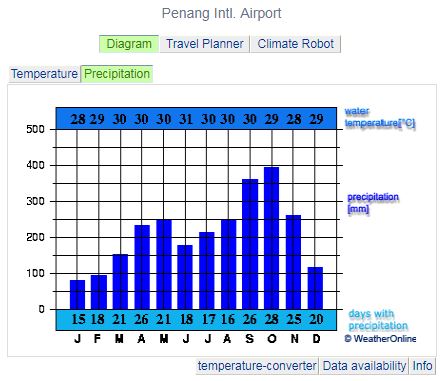


Interesting.  Our rainy season here in Bangkok is May through October (half the year, but often rainier at the end of that).  The "cool" season is a slight dip in temperatures in December and January, and then it really is a good bit hotter in March and April.  It doesn't completely match up with there but a lot of that overlaps.  It should; Bangkok isn't that far from KL (Malaysia is the next country down), and it's even closer to Penang.

The point?  These places are where pu'er is supposed to age best, but only if one prefers relatively wetter storage.  The natural environment range is actually relatively narrow, because they're in similar places as local climate goes.

Let's take a look at Kunming, the place Scott (of YS) initially suggested might represent good dryer storage:


Temperatures run cooler but not cold; the lowest outdoor maximum is 14 in December and January, or 57 F.  Of course a warehouse environment could be controlled further, if a temporary drop below some minimum was a concern.  Humidity dips into the 50s for two months but is more typically in the 70s (RH, of course).  If the indoor warehouse-storage goal there is to keep temperature between 15 and 20 (C, more like 60-70 F), and humidity between mid-50s and mid-70s (RH) the building enclosures leveling out daily variations would accomplish most of that.  It could just get a little cool in parts of December and January, and April is the only month it might dip below that bottom limit for humidity (52 is an average).

Special concerns related to heated indoor air


In US and European indoor environments the main concern relates to outdoor cold air not containing much humidity, so that after you heat that air indoors it becomes quite dry (the air would naturally mix).  The most moisture that air can even possibly hold at 12 C (54 F), the dew point at that temperature, is right at the lowest point of that pu'er window I'd defined earlier on that psychrometric chart, around 8 or 9 grams of water per kilogram of dry air.  But again, I'm not claiming that is an informed optimum range, just a rough working version of that sort of thing.  As you approach water freezing temperature air doesn't hold much moisture at all; it simply can't.  That's why winter-time outdoor cold air can so frequently feel very wet (kind of counter-intuitive, that part); because if a cooling trend is occurring it's really easy for air to be at or near a dew point, where fog occurs, and the moisture naturally condenses out of the air (more on that here).


Some of the outdoor weather range for Kunming is slightly below that 12 degree level I just mentioned, at least in terms of daily minimum values.  If you heat air at or below 10 C / 50 F back up to 70 F (room temperature) without adding more moisture regardless of the starting RH level the final indoor humidity would be very low, well below 50%.  The dew-point level for air at 0 C (32 F; did I really need to convert that?) is below 4 grams per kg of dry air, an absolute level of moisture that relates to under 20% RH at 20 C (68 F).

Of course air in Kunming pu'er storage warehouses isn't shifting about related to temperature or humidity, so the case is a little different than for someone's home, where air mixes freely.  I'm really onto to talking about issues with Northern latitude home storage; natural China-region storage was the last section.  Or the far South, there's just less people down there.  I just looked that up and the South of Australia and South Africa don't extend as far below the equator as Philadelphia is North of it (both of those to -38 degrees and -34, respectively, and Philly is at 39).  Only Chile and Argentina extend below those levels (of populated areas; obviously researchers in Antarctica are using pumidors).


it doesn't snow much in Kunming, but it did in 2013 (photo credit)


Pulling it all together


Unless I'm summarizing it wrong Scott is saying that people claiming you need some controlled, narrow-range optimum for pu'er storage doesn't match his own experience, that it still ages across a range of environmental conditions, the process just changes.  But when he's saying he likes "dry" Kunming storage that's still based on an outdoor humidity level that is above 60 % (RH) for all but two months, and per the one reference graph shown at an average of 57 for one of those months.  We're not seeing equivalents to US outdoor temperatures or humidity in those places, and the real concern would be indoor, adjusted-temperature humidity values.

Scott doesn't drop into talking about environment specifics much in that video, probably because that gets so complicated, but he does mention at one point that as long as relative humidity is above 50% the pu'er should still be ok.  He makes a good related point:  it's not really pleasant for people to live in indoor environments at very low humidity levels either, so in a sense it's about maintaining conditions that are comfortable for a person and also ok for stored tea.

I lived in the mountains in Colorado for quite awhile, where it was below zero C (under 32 F) for about half the year, where literally thinner air--less of it; I lived at over 7000 feet of altitude--made conditions worse, and it typically felt really dry indoors.  Stored pu'er might die, without adding environment controls.  Of course to really investigate what was going on up there for local climate checking out psychrometric charts for higher elevation (lower air pressure ranges) would make sense, but it seems as well to keep this simple, to not pursue that tangent.


in an earlier life


With the proper environment adjustment (use of a "pumidor") someone in any natural environment could move on from concerns about natural conditions and consider instead where to set the controls.  I have no idea, but I guess these natural environment ranges (the local climates) where storage is considered to be good to ideal for wetter and dryer storage would provide a starting point.  That was sort of a main theme in what I said in that thread discussion, and the point of that section of location graphs; we may not know storage conditions ideals for pu'er fermentation but a best storage range isn't a total mystery.

A second part of that discussion comment was about how that discussion prompted me re-read a number of old references on this subject.  I won't go further with speculating about these issues but I will leave off with mention of that reading list:


The Tea Addict's Journal "Ideas of Proper Puerh Storage" post (that I already mentioned):

http://www.marshaln.com/2012/03/ideas-of-proper-puerh-storage/

A Tea Chat forum discussion of "Pu're Storage in Low Humidity":

https://www.teachat.com/viewtopic.php?f=20&t=11148

A Cha Dao reference blog series on aging pu'er (the last article in a series of five, which links to the others)

http://chadao.blogspot.com/2008/10/perspectives-on-storing-and-aging-puer_15.html

This last reference is a research article reviewing the measured levels of biological activity in pu'er (bacteria and fungus causing fermentation in sheng and shou).  It doesn't go into environment factors, but is a good reference for that context of concerns (keeping those organisms alive, but then in conditions where they can thrive too much other fungus that grows as mold also might):

http://journals.plos.org/plosone/article?id=10.1371%2Fjournal.pone.0157847

Monday, November 27, 2017

Is there one best oolong brewing temperature?


This is about there being an objective best case versus subjective preference variation related to water temperature used to brew oolong.  That's not catchy, is it?  Let's try the popular media version:

Do you like your oolongs steeped in boiling point water, or use water that's a bit cooler instead?  Some people claim there is one right answer.


Of course personal preference relates to some degree to every choice and sub-theme related to tea.  Or does it?  Are tea bags generally inferior to mid-range quality loose tea?  I think so.  I guess you could still put those teas in a bag and they wouldn't turn out so differently, but that's complicating the real issue, the actual generality.

Would most people agree that green tea should be brewed using water at less than boiling point temperature?  Sure.  Even an issue like that one, selected to have one clear answer, might not be as objectively clear as it first seems. 

As a bit of background, different references say different things about what temperature to use for oolong.  Check out this version from the Reddit tea subforum page:


There it is then; brew oolongs at 85 C / 185 F, we're finished.  Or maybe not.  That guide may apply better to Western style brewing than Gongfu style, even though one doesn't typically encounter the idea that temperature choices would vary uniformly between the two approaches.  They can, though; along with using a higher proportion of tea to water using much shorter infusion times can serve some of the same purpose as moderating temperature, related to offsetting astringency or other aspect range that could be experienced as negative. 

Since this subject came up related to a tea group discussion let's start from there instead.

Brewing oolong at boiling point temperature


Someone asked about staff in Taiwanese tea shops universally brewing oolong using boiling point temperature water in the Gong Fu Cha FB tea group.  This triggered an interesting discussion of whether or not water at that temperature really is best for preparing oolongs or not.  There are lots of references and tables out there related to standard brewing parameter suggestions (I wrote about that awhile back) and those vary for oolongs.  To summarize, several different opinions emerged:


-brew oolongs using boiling point water temperature, obviously (about half the responses, or maybe just over that).


-only flawed oolongs will give better results at lower than boiling point temperatures, related to offsetting flaws; use boiling point temperature water for every high quality oolong type.


-only brew the lightest versions at lower temperatures (the least oxidized, in this context, although the styles discussed also tended to be less roasted too).


-brew oolongs at whatever temperature you prefer the outcome related to; subjective preference for specific aspects is the ultimate guide.


The argument for the "only use boiling point" option is that tea components extract differently at different temperatures, and for better quality teas--combining the first two answers, sort of--that's really the optimum.

I was arguing for the last, more or less, but probably as much related to defending people's option to prefer whatever parameter they want.  I do tend to brew most oolongs using boiling point water, although I also shift parameters quite a bit, to see what happens related to that.  Per my understanding it does just vary the aspect range a little if you use slightly lower temperature (90-95 C, 195-205 F).  When experimenting with different oolongs--they come in quite a range of types--some do seem better prepared at slightly cooler temperature. 

Of course it is hard to exclude quality level and flaws in specific teas as a factor related to that, and it's impossible for me to taste a tea using someone else's aspect preferences (their sense of taste, in the one sense).  I guess it's conceivable that I'm just not drinking good enough tea, or that my own flawed preferences are a problem.  That sounds like I'd be joking (and it can be hard for even me to tell when I am or not), but preferences do tend to shift over time, and I'm definitely not claiming to have arrived at a God's eye perspective on tea, just somewhere in between only getting started and having sorted some things out.


all different oolongs, but only part of the range


For Dan Cong it depends on the character of the version; some tend to be softer, and boiling point water is fine, and if that characteristic astringency is a bit more intense using slightly cooler water moderates that (versus using flash infusions; both will work, but the results aren't identical).  I'm not so sure that would be a case of a tea considered as flawed, since those teas vary by lots of factors, but of course teas come in a range of quality levels, and it does seem like less of an issue for better versions, so maybe it really is that simple.  I've tried versions sold more as commercial, mass produced Dan Cong that were different in quality and character, but they vary by plant type / aspect range in better versions too.  Ya Shi (duck shit) tends to be softer and more subtle than Mi Lan Xiang, for example (or also aroma based versus flavor intensive, per a different way of using some terms, but that also introduces a second set of concerns).

One comment by Thomas Smith attempted to explain an actual difference in using slightly cooler water, about changes that go along with variation:


[Brewing at boiling point] Definitely pushes more taste to the forefront, bringing it more in line with the intensity the aroma can provide. The cost seems to be a reduction in the ease of distinguishing taste characteristics, a skew of sourness over sweetness, a move to flavors closer to darker leafy greens and citrus in the lighter oxidized teas (as compared to romaine/endive crispness and a fruitiness closer to pomes and drupes), and a slight comparative dampening of aroma in secondary and tertiary infusions. Can provide more heft, though, which can be pleasant.


Interesting!  He added more to that, within the context of additional discussion:


Hotter water can relinquish more solutes more readily, but can also more rapidly force volatiles out of solution, leaving the aroma potentially less complex by the time it is consumed. Certainly not a huge issue for many wulongs, but a factor in some. And, as indicated earlier, oversaturation can diminish one’s ability to actually perceive the full complexity that can be achieved. The compounds that are soluble at appreciable levels with 100 degree water when steeped at typical short brewing times are also soluble at 85 degrees, given slightly more time. There is merit to experimentation.


A couple of those are subtle points that could easily be taken the wrong way, extended to mean something they seem not to intend, or to reach specific conclusions that really aren't being argued.   As I took it he's not really making a case for or against brewing at any temperature in those comments, instead talking around related factors.  Anyone interested in running through all the points made on either side--or the various sides--can take a look at the discussion, since individual comments and points would be in response to the others.


Related to green tea brewing in Vietnam


The grounding of any optimums in tea preference is problematic.  Even for that same point related to green tea, for which almost no one is ever going to advocate use of full boiling point temperature, it's my understanding that it is completely conventional to brew green tea at that temperature in the Vietnamese tea tradition.  The idea is that some people there love the astringency and bitterness that results from that practice (or so I take it).

Of course you can't generalize a whole country like that, and it's likely that not only are some people influenced by lots of factors (foreign traditions, personal experience, and whatever else), there are also regional variations in both teas and brewing conventions.  I just talked to Huyen about that (that friend who sent some Vietnamese tea samples), and she confirmed that there are really two schools of thought about green tea brewing temperature there.  What she actually did say:


green tea brewing at boiling point in Hanoi

With green tea: there are 2 ways brewing. First, if you want to focus about the flavor, you can use boiling water at 95-98 degree.  But if you want to focus about the taste, you can brew at 80-85 degrees.  The time to steep tea is 20-25 seconds.  That’s my way to brew tea.


Someone might justifiably claim that flavor and taste are synonyms, so opposing them doesn't work (or the same would apply slightly differently for the Chinese description opposing flavor and aroma, really, since taste is tongue-based but most of flavor is really aromatic component based, that is, aroma). 


I think what's going on in both cases are references to real, valid distinctions, just framed in these other cultural and language based contexts, which aren't translating well.  Once you try two versions of the same tea, one described as flavor-intensive and the other aroma-intensive (not related to Huyen's comment, still on the Chinese descriptions framing), then you know exactly what that means, and it makes sense.  My take is that there's probably more of a translation issue going on, that these are extended from use of Vietnamese terms.


If the distinctions in what we taste with our tongue versus what's picked up through aromatic compound sensation--and the related terminology--isn't familiar I'd recommend Barb Stuckey's video reference (the author of Taste What You're Missing; that would also work for further reading).


Related to it being one of two common conventions to use boiling point water for green tea in Vietnam (per this account), then could we claim that a broad part of the entire local tradition and those individual shared preferences are somehow wrong?  If the benchmark is inter-subjective agreement among Western tea enthusiasts then maybe we could; it might be that they're doing it wrong.

Or maybe not.  I ran across a reference source claiming that green tea should be brewed using boiling point water not so long ago (not expressed quite that simply, in a Tea Master's blog post on green tea).  This could be just be my impression but there seems to be a broad, general divide in tea preferences between people claiming that any tea should be brewed using boiling water, and very short infusions, with others holding more to the ranges expressed on charts and such.  It may be that the generality correlates quite a bit with regions or branches of tea traditions.


really nice Assam oolong (reviewed here); but as well to not complicate this


McDonald's hamburgers as an analogy for rejecting subjective preference


An influential and experienced member of the tea community provided an example of a broad inter-subjective agreement that we could define as wrong:  if a group of people were to choose the objectively best burger alternative between McDonald's versions and a high-quality fresh-ground version (Angus beef or the like), and some chose McDonald's versions as their favorite (which would actually happen), couldn't we say their preference is wrong?  Phrasing for that gets tricky, doesn't it?  It's hard to express "best" in such a way that it's clear that you don't mean "according to personal preference," since that is one thing that would tend to mean.

Why is McDonald's burger version clearly inferior?  Let's start with the beef itself:

Thankfully, McDonald’s and several other chains recently stopped using the “pink slime” in their beef. But the vast majority of fast food beef comes from CAFO (concentrated agricultural feeding operation) cows. Not only is this horrible for the animals and the environment, but eating meat from sick animals will only make you sick.  Eat a McDonald’s hamburger and you might be getting a mouth full of antibiotics, hormones, and dangerous bacteria.


Beyond all that (some of which you may not actually be able to taste) there are over 50 questionable chemicals and additives in a single burger (including the other ingredients), per that article, and it's not even possible to order those cooked to specific temperatures.  They're just not great.

As I interpret this we're not comparing McDonald's food to the local steakhouse burger version, per the tea brewing temperature analogy; it maps closer to the "best burger in Bangkok" debate that never completely stops in a local FB foodie group.  Maybe somehow one of those burgers really is best, but it seems more likely that most could agree some of the outlier opinions are based on an odd preference range, or perhaps limited exposure to the others.  Maybe it would be possible to come up with a short list, to identify some answers and preferences as more correct.  No one even jokes about McDonald's being best in that group; if they were having a bad day the admins might ban you.


I'm not really finished with mapping out all of this oolong brewing temperature issue, but as I see it there is no end to it.  It seems likely that as with exposure to a broad range of foods--corresponding to McDonald's foods lovers trying a range of fresh food alternatives--people would gravitate more towards consensus opinions.  I can't say if everyone would only use boiling point temperature water for oolongs, with enough brewing experience, and if using the highest quality tea versions.


A friend brought up a related point when talking about tea-houses in Taiwan a couple months ago; to him they tend to brew tea too strong, seemingly appreciating the feel and aftertaste aspects in the tea more than the flavor, and ruin the effect of the taste by over-brewing, per his preferences.  That was seconded by a relatively identical comment in that discussion.  That doesn't map directly onto the hot water versus slightly cooler debate for oolongs, but some of the same concerns could just be playing out a different way. 

Another friend added a thought that muddies the waters just a bit further:  a cigarette smoker would be more inclined to favor stronger flavors, perhaps even flavors in a certain range, and this could push them towards distinct preferences (eg. oolongs brewed at boiling point, versus liking some types of oolong brewed cooler).  It's sometimes mentioned that a lot of exposure to tea leads to preferences skewing in certain directions, not just related to being more right, to fine-tuning awareness, but also to natural progressions occurring.  I've discussed this in relation to de-emphasizing flavor as a main factor in the past, but I've seen it mentioned related to flavor range too.


another interesting non-standard oolong, from Toba Wangi in Indonesia 


Conclusion


To me there is an interesting tension between two competing ideas: 

1)  personal preference ("taste") is individual and varied, and differing opinions can be valid

2)  with enough exposure and progress along a natural preference curve there are consensus right answers related to patterns of agreement (objectivity in the sense of inter-subjective agreement). 


I'm not really arguing for or against either, I just don't see one simple answer as identifying the facts of the matter in most cases related to tea preference.  Sometimes it works better to say "beginners tend to like that aspect range, more experienced tea drinkers this other," but for any one outcome it's rarely that simple.

Since lots of people gave a lot of great input it's also worth reading that group discussion, in light of these sorts of concerns, of course also based on one's own experiences in brewing oolongs.

Thursday, November 23, 2017

Vietnamese snow tea (Ha Giang province green tea)


More about that online friend in Vietnam sending teas to try, tea shared by Huyen Dinh (which will be a tea exchange, once I get around to sending some back).

Huyen, with a cool little teapot (which is quite old)


I thought I might have tried snow tea before, a tea I picked up travelling around the Hanoi area, but that may correspond more to another version Huyen labeled as "ancient tree," from the Son La province instead.  That earlier ancient tree version reminded me of pu'er; a bit bitter, a little dry, and interesting.  Looking back at that post it seemed a little rough, from March 2015; I was still working out some basics related to both tea and blogging (and it may not have been similar; that part was just a guess).


This version was labeled as both green tea and snow tea.  There was no reference to ancient trees, as on the other sample, but I think this may be from "wild" (feral) old shan-type trees in the far North, but that really is as much a guess as anything. 


Again I'm not going to have a specific original source to share, but Huyen does work for a local gift and local-goods sales company that does sell some teas.  Maybe this one, but since it's not a conventional tea business contacting them to review specific tea versions could be a challenge.  The company is Trà Việt (their website contact here), which has gift-shop / souvenir sales locations in Hanoi, Da Nang, and Ho Chi Minh City (Saigon).  It really doesn't look like they're set up for international tea sales through a website but someone could still try out paging through an automatically translated site version to see what turns up there; there are tea gift sets on the site.

locating Ha Giang (credit Hatvala site, a different vendor)


For tasting context, at time of tasting I was well along the way of wrapping up being sick with a throat infection.  My sense of taste seemed almost completely normal again, but I was still a bit off in general then.  I passed on a Lao Ban Zhang vertical pu'er tasting today, held by the same people who did a Yiwu tasting session version (mostly Bank), because it seems like drinking 20 or 30 small cups of intense tea might not be a good step towards being finished with all that.  It's funny how when you're sick even if the illness isn't so bad there's that focus on being done with it.

Review


The tea looks whitish-grey, a bit curled, not exactly like other teas one tends to run across (although a "fish-hook" sort of style is normal for Vietnamese green teas, just not this color).  The initial infusion does taste like a green tea, sort of, but not all that close to other green tea versions.  The pronounced mineral aspect does match that in the standard Vietnamese green teas (Thai-Nguyen region green teas).


It goes without saying but I'm using water below boiling point for brewing, just not on the low side for green teas.  It might be typical to brew this using boiling point water in Vietnam, to really allow the bitterness to come out (funny how that came up again in talking about oolong brewing temperatures; I'll probably pass on more about that later).  Of course I'm really talking about the flavor being bitter, not mis-labeling astringency, as does tend to come up.  A Gongfu approach is also probably not standard, but really using Western brewing with hot water isn't going to change things entirely, it just shifts aspects balance a little.


A second infusion, also on the short side, is similar, maybe warming up a little and picking up a little depth.  Bitterness stands out, then the mineral base after that (towards flint / chalk / limestone; a lighter version).  Beyond that there is some vegetal range, along the lines of kale, and some sweetness.  That sweetness seems to bring in a trace of a richer depth, something minor, buried in with the other complexity, along the lines of sugar cane, or maybe even maple syrup.  The tea has a lot going on.  The bitterness doesn't make it an automatic favorite but if that fades just a little and other range picks up the balance could be really nice.


a bit light in the early rounds, but with plenty of flavor


On the next infusion I let it go for about 45 seconds, not intentionally checking a stronger infusion, typing an idea at the start and not paying attention.  One might wonder, how could I have developed an internal clock, and to what extent are those times ever really accurate?  It wasn't from spending years brewing tea with a timer.  I worked as a waiter (restaurant server) during an earlier life-phase, and that entails converting your consciousness into a timing device, along with picking up a few other capabilities (multi-tasking, reading people, not freaking out when you're in a hurry for hours on end).  And I used to cook, a lot, and it more or less has to become natural to access an internal timer for that.  It was natural for me to just time brewing based on estimation when I first started on loose tea, probably 9 years ago now, and by the time I became more serious about it around half that long ago I'd already been estimating timing for awhile.

This tea is nice and bitter brewed stronger; it's interesting to experience that way.  It crowds out the rest a little but there is plenty to appreciate about the range, and I think it's transitioning a little too, "warming," if that makes sense, probably moving into a light spice range as much as anything.  Flaws in this tea would be more evident brewed this strong but the balance is good, and the feel is nice, with an interesting aftertaste (quite strong, brewed stronger).  Is it hui gan?  Maybe.  I'm going to guess yes, but I suppose at some point I'll just start winging it and saying that aspect is that when I think it is, as others tend to.  I should send a little of this tea to my Chinese-Malaysian friend for a ruling.

Back to normal infusion strength the next time (four--I'll count them); the tea hasn't changed a lot but the balance of the same aspects is shifting.  The bitterness isn't dropping out but the tea is falling into a more even balance, and although it does seem to be "warming" slightly there's more added in vegetal range than something else, at this stage.  Kale may or may not sound nice in a tea; I guess it depends on how someone relates to the taste of kale.  My main natural preference is for black teas and roasted oolongs, so richer, sweeter, more cocoa / cinnamon / fruit / baked yam flavors, but I can still relate to this; I can appreciate and even like it.  The style may not be a close fit for everyone--and to some extent that's where I am--but somehow this seems like "good tea," in some odd, objective sense.  The flavors are clean, the feel is nice, aftertaste pronounced and positive, and it balances.  It is a little bitter though.

Bitterness keeps easing up in the next infusion (5) but that mineral expands to even include some metal range.  Now that does sound odd; a tea tasting like a spoon that you can taste, when you shouldn't be able to.  On the next infusion (6) the tea has softened into a more typical green tea range; the bitterness and mineral tones have faded back, leaving more vegetal character as dominant, and room for other space.  A bit of woodiness adds some depth, which does track a little towards spice, it's just not close enough to that range to really pick out one (cinnamon versus something else, etc.).  I suppose the kale is expanded too, as much green bell pepper now as kale, which probably was already evident an infusion or two ago.  This tea version definitely seems more like a traditional Vietnamese green tea than any other type but it's also clearly not identical to those.  Of course I can't speculate if that's because of a varied plant type input, growing condition, or processing step; how would I know that.


Infusion times are up around 30 seconds now just to get infusion level strength up to a normal level, and it seems to be fading, that it will require closer to a minute from here on out.  It didn't exactly fade quickly since I'm on infusion 7, and it would easily brew several more.  It hasn't changed much, but the current aspects range (in relative order) are green pepper, kale, mineral, wood, metal, and bitterness, with a good bit of depth suggesting added trace aspects beyond that, the complex range from sugar cane, with a bit more warmth seemingly related to that.

Or maybe an aspects list isn't familiar to everyone, and some strange comparison instead would help.  This tastes a bit like biting a tree branch bud.  I don't keep track of those (the tastes of different trees, or different parts of trees), but in earlier rounds it was like a more bitter version of a tree branch bud, and in later infusions just complex, and not as bitter.

I'll wrap this up for now, at least the notes part, although it will keep going.  I'm sure there will be some deep thoughts and conclusions to add in editing, but in general I liked the tea, it was interesting, and had a lot going on.  Bitterness could really put someone off, but although that's quite far from my favorite flavor-aspect range (along with the kale and green bell pepper) I still liked it.  The overall complexity made it work for me, which extended beyond flavor aspects, and the transitions made it more interesting.

Post-script


In talking to an online friend with lots of experience with Vietnamese tea he mentioned his take on bitterness in tea; he sees it as flaw related to processing that could be improved upon.  It's hard to say if that even could be the objectively correct fact of the matter, but it stands to reason that processing may be a related factor, and that leaf characteristics prior to processing are another.  My understanding of his point is basically that the same leaf could be processed differently to not be bitter.  Personally I have no idea about that, just passing it on.

Of course sheng pu'er is the main tea type I've tried that includes pronounced bitterness, not always, but it's not exactly atypical, more the opposite in younger versions.  Some people seem to be ok with sheng being bitter, and per my understanding both bitterness and astringency may not be seen as negative in green teas in Vietnam, which is why it's not a given to use slightly cooler water to offset at least the astringency part.  According to Huyen there are two schools of thought on that, and two different preferences, either using near-boiling point water (even for green tea) or water down around 80 - 85 C instead.

I hadn't intended to pass on much for sources but this tea is almost certainly from local variations of Assamica tea plant types.  Since I've just talked to a number of people involved with selling tea in Vietnam about it and that was taken as a given by all of them, that tea from this region is typically local Assamica plant types, it seems quite well established.  It would probably be identical or else closely related to the "shan" tea types listed in this reference (a plant-type study conducted in Taiwan), but that conclusion is just speculation.