Showing posts with label humidity. Show all posts

Wednesday, May 22, 2019

Pu'er storage background and research summary


First published by TChing in three parts, here here, and here.

I've relatively recently written a couple of articles on pu'er storage for Moychay, a Russian tea vendor, as part of helping them develop English language based content.  In general tea writing is just a hobby for me, not tied to any compensation, but this has been a limited exception, with the proceeds quickly converted into some extra sheng cakes.

Pu'er storage isn't the same kind of concern for me as for most others based on where I live, since the main concern in temperate climates is maintaining a window of relatively higher humidity in colder times of the year when it's drier indoors.  Bangkok stays quite warm and humid.  It's essentially similar to Malaysia's climate, which is regarded as very suitable for sheng aging.  Malaysian storage, and especially a consistently high level of humidity, can lead to teas picking up a slightly earthier flavor, in addition to transitioning relatively quickly, but with Bangkok experiencing some slightly drier seasons that particular characteristic flavor change may differ.

To keep this post short I'll only summarize the four prior posts I've written about pu'er storage.  The first two in my own blog were entirely research based, as part of initial investigation of the topic.  The third is a summary, posted to the Moychay site, an overview of what is conventionally expressed about storage conditions in online references and discussion.  The fourth cites blog sources covering that research input as citations.  It mentions two unique references, one on creating a home-made version of humidity control salt-packs, and a second about a series of controlled storage temperature experiments, isolating the same teas in two conditions over time to review outcome differences.

I've been drinking a considerable amount of both sheng and shu pu'er over the past two years, following four more or so of dabbling, but really that's a work-in-progress related to personal experience informing this subject.  That recent wave of purchases has included young sheng (not yet significantly aged), middle-aged versions (which would invoke some degree of varying results related to conditions and starting points), and more fully aged sheng versions, but not enough of those to separate out aging conditions and location as an input compared against other variables.

Onto summarizing those articles' scopes:

Pu'er storage and fermentation (posted September 2016):  a general topic review based on research, along with more focused consideration of an air contact / airflow related theme, the idea of sealing individual tea cakes in something like ziplock bags versus more conventionally not doing that.  This touched a little on optimum humidity range and managed conditions versus natural climate in better known storage areas (Hong Kong, Malaysia, etc.), but the next blog post goes further, with the last going more into opinions on setting controls.


Pu'er storage optimums, and relative versus absolute humidity (November 2017 post):  beyond exploring the same general themes a little more, and going further with citing natural climate condition summaries, this explores what relative humidity means, which helps explain why indoor levels are so low in cold seasons in temperate climates.  That part might be a bit academic for some.  Control conditions and charting related to my day-job background (data center operations and process auditing) help explain how the same concerns could apply to pu'er, and how much water the air can hold at different temperatures, defining relative humidity.  It's not difficult to look up climate stats for places like Hong Kong, Malaysia, and Kunming, and this covers that.

Hong Kong annual climate summaries


Pu'er storage environment basics (part 1 of 2 articles written for the Moychay vendor site):  the basics, informed by extensive background review for the second article, also grounded by the previous 2 + years of review and public discussion.  It's a complex subject, with some debate over finer points, but the basics aren't that complicated.  This article covers review of optimum humidity in controlled environments (the main concern), air contact / airflow issues, temperature, isolation from external scents (including separating sheng and shu), likely effect of too-dry storage over the short term, avoiding mold, and typical steps to control humidity.  Rather than accept my own summary of a good indoor storage solution control range it's better to hear what works from a number of people who have done their own long term experimentation, which the next article goes into.


Pu'er Storage Environment Part 2: References, Environment Maintenanceuse of supporting references enables taking the concerns a little further.  I've not ran across research content on pu'er storage in the form of academic material, because it's just not that kind of subject, more an isolated practical concern among a very narrow interest group.  To compensate for that subject specialist blog input was used here.  Sources vary in relation to how much personal experience each author and source drew on, with two cases based on experimental results instead (in duplicating commercial salt-pack control devices, and experimenting on temperature as an input to storage effect).

The subject of optimum level of controlled humidity was reviewed from most if not all sources.  One recurring theme is that it's not possible to look at weather-climate graphs and try to duplicate that in indoor storage environments, for different reasons.  This Yunnan Sourcing vendor take by Scott Wilson covers a range of background issues well about that, a reference I don't think I cite in any of the articles.  One point he made stuck with me, one that doesn't tend to come up in discussion much:  rather than trying to seal and closely control humidity in a very small storage space it might work for some to keep their living-space humidity comfortable for people, which could also work out for sheng fermentation purposes as well.  There would be limits to that approach working out, depending on local factors and specific goals and preferences, but taking on related points of view from informed sources definitely helps.

amazingly that's it, a functional salt pack (Tea Forum source)


It's problematic to summarize those citations and opinions as reaching one uniform consensus related to one limited point, since they really don't.  But as a general rule opinions on humidity control typically cited around 60% RH as a reasonable control level to support faster sheng fermentation over time, with 70% RH and above more prone to risk of mold of off flavors developing, and 50% RH and under reducing speed of fermentation.  The additional points on how air contact and temperature also affect fermentation and mold risk are critical.

The salt-pack humidity control replacement solution is particularly novel.  Combining specific proportions of sugar and salt (ordinary versions) results in a mixture that will both absorb and release humidity at a designed control level, the same function typically achieved through use of commercial products.  The controlled temperature and humidity experiments cited from the Late Steeps blog really represent some amazing work.

It all can't really answer specific questions like "are my natural home environment conditions suitable for sheng storage and aging" but the last two articles could serve as some well-grounded input.  One might naturally be concerned about the value and reliability of the referenced sources, a point addressed in the summary article, which describes those author's prior writing history and my take on their degree of experience.


global relative humidity in real time; not helpful, but cool (site credit)


As in my own case when other bloggers are basing opinions and ideas on very limited personal experience, and also on forwarding the ideas of others, it's helpful to get a feel for the form and extent of that actual experience.  Being widely regarded as a long-term subject specialist, as one writer cited is, makes for a more promising start, but even then multi-sourcing can help compensate for potentially outlying opinions stemming from unique preferences or personal understanding.  A risk comes with that too; hearing ideas that are actually wrong from multiple sources can make them seem very likely to be true, and potentially bad input along with the good can make the rounds in narrow-field pu'er discussions.

I'm still putting it all together myself, and these writings represent an in-progress attempt at topic reference summary.  This approach tries to explicitly identify and draw on other sources, which are grounded in different ways.  Such an approach could be much more mature and developed if based on even more extensive subject-expert referencing, which is possible, but people in such positions typically utilize that knowledge as a commercial resource, and share it sparingly.  In another decade current consensus views (typical takes) will probably evolve further, even without reviewers taking such summary steps.

Wednesday, November 29, 2017

Pu'er storage optimums, and relative versus absolute humidity


Pu'er storage:  optimum humidity


I just watched a nice video by Scott Wilson (a Yunnan Sourcing vendor owner) claiming that people might prefer pu'er stored in either wetter or drier conditions (Hong Kong / Malaysia versus Kunming, wetter and drier, respectively).  It almost goes without saying that some people prefer varying storage conditions, younger versus more aged / fermented sheng, and different aspects, region-specific traits, and aging related characteristics beyond all that.  Or potentially some people have broad preferences, and they're not fixed on one optimum narrow range.


Steepster tea group discussion approached all this from an unusual direction  Someone asked why we aren't concerned with absolute versus relative humidity instead.  It's an interesting question, and one that takes some work to make sense of (unless someone is a meteorologist), so lets start with his following introduction example.  It's a bit of a stretch but I will drag this review of relative versus absolute humidity measurement back to the scope of what broader storage parameter selection means, but it's better to get into the meteorology side of things first:


Here in Stockholm right now the relative humidity is 80% at 7 degrees C and 998 mm Hg pressure. That makes the absolute humidity 0.006 kg/m3.  In Hong Kong today the relative humidity is “only” 73% but at 24 degrees C and 1014 mm Hg pressure which works out to an absolute humidity of 0.016 kg/m3... 

So if I was comparing humidity with someone in HK using only relative values it would seem like my tea is stored “wetter” than his, while in actuality his tea is stored at almost three times the humidity mine is.


Of course one issue is that if your tea is actually stored at 7 degrees that alone could potentially be a problem.  Aging is occurring due to biological factors, from the activity of specific bacteria and fungus, and I'm certainly not clear on the temperature window for them to thrive or just continue living but 7 C is getting down there (45 F).  Fermentation might well stop and not restart with exposure to that (or much over 38 C / 100 F).  But then I've not really ran across temperature range quoted for what will ruin pu'er related to aging potential.  I've seen speculation about that sort of thing, comments about how falling outside the range will lead to specific tea-aspect outcomes, but those are hard to evaluate and impossible to keep track of.

I did run through some related background in a post once, about what relative versus absolute temperature means (in a post about shou mei, kind of strange), where I showed a psychrometric chart showing how this works (the inter-relation of temperature range, absolute and relative humidity):


a bigger version of this chart follows


Those are actually the ASHRAE data center environment guidelines shown (optimum ranges for computer equipment environments, housing servers, presented for sea level pressure), if that sort of thing is of interest.  I could say a lot more about that part but I'll stick to tea here.

I've written a little about pu'er storage before (here) but focused more on the issue of air-flow, related to pros and cons of storing tea cakes in ziplock bags.  I referenced some background there, different perspectives, including a TeaDB blog article that defines "dry storage" as 60 to 70 % RH.  Things are never that simple, as this question of absolute versus relative temperature raises, but we can go with 60 to 80% as a typical storage range, for purposes here.  It's not completely clear to me at what humidity range mold thrives, and there may be no simple answer to that but "over 80%" tends to get mentioned.

Let's assume that a pu'er storage window is between 20 and 30 degrees C (68 and 86 F; kind of a normal indoor living environment range for people), and from 60 to 80 % relative humidity.  Again, part of the point here is to review if "relative humidity" makes sense or not, and postulating a starting-point range will help us sort that out.  That envelope looks like this (outlined in blue):


In terms of absolute moisture content (the graph bar on the right) it ranges from around 8 grams of water per kilogram of dry air up to around 22 (g/kg).  It seems like a good bit of range.  But what does that mean, beyond being the proportion of water in the air by weight (beyond the actual definition)?  It makes one consider to what extent air pressure and expansion changes things (the factor that causes hot air balloons to rise, so that kg of air varies in the space it might take up), but it seems as well to keep this review on the simple side, to not introduce extra factors.

In that thread discussion I rambled on a good bit about framing a context, and how I interpreted it, and why I chose 20-30 C and 60-80 % RH as normal-range parameters to review what absolute humidity was in a working range.  I had touched on some of that background in that earlier post about pu'er fermentation, but again that wasn't the main point there.  I'll quote my own comment in the Steepster discussion, but it doesn't work well to edit it down to a few sentences that are the main point (I ramble on a lot everywhere).


It’s a problem that there really isn’t one definitive, well-agreed guideline for any of this, a range of absolute optimum and also what lies beyond that as acceptable. In a Tea Addict’s Journal article (written by an author regarded as one authority on this topic, who is familiar with other inputs) he cites a range of 20 to 30 C as being typical / acceptable (70 to 85 F, roughly). Although he doesn’t state a clear humidity range in the blog article for wet and dry storage optimums but we could rough that out in a typical range of 60 to 80 % RH; much below that and tea won’t age, just above that it may well mold, and towards the top and bottom level wet and dry storage are represented. Mind you I’m not intending this as a last word; I mention specific values for the sake of further discussion, not final definition.

Of course the premise here was that RH means nothing, that between 20 and 30 C (65 and 80 F) the absolute humidity (grams / kilogram of dry air) shifts based on both temperature and RH... 

I’m not sure that’s actually being implied, though. My take is that an envelope of optimum range is being described between those parameters..  Per my understanding these functional ranges are derived from observing natural temperature and humidity ranges in natural and controlled environments where pu’er aging has been successful. Identifying one optimum where the related bacteria and fungus thrive is a different type of project, but then per some input...  periodic natural environment variation is sometimes considered positive, or maybe even optimum.

...The right kind of biologist could move off tea-related research and extrapolate more general micro-biological optimum environment parameter research to say more. Any theoretical optimums would still need to be filtered related to experienced tea-storage practice...

...We are also concerned with limiting growth of fungus that doesn’t taste good, and other optimum characteristics, which is all going to need to be judged subjectively in the end (tasted, not lab-tested, or both, at a minimum)...

...Related to the central point here note that if we really did want to move to discussing absolute moisture content in air instead (stated in grams of water in kg of dry air, or in dew point temperature levels, how that is phrased in meteorology) we couldn’t work from the same terms used in all those discussion, which is relative humidity. 


It's not very conversational, as tea group discussion goes, and a little chopped up to limit the length, but I guess that brings the main points across.  Note that I'm not really concluding much there, just talking around the background some.  A main problem with using absolute versus relative humidity is that everyone else is discussing relative humidity; it introduces translation problems.  Which I will work on fleshing out here, a little.

It's interesting to also consider that against what local environment conditions are like where tea is typically stored, in places like Hong Kong, Malaysia, and Kunming.  Before doing that, let's take that original question more seriously; what if we switch from relative humidity as a baseline to absolute humidity?  Let's use a similar approach, and suggest a range of 20 to 30 C for temperature (65 and 80 F; assuming typical room temperature storage), and go with 10 - 20 grams of water per kilogram of dry air as a starting point range instead, chosen to describe a similar environment window.


Any problems with that?  It seems likely that range on the upper / left side of the blue box (inside the orange control-limit range), above 80 % RH, may be too wet, that the tea really might mold stored in that range.  The lower-right corner of that orange box represents conditions at 30 degrees C, 10 grams water (moisture) per kg air, and under 40% relative humidity.  That would probably feel dry to a person, and possibly to a micro-organism living out a normal life-cycle that just happens to also be causing tea to ferment.  Or maybe not; what do I know about bacteria and fungus.


Optimum storage considered related to conventional regional storage


Leaving aside the in-depth absolute humidity concern, let's consider the typical range of experienced climate in Hong Kong, one of the main places considered for natural "wet" storage:


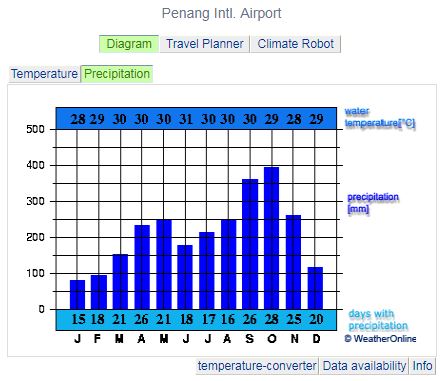
Temperatures do dip slightly below 20 in the coolest season but fall within that 70-80% RH range for ideal "wetter" storage.  Let's check one for Malaysia (this version from Penang, in the North there, but I get the impression weather is a bit consistent in Malaysia):


So much for those people experiencing seasons.  The temperature couldn't be much more consistent but the slight variation in humidity does imply precipitation changes, which are shown in that related precipitation summary graph:


Interesting.  Our rainy season here in Bangkok is May through October (half the year, but often rainier at the end of that).  The "cool" season is a slight dip in temperatures in December and January, and then it really is a good bit hotter in March and April.  It doesn't completely match up with there but a lot of that overlaps.  It should; Bangkok isn't that far from KL (Malaysia is the next country down), and it's even closer to Penang.

The point?  These places are where pu'er is supposed to age best, but only if one prefers relatively wetter storage.  The natural environment range is actually relatively narrow, because they're in similar places as local climate goes.

Let's take a look at Kunming, the place Scott (of YS) initially suggested might represent good dryer storage:


Temperatures run cooler but not cold; the lowest outdoor maximum is 14 in December and January, or 57 F.  Of course a warehouse environment could be controlled further, if a temporary drop below some minimum was a concern.  Humidity dips into the 50s for two months but is more typically in the 70s (RH, of course).  If the indoor warehouse-storage goal there is to keep temperature between 15 and 20 (C, more like 60-70 F), and humidity between mid-50s and mid-70s (RH) the building enclosures leveling out daily variations would accomplish most of that.  It could just get a little cool in parts of December and January, and April is the only month it might dip below that bottom limit for humidity (52 is an average).

Special concerns related to heated indoor air


In US and European indoor environments the main concern relates to outdoor cold air not containing much humidity, so that after you heat that air indoors it becomes quite dry (the air would naturally mix).  The most moisture that air can even possibly hold at 12 C (54 F), the dew point at that temperature, is right at the lowest point of that pu'er window I'd defined earlier on that psychrometric chart, around 8 or 9 grams of water per kilogram of dry air.  But again, I'm not claiming that is an informed optimum range, just a rough working version of that sort of thing.  As you approach water freezing temperature air doesn't hold much moisture at all; it simply can't.  That's why winter-time outdoor cold air can so frequently feel very wet (kind of counter-intuitive, that part); because if a cooling trend is occurring it's really easy for air to be at or near a dew point, where fog occurs, and the moisture naturally condenses out of the air (more on that here).


Some of the outdoor weather range for Kunming is slightly below that 12 degree level I just mentioned, at least in terms of daily minimum values.  If you heat air at or below 10 C / 50 F back up to 70 F (room temperature) without adding more moisture regardless of the starting RH level the final indoor humidity would be very low, well below 50%.  The dew-point level for air at 0 C (32 F; did I really need to convert that?) is below 4 grams per kg of dry air, an absolute level of moisture that relates to under 20% RH at 20 C (68 F).

Of course air in Kunming pu'er storage warehouses isn't shifting about related to temperature or humidity, so the case is a little different than for someone's home, where air mixes freely.  I'm really onto to talking about issues with Northern latitude home storage; natural China-region storage was the last section.  Or the far South, there's just less people down there.  I just looked that up and the South of Australia and South Africa don't extend as far below the equator as Philadelphia is North of it (both of those to -38 degrees and -34, respectively, and Philly is at 39).  Only Chile and Argentina extend below those levels (of populated areas; obviously researchers in Antarctica are using pumidors).


it doesn't snow much in Kunming, but it did in 2013 (photo credit)


Pulling it all together


Unless I'm summarizing it wrong Scott is saying that people claiming you need some controlled, narrow-range optimum for pu'er storage doesn't match his own experience, that it still ages across a range of environmental conditions, the process just changes.  But when he's saying he likes "dry" Kunming storage that's still based on an outdoor humidity level that is above 60 % (RH) for all but two months, and per the one reference graph shown at an average of 57 for one of those months.  We're not seeing equivalents to US outdoor temperatures or humidity in those places, and the real concern would be indoor, adjusted-temperature humidity values.

Scott doesn't drop into talking about environment specifics much in that video, probably because that gets so complicated, but he does mention at one point that as long as relative humidity is above 50% the pu'er should still be ok.  He makes a good related point:  it's not really pleasant for people to live in indoor environments at very low humidity levels either, so in a sense it's about maintaining conditions that are comfortable for a person and also ok for stored tea.

I lived in the mountains in Colorado for quite awhile, where it was below zero C (under 32 F) for about half the year, where literally thinner air--less of it; I lived at over 7000 feet of altitude--made conditions worse, and it typically felt really dry indoors.  Stored pu'er might die, without adding environment controls.  Of course to really investigate what was going on up there for local climate checking out psychrometric charts for higher elevation (lower air pressure ranges) would make sense, but it seems as well to keep this simple, to not pursue that tangent.


in an earlier life


With the proper environment adjustment (use of a "pumidor") someone in any natural environment could move on from concerns about natural conditions and consider instead where to set the controls.  I have no idea, but I guess these natural environment ranges (the local climates) where storage is considered to be good to ideal for wetter and dryer storage would provide a starting point.  That was sort of a main theme in what I said in that thread discussion, and the point of that section of location graphs; we may not know storage conditions ideals for pu'er fermentation but a best storage range isn't a total mystery.

A second part of that discussion comment was about how that discussion prompted me re-read a number of old references on this subject.  I won't go further with speculating about these issues but I will leave off with mention of that reading list:


The Tea Addict's Journal "Ideas of Proper Puerh Storage" post (that I already mentioned):

http://www.marshaln.com/2012/03/ideas-of-proper-puerh-storage/

A Tea Chat forum discussion of "Pu're Storage in Low Humidity":

https://www.teachat.com/viewtopic.php?f=20&t=11148

A Cha Dao reference blog series on aging pu'er (the last article in a series of five, which links to the others)

http://chadao.blogspot.com/2008/10/perspectives-on-storing-and-aging-puer_15.html

This last reference is a research article reviewing the measured levels of biological activity in pu'er (bacteria and fungus causing fermentation in sheng and shou).  It doesn't go into environment factors, but is a good reference for that context of concerns (keeping those organisms alive, but then in conditions where they can thrive too much other fungus that grows as mold also might):

http://journals.plos.org/plosone/article?id=10.1371%2Fjournal.pone.0157847

Wednesday, April 5, 2017

Liu Miao shou mei white tea cake review, and on relative humidity


I just posted about buying a shou mei cake at a Bangkok pu'er themed shop, Teeta Talk (compressed white tea, nice they carry a range of products), and this is about trying it.  I've never owned or even tried compressed shou mei, aside from trying one in the process of buying this version.  It's a relatively standard tea type, so that comes down to my own inconsistent exposure to different teas more than the type being that rare.

That's going to keep happening; some tea type that seems relatively common will keep coming up for the first time, even though I do keep trying other basic teas and some from out of the way places, for some years now.  Since this is intended more as a "journey to tea" theme blog instead of expert opinion that'll work.

I found a bit on the tea online here; it's a Liumiao Tea product, with the following detail listed:


Name: Shou Mei white tea cake (public version) (2012)

Brand: six wonderful white tea
Item: BB300-006-2
Net content: 300g
Retail Price: 159.00 yuan  [converted, $23]
Product Origin: Ningde City, Fujian Province (Fuding)


The automatic translation of the additional description is cryptic, or even the brand name translated as "six wonderful white tea."  I had tried this version in the store instead and didn't like it nearly as well, but what do I know.


the origin, Ningde City, Fujian Province (Fuding), from Google Maps


Straight onto review then, even though there would be more to say about the type or source.  It's my impression that this is a typical commercial producer and product, both just don't turn up much in English language online search. Here's a reference to a different version by the same producer on Amazon that doesn't list the producer name at all; that kind of thing would make it harder to search for.


shou mei leaves, broken up (a little like autumn leaves)


The dry scent is nice, sweet and subtle, in the range of a sweeter forest floor scent.  I know different people would be using that term in different ways, and it would often mean something closer to peat, but I'm comparing the scent here to the clean, sweet, dry, earthy scent in autumn temperate climate forest.  It's a good thing, pretty far removed from the smell of peat or dirt.  It resembles dried hay, just sweeter.


The first infusion wasn't completely clear; in fact a bit cloudy.  It's been odd hearing people comment so much on the clarity of teas since actual cloudiness just never comes up, but it just did for this.  It made me think back to a research article on pu'er storage about those teas fermenting due to the presence of fungus and bacteria, and how toxins go along with that, so a rinse step is really preferable for shou and aged sheng (that research article, mentioned in this post on pu'er storage).  Here's some input from that:


An interesting finding is that the most sought-after tea, aged raw Pu-erh, has a fungal community more like ripened than young raw Pu-erh, and a similar trend was seen for the bacterial community (Fig 3)....  Multiple mycotoxins were detected from either or both categories of Pu-erh, but all but patulin and asperglaucide were under the safety limit. For safe drinking, we recommend discarding the first brew.


starting to open up, looking more like autumn leaves

Given all that background I still tasted that rinse--just a few drops worth--but dumped it, and gave it a second fast rinse.  The tea is five years old, stored in relatively damp climate, just less so and more temperature controlled in a store space.  I didn't notice cloudiness in the initial rinse when I tried the tea again later but I didn't drink it.


You might wonder, what difference would aging make, and how would that have varied stored in a dry place versus in Bangkok?  I can't say much about the first point, but I did write up some thoughts on humidity variation after this review.


Back to tea review (end of that tangent)


I went long on the second infusion, distracted by writing, so I can describe what a long steep is like.  It's nice, but still subtle.  There never will be even a hint of astringency from this tea.  That's not a surprise, really, but interesting to experience it.

The flavor range is still similar; light, earthy, and soft.  It does remind me of brewing a mild version of fall leaves.  There is sweetness to the tea but that's subdued as well.  It's not really complex, not floral, without much mineral, so just a bit subtle in overall effect.  Of course brewing it stronger, as I just did, can help offset that, but it only varies so much.


medium strength infusion


When I tasted the other version in the shop I just wasn't picking much up, which is why I didn't care for it.  The trace of range I did get was interesting, there was potential there, which is why I still bought this tea, a different but similar product.

The next infusion was shorter, but still around a minute, and it didn't lose much for intensity.  It's still subtle, and that's still a lot of infusion time compared to most tea types at the same brewing parameters (it is Gongfu style, a high proportion of tea to water, even given that style range).  A more typical 30 second steep just wouldn't bring enough flavor out, unless someone adapted to drinking this tea very lightly, which does seem possible.  Different tea types seem to work better at different infusion strengths (that's a given, isn't it?), and it's interesting how people tend to be divided about white teas related to that.  Some go with those long 5 to 7 minute Western style brewing times, and bump it up to a more typical strength range for other types, and others just go with the lighter presentation.  I might favor different strengths depending on the character type of a white tea.


fully opened, on the darker side

Even though this tea is quite subtle there is some complexity there, it's just all in a closely related range.  That dry leaf range is accompanied by some dried hay, supported by mild underlying tones like sunflower seed.  It might even pull a little into chrysanthemom / sunflower range, a bit of light, mild floral.  All that is still quite mild, and not unrelated in flavor range, so it doesn't come across as complex even though it expresses some complexity.


The flavors are clean enough, not murky at all.  That was part of my initial concern related to the cloudiness, along with potentially being poisoned, which completely resolved after the rinse.  All this isn't so far from that Sri Lanka Peony style tea awhile back (described in this post).  At first I wasn't attached to it but after drinking it awhile the complexity and that specific profile were really pleasant, and this also is, I'm just not quite there yet.  I could imagine someone being on a different page and not liking it.  It's probably a little less complex than that other tea, with less in the way of mineral undertones, and a bit less full feel, but the general range is pretty close.  It's not typically part of the scope of discussion in a tea blog but I paid a lot more for that Ceylon version than this one, on the order of a bit less than half as much for 1/6th the amount of tea (this is a 300 gram cake).  That tea was slightly better and this one a much better value, but the chance to see it evolve through aging draws it a little closer, and it might be the better tea in a few years.


It seems possible the woman in that tea shop had been using short infusion times appropriate for pu'er in brewing a different shou mei sample tasting, especially necessary for sheng, which caused that related tea to just not taste like much.  It's quite subtle related to other tea type results even brewed longer but a range of flavors are there.

the final test:  she liked it


I went long on another infusion again, a bit too spacey for controlled brewing this morning, so it's probably as well I'm on this particular tea.  Brewed strong it's still subtle but it picks up an unusual fullness.


In conclusion, the tea is nice.  It'll be interesting to see how it changes with aging, and it was inexpensive enough I won't mind sharing it (some).  Before closing this post I'm also going to ramble on about humidity, a factor related to tea aging (fermentation, assuming this is going to undergo that, not completely a given).  In particular I'll discuss how temperature range relates to relative humidity, which I never really will link to the comfort zone of the bacteria and fungus mentioned in that pu'er fermentation related citation.


On a storage environment issue, all about humidity


A bit of aside on local climate:  in the house in Bangkok where I live we experience the natural environment, which is hot and humid, except for using air conditioning when we sleep.  There is more detail on that humidity part here:


When you see people discuss humidity related to pu'er storage they tend to not pair that consistently with discussion of temperature range, and express it in relative humidity percentages.  That one measurement, RH, is convenient, easy to work with, just one number, and that number is meaningful.  The range I live in is typically 70% to low 80s here, per that graph, at least outside.


I'm not a weather expert, but I am an engineer, with a bit more background in lots of subjects as a result, so I'd like to pass on what the limitations are of that humidity specification.  I'll touch briefly on why there are some cases where people might move onto more specific discussion of the actual amount of water in the air.  To cite an unrelated example, data center humidity range guidelines--about facilities for IT equipment--aren't only specified in RH in the more recent forms, also with some reference to dew point values.  To be clear, if you specify the specific air temperature and relative humidity you have expressed how much water is present in that air, with slight variation related to local pressure, but you get the idea.


ASHRAE 2011 thermal guidelines for computing equipment environment range


The short version:  air holds more or less water at different temperatures, so saying that it's 70% relative humidity (RH) here in Bangkok now, when it's close to 90 F (32 C, how we measure temperatures in Thailand), and 90% RH somewhere else where it's 65 F (more like 18 C) relates to a lot less moisture in the cooler place.  The air just won't hold as much at lower temperatures, and RH is relating to the amount relative to what the air could hold.  All that's probably not interesting to most people, but the chart above spells it out in even more detail, along with some guidance on what IT equipment should experience.  That part is really complicated, with variation by type of equipment (shown in the different ranges), and all of it a little controversial.

Maybe it's of more interest to me than most, but it's particularly interesting what happens at the far extremes of temperature.  Around 0 C (32 F; everyone knows that) air can hold very little moisture, relative to at higher temperatures, so when you go out in the cold and it feels damp there is still not much water in the air.  That's also why when you mix cold outside air in the winter into your home it feels bone dry inside, because that outside air contains next to no humidity, and as a result the indoor relative humidity (RH) could drop to next to nothing.  Of course that's why static electricity effect increases.

To put numbers that that effect, on that psychometric chart air at 50% RH at 0 C / 32 F heated to 25 C / 77 F would then contain 10% RH, with no change in actual moisture level (water content, in this case 2 grams per kilogram dry air).  On the upper side from 90-100 F (32-37 C) air can hold loads of moisture.  That explains why when it's 32 C (90 F) and 80% RH here it feels oppressively hot and humid; evaporation of sweat to maintain body temperature stops working well.  At 25 C (77 F) at the same RH it's only a bit damp, and there is actually half as much water in the air.


It's interesting that the current weather reporting says the dewpoint is around 24 when the temperature is 26 (when I first started tasting this tea), and the "realfeel" is as if it were 35 (well into the 90s).  That seems to not really capture that effect, that it still feels cool--to people that live here--but quite damp.


I can only guess at how fungus and bacteria relate to the two differences taken together, if RH or absolute water amount is more critical to them, or if temperature also is for life cycle.  My guess is that they're durable little organisms that thrive across a broad range of conditions, but especially well where I am right now, when it's quite warm and damp.


Another reason to go into all that:  that shou mei cake may have been aging a good bit faster than if it were somewhere cooler and dryer.  It seems likely that most discussions of pu'er aging environment factors overemphasize humidity concerns due to oversimplifying temperature as a factor.  I don't know for sure that shou mei ages and ferments related to exactly the same micro-biological elements--fungus and bacteria--performing the same role, and that doesn't match part of the typical sheng back-story, but I expect that's the case.  It's one more subject to revisit later.

Thursday, September 1, 2016

Pu'er storage and fermentation


A friend recently pointed out a 2013 Tea Chat tea forum discussion thread about how to store pu'er, not focused on typical humidity and temperature issues but instead whether or not to wrap the tea in such a way as to seal it.  It was surprising to me that this is even an issue, since the conventional take on wrapping pu'er or hei cha is so consistent, that it's typically not stored well-sealed, as every other tea type is.


The standard take is that pu'er needs some air contact (very minimal, but some) so storage in the paper wrapper is a given, maybe along with some other form of outer wrapping that also doesn't completely seal the tea.


I'll start with the two different takes expressed in that thread, and move onto what fermentation is as relevant background.  Then I'll close with a bit of feedback from a couple of sources that really know pu'er (always relative that, but seemingly relatively so).  Lots of people have lots of experience with pu'er, and a discussion forum like Tea Chat is a great way to be exposed to some informed takes.  Of course the standard discussion is about ideal storage humidity levels, quite closely related, as in this other more recent Tea Chat discussion.


Tea Chat discussion; to seal or not to seal pu'er for storage  


Not everyone might see this as an open question, but it was raised as such, and brought up some interesting points and discussion in that earlier Tea Chat tea forum discussion.


Initial starting point comment:  This is one of the reasons many people put their cakes into sealed plastic bags to preserve aroma and flavor. Exposure to air will deteriorate this just like with any other tea. It makes sense.

Response:  A lot of people (like Marshal N) believe that doing this stops or severely limits the aging process


Of course that "Marshal N" is a reference to A Tea Addict's Journal blog author, one of the classic tea blogs, still active now.  Others responded that pu'er needs both humidity and oxygen contact to ferment, and later Marshal N himself clarified that further in the discussion:


I don't think constant airflow is the answer. In fact, my storage has very little airflow. I don't believe in sealing the tea, at least not when they're young (when we have 20 years old cakes it's a different problem) but I think airflow is bad.

I store my tea in a cupboard with doors. I only open it when I need something from it. It's not like a fridge door or anything - it will allow a minimal amount of air to circulate, but that's it. In a place like Hong Kong a tight seal runs a very high risk of mold.


And then later, more specific to the point related to sealing:


The point of storing puerh is so that it will change. If your object is to maintain the tea as it is now, then yes, by all means, seal them up, vacuum them, put them in black boxes. But that's not what puerh is - puerh is an aged tea. Those wonderful 50 years old red labels out there? They were, for the most part, not put in plastic bags and sealed up all these years, and they're still wonderful now because the base tea was good and they were stored well. 

...I'm not at all suggesting you should put tea on an open shelf and under the sun - I am saying they don't need to live in plastic bags. ...thousands of drinkers in HK and Taiwan don't seal their tea up when they buy them. They leave them out naturally and let them age. 


That's really the gist of it.  On the one side sealing up pu'er makes sense related to common sense related to storage of anything else, and to the idea that air contact would diminish tea flavors through evaporating off components that cause flavors (that nice smell of tea being stored is molecules you wouldn't get to taste drifting into open air).  The other take is that conventional wisdom demands that pu'er requires minimal air contact to ferment as it ages (not exactly requiring airflow, but not sealed).  A notable justification for the latter is that this is long-standard practice, with a history of effectiveness.  Marshal N says more in his post on pu'er storage, with the same discussion about sealing tea playing out in the comments.  Of course this is all mostly geared towards concerns about aging and fermenting sheng pu'er, not as clear in relation to shou, which does more fermenting during production, speeded up by wet piling processing (for which the question might be if it's most fermentation occurring initially, or all).

Which is right?  The easy way to settle this is to go and buy two each of a number of cakes and store both separately, one of each kind sealed, the other not, and wait a number of years.  Of course results might vary by other factors, temperature and humidity, or by how often the cakes were taken out to sample some, or if they weren't at all.  Cwyn (author of Death by Tea, a funny and informative tea blog) cited an example of someone doing just that in one comment:


One of my tea friends specifically stored three samples of the same tea over a two year period, one in plastic, one in a pumidor [ed. tea version of humidor], and one with no storage (open air). Then he sent unmarked, blind samples of all three to several of us. We all picked the pumidor stored as the best one. The plastic sample in particular was the worst, in my opinion. 


Of course that would seem to depend on his local environment, and it seems possible results could vary by different factors.  Let's check some references about what fermentation is first, and move on to more informed input about these issues after that.

pu'er warehouse storage (photo credit, Seven Cups site)


Storing pu'er, fermentation:  research input


The standard-practice bias will make this harder to evaluate.  It would be possible to find sources advocating sealing pu'er for storage (a comment in that discussion mentioned the Hojo vendor advocates this) but more others will go with what they know, the other more standard approach.  A vote, the count of approach endorsed per reference, might not be a great indicator of likely accuracy.  All the same lets start with Hojo's input:


It is said that a pu-erh tea should be fermented in the original paper wrapping and stored in an open space. However, this method is not practical in most of our living environment. This traditional storage method only works in Yunnan or any place where it is located at an equivalently high altitude, as the weather in Yunnan is very dry with low humidity.

From the food scientific point of view, any kind of tea must be kept under low humidity. In fact, we highly recommend keeping pu-erh tea in a tightly sealed aluminum bag where the oxygen is trapped inside the bag providing sufficient condition to mediate further maturation compared to those that are kept in open space. Moreover, there is another way to create a unique maturation method for pu-erh by storing the raw pu-erh in a vacuum-sealed bag even though most people may think this storage method is ridiculous. 


Interesting that they squarely address going against conventional wisdom with those recommendations, clarifying that most people wouldn't agree.

A wiki-theme tea site or blogger research isn't likely to help out much, since those would either repeat one or more opinions or cover a bit of range in general research.  For example, the TeaDB post on pu'er storage does that, citing conventional wisdom and mentioning this Hojo post.  I'm not really intending a citation as a final starting point reference, but I'll also mention their input on humidity.  This is likely taken directly from Marshal N's "Tea Addict's Journal" posts, as mentioned by them in crediting him as a primary reference:


This storage method [traditional or wet storage] is usually associated with Hong Kong. Traditional storage involves packing a ton of tea, usually by the jian (42 cakes) into a warehouse. The tea will initially be put into a ground storage unit. These storage units will be intentionally (but not artificially) high in humidity and temperature. These conditions result in the quick aging of the tea. After some time has passed, the tea is moved to a drier storage location... 

The proper idea of humidity and temperature for dry storage will vary, usually falling somewhere between 60-70 relative humidity and 60-70 F. Drier stored teas will age more slowly and are a much longer-term game plan for those that engage it.


It makes you wonder what the relative humidity is in Hong Kong, doesn't it, since 70% sounds like a good bit (from Wikipedia):


Climate data for Hong Kong (Hong Kong Observatory), normals 1981–2010, extremes 1884–1939 and 1947–present
MonthJanFebMarAprMayJunJulAugSepOctNovDecYear
Average relative humidity(%)74808283838281817873716978.0


70% and up; that is humid.  I won't be able to track down the reference but cycling between more and less humidity over time has been cited as a good thing, for the tea to sort of breathe.  That's also probably from Marshal N; I read a lot of his posts while writing this.

It makes me wonder about humidity where I live, Bangkok, since it often feels a bit humid here:


Yep, humid.  For better or worse it really doesn't ever ease up much.

Related to what fermentation really is, and how much air contact is required, most references don't get far.  They tend to focus more on wet versus dry storage definition and basics.  That Tea DB post does mention that Hojo is in the minority for advocating sealed storage, but then Hojo had said that too, and repeat that some claim sealing a tea will stop a tea from naturally aging.

Beyond blogs there are a few decently researched tea information sites out there, with one of those, the World of Tea, weighing in on pu'er storage factors:


Non-Hermetic Seal Aging:  Puer (and other post-fermented teas) are not typically shielded from moisture, rather a controlled level of moisture is employed to influence the aging during storage. In this case, over time, the tea leaves undergo a combination of fermentation AND oxidation. In fact, when maocha is fixed, it is often done so at a lower temperature so that the oxidative enzymes within the leaves are not fully denatured, clearly allowing for further oxidation.


This certainly seems to represent a suggestion not to seal pu'er teas for storage, related to allowing for contact with limited moisture, but it's not so clear if ziplock bag storage of teas that are opened from time to time violates this.  It's not clear from that what other factors come into play, but moisture is represented as the primary factor.  A distinction between oxidation and fermentation is interesting.


Maybe it could help to dig into what fermentation really is.  An interesting reference turned up in a search, a study of components found in types of pu'er, with some insight to what activity related to that:


One of our major findings is that fungal α-diversity is higher in fresh tea leaves than in Pu-erh and that bacterial α-diversity shows the opposite trend, that is, lower in fresh leaves than in Pu-erh...  An interesting finding is that the most sought-after tea, aged raw Pu-erh, has a fungal community more like ripened than young raw Pu-erh, and a similar trend was seen for the bacterial community (Fig 3). This result indicates that the accelerated microbial fermentation of ripened Pu-erh, encouraged by the addition of water and the warmth generated by microbial fermentation, results in a microbial community composition similar to that found in much older, raw Pu-erh. It also provides an ecological explanation for the rapid acceptance and widespread use of the ripened Pu-erh process.


Clear, right?  The rest of the article on methodology and detailed findings really does get a bit technical.  As I'm reading that they're saying both aged sheng pu'er and shou pu'er exhibit similar types of bacteria and fungus growth (which is a good thing, more or less).  There's nothing on storage, obviously, so no extension to what conditions support that.  One read of what that just said, "encouraged by the addition of water" might indicate wet storage supports fermentation but it doesn't seem possible to extend that statement to concerns about specific relative humidity conditions, to what is optimum or too much.

Their conclusion is interesting, especially where it leaves off related to a recommendation:


Next generation sequencing revealed high fungal and bacterial diversity in Pu-erh tea. Fungal diversity drops and bacterial diversity rises as a result of raw or ripened fermentation. The composition of microbial communities changes significantly among fresh leaves, raw and ripened Pu-erh with the aged raw tea having similar community to ripened tea. Age of tea is identified as a significant variable affecting microbial community of raw tea, but not of ripened tea. Multiple mycotoxins were detected from either or both categories of Pu-erh, but all but patulin and asperglaucide were under the safety limit. For safe drinking, we recommend discarding the first brew.


So much for drinking the rinse.  The rest of that part on mycotoxins was interesting, if a bit hard to follow.  

Clicking around for input on risks I found this WebMD reference to pu'er effects (positive in this case):


There is interest in using pu-erh tea for lowering cholesterol because, unlike other teas, it contains small amounts of a chemical called lovastatin. Lovastatin is a prescription medicine used for lowering cholesterol. Investigators think that bacteria that sometimes contaminate pu-erh tea may somehow make the lovastatin in the course of their normal life cycle. Animal research suggests that pu-erh tea might lower certain blood fats called triglycerides as well as total and “bad” low-density lipoprotein (LDL) cholesterol. It might also raise “good” high density lipoprotein (HDL) cholesterol.


And I was just explaining to someone that essentially all tea bloggers are very skeptical of all health claims related to teas.  I'll stay a little skeptical but it sounds better than the other earlier content on mycotoxins, which can't be good.


Expert input on pu'er storage (well informed input, anyway)


I asked a few people that would have informed opinions on this, with some of that cited here.  I'll start with a local tea friend, a tea drinker that lives in Bangkok and stores pu'er here.  He makes no claims related to being an expert, but he does have significant first hand experience.


I keep all my cakes in ziplok bags. Some use vacuum sealing (like Hojo). For me, the exposure to air can increase the oxidation level, which diminishes flavor and aroma. Fermentation is another matter. According to Hojo, when the cake is pressed, the fermentation process is already under way. By keeping the cake enclosed or vacuum sealed, there is still enough moisture to keep the fermentation process going.

The main point is about humidity and aging. With high humidity, there can develop a wetness that will make the cakes taste and smell musty. The HK Chinese like probiotic :-) foods that stink. So do the Taiwanese. One could say it's a developed taste. Personally, I don't like it. Maybe the cakes age faster exposed to high humidity without ziplocking. I'm happy with the cakes I have and how they are progressing. I've tasted teas from Wistaria Tea House in Taiwan and didn't like them. I would never buy these musty cakes. But, now we get into taste and what you are taught to like. Who is to say what is right? As long as your cakes are not developing mold, they should be safe. 


Interesting, right?  Issues of personal preference and local climate fold into all that, tying together a lot of the previous ideas.  I'm still curious about how much oxygen content is necessary for a pu'er to age, and how humidity really does relate, but some reading up and discussion will only go so far.


or you could just leave it lay around (credit Tea and Mountain Journals)


Another online friend strikes me as more of an expert reference, not in terms of public record background credentials, but related to regularly passing on input that others have referred to as "encyclopedic."  Of course I'd need to extrapolate a lot from what little I do know to evaluate the relative value of the input, but as far as that indicates anything he's someone to listen to.  It might seem odd accepting ideas from a source without even an online nickname to go on (which is all that is accessible anyway); take that part as you will.


1) Completely sealing the bag limits microbrial processes to anaerobic stuff. That can mean some fruitiness, and it can also mean sourness, depending on the metabolic pathways of our micro friends.

2) Loose package sealing is nice to reduce the loss of volatiles, not really for better aging process.

3) Stagnant humidity promotes way too much activity, leading to toxic accumulation of molds.

4) Puerh does oxidize, but the processes involved in making puerh is meant to reduce such things. Small leaf puerh tends to be more prone to oxidizing to black tea. Browning is fermentation from microbes, like what see in cheese.


And this seems more or less off the top of the head input; he really should write a book about tea.  Mind you he isn't even someone I've spoke to much, just one more person I bother with questions, who is kind enough to humor them.

That last point has lots of room for following up--I'm not so clear on how oxidation and browning vary by input--but this is running long as it is.  I won't really get into all that's covered in those points, most of which are clear on their own.  The first point seems most interesting, delving a little into the variable introduced in that academic journal article, extending it to potential flavors changes.

I discussed the subject a little with Cwyn by message, that other blogger I'd mentioned, and she said this:


For storing sheng in sealed plastic, Hojo is the primary proponent of this method of storage. It works only in humid climates, the idea is to seal out the outside air and prevent the tea from too wet storage. Sealed plastic still leaches air. In dry climates, the tea will actually just dry out slowly and fade. I have one cake preserved this way, mainly because the cake has a large intact leaf across the top. Makes a good demonstration cake that people can hold in their hands without affecting the tea. Otherwise, sealed plastic is not an effective method for my dry household climate. If your climate is humid, it is worth considering.


So sealing the tea really may be a great alternative for pu'er storage in Bangkok, which is humid, depending on preference for fermentation and other results.  Or maybe sealing those teas, even in looser ziplock storage bag format, does all but stop fermentation, to an extent that per most individual preference sealing the pu'er would be an unacceptable solution.  Personal preference related to all the variables is a difficult aspect to fully factor in.

Altogether all those ideas did all fall together better than I'd expected.  The inputs settled into one clear running theme of people saying similar things and arriving at different conclusions that weren't quite as clearly contradictory as they seemed at first.