Showing posts with label TChing. Show all posts

Friday, April 22, 2022

Sheng pu'er storage, wet, dry, and optimum

first published in TChing here

I've been giving sheng pu'er storage conditions some thought lately, and recently ran across examples of teas altered by the two extremes.  One paradigm was in the form of two different 2005 and 2014 sheng pu'er versions stored dry, in Kunming, that were very well preserved, and the other related to two 2009 cakes that were far more fermented than either of those.  That 2014 version was from Laos, so I usually call the type "sheng" but not "pu'er," a naming convention theme I don't revisit every post.

I don't know where the second more fermented versions were stored, but since I live in one of the hottest and most consistently humid places in the world, in Bangkok, I can draw on plenty of experience about how wetter storage tends to go, and speculate about how artificially maintained conditions might be different than here (although I don't do much with that in this).  I've posted about an even more extreme example in trying a 2010 Nan Jian (Tulin) mini brick, after writing this draft, so I'll leave that out of this discussion.
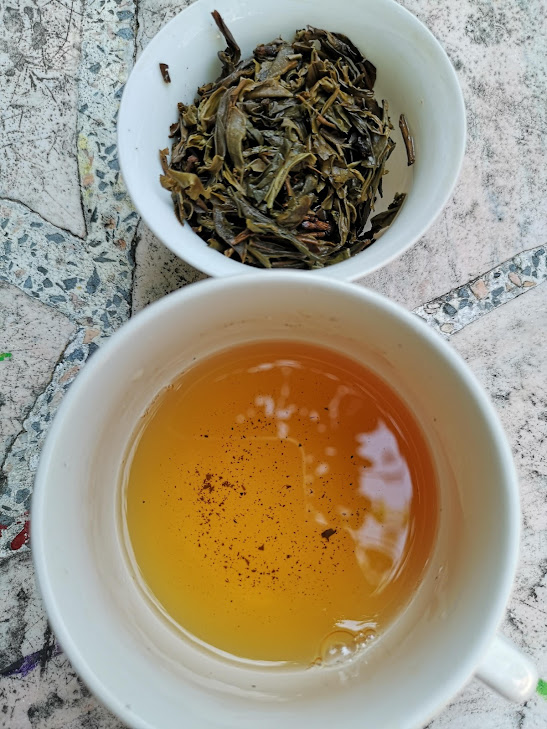

that 2005 Menghai sheng pu'er; a bit age transitioned


the Nan Jian / Tulin 2010 version, kind of at a similar level


Of course all of this is speculation, pulling together perspective based on partial inputs.  I've only mostly been drinking sheng pu'er for 4 or 5 years, so I don't have any examples of cakes that I've seen transition through even a decade of aging cycle myself, with 15 years cited as a more common fully aged starting point.  I did buy a few sheng and shu cakes around a decade ago but finished them.  Of course that range of experience is all relative to conditions, mapping fermentation level to time period, as more about those examples shows.  This could run long, like a short booklet on these themes, so I'll try to offset that by breaking thoughts up by short section, and really only offer input about humidity as a factor in relation to these cases, even though more than one input came into play, with temperature and air contact other main concerns, and starting point, the tea material, is just as critical as storage factors.  

A bit of an aside, I first wrote about pu'er storage conditions when researching that subject in 2016, and updated that adding a bit on what relative humidity is all about in 2017, with more on natural climate area ranges there.  As you read those posts they shift from only referencing external input to adding more about what I've experienced.  I wrote about sheng storage in a summary post comparing Kunming, Hong Kong, and Malaysia standard natural humidity levels back in 2019 (with local area tables in that post from the Weather Online site); I guess it is time to get back to updating comments on this subject.


Let's start with filling in what those examples covered, then a few definitions, then on to those thoughts about transition patterns.


Two "wet stored" 2009 sheng cakes (reviewed here):  it's a shame not knowing the storage conditions, but those two had to be stored right at the edge of as wet as possible to get to well transitioned in 13 years.  They still had a touch of younger character in limited senses, a bit of vegetal range left, but heavy fermentation related flavors stood out a lot more (mushroom, geosmin--essentially dirt, heavy earth, wood, and mineral flavors, warm dried fruit, dark wood and aged furniture).  Lots of teas I've reviewed here shared some of that scope, but it takes a different kind of input to get that much geosmin emerging.  For intense, bitter and astringent teas, like Xiaguan tuochas tend to be, you really need a lot of transition to move off that range some might see as unapproachable, so 15 years of relatively fast aging might be just the thing.  I suppose that's jumping ahead though, on to the patterns.


2009 versions, much more fermentation transitioned than the other two teas


1980 and 1993 versions color comparison (from here), relatively fully transitioned, brewed fast


Two well-preserved dry stored cakes:  a 2005 Menghai version and 2014 Laos tea.  There's a common discussion point that a trade-off for drier storage, beyond not transitioning (fermenting) is that a sour or wood-like aspect can develop, and I keep coming back to whether that happens or not in examples like these.  Both were really well-preserved, aged to a relative degree of half that if they'd spent the time here, or even less.  Some degree of bright, floral, aromatic, and fresh aspects remained in both, of course more so in the 2014 version, with that 2005 more in a "teen years" sort of middle ground for aspects present.  Starting point changes a lot, and I can't be sure how they were initially, but Laos teas are essentially never challenging to begin with (per trying at least a dozen sheng versions from there), and for Menghai versions that definitely can come up, intense character early.  


2014 Laos version, a little washed out by high lighting level, but also light


Is that really a regional character aspect theme though?  I'm not sure.  Laos teas have to be made from wild-grown, naturally occurring material because they're not farming teas in the same monoculture forms that are common in China there yet.  Surely someone is replanting and growing tea through more standard farming, but I mean in general.  Mountainous areas in Laos tend to be cool as SE Asia goes, not like the hotter lower flatlands in Laos.  It's unlikely that heavy pesticide and fertilizer use would come up as often as in standard monoculture farming; the trees have been living naturally for decades, or more likely centuries (a general 400 year age range comes up for the tea growing practices, often extended to saying that the actual plants are often 400 years old, which isn't right, they would vary in age, most much younger).  Then plant types would vary; although parts of Laos close to Yiwu that's no guarantee that plant types growing overlap so much.

To keep this moving back to that one storage input range let's consider what those wet and dry ranges really mean.


Dry storage:  


Based on reviewing average local climate conditions it doesn't seem that dry in Kunming, varying from low 50s (RH %) up to nearly 80, as a monthly average.  It's not necessarily the outdoor humidity level as a relative value that's a problem in temperate locations (the US, Europe), but that if it's cool out and heated indoors then that relative humidity level of heating air that can hold a lot less moisture is dry, relatively speaking.

For indoor storage it's commonly accepted that if the range falls below 50% the tea fermentation will become inactive (whether that's actually right or not, but that sounds like a reasonable conventional understanding to me).  In March and April, stored at natural local humidity levels, Kunming stored teas wouldn't be fermenting much, but that's still perhaps not bone dry.  Since it's an average it's harder to say, and it's not easy to factor in how indoor temperature moderation would work out, if real indoor conditions wouldn't tend to be drier.


Wet storage:  we can cite Malaysian values as an example here, and compare that to indoor controlled conditions:


Malaysian local climate shows humidity level in the mid 70s to low 80s, all the time, that's humid.  That's based on an average temperature window of 24 to 31 C (75 to 88 F, surely often hotter at mid-day).  That's a little more humid than here (Bangkok), where it's quite hot and humid, but weather varies a little more, with both are in a similar ballpark.  


I was going to use here as an example, about how it's cooler now because it's 10 AM, and the value will dry a bit as temperature increases, but it's 32 C (89 F) and 65% now, pretty hot and humid (when I wrote the first draft).  Maybe the point would've worked better at 6 AM, back when it was still in the 20s (closer to 80 F).  I'm first editing this on the Thursday shown and it really did get up to 37 C yesterday, which is hot, human body temperature, so the units conversion to 98 F comes easily.  I ran yesterday, in the afternoon, and was really feeling it.  Due to bad judgment I doubled my normal route length, from 4 km to 8, and I still felt the impact in the evening as a result of both.


People discussing controlling temperature for sheng storage tend to fix on specific humidity level they feel is high but still safe from mold, often using 70% RH for that, or sometimes less.  70% is kind of the edge, although other conditions factor in too, temperature, and degree of air contact.  I don't think you could hold stored sheng at the Malaysian local maximum, 84%, without experiencing problems.  If temperature shifts just a little it would take time for the salt pack to adjust and any condensation is a worst case for tea (sheng pu'er cakes; other teas don't need to be stored in contact with humidity, perhaps with shu pu'er and hei cha as possible exceptions).


Ideal / natural storage (two different things):  I'll have to mostly speculate a little about this but wave off the subject more than I address it.  One idea behind "natural storage" is that you aren't holding the humidity and temperature at one set value, and normal fluctuations in range allow the tea to experience a more normal, organic sort of environment.  If I'm remembering right Marshal N, of the Tea Addict's Journal blog, has speculated that some degree of change could be beneficial, having moisture move in and out of the tea, letting microfauna experience more normal circumstances.  I'm not sure, even if that attribution is completely accurate, since I've not been reading that blog as much for awhile.

"Ideal" would be a tricky concept, since people might naturally want different outcomes based on having different preferences.  Or something that gets less attention, it might depend on the tea character starting point, with more aggressively bitter and astringent teas really needing a lot of transition, and others that don't changing more positively when the shift is slower.  I won't get far with speculating about that second point here, except to say that I have liked some teas that weren't changed much over time, like those two I mentioned earlier.  

That 2010 Nan Jian / Tulin version is probably an even better example, the one I didn't go into here.  But then maybe I would've liked both just as much "younger" and stored wetter, and the 2005 Menghai version did seem to need more time to get to a likely more optimum aging level.  I'm trying it again with breakfast, and after, as I edit this; it will probably be better in 5 more years.

It would be nice if I had more exposure to what others see as optimum results, trials of 20 year old teas stored in different ways, starting from different characters, that turned out very well.  I'll only ever get so far with that; I don't have the tea budget to approach it in the most efficient ways.  This is a hurdle that many could find problematic in relation to feeling like they have a moderate degree of exposure to the subject, that trying 100 aged sheng versions wouldn't necessarily seem like a good background, because then someone might just want to try 100 much better versions.  Or too see the patterns play out for themselves for a few dozen cakes, a project that would take that 15 years or so.

On the one hand this is exactly what I love about sheng, beyond the direct experience of drinking the tea itself, that the experience of these transitions and inputs is never-ending.  In a recent video interview (where I was interviewed, odd) I answered that this is what keeps tea experience so new and interesting to me, even though I've been drinking a lot of teas over the past 8 or 9 years, that sheng versions can change every time you check in on them.

It was interesting talking to a well-known US tea enthusiast about these issues recently in a meetup, with "Mr. Mopar," but it's hard to drill down to discussing these levels of inputs and outputs.  As general patterns you can, but not in relation to getting a sense of how any one tea shifted, where it ended up (at one given time), and why.  Online group tasting is better for that, but it would still go one or two examples at a time.


All this reminds me of a tea enthusiast commenting about trying to break into sheng pu'er in a group post, trying out 15 or so versions from Yunnan Sourcing.   He referenced that as his "ante."  It seemed that if he chose 15 of the same type of versions, younger or medium aged factory teas, dry stored so not age transitioned, he wouldn't really experience much of the broader range of sheng pu'er.  Acclimation to bitterness takes time, and the main way people seem to adjust to that, beyond continuing to try bitter tea versions over time, is to approach sheng through shu experience.  Or it can work to try aged forms first, or milder, sweeter sheng versionss earlier on (with Yiwu origin teas often more like that).  He didn't like many of the teas.

I wouldn't have liked the 2005 Menghai version I'm trying now five years ago, and I guess I still have mixed feelings about it now, about bitterness and green wood vegetal range standing out a lot.  Without knowing the background context I might have expected this to represent relatively aged (fermentation transitioned) sheng, but it's definitely not that.  Dabbling in sheng over time might be a better approach, rather than letting one set of samples from one vendor determine your final take.  

A local friend recommended getting a cake and drinking all of it, just to adjust to the range, and to get brewing down.  Oddly that's good advice, but it also delayed my exploration of sheng quite a bit, because in not understanding types I bought something comparable to this Menghai tea when it was relatively new, based on a recommendation from another contact who probably had little exposure to sheng, with no communication about that context.  I could endure the bitterness and astringency by the end of that cake, brewing it fast, but it wasn't a helpful experience.

Needless to say very little of this is actionable guidance, just scattered discussion instead.  Maybe eventually I'll be able to write a post that goes that next step, on to practical advice and promising approach points.


Wednesday, January 19, 2022

Tea Themed New Year's Resolutions

First published in TChing here.

My own goals related to tea tend to stay the same year to year, if a bit general:  to experience something new.  Not so much related to new types, since I've mostly set aside broad exploration, and try whatever I happen to try, or pushing on to higher quality or more distinct examples of already familiar types, but just new to me in some sense.


sheng "pu'er" from India (from Ketlee), a novel tea I tried last year


For the past two years that has related to a long exploration of online video meeting contact, originating with a few random sessions in early 2020.  That was based around a core group of friends meeting, moving on to more involved sessions with subject experts in 2021.  It wasn't so far off a podcast theme, just not recorded or broadcast.  Prior to that, in 2019, I was messing around with tasting themes instead, and sometime around then I put focus on starting a Quora Space (Specialty Tea).  It's a decent reference now, and I keep writing there.  


This will be about how other types of resolutions might work out, based mostly on talking to a lot of people newer to the subject in lots of online groups, returning back to what I might do that's different.


Drink better tea:  the obvious direction, which could be taken lots of ways.  Anyone drinking tea bag tea might move on to loose leaf, and people still on Harney and Sons blends range--which is fine--could explore better single input teas.  It's easy to sort out how to try better versions of what you already like, but it can take time and effort to get input for leads on better sources.  One approach towards that is to explore social media outlets related to tea, to hear about what's out there, and sourcing suggestions and so on.  This general intro post might help.


Connect with others with a similar interest:  to many this would seem a stretch; why go there?  Some reasons:  to experience in-person tasting sessions, to learn about types and teaware, or to exchange teas.  Or it could just be that identifying with a subject seems odd when you don't know anyone else who does, and it sounds interesting to resolve that through online contact.  

The starting point for this is level of tea interest.  It is actually possible to discuss tea themes with people who are still on flavored tea bag or grocery store tin versions, which to many tea enthusiasts is only an early starting point, naturally leading to more in-depth exploration.  The Facebook Tea Drinkers group or main Reddit r/tea sub-forum focus on that level.  The Gong Fu Cha group is an example at the other extreme.  Discord servers are interesting for using a form similar to old chat boards, and for being populated by really young people, for the most part, and they tend to fall in the middle related to prior exposure.


Drink more diverse tea, at limited cost (improve value):  it's funny how tea enthusiasts tend to split into two sets, with one seemingly not concerned with cost much at all, seeing spending $20 on 50 grams of tea as no big deal, since that would brew quite a bit of tea (a couple of dozen cups, maybe).  For the other set and perspective parting with $20 seems like a significant expense, regardless of volume being considered, so moving beyond what is in grocery store shelves is problematic.  

I can relate to wanting to find a balance in the middle, for working with a very limited tea budget, but still wanting to try a range of teas.  That tends to involve ordering some tea in batches, with expense between $50 and 100 per set kind of normal, or more later, as quality expectations change.

In the past ordering through a general vendor that sells medium quality tea would be a good intro point, one like Adagio.  Unfortunately their marketing theme has shifted, enabling them to move on to selling a broader range of blends and to ramp up pricing, so that for the same cost you could actually buy better tea from other types of vendors.  Chinatown shops are a good way to get to a middle ground, providing access to tins or loose versions of modest quality teas at low cost, examples that are still much more diverse and better than specialty grocery stores would tend to carry.  

Now ordering through a foreign based vendor works best for this general goal, one like Hatvala (for Vietnamese teas), or Chawang Shop (for Yunnan origin Chinese versions).  Yunnan Sourcing is not so far off that theme, a kind of broad outlet selling a large range, but any vendor carrying 1000 versions of tea puts workload on a customer to try and sort it all out.  You don't need to understand what those 1000 teas are but you do need to somehow put a dozen or less in an online cart.


Improve brewing skill and range:  this one is easy, since buying a gaiwan is half the resolution, and practicing to use it most of the other half.  Gongfu brewing, the related approach of using a higher proportion of tea to water and many short infusions, really only works better for some tea types:  sheng pu'er, high quality whole leaf black tea, twisted style oolongs, and to a lesser extent rolled oolongs.  For broken leaf black tea or green tea a Western approach is more or less the same, and shu pu'er gives pretty good results made in lots of ways.  Results related to white tea vary by type and preference.  

It's too much to go into what Gongfu brewing is but a recent Quora answer about how to brew oolongs covers the basics, with lots of guides out there covering a more step by step explanation (just search Gong Fu tea in Youtube to watch a few).


Get family and friends into tea:  good luck!  Don't expect this to work in most cases, but it is cool when it clicks a little for the right person trying the right tea.  There really is something special about a tea party, regardless of what you choose to do with form, or how much the guests love the drink.  

There's no need to cut that off related to what you like most, or tend to drink.  If you can't give children "real tea" due to a concern over caffeine the same theme can work using chrysanthemum, and the kids will love the form.  If you don't have children, or nieces and nephews, that's probably a stretch, but hopefully there are people in your life who can still tap into that exploration range to get the most out of a related form.  A lot of people's moms would love it.  

Try including different snacks, or set it up outdoors, or maybe just do it all on your own, and treat yourself to the same theme without needing others to share it.  If you think that you really should have a ceramic teapot or some range of interesting cups that's a great prompt to check out a local thrift shop, and give new life to tea equipment that someone else needed to pass on.  The "matching set" theme isn't a necessary part of it, as I see it, but individual judgment and style would factor in related to that.

More formal types tasting is something else; for someone on that page the options really span a lot of range.  I've held tastings in a park and a zoo before and the results were pretty nice.  In one other context tasting a guest tried a Chinese black tea and commented that they never knew that they liked black tea until that moment; that can be really special for a guest and the host.


My 2022 new direction:  not identified yet.  If anyone has ideas or leads on directions to chase feel free to comment wherever you see this, or look me up to talk, maybe easiest through my blog's Facebook page.  I've long since thought that broad tea awareness and culture development won't take a next step until it finds its way into mainstream media communication, but I explored that direction and didn't get far years ago.  

A podcast theme would probably work but I don't feel motivated to do that; it's already being done.  Last year that meetup discussion theme included 20 or so interesting and influential tea producers and vendors, from a dozen or so different countries; it might work to extend those introductions and background theme coverage to a networking scope.  The last talk we held covered tea processing details based on input from producers who are exploring new directions from the US, India, Laos, Georgia (the country), and Nepal.  It frees up potential direction in that I don't really need to focus on my own personal gain; that discussion was about them sharing ideas for their own interest and benefit.


A simple resolution might be better than all that:  to relax and enjoy the quiet once more frequently while having tea, just putting the phone down and being in that moment.  I'll try that.

Thursday, December 23, 2021

What does it mean for a tea to be brisk?

first published in TChing here

I answered a Quora question about what it means for a tea to not be brisk, here, which I'll convert into the opposite, a summary of what "briskness" in tea actually means.  To me it either means bright in flavor and character or else astringent (possessing a mouth-feel) in such a way that is appealing, having a feel that is sharp in a particular positive way.  To me the latter is really the core meaning.  Could the two overlap?  Sure; I'll get to that.


A particular feel range does tend to pair with a general flavor and character intensity, or rather multiple variations of both tend to correspond in different tea types and forms. As you experience a slight sharpness in mouthfeel--not harshness, which would be a flaw--you also tend to experience a brightness or intensity in flavor range. It’s not as if they have to be combined, but it tends to work out like that.  Probably we are mostly talking about black tea, which will be implied in a lot of the following, but more explicit in certain ways related to the cause.  After talking through some basic meaning and experience range related to types this will get to root causes and compounds causing related effects.

Green tea often possesses a very different but typical astringency (feel), but to ask about an oolong being brisk makes no sense. Oolong is a broad category, that varies quite a bit in range, but versions tend to be full in feel, rich, or even creamy. Some contain an astringency that’s different than in black teas, but how that works out, and related to what inputs, and how positive that is, is all a bit complicated to add as a tangent.  The main types of oolongs, Tie Guan Yin, Wuyi Yancha, Dan Cong, Taiwanese high mountain rolled oolongs and Oriental Beauty, are all not particularly rough in feel / astringent.  Only off-area Guangdong oolongs I've tried are like that, which I won't go further into here.

A black tea that isn’t brisk might just relate to a different style of black tea not being like that. Yunnan style black tea, Dian Hong, or a related sun-dried variation of those, Shai Hong, are not brisk. The form of astringency is different, and the set of typical flavors. So we’re now down to talking conventional black teas, like those from Assam and Sri Lanka, with typical Assam character including more of that range. Darjeeling can even fall by the wayside a bit; for lots of those being oxidized to different levels aspect range tends to vary, and what we often mean by a positive “briskness” input doesn’t tend to apply.

Whole leaf tea in general possesses far different astringency character than ground up or broken black tea. Flavor range aspects vary too, not in such a narrow set of ways that it’s easy to map it all out. I just drank a very pleasant Georgian black tea for a review and in one sense it wasn’t brisk; astringency was moderate. But flavors were quite distinct and intense, so if someone was using the terms in a different way than I do they might judge it differently.


Greengold Georgian black tea; too whole-leaf to be very astringent

One last aside before getting to more direct cause inputs:  how could there be differences in how a basic description term is used for tea? Aspects tend to adjoin and mix, and then without a centralized form of definitions other usage variation can creep in. Here’s a standard simple definition from a main commercial vendor, Harney and Sons:


Briskness - Refers to a tea’s ability to make your mouth pucker, also known as astringency.


So for them it just means astringency. I take that to be right, but common usage also implies connection to other tea character, even though it’s really a different aspect range (eg. flavor intensity, or certain flavor range).


Let’s consider if a specialized use of the term couldn’t have evolved within a research context in India:


UPASI TEA RESEARCH FOUNDATION


The major quality parameters that are tested in made tea include Theaflavins (TF), Thearubigins (TR), High polymerized substances (HPS), Total liquor color (TLC) and Total soluble solids (Water extract). TF has a direct correlation with quality and price realization. TF contribute towards the briskness and brightness of tea liquor…

In addition to the above quality parameters briskness and color indices developed at UPASI TRI, correlate well with quality of made tea. Briskness index is given as percent ratio of TF to TF+CAF and the normal range for south Indian CTC tea is above 23.


Theaflavins and thearubigins are complex compounds found in black teas, outputs of an oxidation process as other types of complex compounds are converted to those. This Tea Epicure site reference covers all of the main types of compounds found in tea, and more on those in particular:


Chemical Compounds in Tea


There are several known categories within polyphenols. Flavonoids are arguably the most important category; they are the reason for many health claims surrounding tea because they contain antioxidants.

Within the flavonoid group are flavanols, flavonols, flavones, isoflavones, and anthocyanins. Flavanols (short for flavan-3-ols) are the most prevalent and thus the most studied. Flavanols are often referred to as tannins or catechins. The major flavanols in tea are: catechin (C), epicatechin (EC), epicatechin gallate (ECG), gallocatechin (GC), epigallocatechin (EGC), and epigallocatechin gallate (EGCG). EGCG is the most active of the catechins, and this flavanol is often the subject of studies regarding tea antioxidants.

Flavanols are converted to theaflavins and thearubigins during oxidation. They are the compounds responsible for the dark color and robust flavors that are present in oxidized teas.


The reference to color, flavor, and feel (implied in explaining that these are what is referred to as “tannins”) starts in on unpacking why it’s a good thing that certain feel range increases, because flavor range also does. People tend not to value certain colors in tea without training or experience in associating them with other experience, but that links too.


So, heading towards a conclusion, there are two types of discussions about the positive level and role of briskness, depending on the tea type, origin, presentation form (chopped vs. whole leaf), and related to varying use of terms. Describing a tea as brisk or not has two completely different meanings, depending on whether that’s an expected positive input range in the first place. For CTC (ground up leaf) black tea Assam a version had better be brisk (astringent in a particular sense, to a particular expected level), and for Chinese or Taiwanese whole leaf black teas in general they’re just not, because levels of related compounds are moderate, by design.

Astringency still plays a very important role in judging the quality of those teas, and the role and form is comparable. A black tea lacking astringency, in the different sense of fullness and structure, wouldn’t be as positive. It’s just that very positive versions of such teas wouldn’t be described as brisk, because astringency and related compounds are much more moderate, and probably quite different in proportion, at least in relation to those providing the most feel edge / rough feel.


If further reading on types to clarify this is of interest I reviewed a very pleasant Chinese black tea recently, that I wouldn’t describe as brisk, with a lot of detailed commentary about feel range in that review:  Wuyi Origin Wuyishan benefit black tea.


Just to offset this seeming biased towards Chinese versus Indian teas I also reviewed two fantastic, very well regarded Darjeeling second flush black tea versions this month, with very comparable observations in that review:  Arya Ruby and Giddapahar Second Flush Darjeelings.


None of those three teas I've just mentioned would I describe as brisk, but the mouthfeel properties in all three are different.  To me a brisk tea balances on the edge of being rough in feel and intense in warm flavor range, towards aromatic wood tones, without going far enough that it seems better to add milk to delete out that effect.  CTC teas, ground black tea versions, tend to cross that divide, and be more positive drank with milk added, and I suppose good plantation origin Assam is an example of what is right at that edge.  Really good orthodox Assam tends to be more like Chinese black tea, full in feel but smoother yet in character, with this main plantation Halmari version back at the slightly rougher edge but still balancing it well.


two phone cameras back the pictures weren't all that clear


Again I'm a Chinese black tea drinker, mainly, also open to Darjeeling and Nepal versions in different styles that are comparable in quality, so I'm not seeking out the more intense but rougher range of experience right at that edge.  Trying a more brisk black tea could be interesting but I'm fine with almost never experiencing what I interpret as in that range.  And I mostly drink sheng pu'er, which is very diverse related to complex mouthfeel range, but in a different set of ways that wouldn't be described as briskness.


Wednesday, November 24, 2021

Tea blogging life cycle

First published in Tching here

It feels a little like I've written about this before, in considering a tea enthusiast quitting tea in this 2016 post.  Looking back that was about pros and cons of a developed tea habit, about caffeine concerns and expense, with only a little on exploration playing out a natural course.  My favorite tea blog author just gave up blogging, Geoffrey Norman of Steep Stories, making it a good time to revisit that theme.  To add context, his current blog page is 10 years old, but he had been doing tea reviews and writing in different forms before that.

In between that earlier post on a tea interest lifecycle, in the past five years, I've written a lot more than I ever had prior.  I switched from mostly oolongs and some black tea to mostly sheng pu'er.  Maybe more relevant, over the last year I've questioned why I keep writing, for many of the same reasons Geoffrey mentioned in that final sign-off post.  It just gets old, writing similar thoughts over and over, and even covering new tea-range exploration feels like repetition.  In general the audience shrinks as platforms like Instagram draw more attention, with pictures with moderate caption text easier to browse through than reading text.  Facebook now focuses more on showing people ads than private blog link posts.  I could pretty much end this post there; all that is the crux of it.

But of course I can say more.  There would always be ways to add new dimensions to a long-standing interest that you aren't completely burned out on (tea scope, not just tea writing).  Geoffrey mentioned that he will dabble more in making related videos, and he has been making memes about tea for awhile.  Last year I was part of a small social circle / meetup group related to tea interest, along with three friends, and this year we extended that to talking to a number of tea specialists.  I should summarize how that has went here in a post, beyond posts covering individual details, since we didn't broadcast or edit and publish that video.  Even that series sort of felt like it ran its shorter course, since it was hard to set those meetings up, and it worked better as a late covid wave replacement for other social contact, with the pandemic finally easing up a bit now.


Long ago I started taking tea more seriously than would be typical for a beverage interest, and to some extent it's that part that isn't sustainable.  Learning and experiencing new things has been great, and making contacts, even friends, but it would help if it felt like it was leading somewhere.  

This is probably a good place to explain why I even started:  about a decade ago I started exploring social media more and used tea as a subject theme as a basis for that.  Just joining Twitter might be interesting, but connecting Twitter to a subject interest makes sense, not that I ended up liking Twitter.  The same applies for writing a blog, trying out joining and then co-founding a Facebook group (this one), starting a Quora Space, and so on.  A new form for social media channel interaction hasn't clicked in awhile, beyond the meetups.  And it's a little harder to keep learning now, having already encountered so many ideas.  

I'm writing more about other subjects, an activity that isn't new, but that I've only started including in my tea blog over the last year or so.  I guess that started here:  Calhoun's Universe 25 mice experiments; overpopulation effects related to modern social themes.  It's uncertain that this is the "writing on the wall" for quitting blogging about tea; maybe balancing different interests would work well.  Since then I've written about foreigner / expat perspectives on culture in China, Dissociative Identity Disorder (the multiple personality theme), on how social media groups define and reinforce perspectives as distinct subcultures, and on Buddhism as it relates to rejection of a real internal self.

None of this really relates to any broad movement in tea culture or awareness.  It's not that I think the subject itself loses steam, or ceases to renew cycles of discussion.  It just seems natural to only talk about an interest like tea for so long, and then to just drink it.  As one Tea Chat forum veteran said he felt "tead out" after awhile, or to paraphrase Alan Watts (about another subject) after you get the message it's time to hang up the phone.

But then I don't see my own interests, goals, or experiences as the boundary of what I communicate or discuss, or else I wouldn't have stuck with it for this long.  Helping others can be pleasant.  Even then declining interest in text content definitely offsets that as a motivation for writing a blog.  It doesn't matter if 50 or 500 people read posts, but at some lower threshold it somehow seems to make less sense.


people do still read the posts but not as many


I'll probably keep writing, and slow down review pace, and keep diversifying themes.  Asian culture  has been a longstanding interest, related to living in Bangkok for 14 years, and I've not really said as much as I might have about how perspectives are similar or different, which should eventually tie back to tea.  Not in blogs at least, but I did also start a second Quora Space about that.  Other things could come up too, interactions or tangents.  I met with tea producers from five different countries this past weekend to talk about industry perspective and some processing background; things like that.


Wednesday, October 20, 2021

Keeping tea experience simple

first published in TChing here


I recently responded to a Reddit post question (in r/puer) about use of tasting notes and developing tasting abilities, in "Tea Tasting":   

The basic question was this:


Has you sense of taste developed over the course of drinking tea? If so, has it transferred over to other drinks or foods? If taste is not that important for you, what do you look for in tea? Do you think that people are being pretentious when writing elaborate tasting notes? Have you ever been able to match the vendors tasting notes to yours?


To me it's more a question of how much function tasting notes serve, the purpose, which moves on to considering why they would often be inconsistent. Interpretations of aspects vary; that seems to be the short answer to the second part. I review teas for a blog so I'm comparing my own written description to a vendor version on a weekly basis. Still, the first part is harder to sort out than it first seems, why make notes, or why try to break down the experience to concepts and description.

I think in general there's no reason to create formal taste description, and no added value. As someone explores teas further it's natural to want to place experiences analytically though, to describe what you've experienced at different times, even just to yourself, and concepts are going to help with that. Just deciding if a version is better or worse than what you've tried in the past is going to require some definition, then variations in style and specific aspects all the more. Consideration of flaws or limitations is half of that, beyond describing what is experienced as positive.

Vendors often don't seem to be very good at describing their own teas. I can relate to why they really shouldn't even try, in detail, because the subjective interpretation theme is essentially impossible to work around. But then vendors are either bad at descriptions because that's an aptitude they haven't developed, which seems fine, not really a problematic limitation, or some don't seem familiar with a broad range of teas, or of what makes the tea versions they are selling more positive. That could be a problem, a vendor not being a good judge of tea, apart from the aspect description list theme.

People take or leave a lot of parts of tea experience. Describing experienced aspects is one thing, which can be functional, but then other parts can be included: meditation aspects, brewing ceremony, inclusion and collection of lots of tea gear, a social aspect, including background themes (drinking tea outside, or setting up a tasting zone theme), on and on. Someone could value simplicity in tea experience, and try to leave out as many of these parts as they could, and to me that would actually add something else, enabling more focus on basic experience.

If you do get into reviewing teas one approach that might help is along with trying to identify what a specific flavor aspect is like also consider how else it might be interpreted. That can help you relate to varying descriptions better, and can also help with what I see as a brainstorming or imagination related aspect of tasting and formal description.

All that said messing around with review process, aroma wheels, and description frameworks makes sense to me. It's just as well to never lose touch with the simplest form of the experience, just drinking tea, or to take tea so seriously that drinking it with food eventually seems negative. I usually don't eat anything while I'm tasting for writing tea reviews but to completely lose the experience of tea as an ordinary beverage is something else.  These posts relate to a couple such extra directions:


Tea Flavor / Aroma Wheels Reconsidered

Tea Evaluation Template


they're a bit inactive now, but this wheel is from here, used with permission


An edited version of some additional discussion and later thoughts follows.


I think keeping experiences basic and the internal modeling and description of experience limited works well. There's nothing like a good piece of bread, and in plenty of cases adding butter or eating cheese with that is plenty to experience for complexity, with no need to describe any of that. The analytical side of our selves, our mind, is actually separate from the rest, and forcing the two to mix in experiences can detract from the experiential enjoyment. I think people who intuitively reject formal review and description are onto something.

To clarify that, the same can apply to over-analyzing or describing any life experience themes. People who tend to write a lot--a journal, or something else--might also add a lot of internal or external narrative to their own experience, instead of just being present, and enjoying. I think that's why sports hold so much appeal to so many people, because even if you want to you can't add meaningful layers of concepts to the basic experience, in any way that really changes that experience, which can serve to liberate you from all the concepts. Or being in nature works out like that, and so on.


I didn't really connect this to simple versus complex brewing approach or process, but it's easy to imagine how that would naturally extend, and how I take that.  The less gear and the less steps the better, the exact opposite of how many people take "Gong Fu Cha," formal brewing process.  

It's helpful to keep in mind that gong fu means technique, roughly, or a skillfully conducted activity.  The tea ceremony theme comes up but that's not what "Gong Fu Cha" is, it's about making tea skillfully, and using a higher proportion of tea to water, and multiple infusions, to get better results.  I don't see including more infusion steps as adding much complexity, but someone could.  If experiential results are better for adding those steps then it would still fall under skillful means, no less so than Western style brewing would, which is how I see it.

To me it's best to keep tea experience simple and basic.  It works out better that way.  Of course that's just a statement of personal preference.

Then a lot of other aesthetic range can be hard to place.  What about drinking tea in a wood paneled room, with some plants around, and lots of hand-made teaware?  Or burning incense, or wearing special clothes?  I have no interest in those things, but as separate interests that pair with tea experience they could be fine, and add depth.  I can relate to people appreciating drinking tea outside, in nature, and I do regularly experience a setting related to that.


Wednesday, September 22, 2021

Wild origin teas, adopting foreign tea styles


First posted by TChing here.


These two subjects came up recently in an online social meetup with Rajiv Lochan, about teas made from "wild" origin forest-source plants, and that of producers adopting and interpreting foreign styles of tea.  Problems can occur with both themes and approaches.

The range of both of these ideas and cases is all a bit complicated.  It can be hard to map out what is occurring or might occur related to using different types of natural growth plant sources, or drawing on local tea processing styles, and draw clear lines in what is typical or acceptable and what goes too far in violating some type of norm.  We didn't get very far with that discussion, so to be clear all of this is my own framing of a complex set of ideas, that we didn't discuss in detail in that meetup.

It's well known that wild growing tea plants are common throughout the Assam area, and other areas in India, and in Thailand, Myanmar, Laos, and Vietnam.  These Assamica variety plants aren't closely related to Yunnan Assamica, or maybe even to plantation Assamica versions of Indian teas.  Due to interbreeding with other species of Camelia Sinensis the range of what is growing can be inconsistent.  The typical understanding is that these plants are remnants of past use and intended planting by earlier people, not necessarily in ancient times, but as some point in the past.  Within that context the tea plants could be seen as feral versus truly wild, untended but not completely naturally propagated.  All that could be clearer, and to some extent it doesn't really matter.  


natural growth tea plant in the north of Thailand


this shows size better


what that area looks like


One influential tea blogger has claimed that wild tea plant produced beverages are better regarded as a tisane, not as true tea.  To me that goes a little far with applying category judgment, but I get it, and there's a lot to that.  Processed version results are often inconsistent, just less so for Yunnan based versions (or those represented as such).  Two of the main versions I've tried in Thailand ended up being quite sour, and then more other versions presented as such were not atypical of Yunnan Assamica plant based sheng pu'er.  I recently tried an Indian newly-created version of sheng, which was very unusual, as close to black tea in character as sheng pu'er.  It's not "pu'er," which is a region-specific type, but then sheng means "raw," so as I see it using that term is equivalent to calling any tea black (relatively fully oxidized), just a general description.

So again, what's the problem with "wild origin tea," beyond someone preferring to keep the term and range of "tea" narrowly focused?  Inconsistency can be seen as a problem, for products to vary with changes in whatever happens to be gathered.  Some of the plants could really be Camellia Taliensis material, a version that's around in Yunnan, or Camellia Formosensis, a "wild tea" plant in Taiwan.  Or something else, or a hybrid, a mix of types.  It doesn't seem to pose a significant safety issue, that a producer might be poisoning you, but just not knowing what a product essentially is can seem unusual.  Maybe to some extent there is a health risk to be considered; I can't exclude that.


maybe "Shan" versions come up most, not the Formosensis "wild teas" listed (source)


Importing styles from one country or region to another is something else, raising a different concern.  Rajiv expressed how Indians producing something called Longjing or Matcha could be deceiving, whether or not location based designation protection deems that unacceptable or not.  I completely agree.  

This reminds me of a very early experience with tea in visiting Vietnam, trying a version of Japanese green tea there, produced with Japanese support.  I'd be a better judge now of how close the style match was, but I bought some and drank it, and it seemed fine, or maybe just a little rough edged.  At the time I thought it was great that countries and cultures could influence each other like that, to share experience and technology.  Later, after thinking it through and being exposed to more background, I realized that it was likely that the tea was destined to be sold as being from Japan, regardless of where it was finally consumed.  That's different.  The knowledge sharing and alternative product development steps still seem fine, but that last step not so much.

Can we say that Vietnam should not produce Japanese style tea?  It's not as easy to conclude that.  The toothpaste is definitely out of the tube in relation to Vietnam producing Taiwanese style oolong, a lot of which is understood to return to Taiwan to be sold as Taiwanese tea back there.  It would be all the easier for Vietnamese-Taiwanese versions to be misrepresented in other countries.  In the North of Thailand you can buy the same Thai tea packaged as either from local production, what it is, or as being from Taiwan, what it isn't.  That's a hearsay based account, to be clear, related to what has been passed on to me second hand as vendor communication.  It doesn't conflict with how other types of branded products are sold here.

Let's set that aside, and consider that if every product is sold as exactly what it is, should India produce Japanese style green tea or not?  It's hard to find a broad enough justification to say no, but there are clear reasons for seeing that as a negative thing.

What about sheng ("pu'er")?  As I see it we are onto a different kind of case, because at least based on my single related experience the resulting product from India couldn't be presented as Yunnan true pu'er, even if one wanted to do so.  It's too different.  Of course a variation of sheng made just across a border from China could be exactly the same as teas made a few kilometers away.


one year old Ketlee Indian "sheng;" it's dark


So now we are talking about hybrid styles, about one region borrowing processing steps and final tea styles from another.  Is that ok?  To me it is, but I can relate to why some "purists" wouldn't think so.  My favorite Indonesian tea producer, Toba Wangi, has moved to produce tea plant types from other places, made by drawing on foreign processing styles, as novel new tea types.  I think that's fine, but maybe not everyone else would.  It could depend on how the tea plants were obtained, and of course on branding / marketing claims.


early Toba Wangi plantation plantings; definitely monoculture


Nepal tea being sold as Darjeeling is something else altogether; now we are back to a sort of counterfeiting case.  What about a Nepal tea being based on a Darjeeling clone, borrowing as much as possible from Darjeeling processing, grown in conditions chosen to duplicate results, but still sold as Nepal tea?  That seems less clear, and not as clearly ok.  And that seems much closer to what Vietnam is doing with Taiwanese oolong, since all of those steps and factors match in that case.  Even Taiwanese people are brought there to process the tea, per my understanding. As Chinese people are now, and have long since been, training people in Thailand, Laos, and Myanmar to make pu'er-like tea.  


locally produced "wild" Thai "sheng pu'er-like" tea


Vietnam is different related to this case; the tradition of making what they tend to call "sun-dried tea" is not new to them (or maybe really just translated to dried tea, per what I've been told).  Those teas have long since been bought and brought back to China to be blended into Yiwu pu'er versions.  Mind you Vietnam makes a broad range of local styles that don't exist anywhere else too; their tea tradition is very diverse and developed.  Some of it is rustic and rough-edged, and some refined, distinctive, novel, and very high in quality.  Vietnamese teas don't get the credit they deserve, but the more awareness and demand spreads the more pricing inflates, so it's probably not a completely bad thing.


It's hard to end either subject with a clear "in conclusion..." summary.  Varying experiences bring up different combinations of circumstances and final outcomes.  I'm probably a lot more open to producers using different kinds of tea materials and processing styles than some others would be.  I see it as a natural evolution.  The sustainability issue related to using currently growing, forest based plants isn't lost on me; one main (frequent) alternative is for producers to clear-cut forest sections for mono-culture tea production.  That's not better.  Then right up to the edge of tea version counterfeiting I'm fine with producers borrowing styles.

Borrowing tea type names is almost a different subject.  Should Thailand producers be able to call teas Oriental Beauty?  If a type based on Yunnan sheng pu'er is made elsewhere, which is common, and pre-dated the current borders of China and the conventional name "pu'er," per my understanding, what should that be called?  Opinions would vary.  The point here was to raise these issues for consideration, for limited discussion, more than proposing my own take on resolutions or limitations tied to any of these themes.


Thai Oriental Beauty, or at least it's based partly on that type and style


Tuesday, August 24, 2021

Vendor promotion through social media channel creation


First published in TChing here.


I've mentioned a very successful pioneering case of social media channel creation before, the Yunnan Sourcing Fans Facebook group.  This post is focused on that kind of thing, versus a vendor creating good information content that can support sales in a recent post.  Of course any given vendor can do both; Farmerleaf is a good example of that, with only the content creation really clearly successful so far.


the feel of those groups is familiar, but the functional structure is a bit limited


The prompt for talking about this is being invited to a Farmerleaf Discord server (group), and hearing a nice audio interview there with a friend, Anna of Kinnari Tea, about development issues in Laos.  There are other vendor-specific tea-related groups there.  I don't buy enough Farmerleaf tea to talk about them in a group, or enough of any one vendor's tea (except maybe Moychay; they send me more than average for review).  I suppose that's one drawback, that a premise for participation is based on consuming a lot of one vendor's products.  Some people do that, or maybe even only buy tea from one source.


What other channel forms are out there?  Vendors using open form social discussion themed channels for promotion tends to be heavily restricted and moderated, for obvious reasons.  In the Facebook group I run, International Tea Talk, mostly populated by vendors, content about products is allowed but not explicit sales information.  For whatever reasons it's hard for vendors to adjust to talking about their products without moving on to sales range (mentioning a special, emphasizing contact information, utilizing marketing content that looks like obvious marketing content--ads).  Discussing background in other types of social media settings is an option, it would just require carefully working around restrictions.  Adagio created and hosted Tea Chat, really the former main old-style tea forum, but activity dropped off when they tried to play a more direct role in leveraging that for marketing.  Way off; one part of that upset some of the forum members so much that they created a spin-off forum, Tea Forum.

But what else, like Discord, or that Facebook group?  A Facebook page can work for a contact point, or providing information, but it wouldn't provide the same function.  Crimson Lotus has been developing a cool variation on these themes, doing a podcast series on Youtube.  They're a pu'er vendor (mainly), so it might be a conflict to have another similar pu'er vendor as a guest (eg. the Bitterleaf or Yunnan Sourcing guys), but even that might still work.  It's not as if their customers don't know about source options.  One episode had the Liquid Proust vendor Andrew Richardson on; he sells pu'er, but the business theme is a little different.  Making a podcast work can be hit and miss, but it would work to have really interesting people on, and do a good job of asking the questions people would want to hear answers to, just the basics.  It's quite indirect as marketing goes, and not so interactive, but live streaming versus posting edited video can give it a little more of that feel.


What else?  Due to covid lots of forms of online seminars and conferences are turning up; participating as a speaker could work.  This really assumes that the vendor has something to say beyond "I sell such and such tea."  Not all vendors are further through a learning and experience curve than an average social media group participant.  Someone having been to a tea production area in China--or anywhere--only one time could be used for all its worth; it would be enough.  Elyse of Tealet seems to do both seminar style events and informal streaming group talks, all really seeming more social than business-networking oriented.

I recently participated in a small Malaysian vendor holding an online meetup session to discuss this issue, hosted by Bigfuller Foong (his profile name), what would work for marketing or sales approach in the new business and social climate.  We didn't get so far.  Related to his own tea business he was expanding tea types, embracing a new Japanese tea interest there, and exploring cold brewing, so sharing that online could indirectly lead to sales.  The point related to this theme is that even without a group or channel base online video meetups could fulfill a similar function, with people networking to set up contacts to join those in any way that works.  He was doing more conventional tea enthusiast meetups too, not just talking among vendors and tea professionals.

Rather than arriving at approaches, in that discussion, we ended up discussing the context, how tea perspectives and very local cultures vary.  It makes a huge difference where you are and what you are trying to sell.  That Malaysian vendor was trying to move beyond the most conventional and in-demand Chinese teas that are popular there.  Another prospective vendor in Sydney, Australia was considering how to initiate and develop a Gongfu practice sub-culture there similar to what she had experienced in Austin, Texas.  It could work, it would just take some doing.  A one to one mapping of interest form and perspective might not work, actually, but with the right approach a similar theme and practices might be adapted.

One theme that often comes up:  it's a real challenge to try to replicate the effect of in-person tastings online.  Of course related to the main end-point you just can't, handing over someone tea to try.  You can mail it, but that still skips the brewing part.  A novel initiative combining training and online group tasting themes sold tasting sets and allowed participants to try a variety of Japanese teas together, a set they sold prior to the meetings, along with content presentation and discussion (the Tea Creative Japanese Tea Marathon).  That's different.


these online meetups used to be more about sharing tasting experience


No matter what the approach is it seems critical to identify a point of connection.  Going after existing customers who already have the existing product interest could be a challenge, given some sources have already taken steps to solidify a relationship with their customer base.  There would have to be an angle, something new to offer.  Regardless of channel format or approach if a vendor is sharing their own passion for a tea type that could help, some of it would come across.  


To my limited awareness--which must be missing more than I've caught word of--Yunnan Sourcing is the only success case in setting up a really active channel, on par with a main social media group for activity level, that ties back to developing sales so far.  Many others have had some success but aren't quite there yet (excluding podcast and seminar cases, many of which may have been successful, and I wouldn't know for not really following any).  A number of Discord channels could change that in short order, with those already in existence now.

To switch over to fortune-telling mode it seems likely that vendors who can provide the best source-neutral content and develop a shared-interest community theme will be most successful.  In one sense that's the opposite of the Yunnan Sourcing case; you can't even mention another vendor in that FB fan group.  To cite a possible example, once pandemic impact settles a bit doing local events could link together online connections and a meeting in real life theme, which would be helpful for an experiential subject like tea.  Now only vendor-neutral groups fill this kind of space, as far as I'm aware, usually local area themed.  A vendor being open to broadening discussion restrictions in running such a group could work, or just shifting what YS is doing to include real-life contact scope might, keeping that scope restriction.  That's back to the theme that most successful vendor I mentioned uses, Moychay using shop based tastings and events as a very successful tool to promote awareness, just using social media contact as a catalyst.


a Chinese IT vendor hosted a tea ceremony that helped me get started into tea


I'm guessing this, that a vendor hosted but vendor-neutral approach might work in the long run, because few other sources will be able to match the single-source loyalty of Yunnan Sourcing.  Related pu'er-themed vendors might, outlets like Crimson Lotus or Liquid Proust, or maybe even Bitterleaf, but somehow this group contact function doesn't seem to match with the White 2 Tea theme, to me.  

It's nice how this sort of function can seem to work out based entirely online (maybe in part now since so many people are stuck in isolation).  The main Discord tea community, Communitea, successfully shifts old forum style and FB / Reddit post comment discussion connection to a number of chat channels instead, covering some of the scope that had occurred in real life or through private messages.  It's promising.  All sorts of meetup circles seem to be initiating from lots of different starting points.

That Farmerleaf Discord server / group may mix vendor promotion and community / awareness themes, or it might not take, and limited early activity isn't a clear indication either way.  It's interesting how that location and form invokes gaming and tech interest, just related to being there, and to some extent excludes more people than it includes (like Reddit group sub-culture patterns, which can be rough).  Then it's odd thinking through how other permutations might work, how other social media channel biases might combine or prevent combination with a tea shared interest theme.  Communicator app versions, like Slack or Snapchat groups, might have as much potential as other forms, and for sure those forms will keep evolving.


Monday, July 19, 2021

Tea references


First published in TChing here.


Four years ago I wrote a beginner's guide to tea themes post that included a reference section.  Someone just mentioned a good reference on oxidation (a Tea Geek blog post), a source listed in that, and it made me reconsider what I had left out, or what has changed since.

Most of what usually gets mentioned isn't bad.  If you ask in a tea group--which I see, for moderating one--people will bring up blogs like the ones mentioned in that post, or the Global Tea Hut magazines, or a few Youtube channels.  I'll only cover what is new, or that I didn't include there, at least for the most part.  Mei Leaf and Hojo vendor content both aren't bad beginner references, but both contain errors and marketing bias, as I see it.  All vendor produced content doubles as marketing, so it's probably that part of that context bothers me more than that it's different from other sources I am mentioning.

Farmerleaf video content:  this vendor started making interesting tea production videos a few years back, about black, white, and pu'er teas (and most recently about oolong; strange for a Yunnan vendor).  I did actually mention this source in that post.  It's odd how rare it is for vendor content to seem like a reference.  Cindy added background on Wuyi Yancha in hers, there's just not a lot there yet.  That limitation is normal; travel photos typically are as close as vending pages get, maybe just with tea processing pictures mixed in.  It's all partly there to sell Farmerleaf products, but William Osmont does a great job of just covering basics, and some finer points, without steering ideas too far towards product sales.


William making some sheng


Late Steeps
:  this blog includes a lot of cool experiment references on using mylar bags for sheng storage, and heated storage experiments.  I'm not sure what other blogs seem like a reference to me, as half mentioned in that post some years back also sort of don't, more about reviews and general commentary.  One I left out then works for that:

Tea DB:  maybe the most popular video blog out there, with some pretty good research reference text posts.  It's hard for a blogger to level up to really being much of an expert, as tea producers almost automatically are, but someone doing research works out as developed content.

Mattcha's Blog:  this isn't mainly designed as a reference, like the Tea Geek blog is, but it's a personal favorite.  Some parts head towards that scope, digging a bit deeper into background.

Discord Communitea:  not a reference at all, a social media channel and group instead, but then that post included that range too.  An old-style forum like Tea Chat can serve as a reference using searchable threads, but daily streams of discussions just aren't that (but I'm mentioning it anyway, mostly related to novelty and uptake).


a mainframe board kind of feel people would probably like or hate


Tea Forum:  kind of a carry-over from Tea Chat, more what that had been, really by design since a falling out in Tea Chat led directly to its creation.  It never became what Tea Chat had once been, but then it's a different time now; diverse online channels mean no central references or groups could take up the same role some had a decade ago.  This reference on making your own humidity control packs is about as solid as this site gets for that role.


same for this style; it would probably seem familiar and positive or else a bit obsolete


Moychay, Sergey's content:  their content is mostly in Russian but this sub-channel is translated. Content is pretty good, solid and in-depth, and not so directed towards sales.  

Tea Masters, Tea Obsession (Tea Habitat related):  classic blogs are worth a look, and Tea Masters is actually still active (a vendor-related Taiwan based blog), with Tea Habitat, Imen's now-inactive blog, mostly related to Dan Cong.  I must be missing a lot related to this range.  Walker Tea Reviews on Youtube were great (from 2011-2014 or so); I bet those haven't even aged badly.

Podcasts: since I don't keep up with this range, or necessarily see these as a reference, I'll just mention a couple of examples and let it go; Crimson Lotus does an interesting series, and Cody of Oolong Drunk does a cool informal version.  There must be lots of these (I keep seeing mentions), or saved seminar and forum content.  Again the "reference" theme can be vague;  if someone put enough research in a seminar session could be that, or the right expert talking for an hour is a great resource, but hearing stories about how someone got into tea can become repetitive.


That's good for a start.  I'm really not reading around reference content as frequently now; exploration naturally follows cycles, and after awhile that kind of drops out, then something triggers new rounds.  I try to not give up on learning but in basic references I tend to see more errors and omissions in reference content than ideas I'm not already familiar with.  It's hard to think of a counter-example, to place that in relation to something I've read or viewed this year that was newer to me.  William's Farmerleaf content always goes into more detail than I'm clear on for tea processing, and Sergey's Moychay content talks about visiting parts of China, and growing and processing themes there, which of course aren't familiar.

A lot of blogs are just about trying countless teas; I suppose mine could come across like that, even though I'm largely off the subject this year.  A little of that could go a long way.  It's nice venturing into new types range, to higher quality levels, or getting to other basics, but trying to drink the ocean for trying hundreds of kinds or versions of teas could be way too much to embrace.  Even the basic background context has limits for practical utility.  It's all about making a drink from dried leaves and hot water, which doesn't need to be so complicated.  I tend to see the background learning and social media themes as secondary and complementary interests, as much as directly tied to drinking tea.