Showing posts with label content. Show all posts

Monday, August 1, 2022

Vendor use of social media for tea marketing

first published in TChing here 


I was just talking to a vendor friend about this topic, mainly from the perspective of a moderator for a large Facebook tea group, International Tea Talk.  This isn't a rant about people joining a tea group to post ads that violate group policy, I want to discuss the rationale for such rules, and how it works out to filter those in relation to Facebook feed filtering (what gets shown).  Then I can extend that on to how to optimize use of social media posting for exposure, to do better than just posting a typical ad.  

It's not just about working around group rules to counter their intended limitation, instead about engaging potential customers in discussion by providing informational content versus ads.

Let's start with what an ad is.  It's this:


used with permission from vendor, credit source


That's from that group's post filtering folder; that was never shown in the group feed, that part or the catchy supporting background information and contact.  It's not offensive, or badly done, in fact to me that's a pretty good effort, a good example of showing a product using good graphic context.  It just violates the group rules.

So as I define it an ad is a product image and description, with some selling points, contact information, and maybe sales details, like something about a discount.  But other types of promotion isn't as clearly an ad, but can overlap in scope and function.  Here I'll talk about the two extremes, one of which makes filtering an issue, when a post isn't clearly an ad (like that one), but it's still pretty obvious.  Then the rest is about the other extreme, how to "create content" instead, which can be interacted with as a fundamentally different type of thing, which will allow the Facebook algorithm to promote it (show it to people).


High Quality Low Price Green Tea 8810 and 8008.  Crop from Spring tea material with highest quality. Special taste to make it unique style. Talk to us for more details at...


I will often put profiles that show products, but that aren't clearly ads, on pre-review status, because such content is slightly less ad-like in appearance.  I tend to let first posts like that show in the feed as a new member self-introduction, then restrict approving them to group feed distribution a lot more, especially if they are posted frequently, versus once in awhile.  

It's inconsistencies like that which make it hard for group members to keep up with judgment, but without putting every post on automatic pre-review--which I've avoided doing--ad posts or those just showing product photos are posted every day.  It's easy to imagine how that range sorts into a grey area; if a vendor doesn't mention contact detail and price, and only shows a tea product image, that's only implying that they sell it, not explicit advertising.  Let's leave off the definition issue and get on with why groups tend to exclude ads, even though it probably seems obvious enough.


Why the ad prohibition?


A lot of tea groups on Facebook, maybe most of them, consist of feeds that are streams of the exact same ads shown in other tea groups.  Many tea vendors post ads daily, or every other day, and in a group with 25,000 members it's normal for 100 of them to post ads regularly, multiple times a week.  So that's the feed; the group is then just an ad board.  If you are in 20 or 30 tea groups you would never see any of that in your personal feed, because rock bottom level interaction with ads--who is going to comment on one, or "like" it?--relates to those being shown to almost no one.

So that's it; ads defeat the designed purpose of many tea groups, to promote discussion, tea enthusiast or vendor interaction, spreading information (about events, courses, tea background, whatever), or providing a place to ask questions.  And they shut down group activity, because almost no one will interact with advertising content, and it won't be shown in individual feeds by the FB algorithm, generally.  If you can restrict such content, which really takes some doing, that clears up space for information content, event notices, etc., which is more likely to be interacted with.  This brings your tea group back to life, in relation to Facebook algorithm perception and activity (showing posts to people).

Promoting a social media group as a place for discussion isn't as simple as that filtering step, only separating the chaff from the wheat.  The other range of positive input depends on active participation by interested parties, and your group more or less needs to develop a social shared-interest feel to support that.  The one I moderate doesn't exactly have that, at this point.  There was a core group of people active in discussion and posting at one point, but as can happen natural turnover led most of them to become less active there over time.  Even me, to some extent; I monitor the group daily but I'm not as consistent now about sharing interesting things I see on there.  I add blog post links there but that's sort of something else, a different form  of self-promotion (not that I benefit from my blog financially, so I guess being heard is the point, perhaps related to helping others).

Creating content instead


A recent post by a vendor friend, the manager of Gopaldhara, serves as an example of how someone with the right background or awareness of tea themes can express ideas and include informative media content that is a totally different thing than an ad.  That content (a partial citation):


used with permission from Gopaldhara; original source


It has been widely marketed by big Tea Companies that they buy different varieties of tea to create a unique blend. However our view is very different. Each cultivar depending on season produces a unique flavour and aroma.

For eg Yabukita is very Umami in Spring and has complex notes of Plum and Spice in Summer

AV2 has very sweet nectar like notes in Spring and a well made AV2 in Summer will be richly sweet and the best ones will have rich plum and earl grey finish.

The third one I like is B157. Very herbaceous in Spring and Sweet and Woody in Summer.

Another wild cultivar has Spicy notes.

If you mix all these teas the delicate notes are all lost and you will get the flavour of the most common texture. It could be flowery or mineral or stony but without the complexity...


As a tea blogger I can see plenty of room for development of these ideas, and the connection back to the image content (it's not clear which cultivar is being shown, but they know that information).  The subject of character of blends versus more narrow material type inclusion goes on and on, although saying a little about it is still interesting, as this did.  That's basically already it in summary; if you blend a lot of tea plant type inputs together you can balance out flaws or limitations, but the distinct flavors that make a tea version seem the most complex, interesting, and pleasant get blended out, too combined together to appreciate as individual experienced aspects.

The extra effort to express more was there in that post, and responses by people seeing it caused the FB algorithm to show it to more people, so it reached over 3000 views, versus most posts not getting far.

And that's basically it; pretty simple.  The same issue comes up in my company, related to IT services, how Marketing staff write ad content and it doesn't reflect the same depth of understanding and perspective as technical staff.  It's equivalent to tea plantation marketing staff not understanding cultivar differences, or having access to a broad range of photos.  Which is crazy, right?


Let's look at this from a tea blogger perspective:  which steps would help staff who don't understand tea on that deeper level create better content, which might engage potential viewers better?


-get input from other staff who actually make tea, or acquire the same information in whatever ways it is available (eg. read references, or follow tea groups).

-understand what is interesting to social media participants by following group discussions (seems pretty obvious, but then a lot of these points will).

-go easy on overused themes like health benefits and sustainability.  If there is a novel, developed, and well-grounded point to be made that's fine, but otherwise leaving those topics alone is better.  

-reference to older, developed tea cultures is fine, but that takes a lot more development than one might expect, and citing a Wikipedia summary level tea origin myth isn't close to enough.  I suppose it could be sufficient if that's the goal, using a few words of ancient tea wisdom input as a set of short phrases, but it won't add interesting perspective framing or new idea content for tea enthusiasts.

-use local or online events to participate in a form of discussion, for example attending or mentioning seminars, conventions, etc.  Learning and networking are useful outcomes, but it also relates to having something to say, beyond "buy this particular product." 

-related to producer promotion, creating an event could help provide something to talk about.  There's nothing wrong with on-location services including a tour theme, which could be very interesting, but adding distinct events (eg. a hands-on tea production workshop) could add depth to that, which could work better to support online discussion.

-think way outside the box.  A Thai wild origin tea producer once gave a local TedX talk on sustainability.  This is obviously an extreme case for developing theme and a new communication channel, but limiting exposure to purchased ads, FB and Insta posts stops short of exploring a range of other options.  Developing a Discord server might work, or really any such steps would depend on how a producer or sales vendor fits into a niche, which channel or form would make sense for them.  

-standard resale vendors would need to put work into developing a theme just to fit anywhere, to be distinguishable.  Writing a half dozen blog-level researched short articles is a good start, and visiting a tea area is great, but that week's vacation worth of exposure is still going to relate to sightseeing level input.  Meeting a producer and telling part of their story that's better; there would be real depth to that.  It's for the best if the story has a hook to it, some reason that it should be interesting, which could take lots of forms.


How do you maximize quality of text or graphic content, given that the ideas are already developed?


-don't write a first draft and final version quickly; produce the content in stages instead.  This gives you time to think of other ideas to include, or to re-consider how ideas are framed, or to trim back redundancy or fluff in the writing.  It might trigger thinking through variations that could work for other posts, and help you better arrange which peice to put extra ideas.

-if you are cross-referencing other resources, events, organizations, or subject experts include an attribution, and where applicable a link reference.  This absolutely never happens in marketing oriented content, because it's about directing traffic to you, not elsewhere, and it's too quickly developed to reach that depth.  But this kind of content context identifier changes what is presented from self-promotion to information, because the form is different.

-use appropriate photo or other media adjoining content.  It's all too easy to over-rely on a set of in-house produced stock photos, or worse yet, online sourced standard stock photos, which would be created to a high quality standard, but with minimal editing lower quality content could also serve in this role.  The average cell phone image will still not be ok for a lot of context use; the idea is to pair development of media content along with development of ideas and supporting text.  Obviously this is necessary if Instagram is to be used to support some external awareness.


back to the ad theme, simple sale promotion content with a product photograph works well


In conclusion if a vendor doesn't put more work into creating online marketing content than the average personal Instagram account it's going to show, and ads will not attract attention.  Shifting from creating ads to creating content with greater depth can help, including opening up new channels that allow that to be shared, but not ads.  It's important to be sensitive to individual group rules, since even personal blog posts are prohibited in many groups, and then informational post content blurring the line between an ad and sharing information probably also would be.

It takes time and effort, and of course that's a problem, given all the other business function, sourcing, logistics, sales related, packaging, and other aspects to running any business.  But if it grows directly out of personal interest, versus working backwards from creating standard advertising content, that could result in greater external appeal in relation to any level of work input.  

If you can share an idea that a consumer is not already aware of that can create a point of interest for your tea product beyond the potential consumption experience itself, which can't be fully communicated images or text, or even video content.  Using a video medium can show expression of reactions, but for other types of content other information or ideas will need to fill in what can be conveyed, with product descriptions a limited form of that.

Friday, June 17, 2022

Disney, Marvel, and the change in movie formats and values


It's no secret that the culture war has touched on essentially all aspects of American life, that everything divides between liberal and conservative views and preferences, well beyond entertainment media and news coverage.  Since I've been watching more Disney content than usual lately (my wife subscribed us to Disney + last year) those patterns are becoming more and more familiar, related to their input to Marvel movies and television shows.  Probably it would be for the best if I just eased up on hearing any related commentary (online views on their content), since that has moved from interesting and insightful related to outlining the two related points of view to quite tiresome, creating conflict where there only really needs to be preference differences.

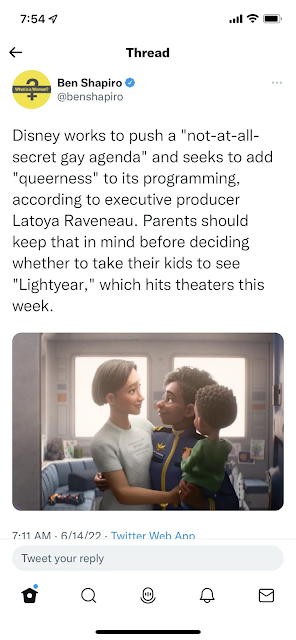
Here is one latest reference I just saw, mentioned in a Joe Rogan Reddit subforum:


That subforum is a good example of what I need to stop being exposed to.  Does it really matter if cartoon movie characters are gay?  I don't know; I guess opinions on that would vary.  Probably it would be more of an issue how they framed that status and general acceptance of it, the perspectives of different movie characters.  I'll get back to placing it further.

A seemingly deeper issue has been Marvel television series and movies "ruining" comic book characters and themes by swapping out white male characters for female and minority equivalents.  Any problem there?  Again it depends.  Plenty of that came up in renewing text comic series, making female versions of Thor and the Hulk, for example, so these are based on existing in-print character versions.  Beyond that it seems to mix with problems with creating good stories, which would seem like a real issue.  This Youtube "Critical Drinker" reviewer post seems to outline the conservative side of this perspective divide, in this post "Ms. Marvel:  How Not to Build a Hero."

One might expect that the problem is that the hero in question is a minority female, a Muslim Pakistani American teenage girl.  It's not really that, or at least as that Youtuber frames things it's not.  He outlines how a movie needs to go about setting up a good superhero story (which we should consider and critique, rather than accept, but at least initially the points seem reasonable).  You need these elements:


1. a hero, with some sort of origin story 

2. that hero's well defined powers (or some just have extra capabilities, like using a bow)

3. an internal conflict to be resolved in that hero, enabling some sort of character and story arc

4. an external threat, typically a primary antagonist, but this could take different forms


So the problem is that this story misses most of that.  This story's hero wasn't like that (as described in the trailer, a preview, since he didn't see the episode then, since it hadn't come out yet).  The Ms. Marvel character (Kamila) has a background, so in a limited sense 1 is met, but 2 didn't seem to be clear in that preview (although later it would be; origin stories can develop that over time).  Based on his assessment, which turned out to match the first episode, since I just saw that, there really isn't much internal conflict to be resolved in the hero, besides her being a teen, and a minority, and being into comic books (although in that story the heroes are real; it's set in the Marvel world, so it's really just the in-movie real life characters).  The external threat might come later; as of the first episode and the trailer there isn't one.

Does what he is saying work?  In one sense sure, but in another maybe not.  This is a primary earlier paradigm for telling comic book stories that he has outlined, for sure.  But do Disney and Marvel need to stick to this template for every movie or television series?  Not really.  Traditional action, adventure, and fantasy story telling tends to follow this form, but leaving a part out or replacing one might be fine.

A common critique is that in this new liberal oriented version, as in Captain Marvel, the hero--or heroine; I'm not sure which term is more acceptable now, probably hero?--is granted powers by an external agent or force.  They're not tied to a development story, or linked with character limitations the hero needs to overcome.  Then again Green Lantern was just given a power ring, Superman was born that way, Spiderman got bit by a spider; like that.  It's not as if Marvel themes are a completely different paradigm, but they do tend to follow their own somewhat rigid patterns.

It's worth noting that this paradigm is part of a much older "hero's journey" theme that evolved in older mythology, as something that was written into stories about Green and Roman gods, Gilgamesh, Beowulf, and so on, up until the modern day.  Jordan Peterson--claimed to represent conservative perspective, and to some degree he does--attributes this form to Disney stories like Pinocchio, and it seems to fit.  This list of 4 plot points would need to add a rescuing of an external valued good, fulfilling a societal norm or family expectation, and probably transforming both self-understanding / actualization and also a broader framework of valued roles and actions.  Heroes often tend to "save the world" in some sense, not just overcome a serious threat.

What if a storyteller wanted to throw out most of these four "rules?"  It should be possible to still tell a different kind of story, which still may appeal to a broad audience.  Something like a tragedy form of story is different; it's not like this.  Of course a Disney television show can't be a tragedy, but I mean that the normal template isn't required, it's not the only one available.  Love stories set up a similar conflict / resolution theme, but they are also different.

All this makes me think back to when we saw forms of story telling change in the past, related to shifting how stories were framed, and which values and forms were promoted.  Star Trek tried to explain, justify, and lead societal changes by promoting inclusiveness for racial equality (represented by aliens, but clear enough in meaning), gender equality (to a limited extent), and the use of reason and value of promoting common good.  It all kind of worked, in a limited sense.  The parallel with the Cold War and roles of the Russians and Chinese (as Klingons and Romulans) was a bit heavy-handed, and they really weren't promoting a mature form of gender equality, but it was fine for the 1960s.

Prior to that what kind of rules could we derive from heroic story forms like Westerns, the Lone Ranger, Flash Gordon, and Buck Rodgers, previous equivalents of stories like Star Trek and Star Wars?  Maybe these:


1. a central hero is a white male, matching that real life societal expectation, for example that every US President was of this type.  This paradigm is from earlier European culture, but these movie forms are based out of the US, from Hollywood.

2. a sidekick role can be used to promote positive value of minorities, females, or youths, with these secondary in importance, personal strengths, and story resolution effectiveness

3. characters need to be truly good or truly evil.  They can change from one to the other, but there can be no anti-heroes (a character who is both), or heroes with deeply flawed characters.  A character arc can transition a deeply flawed but basically good hero to the more uniformly positive form; this is really the most typical form.

4. antagonists represent negative character, not just an equivalent moral value separate interest.  Limitations in character (morality) and competence link together and cause their downfall.  Again I'm referring to an old paradigm; in the most modern form it's better if people can relate to the villain's perspective as somewhat reasonable.  Even the Heath Ledger Joker made some good points, and he was clearly evil.

5. there is room for arbitrary "other" character range as background.  These rules for main hero and main antagonist don't apply to all other characters, although the others are generally aligned with one "side" or the other.


Can we still tell this form of story?  Sure, but it's not going to work out like that in most cases.  It's a dated form, and a far more interesting story theme to move on to the Marvel template, or even beyond that.  Superman is written in this older form (for example he has no character flaws or arc), and it makes stories too simple sticking to that.  This is why they tend to include "evil Superman" arcs in comics, or add shortcomings for him to overcome in movie versions.  Not so effectively in recent films, really, because it runs against his entire character type.

Why is it a problem to include a protagonist / main hero who faces absolutely ordinary and mundane background and challenges?  Why can't being normal be a problem, like being a minority teen seeking out a self-identity and clearer social role?  Or I guess a drug or alcohol problem, or losing a job, or physical injury.  Dr. Strange overcame a physical injury, but his real arc was about character transition, and change of direction in terms of what he values.  But a more mundane form of story might be more relatable, without taking up magic use being so central, or leading on to saving the world. 

In a sense having the Moon Knight (tv series) character experience mental illness followed a related form, even though Dissociative Identity Disorder isn't conventional or mundane.  Mental illness sort of is conventional; lots of people struggle with depression or schizophrenia, and so on.

I'm not sure that Marvel made that work, setting it up as an internal challenge to be resolved.  The two primary internal personalities quickly became friends, although I guess per the writers' intent maybe that was a series long challenge and resolution, and it only seemed thin to me.  The wife of one persona immediately felt a strong personal bond with the other, which I guess could be a basis for later tension and conflict, but it missed an opportunity to write in real conflict to be resolved.

Per the Star Wars story and character arcs what this liberal "side" wants to write are stories where characters are granted special powers, without facing an internal arc, replacing older characters as superior than them, and later triumphing based on those received attributes.  Some of the "life lesson" form intended in old myths, and in not nearly as old Marvel stories, then drops out.  That was about overcoming setbacks, conflicts, and personal limitations.  Is this really a problem?  It's hard to say for sure.

To succeed as a form of mythology, to transmit values for ordinary people to take on as lessons, it might be a problem.  It doesn't take much adjustment for a new form of similar lessons to enter back in.  Per one interpretation Captain Marvel succeeded because an accident gave her powers, and per another she realized her then-inherent potential through deeper self-understanding, and through accepting risk of failure in testing her own limits.  Rey of Star Wars played out a similar revised form of character and story arc.  She did nothing to earn being the most powerful force user in existence, with the movie #8 explanation being that random chance caused that, and there were no unusual choices involving her taking on the hero's path, she was pushed into it externally.

On the conservative side of the perspective divide it looks to some people as if Disney / Marvel / movie content producers overplay this theme by not only having the central character granted special powers, without going through any internal challenge and transition, but the same happens with supporting characters.  In the Shang Chi story one main hero was a sidekick--a minority, without physical gifts or aptitudes, representing an ordinary person--who saved the day in the final battle with a lucky shot with a bow and arrow, after a few hours of practice, hitting a small moving target 1 km away.  Roughly the same happened in the Star Wars series, based on almost exactly the same character type, and to some extent the exact same action sequence.

The lesson here is that ordinary people can be heroes, even if being a main protagonist involves special circumstances and in-born or granted attributes.  In a sense that really is ok.  It just doesn't match an earlier expected form, and per one set of expectations it makes luck way too central to main movie turning points, versus effort and earned aptitude.  It doesn't try to teach people to work to earn special status, and the ability to resolve difficult problems, the lesson is that luck determines most things.  Or there just is no lesson, really.

From there intentionally including a lot of reference to gender, race, and sexual preference is off-putting to conservative viewers.  Female heroes are more effective in many recent Marvel stories, and older central heroes are "nerfed," reduced in power level and importance.  In the new Hawkeye series Hawkeye doesn't take part in the final "boss battle;" his younger female sidekick does instead.  If a very high proportion of primary protagonists are female or minority race, or gay or trans, in a sense that's still fine, but to viewers of conservative political inclinations it won't work well.

Surely all this came up related to the old Star Trek series, and that earlier paradigm shift.  Everyone had to get it that female characters were playing a greatly expanded role, even though, as in James Bond films, those roles were secondary.  It must have been clear that it was all allegory about race or nationality.  Looking back that shouldn't have been a problem, because the Klingons (Russians) were evil, and Romulans (Chinese) were also evil, and also somehow less respectable, so from both of "that time period's" conservative and liberal views the stories should have still worked.  They broke new ground, but from this time period's perspective they were careful about limiting that.

Next we might guess at where all this is leading.  It's possible for better story tellers to use these potential new forms in more developed ways, that support broader acceptance.  That's another sticking point; these stories being told could be appealing to people valuing these minority and gender representations, but they're not great stories in terms of building compelling characters and plot lines, setting up conflict to cause tension, and leading to engaging action as resolution.  The real shift to acceptance should be based on that.  The Star Trek form, and those old shows, are still popular today because it was all so well done, while a series like Battlestar Galactica was novel but largely faded from view, for not pulling it all off as well.

Then it's a problem that new stories aren't being told, as often as old characters and franchises are re-used.  Television shows will need to lead this form, since it's a risk to spend $150 million on a major production not based on a known story context.  Or presumably small-scale drama oriented stories could lead action / fantasy / adventure story context changes.  Streaming platforms are definitely helping drive this.

In the meantime if you listen to liberal or conservative film and television content commentary both "sides" come across as a bit "toxic" (most typically a label the left applies to the right).  They both make reasonable points about these issues, but tend to miss that they are opposed to the sub-contexts that they don't prefer, based around story-telling mode preferences and gender and race character context.  Any one person should only see one set of opinions in their Youtube or Facebook related secondary opinion commentaries, given how political preference filtering works out in those platforms, so that side would seem more right.


Digging deeper into secondary issues and contexts


What about the starting point of opposing or being open to movie characters being gay, or self-defined in other less traditional ways?  That's back to a simpler sticking point of the culture war divide.  "Hollywood" really does want to press a liberal context acceptance agenda, and half of the US population isn't on that page.  Or maybe it's really 45%, with 10% not as actively involved in the left and right divide.  It may come down to which proportion of movies and television content take up that context and portray it as a normal life theme, a standard value norm, and which other content sets that aside.  

The last Marvel movie I saw, Dr. Strange, included a gay character (America Chavez), but they didn't include that portrayal in the story, beyond having her wear a "pride" pin.  I don't remember it coming up in the last Spider Man movie either, and the Eternals had gay characters kiss, as a reference to it.  It's an active culture war; it's going to come up.

As I consider further the challenges faced by the Ms Marvel character it seems like I'm overstepping "internal struggle" concerns as trivial that are being addressed as serious, and of primary significance.  That character was a Youtube content creator with no following, and she had friends, and participated in social activities, but wasn't popular.  Completely normal, right?  Sure, but to not see this as a problem trivializes how younger people, and people in general, relate to their own life experience.  If she was a very attractive girl, with parents pushing her to be popular, and academically successful, or probably if she was wealthy, her conditions would be quite different.  She would experience other status and benefits from social acceptance.  

Her minority status seems to not be problematic at all, as portrayed, but I suppose incidental challenges might be seen as more important than I'm attributing them to be, for example her character having a tighter curfew.  I suppose it's understandable that such context as personal challenges has to be inconsistent, to fit episode plot lines, for example that one week she can't go to a comic convention (real life hero convention "in-story"), and the next she can go to a party.

She isn't really identified as experiencing mental health issues, like attention deficit disorder, but it's implied there.  As a parent I can relate to the general concern that all kids who spend more than half their free time consuming media, playing games, or on social media might naturally develop a limited real-life context attention span.  Dealing with this in a story line is probably going to be problematic, for that show, so they won't go there, but waving aside the issue as trivial isn't right either.  Teens experience this as a problem; they have to deal with it.

The same parallel can come up related to kids who are gay, or who now see themselves as gender neutral, or gender fluid (which I really won't try to unpack here).  To them it's a serious concern and challenge, and it doesn't work for a more conservative viewer to just see that as normal, as nothing to be concerned about, as not a significant internal conflict.  

I'm reminded of one gay roommate experiencing a significant internal struggle with exactly this issue, and after some degree of dealing with self-image and external social image he came to see it as normal, as not particularly unusual or challenging.  But that process took years, probably a main life theme for him between 15 and 25.  It works better for Spiderman to work through challenges of having superpowers and balancing saving people as a demand than for him to be gay; it fits natural fantasy story lines.  I don't mean that it has to be off-limits, or that it's a story that can't or shouldn't be told, but it's complicated, and a lot easier to move plot points along related to having superpowers.  My roommate put it all together little by little, one discussion and social exchange after another, and it took that full decade.  Spiderman tends to go from the spider bite to stopping muggers within a few scenes, only delayed by uncle Ben dying in two out of three portrayals.  He could come to terms with a gender or sexual preference issue in 3 or 4 short scenes too, but it would conflict a lot with real life experience.

Back to the theme of good storytelling form, I think one main problem is that these can be real character concerns, internal struggle for them to overcome, but that in the movies or tv shows I've cited they're not actually addressing and resolving these issues, these are just background concerns for them to deal with.  In one sense the Moon Knight character resolved having multiple personalities, so that's a potential counter-example, but really it went from impossible to work with and relate to on to being completely resolved with very little struggle or resolution effort on the main character's part (the two of them, two personas).  It would've required very developed, nuanced, and abbreviated form story arc to change that, and I suppose to some viewers that's exactly what they pulled off, and I just didn't see it that way.  The same could apply to Captain Marvel; to many maybe she really did overcome personal self-limitations and fear, through long struggle and introspection, and that's just not how I saw it on-screen.  She realized that she had a control device on her and pulled it off; problem solved, easily.

Maybe these personal development arcs are going to need to be like that, to match real life forms, drawn out across running threads and many personal exchanges, across more scenes and screen time.  I'm referring to the abbreviation issue tied to my friend and roommate's case.  These Youtubers who are criticizing this content themselves spent years building up to 100k follower counts, learning their craft of developing content, managing algorithms, telling their own stories, networking to build viewer base, etc., and the Ms Marvel character can't be shown doing equivalent things.  Maybe in a montage sequence of some sort, but even that would look mundane, beyond the limitations of showing it in a half dozen visual images.  Her own resolution needs to be about having superpowers, as occurred in the Spiderman story.  Peter Parker struggled with relationship issues and job concerns, so they balanced all that, but it took careful storytelling to do so, adding a moving depth to that character.

There's one additional problem, a big one, that relates to why the news media divide thrives on developing this perspective divide, instead of helping resolve it.  That "Critical Drinker" Youtube video has 1.5 million views, and that content creator has made another 20 videos with almost exactly the same theme, across different Disney or other producer characters and stories.  It's his job, literally, to take that side on this issue, to express it and for others to consume that content, and for him to get paid for making it.  Over the next year he will make another dozen videos complaining about the same issues, in exactly the same way, and he will draw the better part of another 10 million views for doing it, and earn the related ad revenue.

He's not exactly an outlier in that regard; this other channel, Nerdrotic, made roughly the same video ("Marvel PANICS After Year of M-She-U FAILURES | Ms. Marvel DISASTER Undergoes EXTENSIVE Reshoots"), at the same time, which has so far drawn 680k views, for a channel with less than half a million followers.  It seems like a Youtuber equivalent to doing what it takes to succeed in a corporate job; maybe it matches their views and maybe it doesn't, but it pays off either way.  I don't know that liberal supporters of this content form draw quite the same following, but that content does exist.  Drama and negativity work better for drawing viewership, and this "conservative side" can build on attachment to earlier forms of the same stories, complaining that Disney is ruining comic book stories.  Maybe they are, per one valid perspective and set of expectations?

One might wonder how people in other cultures place all this.  I live in Thailand; what do people here think of sticking to more traditional forms of hero stories (like Iron Man had been), or moving away from that, embracing diversity issues over a main central character arc, like in the Eternals?  They don't tend to think about it.  

I recently discussed superhero movie preferences with my wife's cousin, who is on that page, and his main comment was that he didn't like the way general story tones became darker.  For example, the Infinity War story killed half the universe, Endgame killed off a few main characters, and even the last Spiderman movie killed one main one (aunt May), for no clear story support reason, just to add tension and impact.  The good guy tended to win in the past, and at most they dabbled in offing a secondary character to mix things up.  It's not unprecedented in written comics, but not a sub-theme he likes.  In the written comics characters could die and come back, which also happens in films, but it has a different feel to it.  

Characters being minorities or gay doesn't seem to hold positive or negative value for him, I don't think.  Gender perspective isn't transitioning here, and it was fairly open to begin with, so that people can self-define as they like.  No one is going to learn any extra pronouns, but in general people will call trans individuals according to the role they take up, without anyone overthinking that.  They're not exactly "fully enlightened" in relation to such issues, but a liberal and conservative culture war wouldn't have the same divide to build on, so one has yet to start.

Does it seem like I'm tipped pretty far in one direction related to all this?  I feel as if I can relate to both sides.  If these newer, more progressive hero stories were just better stories I'd be fine with them.  The Loki television series (on Disney +) included a powerful, compelling, well-developed alternate universe female character that completely worked for me, framed within a good story.  It's a little late for me to be newly introduced to the idea that a woman can be a superhero too, since Wonder Woman covered that in the mid 20th century, and Gamora is one of my favorite Marvel characters, but it added to that legacy.  Folding in more social role commentary might be tricky, but if it somehow told an integrated story it could be fine, maybe even if I didn't fully accept the point of view being suggested.  

It will be interesting to see if Disney ever can succeed in normalizing normal internal struggles as part of a new form of hero's journey.  I mean mundane ones, like normal teen social development.  It should work.  It might fail for a reason I've not brought up, that it's too ordinary, and fails to fulfill the function of fantasy escapism.  It was nice having Neo of the Matrix escape life in an office cubicle, but what if he worked there for the entire movie instead, and a main sub-plot was about mundane office politics, him not getting a raise or promotion?  Maybe the imbalance in parallel themes could be interesting, as they started to play off of in Fight Club.  But it took great writing to do what they did in that movie.  They didn't include sub-context just because it made for a cool background aspect; every point brought up was woven together into story lines and character development.  

In the Eternals one immortal character was a child, just because they happened to be that, as one seemed to be a teen for the same reason, and characters were gay just because they were.  It can frame these contexts as normal, as they should be, but without being a part of a story about characters and developed plots it doesn't mean anything.  Could an immortal being maintain the status and personality type of a child, instead of developing mature social perspective, matching an adult form?  Would such beings face and overcome conflict related to same sex gender preference, and would that form shift over historical time periods?  The movie didn't develop these points.  

This is really why a more standard path is to start with origin stories at a more detailed level, to build up how these inputs work, instead of starting from a team-up movie theme context.  It's just good story telling, versus showing cut and pasted versions of expected images, exotic locations, action packed fight scenes, and novel superpowers.  To do justice to supporting new social role definitions and issues movie makers will have to build up interesting characters and tell good stories.

Wednesday, November 24, 2021

Tea blogging life cycle

First published in Tching here

It feels a little like I've written about this before, in considering a tea enthusiast quitting tea in this 2016 post.  Looking back that was about pros and cons of a developed tea habit, about caffeine concerns and expense, with only a little on exploration playing out a natural course.  My favorite tea blog author just gave up blogging, Geoffrey Norman of Steep Stories, making it a good time to revisit that theme.  To add context, his current blog page is 10 years old, but he had been doing tea reviews and writing in different forms before that.

In between that earlier post on a tea interest lifecycle, in the past five years, I've written a lot more than I ever had prior.  I switched from mostly oolongs and some black tea to mostly sheng pu'er.  Maybe more relevant, over the last year I've questioned why I keep writing, for many of the same reasons Geoffrey mentioned in that final sign-off post.  It just gets old, writing similar thoughts over and over, and even covering new tea-range exploration feels like repetition.  In general the audience shrinks as platforms like Instagram draw more attention, with pictures with moderate caption text easier to browse through than reading text.  Facebook now focuses more on showing people ads than private blog link posts.  I could pretty much end this post there; all that is the crux of it.

But of course I can say more.  There would always be ways to add new dimensions to a long-standing interest that you aren't completely burned out on (tea scope, not just tea writing).  Geoffrey mentioned that he will dabble more in making related videos, and he has been making memes about tea for awhile.  Last year I was part of a small social circle / meetup group related to tea interest, along with three friends, and this year we extended that to talking to a number of tea specialists.  I should summarize how that has went here in a post, beyond posts covering individual details, since we didn't broadcast or edit and publish that video.  Even that series sort of felt like it ran its shorter course, since it was hard to set those meetings up, and it worked better as a late covid wave replacement for other social contact, with the pandemic finally easing up a bit now.


Long ago I started taking tea more seriously than would be typical for a beverage interest, and to some extent it's that part that isn't sustainable.  Learning and experiencing new things has been great, and making contacts, even friends, but it would help if it felt like it was leading somewhere.  

This is probably a good place to explain why I even started:  about a decade ago I started exploring social media more and used tea as a subject theme as a basis for that.  Just joining Twitter might be interesting, but connecting Twitter to a subject interest makes sense, not that I ended up liking Twitter.  The same applies for writing a blog, trying out joining and then co-founding a Facebook group (this one), starting a Quora Space, and so on.  A new form for social media channel interaction hasn't clicked in awhile, beyond the meetups.  And it's a little harder to keep learning now, having already encountered so many ideas.  

I'm writing more about other subjects, an activity that isn't new, but that I've only started including in my tea blog over the last year or so.  I guess that started here:  Calhoun's Universe 25 mice experiments; overpopulation effects related to modern social themes.  It's uncertain that this is the "writing on the wall" for quitting blogging about tea; maybe balancing different interests would work well.  Since then I've written about foreigner / expat perspectives on culture in China, Dissociative Identity Disorder (the multiple personality theme), on how social media groups define and reinforce perspectives as distinct subcultures, and on Buddhism as it relates to rejection of a real internal self.

None of this really relates to any broad movement in tea culture or awareness.  It's not that I think the subject itself loses steam, or ceases to renew cycles of discussion.  It just seems natural to only talk about an interest like tea for so long, and then to just drink it.  As one Tea Chat forum veteran said he felt "tead out" after awhile, or to paraphrase Alan Watts (about another subject) after you get the message it's time to hang up the phone.

But then I don't see my own interests, goals, or experiences as the boundary of what I communicate or discuss, or else I wouldn't have stuck with it for this long.  Helping others can be pleasant.  Even then declining interest in text content definitely offsets that as a motivation for writing a blog.  It doesn't matter if 50 or 500 people read posts, but at some lower threshold it somehow seems to make less sense.


people do still read the posts but not as many


I'll probably keep writing, and slow down review pace, and keep diversifying themes.  Asian culture  has been a longstanding interest, related to living in Bangkok for 14 years, and I've not really said as much as I might have about how perspectives are similar or different, which should eventually tie back to tea.  Not in blogs at least, but I did also start a second Quora Space about that.  Other things could come up too, interactions or tangents.  I met with tea producers from five different countries this past weekend to talk about industry perspective and some processing background; things like that.


Monday, July 19, 2021

Tea references


First published in TChing here.


Four years ago I wrote a beginner's guide to tea themes post that included a reference section.  Someone just mentioned a good reference on oxidation (a Tea Geek blog post), a source listed in that, and it made me reconsider what I had left out, or what has changed since.

Most of what usually gets mentioned isn't bad.  If you ask in a tea group--which I see, for moderating one--people will bring up blogs like the ones mentioned in that post, or the Global Tea Hut magazines, or a few Youtube channels.  I'll only cover what is new, or that I didn't include there, at least for the most part.  Mei Leaf and Hojo vendor content both aren't bad beginner references, but both contain errors and marketing bias, as I see it.  All vendor produced content doubles as marketing, so it's probably that part of that context bothers me more than that it's different from other sources I am mentioning.

Farmerleaf video content:  this vendor started making interesting tea production videos a few years back, about black, white, and pu'er teas (and most recently about oolong; strange for a Yunnan vendor).  I did actually mention this source in that post.  It's odd how rare it is for vendor content to seem like a reference.  Cindy added background on Wuyi Yancha in hers, there's just not a lot there yet.  That limitation is normal; travel photos typically are as close as vending pages get, maybe just with tea processing pictures mixed in.  It's all partly there to sell Farmerleaf products, but William Osmont does a great job of just covering basics, and some finer points, without steering ideas too far towards product sales.


William making some sheng


Late Steeps
:  this blog includes a lot of cool experiment references on using mylar bags for sheng storage, and heated storage experiments.  I'm not sure what other blogs seem like a reference to me, as half mentioned in that post some years back also sort of don't, more about reviews and general commentary.  One I left out then works for that:

Tea DB:  maybe the most popular video blog out there, with some pretty good research reference text posts.  It's hard for a blogger to level up to really being much of an expert, as tea producers almost automatically are, but someone doing research works out as developed content.

Mattcha's Blog:  this isn't mainly designed as a reference, like the Tea Geek blog is, but it's a personal favorite.  Some parts head towards that scope, digging a bit deeper into background.

Discord Communitea:  not a reference at all, a social media channel and group instead, but then that post included that range too.  An old-style forum like Tea Chat can serve as a reference using searchable threads, but daily streams of discussions just aren't that (but I'm mentioning it anyway, mostly related to novelty and uptake).


a mainframe board kind of feel people would probably like or hate


Tea Forum:  kind of a carry-over from Tea Chat, more what that had been, really by design since a falling out in Tea Chat led directly to its creation.  It never became what Tea Chat had once been, but then it's a different time now; diverse online channels mean no central references or groups could take up the same role some had a decade ago.  This reference on making your own humidity control packs is about as solid as this site gets for that role.


same for this style; it would probably seem familiar and positive or else a bit obsolete


Moychay, Sergey's content:  their content is mostly in Russian but this sub-channel is translated. Content is pretty good, solid and in-depth, and not so directed towards sales.  

Tea Masters, Tea Obsession (Tea Habitat related):  classic blogs are worth a look, and Tea Masters is actually still active (a vendor-related Taiwan based blog), with Tea Habitat, Imen's now-inactive blog, mostly related to Dan Cong.  I must be missing a lot related to this range.  Walker Tea Reviews on Youtube were great (from 2011-2014 or so); I bet those haven't even aged badly.

Podcasts: since I don't keep up with this range, or necessarily see these as a reference, I'll just mention a couple of examples and let it go; Crimson Lotus does an interesting series, and Cody of Oolong Drunk does a cool informal version.  There must be lots of these (I keep seeing mentions), or saved seminar and forum content.  Again the "reference" theme can be vague;  if someone put enough research in a seminar session could be that, or the right expert talking for an hour is a great resource, but hearing stories about how someone got into tea can become repetitive.


That's good for a start.  I'm really not reading around reference content as frequently now; exploration naturally follows cycles, and after awhile that kind of drops out, then something triggers new rounds.  I try to not give up on learning but in basic references I tend to see more errors and omissions in reference content than ideas I'm not already familiar with.  It's hard to think of a counter-example, to place that in relation to something I've read or viewed this year that was newer to me.  William's Farmerleaf content always goes into more detail than I'm clear on for tea processing, and Sergey's Moychay content talks about visiting parts of China, and growing and processing themes there, which of course aren't familiar.

A lot of blogs are just about trying countless teas; I suppose mine could come across like that, even though I'm largely off the subject this year.  A little of that could go a long way.  It's nice venturing into new types range, to higher quality levels, or getting to other basics, but trying to drink the ocean for trying hundreds of kinds or versions of teas could be way too much to embrace.  Even the basic background context has limits for practical utility.  It's all about making a drink from dried leaves and hot water, which doesn't need to be so complicated.  I tend to see the background learning and social media themes as secondary and complementary interests, as much as directly tied to drinking tea.


Wednesday, November 13, 2019

Water type experiments, with Wuyi Origins Rou Gui and KTM Lao Man E sheng


This is all a bit much.  I've been meaning to test the effect of using different water versions on tea for awhile, it was just always too much messing around to get to it.  Now that I finally did results were interesting, but one part related to sample type selection could have went better.

In retrospect it was odd using teas I hadn't reviewed before, and teas of this quality level for this purpose.  Cindy's Wuyi Origin Rou Gui versions are about as good as that type ever gets, and the fruitier version is a strong contender for my favorite tea among all types and versions.  I guess the reasoning was that using good tea is going to tell more of the story related to what input the water has, versus using teas that are of medium quality, and trying to extrapolate results to likely outcome if the teas had been better.  It was also about just using interesting versions that I had around.

The same concern and atypical theme applies for the King Tea Mall Lao Man E sample; this is a gushu version from a respected, in demand origin area.  It's questionable judgement, shifting focus off the tea onto the effect water mineral content variation has on preparing it.  One might argue that both can be covered at the same time, but per the actual experience a lot gets lost.

About water type / input testing in general, it had always seemed next to impossible to identify what a really good or ideal source of water would be.  Really doing that process justice would involve trying lots of water types, and then probably folding in how that varies across at least a few different tea types.  Online discussions of water mineral levels as an input have been interesting, and standard patterns of opinions do emerge, but nothing that works well as starting point guidance. 

Avoiding high levels of calcium is generally advocated, for example, but my own interpretation of what would be low, medium, and high based on sampling lots of hearsay may or may not be remotely reliable.  I mentioned some advice passed on by Peter Jones in covering some theory in this post, which was really about trying a Myanmar Kokang shu version:

We are still several months away from any conclusions. But basically you want your alkalinity to be 1/2 your total hardness, a pH in the 7s, and a balance of 2/1 of Ca to Mg. The other positive ion mineral salts also play a role in extraction...

The form I finally arrived on--definitely not a final word on a practical, functional approach--was to try two completely different teas using Volvic water (which gets mentioned as some people's personal favorite), compared to the filtered local Bangkok tap water I use at home.  It was a stretch but I picked two relatively random, opposite type teas I happened to have on hand, a Rou Gui and a sheng pu'er.  It turned out to be not the best selection because I didn't factor in the high level of bitterness in the sheng version (a Lao Man E); kind of an obvious mistake to make, in retrospect.  Trying an already familiar, milder version would've made a lot more sense.

I can't describe what the local water is like in relation to lots of other sources, but of course I have tried the same teas prepared using it and also other spring water, RO water, and whatever is being used in other places.  My friend Sasha had a favorite spring water he used, for example, and some of those teas I had tried at home, a number of versions tasted there many times.  A vendor at an expo had been using RO water, and I re-tasted the same teas I tried with them again at home within a couple of days, and I try teas in shops sometimes.  To really isolate differences trying the tea prepared together is all but essential; the point here is that how differences in water source work out in general, and how the local water compares, isn't completely unfamiliar.

Bangkok municipal water had been truly awful, years back.  It varied so much even the color and smell could be off.  We used bottled spring water for years, or at least local water sold as such, which really could be different things.  As of a few years ago we switched over to using a multi-stage filtration system, and the water seems fine.  Per online hearsay the tap water here is based on rainwater sources instead of natural spring origin, so it's low in mineral content, which makes sense given that it rains a lot and we're not exactly near a mountainous or even hilly area.  Per other hearsay local distribution systems are a main problem for water quality, the pipes from there to houses, not so much what the processing centers put out, or even use of old pipes in your house.  It probably helps to live right beside one of the main Royal palaces in Bangkok as we do; infrastructure seems pretty stable and well maintained.

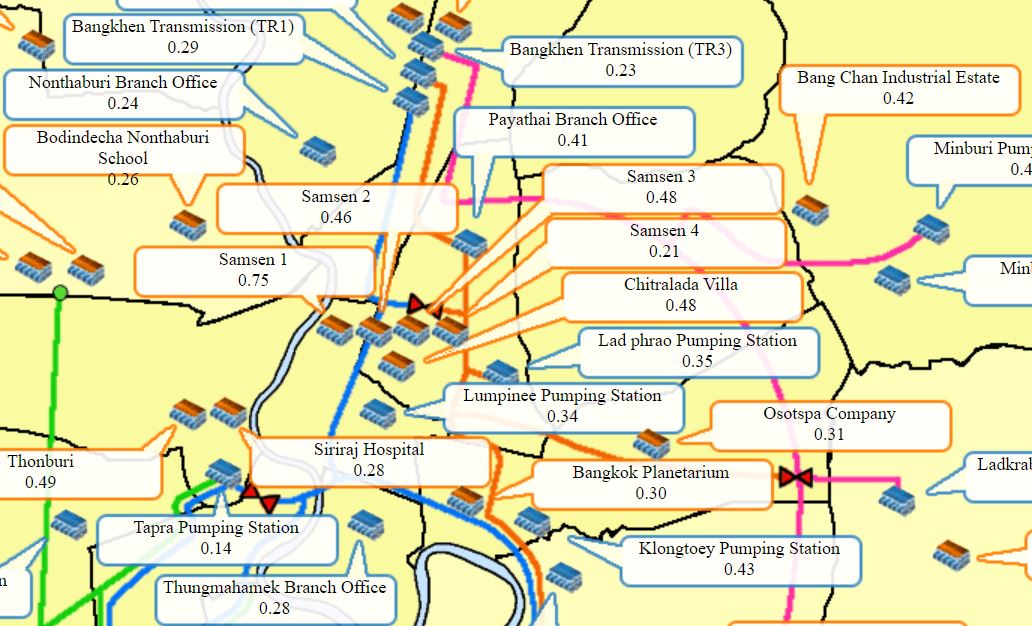
One might expect the water quality and mineral contents to vary based on lots of local factors, and I'm not certain that it doesn't.  I've included a number of captures from the local Bangkok real-time water quality monitoring system, from when I tried these teas, but of course those don't include a measurement of contents broken out by mineral grams / liter at any given time.

It would make the most sense to run this type of comparison multiple times, evaluating tea types one at a time.  I didn't do that, I tried two types together.  That I still don't consider a mistake; I've been training to do comparisons that make sense, or else those that don't instead, for about three years now.  I've tried hundreds of teas over uncountable combined tasting sessions.  It's familiar ground.  If someone without that odd tasting habit wanted to get the clearest results I'd definitely recommend using the more intuitive approach, trying the teas one at a time, perhaps using 3 or 4 types of water to add review complexity.  Selecting mild, well-known versions of teas would probably work best, regardless of type; that part was a mistake.

I'll probably try this again with a rolled oolong version to see how it works with a very mild but complex tea, which should also help to isolate feel effect even better.


Review, comparison of Wuyi Origins Rou Gui with two water types:


Rou Gui with Volvic:  just amazing tea!  I'm not sure if that's the water though.  This didn't say if it was fruity type or cinnamon Rou Gui but judging from the heavy, warm cinnamon taste it's that.  Flavor is intense, feel is thick, level of roast is perfect, slightly noticeable but only complimentary.

Rou Gui with filtered tap water:  this is similar but the flavor may pop a little less.  It seems to be drawing out a lightly different vegetal note, as if the warm mineral resembles celery just a little.  Cinnamon is slightly flattened out.  This difference is so minor that tasting across different times it wouldn't really stand out as much, but side by side it does quite a bit.  Sweetness is down just a little too.  It's the same great tea, almost the same flavor profile and feel, just a little different.

an early round; color differences didn't seem to tell a lot of story, so I'll pass on adding more about that


Second infusion:


Rou Gui with Volvic:  this tea is just perfect as cinnamon intensive Rou Gui goes.  The balance, intensity, all the profile taken together; this is it.  The cinnamon part really jumps out.  It's warm and rich, almost connecting a little with a very subtle roast level, or maybe it only seems that way.

Rou Gui with tap water:  it's almost the same experience but it is missing some of the one high point that makes the other tea experience so special, the brightness, sharpness, and intensity of that cinnamon flavor.  The deeper tones and supporting elements carry across fairly well; fullness and body isn't bad, kind of similar.  The first version might have a slightly heavier, oilier feel, which is more positive.  It's a quite similar tea experience but funny how those parts that seem most interesting and critical are what flattens out.


It's too early for conclusions but the results already seem clear enough; this local water doesn't work as well.  I don't foresee buying bottled water to drink tea with though.  I wouldn't throw out a few large plastic bottles a week to get this effect difference, or probably even one 1.5 liter bottle a week to review using a different version.  It's a shame the local water isn't better but adding expense and impacting the environment to drink slightly different versions of tea isn't going to work out.  Maybe a charcoal treatment effect will help; that idea comes up a lot.

Later edit:  it was too early for conclusions; the opposite kind of trend turned up in the fourth and fifth infusions, a trend that was much more pronounced in the sheng version.

Third infusion:


Rou Gui with Volvic:  This tea is probably evolving a bit in character but I've lost track of clear prior impression to describe that.  It's still great, probably with a slightly shifted balance of aspects.

Rou Gui with tap water:  it's great with this water too, with less difference standing out than had initially.  It's still not quite as intense, giving up just a little sweetness, and more so dropping out just a little punch in the warm cinnamon aspect.  There is a very minor difference in the mineral tone, so subtle it would only come across in direct comparison, but it doesn't work to describe it or judge how negative it is.  I think it is slightly negative versus neutral, but that's a judgement call at this point, as much just a difference.


Fourth infusion:


Rou Gui with Volvic:  a slightly dry underlying mineral in this might have increased this round, it just doesn't stand out as much in this as it had for the sheng at this stage, or take exactly the same form.  The tap water version is just as good this round, or perhaps even slightly better.  So strange; I have no idea why that would be.  I would expect effects to shift a lot for increasing brewing time in later round but this isn't really onto that as much as it would be in two more infusions.

Rou Gui with tap water:  still really exceptional, not losing anything for intensity or positive range.  I think depth is picking up, that the one-note emphasis on cinnamon is deepening to include a lot of other warmer tone range, that it balances even better.  It was great the other way too though, focused more on that one flavor aspect.

Fifth infusion:


I'll lengthen infusion time slightly but these teas are holding up; adding a lot of time for that wouldn't be positive.  I'm brewing these over 10 seconds now, for what I'd take to be optimum, maybe around 15, but it goes without saying that I'm not timing this, since I just don't.


Rou Gui with Volvic:  mineral is a bit much in this, a dry version of it.  Looking at the mineral profile calcium and magnesium seem to be at the level I'd expect to work best, based on following online discussions about that (12 mg and 8 mg, respectively).  It's not "hard" water, but that should be enough to play a standard role in extraction and setting profile.  The rest, the total dissolved solids value, would be a bit much; there's lots of other minerals in this.  This is still really pleasant, and a very nice citrus aspect is ramping up in this tea, a "chen pi" dried mandarin peel type effect.

Rou Gui with tap water:  slightly better than the Volvic, for not including so much of that dry mineral effect.  The rest of the profile is similar.  The citrus part may be at a slightly lower level, so not as intense or positive, but the overall effect is better for not tasting as much like that dry version of mineral.  Mineral is great in tea, in the right balance; it grounds the experience.  Older plant source teas and natural origin teas seem to express a lot of that, an underlying mineral element supporting overall complexity.  It's just slightly nicer in this tap water version for balancing better, in this particular infusion of this tea, per my judgement.  The difference in extracting other flavor range hasn't dropped out but is has shifted in balance; it seems to matter less.

I didn't note differences or aspect range for feel or aftertaste much for these; that didn't seem to vary as much as flavor related to the water type input.


a later round; adjusting infusion times would change effect of color difference


Lao Man E sheng water source input testing:


King Tea Mall 2018 Lao Man E sheng gushu with Volvic:  bitterness stands out; to be expected.  One could learn to love that effect, even at this level, but I haven't.  If it balances well with the rest I can appreciate it, even like it, but this is a bit much.  The tea seems to obviously be good tea; all the other markers for quality work out, thick feel, clean flavors, depth and complexity, lingering aftertaste.  That front end bitterness really defines the experience though, then it trails on, not dropping that much intensity for awhile.  At least sweetness goes along with it, and there is plenty of other range.  I'd expect it to drop off a little by round 3 or so but I'm not sure how far past that I'll get.

Lao Man E with filtered tap water:  a touch of metallic taste seems to be added to the rest.  That extended aftertaste is going to make this a terrible choice for combined tasting though, about as poor a choice as one could make.  I might have considered that, but it's not like I'm drinking Lao Man E all the time.  Rinsing your palate with plain water (not warm, not cold) works, but it's a lot to rinse in this case.  Making mistakes to learn from can be a good thing, it's just more pleasant when they're less obvious, less stupid mistakes.

In general the flavor profile seems to pop a little less, again, with that mineral difference the main change.  Sweetness may be slightly reduced but bitterness is dominating the flavor profile anyway, so it would stand out less.

Second infusion:


Lao Man E with Volvic:  bitterness is easing up; it's balancing a little better.  It won't be until the next round this approaches a more conventional sheng profile though, more evened out.  The point here is the difference anyway.

Lao Man E with tap water:  beyond a touch of mineral difference in this (not really a positive one; a touch of metallic flavor) and a slightly reduced fullness of feel it's similar.  The other Volvic brewed version comes across as slightly sweeter.  In the case of the Rou Gui it's about a shift in the best attributes being slightly dimmed, but the character isn't so different beyond that.  In the case of this it comes across differently.  That shift in underlying mineral, slightly less full feel, and slight reduction in sweetness seems to add up to change the tea character more.  They're only small shifts, and the basic aspects are the same beyond that, the general feel, flavors range, aftertaste, feel, but the effect is more of a change, or a change at a deeper level.  Again the Volvic brewed tea is just better; there was no trade-off that benefited using this local Bangkok tap water, at least not yet at this stage of infusions.

Third infusion:


Lao Man E with Volvic:  this is much better balanced for transitioning over those rounds.  Not in comparison with sheng that doesn't emphasize bitterness, if someone doesn't like bitterness, but I'm fine with it at this level, it's just definitely not a close match to personal preference.  The thick feel is nice, how clean this tea is, how the different layers of aspects work together.  One part under that is actually a little floral, drifting a little towards fruit, but deeper light mineral is really stronger. 

Rich, full feel is nice.  Aftertaste works a lot better for dropping off.  Usually people would couple those last two descriptions with where the feel impacts your mouth or throat, with aftertaste also related to a lingering feel.  I'm never so good with all that, in part for not valuing it.  It probably is as much a valid quality marker as what I do pick up more, but it seems a developed preference that would be as natural to never develop.

Lao Man E with tap water:  this finally works about as well as the other version.  It gives up a little thickness in feel but somehow the fruit and floral range (complex, but subtle, hard to define) is standing out a little more in this.  It might be working out as well or even better for not stripping out as intense a version of that bitterness.  Feel losing a little thickness isn't as positive.

The floral and fruit range I can try to define, to describe, but it would be a guess:  it's bright and sweet, so along the line of plumeria and dried mango.  There are lots of types of dried mango, so those tend to vary a lot, but that gets complicated to wade into that.  The brighter, sweeter, more citrus oriented kind.  In retasting both that bitterness hitting a little harder in the Volvic version isn't quite as positive, to me.  It may make for an exception that stripping out a little less intensity wouldn't always be a bad thing.

Fourth infusion:


Lao Man E with Volvic:  it's really strange how this is exhibiting a stronger mineral aspect, a slight metallic range.  It's almost as if I've mixed up the water sources, but then this probably does have more mineral content, so maybe that makes sense.  I have no idea what that means.

Lao Man E with tap water:  it's nice how that balance evened out.  Bitterness is still pronounced but the proportion is more relatable now.  The complexity is nice, the range of flavor, and how feel and aftertaste contribute to overall effect.


Fifth infusion:


Lao Man E with Volvic:  a dry mineral input is much stronger in this tea version.  It tips just a little towards how chlorine comes, that's just not it.  It's much more positive to say it tastes like limestone, and to be fair it's really in between the two.

Lao Man E with tap water:  there is less mineral effect in this, making it come across as sweeter in character, and better balanced.  I don't know that it is actually sweeter; that may just be how it seems, without as much of the mineral input changing things.  The tap water version was actually slightly better over the last two infusions, but to be fair the difference is a bit minor.


Conclusions:


It's crazy that two main shifts occurred in difference, varying a lot in early and later rounds.  Volvic brewed tea was clearly much better over the first two infusions, and clearly not as positive in the last, probably more even in the fourth, with tap water working just a little better in that round too.  I can't really unpack or explain that.  Somehow a shift in flavor and feel proportion across rounds favored the Volvic earlier on, and the filtered tap water later (which probably contains a lot less mineral).

It's worth noting that different people can and do use completely different timing sequences related to brewing different rounds to different infusion strengths.  It's more common to use lower proportions and longer times, and then to extend the timing more across later rounds than I tend to.  Why that is becomes a lot to account for, and beyond citing personal preference some of the rest wouldn't be clear.  It's hard for me to account for why people like tea prepared differently than I do; to some extent I suppose I never could.

It could be interesting to consider the water mineral content though, starting with the Volvic listing:


I'm kind of guessing, since I have been involved with plenty of discussions about water content but haven't memorized ranges, but the calcium and magnesium levels look ok, if maybe even a little low.  Per discussions those two are the main factors, with a moderate amount improving results, and high levels throwing them way off.  Looking back through old discussions and references, Rie Taluli did a review post comparing tasting results using of a number of types for green tea, and in a discussion comment of that post Peter Jones (who is into reviewing mineral effect themes) cited listings of standard mineral content of a number of brands:


EVIAN - Natural spring in France - 290mg/L sodium bicarbonate, 81mg/L calcium, 27mg/L magnesium, 6.7mg/L sodium. 

AQUAFINA (Pepsi), DASANI (Coke) - Municipal water through RO - no sodium bicarbonate, no calcium, no magnesium, no sodium. 

GLACEAU (Coke) - Municipal water through RO - no data, but unlike Dasani, they then add back in for flavor the calcium, magnesium, and bicarbonate. 

FIJI WATER - Natural spring in Fiji - 153mg/L bicarbonate, 18mg/L calcium, 14mg/L magnesium, 18mg/L sodium. 

NESTLE PURE LIFE - Municipal water through RO - no bicarbonate, 7.4-11mg/L calcium, 2.9-5mg/L magnesium, 4.4-9mg/L sodium. 

ARROWHEAD (Nestle) - Natural spring in Arkansas - no bicarbonate, 4-66mg/L calcium, 1.4-19mg/L magnesium, 3-17mg/L sodium.


I can't imagine that using Evian would work well, and it's odd that Arrowhead water is so inconsistent, but I'll leave off saying much more about the rest.  I do come back to the sodium level idea related to the local water version level.

About the local water description, some input is offered by Bangkok real time tap water quality monitoring (http://twqonline.mwa.co.th/EN/map.php?type=).  We live next to the Chitralada station, in the center.  These don't mean that much to me but they could to someone else:


free residual chlorine levels, Nov 9, 2019, 1 PM


chloride levels (mg / L)


turbidity (NTU)


ph


salinity, listed as g / L (seems wrong, too high?)


July 2019 ph capture (to show variability)


I don't know what was in that water, for specific mineral content, and I don't know what the filtration process would have removed.  Chloride level was around 4 mg / l in this water, versus 15 mg / l in Volvic, but what of that?  Salinity just seemed wrong; those readings would seem like way too much salt, in the 150 mg / l range.  What if that is right; shouldn't the water taste like salt?  As a baseline I checked how much is in seawater:

On average, seawater in the world's oceans has a salinity of approximately 3.5%, or 35 parts per thousand.  This means that for every 1 litre (1000 mL) of seawater there are 35 grams of salts (mostly, but not entirely, sodium chloride) dissolved in it.


So 35,000 mg / l, which still doesn't answer if I could taste 150 mg, but it's a context of sorts.  It occurred to me that salt is sodium chloride, so unless I'm missing something the two values don't match up, the measured amounts of chlorides and salinity.  That prompted me to look up answers to both questions, how much salt can one taste, and what are normal levels for these.  This WHO reference covers the first:

Taste thresholds for sodium chloride and calcium chloride in water are in the range 200–300 mg/litre (2). The taste of coffee is affected if it is made with water containing a chloride concentration of 400 mg/litre as sodium chloride or 530 mg/litre as calcium chloride (3).


I don't think we can take that second sentence as good input about coffee enthusiast perspective.  More input from that source pins down range of chloride in typical fresh water:

The mean chloride concentration in several rivers in the United Kingdom was in the range 11–42 mg/litre during 1974–81..


That still doesn't resolve the monitoring inconsistency between salinity and choloride levels, but it is interesting to compare that to sodium levels in the other bottled waters.


Further conclusions:


That last section was mislabeled, wasn't it; not much for conclusions in there, or even speculation.

I suspect this tap water version ended up with very little mineral content in it, due to starting out with limited amounts and filtration removing some.  It's interesting to consider that tea producing more positive infusions initially might generally relate to producing less positive infusions across later rounds.  At least that did happen here, per my interpretation, and it may work out as a somewhat uniform generality (or may not; that goes without saying).  This could explain why some people push teas to produce very long counts of infusions, and others tend to not like them as much after a much shorter sequence, although simple preference difference seems to be just as relevant an input. 

Then again, who knows.  Round after round of trying out lots of water and tea versions would tell a longer, more accurate story.  In online discussion it's not uncommon for people to claim that they prefer different water (mineral content, presumably) for different tea types, and that would intuitively make sense.

I've never ran across much detailed speculation of why soaking bamboo charcoal in water is said to improve the results for making tea with it, even though people advocating that practice comes up a lot in discussion.  Even when it's being sold for this use, as in the case of this Yunnan Sourcing version, there's not necessarily a reason for why it might make any difference.  It probably does, it would just be interesting to hear guesses about why.  Here is one that Google search turned up, Tony Gebely's input, but somehow it's not satisfying as a complete and plausible explanation:


The idea behind bamboo charcoal, and any charcoal for that matter is the fact that it is extremely porous and will absorb impurities in water. It really isn’t “filtering” water if you set a stick in the water, in order to filter the water, the water must pass through granulated charcoal or some other medium (this is how Brita filters work)...


It would seem that it could be both adding and removing minerals from the water, and that only testing, instead of speculation or traditional input, would shed light on this.  I would tentatively accept that it really does improve results, although that would be clearer to me if I tried it myself.