Showing posts with label liberal. Show all posts

Wednesday, July 29, 2026

The political war extended to movie themes in the US


At first glance everyone already knows how this is going to play out:  there are conservative or liberal oriented movies, and then people on the corresponding side of the US political divide will watch one or the other, and reject the other.  That happens.  But there's a little more to it now.  There is a tendency for a middle group to reject anything remotely like Hollywood liberal inclinations, among people who aren't actually politically conservative.  At least that's how I see things playing out.

The early steps are well-known enough.  In movies like the Star Wars sequels, or Terminator sequels, or later Marvel movies, they tend to build up female protagonists, by "nerfing" or weakening male characters, and gender swap characters, to make white characters into minorities.  Of course this is regarded as fair and inclusive by some, or many, liberals, and rejected by conservatives.

There's a lot less to cite about the opposite trend.  Hollywood is liberal-oriented, so an example of a movie just for conservatives is harder to come up with.  Let's check with Google on that:


Major Hollywood studios rarely label or market films as explicitly "conservative," but 2025 saw a notable rise in mainstream faith-based projects, military/action features, and traditional values narratives. Notable examples include David from Angel Studios, alongside faith-themed and traditional family hits like The Chosen and House of David.


Right, I've never heard of those.  I saw a 20 year old (or so) time travel movie about conservative Christian ideology awhile back; it was odd seeing anything like that.  I had to look up what that was:  Time Changer, from 2002.  It was interesting at least seeing that opposing view, that people might re-adopt values from the 1800s (reject swearing, wearing more modest clothing, all the parts of a very literal interpretation of the Bible, etc.).


Let's skip ahead:  this is mostly about the reactions to the Christopher Nolan Odyssey film.  Of course, since they've replaced Helen of Troy with a black actor, and included a trans-man as a Greek warrior the issue is that it includes liberal signaling.  But the movie is kind of neutral, related to the rest of it, per reviews on both sides.

That brings up an interesting context:  more conservative viewers might either decide to never see the film, because of those issues, or if they did see it would need to find reasons to dislike it, even if ordinarily it would seem like a good movie to them.  That's simple enough.  You can just dislike the story treatment, the character development, any changes from the original Greek myth version, and so on.  And more liberally oriented viewers can find plenty to like as well, to justify why this socially progressive film is good, not only for being socially progressive, but also as a film.


There is a set of Youtubers who benefit quite a bit from this divide, by outlining why the liberal orientation is a bad thing, for viewers who want to feel common ground with others related to disliking that.  The twist is that they're not only conservatives (the viewers, or the Youtubers).  The guy who makes the Critical Drinker Youtube channel stands out among them, related to popularity, and to quality of content (authored by Will Jordan, the name of "the Drinker," per online inpu).  

He communicates clearly, and expresses ideas well.  His perspective seems fine, although it does tend to become repetitive.  His image gimmick is that he is Scottish, and drinks while watching films (supposedly; he has sort of moved beyond that early branding theme, although he still does reference it).

I see his perspective as matching one part of a "classic liberal" view.  This relates to someone who was liberal in the 1980s or 90s, but who then fell into a middle ground for political perspective when the left shifted further left.  There is one other complication to this:  it's normal for people to be more liberal when younger, and then more conservative when older.  This seems to happen for some of the reason I've just described, that society keeps changing, and when people fall behind the pace of the changes they are automatically a conservative.  I'll give an example.

My parents were quite liberal in the 1970s.  They were open to people of all races, nationalities, and social classes being regarded as equal.  My dad was even a social worker; that was his career.  But then as acceptance for people being gay became mainstream in the 1990s, and not just different races, that was harder for them to adopt.  A couple of my close friends were gay, and they never seemed to express disapproval for that, but they still saw people being attracted to the same sex as somewhat unnatural.

Is it possible that it is unnatural?  The question only makes sense within a conservative worldview, that can draw on categories of natural norms, instead of seeing these as assigned by society, and open to change over time.

So they don't really hate gay people, but aren't comfortable with that theme.  It's the same as for others who can't relate to transgender self-definition today, or people being gender neutral, or whatever else.  People who were liberally oriented in the 90s didn't have to accept these later designations, because they were either unheard of or very uncommon then.

I suppose some of this carries over to other minority issues, related to immigrants and such, or maybe to issues related to openness to societal class level changes, but I won't make this discussion more complicated than it has to be.  Feminism also works out to be a complicated topic.  Of course where I'm from, a conservative rural area, in Western Pennsylvania (not that it matters; rural areas are fairly culturally consistent in the US), people are more racist, and against any of the modern progressive agenda and perspective, and for most probably even the older forms of it (classic racism).


Related to that film, the Odyssey, it was interesting how the Critical Drinker, and others, were up against the challenge of explaining why they didn't like it.  It should be easy, right; any parts of the plot or character development could be regarded negatively.  Or the lighting, the action sequence development, use of CGI, and so on.  But in this case most reviewers felt that it's a pretty good film, so lots of that wouldn't work.

The Critical Drinker settled on the portrayal of the main character as the main critique, related to how Matt Damon acted out Odyssius.  Not so much as a personal criticism of Matt Damon's acting, but more the direction.  Even pro-liberal reviewers said that his character is a bit war-weary and one dimensional related to character depth, for most of the movie, so it was simple enough, and a natural choice.  Then the ending apparently doesn't match the original version, so that's easy to dislike.  And the scenery apparently doesn't look like Greece, which would mean more to me if I'd actually been to Greece (parts related to there; I guess Troy was in North-Eastern Africa, so generally near the Middle East, sort of?).


original source cited in the image, worldhistory.org


It's an interesting divide, coupling "classic liberals" with conservatives, related to one part of their media preference.  Maybe they're not so far apart, in terms of general perspective and worldview?  The US isn't set up for there to be any moderate middle ground though, politically.  People are suppose to be conservative or liberal, Democrat or Republican.  Lots of media tone reinforces this.  Trump throws that off a bit, for being so extreme, but in general the society really does break along that line, and media content does, related to news, television shows, movies, etc.

Then one other irony is that Trump isn't really a conservative.  He doesn't care about guns rights, or abortion, or really even about minority issues, although he can play the role of a borderline racist easily enough.  He is pro-Trump, and the rest is flexible.


So what does this mean?  Does this odd part of the culture war open up a space for moderate perspective?  Probably not.  It's just an idiosyncrasy, related to how some films work out, which I suppose would carry over to streamed television content.

These commentators aren't really leveling out the cultural field, in terms of saying that it's fine for people to be trans-gender, or that racial issues shouldn't matter anymore.  It's easy to interpret them as saying the opposite, even though they're not, supporting negative views on racism and transgender acceptance (with negative here meaning bad, being racist, or transphobic).


They earn Youtube views and income by saying what people want to hear.  They really do think that Helen of Troy shouldn't be a black character, and that casting a physically small trans man as a soldier doesn't really make sense.  But they're not necessarily racist or transphobic, or unusually supportive of  race or trans acceptance issues, more kind of in the middle, not particularly concerned with these themes, or against them.  It's easy to take that in different ways, as a viewer, depending on your own biases.  

That's how the 90s went; these things weren't issues, and people let others be however they wanted to be.  You could change your gender back then, and you wouldn't be hated, or seen as some sort of progressive champion.  You'd have been a social role and status outlier, which wouldn't have been regarded as good or bad, by most people.  Conservatives would have found it off-putting, as they do today.  For liberals it couldn't have seemed as normal, since it wasn't as conventional, but it still could have seemed fine.


It's interesting how "political correctness" has changed since, although it doesn't really shift the landscape of these ideas or positions all that much.  Words like "oriental" became regarded as negative (pejorative), and fell by the wayside.  The pronoun theme became complicated.  None of all of that changed the world and personal perspectives all that much though; even among supporters it was regarded as the language simply catching up to modified and updated perspectives.  Sometimes the changes don't stick, and they seem like overreach in retrospect, but often they do.


Odysseus


I finally saw Odysseus, so I can compare my take to what "the Drinker" commented.  I wanted to like it more than I did.  Parts were great, especially the visuals and action scenes.  It was a bit dark; there was no need for that part of the Mediterranean to all look like a Batman movie, matching Gotham in dark tone.  It was slow.  

The characters didn't do much for me.  Odysseus was traumatized by war; that was his only emotion and communicated theme for two thirds of the movie.  Athena did so little that she could've been a PTSD flashback, as some have speculated.  She might have asked a couple of leading questions but essentially she just looked sad.  It doesn't work to use one of the most powerful gods, and the only one actually on screen, to just look sad.  The gods existed in that world, but they only caused storms.

It would have been much better as a standard action movie. Characters could have been likeable and had some depth when playing a more standard role.  Tone could've been more varied, not just dark and tense.  The change of the ending was for the worse; it made no sense.  Odysseus traveled for 10 years to get home only to turn around and take another open ended, unplanned voyage immediately, seemingly within a day or two of getting home, or at least a few days.

The feminist oriented theme that women should be allowed to run a country worked, as a queen.  But it was awkward having Tom Holland's character be 18 or 19 in the movie, and look like 30, and being too young to be a king, until he was designated the new king at the end.


In one sense this doesn't change that conservatively oriented media channels need to arrive at the right conclusions, to dislike left-leaning content like this.  So little of this Odysseus film needed to be "liberal" that it was a shame for them to have included it.  Helen of Troy could've been white, as a Greek would be, and using a trans actor added nothing, beyond that controversy.  Without that baseline going in reviews would probably still be similar, but that one third of the potential audience would be more open to liking the film.


Friday, June 28, 2024

Culture conflict related to trans-gender intolerance


A telling test case came up recently in a news story about a trans-gender related hotel space public performance in Honolulu, in Waikiki.  I'm not sure the most obvious conclusions caught all the importance of the context, that people should be tolerant of others expressing themselves, regardless of what kind of identity they portray.

It was a local Hawaiian ceremonial performance, probably a traditional hula style dance.  That part was de-emphasized in the story, since the negative reaction by a conservative white woman, and how it all then played out, made for the main parts of the story.

She had no reasonable complaint.  She didn't want her kids exposed to people representing that kind of identity, just for being trans-gender, which really is a bit unreasonable.  She said that she would gladly leave the hotel if her room charges were refunded, and hotel staff moved quickly to help her with that.

So it's a clear win for freedom of expression and self-definition, isn't it?  Especially positive for this occurring during Pride Month.  Hawaiian culture is especially open to people representing themselves in all sorts of ways, with a history of trans-gender self-definition being accepted.  Sure, all that is positive.  

The only tension related to open acceptance relates to mainland white people representing external culture that's not appreciated, which includes a lack of tolerance for others who are different than them, as in this example.  It extends a bit from there; any negative aspects of conservative or mainstream culture are looked at negatively, or to some extent people just being white, related to a minority perspective that's not necessarily held by a small minority.  Still, everything played out as it should have in this case.

I'm living within a culture where trans-gender acceptance and conventional uptake is even more normalized, in Thailand.  Part-time; I also live in Honolulu part of the time, where my kids go to high school and grade school.  People living in Hawaii from elsewhere puts pressure on the local housing market, so acceptance of that is mixed, as I suppose it should be.  Since people can move freely between all the US states that tension, and any potential resolution, can be hard to place.

In Thailand trans-gender identity is so normal that people don't necessarily make much of it, beyond any other type of expressed identity theme.  As it should be.  So what deeper issue here concerns me?


US culture war themes


The divide in liberal and conservative perspective never should have extended to where it currently stands, it seems to me.  It's problematic for each side to express contradictory viewpoints, and for individual issues, like this one, to sort out who is in the right, correcting shared common perspective to one step closer to a better middle-ground norm.  I don't see that as happening.  Conflicts reinforce the divide instead.

I think it helps place what is going on to compare this theme to an earlier one in US history, to the civil rights movement.  In the 1950s races were quite divided in the US, with black people and other minorities living out a lower parallel form of existence from white people.  In the 70s a broad social movement corrected for this.  Some white people in the 70s wouldn't have wanted their kids to be exposed to contact with black people, to share schools with them, to attend the same restaurants, or to sit beside them in the same parts of public busses.  Those people were wrong, both in retrospect, related to where the culture shifted to, and back then too, related to not having a valid perspective and internal experience of a natural degree of empathy.

We're still landing on the conservative white woman being wrong in this case, right?  I'm not going to conclude otherwise.  

The point here is to critique where we are in the culture war, if the parallel with racism holds up, or how the two cases might vary.

One other part of the modern context is that media seems to be stoking the basis for this divide in perspective.  One part of the media, the liberal branch, is pushing for greater acceptance and openness, and the other conservative side is trying to develop justification of drawing limits for exposure.  Could it be that communication about gender identity and sexual preference options has become overextended in schools, or in entertainment media?  It seems possible, but we would need to consider why any limit of any kind would be justifiable.

One reason for this divide seems especially problematic; media streams are polarized into liberal and conservative forms because of how ownership of those has changed over the last few decades, and their role in society has shifted.  In the 1970s and 80s the role of the news media was objectivity, at least in theory, presenting events and personal stories from as objective a perspective as possible.  That's no longer true.  Two different conservative and liberal forms represent a general point of view instead.

To me, and this part is my own conjecture, this divide serves a somewhat nefarious purpose at this point, even though it had seemed to evolve organically.  Focus on political extremes takes focus off other social issues that should draw more attention, like the wealth divide, emphasis on government spending on defense, or risks related to climate change.  That sounds like a conspiracy theory, and I suppose to some extent that's how I intend it, and see it.


Do these themes connect?

Where does this set of ideas lead?  People should still be able to express their own identity in any way they like, without others being able to draw those limits for them.  Let's consider a decent example of this sort of theme extending too far, and see if there is any ground for rejecting the underlying conflict instead.

A recent case comes to mind; Disney has been producing media content, movies and shows, that move established franchise story lines into this culture-war identity politics range.  Star Wars is the main example, but not the only one.  The Alcolyte (show) is the latest example.  In these shows the heroes are typically only women, who also tend to be diverse in other personal background, from racial minorities, often representing same-gender sexual preference.  Taken alone this is not a problem, although extended far enough this would tend to portray straight white males mostly in villain roles, and that does happen.

It reaches back to the cowboys and "Indians" theme, doesn't it?  From our current perspective pigeon-holing Native Americans as villains was wrong.  But then what if we flip that; does it really work to only show white immigration to the current American west as villainous?  It works better, but it seems a bit too polarized.  The "noble savage" trope only goes so far.  In comparison with later genocide the local nations and tribes context was ideal, and it's probably difficult to separate out finer or otherwise justified distinctions from there, but in reality of course it wasn't ideal.  

I think we would be right to conclude that US territory expansion and re-definition was conducted in an immoral way, but there's no way to re-write that history.  It's different if local Hawaiians are being pushed out of their own state by economic factors today, isn't it?  That's all happening in real time.  It can be at least partly resolved.  Housing and land allocation projects only supporting established locals have been utilized for this purpose, but it seems to be far too little to make a lot of difference.

Back to the Disney example, one core problem is that new shows don't tell stories as well as older versions.  Communicating the context is a main goal, over-riding story development.  How can we identify this?  Character development is limited, story characters experiencing transition arcs, familiar within most written content, film, television, and theater based stories in the past.  That's just an example; story telling seems to suffer in different ways.

Continuity with past story telling is a concern, among fans.  The Alcolyte casts the Jedi as the villains in the story.  In a sense this isn't necessarily out of bounds; even earlier story themes made allowance for their (fictional) group culture being partly flawed.  A good story could develop this further.  It's possible that broad fan interpretation isn't objective, that "good stories" are judged in light of past expectations.  

But then it seems new story line and character development goes too far, that not much happens beyond making political commentary points.  Events seem to not follow natural story progressions, paced development, establishing tension, progression through interesting events, use of unexpected transitions, active conflict and resolution phases, etc.  Instead of developing these story elements many show or movie versions seem to rely on the positive emotional impact of female, minority characters dominating others.  

Back to cowboys defeating "Indians" / Native Americans, isn't it, a story element crutch that Western genre probably overused?  It works to tell stories in which the white immigrants "lose," but it works better when that's applied within the context of a good story, with developed characters.


Backing up a bit, where am I going with all this?  I feel a lack of satisfaction with the earlier event as demonstrating a clear and justified cultural victory.  It seems to represent that, but I don't think it addresses the context of where the conflict is coming from, or how it finally needs to be resolved.  


There is a more pronounced goal on the conservative side of "owning the libs," of people instigating tension and conflict to cause the other side a problem.  It's a form of trolling, making unreasonable statements or carrying out activities just to draw a reaction.  


My concern is that to some extent justifiable, valid communication and perspective correction going the other way could repeat some part of the same pattern.  People expressing intolerance for reasonable self-identification should be corrected, but the ongoing cultural conflict doesn't lead to any positive endpoint, or even limited progress.


Maybe this isn't as much of an issue in the hotel traditional dance performance case.  It seems possible that these two forms of correction are both justified, and valid.  On the Disney media development side the push-back comes in the form of audience feedback, a "Rotten Tomatoes" audience score of around 15% positive review of The Alcolyte show series.  

It's not as clear if conservatives or true "centrists" are the ones pushing back.  I suppose it's even possible that some liberals don't care for that form of story telling, especially prior Star Wars fans who happen to be liberal.  A minority race woman defeating a white man in a story line that makes no sense would still not be satisfying to them.


I seem to be implying that things aren't working out ideally enough, right?  This is my impression.  I'm not comfortable with media and news emphasis on the two extreme forms of political perspective.  There shouldn't be conservative and liberal perspective friendly hotels, isolation of two population segments in such a way.  Two sets of news channels shouldn't communicate only one of the two messages.  There shouldn't be liberal and conservative entertainment media.  There should be ways to normalize a middle ground.  

Of course in the case of that woman and that incident it's not as if she moved to a conservatively oriented hotel, although that might've been possible.  One not engaging in open support of Pride Month would be sufficient, a hotel represented as politically neutral.

From my perspective all of this should tip towards open acceptance of a range of identities and ideas, that should be normal, so I'm favoring the liberal side.  But I'm still not seeing victory by the liberal side as the right kind of goal, in some range of senses.

Didn't that happen in the US civil rights movement, with minorities being seen as equal to others as decades passed?  It seemed to.  Then during the Trump era that wasn't as clear.  I'm from a rural, white, conservative area, in rural PA, so to a limited extent I can relate to where racism is coming from.  It stems from a lack of exposure to racial diversity.  It's possible to connect racial diversity with the experience of urban problems, under the right circumstances, seeing urban crime and drug problems as relating to race issues instead of economic conditions, and other cultural influences.  Or developed urban speech use can be seen as threatening; it doesn't need to relate to actual societal problems.


But then related to what I've already said I'm seemingly ok with demonizing the wealth divide, elevating this concern to the same level of universal evil.  The "eat the rich" sentiment captures this set of ideas quickly, doesn't it?  Wealthy people have been controlling the public narrative; individuals buying media news channels and using them to promote one of the two story lines is part of the problem.  

To some extent replacing a conservative and liberal divide with a rich versus poor version must just be repeating the same perspective problem.  It would be nice if a more balanced wealth distribution in the US could result from that, though.

But then there can be right and wrong related to these divides and issues, right?  The US is better off for minorities having equal opportunities, to whatever extent that is the case.  Gay people should be accepted, not forced to hide their gender sexual preference from others.  It should be ok for people to be trans-gender, or to develop new forms of self-identity definition.

What about extremes; what if someone identifies as an elf, or a fairy, or as some type of animal?  Maybe there are practical limits.  I'm also concerned that a normalization of non-fixed internal self-identities may lead to new forms of identification that aren't as functional, for our young people.  

My kids can identify as straight or gay, or change their gender identification, if they really want to, but I think it would be a mistake for them to try to walk away from consistent forms of self-identity.  That particular form context, embracing some degree of continuity, seems to be especially functional.  We have yet to experience what would happen if highly variable forms of self-definition became a new norm, people taking up very different self-identification themes day to day, or even intentionally manifesting multiple personalities.  

I think our internal and external representations of personas are a bit arbitrary, conventional, and somewhat fictional, but that's a longer set of ideas that I'll need to set aside here.


Where to next?

How can the US culture war be "walked back?"  What would that even look like?

Victory by the liberal side probably isn't a practical outcome.  And then there doesn't seem to be a natural middle ground to arrive at.  There is no shared perspective to be developed between racism and open acceptance, for example.  Simple separation is still not ok.

The way forward seems to stem from openness and communication, not by any number of individual victories by one side.  In the initial story moving that woman to a more conservatively oriented hotel was only a temporary fix, to the extent such a thing might even exist.


This is the problem I have with this outcome.  That conservative woman "got owned" in that story.  The social media group sentiment was that she could go back to the mainland with that flawed perspective.  It wasn't the worst possible outcome.  

I would want her to understand why it's a problem to limit how other people express themselves.


The one other part of the story I haven't brought up yet relates to how this is all playing out in US public schools.  I think this is where her tension is really coming from, why the lack of acceptance came up in the first place.


Kids are taught that a broad range of gender identity and sexual preference forms are normal, in some cases, and conservatives don't want their kids to learn this.  To me those forms are just normal, maybe not according to what I grew up with, but it's all normal range in today's society.  Can my own relatively liberal perspective be universally accurate?  Maybe not.


That far extreme of atypical identity options also becomes important.  Couldn't it be inappropriate to identify as an animal or mythical character type?  Sure, why not.  On the more moderate side it becoming fashionable, in-trend, for people to identify as trans-gender may also be problematic.  Children don't have a clear gender identity at my daughter's age, typically, at 10.  Many would, and in many cases their initial self-definition would carry over to all of their adulthood, but it's also a time of transition.  

If children in the age ranges of 10 to 15 explore self-identity in novel ways this seems fine, but early options for hormone treatment and even surgery seem potentially problematic.  A decade ago even hormone therapy for a young teen would have been unthinkable, but it's happening now.  These kind of options wouldn't have to be completely reversible later on.

I'm not convinced that the most conservative option, narrowing the range of what is communicated as possible options, is necessarily right, but there may be reasons for why that's not inappropriate or entirely negative.  Societies become stable when a range of normal identity roles are defined and adopted, related to issues like gender identity, and also role identity, becoming a parent, an employee, a national citizen, a good neighbor, and so on.  All of these roles can evolve organically, and change over time.  Mapped to all of those conventional roles it's fine to be gay, transgender, to reject parenthood, to be an entrepreneur, to not participate in any political process, and to choose to remain socially isolated.  

What if social norms change so that these opposite selections become somewhat universally adopted?  The last two seem different than the others, don't they?  Democracy depends on some degree of voluntary participation, and a society made up of isolated individuals may not be as stable.  It seems likely that both of these have "broken down" in the US, and that this negative characterization is at least partly justified.

In Reddit I've recently been exposed to an anti-natalism group, made up of people who not only choose to not procreate, but also to self-identify in relation to shared perspective that people in general shouldn't do this.  Humanity should shut it all down, and cease to exist, more or less as a failed experiment.  It's a bit negative.  Surely their own negative life experiences are the main cause for this perspective.  

It could be troubling if a next step is taken, if it becomes even more common for people to think that more actively reversing human existence would be a good thing, eliminating the people that already exist.  That already comes up.  40 years ago these kinds of extremes were a rare aberration, concerns over who might become homicidal, but it's something that needs to be considered more today.


I'm not sure exactly what I'm proposing, related to walking back the culture war, or the rest.  I don't see any practical way to make any progress at all in relation to this.  I think it should at least come up as an option, that one side or the other winning doesn't need to be the only outcome, that actively setting aside the conflict itself should be considered.  It doesn't help that such a vast percentage of Youtube channels draw a lot of their following based on taking up these extremist themes and views.  Centrist perspectives that take up one extreme and then moderate and soften the framing and conclusions can also be attractive.  

Conservatives could continue to feel uncomfortable about social changes and new self-definition options without dwelling on that scope.  Liberals could continue to embrace and support others self-defining and expressing themselves as they see fit without hating the other 40% of the US population, characterizing them as villains.  What schools teach or enable could be brought in line with a middle-ground acceptance, arrived at through open dialog.  Media forms could embrace political and cultural themes without villainizing broad segments of the population.  

Of course in the last case, or all these cases, problems would come up, related to varying interpretations and perspectives.  My concern is that we don't seem to be framing these issues in these ways, as divides that we need to somehow work through and move past.  I don't think that antagonism and limited issue-based victories by one side or the other is going to help with resolving this divide, the US political culture war.  It seems it will have to play out to some form of eventual resolution that we can't currently foresee.  Maybe future generations will simply tire of it, so over a long cycle of 40 or so more years it will fall out of fashion?


Possible partial resolution; media content commentary on perspective divides


This leads me to think of what form of discussion or media input support existed 40 to 50 years ago that isn't a factor now.  What helped with that earlier change, when a lot of opinions about a race divide did shift for the better?  

A 70s television show that openly critiqued the earlier forms of race and gender imbalance comes to mind, All in the Family.  It used good writing, insightful presentation of ideas, compelling and relatable characters, and good acting to map out where issues stand, and what might represent progress.  The main character, the conservative Archie Bunker, didn't switch over to become a liberal, but the show developed situations where he was exposed to new ideas and people of types he wasn't familiar with, and was biased against, minorities and gay people.  He grudgingly came to accept that some of his earlier broad generalizations were too limited, and there were examples of people of good character from those groups, with different valid perspectives.

Of course it was a different age; without three main networks now no shows could have a similar following.  But what is popular that is trying something similar?  Shows and movies can emphasize representation now, not necessarily addressing modern biases and acceptance issues directly, or even so indirectly, but simply demonstrating a degree of relevance by having modern characters represent different races, genders, and new forms of self-identity and sexual preference.  It's not the same though.  It would be hard to support the same degree of idea presentation and indirect dialog without at least establishing parallel fictional themes.

The Alcolyte could be seen as a limited form of this sort of attempt, since one story line context challenges the form of established patriarchy by eliminating all male characters in one small social group.  It's still simple representation though; this doesn't communicate any indirect message.  In that much earlier All in the Family television show context they used familiar societal forms and character types in simulated real-life settings to develop discussion of issues, which would be much less effective if addressed far more indirectly.  

The Barbie movie seemed to try to take this other approach, to discuss themes within a fictional context, but it was taken in vastly different ways by people looking for their own versions of messages and conclusions.  One simple message might have been that the patriarchy is bad, that women should be regarded as equal to men.  Digging a little deeper the movie might have been critiquing current forms of that critique, saying that replacing it with a matriarchy paradigm might only re-form the same problems.  

I can explain.  After the Barbie World start-up patriarchy was defeated the Barbies decided to allow for token equality and representation of Kens, with severe limits, so that government and judiciary positions could be held by men, but only in a very limited form.  This could have represented a main conclusion, that granting women equality in the real world in a very limited form doesn't actually change the nature of the problem, only the appearance of it.  One male character states this explicitly earlier on, that patriarchy in the real California has only evolved to hide that form better, replacing explicit gender restrictions by implicit versions, adding other requirement criteria that men would be more likely to fulfill.  The Kens in the movie are happy to be heard and granted token equality, not a real version of it, and this could have been a main message, a caution for women accepting limited provisional equality.

Vague movie themes that can be interpreted in different ways may satisfy a range of audiences better, but that's not so helpful for social commentary.  It's a different thing, but as in this hotel meltdown example case I also don't see limited, clear-cut, one-sided victories in support of openness and acceptance as nearly as helpful as they might first seem.  Some of that is necessary, drawing clear boundaries, but it wouldn't help resolve any underlying tensions.  

The same applies to push-back of extremist liberal ideology in mainstream entertainment content as a relatively meaningful step forward.  It's positive, related to setting acceptable limits, but that Star Wars fan reaction is also mostly related to keeping entertainment content entertaining.  At least the Barbie movie did that; it used relatable fictional characters, developed story lines, and some degree of character transition arcs to tell a story.  What that message meant could vary in interpretation, which I guess is a normal component of artistic expression.  

If the received message is that the patriarchy is bad, that both genders should be regarded as equal, that seems too simplistic to function much as a social commentary.  Of course this is right.  Now tell us something we don't know, about how to undo an existing general bias, or about how since it evolved organically in the first place we can unpack and understand those factors to help reverse it.

A Star Wars series could show that the earlier good versus evil paradigm was overstated, and there can be problems within a sub-culture or power structure that is generally identified as positive.  The message wouldn't work without a good story structure, relatable characters, individual character development arcs that parallel the general perspective mapping, and great acting pulling it all off.  

It's a stretch, but not as much of a stretch as US conservatives and liberals actually talking, and learning to give space to opposing views, to understand them, and to just get along.


Friday, June 17, 2022

Disney, Marvel, and the change in movie formats and values


It's no secret that the culture war has touched on essentially all aspects of American life, that everything divides between liberal and conservative views and preferences, well beyond entertainment media and news coverage.  Since I've been watching more Disney content than usual lately (my wife subscribed us to Disney + last year) those patterns are becoming more and more familiar, related to their input to Marvel movies and television shows.  Probably it would be for the best if I just eased up on hearing any related commentary (online views on their content), since that has moved from interesting and insightful related to outlining the two related points of view to quite tiresome, creating conflict where there only really needs to be preference differences.

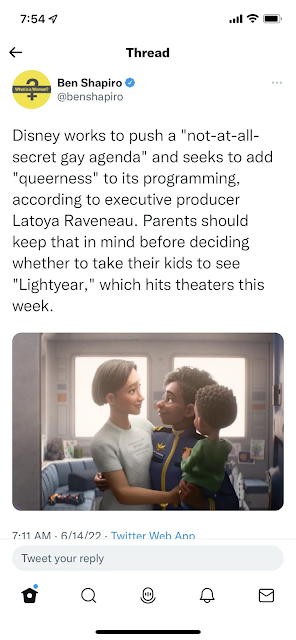
Here is one latest reference I just saw, mentioned in a Joe Rogan Reddit subforum:


That subforum is a good example of what I need to stop being exposed to.  Does it really matter if cartoon movie characters are gay?  I don't know; I guess opinions on that would vary.  Probably it would be more of an issue how they framed that status and general acceptance of it, the perspectives of different movie characters.  I'll get back to placing it further.

A seemingly deeper issue has been Marvel television series and movies "ruining" comic book characters and themes by swapping out white male characters for female and minority equivalents.  Any problem there?  Again it depends.  Plenty of that came up in renewing text comic series, making female versions of Thor and the Hulk, for example, so these are based on existing in-print character versions.  Beyond that it seems to mix with problems with creating good stories, which would seem like a real issue.  This Youtube "Critical Drinker" reviewer post seems to outline the conservative side of this perspective divide, in this post "Ms. Marvel:  How Not to Build a Hero."

One might expect that the problem is that the hero in question is a minority female, a Muslim Pakistani American teenage girl.  It's not really that, or at least as that Youtuber frames things it's not.  He outlines how a movie needs to go about setting up a good superhero story (which we should consider and critique, rather than accept, but at least initially the points seem reasonable).  You need these elements:


1. a hero, with some sort of origin story 

2. that hero's well defined powers (or some just have extra capabilities, like using a bow)

3. an internal conflict to be resolved in that hero, enabling some sort of character and story arc

4. an external threat, typically a primary antagonist, but this could take different forms


So the problem is that this story misses most of that.  This story's hero wasn't like that (as described in the trailer, a preview, since he didn't see the episode then, since it hadn't come out yet).  The Ms. Marvel character (Kamila) has a background, so in a limited sense 1 is met, but 2 didn't seem to be clear in that preview (although later it would be; origin stories can develop that over time).  Based on his assessment, which turned out to match the first episode, since I just saw that, there really isn't much internal conflict to be resolved in the hero, besides her being a teen, and a minority, and being into comic books (although in that story the heroes are real; it's set in the Marvel world, so it's really just the in-movie real life characters).  The external threat might come later; as of the first episode and the trailer there isn't one.

Does what he is saying work?  In one sense sure, but in another maybe not.  This is a primary earlier paradigm for telling comic book stories that he has outlined, for sure.  But do Disney and Marvel need to stick to this template for every movie or television series?  Not really.  Traditional action, adventure, and fantasy story telling tends to follow this form, but leaving a part out or replacing one might be fine.

A common critique is that in this new liberal oriented version, as in Captain Marvel, the hero--or heroine; I'm not sure which term is more acceptable now, probably hero?--is granted powers by an external agent or force.  They're not tied to a development story, or linked with character limitations the hero needs to overcome.  Then again Green Lantern was just given a power ring, Superman was born that way, Spiderman got bit by a spider; like that.  It's not as if Marvel themes are a completely different paradigm, but they do tend to follow their own somewhat rigid patterns.

It's worth noting that this paradigm is part of a much older "hero's journey" theme that evolved in older mythology, as something that was written into stories about Green and Roman gods, Gilgamesh, Beowulf, and so on, up until the modern day.  Jordan Peterson--claimed to represent conservative perspective, and to some degree he does--attributes this form to Disney stories like Pinocchio, and it seems to fit.  This list of 4 plot points would need to add a rescuing of an external valued good, fulfilling a societal norm or family expectation, and probably transforming both self-understanding / actualization and also a broader framework of valued roles and actions.  Heroes often tend to "save the world" in some sense, not just overcome a serious threat.

What if a storyteller wanted to throw out most of these four "rules?"  It should be possible to still tell a different kind of story, which still may appeal to a broad audience.  Something like a tragedy form of story is different; it's not like this.  Of course a Disney television show can't be a tragedy, but I mean that the normal template isn't required, it's not the only one available.  Love stories set up a similar conflict / resolution theme, but they are also different.

All this makes me think back to when we saw forms of story telling change in the past, related to shifting how stories were framed, and which values and forms were promoted.  Star Trek tried to explain, justify, and lead societal changes by promoting inclusiveness for racial equality (represented by aliens, but clear enough in meaning), gender equality (to a limited extent), and the use of reason and value of promoting common good.  It all kind of worked, in a limited sense.  The parallel with the Cold War and roles of the Russians and Chinese (as Klingons and Romulans) was a bit heavy-handed, and they really weren't promoting a mature form of gender equality, but it was fine for the 1960s.

Prior to that what kind of rules could we derive from heroic story forms like Westerns, the Lone Ranger, Flash Gordon, and Buck Rodgers, previous equivalents of stories like Star Trek and Star Wars?  Maybe these:


1. a central hero is a white male, matching that real life societal expectation, for example that every US President was of this type.  This paradigm is from earlier European culture, but these movie forms are based out of the US, from Hollywood.

2. a sidekick role can be used to promote positive value of minorities, females, or youths, with these secondary in importance, personal strengths, and story resolution effectiveness

3. characters need to be truly good or truly evil.  They can change from one to the other, but there can be no anti-heroes (a character who is both), or heroes with deeply flawed characters.  A character arc can transition a deeply flawed but basically good hero to the more uniformly positive form; this is really the most typical form.

4. antagonists represent negative character, not just an equivalent moral value separate interest.  Limitations in character (morality) and competence link together and cause their downfall.  Again I'm referring to an old paradigm; in the most modern form it's better if people can relate to the villain's perspective as somewhat reasonable.  Even the Heath Ledger Joker made some good points, and he was clearly evil.

5. there is room for arbitrary "other" character range as background.  These rules for main hero and main antagonist don't apply to all other characters, although the others are generally aligned with one "side" or the other.


Can we still tell this form of story?  Sure, but it's not going to work out like that in most cases.  It's a dated form, and a far more interesting story theme to move on to the Marvel template, or even beyond that.  Superman is written in this older form (for example he has no character flaws or arc), and it makes stories too simple sticking to that.  This is why they tend to include "evil Superman" arcs in comics, or add shortcomings for him to overcome in movie versions.  Not so effectively in recent films, really, because it runs against his entire character type.

Why is it a problem to include a protagonist / main hero who faces absolutely ordinary and mundane background and challenges?  Why can't being normal be a problem, like being a minority teen seeking out a self-identity and clearer social role?  Or I guess a drug or alcohol problem, or losing a job, or physical injury.  Dr. Strange overcame a physical injury, but his real arc was about character transition, and change of direction in terms of what he values.  But a more mundane form of story might be more relatable, without taking up magic use being so central, or leading on to saving the world. 

In a sense having the Moon Knight (tv series) character experience mental illness followed a related form, even though Dissociative Identity Disorder isn't conventional or mundane.  Mental illness sort of is conventional; lots of people struggle with depression or schizophrenia, and so on.

I'm not sure that Marvel made that work, setting it up as an internal challenge to be resolved.  The two primary internal personalities quickly became friends, although I guess per the writers' intent maybe that was a series long challenge and resolution, and it only seemed thin to me.  The wife of one persona immediately felt a strong personal bond with the other, which I guess could be a basis for later tension and conflict, but it missed an opportunity to write in real conflict to be resolved.

Per the Star Wars story and character arcs what this liberal "side" wants to write are stories where characters are granted special powers, without facing an internal arc, replacing older characters as superior than them, and later triumphing based on those received attributes.  Some of the "life lesson" form intended in old myths, and in not nearly as old Marvel stories, then drops out.  That was about overcoming setbacks, conflicts, and personal limitations.  Is this really a problem?  It's hard to say for sure.

To succeed as a form of mythology, to transmit values for ordinary people to take on as lessons, it might be a problem.  It doesn't take much adjustment for a new form of similar lessons to enter back in.  Per one interpretation Captain Marvel succeeded because an accident gave her powers, and per another she realized her then-inherent potential through deeper self-understanding, and through accepting risk of failure in testing her own limits.  Rey of Star Wars played out a similar revised form of character and story arc.  She did nothing to earn being the most powerful force user in existence, with the movie #8 explanation being that random chance caused that, and there were no unusual choices involving her taking on the hero's path, she was pushed into it externally.

On the conservative side of the perspective divide it looks to some people as if Disney / Marvel / movie content producers overplay this theme by not only having the central character granted special powers, without going through any internal challenge and transition, but the same happens with supporting characters.  In the Shang Chi story one main hero was a sidekick--a minority, without physical gifts or aptitudes, representing an ordinary person--who saved the day in the final battle with a lucky shot with a bow and arrow, after a few hours of practice, hitting a small moving target 1 km away.  Roughly the same happened in the Star Wars series, based on almost exactly the same character type, and to some extent the exact same action sequence.

The lesson here is that ordinary people can be heroes, even if being a main protagonist involves special circumstances and in-born or granted attributes.  In a sense that really is ok.  It just doesn't match an earlier expected form, and per one set of expectations it makes luck way too central to main movie turning points, versus effort and earned aptitude.  It doesn't try to teach people to work to earn special status, and the ability to resolve difficult problems, the lesson is that luck determines most things.  Or there just is no lesson, really.

From there intentionally including a lot of reference to gender, race, and sexual preference is off-putting to conservative viewers.  Female heroes are more effective in many recent Marvel stories, and older central heroes are "nerfed," reduced in power level and importance.  In the new Hawkeye series Hawkeye doesn't take part in the final "boss battle;" his younger female sidekick does instead.  If a very high proportion of primary protagonists are female or minority race, or gay or trans, in a sense that's still fine, but to viewers of conservative political inclinations it won't work well.

Surely all this came up related to the old Star Trek series, and that earlier paradigm shift.  Everyone had to get it that female characters were playing a greatly expanded role, even though, as in James Bond films, those roles were secondary.  It must have been clear that it was all allegory about race or nationality.  Looking back that shouldn't have been a problem, because the Klingons (Russians) were evil, and Romulans (Chinese) were also evil, and also somehow less respectable, so from both of "that time period's" conservative and liberal views the stories should have still worked.  They broke new ground, but from this time period's perspective they were careful about limiting that.

Next we might guess at where all this is leading.  It's possible for better story tellers to use these potential new forms in more developed ways, that support broader acceptance.  That's another sticking point; these stories being told could be appealing to people valuing these minority and gender representations, but they're not great stories in terms of building compelling characters and plot lines, setting up conflict to cause tension, and leading to engaging action as resolution.  The real shift to acceptance should be based on that.  The Star Trek form, and those old shows, are still popular today because it was all so well done, while a series like Battlestar Galactica was novel but largely faded from view, for not pulling it all off as well.

Then it's a problem that new stories aren't being told, as often as old characters and franchises are re-used.  Television shows will need to lead this form, since it's a risk to spend $150 million on a major production not based on a known story context.  Or presumably small-scale drama oriented stories could lead action / fantasy / adventure story context changes.  Streaming platforms are definitely helping drive this.

In the meantime if you listen to liberal or conservative film and television content commentary both "sides" come across as a bit "toxic" (most typically a label the left applies to the right).  They both make reasonable points about these issues, but tend to miss that they are opposed to the sub-contexts that they don't prefer, based around story-telling mode preferences and gender and race character context.  Any one person should only see one set of opinions in their Youtube or Facebook related secondary opinion commentaries, given how political preference filtering works out in those platforms, so that side would seem more right.


Digging deeper into secondary issues and contexts


What about the starting point of opposing or being open to movie characters being gay, or self-defined in other less traditional ways?  That's back to a simpler sticking point of the culture war divide.  "Hollywood" really does want to press a liberal context acceptance agenda, and half of the US population isn't on that page.  Or maybe it's really 45%, with 10% not as actively involved in the left and right divide.  It may come down to which proportion of movies and television content take up that context and portray it as a normal life theme, a standard value norm, and which other content sets that aside.  

The last Marvel movie I saw, Dr. Strange, included a gay character (America Chavez), but they didn't include that portrayal in the story, beyond having her wear a "pride" pin.  I don't remember it coming up in the last Spider Man movie either, and the Eternals had gay characters kiss, as a reference to it.  It's an active culture war; it's going to come up.

As I consider further the challenges faced by the Ms Marvel character it seems like I'm overstepping "internal struggle" concerns as trivial that are being addressed as serious, and of primary significance.  That character was a Youtube content creator with no following, and she had friends, and participated in social activities, but wasn't popular.  Completely normal, right?  Sure, but to not see this as a problem trivializes how younger people, and people in general, relate to their own life experience.  If she was a very attractive girl, with parents pushing her to be popular, and academically successful, or probably if she was wealthy, her conditions would be quite different.  She would experience other status and benefits from social acceptance.  

Her minority status seems to not be problematic at all, as portrayed, but I suppose incidental challenges might be seen as more important than I'm attributing them to be, for example her character having a tighter curfew.  I suppose it's understandable that such context as personal challenges has to be inconsistent, to fit episode plot lines, for example that one week she can't go to a comic convention (real life hero convention "in-story"), and the next she can go to a party.

She isn't really identified as experiencing mental health issues, like attention deficit disorder, but it's implied there.  As a parent I can relate to the general concern that all kids who spend more than half their free time consuming media, playing games, or on social media might naturally develop a limited real-life context attention span.  Dealing with this in a story line is probably going to be problematic, for that show, so they won't go there, but waving aside the issue as trivial isn't right either.  Teens experience this as a problem; they have to deal with it.

The same parallel can come up related to kids who are gay, or who now see themselves as gender neutral, or gender fluid (which I really won't try to unpack here).  To them it's a serious concern and challenge, and it doesn't work for a more conservative viewer to just see that as normal, as nothing to be concerned about, as not a significant internal conflict.  

I'm reminded of one gay roommate experiencing a significant internal struggle with exactly this issue, and after some degree of dealing with self-image and external social image he came to see it as normal, as not particularly unusual or challenging.  But that process took years, probably a main life theme for him between 15 and 25.  It works better for Spiderman to work through challenges of having superpowers and balancing saving people as a demand than for him to be gay; it fits natural fantasy story lines.  I don't mean that it has to be off-limits, or that it's a story that can't or shouldn't be told, but it's complicated, and a lot easier to move plot points along related to having superpowers.  My roommate put it all together little by little, one discussion and social exchange after another, and it took that full decade.  Spiderman tends to go from the spider bite to stopping muggers within a few scenes, only delayed by uncle Ben dying in two out of three portrayals.  He could come to terms with a gender or sexual preference issue in 3 or 4 short scenes too, but it would conflict a lot with real life experience.

Back to the theme of good storytelling form, I think one main problem is that these can be real character concerns, internal struggle for them to overcome, but that in the movies or tv shows I've cited they're not actually addressing and resolving these issues, these are just background concerns for them to deal with.  In one sense the Moon Knight character resolved having multiple personalities, so that's a potential counter-example, but really it went from impossible to work with and relate to on to being completely resolved with very little struggle or resolution effort on the main character's part (the two of them, two personas).  It would've required very developed, nuanced, and abbreviated form story arc to change that, and I suppose to some viewers that's exactly what they pulled off, and I just didn't see it that way.  The same could apply to Captain Marvel; to many maybe she really did overcome personal self-limitations and fear, through long struggle and introspection, and that's just not how I saw it on-screen.  She realized that she had a control device on her and pulled it off; problem solved, easily.

Maybe these personal development arcs are going to need to be like that, to match real life forms, drawn out across running threads and many personal exchanges, across more scenes and screen time.  I'm referring to the abbreviation issue tied to my friend and roommate's case.  These Youtubers who are criticizing this content themselves spent years building up to 100k follower counts, learning their craft of developing content, managing algorithms, telling their own stories, networking to build viewer base, etc., and the Ms Marvel character can't be shown doing equivalent things.  Maybe in a montage sequence of some sort, but even that would look mundane, beyond the limitations of showing it in a half dozen visual images.  Her own resolution needs to be about having superpowers, as occurred in the Spiderman story.  Peter Parker struggled with relationship issues and job concerns, so they balanced all that, but it took careful storytelling to do so, adding a moving depth to that character.

There's one additional problem, a big one, that relates to why the news media divide thrives on developing this perspective divide, instead of helping resolve it.  That "Critical Drinker" Youtube video has 1.5 million views, and that content creator has made another 20 videos with almost exactly the same theme, across different Disney or other producer characters and stories.  It's his job, literally, to take that side on this issue, to express it and for others to consume that content, and for him to get paid for making it.  Over the next year he will make another dozen videos complaining about the same issues, in exactly the same way, and he will draw the better part of another 10 million views for doing it, and earn the related ad revenue.

He's not exactly an outlier in that regard; this other channel, Nerdrotic, made roughly the same video ("Marvel PANICS After Year of M-She-U FAILURES | Ms. Marvel DISASTER Undergoes EXTENSIVE Reshoots"), at the same time, which has so far drawn 680k views, for a channel with less than half a million followers.  It seems like a Youtuber equivalent to doing what it takes to succeed in a corporate job; maybe it matches their views and maybe it doesn't, but it pays off either way.  I don't know that liberal supporters of this content form draw quite the same following, but that content does exist.  Drama and negativity work better for drawing viewership, and this "conservative side" can build on attachment to earlier forms of the same stories, complaining that Disney is ruining comic book stories.  Maybe they are, per one valid perspective and set of expectations?

One might wonder how people in other cultures place all this.  I live in Thailand; what do people here think of sticking to more traditional forms of hero stories (like Iron Man had been), or moving away from that, embracing diversity issues over a main central character arc, like in the Eternals?  They don't tend to think about it.  

I recently discussed superhero movie preferences with my wife's cousin, who is on that page, and his main comment was that he didn't like the way general story tones became darker.  For example, the Infinity War story killed half the universe, Endgame killed off a few main characters, and even the last Spiderman movie killed one main one (aunt May), for no clear story support reason, just to add tension and impact.  The good guy tended to win in the past, and at most they dabbled in offing a secondary character to mix things up.  It's not unprecedented in written comics, but not a sub-theme he likes.  In the written comics characters could die and come back, which also happens in films, but it has a different feel to it.  

Characters being minorities or gay doesn't seem to hold positive or negative value for him, I don't think.  Gender perspective isn't transitioning here, and it was fairly open to begin with, so that people can self-define as they like.  No one is going to learn any extra pronouns, but in general people will call trans individuals according to the role they take up, without anyone overthinking that.  They're not exactly "fully enlightened" in relation to such issues, but a liberal and conservative culture war wouldn't have the same divide to build on, so one has yet to start.

Does it seem like I'm tipped pretty far in one direction related to all this?  I feel as if I can relate to both sides.  If these newer, more progressive hero stories were just better stories I'd be fine with them.  The Loki television series (on Disney +) included a powerful, compelling, well-developed alternate universe female character that completely worked for me, framed within a good story.  It's a little late for me to be newly introduced to the idea that a woman can be a superhero too, since Wonder Woman covered that in the mid 20th century, and Gamora is one of my favorite Marvel characters, but it added to that legacy.  Folding in more social role commentary might be tricky, but if it somehow told an integrated story it could be fine, maybe even if I didn't fully accept the point of view being suggested.  

It will be interesting to see if Disney ever can succeed in normalizing normal internal struggles as part of a new form of hero's journey.  I mean mundane ones, like normal teen social development.  It should work.  It might fail for a reason I've not brought up, that it's too ordinary, and fails to fulfill the function of fantasy escapism.  It was nice having Neo of the Matrix escape life in an office cubicle, but what if he worked there for the entire movie instead, and a main sub-plot was about mundane office politics, him not getting a raise or promotion?  Maybe the imbalance in parallel themes could be interesting, as they started to play off of in Fight Club.  But it took great writing to do what they did in that movie.  They didn't include sub-context just because it made for a cool background aspect; every point brought up was woven together into story lines and character development.  

In the Eternals one immortal character was a child, just because they happened to be that, as one seemed to be a teen for the same reason, and characters were gay just because they were.  It can frame these contexts as normal, as they should be, but without being a part of a story about characters and developed plots it doesn't mean anything.  Could an immortal being maintain the status and personality type of a child, instead of developing mature social perspective, matching an adult form?  Would such beings face and overcome conflict related to same sex gender preference, and would that form shift over historical time periods?  The movie didn't develop these points.  

This is really why a more standard path is to start with origin stories at a more detailed level, to build up how these inputs work, instead of starting from a team-up movie theme context.  It's just good story telling, versus showing cut and pasted versions of expected images, exotic locations, action packed fight scenes, and novel superpowers.  To do justice to supporting new social role definitions and issues movie makers will have to build up interesting characters and tell good stories.

Tuesday, May 18, 2021

Using the term "oriental" in tea names

First published in TChing here.

I suppose this works as a part 2 covering the political correctness and tea theme, related to considering Ceylon last month.  Make no mistake, the non-PC term oriental is almost certainly on the way out, and it's only a matter of time until "Oriental Beauty" (Taiwanese oolong) is no longer an acceptable tea name.  For many people that time was probably around 10 years ago.  

Two opposing references brought up this subject since then.  A vendor mentioned his take on how "OB" had to go, calling his related product "Eastern Beauty." Oddly Don Mei of Mei Leaf--not the vendor I'm referring to--was way ahead of the curve in proposing this change, at least 5 or 6 years ago.  Another tea reference I was just reading used the term Oriental Beauty without even mentioning the controversy. 


For me personally it's a non-issue, but I want to delve into the two positions based on external summary before I get to why.  These aren't the most authoritative takes but Google search probably ranks them highly for a reason, and both are cited in other media references.


An NPR interview summary includes a statement by columnist Jeff Yang:

I have actually, I've heard it before, in not in a very sort of attractive light, used towards me. But I think that, you know, that's actually part of the rationale around this act here. It's a term that feels old. It feels antiquated, and for it to even be kind of contemplated occasionally and in casual usage is something which Asian-Americans certainly feel uncomfortable with, and you know, for it to be stricken from the public record just kind of makes sense in some ways.


I think it makes perfect sense to anyone open to regulating use of language, officially and through convention, and it would be opposed by people who hate the idea of dictated use of speech (opposing political correctness in general).  An opposing view is provided by Jayne Tsuchiyama, an Oriental medicine practitioner, originally in the LA Times:

As an Oriental, I am bemused. Apparently Asians are supposed to feel demeaned if someone refers to us as Orientals. But good luck finding a single Asian American who has ever had the word spat at them in anger. Most Asian Americans have had racist epithets hurled at them at one time or another: Chink, slant eye, gook, Nip, zipperhead. But Oriental isn’t in the canon.

And why should it be? Literally, it means of the Orient or of the East, as opposed to of the Occident or of the West. Last I checked, geographic origin is not a slur. If it were, it would be wrong to label people from Mississippi as Southerners.


One might think that maybe the second opinion is just an earlier take, a less developed position, but the second article came out in 2016, versus 2009 for the first.  It's interesting how a key point is that the first author felt oriental had been used as a racial slur against them personally and the second did not, and rejected that this is a common occurrence, probably mostly due to the obsolete status of the word.  As in the case of this blog reference a single negative use, cited in 2012 as occurring only once about a decade prior, could shift that impression.  The academic background that started this controversy (especially this text, Orientalism, from 1978) is a bit complicated, so I'll have to set that part aside.

To me another main interesting part is that in Asia this isn't even common knowledge; political correctness is a "Western" phenomena.  I just reviewed this in an online work meeting, a section for sharing personal thoughts, and none of my Thai coworkers had heard that "Oriental" is considered offensive.  A lot of business names here in Bangkok imply otherwise.  That second citation author had a personal interest in this, as an "Oriental medicine" practitioner:


In my field, the word “Oriental” appears in the title of 17 of the 58 accredited graduate-level schools, 21 of the 33 state associations and eight of the 24 national associations. Though the new federal legislation does not require us to act, it has increased pressure to toe the politically correct line.


Some of those school and agency names are surely different now, 5 years later.  Compared to that changing the name of a type of oolong seems simple enough.  It will bring up a before and after validity of reference content, which hasn't been occurring in tea writing before, but all vendors making that change in English language marketing descriptions would work.


Onto my take on this: I personally don't see "oriental" as a problem.  It's somewhat obsolete, for sure, but I never made the connection with it being offensive.  Here in Thailand, in "the East / the Orient" they still haven't even heard of that pejorative tone problem.  In other Asian countries where English use is less developed, which is most of them, it would be all the less so, if less than no awareness was possible.  Asian American experience is something else; probably liberals would completely reject the term and conservatives would completely reject the broader PC agenda.


the Peace Oriental shop in Bangkok, a chain established in 2014


I was active on an expat forum, Orient Expat, that had to change to Xpat.life (and then it folded; the forum owner lost the main ad sponsor and got tired of doing it).  There was no real debate then; the writing was on the wall, and that was the Western reality to be addressed.

Even though I personally think there is no problem with an oolong being called Oriental Beauty I don't think that my own opinion carries significant weight.  Unless the PC movement loses steam, which seems unlikely, the designation will have to go.  It's strange that it hasn't already.  I suppose one reason for that is the one that grounds my own opinion; it's just not regarded as a real issue, by many, certainly not in Asia.  

To say that Taiwanese people are racist--against themselves--for continuing to use a relatively old tea designation makes no sense.  They're just not keeping up with shifting English use, which doesn't actually need to shift, according to everyone.  It's also possible that the other Chinese language based tea names for that type, Dongfang Meiren and Bai Hao, are more common there, so it's a non-issue for only being the Western facing designation.


Editing note:  TChing didn't publish the last paragraph, which seemed too controversial.  I don't interpret this as being offensive to either the conservative or liberal extreme perspectives, but I suppose I could be wrong about one or both cases.  For living outside of the US for over a decade I'm not really "caught up" on changes in racial designations, because what one runs across on the internet isn't the same as being fully immersed in that culture.


I would imagine that most black people in the US still use the term "black people," not the newer "people of color," and that the "African-American" replacement failed to stick because it wasn't an improvement, not mainly because the structure of the term was flawed.  It's possible that "oriental" could hang in there in a similar way, so me speculating that it won't is just a guess.


personal connections don't necessarily prevent racism, but my two favorite people are Asian 


Monday, March 8, 2021

Cancelling Dr. Seuss


I get it that Dr. Seuss wasn’t cancelled, 5 or 6 of his early books were instead.  And maybe that was appropriate, and reasonable; that’s what I’m going to discuss.  Obviously this is my take; that goes without saying.  

For issues like this I think it makes sense to keep any potentially objective conclusions or stances separate from personal opinions that are subjective, that could as easily be taken in different ways, that only represent preferences or differences in perspective.  It's helpful for mapping out complex or problematic issues, keeping the layers of baseline context straight.  There's nothing wrong with having strong personal preferences, feelings, and opinions, but it's best to keep that clear as not necessarily "right for all," since the project here is to identify finer points of perspective and communication.

The background is simple enough:  Dr. Seuss’s publisher dropped distribution of some of his works.  They were deemed racist, and unacceptable to today’s audience, primarily because they depicted racist images.  In particular depictions of black people and Asians drew on offensive stereotype images.  A Snopes review fills in more of that scope, effectively concluding that he was racist (implicitly).  Was he racist?  Maybe, but let’s not jump ahead.  And let’s call Dr. Seuss just Suess from here on; he wasn’t really a doctor, and that was some sort of pen name (presumably).


not so much better after the white-washing, but maybe not that bad initially


Part of what informs my perspective is being alive for awhile; I’m 52, so I can vaguely remember some of the 1970s, and I’m really a product of the 80s.  Living in a different country gives you a different perspective on race or nationality issues, as I do now, in Thailand.  I'm the minority here.  In Hawaii too; that was interesting.

Edit:  in this initial post form I didn't cite much for external sources, besides images from a Snopes article showing the background and two quotes framing Seuss's own take and some background.  A number of additional image and background citation in an end section add to that, identifying Seuss's own take on this matter even more completely. 


Before getting into sides or perspectives let's consider if "cancellation" is right context for what is occurring.


Questioning the cancel culture framing


In a good discussion of this someone quite familiar in tea circles asserted that this isn't a case of cancellation, as the football player kneeling in protest losing his career was (kind of the general culture-war theme; opposing liberal and conservative versions of rejections).  Instead it was just eliminating media content that is no longer relevant and acceptable.  

I'd cite that post link and give credit but people are as likely to not want to be mentioned in relation to sensitive views, and it doesn't change things adding an attribution.  And this doesn't reflect a proprietary creative contribution, it's just a framing statement.

To me that assertion kind of works, at first glance, but we still need to question if it's as well to update old media by removing access to it (effectively cancelling it; all of this just moves around the terms).  And it stops at the first glance.

I wanted to start here with Seuss’s side.  It’s backwards, intuitively; it would make more sense to flesh out the two different ways of looking at this first (or however many ways there seem to be).  Maybe I’ll just sketch a few stances as context then go straight to a statement from him that seems to imply where he stood on racism.

A few potential modern perspectives could apply:

-One extreme:  racism is ok; I’m a racist.  This really should be a minority view but it’s out there.  Obviously I'm not going to discuss that much here.

-Conservative, but not as extreme:  stop cancelling things, and ease up with the political correctness.  People could filter what they expose themselves and their children to without this complete removal of access.

-The other extreme:  anything remotely racist or inappropriate by today’s standards should be relegated to the scrap-heap of cultural history.  Maybe Tom Sawyer would get a pass, because it was clearly sympathetic to the slave / black perspective, or maybe not, maybe that should go.  Probably that works as a cut-off; anyone as far on the correct / liberal-left / inclusive side as Samuel Clemens had been is probably fine.  The general idea is that children shouldn’t be exposed to anything that doesn’t match modern sensibilities, which could distort their own.  Adults could view such material within the scope of studying cultural history but otherwise it’s irrelevant in relation to modern appreciation.  We should basically cancel it.

-Moderate (as I see it):  we should be able to look past or re-interpret past perspectives that don’t match our own, and view that material from our own lens and worldview, instead of cancelling it.  It may even be helpful to expose children to such content and explain what it is, to keep them open and primed to identifying and experiencing what doesn’t work in the modern world, and how perspectives change over time.  Analyzing older content that doesn't work now could turn up a different perspective than the black and white "racist / not racist" sort of divide we generally accept.


Suess's own position

This passage cites an interesting Seuss quote addressing a related issue, framed as a citation, which might be interesting to look up as well, so I'll include that part too:


How Dr. Seuss Responded to Critics Who Called Out His Racism


...Seuss actually has an essay, which I put up on my blog, where he thinks about racist humor and argues against it. It’s titled “ … But for Grown-Ups Laughing Isn’t Any Fun” and was published in 1952. He argues that writing for grown-ups is less interesting because they’re culturally conditioned. They have something called “conditioned laughter.” Here’s the passage.

This conditioned laughter the grown-ups taught you depended entirely upon their conditions. Financial conditions. Political conditions. Racial, religious and social conditions. You began to laugh at people your family feared or despised—people they felt inferior to, or people they felt better than.

If your father said a man named Herbert Hoover was an ass, and asses should be laughed at, you laughed at Herbert Hoover. Or, if you were born across the street, you laughed at Franklin Roosevelt. Who they were, you didn’t know. But the local ground rules said you were to laugh at them. In the same way, you were supposed to guffaw when someone told a story which proved that Swedes are stupid, Scots are tight, Englishmen are stuffy and the Mexicans never wash.

Your laughs were beginning to sound a little tinny. Then you learned it was socially advantageous to laugh at Protestants and/or Catholics …


That same work adds more depth to the images and framing that is problematic, related to the image I already included:

There are racist caricatures of people of African descent, people of Asian descent, of Arab descent. For example, at the end of And to Think That I Saw It on Mulberry Street [1937], the version that was published in the 1930s had a page that said, “I’ve seen a Chinaman who eats with sticks.” The man was colored yellow and had a pigtail, wearing one of those triangular hats. He cleaned that image up a bit in the 1978 edition, cut off the pigtail and removed the color, changed the language to “I’ve seen a Chinese man who eats with sticks.”


Unless that citation is completely wrong there must have been three versions, because the two already shown here change from "I've seen a Chinese boy who eats with sticks" to referring to a Chinese man.

In the first passage he’s basically saying that racism is bad, and also rejecting quite a bit of political division based on shared culture and learned bias.  That latter point is probably even more relevant today than it was in 1952 when he said it.  He doesn’t say that he’s not a racist there, and that he never was.  Whether or not the part about a Chinaman was an expression of racism requires more interpretation than it first seems to, to me.  I don't think it makes racism any more acceptable for it to have been expressed in 1937 but the dating is still an interesting factor in this story, something that needs to be considered further.


It’s also interesting how in today’s world someone might feel a need to explain that they aren't racist; it wouldn’t go without saying.  Can I justify that I’m not really opposing this cancellation (where this will sort of land, conditionally) because I’m sympathetic to racism?  Or that I’m not a racist?  Let’s make a start on that.

What if I could claim the following:

-I was raised as a liberal, including not tolerating any expression of intolerance from others, taught to openly and clearly reject such expressions when hearing them.  Too vague, right?  What if some of my perspective is still not up to date, or fully corrected?  That first part reminds me of one of my earliest childhood memories of my parents causing quite a stir at my grandparents' house because my grandmother called a Brazil nut a "nigger toe."  That was just the common term for them when she grew up, but my parents weren't having it, that being expressed to us.  I never heard "the N word" there again, but then I never had in relation to people before then.

-I’ve dated an African woman and married a Thai; my kids are half Asian.  That doesn’t seem to go far, does it?  Someone could be quite racist and do those things; it would just relate to how they related to those people.  A black person could be racist against black people, under the right circumstances.

-I don’t really know many white people as in-real-life friends now; I’m living within an Asian culture, for quite awhile.


And so it goes, on from there.  It’s hard to build up the proper credentials to really put yourself in the liberal right (probably only a bit easier for conservative scope), hence virtue signaling does actually have a functional purpose, if you see group inclusion as a function.


The point related to Seuss, tied to defending him, can take a few forms.  Let’s break that down.


1. He may have been somewhat racist in his younger years but clearly moved past it, related to being instrumental in teaching against it later on in his works.  It’s a subtheme of that to conclude that he was only a little racist, adopting imagery that wasn’t extreme at all in his time, in the same way that US Founding Fathers didn't completely reject slavery back in the 1700s. I’m skeptical that either works as a reflection of likely reality, but that is where most people seemed to move to right away.  


2. Regardless of his perspective the work is useful as a teaching point for kids, even if clearly and simply just racist, so cancelling it is inappropriate (already touched on earlier).  It’s not actually a defense, it just sets aside his own take as irrelevant, and by-passes the cancellation move.


3. He may have been trying to oppose those racist images by pointing out the problem with them.  I suspect some form of this is the actual case.  He might have became a lot clearer on what he was opposed to or accepted later on, and more than that he might have gained skill at expressing this opposition.  Or both.  He couldn’t really reject racism so directly, because on the earliest side it was nearly half a century before political correctness and those forms of images and expressions became commonly rejected by society.  He would've needed to take a less direct approach to rejecting norms that he saw as not ok (if that was the intent, which all this never does finally conclude).  It's relevant to keep track of the main context being cartoon images in kids books, which is not the right place for a text discussion of social norms.  

Edit:  he expressed regret later in life for creating these images, so it seems like option 1 is essentially how that went.  He was a racist by late 20th century standards, just perhaps within a mainstream perspective of his day.  But that's still a position of accepting unfair and inappropriate racial bias that could have been identified as wrong, even at that time, even if it fell within a general norm.


photo credit USA Today article; this was published around 1929


The Civil Rights movement in the 60s definitely related to the same rejection of racism theme becoming mainstream (Rosa Parks actually rejected a seat in the back of the bus in 1955; it started earlier), but it didn’t evolve to take that form of rejection until some time later.  My grade school mascot, an "Indian," was changed in the late 70s, so it had started then, only a decade and a half after the start of that broad movement.  The mascot became a "Super-Berry," a superhero version of a cranberry; different.

Seuss used animal or fictional creature images later on, since he couldn’t work with minority images to express or reject the same themes.  I see this as a development of maturity in his form of expression, his choice of communication method.  In this he could also by-pass addressing gender issues indirectly, because these animals or fictional characters didn’t need to have clearly expressed gender, when it wasn’t relevant to what he was expressing (in that same Slate article):

...He was also really resistant to criticisms of his work as sexist and wouldn’t change it on those grounds. He most famously said of Alison Lurie, who wrote a critique of gender and Seuss’ works in the New York Review of Books, something along these lines: Tell her most of my characters are animals, and if she can identify their sex, I’ll remember her in my will!


It seems like this modern discussion of this book cancellation is missing considering these levels of details and perspective.  The discussion I’ve seen, even from media commentary, has moved straight on to “wow, Suess was a little bit racist.”  I’m just not convinced.  I’m not even convinced he expressed bad judgment; it depends on his intention. 

By today's standards of course he did use terrible judgement, but I mean that in setting up opposition to images that were common then using those images wouldn't be problematic at all.  Getting back to the conclusion of that Slate article, that's exactly what they concluded:


Some people look at that and think, “We just must be wrong about Seuss.” That’s because they see racism as an either/or—like, you’re on Team Racism or you’re not. But you can do anti-racist work and also reproduce racist ideas in your work. And Seuss wasn’t aware that his visual imagination was so steeped in the cultures of American racism. He was doing in some of his books what he was trying to oppose in others.


This interpretation is definitely one possibility.  It's worth keeping in mind that the people who created the US Constitution also owned slaves, and surely were very clear on that contradiction.  I can't say why more of them didn't reject it more completely or more often than they did, but they didn't.


Placing cultural norm critique in recent examples


It's hard to find a comparable example of this somewhat blatant racism being ingrained in the mainstream today, isn't it?  Inclusiveness has extended far enough that low-hanging fruit of most striking examples isn't around.  Some people are still completely racist; I don't mean that.  I mean that within the least racist half it's hard to find comparable themes.  

Someone might see being ageist or ableist as new frontiers for subtle discrimination, or not so subtle but still accepted examples.  But a caricature version of old or disabled people shouldn't be used in similar unacceptable ways.  Shouldn't be; of course it still could happen.  Eventually saying "you kids get off my lawn" in jest might be seen as the same kind of inappropriate framing as comparing a Brazil nut to a black person's toe.

It's possible to go a step further, to look at examples of humor from the last 20 to 30 years that was designed to reject stereotyping through humor, but in a form that just wouldn't fly in terms of todays sensibilities.  

Two examples of 90s comedy come to mind.  In Living Color did comedy sketches about gay and disabled people that were intended to both poke fun at and reject negative images, using an approach that wouldn't be tolerated today (about gays in the military or a "handiman" superhero character).  Saturday Night Live did an Ambiguously Gay Duo sketch apparently intended to lampoon gay stereotypes.  Or maybe it was just in very poor taste (the last, I mean, or maybe all of it).  It could be hard to tell the difference between being in poor taste and not "pulling it off," just not being funny.  That Gay Duo superhero example was kind of a stupid premise; it's odd that it made it on the show at all.  Somehow it was supposed to be funny that maybe Batman and Robin were really a couple.

Edit:  in adding to this I'm reminded of an "Airplane" movie skit about interpreting "jive talk" of black people, adding subtitles to that scene.  In retrospect that was a clear expression of racism, just as the "blaxploitation" films of that era could rightfully be interpreted.  It didn't violate a social norm at that time.  Including Kareem Abdul-Jabbar as a positively framed character doesn't necessarily offset or resolve this depiction; it just was what it was.


Can we conclude that those television based examples were clearly trying to oppose extremist stereotypes that they were rejecting, through comedy, highlighting that absurdity? Maybe, maybe not. Today they would definitely be interpreted as an expression of that unacceptable bias instead, of racism.  Why the difference?  In general that societal norm is no longer so universal (bias against homosexuals or the disabled), so the indirect opposition just doesn't work. Of course we already know that gay people may or may not express the stereotypical mannerisms, and that handicapped people are exactly like everyone else, except within the scope of their disability.  That should have also been the case in the early 1990s but it definitely wasn't as universal a perspective.

In short, you can't make fun of a universal misunderstanding that has already been largely resolved.  Today SNL could do a skit making fun of Muslim stereotype preconceptions, because those are more universal, but the current cultural climate rejects use of such form in general.  It couldn't portray the characters negatively in any way, eliminating part of the form.  I've seen that kind of skit produced by SNL, about random airport security screening.  But it had to be so positive and limited that it eliminated most of the form typical of the Sacha Baron Cohen characters, like Borat, or the lesser known "Aladeen," related to Muslim stereotype.  

All of those Cohen character examples may or may not work as comedy or effective social commentary, depending on your perspective.  I think the Adam Sandler "You Don't Mess With the Zohan" movie is a good example of a film getting all that completely wrong.  It's not clear there was any somewhat indirect social commentary implied; it only made use of stereotypes, versus making fun of them, without offering any plausible redeeming observations.


The connection back to the Seuss theme is clear enough, right?  It seems likely to me that this was an expression of social commentary and critique, not racism.  Maybe just not an effective example of it.

Between the time he wrote the problematic Mulberry Zoo work in 1937 and the Cat in the Hat in 1957 maybe his skill at addressing such issues changed, or maybe a conventional framing of the ideas and images shifted.  Or both.  Maybe he was only trying to reject racism the whole time, in different forms.  Or it's conceivable that he could have went from being a bit racist to not as racist, or not racist at all, the common current media take.

It's really hard to tell what was happening on his end, but it helps to at least think it all through a bit before passing judgement.


Post-script:  referencing other research and discussion


Mentioning this link brought up more commentary about other media review of this subject, that adds good input about Seuss's later life feelings about these images, and a timeline for when different types of racist or racially insensitive depictions were published.  The earlier depiction of a black person with apelike features was probably published around 1929, but a clear date wasn't cited for that, just references to what seem to be related works.  This similar cartoon was dated:


photo credit Snopes article


The idea here isn't that racism was ok and normal back in the 1920s, although it probably was a lot more accepted and universal than in the 1950s or 60s.  It's to set up a timeline for a transition of Seuss's views and image publication practices over time.  Early works were more racist; that seems clear enough.  But this image from wartime is only more subtle in comparison, and targeted at a different group of people, not free of the same concern.


published in February, 1942 (BBC article source)


This BBC article citation lists indirect input from Seuss and direct statement from him about this issue and these depictions:


“I think he would find it a legitimate criticism, because I remember talking to him about it at least once and him saying that things were done a certain way back then,” Ted Owens, a great-nephew of Geisel, told The New York Times. “Characterizations were done, and he was a cartoonist and he tended to adopt those. And I know later in his life he was not proud of those at all.”

Seuss followed up a 1976 interview for his former college, Dartmouth, with a handwritten note in which he partially apologised for the cartoons. “When I look at them now they’re hurriedly and embarrassingly badly drawn, and they’re full of many snap judgements that every political cartoonist has to make… The one thing I do like about them, however, is their honesty and their frantic fervor. I believed the USA would go down the drain if we listened to the America Firstisms… I probably was intemperate in my attacks on them. But they almost disarmed this country at a time it was obviously about to be destroyed, and I think I helped a little bit – not much, but some – in stating the fact that we were in a war and we damned well better ought to do something about it.”


It's not exactly an apology or expressed regret over using racist imagery.  It's probably telling to include both the date, 1976, and the context, that of political cartoons, in this account.  It was common for cartoonish and overly exaggerated forms and images to be used in political cartoons at that time, not just of a wartime enemy or "hated foreign race."  Current political leaders and essentially every character in those works would be drawn as exaggerated cartoons.  It's highly insensitive by 2021 standards, or even the perspective of the mid 1990s, but drawing Herbert Hoover or Roosevelt in a similar way wouldn't be regarded as racist, even though it would essentially be the same thing.


FDR cartoon from 1935 (credit)


modern Carter and Obama cartoon, not different than those in the 70s of Carter (credit)


So it seems Seuss did go through a personal perspective transformation, and one that paralleled changes in standard American perceptions of race.  Highly negative black image depictions and racism itself were probably far more common in the late 1920s through some of the 1930.  Seuss didn't completely leave behind this type of imagery, using a related form as wartime propaganda in advocating that the US enter World War 2.  In retrospect that was the right call; staying out of that war was not a practical option, not in the long term best interests of the US.  The Japanese bombing of Pearl Harbor caused that shift in popular perception, not political cartoons.  But then it wouldn't have really fit with the style of political cartoons to not depict the Japanese characters in an exaggerated and cartoonish way, as shown in the 1935 and modern era political cartoon versions prior.


the transitions happen in Thailand, but they are behind (photo credit and story)