Showing posts with label quality. Show all posts

Monday, August 4, 2025

Sheng pu'er aging transition patterns: bringing it all together


I've been writing a good bit about this subject lately, related to trying a couple more sample sets.  But it has been a running theme for the past decade or so, even though I really only completely switched over to mostly drinking sheng pu'er within that time, maybe something like 8 years ago.

I still only guess about transition patterns, and the effects of varying storage environments on teas of different character, expressing different aspects.  But I've been guessing about it for a long time, based on varying exposure.  I first bought sheng right around the time I started this blog, maybe within a year of then, so I've been dabbling in that exploration for around a dozen years (or looking back the first post about sheng pu'er was 13 years ago).  

It's interesting thinking back to how badly some of those initial trials went, the earliest of which wouldn't have been covered here (although buying that one cake 13 years ago was an early venture).  It's no wonder lots of people don't like sheng early on, given how new factory teas or bad versions can go.

I'll separate this out by individual topics to make them approachable.  These won't be in any particular order, maybe starting with more of what comes up first, and some of what I like best.  

The context that I've been trying two different sample sets recently is interesting; that never goes exactly how I expect.  One was from a favorite vendor, mostly newish versions of "gushu" from a Swiss vendor, Tea Mania, and the other was known Yunnan area versions from a Malaysian vendor, of even more varying age, with storage occurring there adding an interesting twist.  Final outcome is always complicated, and in between 3 and 4 years or 15 to 20 there's a broad range of fermentation levels that make less sense, that vary a lot by starting point.  It would be nice if I could summarize that more clearly than I'm able to.


wet versus dry versus natural storage:  this is really a better topic for an entire 1500 word post on the one storage conditions input.  But I'm limiting this discussion to quickly framing a lot of related inputs, so it makes sense to only add a little about it here.  I don't necessarily think that cooler and dryer storage is really a bad thing, but that kind of environment does preserve tea, slowing it from changing in any way.  Maybe a slow, gradual change is better under some circumstances, and there might be typical negative trade-offs related to that, other aspect input experienced as less favorable.  A limited sourness or cardboard flavor can come up in dry-stored teas, but long-term storage in cardboard boxes may be a part of that.  

For factory tea, aggressive, intense, unapproachable tea that really needs at least 15 years to be approachable, more humid storage is better.  The effect of temperature can be a bit complicated; reading up on some Late Steeps blog post experiments on that is interesting.  I think teas I keep in Bangkok change fast and change differently because of both the humidity and the heat, but I can't really break that down, even to the extent he does there based on testing.  The heat might cause heavier flavor range to emerge, just to add something.

I've not really said much about more conventional cases; what about boutique style teas, or factory teas that aren't as clearly in need of lots of transition, as a Dayi 7542 cake or Xiaguan tuo demand?  How variations of styles and character age in general is a bit complicated, and my own guesses aren't much of a clearly acceptable baseline.  I'll add more about types and get back to those later on.


factory tea:  this is what people encounter first, not my own main preference.  Dayi / 
Taetea 7542 is a main example (a "recipe" number), and Xiaguan tuocha versions I see as the other main example (and the cakes they produce).  This general style, as much as it represents one, typically requires a full 20 years of aging to enter a pleasant and drinkable range, and under conventional conditions 30 years might be better.  You can get away with rushing that when hot and humid storage conditions rush the process, as occurs here in Bangkok, or someone maintaining high humidity in a cooler place would work, just not in the same way.  I think the faster transitions happen the better for these teas, since in cooler and dryer storage they may not be well-transitioned even after 30 years.

The change is what people expect, what they think of related to pu'er transition in general:  harsh, astringent, bitter and intense general character gives way to smoother, deeper, warmer tones, that is much more drinkable.  There is no partially aged stage that also makes sense for most factory teas, in general, as occurs for versions that can be exceptional with some rough edges smoothed out, after "only" 3 to 5 years of limited change.  Then again that's probably a statement about my own preference, over-extended a bit related to what could possibly occur.  There was just a Reddit thread about someone liking some 5 year old Dayi 7542, and that preference opinion isn't invalid.


nearly 20 year old Xiaguan, aging fast due to storage time in Bangkok


A truism comes up that aging won't turn bad tea into good tea.  This can be taken as meaning completely different things, all of which may only apply to a limited extent.  One potential meaning is that if a tea tastes bad originally it may never recover from being of bad quality (which already mixes different inputs as assumptions).  A limitation of this is that aging potential doesn't necessarily always relate to a tea being approachable when young; factory teas are the main counter-example of this.  Another factor is that maybe being approachable when young relates to good aging potential, and maybe it doesn't.  Considering the relatively opposite style of sheng categories can help place this.


drinkable when young pu'er:  this is the opposite extreme.  It's not really a single, unified category, because sheng can be more drinkable for a number of different reasons.  Autumn harvest versions can lack intensity, or more wild origin material can seem quite different, less bitter and astringent, and quite flavorful.  Processing variations could lead towards this general nature, but the result wouldn't be the same as when these other two causes were primary.  Breaking this range down by these distinct inputs makes sense, even when they would tend to combine, and not enter in as just one input.

Some areas tend to produce much more drinkable versions, probably related to a combined set of these kinds of inputs (plant genetics, local climate input, typical growing conditions, and processing choices).  Yiwu area teas might be interpreted as mostly sweet, approachable, and floral, but saying that brings in a limitation and risk of over-generalizing:  that's a broad area, and the teas would surely vary a lot from different places there.  That general pattern might often hold because expectations have evolved in that direction, again for different reasons.  Then it wouldn't necessarily have to be accurate.


autumn harvest versions:  spring teas are typically more intense, often more flavorful (range is greater, not just intensity), and are more desirable.  They'll often have more aging potential, and can reach favorable intermediate age stages that work out better, in some circumstances.  So why drink autumn tea?  Mainly because it costs less.  Sometimes a vendor will obtain and sell a highly in-demand origin area tea version from the autumn, because they have trouble finding a version they can afford to buy and resell from the spring.  Once their applied mark-up involves trying to sell a tea at over $1 a gram they might naturally see market demand as a likely problem.

Could an autumn harvest version be more favorable in some way, beyond just being less intense?  This goes beyond my experience range to answer.  Those kinds of absolutes seem to never fully hold up, but you don't hear much about exceptions either.  It brings to mind a Chinese Wuyi Yancha producer describe how they never do more than one harvest per year for their teas (from their plants), because the cost is too high related to offsetting positive character of the tea and general intensity.  I think pu'er material sources are often harvested three times a year, twice for pu'er, in the spring and fall, and once in the summer for making black tea, although who knows, maybe that's completely wrong.  I'm passing on standard hearsay.


wild origin / varying genetic material teas:  this mixes two radically different inputs that tend to go together, growing conditions and plant types.  It's hard to say why a tea plant growing in the midst of other types of trees would produce more flavorful, more distinctive, and less intense and less challenging tea.  Maybe a lot of shading would reduce intensity.  Maybe plants do carry over flavors of what is growing around them (this generality is often repeated).  It could be that plantation tea tends to be more managed, weeded, and fertilized, the types of inputs that allow plants to grow at maximum speed and produce a lot of leaf compounds.  Who knows.  

We tend to want one or two causes to explain any given thing but in the real world a mix of lots of inputs can enter in.  Maybe it works out that monoculture oriented, high volume production plantations are often located at lower elevation, and more natural gardens higher up, and this one input alone changes things.

Genetic variation of tea plants is an even more complicated subject.  Some plants probably would interbreed with other Assamica or Taliensis versions, as people often speculate.  Just the normal range of variation of genetics by different locations is hard to place. 


effect of varying pressed forms on tea aging:  there isn't as much effect as one might expect.  A very tightly packed tuocha, or larger well-pressed cake, probably would age slower than a smaller, looser packed cake.  I've not seen much speculation about how dragonballs or tea coins age differently, but in general those aren't as favorable for brewing for other reasons, per my experience.  Maocha, loose versions, could potentially age a little faster, but it's still much more standard for vendors to carry and sell pressed versions.  

Related to shapes like dragonballs and tea coins, you end up taking 4 or 5 rounds to get all the material wetted, so you are brewing the outer material well into the transition cycle before the stuff in the middle gets started.  That still works, but out at 10 infusions in or so you have relatively spent material having been infused for longer than normal, to push the pace of wetting the inside, and to get enough intensity out of a fraction of the tea in early rounds.  So that starts contributing characteristic bitterness and off flavor before the infusion cycle ends, maybe green wood, as brewed-out sheng still produces well past 10 rounds.

This is more about aging, and I'm not sure how that would be different.  It might age faster in small forms, since most of the material is relatively near an edge.  For a hard-pressed dragonball maybe that's not as true.  A loosely pressed 357 gram cake might afford a lot more air contact exposure.  It makes sense to me that vendors have moved on to pressing everything a bit less tightly, making the tea easier to access, and potentially enabling more uniform fermentation.


optimum fermentation transition range for different types of tea:  this comes down to preference, as everything does.  Some people might only love well-aged sheng.  To me for factory teas, of a conventional style range, those really do work much better fully aged, so it's on to considering a now more dominant style range, more whole-leaf, higher quality, often narrow origin sourced (versus blended) range of teas.  Sometimes these are referred to as boutique style teas, but people probably mean different things by that reference.  Some would fold in quality concerns, not just style.  Some of these can be much more drinkable when young, and intermediate aging levels may make more sense, drinking them new, or within 3 or 4 years.

There are too many variables and potential outcomes to frame it all as being that simple though.  To me, as a general rule, a high level of bitterness and pronounced astringency, a rough feel versus fullness and richness, are the kinds of starting points that enable positive transitions, and to the extent these are very pronounced maybe more transition could be better for a tea.  I've kind of already said that, and this is more about the opposite range.

People sometimes criticize young sheng for being unapproachable (typically early on in their exploration), which could relate to different things.  Maybe they're just not acclimated to any bitterness yet, or a significant level.  Rough astringency feel can correspond with broken leaf or lower quality material; that's usually not so pleasant.  It's funny hearing different descriptions for off flavors in young sheng, like describing it as tasting like kerosene.  That kind of thing might relate to a quality issue.  A brand new 7542 cake doesn't taste great, per my exposure to those at different ages, but it might not actually taste like kerosene (like it smells; people don't end up tasting that).

The generalities only go so far; to some extent you need to try different types of tea at different ages to see what you like.  Something might really click that you don't expect, doing so.  Interesting flavor changes can occur, beyond the transitions that you might come to expect.  


a few intermediate range patterns:  I've been trying teas of different ages lately, and lots of different patterns emerge.  These are higher quality, relatively whole-leaf, origin specific, relatively less blended versions, again which one could think of as "boutique" versions.  Or not, the label doesn't change much, beyond narrowing things a bit further for some people.

One pattern is that some teas just fade away after a medium-long storage time, within 15 to 20 years.  Some can lose lots of intensity within a decade, even if the character doesn't change over to a relatively aged form.  I suspect that it's not so difficult to experience and identify a range of initial aspects or character that relates to the negative or positive transitions, it's just hard for me to draw clear and conclusive links.

Another negative pattern is that some teas end up expressing off flavors, eg. tasting like wood.  This is separate from less favorable storage conditions either adding negative flavor input (eg. mustiness), or suppressing fermentation transition altogether.  In general I think a range of styles and initial aspects probably tend to link to this outcome as well.  I'm not sure it's a one-to-one mapping of what you might taste in a new tea shifting to that later; it may work out that non-standard initial character could change negatively in different ways.

Then there are a range of positive transition patterns.  This can relate first to some teas being quite pleasant after very limited transition time, maybe 2 to 3 years of storage.  Rough edges can settle, and some depth can emerge, with bitterness and astringency mellowing.  Usually flavors won't completely shift over this short a time, but teas can change a lot.  The next two ranges of concerns are more complicated, an intermediate in-between stage, where it all can make less sense, as younger and older (more transitioned) aspects mix, and then finally, after 15 to 20 years, the final aged form can emerge, which is often interesting and pleasant, but not always remotely close to optimum.


atypical processing inputs:  this relates to a theme I've encountered a lot in South East Asian teas, with sheng pu'er often more oxidized (only one pattern, that overlaps with another topic already mentioned, drinkable when young versions).  That makes it sweeter, a little warmer in tone, and more approachable, at the cost of swapping out some aging potential (my take, at least, which does tend to keep changing).  How do I know that oxidation level was higher, in any given case?  You can taste it, and also see it in browning of the leaves, often more noticeable in the stems.  

Per input from one vendor (a main one in China) this can relate to not drying the tea to a normal level at one step.  Per input from another tea producer, and a researcher, this can be a very intentional style choice.  One producer even mentioned that they add more rest time to allow for oxidation after the heating / kill-green / fixing step, which isn't something I would expect.  I would've expected a long wither and initial oxidation to be a main input instead.  I suppose both could come up, used differently by different producers.


two examples of that, subsequent years from the same Vietnamese tea producer, both young


Some of my overall favorite teas have seemingly been processed in this way.  They can be sweet, warm, fruity (which relates to different inputs), and less bitter and astringent right away, very approachable and pleasant as relatively new tea.  I've not tried much of this range of tea aged for a decade to confirm that it wouldn't age well, or maybe none at all, it can be hard to keep track, since I've not been buying and tracking aging progress for lots of tea versions for over a decade.

Some other versions don't have this included as a noticeable input (although that may be hard to identify), and those other versions can also be sweet, mild, complex in flavor, and approachable over the first year.  I have confirmed that one of my overall favorite sheng versions--from Yunnan, sold by a main vendor--was best within the first year, still ok by the second or third, and then not as positive when I tried it later on.  I suppose that could have related to a processing input I've not identified, or mostly to plant type, or some other cause.  Even when you see interesting transition patterns play out you don't always sort out a clear cause or set of causes input that explains what had happened.

If some tea versions are a blend of lots of different versions of material, balancing out initial character, offsetting flaws, making the most of positive contributions from several, then it might be quite complicated what led to what as such a tea changes over time.

If a tea version is heated too much during the kill-green / sha qing step it will just seem like green tea.  That can still be ok; I've tried a version that worked out well for.  Related to input from a vendor it's possible for a cake pressing vendor--that kind of thing can be outsourced by producers--to overheat cakes during a drying step, and a comparable effect can occur, pushing the style towards green tea.  Again it's conceivable that the outcome could be positive, but more likely that wouldn't be regarded as a positive input, by the tea producer or by a endpoint customer.


problematic teen-age middle years:  I comment on this all the time, but left it out of the initial posted version.  People often mention that there are years in between early fermentation and final aged form that just don't make sense.  The tea can come across as flavorless, or else aged and young flavors can not match together.  It's such a standard theme that just mentioning that adds nothing new to the discussion, so I'll extend this line of thinking a little.  

This can happen at different actual ages, at a different number of years, because dry and humid storage happen at different paces.  A tea can be a decade old and still express young character, when dry stored (often in Kunming, but anywhere).  Where I live, in Bangkok, natural humidity is often around 70% RH, sometimes higher, and the heat seems to change and speed up transitions as well.  Within 5 years all of the newer characteristics have transitioned, and teas take on a relatively aged character within a decade, a bit ahead of a normal schedule.  It still takes about 15-20 years for a full transition process to occur, but this can take 25 to 30 under different circumstances.

Can a tea character be positive right at this stage; could preference lead to someone liking this character?  There's no reason why not, but in general no.  Teas just don't make a lot of sense at this stage.  Some greener aspects mix with warmer tones, but it all doesn't really integrate.  Flavors can come across as muted.  Feel doesn't transition over yet, and bitterness can be at an odd level, not gone, not pronounced as when young, but not matching the level of the older, more developed, transitioned range (jujube, medicinal herb, incense or root spice, etc.).

It wouldn't even be easy for people to evaluate how the next step would go at this stage, per my experience.  With enough practice maybe to a limited degree, but it seems to me that it might be easier to identify how a tea will age within the first 5 years than in between 10 to 12.


real cases being a bit complicated:  people tend to not write meandering, overly general descriptions of this sort of range like this, because too many variables enter in for the presented ideas to be cohesive and helpful.  The last half dozen posts about sheng versions highlights how that works, but I can't really extract an extra helpful few hundred words of description to pin it all down.  When you try a half dozen teas you see a range of outcomes, snapshots at a certain point in time, but you can only ever guess about specific inputs, or next steps, the further potential.

It makes it all the harder that the goalpost is a match to personal preference, not some range of objectively desirable outcomes.  Maybe shared consensus about what is positive lets those two themes map together, to some extent, but probably variations add up to as much range as the shared space.

This can seem to contradict what some online tea discussion expresses.  People more than a decade into exploration, more experienced than me, tend to discuss tea in shared, common ways, and agree on patterns and outcomes that they prefer.  Often these people learned those preferences together, even if they weren't sitting at the same tea tables regularly.  Tea groups discussing teas tend to collect and form into informal "classes," self-sorting to end up that way.


What does this leave out?  Probably as much as it includes, with parts included on the "getting it all wrong" side.  Whatever I write I often second-guess as my opinion and understanding evolve over time.  It seemed like a good time to collect some thoughts, but these will keep changing.

I didn't commit to whether gushu material tea really will typically offer more aging potential; lots of limitations like that must be included as well.  At a guess that depends on the tea style, largely tied back to processing choices, and other factors, more so than that one plant related input (plant age).  Probably in another 10 years I'd express that completely differently.

I think people with different exposure, with more budget to throw at their sheng pu'er habit, and draw on more input from a group of fellow pu'er enthusiasts, might be onto different patterns and outcomes I've yet to experience.  Or maybe they could "poke holes" in some of what is offered here.  I never do get much feedback about writing; that part of blogging never worked out.  It's understandable; I should be part of a set of friends who explore together so that more-interested parties read the content.  Even if we've never spoken it would be interesting to hear from you, about how your experiences work out, whether they're the same or different.  Or not; the standard paradigm of just putting ideas out there has been ok for me.

If you are a vendor who has sent me samples, supporting my exploration, then many thanks for that contribution.  This wouldn't have went as well without your help.


Friday, June 20, 2025

Asking The Expert: Choosing Pu’er Tea (Michelin guide)


Someone commented this on a Quora post I added about a Vietnamese tea shop, some writing I did for Tea Journey magazine a year ago.  It's what the title says, a Michelin guide to pu'er from a pu'er expert.  

I'd expect some inconsistency and error in such a guide, even if written by a relative expert, and I wasn't disappointed.  Most of it was fine, but the exceptions stood out.  And what they didn't say also seemed odd; they referenced shou / shu / ripe pu'er processing, but never called it any of those names.

Since a lot of the content is good background information, and since selection of what to include or not include is a bit arbitrary, I don't want to be too negative about this source.  By highlighting what doesn't work I'll be implying that it's full of errors, and low in quality or accuracy, but it's really not.  It's just not 100% correct.  Since it also lacks clear framing, what range the ideas fall within relative to the rest of pu'er experience scope, to me it's a bit more deeply flawed, even though most of it is ok with that framing added back in.

Let's start with the intro to the author, which places it as likely to be completely reliable:


For newcomers to the tea-drinking culture, how should they select the right pu’er tea? Ann Sit from Fook Ming Tong gave us some valuable insights.

Sit is a tea sommelier and Fook Ming Tong’s general manager. She began learning about Chinese tea as a teenager, and her qualification in tea connoisseurship has been recognised by the government of Mainland China. At the moment, she dedicates her time scouring tea plantations around China to source the best teas for her customers.


Sounds good.  I don't know what Fook Ming Tong is, and that makes a lot of difference, but let's move on from that (after pointing out that the first Google search entry describes it as a Hong Kong tea shop).


What’s the distinguishing characteristic of pu’er? 

Tea leaves are mainly categorised by the degree of fermentation. The production process of pu’er involves procedures such as picking, withering, fixing, kneading, drying. In the end, it’s heaped up and stored before it gets fermented. In comparison to oolong, green tea, shoumei, tieguanyin and other tea varieties, pu’er is fermented the most. Industry professionals call it black tea or post fermented tea.

In fermentation, the stimuli in tea leaves like chlorophyll are decomposed. Pu’er is usually dark brown in colour. It tastes mild and smooth. Thanks to the long fermentation period, there’s also a deep fragrance to the tea.


At first read this is all wrong, but taken in the right way it works better.  Fermentation is a main input to pu'er, but it's not clear that she doesn't really mean oxidation here, or isn't mixing the two terms and inputs.  Pu'er isn't typically oxidized, but any background on pu'er should make it a bit clearer which process is being referenced, since fermentation is often used incorrectly to specify oxidation.

The processing steps are fine.  Kneading should really be shaping, since it's more conventional to call a different leaf bruising step in black tea processing kneading, intended to break open the plant cells to allow air contact with the cell contents, and resulting oxidation.  Pu'er is made using the other steps, then after a pan-frying fixing step it's shaped into that twisted leaf form.  It's probably not so bad to call that shaping step kneading; the different use of terms is minor.

In the next sentence, about tea types, Tie Guan Yin is a type of oolong, and Shou Mei is white tea, so it mixes types and broad categories in an odd way, but that's still fine.  Saying that pu'er is a type of hei cha--black tea, or dark tea, from the Chinese categorization system that calls oxidized teas red instead of black--sort of works, and sort of doesn't.  Some people think it's a version of that, but it's more common in China to use hei cha to designate a range of other types, like Liu Bao, Fu brick teas, and so on.  Again this is sort of splitting hairs; plenty of people use this categorization that she mentions, it's just that others wouldn't see it that way.  In "the West" people argue if sheng pu'er is really hei cha, since it's only fermented after aging input, but they seem to miss some background too, as I see it.  We can just call pu'er pu'er, and leave the broad categories out of it.

The next part skips over that sheng pu'er exists, that not all pu'er is fermented in any way.  It circles back to including that, so it's just an odd initial framing choice, to get that mostly wrong.  Really you need to read those sentences a few times to sort out what she's really saying, and later it gets more confusing when sheng and shou descriptions are mixed together in different places.


How many types of pu’er are there?

Pu’er can be roughly divided into loose tea leaves and tea cake. After fermentation, tea cakes can be made using steam and machinery to flatten. Without shaping, it would be sold as loose leaves.

Some pu’er teas can be fermented longer than others. The dry room method puts leaves in an airy space for natural fermentation. Alternatively, some tea makers would ferment the tea manually by placing it in a room with high temperature and humidity. This step is called piling. The wet room method has the tea in a humidity-controlled space to speed up fermentation.

Loose leaves or tea cake can be further categorised into many more varieties. For example, raw (sheng) or green pu’er have a shorter post-fermenting period and would display a light green colour after brewing. As for tea cakes, there are many shapes available. Tea bricks are pressed into rectangular blocks, while tuo cha carries the form of mushroom caps.


This is all more right than wrong, but the degree of error included is puzzling.  Of course someone can see the distinction of loose and pressed pu'er as primary.  Most people would see the divide between sheng / raw and shou / shu / ripe / pre-fermented tea as more fundamental, but this part is still ok.  

The piling description of pre-fermentation of shu is too far off to accept in this way.  It's piled wet, with water added, not just stored in a humid room.

The reference to a "shorter post-fermenting period" really makes no sense.  You can sell sheng as completely unaged, as soon as you make it, not fermented through ordinary storage at all, so there is no period to reference.  Just referencing post-fermentation is misleading, as if there is some other treatment step.  You just hold onto the tea.  Within one year it's not really all that age / fermentation transitioned, regardless of storage climate, and after 25 to 30 years the process is relatively complete, with other changes happening in between.

Note that the light green reference is the wetted leaf color.  Sure, they're a bit green, where shou pu'er is brownish.  The brewed liquid color would be a pale yellow, and this isn't clear on which it's referencing.  Not much brewed tea liquid is actually green, but that can come up with Japanese green tea versions.

I like this reference to mushroom caps; tuos do look like that.  Usually they're referenced as bird's nest shaped, and I guess that also works.


the bottom is sort of cupped, so from the top it just looks like a ball


In the next section she says that people new to sheng should buy loose tea, which is fine, even though that's not how it usually tends to go in practice.  The she comments this, which doesn't work:


A tea cake costs at least $300. Some are even priced at several thousand dollars.


I wouldn't own a tea cake if it costs $300; that's way outside my budget.  That Xiaguan tuo shown (two different pictures of different versions) would often cost between $10 and $30-some for different versions of different ages, in online outlets.  They're not tea cakes though; those are 100 grams of tea, instead of a standard 357 grams for cakes (which varies).  I've just ran across mention that a famous Hong Kong shop, Yee On Tea, sells one of their aged Xiaguan tuos at the same age range (around 20 years old) for $60; that kind of thing would depend on different factors, like preferred storage input, and initial quality of the material.

I'd say the range of factory cakes, large-scale producer versions, is between $40 and 60, for new, moderate quality versions.  Those aren't ready to drink yet though, because that kind of tea requires aging.  Most Western boutique-oriented vendors sell their cake versions between $80 and $160, with fully aged versions falling into a higher level and broader range.  You can find high quality, limited production, high demand young (new) sheng cakes for $300 and up, but they are very much the exception.


What to look out for when buying loose leaves?

The most important element is that the leaves remain intact. There shouldn’t be too many broken leaf fragments, branches and petioles. You need to also give it a sniff. The leaves should smell fragrant instead of dull or sour. If you spot green mould, it means the leaves have gone bad and should not be bought. It would be ideal to taste the tea on the spot. The brewed tea has a rich and bright red colour. However dark the tea is, it should be clear enough for you to see the bottom of the cup.


If you spot any color of mold you shouldn't buy a tea.  Again this works ok for shou or aged sheng but for younger sheng the color range isn't right.  I just reviewed a Xiaguan tuocha from 2006 that's in a decent place for aging input, not fully through the process, but quite pleasant, and it's not "red" yet:


It's pretty far off the initial pale gold infusion color, but will seem closer to red in another decade, at 29 years old.  It might seem more desirable then, so maybe saying that at an optimum aged sheng should be darker works, but this isn't clarifying things for people who can't place those specifics.  Let's consider a 20 year old version stored in Malaysia that I reviewed a couple of years ago:


It's more fermented, redder, related to being stored in a humid place, but then the other 19 year old Xiaguan also was (stored in a different humid place, Bangkok instead of Malaysia).  Well-pressed tuochas seem to ferment a little slower, as hard-pressed iron cakes also do.  Oddly younger teas stored in the right way can darken (ferment quite a bit) even faster, as these 6 and 9 year old Dayi / Taetea 7542 sheng pu'er versions did:


Just brewing a tea light or strong will affect coloration quite a bit, so I don't mean to make too much of this tangent.  And loose stored sheng might well transition faster, making 20 year old versions more fermented and darker colored, as those two considerably younger cake versions--aged for less than a decade--just shown were.


Rating her content and input


Most of it is fine.  I don't think it works well as a general guide as it could, since so much is left out, and what it all means is only clear when you already know what it's saying.  The description of what shou pu'er is (a ripe or pre-fermented type) doesn't work at all here; it could hardly be less clearly explained.  The premise of it talking about higher quality range pu'er should be made clearer, which really doesn't work well for shou, since even better quality, higher demand versions aren't all that expensive, so it's a different theme.

Shou tends so much less expensive that finding any cake that costs significantly over $60 to 80 is a rarity, unless it has been extensively aged, which doesn't really help much with shou.  Of course there are plenty of outliers out there that cost over $100, but the average of what's on the market would be under 100, maybe even counting many aged versions.

The implication that she is mostly covering high quality tea range shifts things quite a bit.  I can go and buy good factory shou cakes for $40 to 50 in lots of places, but she's talking about other range, what is better yet.  Those same cakes would be kind of expensive in 15 to 20 years, so people see value in significant aging, even though it makes less and less difference past 3 or 4 years of early transition, for shou.  

Let's go back to the initial framing, the intro, and see what is implied:


Pu’er tea is arguably one of the most popular Chinese teas. Its pervasiveness across all social groups is reflected in the price difference of various options in the market.

Pu’er can be seen at any dim sum restaurant for ten dollars a pot, but the same tea can also be sighted in the form of a cake at auctions, with connoisseurs splashing hundreds of thousands dollars for it.


That last part seems high; spending thousands on a cake should be enough.  A desirable version from the 1930s might go for an outrageous price.

What does it tell us that the most basic range is ten dollars a pot?  That could be about right, for low-medium quality pu'er, sold at a medium cost scale restaurant.  

To discuss the quality range you are talking about you really need to specify what tea is selling for by cake, or as a price per gram, and from what kind of outlets.  That level of detail isn't brought up in this, beyond the vague claim that tea cakes might sell for $300 or more, in general, which again doesn't really work.  For higher demand, 20 or more year old cakes that's about right, or even some new material cakes from the more sought after origin areas, but for most of the market range that's way too high.  She was focused more on generalities related to pu'er, and the experience, not cost and buying issues, but to invoke the cost theme at all it's necessary to place whatever range you are describing.

Maybe this fails the most related to the implied purpose:  covering "Choosing Pu'er Tea."  The main advice this gives is to buy loose tea versions (called maocha, which is also a reference to semi-processed teas of other types), which sort of works, and also sort of doesn't.  Without it being clearer on the distinction between shou and sheng it couldn't possibly succeed.  You need to outline why brand new--unaged and unfermented--sheng might be a viable selection, and why plenty of other range is only consumed as well aged tea, back to the boutique versus factory tea theme.  It would help to treat the cost issue a bit, versus just saying that it all might be expensive.  Xiaguan tuochas selling for between $10 and 30 are not so costly; standard cakes priced between $80 and $120 are less affordable, even though the per-gram higher end range of both isn't so different, which brings up the sampling theme, that vendors often sell smaller quantities for people to try.

Maybe I should re-write a better version.  I've written sheng and shou basics posts before, (on exploring sheng pu'ersheng pu'er aging exploration, but it's been years, so I could run back through that, with an eye towards how to source tea during the exploration phase.


I ran across this looking for another photo; the visits are a favorite memory of those tastings


Friday, May 13, 2022

Context and concerns related to high quality level sheng pu'er


Two online discussions have approached this general subject, of sheng pu'er quality levels, from two completely different perspectives. Both map back to what I see as one concern in relation to tea enthusiasts naturally pursuing higher quality level tea experience over time, which also relates to other tea types.  

There is already a problem related to assumptions that are included, right?  How can we really define a higher quality level, or a general quality continuum?  Onto the end point instead, the main issue I'll map out isn't a serious problem that I'm concerned about, related to one outcome consideration, just the way a shift in trends in sheng pu'er demand and vendor offerings works out, which might become more extreme if current trends continue to shift in the present direction.  

Of course those starting point references will clarify how they are using that "quality" context, but this subject just came up in relation to a statement about oolongs in a comment on a post I made, so I'll start with that.  As background I was talking about the pleasant nature of a limited quality inexpensive tea, which does naturally lead towards questioning what the distinction is then, between pleasantness and quality level:


I use it [quality] as a broad blanket term with no clear meaning, not really even a clearly defined range of meaning. If I taste that shui xian beside a high quality wuyi yancha version a lot of specific meaning would come to mind. Such a tea would be more intense, complex, refined, and balanced, and it would brew cleaner from early rounds into a longer cycle of infusions than this one. One hard to grasp aromatic quality tends to stand out, a liqueur or perfume like aspect in better versions. But it's ok tea still, it's nice.


I see that as a discussion of "quality markers," aspects that naturally link to perceived higher quality for an individual tea type, even though it doesn't actually make that explicit.  It would vary by tea type, and different people might naturally see it as differing aspect sets per that tea type.  For sheng pu'er flavor range comes into play, with mouthfeel and aftertaste effect varying more than for other types.

A friend tried that tea that I was discussing, an oolong, and agreed that it was a lack of flaws that made it really stand out from what one would expect from that category, low cost wuyi yancha from a Chinatown shop. The character present was positive too, especially a nice inky mineral base and a tree bark sort of woody taste, with sweetness in a good level to balance the rest, and decent feel in relation to thickness.  But beyond that the experience was a bit general, not defined by significant inclusion of these kinds of "quality level" marker aspects.


Let's start with a discussion of pu'er types, quality levels, and cost, in this Reddit post, which is titled "So this is what straight edge rich people do," asking if pu'er interest replaces wine or drug consumption (more or less).  A comment there, cited in more complete form than is typical, defines quality context better, from an individual perspective on a mapping of levels: 


...here's my tier system (prices per gram):

0-5 cents: Aside from huge bulk buys I have yet to see anything aside from mass marketed tea that is low quality in every sense. I do not buy directly from Taobao or whatever. It is probably still very possible to find drinkable teas here if you know how to look.

5-15 cents: A gamble but you can find drinkable tea.

Up to 25 cents: You can get enjoyable tea from reputable vendors. The "daily drinker" marketing concept is probably right here for most people.

Up to 35 cents: Not very hard to find decent aged or otherwise "notable" teas in this range, but requires some connections or searching.

Up to 50 cents: Unless you are getting scammed, you should definitely be able to get some notable and exciting teas.

Up to a dollar per gram: There's still some overhyped tea here (as in all categories), but you can get most of whatever you might want in this range, aside from extremely hyped regions or very aged tea.


That "tier system" concept alone is problematic; there is just no way that typical experienced "objective quality level" teas would map over to clear cost-identified ranges like that.  If we shift that to a "good value" intended context instead, to what one might ordinarily be able to find, that represents good quality for that cost, then it becomes more consistent, and works better, it's just still problematic.  There would be a lot of less promising value range that isn't as good as it should be to fit into those defined ranges, related to those selling prices, and there would be another tail to the distribution, teas that are too good a value to fit in the normal category, really fairly competing with the next level up.

Does the rest seem to work, based on my own experience?  It's not so bad.  You have to correct the interpretation so much for "what is typical," versus actual sales offering range, that it almost relates to assuming that this works, and then squeezing experienced outcomes back to mapping to this division.  You have to do the same for preference, rounding off what you experience in relation to your own preference, and demand spikes affecting costs or limitations for individual types or versions, to get back to fitting this, so that only in the end do you find what you set out to look for by making a few adjustments.

Let's consider two examples, one in relation to some of the last teas I've been reviewing:


That's a recent Chawang Shop order (teas I actually bought), almost all sheng pu'er (one is shu), the type being discussed.  Right away a lot of people might see this example as invalid, because that vendor stores teas in Kunming, under relatively dry conditions, so to many people versions that are more than a year or two old are already compromised in relation to transition form.  Not just lack of appropriate degree of transition, but that is one potential interpretation, that it just preserves the teas, with another interpretation relating to the form of change being negative, not just slower.  I don't have a developed opinion to offer on this, just a guess, which I'll mostly leave out here.

I reviewed the Tulin Wuliangshan brick here, which works as a decent example.  I cited other reviews of the tea on Steepster (not necessarily a reliable reference, random input from tea drinkers with varying perspectives, with the same tea version but sold by another vendor), and none of them really liked it.  I did though; back to subjectivity being problematic.  It seemed like it had aged further after most of them had been trying it, and was entering an interesting character range, even though that aging process was unusually slow (it was nothing like a typical 12 year old tea).  That was selling for $10 / 100 grams, so on that person's tier system it should only be "drinkable," the second tier, but not yet "enjoyable," what he is explicitly framing as a daily drinker in that detailed comment.


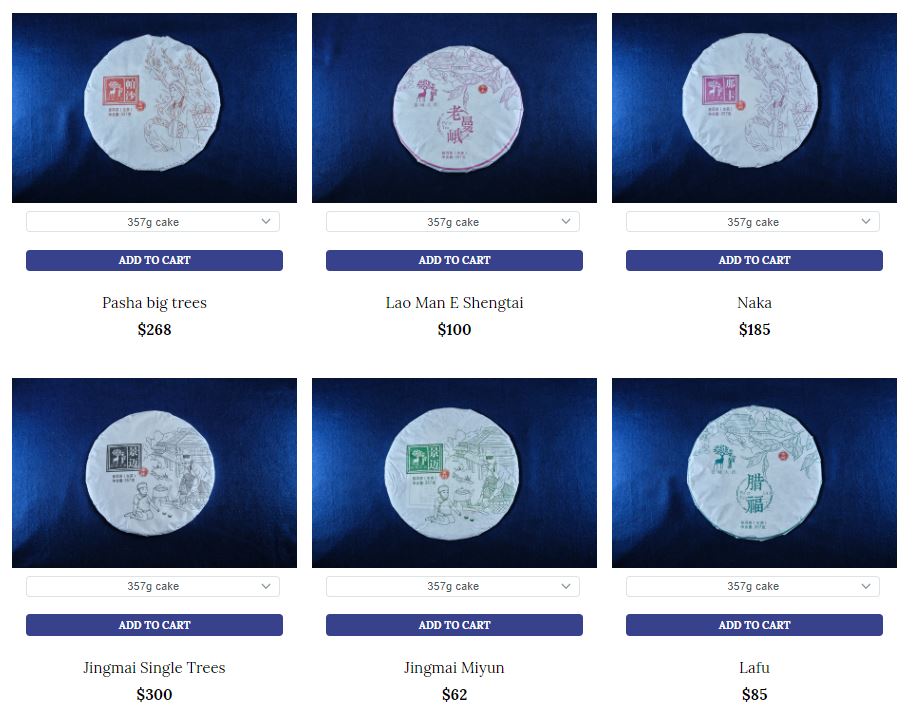
Let's consider another range, before moving on, checking out Farmerleaf page offerings in relation to this matrix of cost to quality level, switched back to the topic of unaged / new / young sheng.  They are a reasonably well regarded sheng pu'er vendor, specializing in Jing Mai origin versions, that shifted focus on lower cost products to (presumably higher quality) higher cost versions around 5 years ago or so:


The range there is from $62 to $300 per 357 gram cake, 17 cents per gram to 84 cents per gram.  So that's back to the lower priced version--per that tier system comment--probably being enjoyable, if all went well, but not notable.  The more costly tea should be unusually "notable and exciting," beyond that of a 35 to 50 cent per gram range that's already at the minimum threshold of notable and exciting.

I'm not going to guess if those teas actually are like that; really so much subjective interpretation comes into play that it probably wouldn't be meaningful, especially for tea versions I've not tried.  I last ordered Farmerleaf teas maybe 3 or 4 years ago and one $90 cake example seemed pleasant, maybe not so much notable and exciting.  That actually works on this scale, putting it in between pleasant and unusually good or interesting in character, but not significantly related to the second.  

Presumably those teas are what well-informed tea drinkers expect in relation to that pricing, and compare reasonably well to what other vendors are offering.  Or again maybe specific styles come into play quite a bit, and demand per style, with a somewhat variable mark-up rate factoring in, so it's just not that simple.


Let's move on to the other citation to place this better, since what we are looking for in relation to quality levels hasn't clearly emerged yet in these references, limited to subjective impression only, relative pleasantness.

Peter Jones, manager of the Trident Bookseller and Cafe, recently posted these thoughts:


Most people seem to think they should only buy aged sheng puer, but that is a mistake. It limits their knowledge and understanding of the tea and the market. Buying sheng every year from the same farmer relationships allows one to gain a deeper understanding of why some sheng puers are priced the way they are and how the market sets the price. This year was a hit or miss harvest for many of the smaller villages and tea mountains in the Yiwu area, and in 5-10 years some of the smaller lots will command an incredible price due to specific factors from this spring. 

One example is Guoyoulin Gushu, which is located within a nature preserve. The harvest is only allowed to take place for 10 days, and rain and Covid impacted that time period. Here we are sampling the 2020 spring material, which is already outstanding. Young sheng can teach us many things that go beyond simply "flavor."


A few factors mentioned shed some light on this quality levels divide that haven't become explicit in the earlier content just yet:


-annual supply and demand shifts affect tea pricing, varying by type and local origin range.

-aged sheng and new sheng are two completely different subject ranges (already clear enough to anyone vaguely familiar with sheng pu'er, but the way the two pricing ranges relate to each other isn't as clear).  

-flavor isn't the only baseline for evaluating sheng pu'er.  Again anyone drinking sheng pu'er would already know this, but filling in what you personally value over time is a long process, probably a never-ending one, that varies by person.

-it takes a lot of exposure to sort out any patterns in pricing, related to what inputs cause what outcomes.  Fully identifying pricing inputs at any one level (eg. local wholesale maocha pricing) is probably all but impossible, and then it would be all the more complex to map out how varying mark-ups and pricing themes work out across end-customer outlets.  Just the local origin supply and demand part (input) would be hard to get any feel for, even in higher profile and more discussed cases, eg. in-demand village area cases.

-ideally aging potential is part of what people might value, or should value, another very complex factor to unpack. Two year old sheng is something else, not new or old, which under some conditions may be much better than brand new sheng, depending on the starting point.


Back to the broader analysis topic and breakdown, next one might consider other examples of what falls out related to better and worse value, which vendor sources are in the far tails for higher than standard range quality per price, or else lower.  For this discussion it works better to just set that aside, and arbitrarily accept that there is a normal range of vendors selling somewhat equivalent products and value versions.  

Quality level, origin, age, storage conditions input, and style really do affect what a standard market rate pricing should be, so it's complicated citing examples, since tasting the tea is necessary to identify some of what matters most related to that.  Considering a Trident sheng pu'er offering might help clarify that, a tea somewhat related to what Peter was discussing, just a different version also sold by them:


Is this slightly aged 200 gram cake a fantastic value, selling for $50, or is it only in a normal market range, or maybe a somewhat flawed tea that's not a great value at that rate?  Probably the first, per my guess, informed by trying other teas from them, but only through tasting that tea would one know, and even then developing good judgment to place sheng pu'er takes awhile to develop, and preferences vary by individual.


Going back to the first considerations, maybe it's all not as clear as that comment about tiers and standard character results described, and maybe preference throws off setting up such a structure, and value variations, but still there's something to that.  Higher demand teas do tend to sell for more, and there has to be some limited correspondence between preferences, quality level, and final consumer demand, with marketing branding another kind of related input.  But then vendors also definitely sell for better and worse value, over-hyping and overpricing mediocre tea in some cases, or selling at below market rates for high quality versions in others (but for sure the first paradigm is more common).


Where to go with all this, related to an ordinary exploration of sheng experience, and normal preference transitions?  Ordinarily people might pick a vendor like Yunnan Sourcing and first explore sheng pu'er by buying a good number of samples, whatever others happen to recommend, mixing cost levels, origin areas, ages of versions, and so on.  Then an organic exploration process would extend from there, related to whatever that person liked best, confined or relatively unconfined by budget concerns.  Only after that introduction phase could someone really interpret how good a version actually is, versus those other factors, style, local area typical character, etc.

The teas I mentioned buying were on the low price side, because of a self-imposed budget constraint (which my wife helps reinforce motivation for).  That introduces value issues as a priority.  People also tend to discuss sheng pu'er preference in relation to aged or relatively new versions, then origin areas, with a lot of reference to factors like tea plant age and natural arbor growth, and finally tied to experienced aspects they like or try to avoid, which to some extent should map to the rest.  Aging potential can be something of a guess and an afterthought but it could also factor in, or else it could be a primary concern, for many.

We might expect people to fall into a preference range related to their budget, and then stay there.  For people with an open budget they might experience a natural drift to higher and higher quality teas (or higher demand versions, which should correspond some).  Others could stick to a certain pricing level with the drift occurring in better and better sourcing approaches, getting better value for what they spend.  Here's that one point I wanted to add:


One overall concern is that social media influence pushes people to experience what others experience, and to value what they value, causing a general grouping based shift over time.  


If someone had very free budget to spend on tea they might buy the $300 and $268 cakes listed in that Farmerleaf page sample, to see what is so special about those, and looking for positive distinctions they might be more inclined to find them, than if tasting the teas without that bias entering in.  Then a status could adjoin that experience; they could post online about drinking teas that others couldn't afford to experience, back to the "what straight edge rich people do" context.  A 7 gram session of an 80-some cent per gram tea is still costing "only" $6 or so, back at Starbucks takeaway coffee range, but owning a half dozen $300 cakes adds up to an $1800 buy-in, which is where anyone on a more typical limited budget gets filtered out.

A different and moderate version could, and surely would, happen in relation to people wanting to experience what is valued by others in a more moderate price range, which could shift demand and available options as a broad shared preference, and then also standard pricing levels.

Getting into aged cakes brings up the same issues, and the same potential resulting divide between haves and have-nots.  Teas We Like stands out as a currently popular, well regarded curator source for aged Taiwan stored sheng pu'er, let's check a sample of their offerings:


To be clear their site is down for maintenance right now (when I wrote this first draft); that's from an April 2022 internet archive capture, which is what we would've seen clicking on the site a month ago.

The range seems to span from $165 up to $480, or just below 50 cents a gram up to well over $1 / gram.  Still, not bad for carefully selected and well transitioned (fermented) versions, given that lower level pricing is really more in the average price range for brand new Farmerleaf offerings (the $60 to $300 range sampled averages to $180, slightly higher).

Again, what's the point, the general takeaway?  With preference naturally shifting from moderate to higher quality sheng versions, which would apply across tea types, or from people experiencing limited aged versions (old Xiaguan tuos and such) onto more carefully selected, better versions sheng pu'er interest seems destined to guide normal interest towards a tea preference of 50 cents per gram or higher.  That would also map to style and type range preferences.  If broad demand patterns shift enough that pricing level would also shift, upward.  

It's odd how clearly that ties to what is portrayed as upper medium quality level tea, how the standard levels layering kind of does work.  This part is just hearsay that you can research for yourself, but upper medium quality level in-house Yunnan Sourcing new (young) sheng has settled to around a $100 per standard 357 gram cake range now, a pricing level that would've been unthinkable 5 years ago, when around half that was a standard norm.  30 cents a gram sheng is just normal now, somewhat notable per that one comment's scale, but still moderate in cost.

Is value dropping (quality level in relation to price), or are quality levels really escalating?  Maybe some of each.  Since I do accept that it's a mix of both, with higher demand pushing both, it's not accurate to simply say that it's unfair or opportunistic on vendor's sides, that markups or a spike in producer or reseller pricing are causing this.  You can still buy plenty of 20 cent per gram sheng that's still being sold ($30-some cakes), or $15 low quality Chinatown or Ebay cakes (at around 5 cents a gram).  Maybe it's more a concern that many of the $30 / standard cake offerings from 5 or 6 years ago are now replaced with a $50 and up range, that pricing for equivalent teas also goes up.  

I don't think the general increase is mostly about the same exact teas costing more though, it's that people group together in what they prefer, so higher demand for a narrow range can quickly increase pricing in that range.  It's probably more evident across a half dozen main Western facing vendors than across the broader range of what is out there.  More legitimate "gushu" is and has been selling for $1 / gram; a higher end isn't shifting as fast (or teas presented as such).  Then it's complicated how much more legitimate gushu is sold in relation to what is offered as such; maybe it's not so much.

It seems like I'm heading somewhere with all this, doesn't it, maybe to speculate that a consistent middle ground for good but not high-demand, trendy origin area and style teas might be a more natural end point for people to explore, than for sheng drinkers to accept that cakes just cost $80 to 100 now, or $150 and up for aged versions.  It seems like I might be narrowing a broad set of information towards a conclusion I already wanted to arrive at, if so.  Very little that appeared here suggested that there is a range of $50-60 more moderate sheng cakes out there to be experienced.  Even the Chawang Shop example required accepting relatively dry storage as a main input, a lower demand category, and the teas they sell priced at or under $50 per cake are on the way out of their stock, selling out and being replaced by others.  Their sales page, showing newer offerings:


The least costly of those cakes sells for $78 per 400 gram version, the next "cheapest" for $95 for that amount, and next a 200 gram cake at an equivalent cost of $116 (for the same amount, for two).

Again I don't doubt that Chawang Shop is sourcing better tea than they were 6 or 8 years ago, catering to a shift in preference and demand, and general acceptance of cakes costing $90 instead of $40, for better tea versions.  Why wouldn't vendors move to catering to a higher quality demanding customer base, since surely profit per cake must be higher, with overhead costs staying similar to before?

I'm not cherry-picking the costliest range or most extreme examples of pricing shifts to serve some sort of narrative, although maybe the Farmerleaf and Chawang Shop examples work better as the second than the first.


Another popular Western vendor, Bitterleaf, who I've never tried teas from, with sheng offerings shown (arranged by order added to their catalog, so recent).  

Earlier content correction:  with many of these 200 grams cakes and some tongs (cake sets) it's not clear from this form of listing what the tea actually costs.  From a post comment here (a bit atypical) that is clarified:

The highest sticker price on the page ($445) is for a 5 cakes of our most expensive sheng ($0.95/gram when purchasing a cake). The most affordable 200g cake (from 2021) would be $25 ($0.125/gram), with our sole 357g cake being $38 ($0.105/gram), or ~$21 if converted to a 200g cake. Overall the average $/gram is ~$0.35/gram.


That average is $100+ per standard 357 gram cake, they just sell more small versions right now, it seems.  10 to 12 cents per gram is atypical on the low side, so they are already addressing this concern and divide.

I've tried a good bit of tea selling for $1 / gram, so its not as if that range is completely unfamiliar, but still I tended to notice what others might be seeing in it more than appreciating it myself, in comparison to teas presented as good but not that high in demand.  If it's largely aging potential, one possibility that gets discussed, that I couldn't necessarily experience that directly, without a 15 year wait.  In aged samples maybe, but these are relatively new teas.


It helps to place this in perspective in relation to wine.  People are buying $200 new cakes of sheng now, or 3-400, but that relates to about 50 7-gram sessions, while it's not unusual for people to buy $100 bottles of wine to drink 4 glasses in one sitting.  Once related awareness and demand broadens there's no reason why that price range couldn't shift a lot higher.  More and more people actually buying $200-400 cakes drives that shift, demand leading to supply, and then scarcity of the supply.

As with wine interest tea drinkers without over $1000 per year to spend on their sheng habit will eventually be priced out of the above average range of products.  That already happened, related to this more expensive offerings, but if it keeps shifting it could slide more towards the most expensive third, or half.

On a personal level I'm not concerned about it.  I can drink what others see as moderate quality, less appealing, low status level teas.  Nothing in experiencing teas presented as better and more costly, which I've only been able to experience in relation to samples, most passed on by vendors for review, led me to see that as a particularly problematic outcome.  I can see why a range of types is regarded as better, and in general I agree there is real justification for those quality assessments, but I just don't need to experience that minor character difference.  To me different is interesting, and it also works well to shift to broader experience, not towards accepted and established "higher quality" range.


Let's make that clearer:  am I rejecting the importance of aspects Peter described as desirable, here:  Young sheng can teach us many things that go beyond simply "flavor?" Not exactly.  As I take it he is referring to moving past interesting flavor and a lack of flaws as identifying better tea, on to the well-known ranges of mouth-feel, aftertaste experience, and "cha qi," body feel.  Emergent properties like balance, refinement, intensity, and complexity relate to how individual aspects (eg. certain flavors) are perceived as a set of interrelated individual aspects; he probably means that as well.  Aging potential is something else, another broad and complex subject, which he also indirectly touched on.

Am I saying that people could just as easily make their peace with accepting a reduced set of these identified aspect-range goals, or selling points, to reject pushing on to experience the highest possible quality level in teas, or at least to not blindly demand what others also demand most, like rare and in-demand experiences tied to origin areas?  More so that.  Or at least it could work to explore and appreciate some of what others tend to appreciate most, and keep some $200 cakes around, but then also lean into other range, and see what else is out there, with emphasis on trying more types that involve moderate spending.  

It gets trickier to highlight how that might work with links and screenshots as examples.  That Trident tea probably worked as that, although to be clear that was probably a case of direct purchasing leading to lower markup, not an off-demand type costing less.  I've long since claimed that I've appreciated value and character in Tea Mania teas, a Swiss vendor, but it's a stretch to say that they represent an alternative that is completely different than all of these other vendors.  I think it works to say that staying in touch with "modest quality" range like Xiaguan or Dayi Jia Ji tuocha teas, or anything from Taetea that's not 7542, is also what I mean, just not "growing out of" that preference range through an exploration process, retaining it as one of many things you appreciate.

I'll keep saying more about South East Asian sheng, a topic that already made it into this post in relation to one CS example being from Laos.  It seems as well to stop short of claiming that other country origin versions are going to help partly resolve escalating sheng pu'er costs, but there is always that hope.  Let's take that one step further; there is one standard SE Asian tea outlet I mention more often than the rest, in relation to selling good teas at good value, Hatvala from Vietnam:


The second price listed is for a 100 gram quantity (it is sheng; calling it "dark tea" or hei cha is one possible work-around for avoiding the area-restricted term "pu'er"), making it easy to identify per-gram cost, at 33 cents, 28.5, and 18.5.  That would relate to 357 gram tea cakes costing over $100, or around $70 at the lower end, for the other example.  Is that a good value?  I've tried versions of those teas a few years ago, and in my judgement sure, it's fine.  Of course that's not an objective assessment; it's a statement about personal preference.  

Was I really basing a value judgment in the past on a lower priced rate?  This is a real possibility.  Let's check that with the Internet Archive, from the earliest backup page there from Oct. of 2019:


It's interesting looking back to realize I last reviewed a Hatvala sheng (dark tea) in 2019 as well, this one.  Those 2022 prices increased 40-some percent in less than 3 years, in relation to that 2019 page, well over 10% per year, not far off that doubling of general sheng pricing in 5 or 6 years that I've been describing.  My friend Huyen has said that Vietnamese sheng pricing has been increasing a lot at the producer / wholesale level over the past couple of years, so that's probably a main cause, not just final consumer sales pricing shifting.  If vendors and bloggers keep talking about SE Asian sheng demand will keep increasing, and pricing.  

It's another long story but I think there is room for greatly expanded production of higher quality sheng from Vietnam, Laos, Thailand, and Myanmar, so that could lead to a correction on the supply side.  Per my understanding Chinese purchasing is already restricting what does or could possibly make it to the Western market, with some of that tea now being sold as Yunnan sheng, probably often after being mixed with Chinese material.

Now I'm just heading off on tangents.  To me it all connects; demand shift, style changes, quality level, potential new area sources and types, and pricing changes all link together.  A well-informed tea consumer can maximize their experience at whatever budget is available to them to do so, by considering and factoring in these inputs.  Following the latest, hottest trends is probably bad strategy related to that, going mostly by whatever draws out the most buzz on social media, or using catchy vendor marketing content as a primary information source.  It's too much work to read long text blog posts, for sure, but bearing this described context in mind could help with sorting out ideas from lots of other sources.


Wednesday, November 13, 2019

Water type experiments, with Wuyi Origins Rou Gui and KTM Lao Man E sheng


This is all a bit much.  I've been meaning to test the effect of using different water versions on tea for awhile, it was just always too much messing around to get to it.  Now that I finally did results were interesting, but one part related to sample type selection could have went better.

In retrospect it was odd using teas I hadn't reviewed before, and teas of this quality level for this purpose.  Cindy's Wuyi Origin Rou Gui versions are about as good as that type ever gets, and the fruitier version is a strong contender for my favorite tea among all types and versions.  I guess the reasoning was that using good tea is going to tell more of the story related to what input the water has, versus using teas that are of medium quality, and trying to extrapolate results to likely outcome if the teas had been better.  It was also about just using interesting versions that I had around.

The same concern and atypical theme applies for the King Tea Mall Lao Man E sample; this is a gushu version from a respected, in demand origin area.  It's questionable judgement, shifting focus off the tea onto the effect water mineral content variation has on preparing it.  One might argue that both can be covered at the same time, but per the actual experience a lot gets lost.

About water type / input testing in general, it had always seemed next to impossible to identify what a really good or ideal source of water would be.  Really doing that process justice would involve trying lots of water types, and then probably folding in how that varies across at least a few different tea types.  Online discussions of water mineral levels as an input have been interesting, and standard patterns of opinions do emerge, but nothing that works well as starting point guidance. 

Avoiding high levels of calcium is generally advocated, for example, but my own interpretation of what would be low, medium, and high based on sampling lots of hearsay may or may not be remotely reliable.  I mentioned some advice passed on by Peter Jones in covering some theory in this post, which was really about trying a Myanmar Kokang shu version:

We are still several months away from any conclusions. But basically you want your alkalinity to be 1/2 your total hardness, a pH in the 7s, and a balance of 2/1 of Ca to Mg. The other positive ion mineral salts also play a role in extraction...

The form I finally arrived on--definitely not a final word on a practical, functional approach--was to try two completely different teas using Volvic water (which gets mentioned as some people's personal favorite), compared to the filtered local Bangkok tap water I use at home.  It was a stretch but I picked two relatively random, opposite type teas I happened to have on hand, a Rou Gui and a sheng pu'er.  It turned out to be not the best selection because I didn't factor in the high level of bitterness in the sheng version (a Lao Man E); kind of an obvious mistake to make, in retrospect.  Trying an already familiar, milder version would've made a lot more sense.

I can't describe what the local water is like in relation to lots of other sources, but of course I have tried the same teas prepared using it and also other spring water, RO water, and whatever is being used in other places.  My friend Sasha had a favorite spring water he used, for example, and some of those teas I had tried at home, a number of versions tasted there many times.  A vendor at an expo had been using RO water, and I re-tasted the same teas I tried with them again at home within a couple of days, and I try teas in shops sometimes.  To really isolate differences trying the tea prepared together is all but essential; the point here is that how differences in water source work out in general, and how the local water compares, isn't completely unfamiliar.

Bangkok municipal water had been truly awful, years back.  It varied so much even the color and smell could be off.  We used bottled spring water for years, or at least local water sold as such, which really could be different things.  As of a few years ago we switched over to using a multi-stage filtration system, and the water seems fine.  Per online hearsay the tap water here is based on rainwater sources instead of natural spring origin, so it's low in mineral content, which makes sense given that it rains a lot and we're not exactly near a mountainous or even hilly area.  Per other hearsay local distribution systems are a main problem for water quality, the pipes from there to houses, not so much what the processing centers put out, or even use of old pipes in your house.  It probably helps to live right beside one of the main Royal palaces in Bangkok as we do; infrastructure seems pretty stable and well maintained.

One might expect the water quality and mineral contents to vary based on lots of local factors, and I'm not certain that it doesn't.  I've included a number of captures from the local Bangkok real-time water quality monitoring system, from when I tried these teas, but of course those don't include a measurement of contents broken out by mineral grams / liter at any given time.

It would make the most sense to run this type of comparison multiple times, evaluating tea types one at a time.  I didn't do that, I tried two types together.  That I still don't consider a mistake; I've been training to do comparisons that make sense, or else those that don't instead, for about three years now.  I've tried hundreds of teas over uncountable combined tasting sessions.  It's familiar ground.  If someone without that odd tasting habit wanted to get the clearest results I'd definitely recommend using the more intuitive approach, trying the teas one at a time, perhaps using 3 or 4 types of water to add review complexity.  Selecting mild, well-known versions of teas would probably work best, regardless of type; that part was a mistake.

I'll probably try this again with a rolled oolong version to see how it works with a very mild but complex tea, which should also help to isolate feel effect even better.


Review, comparison of Wuyi Origins Rou Gui with two water types:


Rou Gui with Volvic:  just amazing tea!  I'm not sure if that's the water though.  This didn't say if it was fruity type or cinnamon Rou Gui but judging from the heavy, warm cinnamon taste it's that.  Flavor is intense, feel is thick, level of roast is perfect, slightly noticeable but only complimentary.

Rou Gui with filtered tap water:  this is similar but the flavor may pop a little less.  It seems to be drawing out a lightly different vegetal note, as if the warm mineral resembles celery just a little.  Cinnamon is slightly flattened out.  This difference is so minor that tasting across different times it wouldn't really stand out as much, but side by side it does quite a bit.  Sweetness is down just a little too.  It's the same great tea, almost the same flavor profile and feel, just a little different.

an early round; color differences didn't seem to tell a lot of story, so I'll pass on adding more about that


Second infusion:


Rou Gui with Volvic:  this tea is just perfect as cinnamon intensive Rou Gui goes.  The balance, intensity, all the profile taken together; this is it.  The cinnamon part really jumps out.  It's warm and rich, almost connecting a little with a very subtle roast level, or maybe it only seems that way.

Rou Gui with tap water:  it's almost the same experience but it is missing some of the one high point that makes the other tea experience so special, the brightness, sharpness, and intensity of that cinnamon flavor.  The deeper tones and supporting elements carry across fairly well; fullness and body isn't bad, kind of similar.  The first version might have a slightly heavier, oilier feel, which is more positive.  It's a quite similar tea experience but funny how those parts that seem most interesting and critical are what flattens out.


It's too early for conclusions but the results already seem clear enough; this local water doesn't work as well.  I don't foresee buying bottled water to drink tea with though.  I wouldn't throw out a few large plastic bottles a week to get this effect difference, or probably even one 1.5 liter bottle a week to review using a different version.  It's a shame the local water isn't better but adding expense and impacting the environment to drink slightly different versions of tea isn't going to work out.  Maybe a charcoal treatment effect will help; that idea comes up a lot.

Later edit:  it was too early for conclusions; the opposite kind of trend turned up in the fourth and fifth infusions, a trend that was much more pronounced in the sheng version.

Third infusion:


Rou Gui with Volvic:  This tea is probably evolving a bit in character but I've lost track of clear prior impression to describe that.  It's still great, probably with a slightly shifted balance of aspects.

Rou Gui with tap water:  it's great with this water too, with less difference standing out than had initially.  It's still not quite as intense, giving up just a little sweetness, and more so dropping out just a little punch in the warm cinnamon aspect.  There is a very minor difference in the mineral tone, so subtle it would only come across in direct comparison, but it doesn't work to describe it or judge how negative it is.  I think it is slightly negative versus neutral, but that's a judgement call at this point, as much just a difference.


Fourth infusion:


Rou Gui with Volvic:  a slightly dry underlying mineral in this might have increased this round, it just doesn't stand out as much in this as it had for the sheng at this stage, or take exactly the same form.  The tap water version is just as good this round, or perhaps even slightly better.  So strange; I have no idea why that would be.  I would expect effects to shift a lot for increasing brewing time in later round but this isn't really onto that as much as it would be in two more infusions.

Rou Gui with tap water:  still really exceptional, not losing anything for intensity or positive range.  I think depth is picking up, that the one-note emphasis on cinnamon is deepening to include a lot of other warmer tone range, that it balances even better.  It was great the other way too though, focused more on that one flavor aspect.

Fifth infusion:


I'll lengthen infusion time slightly but these teas are holding up; adding a lot of time for that wouldn't be positive.  I'm brewing these over 10 seconds now, for what I'd take to be optimum, maybe around 15, but it goes without saying that I'm not timing this, since I just don't.


Rou Gui with Volvic:  mineral is a bit much in this, a dry version of it.  Looking at the mineral profile calcium and magnesium seem to be at the level I'd expect to work best, based on following online discussions about that (12 mg and 8 mg, respectively).  It's not "hard" water, but that should be enough to play a standard role in extraction and setting profile.  The rest, the total dissolved solids value, would be a bit much; there's lots of other minerals in this.  This is still really pleasant, and a very nice citrus aspect is ramping up in this tea, a "chen pi" dried mandarin peel type effect.

Rou Gui with tap water:  slightly better than the Volvic, for not including so much of that dry mineral effect.  The rest of the profile is similar.  The citrus part may be at a slightly lower level, so not as intense or positive, but the overall effect is better for not tasting as much like that dry version of mineral.  Mineral is great in tea, in the right balance; it grounds the experience.  Older plant source teas and natural origin teas seem to express a lot of that, an underlying mineral element supporting overall complexity.  It's just slightly nicer in this tap water version for balancing better, in this particular infusion of this tea, per my judgement.  The difference in extracting other flavor range hasn't dropped out but is has shifted in balance; it seems to matter less.

I didn't note differences or aspect range for feel or aftertaste much for these; that didn't seem to vary as much as flavor related to the water type input.


a later round; adjusting infusion times would change effect of color difference


Lao Man E sheng water source input testing:


King Tea Mall 2018 Lao Man E sheng gushu with Volvic:  bitterness stands out; to be expected.  One could learn to love that effect, even at this level, but I haven't.  If it balances well with the rest I can appreciate it, even like it, but this is a bit much.  The tea seems to obviously be good tea; all the other markers for quality work out, thick feel, clean flavors, depth and complexity, lingering aftertaste.  That front end bitterness really defines the experience though, then it trails on, not dropping that much intensity for awhile.  At least sweetness goes along with it, and there is plenty of other range.  I'd expect it to drop off a little by round 3 or so but I'm not sure how far past that I'll get.

Lao Man E with filtered tap water:  a touch of metallic taste seems to be added to the rest.  That extended aftertaste is going to make this a terrible choice for combined tasting though, about as poor a choice as one could make.  I might have considered that, but it's not like I'm drinking Lao Man E all the time.  Rinsing your palate with plain water (not warm, not cold) works, but it's a lot to rinse in this case.  Making mistakes to learn from can be a good thing, it's just more pleasant when they're less obvious, less stupid mistakes.

In general the flavor profile seems to pop a little less, again, with that mineral difference the main change.  Sweetness may be slightly reduced but bitterness is dominating the flavor profile anyway, so it would stand out less.

Second infusion:


Lao Man E with Volvic:  bitterness is easing up; it's balancing a little better.  It won't be until the next round this approaches a more conventional sheng profile though, more evened out.  The point here is the difference anyway.

Lao Man E with tap water:  beyond a touch of mineral difference in this (not really a positive one; a touch of metallic flavor) and a slightly reduced fullness of feel it's similar.  The other Volvic brewed version comes across as slightly sweeter.  In the case of the Rou Gui it's about a shift in the best attributes being slightly dimmed, but the character isn't so different beyond that.  In the case of this it comes across differently.  That shift in underlying mineral, slightly less full feel, and slight reduction in sweetness seems to add up to change the tea character more.  They're only small shifts, and the basic aspects are the same beyond that, the general feel, flavors range, aftertaste, feel, but the effect is more of a change, or a change at a deeper level.  Again the Volvic brewed tea is just better; there was no trade-off that benefited using this local Bangkok tap water, at least not yet at this stage of infusions.

Third infusion:


Lao Man E with Volvic:  this is much better balanced for transitioning over those rounds.  Not in comparison with sheng that doesn't emphasize bitterness, if someone doesn't like bitterness, but I'm fine with it at this level, it's just definitely not a close match to personal preference.  The thick feel is nice, how clean this tea is, how the different layers of aspects work together.  One part under that is actually a little floral, drifting a little towards fruit, but deeper light mineral is really stronger. 

Rich, full feel is nice.  Aftertaste works a lot better for dropping off.  Usually people would couple those last two descriptions with where the feel impacts your mouth or throat, with aftertaste also related to a lingering feel.  I'm never so good with all that, in part for not valuing it.  It probably is as much a valid quality marker as what I do pick up more, but it seems a developed preference that would be as natural to never develop.

Lao Man E with tap water:  this finally works about as well as the other version.  It gives up a little thickness in feel but somehow the fruit and floral range (complex, but subtle, hard to define) is standing out a little more in this.  It might be working out as well or even better for not stripping out as intense a version of that bitterness.  Feel losing a little thickness isn't as positive.

The floral and fruit range I can try to define, to describe, but it would be a guess:  it's bright and sweet, so along the line of plumeria and dried mango.  There are lots of types of dried mango, so those tend to vary a lot, but that gets complicated to wade into that.  The brighter, sweeter, more citrus oriented kind.  In retasting both that bitterness hitting a little harder in the Volvic version isn't quite as positive, to me.  It may make for an exception that stripping out a little less intensity wouldn't always be a bad thing.

Fourth infusion:


Lao Man E with Volvic:  it's really strange how this is exhibiting a stronger mineral aspect, a slight metallic range.  It's almost as if I've mixed up the water sources, but then this probably does have more mineral content, so maybe that makes sense.  I have no idea what that means.

Lao Man E with tap water:  it's nice how that balance evened out.  Bitterness is still pronounced but the proportion is more relatable now.  The complexity is nice, the range of flavor, and how feel and aftertaste contribute to overall effect.


Fifth infusion:


Lao Man E with Volvic:  a dry mineral input is much stronger in this tea version.  It tips just a little towards how chlorine comes, that's just not it.  It's much more positive to say it tastes like limestone, and to be fair it's really in between the two.

Lao Man E with tap water:  there is less mineral effect in this, making it come across as sweeter in character, and better balanced.  I don't know that it is actually sweeter; that may just be how it seems, without as much of the mineral input changing things.  The tap water version was actually slightly better over the last two infusions, but to be fair the difference is a bit minor.


Conclusions:


It's crazy that two main shifts occurred in difference, varying a lot in early and later rounds.  Volvic brewed tea was clearly much better over the first two infusions, and clearly not as positive in the last, probably more even in the fourth, with tap water working just a little better in that round too.  I can't really unpack or explain that.  Somehow a shift in flavor and feel proportion across rounds favored the Volvic earlier on, and the filtered tap water later (which probably contains a lot less mineral).

It's worth noting that different people can and do use completely different timing sequences related to brewing different rounds to different infusion strengths.  It's more common to use lower proportions and longer times, and then to extend the timing more across later rounds than I tend to.  Why that is becomes a lot to account for, and beyond citing personal preference some of the rest wouldn't be clear.  It's hard for me to account for why people like tea prepared differently than I do; to some extent I suppose I never could.

It could be interesting to consider the water mineral content though, starting with the Volvic listing:


I'm kind of guessing, since I have been involved with plenty of discussions about water content but haven't memorized ranges, but the calcium and magnesium levels look ok, if maybe even a little low.  Per discussions those two are the main factors, with a moderate amount improving results, and high levels throwing them way off.  Looking back through old discussions and references, Rie Taluli did a review post comparing tasting results using of a number of types for green tea, and in a discussion comment of that post Peter Jones (who is into reviewing mineral effect themes) cited listings of standard mineral content of a number of brands:


EVIAN - Natural spring in France - 290mg/L sodium bicarbonate, 81mg/L calcium, 27mg/L magnesium, 6.7mg/L sodium. 

AQUAFINA (Pepsi), DASANI (Coke) - Municipal water through RO - no sodium bicarbonate, no calcium, no magnesium, no sodium. 

GLACEAU (Coke) - Municipal water through RO - no data, but unlike Dasani, they then add back in for flavor the calcium, magnesium, and bicarbonate. 

FIJI WATER - Natural spring in Fiji - 153mg/L bicarbonate, 18mg/L calcium, 14mg/L magnesium, 18mg/L sodium. 

NESTLE PURE LIFE - Municipal water through RO - no bicarbonate, 7.4-11mg/L calcium, 2.9-5mg/L magnesium, 4.4-9mg/L sodium. 

ARROWHEAD (Nestle) - Natural spring in Arkansas - no bicarbonate, 4-66mg/L calcium, 1.4-19mg/L magnesium, 3-17mg/L sodium.


I can't imagine that using Evian would work well, and it's odd that Arrowhead water is so inconsistent, but I'll leave off saying much more about the rest.  I do come back to the sodium level idea related to the local water version level.

About the local water description, some input is offered by Bangkok real time tap water quality monitoring (http://twqonline.mwa.co.th/EN/map.php?type=).  We live next to the Chitralada station, in the center.  These don't mean that much to me but they could to someone else:


free residual chlorine levels, Nov 9, 2019, 1 PM


chloride levels (mg / L)


turbidity (NTU)


ph


salinity, listed as g / L (seems wrong, too high?)


July 2019 ph capture (to show variability)


I don't know what was in that water, for specific mineral content, and I don't know what the filtration process would have removed.  Chloride level was around 4 mg / l in this water, versus 15 mg / l in Volvic, but what of that?  Salinity just seemed wrong; those readings would seem like way too much salt, in the 150 mg / l range.  What if that is right; shouldn't the water taste like salt?  As a baseline I checked how much is in seawater:

On average, seawater in the world's oceans has a salinity of approximately 3.5%, or 35 parts per thousand.  This means that for every 1 litre (1000 mL) of seawater there are 35 grams of salts (mostly, but not entirely, sodium chloride) dissolved in it.


So 35,000 mg / l, which still doesn't answer if I could taste 150 mg, but it's a context of sorts.  It occurred to me that salt is sodium chloride, so unless I'm missing something the two values don't match up, the measured amounts of chlorides and salinity.  That prompted me to look up answers to both questions, how much salt can one taste, and what are normal levels for these.  This WHO reference covers the first:

Taste thresholds for sodium chloride and calcium chloride in water are in the range 200–300 mg/litre (2). The taste of coffee is affected if it is made with water containing a chloride concentration of 400 mg/litre as sodium chloride or 530 mg/litre as calcium chloride (3).


I don't think we can take that second sentence as good input about coffee enthusiast perspective.  More input from that source pins down range of chloride in typical fresh water:

The mean chloride concentration in several rivers in the United Kingdom was in the range 11–42 mg/litre during 1974–81..


That still doesn't resolve the monitoring inconsistency between salinity and choloride levels, but it is interesting to compare that to sodium levels in the other bottled waters.


Further conclusions:


That last section was mislabeled, wasn't it; not much for conclusions in there, or even speculation.

I suspect this tap water version ended up with very little mineral content in it, due to starting out with limited amounts and filtration removing some.  It's interesting to consider that tea producing more positive infusions initially might generally relate to producing less positive infusions across later rounds.  At least that did happen here, per my interpretation, and it may work out as a somewhat uniform generality (or may not; that goes without saying).  This could explain why some people push teas to produce very long counts of infusions, and others tend to not like them as much after a much shorter sequence, although simple preference difference seems to be just as relevant an input. 

Then again, who knows.  Round after round of trying out lots of water and tea versions would tell a longer, more accurate story.  In online discussion it's not uncommon for people to claim that they prefer different water (mineral content, presumably) for different tea types, and that would intuitively make sense.

I've never ran across much detailed speculation of why soaking bamboo charcoal in water is said to improve the results for making tea with it, even though people advocating that practice comes up a lot in discussion.  Even when it's being sold for this use, as in the case of this Yunnan Sourcing version, there's not necessarily a reason for why it might make any difference.  It probably does, it would just be interesting to hear guesses about why.  Here is one that Google search turned up, Tony Gebely's input, but somehow it's not satisfying as a complete and plausible explanation:


The idea behind bamboo charcoal, and any charcoal for that matter is the fact that it is extremely porous and will absorb impurities in water. It really isn’t “filtering” water if you set a stick in the water, in order to filter the water, the water must pass through granulated charcoal or some other medium (this is how Brita filters work)...


It would seem that it could be both adding and removing minerals from the water, and that only testing, instead of speculation or traditional input, would shed light on this.  I would tentatively accept that it really does improve results, although that would be clearer to me if I tried it myself.