Showing posts with label sun-dried. Show all posts

Saturday, April 15, 2023

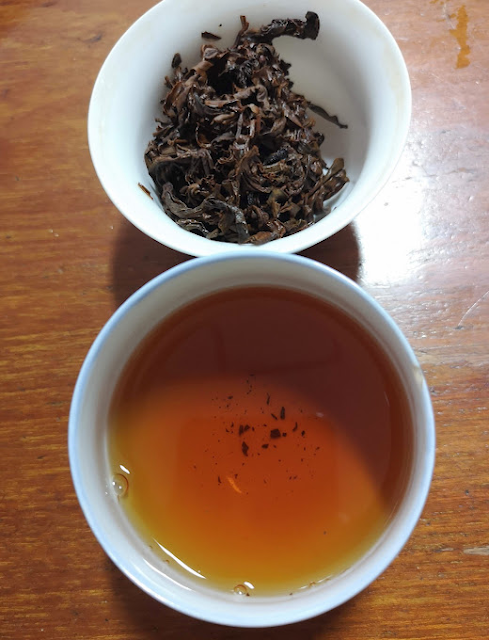
Wawee Tea compressed Thai shai hong (Yunnan style sun-dried black tea)


these images are from trying it back in Bangkok


This is a tea I received just prior to leaving Thailand, that I'm only now getting around to writing about, nearly a month after first tasting it.  It's good.  This particular style of tea has aging potential, so in a sense the experienced aspects are subdued, or maybe not even optimized, related to processing leaving potential for positive future change.  It will work well to say more about that along with the tasting notes.

The producer FB page is here and main website is here.  I've been writing about other versions, mostly sheng, so this post isn't really about introducing them or that other range.  This tea is sold out, a post there said, pretty early on after it was pressed, so it's as well to contact them directly if interested in versions, to see what is still around, or order what is about to be listed.  This production area is in the north, in the general Chiang Rai area, which I've written quite a bit about over the last year and a half.


Review:


First infusion:  brewed a bit long to skip the part about saying the next round will tell more.  There's a tartness to this I may not have noticed as much before.  At one time I really disliked tartness in black  red teas, but like some other flavor range I've come to accept it better with more exposure, and inclusion in positive and balanced versions that it worked out ok in.  

Overall this tea is nice.  Tartness isn't an optimum flavor range inclusion for me, but the rest balances ok with it, and decent sweetness and good complexity compensate.  One part hints towards a malty range, not like dry and aggressive Assam, but covering a bit of the flavor in those.  I suppose there's a faint touch of cocoa in this, and a little of the mineral edge that's distinctive in Ceylon, that one profile range that really marks those out.  There's some fruit; I'll describe it better across more rounds.


Second infusion:  I more or less flash-brewed this round, to get a feel for the opposite extreme, brewed very light.  Color is still intense, the deep red, and feel and base of flavors is normal, but the higher end / forward flavor range is quite thin, as one might expect.  It's funny how it has so much feel and base complexity, but also doesn't taste like much, more lacking aromatic range than the mineral tones that come across through tongue-based sensation.  It even includes a good bit of mouthfeel, not really dry or heavy, but it coats your mouth well, and links to an aftertaste experience.  Maybe this is a good black tea for a sheng drinker.  I'll do more of a flavor list review letting this infuse for a bit over 10 seconds next time.


Third infusion:  that flavor list then:  tartness, warm mineral tones, that bit of malt, dried fruit range, along the line of tamarind, but not clearly defined.  In a sense this isn't matching what I led into about it being subtle, but I mean that the sweetest, most aromatic, warm-toned, chocolate, cocoa, and warm floral range that fully oxidized and oven-dried versions doesn't come through.  

With shai hong, which tend to be oxidized a bit less, it seems like backing off that complete expression of black tea range, the full oxidation input, allows for sweetness and depth to increase over a few years, but at a cost, related to drinking it this young.  This tea was produced a year ago, but just pressed recently, in the last two months.


Fourth infusion:  it's improving across rounds; that's nice.  Slight dryness eases up, and tartness, with more warmth, depth, and complexity evolving.  Range towards cocoa / cacao is increasing, but it will never fully develop as a main theme, per trying this plenty of times already.  Complexity is positive in this; there's a lot going on, just not all of it, or maybe even most of it, across the forward flavor range.  It has depth.  It's not the sweetest kind of black tea, but I really do think an impression of that would increase within a couple more years of storage.  That might mostly be because some other aspect range settles, more that that it actually tastes much sweeter, but what we really pick up is a final balance, how it all comes together.  Add a touch of salt to any tea, just less than you can readily identify, and a lot of the balance changes, it doesn't just taste slightly salty.  But don't take my word for that, try it.


Fifth infusion:  more of the same; this isn't really going to keep changing across rounds, as sheng versions tend to.  It's fine, pleasant to enjoy now, but it will probably be more interesting, and come across as more pleasant and complex, after it ages for a couple of years.  I'd expect that increase in positive character to even back out fairly quickly, as aging some other types goes, and that after 4 or 5 more years it would just fade, not changing so much and improving.  But then this is fairly tightly compressed, so maybe that time-frame will extend as a result, and this will only be at it's early peak in that 4 or 5 years, and after a decade it will just taper off, versus that long.  I bought it to drink though, to have some black tea around, so if there's any left after 2 or 3 more years there won't be much.


Conclusion:


This may seem to imply that this tea needs to age transition more than I see as necessary.  It will improve, I think, but it's nice now, just not in the sweetest and most aromatic form, compared to fully oxidized oven dried versions.  Sweetness is fine but I think the effect of that will increase, maybe as much from other range changing and the overall profile shifting.  

I really do like extra sweet, sweet potato, roasted yam, and cacao flavor intensive Dian Hong just a little more, but this will move to a space closer to my main preferences over a few years (I think), if it sticks around.  I wouldn't have brought it to Honolulu this time if I had planned to just set it aside; I'll drink some, maybe a good bit, or even most of this.

I had considered doing a comparison tasting with an aged shai hong version (there's one set aside and getting to on the older side at home), or trying it with more conventional black tea, but those ranges might be familiar to many, and I'm out of the habit of reviewing entirely lately.  I can write a separate review of a sample from Wawee Tea later and refer back to this.


the corner I write in now is worst-case for degree of clutter


the view outside, Waikiki


jungle hiking recently; conflicting approaches to posing


happy Easter!


a modest egg decorating session


Tuesday, December 25, 2018

Kinnari Tea Xayaboury Laos Shai Hong (sun-dried black tea)


I'm behind on trying lots of teas; probably a good problem to have.  Anna of Kinnari Tea dropped off some when visiting Bangkok (mentioned in this post), and I've really been looking forward to getting to them.  Yesterday was kind of a long day, starting out with my relatively new practice of running (2+ miles, not far yet), and ending with a family Christmas gathering (prior to Christmas; I write these posts in two parts, making the notes along with later editing).  It will be nice tasting a "comfort tea," a style of black tea that I really like.

my wife (in purple) with two of three cousins, the two guys


the one on the right isn't mine; hopefully she didn't pick up any bad habits


These are never far off Yunnan blacks, teas from right at the edge of Yunnan (at least when similarly processed, given the tea plant types are so closely related).  That last version from Somnuc was great for being pleasant and novel; we'll see if this compares well to that.

Review


The initial flavor is a bit subdued; that was to be expected for this black tea type.  It should open up a bit and gain depth and sweetness across a couple more infusions, but this tea type gives up intensity in a trade-off to achieve a different aspect range, and to be able to pick up some depth and complexity across a few years of aging.  The aspects it already shows are nice:  soft, sweet, rich black tea sweetness, towards the dried fruit and light spice range that is typical.

Where that other Laos black tea I just reviewed has a bit of tree-bark character to transition off of, not musty, but earthy in a completely different sense, this is very clean in effect from the start.  Beyond that the general range isn't all that different.  I'll revise that general description to a flavors list in the next round.

The intensity really did pick up; this probably has one more round of opening up to really kick in too.  It seems to me that some teas describe better than others; some are so close to a typical, standard type and set of aspects that it would be easy to just flesh out finer details.  This one not so much.  It's not atypical for sun-dried black tea but those do vary, and the interesting character range, the style variations, doesn't describe well.

Fruit and spice still stand out most; I'll start with that.  A slight earthy dryness hits you just as quickly establishing the balance that defines the experience.

My tasting area just turned into a winter Lego Disney cartoon theme screening area, with Elsa and Anna in that video, so I was bumped to the outside tasting theme.  It's a nice reset.


As far as pinning down the individual aspects in this tea it's hard to separate them.  Fruit, earth, and that slightly dry mineral structure could be described in lots of different ways, and what you really notice is how it all balances together, not whether the fruit is dried cherry, dried tamarind, or if it contains citrus, or relates to roasted squash.  Maybe all of those; it's complex.  If there is any citrus that would be very mild, just a bit of dried peel to balance the rest.  It probably works as well to say it all tastes a bit like dried persimmon since I think that's closer.  The spice range might pick up more later; for now it's a faint trace of cinnamon.  The earthiness isn't too far from a tropical dark hardwood flavor.


The spice range did pick up on the next infusion.  Sometimes it must seem like I've edited those predictions back in later, right?  Except when they're wrong, of course.  Cinnamon does seem like part of the spice range but it also seems like a different aromatic bark or root component, I'm just at a loss for which.  It's not sassafras, the general taste in root beer.  It's not clove either, but the way that a more aromatic part works together with a richer, deeper range is a bit related to that in form.  The touch of dryness is nice, related to a warm underlying mineral range, which isn't pronounced.  This tea isn't astringent at all but having that slight edge fills in some feel range, adding to the overall complexity of the experience.

A little more fruit and sweetness might be nice but that could develop in the next infusion, or probably would within about a year to a year and a half if left to age.  It would probably be better yet after two, and maybe just fading after four.  Of course I'm guessing; I've tried a number of shai hong versions (sun-dried black teas) at various ages but if you don't try the same tea and track how it was versus how it is there's no piecing it all together.


(Next round) this overall balance is really nice.  I've tried versions with more fruit but this earthiness is good, and fruit balanced with a bit more spice range makes for a great effect.  This tea doesn't seem to be transitioning a lot as black teas go, but then the last similar tea I reviewed might have more for including a range of material types (adding yellow leaves; maybe varying beyond that), and the relative inputs of those may have been shifting.  This version is simple in character, as some teas go, but catchy in overall effect; every sip makes you crave drinking the next one.

I probably would have described this tea completely differently a year ago, or at yearly intervals, due to interpreting the same aspects in different ways over time.  To me it seems like I'm zeroing in on better descriptions that are more accurate, that would mean more to a reader, but I'm not completely sure of that.  It might just be a personal convention shift, a different form of interpretation of experience, more neutral in accuracy and effectiveness.


More of the same next round.  It's not really fading, and I went slightly longer to compensate for the round count (infusing it around 20 seconds, maybe slightly longer), so as a result I'm drinking this slightly stronger.  It's nice this way too.  The earthy edge that takes the place of astringency is a little stronger, but this tea is soft and approachable, just a bit complex, so it would work well even stronger.  Optimum is lighter, it balances well there, but it's not like sheng that often just doesn't work well outside of the narrower range for which it works best.


On the next round the tea is just thinning a bit; I probably went a bit shorter on infusion time, 15+ seconds instead, adding to the effect of diminishing.  From here the only remaining story to be told is how brewing it for 45 seconds to a minute to compensate for further fading changes effect.  Based on only one longer infusion earthiness picks up, shifting to a lessened proportion of fruit input, and even less spice, really, even though that somehow seems to tie to the dark mineral / dark aromatic wood underling tone more.


All in all it's a really nice tea.  It was definitely cleaner in overall effect than the last Laos black tea I reviewed, and probably a little more refined.  And more standard in character type / aspects range.  I think I liked that other one a little better for being novel, for the complexity taking an unusual form, and for fruit range being so intense, which is a good match for my personal preference.  This traded out some fruit for spice and other earthy range in comparison.  Shai hong can be subtle when first produced though, and this tea would probably be better in a year, and better again in another year after.  It's hard to factor in that potential in evaluating one since you don't get to experience it, until later, at least, if you have enough around for it to stick around.


This tea isn't separate from the range of Yunnan Dian Hong produced, not different in character or any lower in quality.  As with the sheng pu'er from Laos it's made in mountain ranges and from tea tree types (usually forest-grown older plants, but that would vary), that are continuous with those in Yunnan, with processing styles varying per individual practices, not separated by country borders.  This tea is probably a good bit better than the average version of "Dian Hong" sold by conventional vendors in the US; what makes it through would vary in character and quality level.  Yunnan produces most of their teas as sheng pu'er, because the demand is there for that, and the selling price also is, with some moderate quality versions being converted to shou pu'er instead (typically; of course that would vary).

Good luck finding any Laos teas on the Western market.  Beyond a resale vendor carrying Anna's (Google that), and one other mainstream producer (who's teas aren't quite this good, per what I tried of them, and not widely available in "the West" since they're not US or EU based), they're just not around.

Monday, December 17, 2018

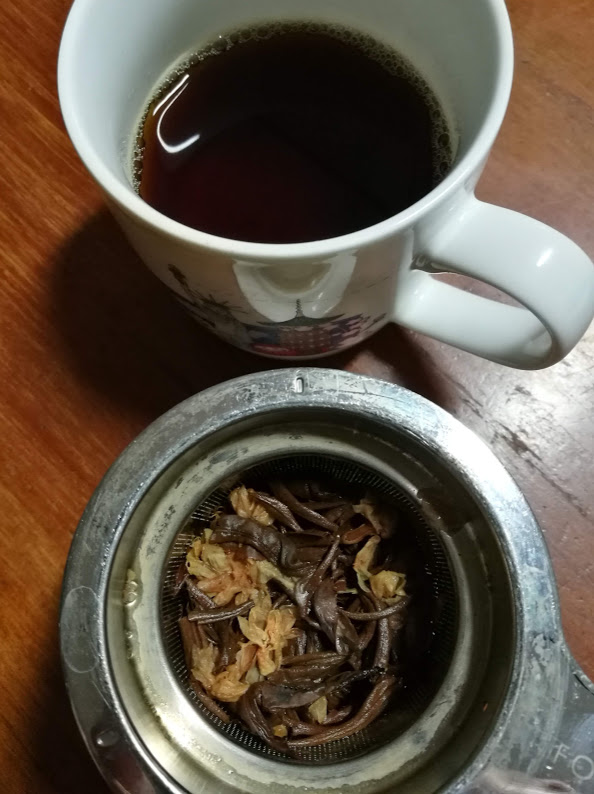
Moychay jasmine sun-dried black tea


It's a little odd to be reviewing a tea that shows up on the site as "not available," (an archived product), but it seems like they rotate those products so a related version would come back later.  The point isn't just to promote marketing for what they're selling anyway, more about talking about teas, on my end.  They sent this tea as a sample but that was back towards the beginning of the year; I've been turning up what I've lost track of lately.

For me there are only a couple of flavored teas I tend to like; Earl Grey and jasmine black.  Monsoon in Thailand did a coconut flavored black tea that was unusually good that I tried awhile back too (3 year ago; the time just flies).  And then there's masala chai, but that's getting into a different subject, a spice and tea blend.

from checking that Monsoon coconut tea post; they were so cute


Hatvala makes the best version of jasmine black tea that I've tried, hands down (at least until this version, and experiencing it unfolded in two parts).  On first take in just looking at this tea it seems amazing they used a black tea of this quality.  Of course it's the taste of a tea (and mouthfeel, and body) that makes it good or bad, not the appearance, but you can sort of get a sense.  I'll say more about that difference in inputs and results in a review section, which actually covers trying the tea twice.

Review


I brewed this tea Western style, during a work-day breakfast that didn't allow time for normal process Gongfu brewing or making any notes.  I will brew teas Gongfu style even if I am eating a quick breakfast; there's a trick to that.  It's possible if you use two different cups and just keep the tea brewing, rotating the cups to allow some of the heat to dissipate off.  Seems like a lot of messing around?  Some teas perform better made Gongfu style, and once you get used to those extra steps it's still extra work but they feel natural, and don't take up much time.  Since for black teas the outcome difference in preparation approach is lessened I just tried out Western style instead, at least at first.

The tea was a bit more subtle than I expected.  I guessed that was probably because it's a sun-dried black, which tend to be a bit more subdued, and it is that.  They pick up more complexity, or at least have the potential for it, because they can develop over a couple of years after processing.  It's not just theory; I've actually re-tasted the same teas and have experienced it.  It's a bit odd making a floral blend out of this type of tea since aging it wouldn't seem to come up but it's not as if those really need the time to get to some higher potential; they just pick up a bit more depth and complexity.

Onto a flavors list, before saying more about a style comparison between this tea and Hatvala's (or more a contrast, as it works out).  You pick up black tea and floral, in the jasmine range (mild jasmine though; absolutely nothing like the floral blast more typical in green teas).  I had trouble sorting out a flavor list for the black tea beyond that.  It might've been a bit earthy, possibly in the range of light spice.  Working from a subtle flavor profile with floral range added it was hard to tease out if there was any floral aspect coming from the tea itself, or if a subdued fruit input might be.  A touch of citrus does seem present.

I really think a Gongfu approach would work better for this tea to have more of a go at moderating intensity.  One could try out variations to confirm that but I'd guess that using water at full boiling point might work well since the tea is so subtle, in order to ramp up flavor and draw out a bit more of an edge.  For a lot of black teas just below that works as well or better, in order to preserve the same flavor profile but keep sweetness without maximizing astringency.  With no significant astringency that drops out as a factor.

I did try it a second time prepared Gongfu style, but somehow it makes more sense to compare my impression of it with another favorite jasmine black before getting to that.


In comparison with Hatvala's jasmine black version


This is different, contrasting styles of comparable teas.  I might say first that I first tried jasmine black tea as a typical commercial product in Indonesia, a form of grocery-store tea (which I mention here in talking about trying out Christmas themed blends, but never did review in a standard form).  I liked those.  It was obvious the quality was limited, for both the tea and what they did to get to that flavor input, but it meshed.  A friend living in Indonesia mentioned having health problems he traced back to drinking that same product, a skin condition as a side-effect.  At a guess that was a reaction to some ingredient used in drawing out the jasmine flavor, a solvent of some sort, versus being some other type of contaminant, but of course that's just a guess.

Hatvala's version is much better than that.  They started with a pretty good black tea I'm familiar with, their Wild Boar (Vietnamese tea; their black teas vary enough that generalities about them tend not to apply).  Then they added jasmine flavor by layering the tea with a lot of jasmine flowers, repeating that process until the added flavoring was strong.  It really works.  Their description of that is interesting:


that Hatvala version (credit their site)

...Black Jasmine requires four kilograms of flowers to make each kilogram of tea. Flowers and tea are blended over a five day period in Hanoi using unopened blossoms collected from gardens in the city’s West Lake area.


To me it's not all that different than the effect of Earl Grey, even thought the floral range is completely, absolutely different than bergamot citrus as an addition.  It adds complexity to the black tea in a way that complements it.


This Moychay version used a much milder tea base, with a good bit less astringency.  In one sense it might be better tea but more than that it's just different in style.  And they've mixed dried jasmine flowers with the tea, a completely different approach.  Oddly actually adding the flowers ends up providing a much milder jasmine input, probably related to how much flower it took for that other process to lend that flavor.  Still this really works, even better brewed a different way, as described in the following.

Trying the tea brewed Gongfu style


I hadn't expected this preparation approach variation to make much difference before brewing it Western style but concluded the opposite afterwards.

It's much different; this really is much better.  That jasmine ramps up quite a bit, and the black tea picks up intensity as well.  I went with a long first infusion (based on using a moderate proportion for Gongfu style, for me, half filled with dry leaf, 2/3rds full after expansion); brewed for just over 30 seconds.  I think 20 seconds would maintain the same intensity from here out, probably increased again after a couple more.  Since there is no astringency to factor in level of intensity is up to preference, not "brewing around" aspects like that.

The effect of the jasmine is completely different; that's interesting.  It's sweet, floral (of course), and creamy.  It tastes warmer than jasmine tends to, towards rose or something such, probably due to the way the black tea flavor mixes, not so much something about the flower.  The earthiness of the tea works well; even that softness and subltety of using a sun-dried black makes lots of sense when the balance is better.  A lot of Yunnan blacks might sweep aside a lot of the jasmine effect for intensity (Sergey, the Moychay owner, mentioned that this tea is from Jing Mai after I did that first tasting).

That's a bit bold, using a known-area black tea for a blend.  A skeptic would say they did it to cover a flaw in the tea, but if so I've not picked up yet what the flaw was.  It was subtle, made Western style, but that resolved a good bit using a different approach, and sun-dried blacks run a bit subtle.  They can pick up depth and complexity, and to a limited extent intensity, by aging for a year or two (or maybe longer; I'm not clear on how that progression tapers off, and when), but they're still not as intense as oven-dried teas made for consumption within half a year or so.


The aspect set and effect is similar on the next round, but the taste is still surprising.  It has a clean, sweet intensity, a creamy feel, supported by a lot of earthy complexity, and it all kind of comes as a shock when you first sip it.  The sweetness and flavor hits you first but the depth is right there too.  It's an odd feeling, getting a bit overloaded by a tea that's on the subtle side.  Malt or grain range is giving this experience depth but prepared a little stronger the way that floral comes across stands out.  Mild spice is there too (cinnamon range) but it's subtle.  Some citrus present is a bit subtle too; it layers in with the floral tone.

It's appealing for having that pronounced "higher end" aspect (the jasmine flower, just a soft version of it), which trails into more and more subtle supporting aspects, all of which integrate in a way that balances and makes sense.  It really is a shame to brew this tea Western style.  I wonder why that is; you'd think the jasmine would really need a longer infusion time than tea leaves to extract.

The effect isn't really different on this next round but the aspects have shifted.  It's pretty close to tea-berry, it seems to me, that effect of mint joining an unusual version of fruit.  It's a shame I can't really describe what tea-berry is like but for those who have experienced it there's nothing more to say.  I've ran across the idea that you can brew those leaves (of that plant, a relative of mint, that makes a berry that's really not a berry), and that it can even oxidize.  It would be nice if a reader could check that out and get back to me.

The tea is the best it's been this second round, and it was already nice before.  I'll have to change that assessment related to the Hatvala version from this being a reasonable second as a favorite to drawing even, to being just as good but quite different.  For a blast of floral tone and pleasant black tea earthy intensity it's not even close to that Vietnamese version but for people into plain teas the subtlety, complexity, depth, and balance of this version would probably be preferable.

On the next round cinnamon does pick up a little, approaching the floral range aspect intensity; it might be slightly better yet, or maybe just different.  It seems a little fruitier too, adding a bit of apple to the mix.  It's a type of apple flavor that's unfamiliar, one of those strains that no longer gets produced, crowded out by Fuji, Macintosh and the rest.  I interpret citrus (along the line of orange peel) as a mild supporting aspect across these infusions but that might just be a matter of interpretation.


Conclusions, other thoughts


For anyone drinking Twinings flavored or blended teas--who probably wouldn't be reading this blog in the first place--this tea would be a revelation, an amazing step up in quality level.  Then again decent Tie Kuan Yin light oolong probably would be too, or Dan Cong in general, the whole starting point range of better teas.  For someone looking for that flavor rush Earl Grey gives you the Hatvala style jasmine black would be better.  This tea would appeal to people who don't drink flavored or blended teas at all (kind of a strange target demographic for a blend, when you put it that way; a blend for people who tend to not like blends).

Since this tea isn't listed I have no idea what it had cost.  In one sense it doesn't matter--costing more or less doesn't change what it brews to become--but in others it does.  Really that seemed more relevant based on how much I liked it brewed Western style, if it could compete as a moderate priced "daily drinker" or not for value.  Brewed Gongfu style this turned out so well that it stands up to good plain teas in quality and level of appeal; it's just different.

Sergey said they'll probably add another similar version after a spring production.  Even for people who normally wouldn't even consider trying a floral blended tea checking that out might make for a unique positive experience.  I drank a round at the very end cold-brewed, sat in the refrigerator overnight to make one more infusion, and it was really nice cold too.  Even though it would work it's way too good a tea to be drank just as iced tea, it seems to me.


they grow up so fast; just three years after that earlier photo


this kid too


Tuesday, October 24, 2017

Comparison tasting three Dian Hong (Yunnan black) from Farmerleaf


I've been planning to finally change gears related to exploring pu'er, to stop dabbling in teas from lots of different countries and get a better start on that one rather complicated tea type.  But this is about my favorite category version of black tea instead, which I'll get back to after saying more about that context.


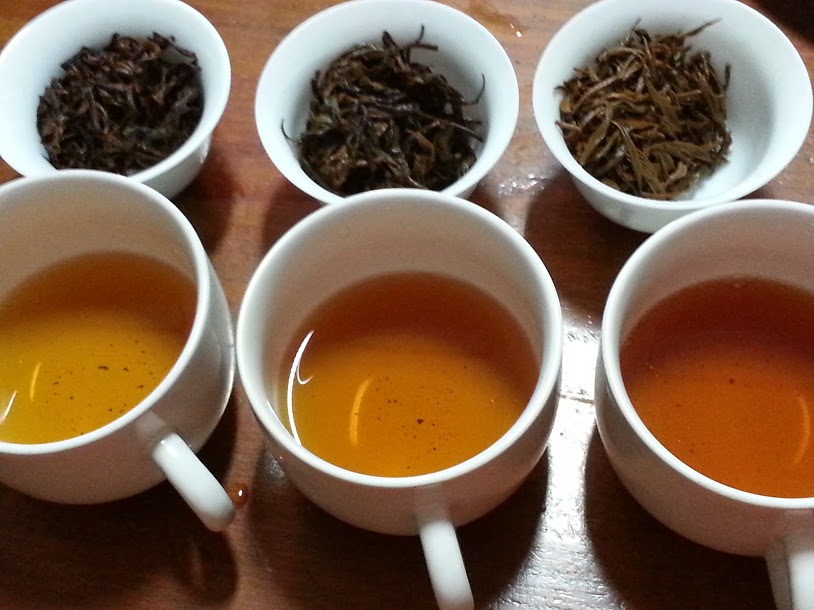
Farmerleaf Jing Mai black left, golden tips top, sun-dried black right


An aside about a completely different subject, pu'er


My favorite tea blogger just wrote a blog post in Steep Stories related to the theme of exploring pu'er taking a long time. 

By the time you add in all the factors related to variations in pu'er--origin, tree age, other material quality issues, processing--itself a range of concerns, storage, etc.--you can't just try a dozen samples and get a feel for the type.  And all that's for sheng alone (a type for which I probably have posted about a dozen reviews); never mind the category division into two types.  I think that trying these three black teas I'm comparing would work for a starter introduction to Dian Hong (Chinese black tea from Yunnan), but there's still plenty of range to get to beyond them.

To expand a little about pu'er complexity, there was recently a Tea DB article and discussion video about vendors selling young versus aged sheng, and Scott of Yunnan Sourcing responded about that subject, and about number of other issues.  One main sub-theme that's been of interest to me is how some pu'er is sold as from a narrow origin location, and for different reasons some with no reference to origin at all.  That subject relates to a recent Yiwu Ding Jia Zhai pu'er vertical tasting event, about comparing different years from a smaller area within Yiwu. 


But then in describing black teas in a Reddit post comment I mentioned Dian Hong as a favorite, and the Farmerleaf vendor related to them selling a few.  They sell directly out of Yunnan; one related part of the cost being on the lower side.  In effect I talked myself into ordering the tea too, and before I could change my mind I clicked through buying 100 grams of three different teas.

Of course they sell pu'er too, a number of samples of which I have reviewed, and it seems fine to me, to the limited extent that I have a developed opinion on those.  For around the same cost I could've bought a cake of it, for about the same amount of tea.  But I had these other complicated plans for trying different samples and starting in on certain types of cakes after that, which will probably all change by the time I get to it.  That "vertical" tasting was a bit of a prompt, but I already had this in mind when I went through that other recent hei cha phase (which has one chapter left to cover, for now).


There's one connection I meant to get to, related to bringing all this up.  I'd rather drink this black tea than any lower end or medium quality pu'er I've ever tried.  Surely I've not yet been exposed to much in the way the highest quality levels of pu'er, and may never be at this rate.  Acclimating to the type and learning the range were factors in that other initiative, along with exploring aging changes.  I own two sheng cakes around a decade old, and have finished two that were much younger, but for sheng pu'er that's barely even starting on dabbling.  As memory serves I've bought and reviewed three shou this year, although all modest cost and quality-level versions; I think I'm ok on those for now.  I'll get back to it all soon enough, after re-trying these nice black teas.  It's some consolation that Farmerleaf also sent a pu'er sample.


This Dian Hong tasting background


These teas are all from 2016.  One is a sun-dried version, Jing Mai Sun-dried black Autumn 2016, which was supposed to improve with some age (per William's input), so it might be better than when I tasted the same tea last year.  I've also reviewed the other two, or nearly identical teas, an Autumn 2016 Jing Mai black, and Spring 2016 Matai Golden Tips / Pure Buds. 


I've been considering trading some teas with a few different people recently, with one set of batches sitting on my desk just now (from an online friend in Malaysia; cool enough).  These teas will work well for that, teas that I love that I can part with a little of.  I think I might have meant to buy a Matai leaf based tea instead of buds, since those really do match my preference better, but for comparison of the range and for trading the buds-style tea will work better.


Side by side comparison tasting is new since trying them first, kind of the theme I've been on this year, but the teas should still be about the same as in those first reviews.  These tend to brew a good bit of tea, and won't infuse a few times and be finished, so I remembered to use the small gaiwans to avoid getting blasted on caffeine. 

Review


an early infusion, brewed lightly (L to R, black, sun-dried, golden tips)


I went a little longer on the first infusion than doing a quick wash, so I could start the tasting then, but infusing for around 20 seconds the teas won't really be opened up yet.  The Jing Mai black seems to just be getting started.  It's malty, but in a completely different sense than the Assams I was just reviewing, more like ovaltine, that warm, sweet, light, but rich slightly fermented grain effect.  And it probably tastes as much or more like cocoa, which isn't that far from that other flavor.  I'll keep this first infusion notes short but there should be lots more to say about this tea.

The sun-dried tea overlaps in character with the first, the Jing Mai black.  But it is more complex; there are other layers of light earthiness going on, not the same types of leather and wood I've been describing in Assam and Wuyi Yancha teas, but not that far off those.  There is some cocoa to this too, and that light version of malt, but also other range, which will probably include fruit, and some other earthier range.  I expected to like the first tea the best, even though it might be simpler, and I still think that might be right.

The golden tips version is quite different (or it's called pure buds in a different description; I'll just go with golden tips).  Even with a short rinse, and not really fully beginning to infuse, the tea still has a strong effect, not completely unrelated to the other two but not really in a similar range.  It has an unusual level of dryness to it.  That ties to a flavor that leads back towards coffee, but probably a very light roasted version of coffee.  It will also have plenty of other range to explore, which I'll hold off on filling out until the next round.


Second infusion


On the next infusion the Jing Mai black tea is still a little light.  The combination of using water a bit off boiling point and relatively short infusion times (still just under 30 seconds) may not be ideal for this tea.  The flavor is nice but it would work better stronger, so I'll need to adjust that.  The taste range is still nice, light malt and cocoa, with hints of fruit beyond that, and background earthiness layered in lightly.  Personal preference is a funny thing, how different people would like teas best in different aspect ranges, and to me this set works really well.  Related to the intensity I would never really know if it had faded some since being made a year earlier.  It's really about how much you like a certain tea anyway, more than sorting out background for why or why not.

The sun-dried black is different, definitely more complex than the first in the sense of adding other aspect range.  As I recall it was a bit simpler last year; maybe it is already picking up some depth with age as William said that it would.  This could brew a bit longer too, or upping the temperature to full boiling would also work.  That particular temperature choice, not using full boiling point water, is usually used to offset astringency, which was never going to be an issue for these softer black teas, but also to shift the range of flavors that come out.  Water at full boiling point will extract richer, heavier flavors, upping the dark caramel / aged leather input in teas like these, and slightly cooler water will help the cocoa, yam, and lighter grain notes play a bigger role.  Or at least that's my take, but what do I know.  I'll test that next infusion.  The natural transition cycle the teas were going to go through using any parameters will throw off noticing that as a single factor; these teas were still sort of "opening up," just in a different sense than for other types.

The matai golden tips version is quite different.  That dryness to the tea almost comes across as a touch of sourness, an interesting effect that seems to bridge across flavor into feel range.  It's sweet too, with lots going on for flavor range, almost too much to separate out.  More pronounced mineral underlies all of the experience, in a soft, rich range.  A wood-tone along the lines of redwood forms part of the profile, along with fruit, roasted yam I guess, with some roasted sweet corn adding complexity to that.

The golden tips is the kind of tea that someone else might write a completely different aspects list for, and it's not as if either set would be wrong; both would just be different interpretations of a complex experience.  Rich floral tone would work as a description, and the sweetness could be described as a dark honey.  Some of that resinous nature that was present in Cindy's Jin Jun Mei is common in this tea, and the taste isn't completely different, although I wouldn't say it reminds me of that tea across most of the aspect range, it just overlaps some.

Shifting that trace of sourness would make the tea more approachable but it still works.  To pin down what I really mean about that aspect, the woodiness that I'm describing as redwood forms a continuous range with wood-tone that might be closer to balsa wood, something lighter, a little sweeter, but with a bit of sourness to it as well.  It's not unrelated to that sweet, rich, complex smell in brand new cardboard boxes, just not exactly that.  I'm not saying the tea tastes like cardboard, and it doesn't, I'm trying to describe how part of the aspect range can be earthy, sweet, and slightly sour in a way that all connects.  A fermented grain would potentially go in a similar direction, so I suppose a craft-beer enthusiast would be describing this related to that instead.  I'm just not sure if a connection to malt or hops is closest.

Third infusion


The Jing Mai black is better prepared stronger, going with more like 40 seconds and slightly hotter water.  The leaf preparation in these teas is completely different than for the other Assam and Ceylon I've been reviewing, made from larger leaves a good bit more twisted, so where using these same parameters would've made for an undrinkable strong brew for that last orthodox Assam it's just in the right range for this one.


a bit more color brewed stronger


This tea is simpler than the other two, but across a range of aspects I personally love, so I guess it works even better for me.  There is a light and sweet maltiness, cocoa, sweetness that someone could easily interpret as different types of fruit, slightly raisin-like, but probably more towards dried tamarind.  The feel isn't overly rich, or the aftertaste unusually long, but it's not thin and it doesn't just disappear when you drink it.  Altogether the effect is that of a very nice, basic tea, nothing too complex or novel, just nice.

The sun-dried version does show more complexity.  It wouldn't really be wrong to interpret all those same attributes in the last description as present in this tea too, but it has more of an aged leather higher end going on, not so far off the scent one might pick up in a mahogany cabinet.  It's not astringent but the feel is thicker, seemingly tied to that taste range.  The way that works out seems related to that mineral layer present in Ceylon; not the bite in CTC teas, of course, that complex underlying structure instead.  I've been talking down Lipton teas quite a bit lately, and they really are something to be avoided, but some of that aspect is present in them, as I recall, a complexity that extends from underlying mineral to dark-wood tannin, related to both taste and feel aspects.  But those are still inferior grade tea dust; the point is that they definitely don't get everything wrong in blending them.

That range of related flavors into feel (leather, dark tropical wood, mineral) extends a long step further in the golden tips version.  To me "resinous" captures that, but then I already know what I mean by it.  The "sour" effect even eases up in this last one, folding in more as a complexity and richness.  Mineral really plays a larger role.  I showed a picture of an old oil well holding barrel and steel pipe once in a post, trying to capture how mineral can come across as very sweet and rich, and this also invokes that.  In completely different senses all three of these teas are better than the other two. 

a common sight in rural PA oil country, artifacts of history with a cool smell


Fourth infusion


Some black teas, or even some lower quality roasted oolongs, would be starting to fade based on this infusion count and brewing time, but I'm expecting that these will just be hitting their stride, showing off their best character.  I'll stick with using identical parameters for all three but really the Jing Mai black could work well with a slightly longer infusion time and the golden tips with a slightly shorter  one.

The Jing Mai black is moving towards a bit more toffee sweetness.  That tends to come out naturally when pushing a black tea further to get more infusions later in a cycle, using hotter water when brewing off boiling point initially, and using longer infusions, but I'm still not using an extended brewing time, only a bit over 30 seconds.  Which I'm not timing; I don't care for that practice, since writing notes adds enough complexity to the tasting process as it is.  It's following the sun-dried black in deepening in aspect range, shifting from cocoa and light malt towards dried tamarind and a light sweet version of leather.  Not everyone would love this aspect set as I do but for my preference it's great; simple, basic, and well balanced.

The sun-dried version lightens a little.  Some of that interesting complexity fades, and the aspects range narrows, so these first two teas are closer in effect than they've been across the whole tasting.  The Jing Mai black has a bit more pull toward cocoa, and is a little softer, but still full, and this sun-dried black has a bit more tannin to it still, definitely not coming across as astringency, in the sense of roughness, but the feel is different.  Along with that feel, and slightly more mineral, and diminished cocoa, the slight sharpness of dried tamarind is stronger, not just slightly tangy as those are but also rich, towards a roasted pumpkin effect.  It's thinning but still quite complex.


Jing Mai black left, sun-dried top, golden tips right

The golden tips version strikes a great balance at this infusion.  It's slightly thinner too, but the balance of the same aspects is shifting, and they work well across these proportions.  Odd how it worked out but a lot of what I said about the sun-dried version also works for this tea.  The extra tropical dark wood tanin and dried tamarind tangy range extends towards an iron-pipe-rust mineral tone, with sweetness and complexity balancing that. 


One main aspect had initially been a slight sourness but that has dropped out now, and the feel has also softened.  The dark toffee effect in the Jing Mai black (more a tamarind / roasted pumpkin in the sun-dried) maps onto range in this closer to the second tea, but slightly different in this.  It's hard to separate out but one part reminds me of fire roasted sweet corn, it just doesn't taste anything like corn, only the way some of those fresh corn flavors evolve when you cook them in that way.


This runs long to be adding tangents but as a teenager growing up in a rural area we would occasionally hang out in some pretty remote places, and would sometimes would pick up a snack of corn on the way, from some growing in a field.  We would use a campfire to cook that, more or less just throwing it in beside the coals.  It's a primitive form of cooking, to be sure, but the results could be great, really fresh with a bit of complex char and sweetness, sort of a cooked sugar taste.


Fifth infusion


Since this is turning into a chapter-length tasting description I'll give these a longer steep and use this for closing thoughts.  The teas aren't completely finished but this infusion should be about how much they've faded.  I'll give them about a minute to steep, extending it a little to keep the infusion strength up.  It would work to give them a two minute soak at this point, and then I'd end up talking more about a heavier range flavors and feel aspects more in the description.  Even though the same relative level of these aspects would be present they'd probably come across as more dominant in a double-strength infusion, or closer to where the teas had been a couple of infusions ago, just transitioned some in aspects range.

The Jing Mai black is just fading; not much more to tell.  The flavors aren't really transitioning in any way, there is just less going on.  This tea has been really consistent in character across all the infusions so that list-description more or less told its story.

The sun-dried tea is also getting lighter, but a slight shift in how it comes across works well, not really negative.  That dark wood / leather / tamarind range of aspects shifts a little towards an aromatic bark spice effect, but not really cinnamon, something else.  Brewed again steeped twice as long this tea would have a slightly different but still interesting character.  The feel has thinned, and it wouldn't come back to where it was, but the tea isn't finished.

The golden tips is still pretty intense, for a black tea on the fifth infusion that I'm not pushing for intensity.  Softening in character with the aspects fading works well for this tea, in one sense, although those do diminish it in another.  It's losing some complexity but settling into a different nice range.

Conclusion


I love teas like these!  They're not challenging at all, on the simple and basic side, although not really quite as straightforward as some types, with a good bit going on.  I think that it's really my own preference for this range of aspects that makes these teas seem so nice.  I'm not really trying to put them on a scale for being type-typical Dian Hong, or better versions from that broad category.  The descriptions are just meant to convey what I experienced, and hopefully why I like them also comes across.


seems a little high


Sunday, January 29, 2017

Farmerleaf Jing Mai Autumn Sun-Dried Black Tea


After a good long break for a trip back to the States, and doing some writing on teas from there, I'm getting back to a sample from Farmerleaf, the Jing Mai / Yunnan local tea producer and vendor.  The last black tea from them (a similar version, also an autumn tea) was just great, as I'd expect this to be (with their description of it here, along with an explanation of the versions differences).  They mention in that description that like pu'er this tea will improve with age, up to three years or so.  That's not something I'll be confirming with this sample but the reasonable pricing of this tea does lend itself to buying enough to drink some and also set some aside.

The tea is heavy on tips, with a typical cocoa rich sweet dry scent that implies a lot of earthy complexity.

The initial taste is nice.  The cocoa does show through, and sweetness, with just a hint of dryness in place of where an edgier astringency would be in some other black teas.  It's malty, with complexity that would list out as lots of aspects.  I went a little quick on the first infusion and drawing that out will allow for describing them better.

I'm brewing the tea in a gaiwan, a switch from more typically brewing similar black teas in a Western approach context, but shifted towards Gongfu parameters, so in a hybrid style, upping the proportion of tea to water and dropping infusion times.  But that probably ends up in a relatively similar place, related to these results.  It would be interesting to compare this tasting with results from true Western style brewing, using a 3 minute or so infusion time with a much lower proportion of tea to water.  Using a Gongfu approach the tea prepares a lot of infusions, more than a half dozen.


I was just explaining mixing those two brewing approaches and brewing each tea differently, or just differently according to immediate inclination, to a local vendor doing a Ceylon tasting.  I'm not sure they had any idea what I was talking about.  Maybe all that really doesn't make any sense, and gravitating to a set of more standard approaches instead does.


Brewed to a more typical infusion strength the dry edge comes across more like astringency, but the tea is still soft, so it's still more a structure to the feel than a bite (or "briskness;" you get the idea).


Malt and cocoa stand out.  That dryness is paired with a range of tastes in between minerals and earthiness, so autumn forest floor and mountain-spring mineral tones cover that (although already that's an interpretation).


It's a bit of a tangent, but that last aspect reminds me of something I've mentioned before, the mineral scent from natural flowing artesian wells back home in Pennsylvania, the scent of the minerals (rocks) being dissolved and carried to the surface.  What is an artesian well, one might ask:


PA deer's version of a multi-vitamin

If water reaches the ground surface under the natural pressure of the aquifer, the well is called a flowing artesian well. An aquifer is a geologic layer of porous and permeable material such as sand and gravel, limestone, or sandstone, through which water flows and is stored.


Back home I'd expect that to be sandstone, since the Appalachians are very old uplifted lands that must have been a sea floor at some point, given that the rock is mostly sandstone.  Of course I can't guess about rock or mineral types that have influenced this tea.  Back to tea review though. 


Some rich fruit comes across, date and cooked yam, which isn't so far from sweet potato, and plenty of malt.  The profile hints toward spice but doesn't quite lead to clear aspects from that range.  It's hard to go beyond that; the minerals, autumn-leaf / light wood scent, and fruit tones cover most of it.  The cocoa of the dry scent doesn't stand out as a main taste aspect but joins into the rest of the complexity.


Another infusion in that dryness lets up and the tea takes on a nice juicy feel.  The fruit stays pronounced, if a bit subtle, an underlying layer of complexity, and the mineral tones shift a little more towards spice.
  

It's hard to really describe the way the autumn leaf / forest floor and light wood tone fills in a main aspect.  I've just said what it is, in terms of naming a label, but somehow that doesn't really capture it.  It seems continuous with a malt tone that is more typically paired with dryer, astringent black teas based on Assamica plant types, which often have a good bit more edge.  


I like the tea.  There was a time I preferred variety Sinensis based black teas for being softer, fruitier, even sweeter, with a bit less earthiness range, but really nice versions of Yunnan / Assamica based blacks don't share in the flaws or limitations that might go along with that range.  They can also be soft, sweet, malty, and earthy, at the same time exhibiting plenty of fruit and complexity in a nice balance, as this tea does.  


It's quite clean; there are no off flavors or muddled effect that detract, another part of that general equation.  I just tried a Taiwanese black tea--a number of times, since I bought plenty in Taipei, but I only mentioned how it was in passing in this post on shopping for tea--that shows how much those types can share in common, and what separates them.  It's hard for me to say which I liked better of these versions, this tea, or the last from Farmerleaf, or the Taiwanese black I've been drinking, since all were quite nice, just different.  Side-by-side tasting enables a finer level of judgment but I'll probably try that at some point with the two different similar Taiwanese black teas I brought back from Taipei instead.