Showing posts with label golden tips. Show all posts

Wednesday, September 1, 2021

Gopaldhara Spring Honey Oolong and Summer Golden Tips


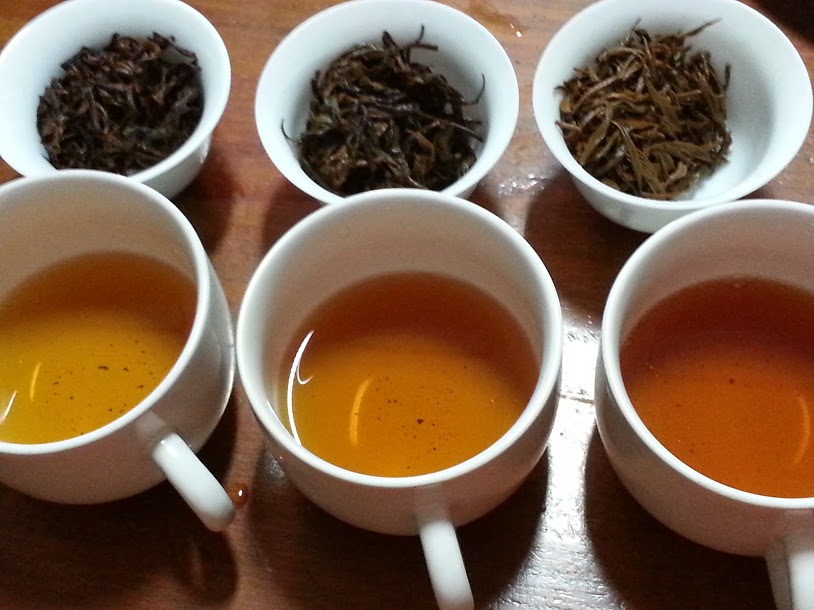
Spring / first flush tea on the left in all photos, second flush / summer harvest right


I'm trying two teas from a new set provided by Rishi of Gopaldhara for review (many thanks).  We talked to him not long ago in one of those online meetups, here.  The theme of developing higher quality, whole-leaf oolong that draws on varied processing approach inputs, especially from oolong processing from China, was a bit familiar prior to then, but nice to hear more details about directly.  The proof is always in the pudding, and their teas have been great for a long time, for years.  I would expect them to continue to improve, making results hard to place in relation to past experiences with Darjeeling, maybe even with their own prior versions.


Just prior to trying these teas I remembered that the last time I reviewed a set of samples from them I kept doing combined tastings that coupled first and second flush versions, which is not an intuitive approach at all.  It makes the most sense to try versions that are as similar as possible, to identify finer differences between them, variations in feel, flavor aspects, or intensity that distinguish them.  Trying dissimilar teas actually leads to picking up less in the tasting process, in a similar way that the more versions you taste the harder it is to focus, or background noise and distractions can have a negative effect.  Oh well.  I'm not sure what I picked these based on; it seemed like maybe there would be a common character thread that is interesting, probably only reacting to the names.  Or it's down to my stupidity and random chance.

On with tasting then.  Of course I'm brewing these Gongfu style; for teas of this type it's really the only valid approach, per my preference and opinion.  I've discussed that recently, about how vendors might actually recommend whatever they think would work well and ring a bell for consumers, so a website suggestion for these teas would probably relate to Western style brewing, related to the latter factor.  Eventually I might try some of these versions prepared Western style but to me it doesn't get the best results out of them.


Review:


Spring Honey Oolong:  just fantastic; really what I expected.  Sweet, creamy, rich floral notes are intensely pleasant.  Of course there is none of the astringency edge in typical Darjeeling first flush versions, which can be ok, maybe even a positive balance, but to me the teas are much better without it, or at least with a very moderate input of that.  Fullness and creaminess replaces that.  The taste range is primarily floral but strong fruit tones stand out too, maybe a type of berry I probably won't place.  It's not far off the range of red raspberry but that's not it.  The floral tones are complex, probably a mix, only well described if someone could split that apart, which I can't.  

Sweetness is at a high level, which supports the rest really well.  You never fully appreciate sweetness until it's not present at a normal level in a tea, and then you miss it.  The brightness resembles citrus, almost lemony, but as much in effect as the actual taste of lemons.  Often it's possible to specify a different citrus then, but this seems to be in between lemon and tangerine.


Summer Golden Tips:  the contrast is just great, how these are both so good in related but different ways.  A light astringency edge is present in this; it's a black tea.  It's on the soft side as Indian black teas go, of course, replacing a typical biting edge with structure in this case, versus creaminess in the first.  There's a lot going on in relation to flavor.  A mild version of malt couples with that astringency, nothing like the form of typical Assam, but not so different than the highest end versions.  Floral tones inclined towards fruit stand out in this too, but across a much different range.  Those are rounded out by a nice balancing warm mineral range.  

The floral tones and fruit are different in the two tea versions, different flowers, and a different warm fruit range versus the bright berry of the first, towards light citrus.  The fruit is a little like dried tamarind, not exactly like dried longan, but in that direction.  Dried longan is fantastic, by the way; if you ever see that you should buy it.


Second infusion:


Spring Honey Oolong:  this is a little too intense, too strongly brewed, and I used a time just under 10 seconds.  It's fine, not at all ruined, but finding the optimum might involve taking care to account for intensity.  Astringency picked up a good bit, not to the level of a chopped leaf version but with enough to move towards a comparable balance and effect.  I suppose that's a good thing, or to me it's just different.  Honey is really pronounced now.  I suppose it was present last round but not like now.  


Golden Summer Tips:  really essentially the same flavors as last round, just with relative balance of inputs switched around a little.  Astringency level is comparable to the honey oolong but in a completely different form.  There is citrus and muscatel range to this; maybe that didn't come out as strong in a first round.  Muscatel range is very moderate though; it could easily be interpreted as some other general fruit range.

It's complex in a positive way, and also intense.  It's interesting experiencing strong flavor intensity and positive feel with moderate astringency input.  Notable, but still moderate.  That input effect would change completely brewed lighter, which would take a really fast infusion time at the high proportion I'm using.  Of course backing off that proportion is an option.


Fourth infusion:


I took a break for a few hours and used the third round as a rinse to refresh the tea, which I drank, but didn't write notes for.  It was an interesting break; first we bathed the cats, when it started to rain, so we had to do that in a roofed area that serves as a garage space.  It kept on raining and the kids decided to go shoot baskets in a downpour, so I joined them for that.  I helped them clean the bathroom that they use (the covid theme relates to us not having a housekeeper visit), and I went for a run after, when it was only raining lightly.


Spring Honey Oolong:  honey is still really pronounced in this round, and floral tone, with a citrus range closer to orange peel now.  There's an astringency edge paired with a flavor that is distinctive in first flush Darjeeling, which I take to taste like green wood mixed with a floral tone.  It's a great balanced and complex effect, adding in nice intensity, smooth feel, and more aftertaste than Darjeeling versions ever tend to have.  That high level of sweetness and honey tone works well for me.  But is it oolong?

Kind of.  I don't know about the processing steps, and for the most part I'm more concerned about aspects outcome than category placement anyway.  Feel is quite smooth, rich, and full for any Darjeeling (just not on the level of those for Taiwanese high mountain oolong).  They can have a great structure, or fullness, but not typically like this (again not based on a God's eye view of Darjeeling, just a prior impression).  The flavor set is definitely not even close to Chinese oolong versions ranges I'm familiar with, since that part is Darjeeling, the list I keep repeating.  Leaving aside any expectations about Darjeeling or oolong the overall effect is great, and it also works folding those in, to me.  It's nothing like one of the typical type-ranges of oolong (Wuyi Yancha, Dan Cong, Anxi TGY, or Taiwanese high mountain versions), but then those are all different from each other too.  

It might not make that much sense to ask if there is a subset of commonality within those four type ranges that this overlaps with; the first part isn't as simple as it first sounds.  Within those broad categories oxidation level, roast, leaf input related factors, processing, and quality level cause a lot of variation.  I think there is common ground among all those oolongs but I'm not so clear on what it is; smoothness, fullness of feel, flavor intensity, a refinement in better versions (that part is vague), and being approachable (not challenging).  This isn't completely different, it just tastes like Darjeeling, and feel and aftertaste are less pronounced.


Summer Golden Tips:  this came out less intense than the other for the same parameters; that doesn't automatically mean anything in particular to me.  The astringency edge has shifted to come across as dryness, still paired with warm mineral undertone and malt flavor, or at least it seems connected to me.  It's pleasant.  

The other Spring version seems just a bit more novel, including a set of aspects that you don't often run across together.  This is a well-balanced version of second flush black tea Darjeeling, it seems.  For a broken leaf tea this astringency edge would be light, but for a more whole leaf version it stands out as moderate (lower medium level), and distinctive in character.  The complex range of supporting flavor is unusual.  

It's not so atypical for black tea versions of Darjeeling to hammer just a few flavor aspects, and this does express a limited set most, but keeps going beyond that.  It's malty; that seems different.  Citrus is a main supporting tone but really that balances with floral and fruit range.  Muscatel is limited in this, maybe not even in a range one would interpret as that, maybe as well left described as only citrus.

I think it would seem more impressive if this other tea wasn't so unique, complex, balanced, and intense.  It's quite good, but the novelty of the other version adds another dimension.  I usually like second flush versions better too, the way that aspect range comes together at that oxidation level.


Conclusions:


The next infusion wasn't so different and late rounds transitions seem like a lot of trouble to add, going through what shifts most later on.  These are so high in quality and exceptional in character that I don't think either is going to fade fast or shift to straight woody taste.  So then it's either about what comes out stronger later (usually flavor profile narrows and astringency picks up as you stretch infusion times), or there could be a surprise, some kind of shift.  I'm doing this edit days later but there were no surprises, they just kept transitioning, and brewed a lot of rounds, at least ten.

It's hard to describe just how good these teas are.  My friend Ralph made a good point in reviewing one (not the same, maybe, but from a similar set, with this Spring version reviewed here) about how not expecting this particular character going in can be experienced as a challenge.  The novelty could make them work really well, but it's also possible to not completely get what's going on at first, in the same way one does in drinking familiar tea types.  Brewing approach can require a slight adjustment in relation to chopped leaf Darjeeling, with the more moderate astringency probably a positive difference for most people.  Both of these weren't as soft as mild Chinese black teas can be, but the astringency present was in a good range to balance the rest, not detracting from the experience.

Beyond that whole leaf character they really must be experimenting with shifts in processing styles, as Rishi described, years past earlier forms of changes where what is different but not better gets included, onto moving forwards with approaches that have been working out well.  Of course factors like weather would make a lot of difference too.  2021 must have been a really hard year just to keep making tea there, but that didn't showing up in any negative ways in these teas.

So they are amazing teas, as usual, just more of the same, in relation to that being how their teas go.  Based on this early impression they might have set the bar that bit higher, as I would've expected.  The "golden tips" version suffers a little in comparison with the other for just being a pretty good, novel, high quality, well-balanced example, and for giving up a little intensity and complexity, but all that is no small feat, and it's quite pleasant to experience.  I think if that citrus present had seemed a little more pronounced, and further into muscatel range in character, it would've came across quite differently, but it was nice as it was.  It's possible that for trying these a few more times, with novelty as less of a factor, I would like the second flush version as much for being a solid, well balanced black tea version, since that general type range is a personal favorite.


Vendor descriptions:


This rambled on so long I almost forgot to include Gopaldhara's input about what I was trying.


Rohini Honey Oolong Spring – First Flush 2021 (it seems like it's that)


A rare first flush oolong tea made from the best quality AV2 bushes, which has very finely plucked tippy whole leaves with a silvery appearance. It has a traditional spring character & tantalizing sweet aroma with a finish of honey. The tea has a very pleasant & distinct aftertaste with zero astringency which leaves behind a very memorable experience.

The tea bushes are grown and harvested at an elevation between 1500-3000 feet...


That sounds right.  Onto the other:

Rohini Summer Golden Tips – Rare Hand Rolled Tea 2021 (I had no idea both were from Rohini; I should read the information sheet next time)


Rohini Summer Golden Tips is one of the finest second flush teas from Rohini Tea Estate of Darjeeling. The tea is made from small leaves having lots of buds. It is made from AV2 bushes which is one of the most preferred clones of Darjeeling. The leaves are freshly plucked in the last week of May. The dry leaves appear to be brownish with lots of golden tips.  This finest second flush tea brews into a bright orange and clear cup having mouthful, sweet & fruity muscatel character with a finish of honey.

Second flush teas are considered matured because of the sufficient rainfall received during the month of May in the Darjeeling region. The leaves absorb enough water during the monsoon period which helps in developing rich colour, strong aroma & muscatel flavour to the teas. 


Sounds right too, the muscatel just came across more as a less distinct citrus range in this tasting, to me, which is pretty close.


Keo shooting baskets during the tasting, before it rained


reviewing outside again


I haven't posted her picture in awhile.  she made that bag; she's really creative.


long haired Keo with Myra


Tuesday, October 24, 2017

Comparison tasting three Dian Hong (Yunnan black) from Farmerleaf


I've been planning to finally change gears related to exploring pu'er, to stop dabbling in teas from lots of different countries and get a better start on that one rather complicated tea type.  But this is about my favorite category version of black tea instead, which I'll get back to after saying more about that context.


Farmerleaf Jing Mai black left, golden tips top, sun-dried black right


An aside about a completely different subject, pu'er


My favorite tea blogger just wrote a blog post in Steep Stories related to the theme of exploring pu'er taking a long time. 

By the time you add in all the factors related to variations in pu'er--origin, tree age, other material quality issues, processing--itself a range of concerns, storage, etc.--you can't just try a dozen samples and get a feel for the type.  And all that's for sheng alone (a type for which I probably have posted about a dozen reviews); never mind the category division into two types.  I think that trying these three black teas I'm comparing would work for a starter introduction to Dian Hong (Chinese black tea from Yunnan), but there's still plenty of range to get to beyond them.

To expand a little about pu'er complexity, there was recently a Tea DB article and discussion video about vendors selling young versus aged sheng, and Scott of Yunnan Sourcing responded about that subject, and about number of other issues.  One main sub-theme that's been of interest to me is how some pu'er is sold as from a narrow origin location, and for different reasons some with no reference to origin at all.  That subject relates to a recent Yiwu Ding Jia Zhai pu'er vertical tasting event, about comparing different years from a smaller area within Yiwu. 


But then in describing black teas in a Reddit post comment I mentioned Dian Hong as a favorite, and the Farmerleaf vendor related to them selling a few.  They sell directly out of Yunnan; one related part of the cost being on the lower side.  In effect I talked myself into ordering the tea too, and before I could change my mind I clicked through buying 100 grams of three different teas.

Of course they sell pu'er too, a number of samples of which I have reviewed, and it seems fine to me, to the limited extent that I have a developed opinion on those.  For around the same cost I could've bought a cake of it, for about the same amount of tea.  But I had these other complicated plans for trying different samples and starting in on certain types of cakes after that, which will probably all change by the time I get to it.  That "vertical" tasting was a bit of a prompt, but I already had this in mind when I went through that other recent hei cha phase (which has one chapter left to cover, for now).


There's one connection I meant to get to, related to bringing all this up.  I'd rather drink this black tea than any lower end or medium quality pu'er I've ever tried.  Surely I've not yet been exposed to much in the way the highest quality levels of pu'er, and may never be at this rate.  Acclimating to the type and learning the range were factors in that other initiative, along with exploring aging changes.  I own two sheng cakes around a decade old, and have finished two that were much younger, but for sheng pu'er that's barely even starting on dabbling.  As memory serves I've bought and reviewed three shou this year, although all modest cost and quality-level versions; I think I'm ok on those for now.  I'll get back to it all soon enough, after re-trying these nice black teas.  It's some consolation that Farmerleaf also sent a pu'er sample.


This Dian Hong tasting background


These teas are all from 2016.  One is a sun-dried version, Jing Mai Sun-dried black Autumn 2016, which was supposed to improve with some age (per William's input), so it might be better than when I tasted the same tea last year.  I've also reviewed the other two, or nearly identical teas, an Autumn 2016 Jing Mai black, and Spring 2016 Matai Golden Tips / Pure Buds. 


I've been considering trading some teas with a few different people recently, with one set of batches sitting on my desk just now (from an online friend in Malaysia; cool enough).  These teas will work well for that, teas that I love that I can part with a little of.  I think I might have meant to buy a Matai leaf based tea instead of buds, since those really do match my preference better, but for comparison of the range and for trading the buds-style tea will work better.


Side by side comparison tasting is new since trying them first, kind of the theme I've been on this year, but the teas should still be about the same as in those first reviews.  These tend to brew a good bit of tea, and won't infuse a few times and be finished, so I remembered to use the small gaiwans to avoid getting blasted on caffeine. 

Review


an early infusion, brewed lightly (L to R, black, sun-dried, golden tips)


I went a little longer on the first infusion than doing a quick wash, so I could start the tasting then, but infusing for around 20 seconds the teas won't really be opened up yet.  The Jing Mai black seems to just be getting started.  It's malty, but in a completely different sense than the Assams I was just reviewing, more like ovaltine, that warm, sweet, light, but rich slightly fermented grain effect.  And it probably tastes as much or more like cocoa, which isn't that far from that other flavor.  I'll keep this first infusion notes short but there should be lots more to say about this tea.

The sun-dried tea overlaps in character with the first, the Jing Mai black.  But it is more complex; there are other layers of light earthiness going on, not the same types of leather and wood I've been describing in Assam and Wuyi Yancha teas, but not that far off those.  There is some cocoa to this too, and that light version of malt, but also other range, which will probably include fruit, and some other earthier range.  I expected to like the first tea the best, even though it might be simpler, and I still think that might be right.

The golden tips version is quite different (or it's called pure buds in a different description; I'll just go with golden tips).  Even with a short rinse, and not really fully beginning to infuse, the tea still has a strong effect, not completely unrelated to the other two but not really in a similar range.  It has an unusual level of dryness to it.  That ties to a flavor that leads back towards coffee, but probably a very light roasted version of coffee.  It will also have plenty of other range to explore, which I'll hold off on filling out until the next round.


Second infusion


On the next infusion the Jing Mai black tea is still a little light.  The combination of using water a bit off boiling point and relatively short infusion times (still just under 30 seconds) may not be ideal for this tea.  The flavor is nice but it would work better stronger, so I'll need to adjust that.  The taste range is still nice, light malt and cocoa, with hints of fruit beyond that, and background earthiness layered in lightly.  Personal preference is a funny thing, how different people would like teas best in different aspect ranges, and to me this set works really well.  Related to the intensity I would never really know if it had faded some since being made a year earlier.  It's really about how much you like a certain tea anyway, more than sorting out background for why or why not.

The sun-dried black is different, definitely more complex than the first in the sense of adding other aspect range.  As I recall it was a bit simpler last year; maybe it is already picking up some depth with age as William said that it would.  This could brew a bit longer too, or upping the temperature to full boiling would also work.  That particular temperature choice, not using full boiling point water, is usually used to offset astringency, which was never going to be an issue for these softer black teas, but also to shift the range of flavors that come out.  Water at full boiling point will extract richer, heavier flavors, upping the dark caramel / aged leather input in teas like these, and slightly cooler water will help the cocoa, yam, and lighter grain notes play a bigger role.  Or at least that's my take, but what do I know.  I'll test that next infusion.  The natural transition cycle the teas were going to go through using any parameters will throw off noticing that as a single factor; these teas were still sort of "opening up," just in a different sense than for other types.

The matai golden tips version is quite different.  That dryness to the tea almost comes across as a touch of sourness, an interesting effect that seems to bridge across flavor into feel range.  It's sweet too, with lots going on for flavor range, almost too much to separate out.  More pronounced mineral underlies all of the experience, in a soft, rich range.  A wood-tone along the lines of redwood forms part of the profile, along with fruit, roasted yam I guess, with some roasted sweet corn adding complexity to that.

The golden tips is the kind of tea that someone else might write a completely different aspects list for, and it's not as if either set would be wrong; both would just be different interpretations of a complex experience.  Rich floral tone would work as a description, and the sweetness could be described as a dark honey.  Some of that resinous nature that was present in Cindy's Jin Jun Mei is common in this tea, and the taste isn't completely different, although I wouldn't say it reminds me of that tea across most of the aspect range, it just overlaps some.

Shifting that trace of sourness would make the tea more approachable but it still works.  To pin down what I really mean about that aspect, the woodiness that I'm describing as redwood forms a continuous range with wood-tone that might be closer to balsa wood, something lighter, a little sweeter, but with a bit of sourness to it as well.  It's not unrelated to that sweet, rich, complex smell in brand new cardboard boxes, just not exactly that.  I'm not saying the tea tastes like cardboard, and it doesn't, I'm trying to describe how part of the aspect range can be earthy, sweet, and slightly sour in a way that all connects.  A fermented grain would potentially go in a similar direction, so I suppose a craft-beer enthusiast would be describing this related to that instead.  I'm just not sure if a connection to malt or hops is closest.

Third infusion


The Jing Mai black is better prepared stronger, going with more like 40 seconds and slightly hotter water.  The leaf preparation in these teas is completely different than for the other Assam and Ceylon I've been reviewing, made from larger leaves a good bit more twisted, so where using these same parameters would've made for an undrinkable strong brew for that last orthodox Assam it's just in the right range for this one.


a bit more color brewed stronger


This tea is simpler than the other two, but across a range of aspects I personally love, so I guess it works even better for me.  There is a light and sweet maltiness, cocoa, sweetness that someone could easily interpret as different types of fruit, slightly raisin-like, but probably more towards dried tamarind.  The feel isn't overly rich, or the aftertaste unusually long, but it's not thin and it doesn't just disappear when you drink it.  Altogether the effect is that of a very nice, basic tea, nothing too complex or novel, just nice.

The sun-dried version does show more complexity.  It wouldn't really be wrong to interpret all those same attributes in the last description as present in this tea too, but it has more of an aged leather higher end going on, not so far off the scent one might pick up in a mahogany cabinet.  It's not astringent but the feel is thicker, seemingly tied to that taste range.  The way that works out seems related to that mineral layer present in Ceylon; not the bite in CTC teas, of course, that complex underlying structure instead.  I've been talking down Lipton teas quite a bit lately, and they really are something to be avoided, but some of that aspect is present in them, as I recall, a complexity that extends from underlying mineral to dark-wood tannin, related to both taste and feel aspects.  But those are still inferior grade tea dust; the point is that they definitely don't get everything wrong in blending them.

That range of related flavors into feel (leather, dark tropical wood, mineral) extends a long step further in the golden tips version.  To me "resinous" captures that, but then I already know what I mean by it.  The "sour" effect even eases up in this last one, folding in more as a complexity and richness.  Mineral really plays a larger role.  I showed a picture of an old oil well holding barrel and steel pipe once in a post, trying to capture how mineral can come across as very sweet and rich, and this also invokes that.  In completely different senses all three of these teas are better than the other two. 

a common sight in rural PA oil country, artifacts of history with a cool smell


Fourth infusion


Some black teas, or even some lower quality roasted oolongs, would be starting to fade based on this infusion count and brewing time, but I'm expecting that these will just be hitting their stride, showing off their best character.  I'll stick with using identical parameters for all three but really the Jing Mai black could work well with a slightly longer infusion time and the golden tips with a slightly shorter  one.

The Jing Mai black is moving towards a bit more toffee sweetness.  That tends to come out naturally when pushing a black tea further to get more infusions later in a cycle, using hotter water when brewing off boiling point initially, and using longer infusions, but I'm still not using an extended brewing time, only a bit over 30 seconds.  Which I'm not timing; I don't care for that practice, since writing notes adds enough complexity to the tasting process as it is.  It's following the sun-dried black in deepening in aspect range, shifting from cocoa and light malt towards dried tamarind and a light sweet version of leather.  Not everyone would love this aspect set as I do but for my preference it's great; simple, basic, and well balanced.

The sun-dried version lightens a little.  Some of that interesting complexity fades, and the aspects range narrows, so these first two teas are closer in effect than they've been across the whole tasting.  The Jing Mai black has a bit more pull toward cocoa, and is a little softer, but still full, and this sun-dried black has a bit more tannin to it still, definitely not coming across as astringency, in the sense of roughness, but the feel is different.  Along with that feel, and slightly more mineral, and diminished cocoa, the slight sharpness of dried tamarind is stronger, not just slightly tangy as those are but also rich, towards a roasted pumpkin effect.  It's thinning but still quite complex.


Jing Mai black left, sun-dried top, golden tips right

The golden tips version strikes a great balance at this infusion.  It's slightly thinner too, but the balance of the same aspects is shifting, and they work well across these proportions.  Odd how it worked out but a lot of what I said about the sun-dried version also works for this tea.  The extra tropical dark wood tanin and dried tamarind tangy range extends towards an iron-pipe-rust mineral tone, with sweetness and complexity balancing that. 


One main aspect had initially been a slight sourness but that has dropped out now, and the feel has also softened.  The dark toffee effect in the Jing Mai black (more a tamarind / roasted pumpkin in the sun-dried) maps onto range in this closer to the second tea, but slightly different in this.  It's hard to separate out but one part reminds me of fire roasted sweet corn, it just doesn't taste anything like corn, only the way some of those fresh corn flavors evolve when you cook them in that way.


This runs long to be adding tangents but as a teenager growing up in a rural area we would occasionally hang out in some pretty remote places, and would sometimes would pick up a snack of corn on the way, from some growing in a field.  We would use a campfire to cook that, more or less just throwing it in beside the coals.  It's a primitive form of cooking, to be sure, but the results could be great, really fresh with a bit of complex char and sweetness, sort of a cooked sugar taste.


Fifth infusion


Since this is turning into a chapter-length tasting description I'll give these a longer steep and use this for closing thoughts.  The teas aren't completely finished but this infusion should be about how much they've faded.  I'll give them about a minute to steep, extending it a little to keep the infusion strength up.  It would work to give them a two minute soak at this point, and then I'd end up talking more about a heavier range flavors and feel aspects more in the description.  Even though the same relative level of these aspects would be present they'd probably come across as more dominant in a double-strength infusion, or closer to where the teas had been a couple of infusions ago, just transitioned some in aspects range.

The Jing Mai black is just fading; not much more to tell.  The flavors aren't really transitioning in any way, there is just less going on.  This tea has been really consistent in character across all the infusions so that list-description more or less told its story.

The sun-dried tea is also getting lighter, but a slight shift in how it comes across works well, not really negative.  That dark wood / leather / tamarind range of aspects shifts a little towards an aromatic bark spice effect, but not really cinnamon, something else.  Brewed again steeped twice as long this tea would have a slightly different but still interesting character.  The feel has thinned, and it wouldn't come back to where it was, but the tea isn't finished.

The golden tips is still pretty intense, for a black tea on the fifth infusion that I'm not pushing for intensity.  Softening in character with the aspects fading works well for this tea, in one sense, although those do diminish it in another.  It's losing some complexity but settling into a different nice range.

Conclusion


I love teas like these!  They're not challenging at all, on the simple and basic side, although not really quite as straightforward as some types, with a good bit going on.  I think that it's really my own preference for this range of aspects that makes these teas seem so nice.  I'm not really trying to put them on a scale for being type-typical Dian Hong, or better versions from that broad category.  The descriptions are just meant to convey what I experienced, and hopefully why I like them also comes across.


seems a little high


Wednesday, February 15, 2017

Comparison tasting golden tips teas from Nepal, Darjeeling, and Laos


I happened to have three similar buds-only or mostly-buds black teas from three different countries, different versions of golden tips, so I compared them.  Two of them including some fine leaf material, or buds developing into leaves--and one not--is an inconsistency, but then lots of variables could change the results, and they're not supposed to be completely identical.  The point is only to compare similar teas, to taste how final results stand in the cup.  I tried a vaguely related black tea from Sri Lanka not so long ago but didn't have any on hand; probably as well since three teas is enough, and stylistic variations beyond origin differences are already problematic enough.

It's unconventional to compare teas from three different suppliers, stemming from the marketing function blog reviews serve.  This blog was never supposed to be advertising, that function and discussing tea just happen to overlap.  That makes for a good placement to mention that all three of these teas were contributed by the suppliers for the purpose of review.

In general I only review teas I like, since those are most interesting, although in discussing that scope with suppliers I'm clear on reserving the right to publicly express what I really think about any of the teas.  I suppose if a tea were bad in a really interesting way that could work for a post, like reviewing a ridiculously smoky lapsang souchong recently, perhaps due to chemical treatment instead of smoking.  That tea wasn't provided by the supplier; I bought it.  Typically suppliers provide nicer teas for review, so the most frequent concern is describing when preferences don't match a style, more so than for teas being bad or mediocre.  On to it then.


Himalayan Tea Shop golden tips (Nepal tea)


Rohini (Darjeeling) golden tips


Kinnari Tea Laos golden tips (Golden Flame)


The teas, and background


I've already reviewed one of these, a Kinnari Tea Laos Golden Flame (golden tips).  It's good.  The point here is to compare that to two others, a Golden Tips from Rohini Estate, a Darjeeling, and from a private vendor reselling teas from Nepal, the Himalayan Tea Shop.  Maybe interesting similarities and differences will turn up, for example comparison of region related (terroir) aspects.  Of course terroir can also refer to other things, to the effect of the specific micro-climate (eg. amount of direct sun, effect of fog), or the minerals in that particular soil, or to effects from other plants growing nearby.  A more experienced reviewer could say more about trueness-to-type, matching a typical range, than I'm going to here.

The Nepal vendor I'd mentioned in this post reviewing a green tea (a decent green tea at that).  That vendor's name is Arpan Khambu, essentially someone with a family business background starting to sell teas internationally on his own, a very small-business model.  That's an interesting back-story, one that would be more familiar for a vendor based somewhere like the US, but those circumstances change sourcing quite a bit.  In the future his business practice may evolve to include more information about the grower, including details about growing conditions (organic claims, etc.), but due to just starting out as of yet the related information that's available is sparse.

Rohini is a major Darjeeling producer, or really a sub-set of Gopaldhara, so there is information about them and their teas on their website.  Not about this particular tea though, since it is likely not a main production version, and that producer sells teas primarily through distributors, with only the main types described there.

I was surprised that Kinnari Teas had developed materials describing the teas in great detail, just not down to grower's photos and Google's coordinates of the farms.  Here is some background on the teas they are working with that I didn't get around to mentioning last time:


All our tea plants are grown from seeds from ancient wild Lao tea trees. These unaltered tea plants are perfectly adapted to their environment, evolved to thrive in this particular microcosm without the need for human intervention. In our highly biodiverse tea gardens, the collaboration of different plants, animals, insects, minerals and microorganisms ensure healthy and rich soils, no pesticides or chemical fertilizers are required. The tea plants’ strong taproots provide them with all the water and nutrients they need, while anchoring the soil on the hillsides. Each garden is a biotope: their cultivation contributes to the protection of the environment in rural Laos.  

Growing tea from seed and artisanal hand-processing also results in less predictable and more complex aromatic characteristics within one single garden and throughout the seasonal harvests. Like with fine organic wine, each harvest and each batch is an adventure and a surprise.


Interesting!  Someone with skeptical inclinations could reject that as less valid than an organic certification but it seems to really not be intended as standing in place of that, just a bit on context.  The part about genetic diversity of plants of course is a real thing, which leads to more questions about the differences between native types of plants grown through natural breeding versus use of clones (controlled breeding).  There's more on the general background related to this particular tea:


Southern China’s Yunnan Province is widely regarded as the cradle of tea, and famous in the west for its excellent black and puer teas. But plants don’t care about borders, and northern Laos’ geographical proximity to Yunnan can be felt in this exceptional tea from Phousan Mountain in Xiengkhouang Province, which echoes the renowned Chinese Dian Hongs...  Upon infusion, the tea releases rich aromatic compounds reminiscent of Yunnan blacks, but with a distinctive elegance.


That mention of Yunnan and Dian Hongs makes perfect sense.  These teas are not that far from versions I've been reviewing in the not so distant past (like this Farmerleaf autumn sun-dried Dian Hong).  

All of this about the Laos and Yunnan origins isn't to imply that Darjeeling and regions in Nepal are giving up a lot related to working with near-ideal high elevation growing conditions, or that great results couldn't be obtained from working with modern tea plant types or species evolved elsewhere.  It's really about the final results, and different good teas can be produced in different places, which is really the whole point of this tasting exercise.


Tasting


Initial color difference seems to relate to teas including only buds (the Kinnari tea) or fine tea leaves and buds.  That will likely shift flavor profiles a lot, and change the effect of brewing times.  But then it's not science, just a comparison tasting.


The Nepal version (Himalayan Tea Shop; I'll just refer to these by country designation) is nice, darker, sweet smelling as a dry tea, and complex (they all are, really).  The initial taste is in the cocoa range, a bit subtle, sort of malty, but in that softer sense of that flavors range.  Malt is sort of complex anyway, not so definitive, but cocoa and malt describe most of the initial range.  It is nice and clean across that range, with a bit of bright citrus helping the profile.

The Darjeeling version (Rohini, a plantation associated with Gopaldhara, owned by them) is nice too, in a similar range, again malt and cocoa, maybe malt with cocoa versus the other way around.  The mineral structure below that seems to stand out more but it's still quite soft, and definitely not astringent, not even significantly "structured" versus biting, if that makes sense.  It might be the earthiest of the three, pulling a little towards wood tone, maybe even a hint of mushroom, but not in a bad sense, that clean tasting woodiness some wild mushrooms have.

The Laos version (Golden Flame from Kinnari Tea) is more subtle at the same parameters, without addition of some fine leaf content that would allow it to brew out as quickly.  It's more cocoa in the range of chocolate instead, that sweetness extended into those types of richer tones, maybe with a little brighter citrus tone mixed in.  Being more subtle offsets comparison a little; it might make sense to adjust brewing process since it may brew out slower.  I'll go a second infusion at the same times and judge that.


left to right:  Kinnari Tea, Rohini, Nepal tea


On the second infusion the Nepal tea is really nice, that cocoa and malt balancing even better.  Citrus is also there, with some spice tones joining in, close enough to cinnamon.  The sweetness is good and the feel is nice. There is a citrus element, a very light ruby red grapefruit (as a taste only; there is no bite / edge as from even mild grapefruit, just that warm sweet range is there).

The Darjeeling is in a different range, woody, maybe towards cedar, again with cocoa as dominant and plenty of malt (so maybe cocoa even picked up a little).  It's still nice, just different, it trades out citrus and spice for wood tones.  There is a lighter trace of citrus too but a different citrus, more toward bergamot.  The flavors are nice and clean.  It had seemed that woodiness could drift into a less cleaner over-all flavors range but it didn't work out like that.  That hint of wild mushroom transitioned to clean wood tones.

The Laos tea does seem to brew slower, so I'll be tasting it as a milder tea without adjusting to add time.  The proportion could also relate; going just a little heavier would add to the infusion strength.  This tea will probably last longer too, being only buds, or it might transition less later since the other two will see the fine leaves give out while the buds take more time to do that (at a guess).  The flavors are nice, again malt and cocoa (common to all of these), with citrus, and a light woodiness that's not the same as in the Darjeeling version (the Rohini).  That tea is more in the range of cedar, and this is really something that may be more like hay, it just covers the same range.  The last review also mentioned raisin, and between the more dominant cocoa and citrus underlying aspects could be sorted out as fruit, that raisin, or as malt (sweet malt, as in malted milkballs; there's nothing dry or mineral intensive about this tea, the standard pairing with other types of black teas profiles).

The citrus aspect may be the strongest in the Nepal version, or maybe it's that the spice tone adds to that sort of aspect effect, with those two sort of defining a "top" range, of sorts.  It's interesting the way there are so many comparable elements in these three teas playing out slightly differently.

On the third infusion the Nepal tea doesn't change much, maybe just a little nicer.  That cocoa, malt, cinnamon, and citrus integrate well together.  The other "earthy" range is more dark wood than mineral, or just a bit off cedar towards something darker yet, but not at all murky in effect.  The malt sort of has that brightness and complexity it seems to have in very different black teas, just not paired with astringency at all, and with different flavors altogether.  The spice tone (close to cinnamon, but not exactly that) covers range out towards coffee, just a mild version of it, a light roast, I guess.


Rohini plantation (photo credit)


The Darjeeling is moving into a richer, earthier range.  Without trying that Nepal tea just prior it would seem a lot different, brighter in comparison, with some of the same general aspects filling it out (cocoa, malt, citrus).  Due to direct comparison with the Nepal tea just prior a heavy, earthy tone stands out a lot more.  With that comparative bias going it seems a little towards a shou or aged pu'er, that dramatic, but once you adjust to tasting it on it's own it's nothing at all like that, just earthier.

Is all this clear?  It's covering similar cinnamon / coffee complexity range as in the Nepalese tea, just earthier, more centered towards a dark wood, and it seems the difference stands out more than the rest of the common flavors profile--most of what comes across--due to comparing the two teas.  It wouldn't be unusual for someone to attribute that to something else, peat, autumn leaves, mineral range, or something else, but it's clean and integrated, not "off" in any way.  The tea works well.

The Laos tea is more subtle than the others, again with part of that down to brewing parameters issues, trying to brew teas that aren't identical in the same way.  I can taste around that, and let it sit a little longer next time.  As with white teas this seems a little like tasting a silver needle style against a bai mu dan type.  Of course there is less complexity for including one type of thing instead of two (buds versus leaves and buds).  I think I'm biased towards that more complex effect, in general for both types, related to tasting these and for those white teas.  The opposite preference would also make perfect sense; it's subjective.  The tea is great though, as I just reviewed separately.  Cocoa, malt, hay, citrus, and fruit make for a nice profile, and it's quite clean and well presented.  It's possible to ramp up infusion strength different ways with brewing, it's just not possible to add more elements that aren't already there, and those aspects and balance are nice.


On the next infusion the Nepal tea is still similar, picking up just a touch of dark caramel tone.  I would expect it to start tapering off a little from here but who knows.  The Darjeeling version stays clean, with dark wood still pronounced, maybe shifting a little closer to the Nepal version, starting to come across more in between spice and light coffee.  It is a little more earthy than the Nepal tea.  The Laos tea is just hitting it's stride, bright in effect and picking up more complexity, but then it had already been complex.


not so related, but she does love tea

I think I'm liking these teas a lot more for calibrating my expectations to the range more, for appreciating them as a bit subtle (compared to leaf-only black teas).  It didn't hurt that two versions met me in the middle for including fine leaves in addition to buds, more familiar to me and a better match for my preference, that additional complexity.  And all three are really nice teas; that helps.


I suppose I am describing them in such a way that the Nepal tea sounds better, and I do like it better, slightly, but the Darjeeling is quite close in aspects range, so they are more similar than different.  The differences stand out a lot more for trying them side by side; tasted a month apart it might be harder to distinguish the two.  The Laos tea has a different effect going, brighter, in a slightly different range, but it's also nice in a different way.


It's odd the mineral aspects are so subdued in all these teas that I've barely mentioned them.  It must be an underlying element of the flavors context, part of the reason they come across as complex, but quite subtle for all.  I like the way the dark woods / spice range is doing more for the two more Himalayan teas, with different citrus higher notes supporting the more dominant cocoa for all three.


On the next infusion I think all the three teas are dropping back a bit  The same elements are there but they're thinner, and would surely keep getting thinner.  Based on the tasting last time that Laos Golden Flame really is able to go more rounds than one would expect, staying consistent across longer infusion times for a number of extra rounds.


lower left Laos, right Nepal, top Darjeeling


The spent leaves look a little different but the Nepal and Darjeeling versions aren't so far apart, more a slight color difference, with the Nepal leaves just a little darker.


That was interesting!  A word of caution about comparison tasting golden tips style teas:  the level of caffeine in these feels substantial, with that effect going a bit far given how many rounds I tasted through.  It took a good number of hours for that extra level of tweak to wear off.

Monday, February 6, 2017

Kinnari Tea Laos Gold Tips (Golden Flame)


I'm trying out a Golden Tips style tea from Kinnari Tea, in Laos (Golden Flame, their name for it).  I was looking forward to trying teas from Laos before I even checked what they had sent, then all the more so, amazed by the types selection.  Others include a pu'er-style tea, Moonlight White, an interesting looking green, two versions of white teas, one a silver tips (the other I'm curious about), and a green-based version of an Earl Grey.  They have an instagram profile but haven't loaded pictures of all those just yet, but you can get the general idea.


They're all well-packaged even by professional standards, in multi-layer sealed bags, with clear descriptions, growing location citation, flavor-aspect notes, picking standard, and brewing instructions, including hot and cold brewing suggestions.  By outward appearances this looks to be one of the best novel tea resources most people have never heard of.  I'd be surprised if these weren't amazing tasting teas that sell at a good value too, although I've not checked on that last part.


it really is golden

Trying tea from Laos helped get me into tea, on a trip including a stop at a small local coffee grower, probably seven years ago now.  That was more towards the South of Laos, the Bolaven Plateau.  I've seen more online about better tea production in the North since, close to Southern China.  That tea I tried then was ok (hard to judge now since I essentially took up tea since), but I'm guessing it was far from reaching it's potential due to the farmer more or less just drying it in the sun.


I tried very fresh coffee there on that visit, both Robusta and Arabica.  The difference in those types was clear for the first time, and also how very fresh single-source coffee might be different (it was a bit fruity).  And they nearly poisoned me with caffeine in that tasting; as far as I remember that was my first near-anxiety-attack from that drug.  It might be a good rule of thumb to be careful about how much really fresh coffee you drink, and it seems likely that Robusta was running higher in caffeine level.


Gongfu style, for some not the natural choice but it works out about the same


One of these teas is from that Southern growing area, an interesting looking green, but I think most are from the North (something I can check since locations are specified).  I've long since thought the right person with processing knowledge could build an amazing business out of developing the potential of the existing growing teas in a place like I'd visited, and I've read of at least one other business in Laos claiming that is their primary business theme.  That seems more common as one gets close to the edge of the South of China, in Thailand and Myanmar too, since there was no sharp division in past local tea production based on the current country borders.


The tasting notes say the tea aspects include warmth, hay, cocoa, citrus, and raisin must.  I went light on the first infusion--using a light proportion Gongfu style, although Western should be about the same for this tea--and although that infusion was a bit faint that sounds about right.  It will be easier to tell with a more standard infusion strength.


tea and spices simmering (not that batch; I was too lazy to take pictures)

As a bit of an aside, I'm getting over a cold now.  That never helps with tasting but I think I'm far past it that it'll work.  The day before on break from review tasting I tried out making a masala chai with a mix of that smoky Lapsang Souchong and some generic CTC Assam I had around, mostly to test out if that smoke would work well layered with the spices, something I've tried before.


It worked well.  The chai spicing was the standard mix, ginger, clove, brown cardamom, cinnamon, and a dash of vanilla extract.  The only glitch was a bit of petroleum aftertaste, not in the warm, rich fresh crude range I'd mentioned not so long ago in a review but closer to engine grease, not as nice.  I'll probably give away some of the rest of that tea.


not quite as red as standard leaf-based black teas


Back to tasting.  It is natural to follow the influence of the power of suggestion and notice hay, cocoa, citrus, and raisin, which is one reason I never read flavor descriptions before tasting.  The tea is like that, and it's a nice overall range for a tea to be in.  The complexity and those flavors might point in other directions, like the raisin could come across as date, or the citrus could be interpreted towards a citrus-oriented trace of other fruit or floral aspect, but really that list seems to catch it.  It doesn't have a pronounced mineral layer, really, a rich expression of cocoa extends across a lot of flavor range, or to some degree where that might be in the character gets expressed in the feel of the tea instead.  Or there's always the chance that I'm making no sense related to that last part.


Buds-only blacks can have a subtlety to them, definitely not the same as the range of white teas but not completely unrelated.  This tea is flavorful but just a little subdued, with some of the general effect out in the range of nice fullness and feel, as occurs with Silver Tips style teas, not thick like oolongs tend to be but different, not really dry, definitely not astringent.


It's nice for being a bit unique.  I'm in the habit of seeing black teas break down into a divide of being softer, sweeter, and more floral, or possibly similar but heavier on fruit instead, or else with a bit of dryness and doing more with mineral tones, and this is just a little off of those.  I'm reminded of another blogger's take on a range of black tea styles recently, Amanda of My Thoughts Are Like Butterflies:


In my addiction, I have noticed that there are different categories of the stuff [Chinese black teas], ones that taste super chocolaty, ones that are fruity, ones that are odd and don't taste like anything else... It doesn't seem to be based on anything I can figure out, I have had two teas from the same region, made in the same style, from the same season but from different farms...taste completely different. This particular Dianhong goes into what I lovingly classify as the yam pile, strong notes of yam with a bit of malt, peanuts, and cocoa. 


Sure, it's like that, although they probably span a continuum as much as they can be grouped.


Xiangkhouang Province, Laos, not so far from some other nice places


On the third infusion the tea drifts a little towards mineral but the tastes are still in about the same space.  The cocoa is still a bit dominant but it shifts towards cinnamon.  Even brewing a little longer the tea isn't picking up more dryness, which would almost seem natural related to the rest, it still has a nice full, slightly juicy feel, or at least towards that.

It's a very nice tea, not giving up anything in terms of general quality level to somewhat similar Yunnan black tea versions I've been trying lately.  It's perhaps a bit more subtle, related to the style being black tea shifted towards a white style.  I guess it could be similar to that Ceylon Gold Tips I tried not too long ago in some regards.  I just had trouble dialing in that experience to a higher resolution for it being part of a lot of tasting and discussion in an unfamiliar context.  Related to those tasting circumstances, I'm reminded of a tea vendor friend's comment about tasting in a "meditative space," a subject I have gone on about.  As the level of background noise from my kids rises and falls it's easier or more impossible to really evaluate teas, and it can reach a level where I might as well just not bother.  That input was medium for this.


On the fourth infusion--I think it is--the character aspects shift a little more in the same direction for lengthening the brewing time, still nice, just as good really, just different.  Cocoa in a well-balanced black tea is nice.  The hay extends a little towards heavier earthiness and mineral but a separate description for that doesn't jump out.  It's not "woody."  It's refreshing to not be saying "sweet potato / yam," even though those aspects are nice in black teas when they balance well.  All in all this tea is just great.  I suppose a slightly different style matches my own preference just a little better but it seems odd finding fault in this tea, and I would expect people with a broad range of preferences to appreciate it.


What this tea gives up for being on the subtle side it claims back for brewing a lot of nice infusions.  I kept going with long infusion times thinking each would be the last and it wasn't fading much, or transitioning in any negative way.


I'm getting a bit behind in reviews, with teas I'm excited to try piling up, so I might switch to a less rambling review-only style.  But then I always say that and never succeed in doing it.  There was really more rambling to have been done here, more back-story about another type of personal connection to Laos, or more about visiting there, or about the company, or the one owner that I've talked with.  She's a German woman, who is not at all as edgy and intense as the side of my family that feels a closer tie to that set of my roots, the side that granted me my last name.  There must be lots more to say about how it's possible that this tea is this good, but with more nice teas to try I can get into that in later reviews.

Wednesday, May 13, 2015

Thurbo Moonlight Darjeeling white tea from Golden Tips

I wanted to break from just reviewing teas at some point but recently tried a nice white tea, and I'd been saying white teas aren't a favorite in some online discussion, so I wanted to set it all straight.


Of course I did just review a bai mu dan, saying I liked it, and past reviews of silver needle teas have been generally positive, so the comments weren't that negative.  My favorite types are darker oolongs and interesting black teas, and I can definitely appreciate white teas, and Darjeelings, and lots of other styles.  I always try to keep expressing thoughts on teas simple, but it never works out like that, so there are two tangents in this post.


beautiful, but you really should smell this too


I should note first that the tea is from 2014, first flush, so it's odd to review a tea that's essentially a year old now.  The vendor sent the sample earlier in the year, so part of that was just about not getting to it right away, and the rest about not getting to it.  I'd planned to say more about the other darjeeling samples related to posting about a different version here (black Thurbo Moonlight, second flush).  That intention related in part to saying more about seasonal differences and Darjeeling as a non-traditional type of black tea, neither of which will really work since this is most distinctive related to being a white tea.


I wonder if a bit of extra aging had changed the tea, but would never really know.  Based on my limited understanding of how different teas age green teas typically are intended for consumption as soon as possible, and white teas generally aren't intentionally aged, but more oxidized teas, including oolongs and whites, can actually benefit from changes related to even extended aging. So of course I looked around a bit about that, and ran across a discussion thread on aging white teas on Tea Chat (tea discussion forum).


Of course different people say different things in such a discussion, but aging white tea isn't unheard of.  It would be more familiar related to white teas pressed into cakes, it would seem, but the discussion is more about aging loose white teas.  A tea that's one year old isn't really aged all that much, but of course I'm still curious about the difference a year could make, if any, and changes another few years would bring.  That discussion doesn't settle it at all, and barely gets into descriptions of changes, but it is a few pages of informed input on the subject from people that are into tea enough to go to a site like that to talk about it (of course with differing levels of background--which goes without saying).  Storage conditions would relate too (another thing that goes without saying), kind of sore subject if you live in Bangkok, one of the hotter places on the planet.


What would a tea expert say about this?  Probably different things from different people.  One vendor, from Peony Teas, who writes about tea background, says:  with age, white tea actually changes its properties to sweet and ‘cooling’.  Who doesn't love those Chinese nature-themed properties references?  Maybe easier for many to relate to comments about taste changes though; I'm not sure if I should be getting cooled or warmed, or if it matters.  I guess this is one more idea to keep on the back-burner for later review (or two; aging white teas, and the cooling).


the review part:


At first I thought the tea was a silver needle, but it contained some leaf fragments, maybe closer to an even mix of buds and very small leaves, not the normal balance towards leaves in a bai mu dan.  It is sold as a "white tea," see reference page here, so they don't commit to either style, and I probably like this mix better than either other traditional type (all buds or mostly leaves).


My first impression related to how floral and sweet the tea tasted, but then I also appreciated how fruit was a component (closest to pear, it seemed to me), and how complex the flavors were, and the rich body of the tea, so lots going on.  The second infusion shifted more towards fruit than floral, with a bit more earthiness and less floral nature, with more of the trace of distinctive grape / muscatel more pronounced in second flush teas and more oxidized versions.


To me the complexity came across as a consistent expression of positive traits of both white teas and more subtle darjeelings:  sweetness, floral and fruit components, rich depth, floral transitioning to earthier flavors in later infusions.

As I ran through what I thought and later expressed about the tea it didn't seem I'd really captured the essence of this tea in the description.  Really no set of accurate concepts does get you far towards the experience of actually trying the tea, but it can describe it to some extent.  To me the richness of the tea, along with sweetness and bright flavors, gave it an interesting overall effect.  The feel was so full it was almost a bit buttery, but not really in the sense it tasted like butter, but maybe just a little creamy in a way.


My main reason for not appreciating some white teas in the past, even though I really have liked all I've tried, is the subtlety, the way interesting flavors and a nice body can still be exhibited as flavors that come across a bit wispy.  This tea wasn't like that, no struggle to taste it along with feeling it.


The vendor recommended the typical longer brewing time for white teas, four to five minutes, and based on varying brewing times it seemed to me the flavors were still full using a shorter steep, maybe even better in some ways.


A shorter and lighter infusion enhanced the brightness of the tea without coming across as weak, without limiting the floral or fruit elements, still with an exceptional body, but just didn't bring out the full rich complexity that would seem more typical of an even more oxidized tea.  I guess this could relate to a touch of astringency, but not in the same sense as more typical black teas and other Darjeeling types, definitely not bitterness.  For some brewing lighter style versions of the tea would be more enjoyable; it would depend on which elements someone liked best about the tea.


It raised the question of just how oxidized the tea actually was, since an earlier and lighter infusion seemed to have a different character than a later or heavier infusion (two separate factors, but taken together it could come across almost as two different teas).  Some tea lovers might well read this with disgust and think optimizing tea experience is the obvious and only goal, so messing around with brewing times and drinking a tea as different types of final infusions is madness.  Good for them; I love reading blog posts from people that have tea process and their own preferences so carefully dialed in.  It's also interesting that different people have equally strong preferences and convictions about how they brew different types of teas.


Of course the two main general brewing techniques also relate, and it would seem more natural to brew a tea "stronger" using a Western approach than gong-fu style, whether in a gaiwan or differing types of pots.  At the same time the higher tea to water ratio for the latter would change the brewing time required, and resulting flavor profile, so that a comparison of relative "strength" wouldn't really make sense, or the opposite could be concluded.  For what it's worth the vendor instructions for this tea related to Western style brewing, which I used, except for trying on shorter infusion time.


Really I'm not the right person to specify how all this "should" go, or describe different techniques as they apply to different tea types, and references you find online differ quite a bit, as these describing gong-fu preparation here and here.  Note in particular the brewing times are relatively opposite, with the two approaches one generally runs across described in each, very rapid brewing time and use of 30 second infusion and subsequent longer periods.  Now I'm drifting a little but you might read this about reasons to prefer use of a gaiwan (and related gong-fu style brewing).


I've been impressed with this and the few other white Darjeeling teas I've tried, very novel teas with unusual strengths, and this one stands out.