Sunday, July 23, 2023

Foreigners living in Thailand "honeymoon period" and experience cycle


I'm sharing an answer I recently wrote for a Quora question here; it was this:


Why do so many foreigners living in Thailand wear rose colored glasses and have this attitude that Thailand and Thai people can do no wrong?


Kind of a biased framing for that general question content; foreigners new to Thailand don't seem like that to me.  But there is a related cycle of experience people tend to go through, often starting with seeing everything about Thai culture and Thailand very positively, gradually transitioning to a more balanced or even negative outlook over time, so it's close enough, just not really summarized as "Thai people can do no wrong."  The first time a tuk-tuk driver quotes you an unfairly high price for a trip that seems a bit off, and most people would experience this in the first few days.

That post answer is definitely long and detailed enough, without any more framing or clarification, so I'll just cite that as the post text following.


The first answer that comes to mind relates to a conventional cycle of perspective change over time, to a “honeymoon period” that people experience, foreigners new to living in Thailand. The idea is that over the first year or two everything is novel and positive, and any negative differences are minor in comparison. Then the standard idea is that people tend to see it all as more balanced later on, and often become bitter about differences and more negative side seeming to stand out all the more many years later. Of course that would relate to having specific negative experiences, like a divorce, or failed business.


Oddly I like Thailand and feel more at home than I ever did in those first few years, 15 years after moving here. I think that’s because I didn’t follow a more conventional path of extending vacation experience to life circumstances, moving to Thailand to live a beach life, or to pursue new relationships. I was already married to a Thai, and working in a new type of position was a real challenge, with having a baby added to that within the first year (14 months after the move, but about that). I moved to Thailand because of visa issues, or more so related to a scholarship clause of my wife’s requiring that we either leave the states or give back a lot of money that we really didn’t have.


Back to the convention about a cultural perspective learning curve, the idea is that people aren’t a good judge of local perspective difference early on, and mistake a Thai outward pleasantness and cheerfulness for genuine good will and happiness, then later they realize that these are just communication and demeanor norms. That seems partly true to me; it’s a bit like that. Thais do tend to have mixed feelings about foreigners, seeming very open and positive at first, then later it’s not difficult to notice limitations to that, and another side. Negative interactions would occur, eventually, or a limitation in the range of how you can interact with others.


Foreigners, especially white Western foreigners, tend to be seen as all one thing, or viewed through a lens of a narrow range of stereotypes (professional foreigner, backpacker, English teacher, sexpat, etc.). Most foreigners living in Thailand do fall into one of those categories, but being interacted with as a known and simple type isn’t always positive. Early on, and in the simplest possible forms, that type is generally positive; foreigners are automatically granted a relatively high social status, somewhat equivalent to being a relatively upper class Thai. Later it’s clear that this is only a superficial place-holder for not really knowing how to place foreigners, with people erring on the side of being more respectful.


In the past there was a certain degree of Thai cultural perspective “looking up to” Western culture, which has largely been replaced now by a feeling that Thais are “as good as” anyone else. A bit of uncertainty and insecurity might go along with that, which could easily lead to resentment; “why does that guy think he is any better?”


Then other factors enter in, like language limitations. It’s easy to explore a new environment based on very limited depth of interaction with others, but it prohibits later deeper exploration, and more meaningful exchange. Early on foreigners visiting or living in Thailand wouldn’t be clear at all about the complexities of normal Thai life and perspective, which could come across as positive, as a lack of negative factors, but then later not being “in on” others’ actual worldview could be regarded as very limiting. Some of the “rose colored glasses” limitation mentioned in the question could relate to foreigners just not understanding Thai culture, perspective, or life experience early on, and embracing the experience of positive and superficial aspects. It’s easy to love the beaches, the novelty of a completely different environment, or people seeming friendly, without being aware of limitations or more negative aspects for quite some time.


I don’t want to make it seem like there aren’t very substantial, positive, meaningful aspects of Thai culture that are unique to Thailand. There are, and my life experience has been very positive in general for a long time (although that woman on the right in that photo is certainly not smiling a majority of the time). And there are also subtle limitations and negative aspects, which take time to understand and relate to.


Saturday, July 22, 2023

A friend visits from China


There would have to be more of a point, right, beyond describing a friend visiting from another country, having dinner and going to a play area or museum?  It's my daughter's friend, a 9 year old Chinese girl.  An interesting part has been discussing perspective on different countries and cultures related to both our kids, about how that girl's mother thinks that an antagonistic perspective between Chinese and Americans isn't valid, given that people in both places have much, much more in common than differences.  I completely agree.

My kids are Thai too; from two cultures, races, and nationalities.  It's interesting how the potential divide seemed to relate more to the US side of that.  China and Thailand are much closer; Thailand has a good relationship with most countries, beyond minor friction with some near neighbors over past differences.  Even related to that their immigration and working rights policies are quite open for people from Laos, Cambodia, and Myanmar, maybe just not quite as developed to support local or foreign origin indigenous people who may not have as clear documentation of being citizens of anywhere.

From there the insights can be a bit vague; all this relates to exactly what everyone would expect.  Americans are informed and conditioned to believe that Chinese national policies and actions, and to a lesser extent that of their citizens, can be unfair to others, and I would guess that's probably roughly as true in China.  Oddly I don't think it's really more of a universal convention in China, even though the government there has much better control of media and education content and narrative.  Why would I think that?  I have Chinese friends, Amber isn't the only one, and they pass on what they think.  And I've been to China 3 times, or a half dozen, if you count trips to Hong Kong, Macau, and Taiwan, but I see the last as a different place, or really even the other two.

Amber hopes that the kids can stay in touch, which hadn't worked out over the covid period, but we would meet them when her daughter attended a summer program at a British school that my daughter also attended then.  Kalani moved on to go to a Thai school after, and just completed the third grade in Honolulu, Hawaii, adapting well to both of those changes.  I also hope that my kids can continue to feel a connection with that friend, and other Japanese friends they have known and still do.  Bangkok is really their home, based on how they feel about connections to different places, so I'm not worried about that dropping out, even if we can manage to live full-time in Honolulu after the school year that starts very soon.  Summer break is almost over!


It helps that the girl visiting is very special, which I feel to be true of many of my daughter's friends, or even most of them.  She is cheerful, bright, energetic, empathetic, and multi-talented.  Her English is a little limited but she speaks very clearly and appropriately when she does use it, probably as good or better than my Thai (just more limited), and I've been in Thailand for 15 years.  She has a strong personality; she's stubborn, when attached to an idea, and speaks her mind regardless of what is on it.  She would make a good American.  And she's amazingly well conditioned for extended play; we just visited a play-space and slide area and barely stopped running for 2 1/2 hours, which Keoni, my 14 year old son, said he's getting a bit old for, and is not conditioned to keep up.


All this makes me consider what I can pass on about Chinese culture or perspective, beyond it just being another normal worldview, supporting a range of very conventional life experiences.  I'm really into tea myself, but that's an exception in "the West," and not common related to the emphasis I put on it even back in China.  If you visit places like Shanghai, Beijing, Shenzhen, or Taipei it almost feels like you are in any Western city; the general look and range of activities and options isn't so different.  

People are Asian, of course, and public transportation is unusually developed, language use and foods vary, and so on, but there's not a lot of other outward difference.  If you talk to people, as I have, tea contacts, my kids' school friends, and work contacts, they don't seem so different than Thais or Americans.  I suppose that's not true in the same sense of Japanese people; they really are a good bit more reserved.  Get past that and they're similar too; one of the local friends I've felt the closest to in Bangkok was Japanese, and a Japanese family in Honolulu, again including a friend of my daughter's, has been wonderful to be in regular contact with.


that Japanese friend is just great


When Amber discussed this with Keoni and I she tried making the point that China isn't so bad, even as a nation, that a broad range of atrocities aren't happening, related to ordinary life experience not having anything to do with them.  I get it.  Keoni and I had to express that some of the negativity is grounded, that China does restrict flow of information and internet access, and worse, and houses concentration camps, but then the US has those too.  Either country might contest that negative designation, but if an "immigrant detention center" is holding people indefinitely and separating family members, in conditions that aren't monitored or discussed outside those facilities, then it just is what it is.  China probably couldn't turn a blind eye to the homeless and mentally ill population that's living on the streets in US cities, even if their solutions may not be ideal if that would come up.

The US gets in wars for bad reasons, for personal profit of people with influence in government, and China makes territorial waters claims that other countries don't see as reasonable; it's kind of a wash.  China is better at monitoring its population, at collecting face recognition based video data, but the US is essentially collecting and retaining all the same information in other ways.  The US doesn't maintain social credit scores; there probably are real differences that are better or worse across different aspect range, maybe generally in favor of the US being "freer" in some ways.  Of course that freedom doesn't help you when you get murdered for being out in public in the wrong place and time; in that case it probably would've been nice if the shooter didn't have free access to military use weapons.


I think these nationalistic perspective differences, the standard negative narratives, aren't helpful or positive, for people in any countries.  Those evolve on their own, and support the aims of a few.  I see it as a general level of background ignorance and foolishness more than a conspiracy theory-oriented designed shared conception, although I suppose in China's case maybe there is more coordinated intent behind it.  At least US media extremism seemed to evolve more organically, for better or worse, driven by personal interests of a limited few more than an organized political agenda (which doesn't work out to be so different).


There's a saying that relates to travel dispelling these forms of misconceptions and limited perspective, to contact with other countries resolving them.  I suppose that works.  If you go with your daughter and her Chinese friend to a play area you see that she's no different than your own family members, and over a dinner at IKEA there wouldn't be too much to go on about related to real differences or antagonism between the US and China.  They have play areas and IKEAs in China too, of course.  That girl plays violin and does martial arts, not so different than Keo doing Tai Kwan Do when younger, or kids in the US taking that up.  All three kids, mine and hers, took up roller-blading as an activity when younger, and all swim now.


both of them younger, a year before covid


We've met them one more time since writing this initial draft, with those newer experiences all the more positive.  It was disturbing to hear that my daughter's friend had experienced negative reception from many of the girls in her summer camp class; they wouldn't accept her playing with them.  Some of that could relate to language issues, but I suspect it's a negativity related to outsiders in general, not just related to her being Chinese.  

My daughter wouldn't accept such a thing, if she was there with them, even in relation to someone who wasn't a close friend of hers.  In Honolulu, where both my kids just first went to attend a school a year ago, they both experienced no such negative reception.  The kids there are from all over, most mixed race, almost all including some Asian background, so it makes sense.  It goes beyond that though; there is a real local culture in Honolulu and Hawaii that focuses on friendliness, openness, and acceptance, in spite of immigration to there being a really serious problem, pushing housing and other costs beyond what many working locals can keep up with.

Related to the visiting playing with a friend was the focus; it had little to do with cultural differences or similarities.


Friday, July 21, 2023

Adapting to running in heat, related to training in Bangkok


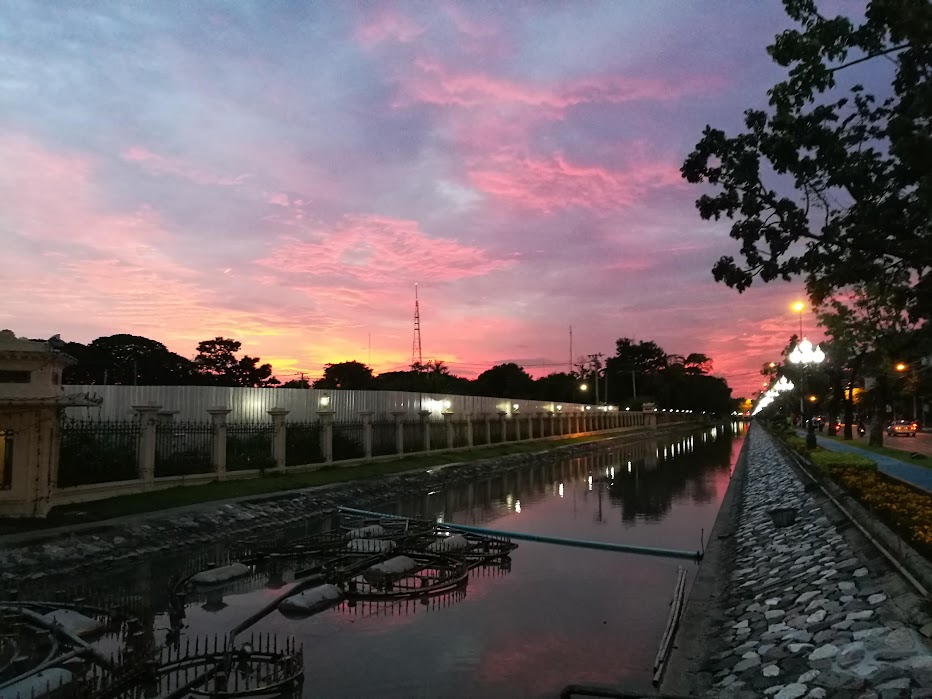
my local running route, a track around the nearby Royal palace


I saw a text content post about how to approach running in heat recently, from a favorite Youtube video channel source, Believe in the Runwith that post here.  

Their advice was all pretty standard stuff, but definitely good advice, about running in clothing that wicks moisture well, wearing light colors, running in the morning or evening to miss the hottest time of day, wetting clothing or a hat (which makes all the difference for desert hiking), and even running in the rain.  Other points were perhaps less practical but still worth considering, like trying to run in the shade.  There's a sidewalk beside the running or biking track where I run and I do switch over sometimes if one part is better shaded, which varies based on direction of the sun.


that sidewalk under repair (left) has been mostly completed since


I've written status updates about my training, last about running longer distances in Honolulu a couple of months ago, bumping my local route from 7 km to 12.  Heat wasn't much of an issue there; it could get up to 88 F or so (31 C), but with generally lower humidity and an ever-present breeze even running in the mid-day sun felt fine.


From running in Bangkok I had some ideas to add to that Believe in the Run content I mentioned, commented there as follows:


I've been running in Bangkok, as hot and humid as anywhere, and a couple of extra points come to mind. You need to stay on top of electrolyte replacement, not just after a run, but as a supplement routine based on estimated extra demand. Heat can be treated as another conditioned tolerance, like running at altitude, so adding exposure to the hottest times can help, just in moderation, building up. Easing pace helps, but you condition to an amount of exposure, with distance and time going together. 

There's one unique feel to learn to recognize, the early stage of heat stroke. It's not unlike normal fatigue but not the same. Your energy level might not drop that much, and breathing speed up a little, but beyond those you can feel when it's enough. Running relaxed helps tolerance.


From seeing videos about this topic recently (it's the peak of the Northern latitudes summer) I've been considering the subject, which really hit home moving from Honolulu to Bangkok again a bit over a month ago.  For the first two weeks I was just re-acclimating to the heat, conditioning to be able to run here again, building up tolerance and distance.  To some extent that's ongoing; lots of days I'll quit after 4 miles (6 km), instead of running the usual 6+ miles / 10 km, if I'm out in mid-day and the heat is getting to me.

Of course for people tracking heart rate--which I don't do, even though that makes sense--there's a decent chance that heat stress would spike that, so it would be easy to see when the effect is kicking in.  I still think it would be best to monitor internal feel, since how you react to heat stress as an input seems to vary a good bit outing to outing.  Heart rate monitoring alone might not protect you, and noticing impact in other ways could help.

When I was younger I would hike in the desert in Utah on vacation when it would get up to 115 F (46 C); the rules and effect is different during hiking, when it's much easier to moderate intensity.  You could carry large bottles or jugs of water frozen, to drink cold water, and to carry a cool pack, I just didn't because I was camping on those outings, of course without bringing a freezer.  That Believe in the Run article mentioned that trick, that you can bring ice, and it can cool you through body contact through a pocket.

It's a lot more of a balancing act when running than when hiking.  Intuitively running slower would help, but it only helps so much, and you have to be acclimated for that to work in Bangkok heat and humidity.  It's a relatively cool and cloudy day outside now and it's 90 F, for example, 32 C, and if it happened to be sunny it would've been more like 35 C in mid-afternoon, on towards upper 90s.  Checking the next day it's now 86 F at 9 AM (30 C), with the daytime low above the 25 C (78 F) version of room temperature here, even though it's the rainy season, not hot out by local standards.


it is nice running that route at sunset, when it works out like that


my old Diamondhead loop (Honolulu) route at sunset; a bit nicer


I run when it fits my schedule, versus a cool time of the day, and it's odd how often that's at noon, on a lunch break.  I'm not a morning person so before work is out, and I can't run right after eating, so evening time gets limited by dinner plans.  When you have kids your schedule just isn't your own to dictate, period, and what everyone else is doing factors in.


So what else did I miss in that comment?  It's a bit of a false parallel comparing heat training to altitude conditioning, even though in part that works.  Extra red blood cells aren't going to help you, and there's a limit to your body acclimating to operate at a higher internal temperature.  "Running relaxed" is a funny subject theme, one I was just considering out on my last run.  You can shift how your body reacts to the experience with practice, slowing breathing pace and reducing internal tension, even without cutting pace.  

There wasn't that much "how to" in those comments.  It would help to not run "out and back" routes when time or distance exposure issues aren't clearly determined; it would seem odd to run half of an 8 mile route here and end up taking a taxi back.  I run two versions of local repeating long loops so it doesn't come up, here.

Replacing electrolytes becomes critical when it's hot; there's a lot more about levels and approach to get to.  That's familiar ground from dabbling in fasting over the past year, and something that I've just seen an interesting reference for in a Reddit running group post, here:


...some people have done some research to see what electrolytes the average person loses in sweat.  SaltStick claims:

"The average persons sweats a salt ratio of 220 Sodium to 63 Potassium to 16 Calcium to 8 Magnesium."

That's a ratio of:

Magnesium: 1x; Calcium: 2x; Potassium: 7.875x; Sodium: 27.5x


That goes on to compare a large number of electrolyte supplements, and I suppose many drink versions, based on those forms of replacement being universally accepted in running circles.  A Reddit fasting sub reference takes a different approach, and explains daily requirements and varying approaches for using other mineral replacement forms, for example using potassium based salt substitute mixed with water.  In fasting circles people focus only on replacing sodium, potassium, and magnesium, generally, but a friend once mentioned that calcium level falling out of balance with those others could be a problem.

To me it makes more sense to try to guess about extra demand and add that back into your diet gradually, day to day, than to try to immediately replace an estimate of exactly what a long run just expended.  I take magnesium and calcium as supplement pills, and use a potassium based salt replacement, at times drinking that and salt mixed into water, after longer outings.  Using that approach your electrolyte levels can stay a bit high, beyond that periodic dip, but as long as you drink plenty of water overshooting intake wouldn't be a problem, because your kidneys could keep removing the excess.  Staying very hydrated is critical anyway; I try to gradually restore water balance over each day as well, versus drinking a lot just before or during a run.  I do try to consider when I'm going to run and drink half a liter or so of extra water a half an hour before an outing, just to be on the safe side.  

Even though I'm often running 10 km (6 miles) in extreme heat and humidity I don't drink water while out; I hydrate before going out and drink immediately after.  That's about as far as I think that approach would work, under those conditions; for quite long runs drinking water while running would be necessary, and adding electrolyte supplements.  Per following running social media content, like that Youtube channel, lots of runners tend to love adding extra products and gear to their routines, varying drinks and energy gels, or more recently a "legionnaire's hat" for extra shade around your neck.  I'm definitely in the other group, not buying or collecting any extra stuff or using much for supplements.  I've developed a running shoe habit; that's about it.


another favorite running channel, Kofuzi's


missing my new addition and favorite pair; this includes my son and daughter's shoes


my favorite shoes, ACIS Novablast 3, but I really like the New Balance 1080 too


One important part of adapting to running in the heat is liking it.  If you absolutely hate the experience it would be natural to avoid it, and it all would never click.  Relaxing would be harder.  In discussing heat acclimation, in travel or expat threads, I often mention that a big part of adapting to heat, in general, is to keep experiencing it.  Living out all of your daily routine in cold air conditioning will then relate to struggling with the change when you go outside.  Going for a walk is perfect light contact, or working outside, or just being exposed to indoor natural temperatures.  It's crazy to me how so many of the aspects of daily life that we've dropped out seem relatively ideal for maintaining good body mobility, activities like hanging out laundry to dry.

It can help to reset AC temps higher, which would also save on a utility bill, setting that to 26 to 28 C here instead of 22 (closer to 80 than 70 F).  For many that would defeat the purpose; my wife (who is Thai) would much rather sleep at 22 C than 26 (closer to 70 than 80 F), and for her limiting cooling to 25 already is a compromise.


How would someone develop a love for being really hot, which is almost objectively a negative state of being?  I don't see it as so different than adjusting to the experience of running, which doesn't come naturally to most people.  You can walk first, then run slowly, and later even higher levels of exertion become pleasant, on some level, and then you crave it (in general, or maybe even when it's hot).  No one craves running in the mid 30s C / mid 90s F, in high humidity, when the early phase of heat stroke experience enters in before long, but it can normalize as an internal experience, more than it might seem possible.  

Just as that higher degree of exertion, just the running, feels unpleasant without acclimation if you never experience heat exposure in any positive context of course it's going to seem bad.  Outdoor childhood play can lead to acclimation early on, but it would be harder to identify with later on.  For the longest time my Thai family was happy that I didn't die on runs out on hot afternoons; it's also a cultural convention here in Bangkok that you should avoid the heat.  Only in a few cases did I experience hitting a wall on runs, experiencing part of what they were concerned about, significant physical distress.


where we live in Honolulu, from Diamondhead; lots of nice running routes