Wednesday, July 17, 2019

Kokang 2018 Myanmar sheng; meeting the producer


I just met some of the staff from the Kokang Myanmar based producer at an expo (sales convention) this past weekend, and tried their 2006 sheng earlier that day; it will be a good time to keep going and review a younger version.  The first half of this post is a review, with the second covering ideas they shared there at the event.

Paging around their website and Facebook page doesn't turn up a lot beside some direct contacts, general background, and shared images, with this inner tea label filling in details along those lines:


Sounds good.  I generally take specific tea-tree age claims with a grain of salt, and they practiced some restraint in not even going there in this label.  There are really old tea trees throughout Yunnan (of course), Myanmar, and Northern Thailand, Laos, and Vietnam, so to some extent whatever age range people cite as a source-plant age could be partially justified.  It's probably also true that growers aren't out there in the forests scattering chemical fertilizers and spraying pesticides, that the vegetation in those environments has reached its own natural balance long ago.

Technically this isn't pu'er since that tea-type name is registered as restricted to Yunnan, but then this part of Myanmar was a part of China at one point before that restriction was ever in effect.  Locally it must have a different name in their local language.  As I take naming conventions it still is sheng, because the Chinese didn't register the modifier of it being "raw," as far as I know.

Full disclosure:  they did provide these teas for review (many thanks!).  I was going to buy some too, given the pleasant tasting experience and very fair pricing, which I'll skip citing here since it may have related to a promotional offering at that expo event, only discussing relative quality level and value in general terms at one point.


Review:


The dry leaf scent is sweet, bright, and rich.  In brewing the tea the scent of rinsed leaves is very sweet, with a strong honey-like smell.  I'll only pass on some first impressions from the first round (and I guess carried over from trying it two days ago) since it's not where it will be when fully wet.

It's sweet, light, and bright.  Bitterness doesn't develop much so early on but that will kick in.  That honey flavor is pleasant, joined by still non-distinct floral, fruit, and mineral range.  This is mostly floral but a light and dry version of mineral stands out already.  Even for being a bit light the feel structure is nice and aftertaste lingers, both so intense the tea experience doesn't diminish after you swallow.


This second round was brewed for a relatively short time, under 10 seconds, and it's still a bit intense.  Until the infusions lose intensity a half dozen rounds in, or later, using a 5 second time would work better.  It's not overbrewed in the sense of being unpleasant, or hard to appreciate or evaluate, just stronger than I prefer.

In that 2006 version review I'd mentioned how a mineral aspect reminded me of one in Vietnamese Thai Nguyen teas, a light and dry but relatively intense mineral aspect that seemed to tie to a vegetal range along the line of kale.  That's present in this too.  Sweetness stands out the most, warm like honey, and pronounced floral tone after that, and then next that mineral.  There is bitterness but that level balances reasonably well; it's still moderate.  It helps that I've been drinking an awful lot of sheng for the past year and a half; helping with interpreting a significant level of bitterness as "moderate," and enjoying that in the right balance.

This is probably not that far off the last version Noppadol passed on, which was a very positive tea (and one he gave me a sample of last year was as well).  I tried that first version again in the last two weeks, even though he gave it to me half a year ago now; I tend to drink the teas I don't like as much quickly and then hold onto the ones I do.  Backwards, right?  At some point to get the most out of them I need to share them, since me having the same experience again seems to add less value than someone else experiencing them.

Feel and aftertaste stand out in experiencing this; I've not done that part justice.  It's sweet to begin with, while you are still drinking it, but after you swallow that bitterness crosses over to a pronounced experience of sweetness.  I've largely given up communicating where tea feel-structure impacts your mouth, but this feels full throughout, with a good bit of structure coming across all across the rear of your tongue, mouth, and throat.  The feel isn't as rich, oily, and full but still soft as can occur but it's pleasant, not dry or harsh in any way.

leaves still unfurling; color a bit darker for being in shadow


Brewed quite quickly the balance works really well.  Somehow it's even sweeter; the flavor intensity in this is impressive.  Per splitting that to taste (as experienced by the mouth) and aroma / fragrance (as picked up in the rear nasal passages, as aromatic components) that sweetness is a taste, as the even more limited bitterness is, but the tea is also fragrant.  The floral range is very nice; that may even trail over to a bit of dried sweet fruit, like a light version of dried mango (of course there are lots of species of those).

The only negative might relate to someone not loving that form of mineral, which works for me.  Again it's pronounced, just not as much as the sweetness and floral range, a dry mineral (eg. limestone) trailing into a hint of vegetal range.  For the right green tea lover this tea could be ideal, although the bitterness may not match expectations or ideal preference.  Bitterness level drops a lot in comparison with the rest brewed lightly, so even though the balance in the last round worked ok for me this is much better.  It's a beautiful tea; it's easy to appreciate how good this is, how distinctive, and the quality level these experienced attributes represent.  Just not necessarily for someone at the start of their sheng journey; avoiding bitterness as much as possible early on might work better for many, and this might not be perceived as balancing well related to that.


A bit of a tangent, but it makes me consider how this will age.  It's more than intense enough to not simply fade over a normal span of limited aging, and could surely hold up to a long cycle, but being as approachable as it is may not be the most positive sign.  Then again I think with this degree of flavor intensity, bitterness, and structure it might come out the other side of dozen years of moderately humid storage just fine.  I should try explaining that to my wife, related to picking up a tong.  I already need to go through a tea storage re-configuration just to quiet her threats of either throwing out the tea or me along with it.

There might be a moderate-age sweet-spot this tea goes through on the sooner side.  At one year old it will have lost a little of it's youthful bright character and intensity but also would have swapped out some bitterness and astringency.  It might be really nice within one to two more years as that exchange continues.  Some people do seem to love middle-aged sheng, drinking versions between 3 and 8 years along, which makes less sense to others.  It would depend on the tea, and the storage.


Next round more of the same; I don't remember this transitioning all that much in that expo tasting session.  The flavor of the honey seems slightly more pronounced; the profile has warmed a little.  That kale-range vegetable, which always was a minor aspect compared to the rest, seems to be transitioning to hardwood, a more typical profile.  Mineral might be easing up a little, letting the honey and floral really take over. 

That honey-like warm sweetness and rich, mild, but still-fragrant floral scent overlaps a little with Ya Shi (duck shit) Dan Cong character, just framed in a completely different context.  For a Dan Cong oolong lover this bitterness may well be way too much, and the level of mineral unfamiliar, or at least unpleasant.  For someone who loves a broad range of teas for different reasons--how I see my own case--both could be great.  I'm not saying this is the Ya Shi of sheng, that overall place and character map over, only that one set of two different flavor aspects does.

I'd had a tasting-environment complication of kids out here using the trampoline beside my outdoor tasting location but things have went quiet.  It's a nice day, early in the morning, warm but not hot yet; it's hard to appreciate good weather in Bangkok unless a cool edge to the feel triggers it.


trampoline jumping and messing with electronics; not ideal


selfie version, with laundry drying


The next round is more of the same; not such a bad thing.  It's soft enough now that messing around with longer infusion times might work but the intensity is still definitely there brewed light.  I love the character of this tea but brewing transitions also relate to not drinking exactly the same thing 10 rounds in a row, experiencing that extra dimension.  That trade-out within the next year or two of aging might compensate for that, adding some other range that could evolve throughout an infusion cycle, along with trading out a lot of what is already present.  This tea definitely has sweetness and floral intensity to spare.


Wood tone picks up a little brewing it slightly longer next round.  It's still pleasant, still not completely different than it had been, but this seems to be the early part of it fading.  People who throw in the towel after the character changes to be slightly less positive might call it quits here; for others who would rather experience more a tea can offer could keep going for awhile.  To me it's still very nice; the overall balance is good.


All in all a very nice tea.  It can't be judged related to the price they were asking at a wholesale oriented sales expo but for value related to that factor it's an incredible tea.  This may not be on the same level as $1 / gram Yunnan gushu versions, related to sought-after character aspects unique to limited areas, but it shares some of the same scope for what it is, definitely at least an upper middle-level quality sheng version.  What I mean by that isn't that it's above average as factory sheng goes, an above average version of the entire category range beyond that instead.  Of course personal preference related to aspects and demand for tea related to location shift things, across a broad scope of how good it is and where a fair market price would be.

beautiful fully opened brewed leaves


2006 version.  much more broken, but almost the same color!


I'm tempted to compare it to that 2006 version, to say which I liked better.  At this point it's a bit of a toss-up because they're just so different in style, positive in completely different ways.  I think in 2 to 3 years that older version will be really nice, properly through it's fermentation transitions, or at least enough to bring that potential across, after steaming in Bangkok heat for that time.  This 2018 version doesn't necessarily need bitterness or astringency to drop out to be approachable but it may be just as pleasant in a different way at that time, and may also have good long-term potential, just based on starting in a different place (probably).

I like both, but the other is more interesting for being unique, and this version better for seeming a higher quality tea version, ticking more boxes related to how young sheng should be.  For whatever personal preference reasons I'm most drawn to sheng versions inclined towards fruit range, so this doesn't match my own best-case profile, but for the character range it covers it's quite nice.

Related to value, the price I bought the 2006 version for and what this 2018 cake were selling for were both amazing.  It often comes up trying to place if teas selling for $60-$80 per standard size cake amount (357 grams) really justify that upper-medium range of pricing, with a jump from there straight to $1 a gram for those presented as gushu.  Both of these were priced nowhere near that middle-range level but they hold their own for positive character.  From there supply and demand kick in though; putting "Yiwu gushu" on a cake links it to established high demand, especially if the source reliability implies that it really is that.


nice representatives (the one not wearing a badge was fellow visitor)


At the expo:


I can pass on some of what I remember the Kokang representatives mentioning at that expo, but of course I didn't use a recorder or take notes, so some of that recollection could be a bit off.


How old are the tea trees?

As good a place as any to start.  Of course they cited lots of different ages; some 200-300 years old, some younger or older.  It's my understanding that tea plants came to countries like Myanmar, Northern Thailand, Laos, and Vietnam a very long time ago, and tea-tree age estimation is imprecise, so no one would really know for sure, short of calling in a biologist.  These teas are from the Shan state, where other versions I've tried from a local vendor friend (Noppadol) has passed some on, of course the region bordering China.  I should've asked about the conflicts there but got side-tracked talking about tea instead.


How long have they been making shu?

Not so long, starting in 2015.  This question occurred to me related to trying a pretty good shu from Myanmar relatively recently, a Tea Side version, and related to trying their 2006 version of Kokang sheng.  The one representative visiting, Maung Lwin, was described by another as a 5th generation tea producer (referenced on their website page), so apparently involved with the production and business ownership as his family has been for a long time. 

I'll review that shu before too long, and did try it there already, so I have a relatively clear impression of it now.  It was good; a bit mild and subtle, but that's not necessarily a bad thing.  It might've been less fermented than some, which makes you wonder if it wouldn't have more potential related to aging and transitioning more over a longer time period.


In reference to why the teas are less smoky now.

The one representative showed pictures of lots of very large woks processing the leaves, all with smoke contained in isolation housings that ventilate the fires' smoke away from the tea, eliminating potential contact with the tea.  It makes sense that some of the flavor in teas (sheng) could be some version of natural smoke flavor (just how the tea happens to taste), but also that contact with smoke during processing and storage would also be a factor.  The idea comes up that it's not difficult to tell the difference between the two, and who knows, maybe with the right exposure that would go well.  I have trouble separating the input distinctions I think I can make from those that are actually reliable.

The effect from smoke contact would probably vary a lot though, depending on the form that contact took, type of wood, etc.  This sheng definitely isn't smoky, which already came up in the review.

they also produce dragonballs (not clearly identifiable in this, on the right)


Can people buy the teas online directly from them?

My impression is that they're just not set up for that, based on their response, and reviewing the website bears that out.  They must sell the tea but seem to not be using a direct retail sales model.  I bought an old version from another vendor (the Chawang Shop, an online outlet in Kunming), and someone mentioned another vendor selling that same tea elsewhere, so it's around.  This might make their teas a perfect opportunity for resale back in the US, since although they're not set up for selling a couple of cakes and samples they must be able to sell larger volumes.  They were at this expo to meet resellers to distribute at wholesale volumes, so now could be the perfect time for that.


Are the teas organic?

We didn't discuss this in the form of them guaranteeing that they are, but we did related to the perceived importance of certifications.  They implied that all the teas are naturally grown, without the use of chemical fertilizers or pesticides, but of course if they are producing a broad range of different products from differently sourced leaf material there seems a chance that inputs could vary.  The label print reminds me of this point (the one I posted an image of earlier):

"...grown in Northeastern Shan State in Myanmar, altitude mountain sea level at around 1800 to 2000 meters, never applied pesticides, chemical fertilizers..."


They specifically mentioned that the black tea they produce is from different plant material from a different area, so it may be that the claims and background don't carry over to those.  The black tea was ok, interesting and pleasant if not as complex as it might be.  It was really pleasant in terms of fragrance, but then a separate review will tell that story better.

I really appreciated the opportunity to meet and talk to them, and experiencing the teas has been a wonderful experience.  I think I'll appreciate the shu and black tea all the more for having a chance to mess around with brewing parameters, since to me if you infuse sheng fast and light at a high proportion that works well, but for those others varying inputs makes a lot of difference.

Tuesday, July 16, 2019

Sharing photos from a Thai local hill-tribe tea producer


I reviewed a tea awhile back shared by Aphiwat Kokhue, a very nice black tea produced outside of Chiang Rai (Thailand).

That post gives a very detailed description of the tea, of course, along with about as much background as I'm familiar with. 

I don't think I mentioned that his ethnicity is Akha, only that he's from a "hill tribe," the local way of saying indigenous.  That designation could mean more to me.  I'll cite another reference page here with background, since it is relevant to telling a story here, almost entirely through pictures forwarded by Aphiwat in what follows:


The Akha, also known to the Thai as the Gaw or the E-gaw (names that the Akha do not like), are located primarily with Chiang Rai and Chiang Mai province. The Akha are closely related with the Hani of Yunnan province, China, the Akha-Hani complex numbers about two to three million people, but with just over 70,000 members in Thai territory. The Akha speak a language in the Lolo/Yi branch of the Tibeto-Burman language group, but have no traditional written language. There are a variety of schemes for writing Akha developed by missionaries or linguists which employ Roman, Thai or Burmese characters, but literacy in Akha is still virtually nil. The Akha are traditionally subsistence farmers, growing a variety of crops including rice and corn.

Though many Akha, especially younger people, profess Christianity, Akha Zang (The Akha Way), a total lifestyle perscribed in the oral literature of the Akhas, still runs deep in the consciousness of older generations. The Akha Way combines animism, ancestor worship and their deep relationship with the land.. For an Akha, the Akha Way is a way of life which extends beyond simple religious practice and infuses every aspect of their existence. The Akha Way emphasizes rituals in everyday life and stresses strong family ties...


Kind of amazing that he reached out to me through Facebook then; the world keeps changing.  As you'll see in the pictures he sent to me they are joining the modern world but not completely leaving behind older forms of practices or lifestyle.  Each photo would benefit from additional explanation, and we didn't get far with doing more of a question based interview-themed post. 

I checked with Aphiwat about which Akha tribe he was from, and he said this:

We are not Archer Arkhar. The real name is Aownye Gaokhue, or Aownyer Kokhue.  But other people call us Archer Arkha.


The group description from that other reference follows:


The Akher Akha moved from China close to Tibet. Firstly they moved to Burma, but the government did nothing to protect them from pirates and so they moved again to Thailand. Arkher Akha is the name given by the other Akha groups because they are so different in ways such as language and clothing. The names they use themselves are Kohkuer or Onjeyor. 

The population is around 650 and they live in Chiangrai at Maesuay. They believe and practice the old traditions but some groups did change and became christian. The language is absolutely different to the other Akha, but when communicating between other Akha groups they use the Uloh language.


Amazing to consider, isn't it, a people moving around as such a small group, between multiple countries, retaining unified traditions, practices, and even language.  This doesn't go into his personal story much, only sharing some images, but it must be an interesting one.

It's interesting that an "indigenous" people might not have long ties to the location they are currently in, related to prior disruption and migration.  The story of his people might include a lot of bad luck with societal level transitions, encountering unique forms of problems in both the Tibet area and Myanmar.  I truly hope it works out well where they are now.  Thais are pretty good about being open to different cultures, religions, and backgrounds.


his village


not exactly contemporary Thai style but seemingly quite comfortable


in Western style clothing with his kids, who are adorable


forest and tea


I'm not sure how the tagging works


That tea I reviewed from them was slightly rustic in style but actually better than a relatively standard Farmerleaf vendor version I bought this year (with that review here).  It's my understanding that they produce teas from very newly planted sources, or maybe those are still growing to be able to support production, and then also from older forest-area sources, which is what that was from, and what these pictures show.

the Farmerleaf / Yunnan version left, Aphiwat's tea right


brewed tea and leaf comparison of those two; both were nice


It's not the whole story yet; he shared some pictures and I'm sharing them as well.  If I can I'll work through language concerns and add more to it but even without that it's a glimpse into a local side of Thai experience that doesn't often come up.

I really should be helping him sell tea; I keep thinking that as I come in contact with sources and versions that just aren't out there on the market.  It's not what I do but it could be, later on.  People reading this who visit Chiang Rai might look him up and check out that part of local culture, and could pick up some really nice, novel versions of local tea.

Monday, July 15, 2019

2006 Kokang Myanmar Mei Hua sheng pu'er


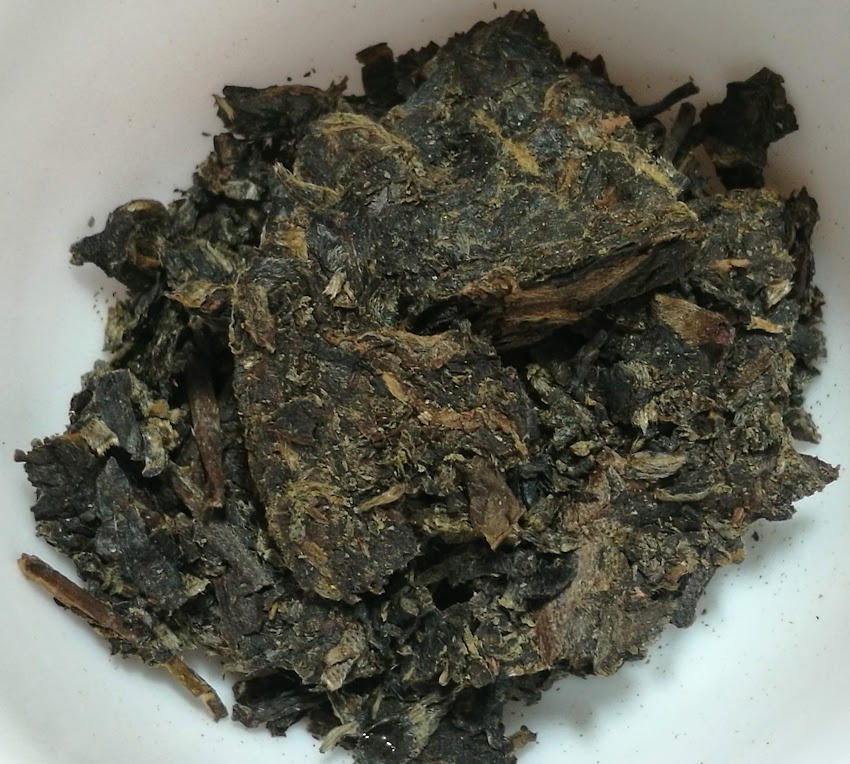
I think the texture looks odd because it had to be ripped apart


I'm reviewing an aged Myanmar sheng; very interesting.

I looked up details of what this is on the order image capture; it's the third one down, from a list of the latest teas I bought from Chawang Shop two or three months ago:


As chance has it I just heard about this same Myanmar tea producer visiting for an expo here (sales convention), but it's the last day, and I already have plans.  We'll see how that goes, if I can change them [I did; it's brutal how far out there that event hall is but it was great meeting them].

That 2012 Daxueshan version stands out as one of the more interesting teas on that list, which I didn't try yet, and the 2008 Yiwu brick.  I'm not necessarily trying them in any order, just what seems natural next, or comes to mind.

This tea may well need a bit more age, in spite of being 13 years old now.  Myanmay sheng tends to be on the bitter side and that's the one comment that stands out related to Kokang produced teas (but the next parts of that story become clearer after meeting that producer and trying a 2018 version, which I just made review notes for).  This is a very compressed cake; that probably slowed the fermentation process, it experiencing limited air contact.


I'll start with a vendor description first:

This little cake come from border area with Myanmar from Kokang (果敢; pinyin: Guǒgǎn), area about 20km outside from China. Kokang county was part of China for long time and is famous for ancient tea gardens. Nowadays the is tea from this area sell to Chinese market as most border teas,

Stored since 2006 in Kokang and this year (2015) sold to Kunming tea seller. This cake will surprise you with the quality and taste. Nice floral aroma, full body and thick,floral sweet with fast huigan. 

This tea is powerful and give many nice infusions !


That's promising that it didn't spend all those years in Kunming; that has to be a good bit drier, and would've caused it to age slower.

It's odd not developing meeting the producer further here, at that expo.  They were really nice.  I probably should split out talking about that to more of a vendor profile post since these reviews run so long as it is.  They discussed their teas and their history for a half an hour, so it really could add up to a good bit of information.


the guy beside me is a 5th generation tea maker, or something along that line


Since the aging and compression issues come up throughout this tasting I'll add a picture from the vendor (Chawang Shop) from 2015 here for comparison:


It was actually still a bit green then, as a 9 year old stored sheng.  That color has darkened in the 4 years since but it was still aging slowly.


Review:


The first infusion is more pleasant than I expected; a bit smoky, with some bitterness still evident.  It's not really fully saturated, so it will take a couple more rounds for a more informed early take.  It has some warmth and sweetness, along with a good bit of mineral, so complex and distinctive that it's covering normal light rock range along with some metal.


The next infusion I went a bit long on, maybe just over 15 seconds, trying to strike a balance between overbrewing what is already wet and getting the rest to open.  I used two rinses with this to remove more of the tea dust, and I've broken form and am filtering the tea, but some dust still gets through.  It's hard separating out really compressed tea.  That could potentially throw off the brewing a little; being more careful to not include it initially might've helped.  Someone once mentioned their practice of setting aside finer dust and ground bits into a separate jar when sorting sheng, mixing the inputs, then drinking that prepared differently; an interesting idea.

This does seem like it's still in the middle of aging.  It's ok as it is, with some warmth and sweetness, somewhat approachable, with what must have been really intense original bitterness leveled off.


On this second round the first flavors list still stands, quite a bit of mineral, that warmth and sweetness, moderate bitterness.  Some extra thoughts on interpreting those:  warmth and earthiness might be towards tobacco (cigar or pipe; I'll refine that further), mineral has backed off metal a little already but the light rock is still strong, and smoke level is moderate.  It's definitely complex; there are surely other layers I'm not getting to yet.  The only issue seems to be that it hasn't made it to a fully aged character yet, that it seems to have some years to go for that.


Tobacco ramped way up on the next infusion; that's closer to cigar for sure.  The sweetness and complexity along those lines probably also relates to dried fruit, but the earthiness is blocking picking it up as clearly.  Switching over to shorter, lighter infusions should help with that.  Smoke might be fading a bit.  This bitterness level is moderate enough that it works, so seeing this as not quite ready doesn't relate to seeing that as overpowering.  It just seems like that sweetness could develop a bit, and the softer flavor range.  Describing it at a more optimum infusion strength (when now finally fully saturated) will help place that.


A five second infusion is better, more than intense enough; this would work doing flash infusions.  A flavor aspect similar to those Tulin tuochas I'd been drinking is present (reviewed here, along with a nice Xiaguan FT iron cake), a musty old wooden furniture range, which isn't as bad as it sounds.  Sweetness and bitterness levels are ok, and the feel isn't bad.  It has a good thickness to it, and overall intensity, and the aftertaste definitely packs a punch; it's quite intense along with the initial taste flavors coming across as such.  Astringency isn't problematic but the feel could still smooth out a bit more.  Tobacco range still takes over the main flavor, with that old furniture filling in, but beyond all that I think the sweetness does tie to a dried fruit, maybe date.

There's a lot going on with this experience, flavor-wise; it would be open to varying interpretations.  Seeing that tobacco as a wood tone might make sense, and others might not see the smoke as essentially completely faded at this point as I do, since a trace is still present.  It's relatively clean in effect; that musty old furniture edge is quite limited, and to an extent I like that, in proper proportion with the rest.  Feel and aftertaste are interesting in addition to the complex flavor.


Sweetness bumps again in the next round; the balance is even nicer.  I'm experiencing smoke as slightly heavier again; I'm not sure why that would keep varying.  With this tasting mostly like tobacco with a little smoke I guess this could work for smokers, or for people who always like the idea of cigars but could never get the experience to work out.  Of course I've smoked cigars before but I missed the part where it seemed like such a pleasant experience that I wanted to keep trying it.  On the subject of alternate flavor interpretations a bit of peat seems to come across too, filling in the part a Scotch-drinking cigar smoker might look for.  I like it, but I could relate to this not clicking for lots of people, including some aged sheng drinkers.


One nice aspect is that it keeps shifting a little each round, the balance of all those flavors.  The feel stays pretty thick and substantial, and the aftertaste hits hard, with the latter changing to some extent with the taste as experienced during drinking it.  The dried fruit part doesn't stand out more than the tobacco / smoke / peat but that sweetness and flavor seems to lend the rest a nice balance.  The aged furniture effect (think old mahogany with a touch of aromatic furniture polish oil) is nice for adding another trace of depth; also better for being so secondary.

I get the sense that this could brew relatively endless infusions using these fast rounds, at this relatively high tea proportion (normal for me, but still high).  It might make sense to brew this in one of those comically small clay pots, a 50-60 ml version that might produce half that or less in brewed liquid; 15 rounds of that would probably be enough tea, with a couple extra after for good measure.


It still changes a little round to round, now something like 8 infusions in, but this seems to tell the story of this tea already.  It's fine to drink right now; it doesn't need more aging in the sense that it's not ready.  I just get the sense that further transition could be positive, that some of that early bitterness and smoke throughout rounds could swap out for more complexity in other forms.  Buying two of these tiny cakes related to that expectation, that it might be interesting later on, and one wouldn't allow for trying it across long periods of time, that I could sample it once a year until it's much improved later on but then wouldn't have much left.

For people who know they are on this page already (from Xiaguan tuocha experience or the like) buying a 5 cake tong would make lots more sense; 5 of these times the $8 cost is still less than aged cakes of any kind.  A half a kilo is a good amount for moving past just trying it now and then, into actually drinking some.  For the right person, centered on that page for preference, buying only a half a kilo might have them kicking themselves a half dozen years later once this tea really hits its form.


so green for a 13 year old sheng version


Comparing different takes on the same tea version


A little more on alternative interpretations might be of interest, a subject I've been venturing into related to reading Steepster reviews.  That vendor description mostly described it as floral, and a vendor-site review comment said this:


The taste is powerful, still bitter and a little bit tart. Smoked prunes, raisins, dried fruits. Aroma is very sweet and pleasant.


Floral I kind of didn't get, but this tea might have changed character a good bit over the past 4 years (or I could've just missed it).  That attribution could work to fill in a lot of the sweeter-range complexity I was having trouble placing only as a fruit input, it just seemed non-distinct to me beyond all the rest.  Floral could even span some range; it could relate to warm, rich floral tone like rose and then also lighter, sweeter, brighter range like plumeria or lotus flower.  I routinely say I'm not familiar with flower smells but I do pick up a plumeria flower walking home once in awhile and smell it while I walk, to give to Kalani at home, and she and I checked the smell of lotus flowers about a week ago in a temple visit.  They're sweet, not completely unlike plumeria, just in a different range.


I like the description of this tea as powerful in the one take; some version of expressing that is necessary to describe it.  It may include some tartness (it does more when you think of it), and smoke and dried fruit works, but it's more centered on tobacco across a lot of infusion range, to me.

It is on Steepster; two reviews there were interesting, one for including comments from two people I've talked to about teas a reasonable amount.  The first review is also interesting for citing a blog review that relies mostly on a flavor-profile chart, the type the Gastrograph app outputs, also related to the work Teapasar was doing on profile charting, both described in this post.

That German-blog linked reference text is simple enough:  Strong astringent and floral.


The second review is by Jay in Hong Kong (JayinHK there, also listing his Tealife.hk vending business):

This tea needs a lot more time to get to where it needs to go—lots of smoke. The material is promising. Lots of chopped leaf, but good flavor and aroma and strength, which I like. This is the kind of tea I like to age, but the extremely high compression mean I probably won’t want to drink this for another ten years, even with Hong Kong storage. When it IS ready, though, I expect it to be incredible!


It's been three years now since that post, so things might have changed a little, but I'd expect he would say the same type of things at this point.  It's probably more drinkable, and it seems smoke has probably faded quite a bit, but not there yet.  It's interesting how green this leaf is; you don't even need to taste it to get some impression that it's aging slowly, surely related to that tight compression.


I'll be back in touch about the much newer versions of sheng and shu I have from the expo meeting, and with more vendor background related to what the Kokang staff said there.  I just finished writing review notes for the 2018 sheng (the short version:  it's very nice!), so it's odd not including that, but this ran long enough already.