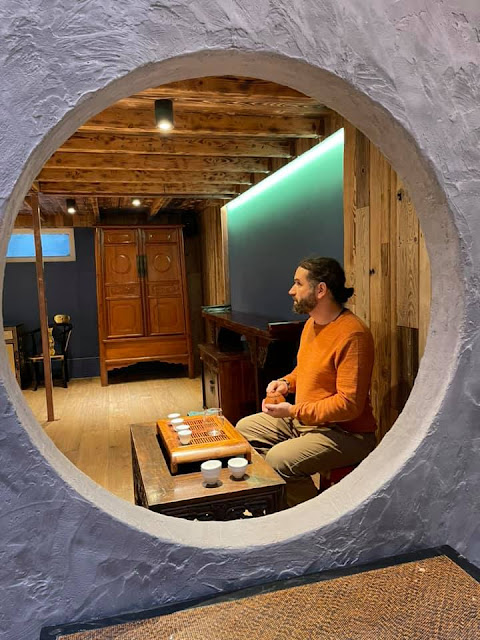
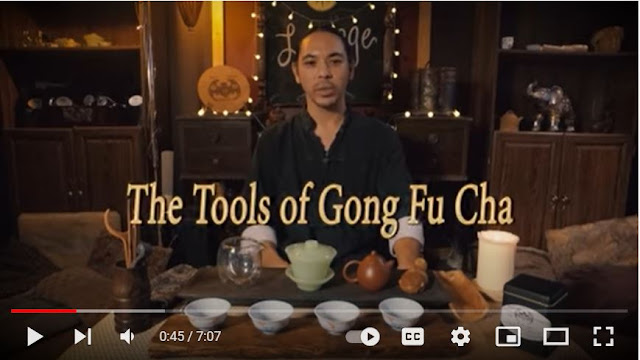
I just caught an earlier discussion between So Han Fan and Riu Liu on this subject, which was quite interesting. It wasn't what I expected; much more developed and refined, and very insightful, just great really. One would expect this kind of discussion to never move far off saying that white people new to tea aren't well-trained enough or "Chinese enough" to have a developed opinion worth listening to about Chinese cultural aspects, and that was part of it, but it kept going from there, uncovering layers of how all that really maps out.
I won't be able to summarize everything they said; it covered too much ground. People should watch that instead of reading this, if it came down to choosing; just put it on 1.25 speed if nearly two hours seems like too much, and listen to it while you're doing something else.
As far as further commentary here goes let's take it bit by bit, point by point, without ever trying to tackle the grand scope in one go.
white people new to tea aren't well enough informed or Chinese enough to have a developed opinion worth listening to: this was never expressed or addressed directly, at least in clear detail related to fully unpacking this, but it definitely was a sub-theme that factored in early on. Both speakers, So Han and Riu, touched on examples of how this really did manifest in real life problems they've experienced personally, and that worked, probably better than a regressive development of ideas, exploring layer after layer of context and assumptions.
In some of those cases people really did cross over from appreciating Chinese culture (positively engaging with it), exploring it, into taking it on as their own, and using it for personal gain and profit, while promoting overly summarized and partly incorrect ideas. Without clear examples the nuances of what really happened wouldn't have shown through, and how complex inputs come together.
To back up quite a bit, this already assumes that there is a traditional, unified, accepted, authority based, accurate version of traditional Chinese culture, or strands of that, sets of ideas and practices. Does this work? Yes and no, probably. But then it would really take the nearly two hours to develop only this point. It's something I've been considering a lot for many years, in the most recent form repeatedly discussing this with a friend who is exploring Chinese tea culture as a research anthropologist, in China, Taiwan, and the US, with only early research and summary academic publication related to China completed. That anthropologist friend looks for "schools," training organizations, or "masters," and for looking for that kind of thing he is able to find it. So Han and Riu both explicitly covered how it doesn't occur in the form one might expect, as a Westerner, related to exactly that context, which I'll get back to.
So where does this leave us, setting this aside, if we can't fully unpack this dimension? It's a little awkward, because it's not clear how we can specify the contrast with a Chinese person who is a part of an original culture, who can speak for that perspective, without clarifying to what extent a unified historical culture even exists.
Different levels and factors enter in, related to the second part about someone being a suitable representative, brought up by both speakers: someone being racially Chinese, part of a Chinese culture (foreign or in China, which is different), speaking Chinese languages, exposed to a strand of the tradition ("study under a master" and such), with background engaging with tea producers, vending experience (both a pro and a con, as I see it), and so on.
Indirectly So Han ends up justifying his position as "Chinese enough" based on family history, race related genetics, language proficiency, visits to China, and contact with producers. That's Chinese enough, probably, but someone else could try to move the goalposts and demand exposure to some other background or training of some sort, or claim that the sourcing exposure was actually very limited. Let's set that aside.
tea producers as a reference: one of So Han's examples is clear and easy to consider, about producers identifying types of tea, with this serving as a more distinct and accurate identifier of type than Western oriented categories. This gets a little odd; he was saying that a partially oxidized green tea was identified as a green tea by the producer, so it is that, even if Westerners see it as some sort of exception, or not in that category. It's hard to say if that authority justification would work in every case, but there's something to it. Then Riu started in on saying that organization of categories and use of concepts might be slightly different within different cultures, which they both developed further, and I'd like to add more on here.
A friend who produces oolong in China once almost apologetically offered that they don't really use the category of oolong (/ wulong) there, and just call tea versions by the name of what they are, per individual plant type input. The same kind of divide has came up related to saying whether sheng pu'er is a version of hei cha. A driver for it needing to either be that, or to not be, relates to the familiar initiative for Westerners to put every tea into one of a limited set of main categories (green, black (/ red), oolong, white, hei cha, yellow).
Per seemingly good input from people familiar with local Chinese perspective sheng pu'er is just sheng pu'er, and hei cha is something else, and they don't need to force that complete division into main groups to work out. Surely some people in China would want the groups to stick, and they would have their own opinion, but in general it may well just not be a typical Chinese project. Other examples So Han and Riu covered reinforced that.
Buddhists and Taoists have lineages, but not tea cultures: a great point by So Han. I'm not sure this is right, since the "master" and "schools" themes come up in China and Taiwan too, but I agree with and love the point he's making, that tea culture is a living, diverse, locally oriented theme in China instead, not at all unified and codified as religions are. This single point I keep returning to in discussion with that anthropologist friend, how it may not be valid for some people in China to try to fix, package, and essentially sell one version of Chinese tea culture, regardless of what credentials they can collect together or justify. Riu mentioned her own experience studying under a "master" (I don't love that term, but it must apply in some cases). I can't do justice to summarizing that, and would make it less accurate by trying to, so people should check it out there instead (around 53:30, with So Han introducing the set of ideas there first).
To be clear I'm not the right person to try and place those claims of people being masters, with lineages, tied to training classes and certifications, etc., in both China and Taiwan. Even relatively unified or standard approaches to ceremonial Gong Fu Cha brewing I'm just not familiar with. Oddly a main stepping stone in exploring tea was a ceremonial brewing demonstration, held at a Huawei product display site on a visit to Shenzhen a decade ago for an IT project, so it's not as if I've never seen any versions of it.

Was that an example of cultural exploitation on their part? I don't see it that way, but an argument could be made for that, depending on what was presented there, and how it was framed.
how does all this relate to Buddhism scope?: it's a bit of a tangent but I did study Buddhism for quite awhile, on my own and in academic scope, and was ordained as a Thai Buddhist monk at one point (only for a bit over two months, which is normal in their tradition), and have lived in a Thai Buddhist family for the last 15 years. So how do these parallel themes overlap or differ; would it be ok for a Westerner to have the same kind of exposure that I've had, or a few years' worth instead of 30, and to position themselves as some sort of teacher, or cultural authority? Of course not. Even if a respected member of that tradition officially sanctioned it that would still seem sketchy, especially if it was for-profit.
To be clear it's fine to comment on Buddhist themes in online discussions, for anyone, even with very limited exposure. There's no reason why someone couldn't answer Quora questions, comment on Buddhism group threads, write a blog, or post videos to Youtube. It would be best if they clarified their level and type of exposure, but that's up to them. Selling anything drawing on their own authority in relation to Buddhism, or promoting themselves as a teacher or representative, even without a commercial angle, would be a step too far. Wearing robes and such would be context dependent, if that would make sense or not, but in general a little would go a long way in terms of adding on such trappings. It would be as well to not do that, but of course anyone can if they want to.
It's not as if there is a fixed timing or exposure level after which changing a role would make sense, but anyone participating for a few years in such a tradition and then making it their own, taking on the role of teacher and passing on adjusted ideas, would seem to be acting in bad faith, or at least poor judgement. Tea vendors just selling tea don't parallel this context concern at all, but a little goes a long way related to re-packaging Gong Fu ceremonial or aesthetic practices. If that kind of thing is offered as something they've taken up as a derived and adjusted individual practice, versus a direct continuation of an older tradition, that changes things a little. Training certificates make for a strange scope; I'll stop short of getting into that part.
why do Westerners need to apply the Chinese cultural context framework?: this is more a tangent here than coverage or response to what they said, my thoughts on how this tends to go. It seems like people don't need for their tea experience to follow a traditional Chinese form, right, they could just drink tea? A couple of natural exceptions to that come to mind.
Plenty of Western tea enthusiasts love both the experience of drinking tea, the taste, getting brewing right, learning types, etc., and also the formal, ceremonial, and aesthetic forms and aspects. I don't see anything wrong with that. Collecting teaware is fine, or setting up a room in a Chinese decoration theme, adopting a formal way of brewing drawn from some external source, even going further and investigating Taoism, and so on. Once someone starts wearing traditional Chinese clothing it all gets a little strange, because why, and what imagery is being borrowed? Then it's hard to say where a natural dividing line should occur. It's subjective.
 |
my friend Huyen's family appreciates traditional aesthetic range without making it strange |
 |
at least the goggles go a step beyond more original scope (credit Wikipedia Gong Fu cha page) |
Still I have no problem with that, people adopting and adjusting foreign cultural traditions, but what if the person taking this up is a tea vendor? Now we're on to that all being a marketing angle, which somehow seems worse.
Two lines of concerns come up: is that even ok for someone with limited exposure to these themes, and how would there ever be a line drawn as to when it's ok? What if So Han was American born Chinese but he didn't speak the language, and hadn't visited China, and learned from text sources and discussions instead? It's hard to say how that would be different. Someone could visit China dozens of times and still not have relevant additional cultural input, even though that would tend to come up if they were interested. Lots of people visit China once or twice and take up a mantle of being an expert, and I've been to China three times, and Hong Kong and Taiwan as many more, and I had limited exposure to tea themes. Visiting producers changes things, but only a little. Short visits are tourism, even if someone brings back some tea they bought from a producer.
It's hard to place how it would all be different if So Han was white, if his genetics were different. Is it really more "his" for being Chinese? In one sense yes, but in another maybe not. If he grew up as a third generation Chinese American with almost no contact with that aspect of Chinese culture it would only be "his" in a very limited sense. If someone else, who is white, somehow entered into close contact with a Chinese family or local culture over an extended time, along with a tea tradition, the genetics would seem to drop out as a most relevant factor.
A European tea vendor friend commented that he is in the no-win situation of cultural borrowing being expected of him, that if he hosts tastings with absolutely no reference to Gong Fu cha background it would be seen as problematic, as not fulfilling expectations. Then no matter what he learns and incorporates of course it can't apply as a universal, valid, appropriate inclusion from Chinese culture, which is a very diverse thing on its own. So what should he do? Probably intention and framing is important, to address why he is including some components, what background he is drawing on, and what kinds of claims he isn't trying to make. Then of course you can't add a disclaimer to every sentence; that kind of thing could only be an early framing point.
Finer points made in examples in the video: I think this is worth touching on a little, especially since that Reddit discussion went there, without the clear benefit of someone having an informed perspective to review these points made. Let's examine some:
American tea enthusiasts rejecting that shai hong is red (black) tea (a sun-dried variation of Dian Hong, Yunnan black tea): that's crazy; what else would it be?
questioning if green tea can be partially oxidized: this breaks down to how people use categories, and the Western project of making things fit in boxes doesn't map back to China (as So Han explained). For the most part I think if a producer says a tea is green tea then it is, with that broad scope potentially varying more than one might expect. That's a problem with awareness and perspective related to the negative judgment, but to a limited extent people are also just talking past each other. There are many kinds of green tea made in China, in lots of regions, and it's quite reasonable that some of that scope is unfamiliar.
This comes up a lot with sheng (pu'er-like tea) made in Southeast Asian countries either being oxidized a bit much (from a long wither, maybe?), heated too hot, so taking on some green tea characteristics, or seeming unfinished by not being heated enough, taking on an in-between-white character. To me it's still sheng, but a stylistic variation, with aging potential likely impacted, more than there's a concern over any naming or type convention. Call it whatever you want; that doesn't change what it is.
is yellow tea fermented or oxidized?: I don't know, really, maybe both. The person making the comment, interrupting a presentation with a correction, was clearly wrong on that level, so we could almost just stop there. If a green tea stored wet and warm transitioned based on a chemical reaction involving enzymes and an input from oxygen then it oxidized; if bacteria or fungus was involved it fermented (as we commonly used the term; really food science uses two other terms for both these things), and it could be both.
There was a time when an oxidation process was often translated as fermentation instead, and it could less than perfectly clear what role bacteria and fungus are playing in some processing. But again it sort of doesn't matter, and communicating respectfully is more important than taking better and better guesses about such things.
claiming a lot of Chinese tea is at high risk of being contaminated: I think So Han's explanation of why the context and framing of that perspective is absurd is worth considering. Again that's the main point, the form and tone of exchanges, but this kind of claim or belief comes up over and over. I've heard vendors based in China say the same thing (one Chinese and one European, that come to mind). Was that because of awareness of real risks, due more to personal bias, or just marketing?
Here in Thailand my wife buys into this bias a lot more than I do because of isolated cases, like people in China once putting melamine (plastic powder) in powdered milk, to increase protein test level results. The way that played out in the example So Han shared was clearly way out of line, but it's not really only racism that fuels that concern, even though it is mostly that.
On my first visit to China our local guide went on and on about how many foods are at risk of such problems, and he explained that a whole egg can be "faked," re-created from other ingredients. I'm not so sure about that, but it's an interesting thought. The tricky part about interpreting such comments is that it can become a joke to Chinese people to play up the absurdity of the more extreme rumors, so all that part could've definitely been a put-on. Or urban rumors and myths enter in. Then people drinking powdered plastic in powdered milk was real, and not necessarily only isolated instances, so the worst cases are definitely bad enough.
what about appropriation being an example of appreciation?: this seemed to be covered from lots of different angles in the video, on different levels. People taking up foreign culture based practices are fine, but communicating their own expertise and authority, and utilizing these for their own personal gain, is all typically a step too far. Even if a good review and sorting process could extract a dozen or two individual aspects of the broad Chinese tea cultural landscape patching those together to serve as a functional "school" of sorts doesn't really work.
Setting aside vendors taking things a bit far atypical personal practices can seem a bit absurd, viewed in one way. Lots of people wear natural fiber robes to drink tea out of beautiful hand-made teaware. Per one take this is functionally ceremonial (it supports relaxation and meditation functions), and also aesthetically pleasing, or it could just seem odd to someone else, or related to a subculture that might be overly dependent on borrowing aspects from other cultures.
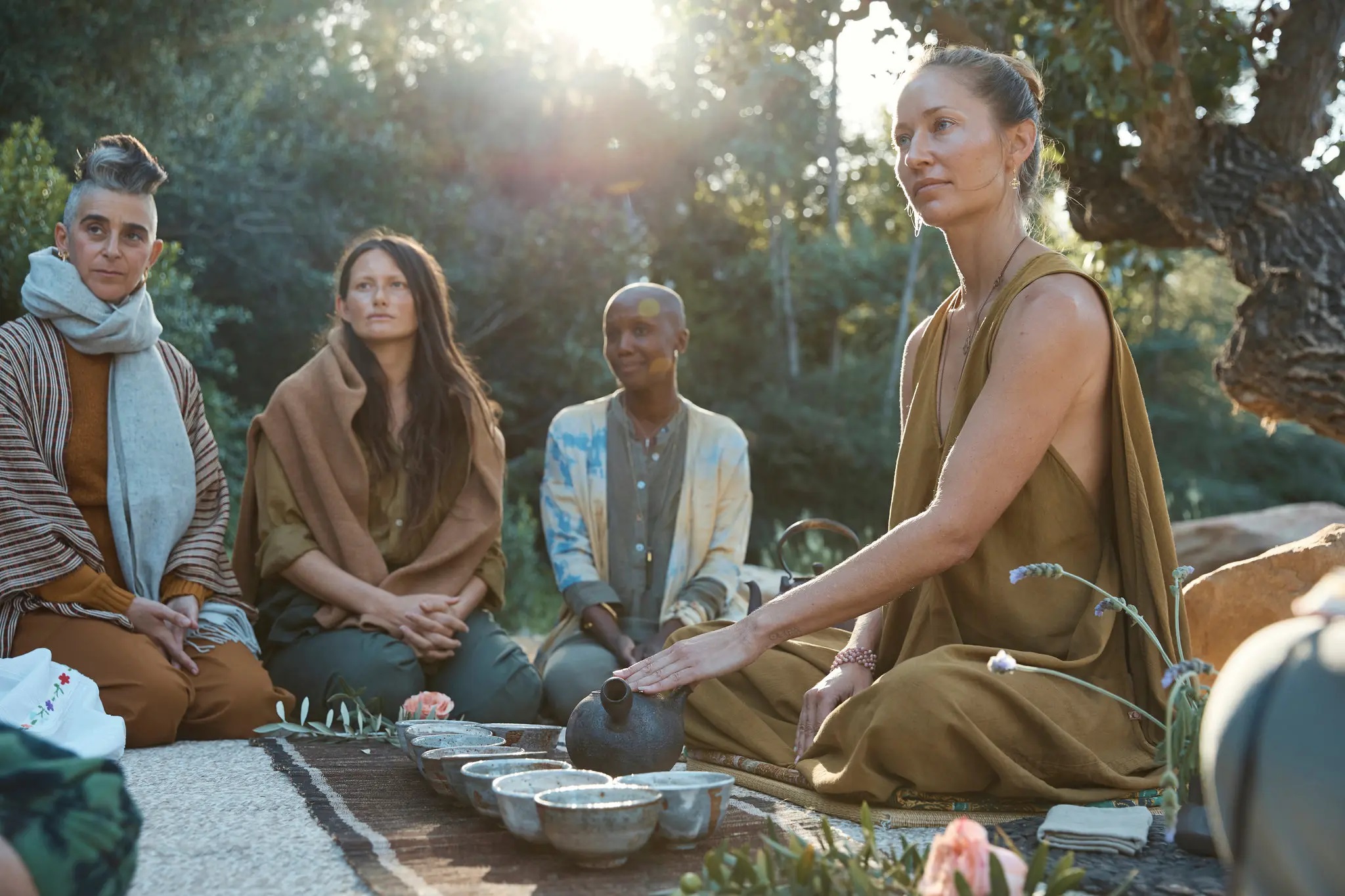 |
a NY Times article sums up a take on an LA subculture (photo credit and article) |
a finer point about prior context of discrimination mattering: So Han raised a good point about how all these ideas don't necessarily stand alone as a guide to what works and what doesn't related to borrowing from other cultures, because the context of how different cultures interact in the present matters. If there was no racism against Asians, or negative stereotypes at play to work around, different forms of uptake could be regarded as more reasonable, because the broader context would be simpler, and less problematic. On the negative side Chinese people can be regarded as potentially deceptive, an unfair stereotype since anyone can be like that, and I don't see that as necessarily being a broad cultural condition (even though my wife does tend to claim that "Indians are tricky," even after we've been mutual friends with several Indians, and I count even more as friends).
This can be a little harder to place than it might seem at first. Black people in the US experienced a fairly consistent and broad form of racism in the US in the 1950s and 60s, which unfortunately isn't completely resolved today, but discrimination against Asians in the US never took as consistent a form. There are negative aspects to common Asian stereotypes, and the ongoing culture war surely has made racism worse instead of better, relating to plenty of examples of incidents, but it all varies a lot, and keeps changing.
what about Chinese people exploiting Chinese culture?: tied to another less than fair or ideal stereotyping anyone with a certain nationality or "race's" genetics can also be granted freer reign to speak for broad traditions that they may or may not have a lot of exposure to, or the right type and degree of background.
In one of my first exposures to differing tea types a local Chinese-Thai woman was selling sheng pu'er. Looking back what she communicated about tea was quite limited, over the course of a number of visits (her shop was close to where I worked), a bit odd given how that would've factored into selling it. Per what she shared it seemed like either her father or uncle was into tea, and it wasn't clear that she had learned much about the subject from them. About 10 years ago I bought a cake of modestly priced "young" or new factory sheng at that shop to drink, to explore and acclimate to the type. That purchase was based on a recommendation of a fellow visitor there instead of that shop owner, who made no recommendations, related to limiting discussion of any background. It was probably roughly as poor a choice as I could've made, quite harsh without significant aging input. Still, it worked out; I acclimated to bitterness, some, and went on to explore oolongs more, returning to sheng exposure and preference some years later, only after her shop had closed.
That shop owner was also selling Chinese artwork, in some seemingly traditional form, having people produce high volumes of quickly made versions using related site space as a studio. Looked at one way both ventures represented exploiting a connection to "her" culture, two different subject themes which she may or may not have been an expert in, or even as knowledgeable as an average tea enthusiast or fan of art. Or maybe that's a completely unfair and inaccurate take. Thais don't put much thought into topics like cultural appropriation, or even racism for that matter, so it wouldn't have been discussed as being an example of that back then.
Maybe this doesn't connect as well to this point for a second reason, because the stereotype image of Chinese people is completely different here in Thailand. In one sense it's not negative at all, and in another it could be seen as such. All that is complicated, and maybe a bit off the point, but somehow it seems relevant to clarify that there isn't the same sort of otherness or negative connotation here that Chinese people would experience in the US in most places. A lot of people have Chinese ancestry, and people with Chinese family background tend to be among the most wealthy members of society.
That last part may muddy the waters a bit in relation to a strand of other related themes matching up better. I suppose it works to be mindful that simple conclusions don't work well related to unpacking and understanding complex issues and perspectives. That's why So Han and Riu offering their thoughts and examples worked so well, because they touched on broader scope issues, then brought up examples of personal experiences relating to those points, and clarified how they saw it all fitting together based on the benefit of hindsight and further consideration.