Showing posts with label Xishuangbana. Show all posts

Monday, August 11, 2025

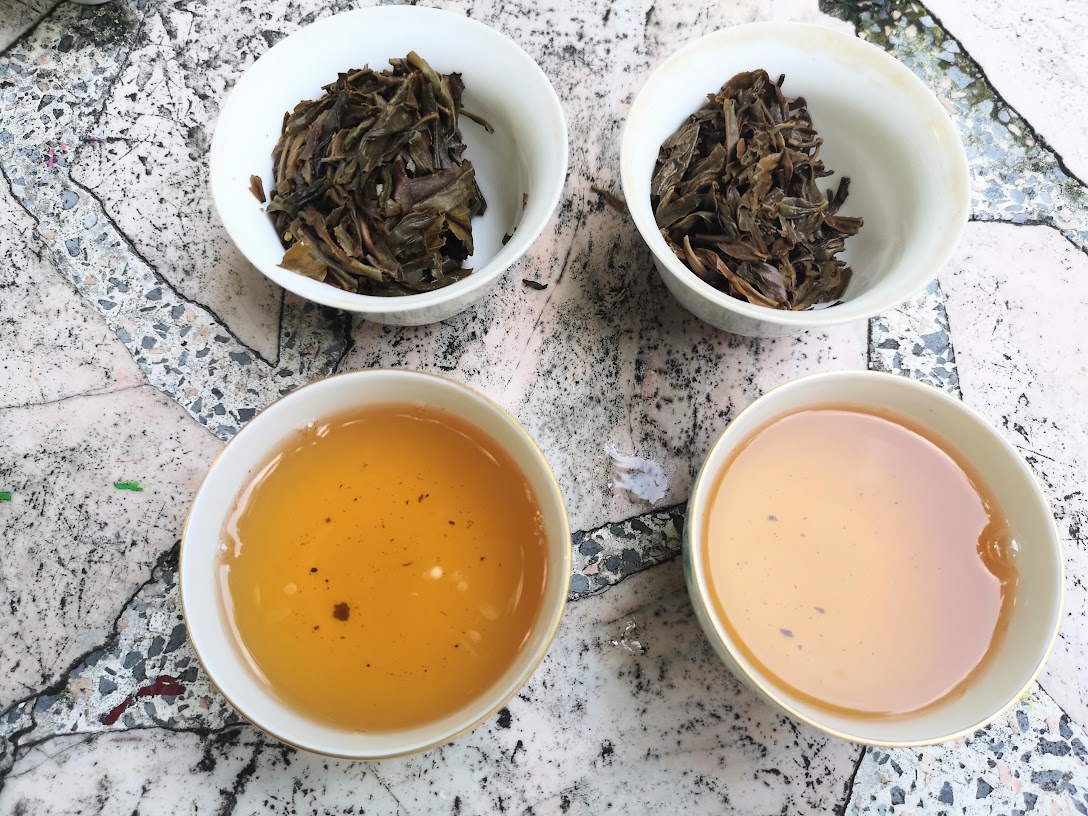
2022 Bangwai and 2021 Bulang gushu sheng pu'er


I'm reviewing two more of what should be fantastic gushu sheng pu'er from Tea Mania.  Again these are mini-discs, not the ideal form for brewing, but it works, and with practice it works well.

I've been trying Bulang versions some lately, but of course that range could vary.  I might seem to imply understating origin as an input to flavor and other character, even though I claim that the two connect, and that there are regional consistencies, probably more pronounced the more local the area is under consideration.  It's just that I don't memorize a matrix of past impressions, and derived general expectations.  For the Bangwai even that wouldn't apply; I may or may not have ever tried a version from there, and don't know where that is within a broader region.  I'm fine with only passing on an impression, as a primary review practice, but it seems a bit like sloppy work.  

Of course I'll compare this a little to Bulang versions I've tried in the past month, but even then not much.


Bangwai Gushu 2022  ($117 USD for 200 grams; equivalent to a $209 357 gram cake)

The Bangwai Gushu is celebrated for its meticulous, traditional handmade processing and the selective use of the finest tea leaves. This dedication to quality is evident in every sip, making it a treasured choice among collectors. Due to the limited availability, Pu-erh teas from the Bangwai region are released in small quantities each year, adding to their exclusivity and allure.

Ideal for long-term aging, thi tea is a tea connoisseur’s delight, known to develop richer and more complex aromas over time. Its robust character and evolving taste profile make it a remarkable choice for those who appreciate the depth and intricacy of Pu-erh teas.

Harvest: Spring 2022...

Aroma: Spicy, much Cha Qi and sweet finish

Terroir: Bangwai, Lancang prefecture, Yunnan province, China...

Tip: This Bangwai tea is ideal to mature a few years


Bulang Gushu 2021 Balanced  (the same price as the other cake, 95 CHF, $117 for 200 grams)


Harvest date: Spring 2021

Pressed: 2021

Typ: Sheng

Taste: Strong, intense and deep

Terroir: Bulang Mountain, Xishuangbanna prefecture, Yunnan province, China


There is a bitter version and "balanced" version listed, and I'm guessing that this was balanced, since it's really not all that bitter.  I guess it's possible that 4 years of aging transition changed it a lot, and it could have been, and it might be the other one, but probably not.

[later editing note: per discussion with Peter, the owner, it was probably the bitter version, which did emerge more in the late rounds (that flavor aspect).  But it was probably a good bit more bitter when new.]

There isn't much more description of the tea there, just some related background (only sampled):


This exquisite Bulang Gushu is a product of the collaborative craftsmanship of teamaster Panda and Yang Ming, crafted exclusively for us with a keen understanding of our fondness for Bulang teas. Reminiscent of the legendary 2015 Bulang Gushu, which we still fondly remember and has long been sold out, this tea promises a similar allure.

Echoing the legacy of both the 2015 Bulang and the esteemed 5-Village Blend, this Bulang Gushu shares a unique connection – it is sourced from the tea fields of a former school friend of Yang Ming.


These teas are really good, and they may well be very type-typical for this origin and general style.  It doesn't work very well for a vendor to add lots of flavor list, because in the 4 years this aged that probably changed some.  Interpretations vary so much that I'm sympathetic to vendors skipping adding much initially, even as an early snapshot.  They need to say something, but the flavor-list approach is problematic.


Review:


2022 Bangwai:  I let these infuse for about a minute, to start opening up.  Unless you really pry the tea apart it will brew somewhat unevenly, with the outside starting early, and being relatively far along the transition cycle by the time the center is even wetted.  I can accept that; it doesn't throw off results much, it just changes them a little.

Feel has nice creaminess, even though this is still too light to clearly identify a lot of flavor.  It's in a floral general range.  It's bright and clean, probably with decent complexity, and pleasant sweetness.  The effect seems quite fresh; 3 years isn't that long, in moderately dry and cool storage.  More description to follow next round.


2021 Bulang:  a warmer tone is included in this.  It also expresses quite a bit of feel, for being so light, but it's different.  The other was light in tone and creamy, and this contains some structure already, a vague hint of dryness.  There's a really catchy flavor that I can't make out yet, and good overall balance.  These aren't the kind of teas where you throw out half of the early infusion that you don't make out as clearly; they're already quite good.

At the risk of brewing them a bit strong I'll give them another minute to infuse, and while they won't be completely wetted yet by the third round they'll be brewing more normally.  Two full minutes of infusion time is a lot, for that outer layer, but to me it's not as if the time the tea spends wet (under water) is the only brewing it does; it seems to continue to extract into the moisture in the leaf between those cycles anyway.


2022 Bangwai #2:  the Bulang version opened up a lot more.  It's interesting that the topic of how hard pressed a tea coin is never occurred to me before.  And I suppose I expect dragonball shapes to be really tightly pressed too, in a relatively uniform way.  Of course that could vary.

Warmer mineral depth comes out more than I expected.  Bright, fresh, sweet, floral tones are present, but the overall character is layered, and not light and bright in tone, more medium.  It integrates well.  It's still a bit creamy, but those warm tones and slightly more structured feel change overall character.  Beyond the vague floral description, and mineral, there is a substantial richness to the flavor, matching the feel, I guess along the line of macadamia nut.  It's really clean and complex, well-integrated, so an impression of quality comes across.


2021 Bulang:  this is a little strong (where the other hadn't been yet).  Dryness stands out more, and a very different warm mineral layer.  In this it resembles cedar, or maybe an incense spice.  That catchy aspect may have been a fruitiness, that's hard to identify, along with the cedar or spice tone.


2022 Bangwai #3:  light; I dropped back time a lot, maybe too much for this version, at this level of leaf separation.  I'll pull it apart for the next round.

Flavor is still bright, clean, and somewhat complex, even though it's subtle.


2021 Bulang:  this balances really well, brewed to a proper infusion strength.  That catchy aspect is some sort of fruit, along with a spice tone.  I should be able to describe that fruit tone better than I can.  Maybe it includes floral range, a mix, that is integrated, making it harder to separate.


2022 Bangwai #4:  this is an unusual experience, how it comes across as quite complex and also quite subtle (lacking intensity, I guess, put another way).  The rich flavor might be in the range of butter cookie instead of macadamia nut, or between the two.  Bright floral range is quite limited, but it still seems to be an input.  There is a mineral layer, it's just light, both in the sense of being light in tone and also not strong.  Somehow it comes across as fresh, and refined.

Bitterness is quite limited; as a sheng drinker, who is often appreciating even younger versions, I don't really notice it.  Maybe to someone more into oolong that would actually stand out some.


2021 Bulang:  stronger, for sure.  Bitterness is much more pronounced, and warm mineral, some degree of floral, and range I'm interpreting as both spice (or aromatic wood, cedar or redwood, maybe sandalwood) and some limited dried fruit all give it great complexity, and intensity.  There's a lot going on.  For sure the bitterness was a good bit stronger 4 years ago, and tones brighter.  This has mellowed into a very pleasant and drinkable character.  

It's interesting considering how this compares to a Legend of Tea Malaysia stored 2021 Bulang, reviewed here, three weeks ago.  It has been a long three weeks; that feels like over a month.  The write-up sounds pretty similar; the same basic flavor profile is expressed.  This is probably cleaner and more refined, and slightly lighter in tone.  I'm not sure it works to guess that it's better, but in a limited sense that's probably true, at a minimum related to preference for one type of character, and maybe to some extent in general.  This definitely lacks rough edges.  That tea had a sappy, perfume-like feel and associated flavor range; this sort of does, but probably not to that degree.  That tea was really good, exceptional for the price-point, and the quality of this is probably even better.  Or maybe it's that it is made in a more drinkable style, which is a different thing.

Put another way, expressed in more detail, that probably started out as more intense, with rougher edges, more bitterness and astringency, and had transitioned more by the time I tried it, perhaps arriving at a slightly warmer tone range.  For people more accustomed to factory tea that context and style could be better.  This might ring a bell more with people more on the page of boutique-style, drinkable when young tea versions, that are clean, sweet, and balanced, but not challenging, I suppose "giving up structure and intensity," if someone sees it that way.


2022 Bangwai #5:  this integrates all the better this round, with warmer spice tone entering in, resembling one part of the other tea.  Complexity and intensity really ramped up.  Maybe because I finally got timing right, and it's all wetted and brewing now?  It's not as if this has been challenging to brew, since results were really positive before, I'm just getting variation out of it.

Bitterness doesn't really stand out much, as sheng experience goes, but a little more of it balances nicely.  At least I can notice it.  The butter cookie / macadamia expression is nice, and light floral range, that I'm not really covering as much.


2021 Bulang:  perfume-like nature and sappiness ramp up; interesting.  Maybe because I'm looking for that?  But in that earlier review--of a different 2021 Bulang sheng--it ramped up across a number of infusions, as just occurred.  Dryness picks up a little too, but this is far from dry.  "Sappy" works.

Even though I'm in between the kids being here and the next travel step (I'll go back to Honolulu the day after tomorrow) I'm still busy, with a list of a few things to do to get ready, so again I'll cut this short.  One more round will work for catching final thoughts, or whatever I've missed.  Of course these teas are going strong, and will brew at least as many more rounds later, and of course I'll miss a couple of minor aspect transitions.


2022 Bangwai #6:  full, creamy, complex, and well-balanced, with flavors not so different than last round.  This flavor set, and other aspects, works really well for my preference.  Sometimes I'm describing a flavor range that could be fine, or even exceptional, but it just doesn't click with me as well as this does (like root-spice range sometimes doesn't).  This could even be interpreted as heavy on root spice, but it would be a light ginseng sassafras fullness, not a heavier bark spice oriented range, something more medicinal.


2021 Bulang:  brewed fast this round this is exceptional.  Intensity and complexity is great in both, and again this flavor and other aspect set seems very appealing to me.  Clean, balanced, and refined character is great.

So which is better, either in terms of general quality or a match to my preference?  Both are pleasant in novel ways.  The Bulang isn't challenging, at all, but it's more intense, and heavier in flavor range, with more bitterness offsetting that flavor set.  It's far from straight floral tones; the spice or aromatic wood tone might be even stronger, at this stage.  It all makes perfect sense together, to me.  These are in a great place for aging transition to integrate well just now.

It's all as I expected.  Really high expectations can be a challenge for a tea to be reviewed against, because any minor flaw or less favorable balance would stand out all the more.  Then when a tea is great it's just meeting those expectations; there is no exceeding them.  Even a novel flavor input or atypically positive feel aspect can only seem normal, if you go into it expecting a tea to be great.

There's a lot going on with these, so that I've cut short feel and aftertaste range descriptions.  There's some background noise as well; my wife is talking to our kids online about first week of school preparations (they just ended it, but hanging details remain, needing an extra binder or highlighter, and getting jet-lag sorted out).  I might've even added a couple more flavor aspect descriptions without that distraction.  This will do; the teas were great, as described.


Further conclusions:


Describing these as "really good" seems a bit limited.  They are, and the aspects seemed like what I've listed, but the clean nature, complexity, depth, and refinement are hard to pin down in a description.  This pricing may be more than I'd end up spending even if I had a loose budget, instead of very little of one to work with, but I get it why people open to that would drink teas like these.

It's hard to guess about longer term aging potential.  For as good as these are now I'd drink them right now, or within a year or so.  For someone with a wide open budget buying one to drink and one to age might be a good strategy.  That only goes so far, for these being sold as 200 gram cakes.  You could drink through one fast, if you weren't rationing it.  Which could work out; it's good tea.


I'm traveling now, for a month, and already miss them terribly


not exactly bonding, but at least Myra is adjusting to them being around


Saturday, December 21, 2024

2004 HTC shou pu'er and 2011 Xishuangbanna


A friend and I just did a tea swap, and I sent some of whatever was around in exchange for aged shou and hei cha.  So nice!  He is Bruce, living in Chiang Mai; maybe you know him.

One is a 2004 Hong Tai Chang shou, which is probably tea from a Chinese producer made in Thailand, since I've tried a good bit of that.  I own a 2006 sheng cake, or what is left of one.  Tea Side sells those here, an online vendor (where I bought that).  Looking back I tried that as a sample in 2015, and a 2006 shou version also from 2006, and bought that sheng then.  Nine years ago I was not a very good judge of pu'er, and my reviewing and blog writing was a bit rough.  Maybe it still is, but at least in a different sense. 

The other is a 2011 Xishuangbanna version, from Yunnan (so "true pu'er").  Bruce wrote on the label that the 2011 represents a version and style he doesn't like as much, sent for comparison, so we'll see.


Review:


2004 HTC:  it's smooth, rich, and mellow, with decent complexity and depth.  My problem with shou has always been that it all covers too narrow a range; this and the best and worst shou versions I've ever tried are all not so different.  Ok, maybe bad shou really is something else, but it's still a lot closer than for other types, nothing like bad sheng or bad Wuyi Yancha oolong.

There's a hint of fruitiness in this, like a dried berry or cherry.  I'd bet that and going on more about mineral will be the story of this shou.  If you use your imagination it could seem a little like spice, I guess, and that familiar dark earthiness does vary slightly.  This is clean in flavor effect; there's that.  Feel is rich and velvety.  It's good.


2011 Xishuangbanna:  there is something a little off about this.  It has that barnyard sort of flavor, like a scent literally from a horse's stable.  At a minimum it takes me back to experiences with country life from my youth; we had a horse at one point, and lots of other animals were around.  I would go help an uncle bale hay in the fall; there is nothing like that experience, for work seeming like a workout.  A tractor and machine does the baling; the workers' part is throwing it into a wagon, then taking it out and stacking it in a barn.  Those must weigh something like 50 pounds?

This will clean up a little over the next two rounds, I think, and it's not as bad as I'm implying.  It's not good either, not like that really dicey Honolulu Chinatown shou I bought a couple years ago, to fill a gap for not bringing enough tea.  In bad shou you end up talking about fishy range, or petroleum-like character, not just a bit of barn smell.


HTC, #2:  it picks up complexity; that's nice.  This expresses a cool marshmallow flavor aspect that I've ran across before, really a nice flavor in shou, for how it integrates with other earthy range.  Sweetness is good in this, and rich feel, and also complexity, depth, and refinement.  This is roughly as good as shou gets, per my experience.  Then again it's not that far off above average shou either, so if a vendor was charging 60 to 80 cents a gram for this, as they would, there's absolutely no way I would buy it.  But then preferences and judgment does vary.

The rest of the description still applies, pleasant earthy range, of course mineral, and probably some spice, maybe some strange dried Chinese medicinal herb I'm not familiar with.  It's good.


2011 X:  rough!  On the one hand this is pretty good, related to the positive range, and on the other it tastes like the smell of dried horseshit.  I get it why Bruce sent it as an example of what might not be ideal, or even further toward the opposite side than that.  It's interesting.  After the initial taste the shock of that one aspect being so oddly placed in that range settles out, and it's really not so bad.  The rest seems to pick up intensity as you keep drinking it, conventional warm mineral and earthy tones.

I haven't mentioned a brewed liquid color difference; the first is inky, and this is lighter, more reddish brown.  These are both pretty far along for aging; 13 to 20 years shouldn't make that much difference for shou, unless one was not very completely fermented to begin with, then I guess maybe.  I actually like this, once I drink a little more.  I don't think I'd be reaching for it often if I owned a cake of it though.

I drink shou when I fast; I've mentioned that here before.  I've fasted for about 60 days in the past two years, I think it is.  It's a long story as to why; to gain supposed health benefits, to offset disease risk, to increase mental clarity, to adjust for insulin resistance, to clear whatever is stored in my tissues that shouldn't be there, maybe even to offset aging effect.  I think it helps.  Shou is the easiest on your stomach, as teas go, and I pretty much only drink that and some aged white mixed in.


HTC, #3:   these will keep brewing, up to at least 10 rounds, even though I'm pushing them (brewing them strong).  But I'll stop taking notes here.  They won't transition that much more, and I have things to do.  

Actually this is pretty much the same as last round.  Which is good; it was really nice.  I love that marshmallow flavor inclusion, and the rest balances well, the depth, intensity, feel, etc.


X:  that more objectionable barn flavor did mostly fade already.  This isn't bad at all.  Maybe not great either, but it's pretty good shou.  If I used my imagination I could come up with a list of ten different flavors in this, but it's also just kind of earthy.


Later:  trying both again later a dark bread like flavor range stands out in the HTC version, like very dark rye.  It's nice; it complements the other earthiness and fullness well.  

The Xishuangbanna version has lost essentially all of that barnyard note, and a mineral aspect like slate stands out.  It reminds me a little of Liu Bao character, how that can be similar in those.  It's so heavy on mineral in a dark range that it's almost like smoke, but it's not that.


Conclusions:


These will keep shifting, a little; another few rounds would turn up another aspect or two.  I just won't write about that.

I ended up liking the second more than I expected; it cleaned up nicely.  The HTC version was better.  I didn't go on much about age issues in this writing.  Shou mellows and deepens in character some over a longish time, but I'm not sure the Xishuangbanna version will be all that different in 7 more years, matching the current age of the other.

I looked to see if Tea Side lists this, and they don't.  A loose 2006 HTC shou version sells for $18.50 for 50 grams there; not as bad as I thought.  Teas like these can vary quite a bit though, since beyond variations in original character storage conditions can change a lot.  That may or may not be a lot like this tea.


Monday, November 11, 2024

Tea Mania Mengsong (2014) and Bulang (2021)


Another sort of contrasting type theme post, related to these being different ages.  Sometimes it can be interesting comparing a shift in character over storage time so directly, or in other cases it just doesn't make sense together.  We'll see.  Both versions are presented as gushu (older plant material).  Per usual I'll add the vendor description after making notes. 


Mengsong Dragon Balls (50 CHF or $57 for 80 grams, 71 cents a gram)


...But the lovers of stored teas were a little bit forgotten. For them we now have a well stored Mengsong Gushu from spring harvest 2014. Dragon Balls, Long Zhu in Chinese language, of 8g were made from the tea leaves in Yang Ming’s tea factory to offer the tea in small quantities or as a sample. The tea was stored in Xishuangbanna under natural conditions until 2020 and is already very ripe.

Aroma: Mellow aroma, strong Cha Qi and fruity taste

Terroir: Mengsong, Xishuangbanna prefecture, Yunnan province, China

There's no need to take the "already very ripe" part too specifically; it's a general claim that the tea has transitioned quite a bit.  Of course this isn't remotely similar to shou pu'er; it doesn't mean that.


Bulang Gushu 2021 Balanced  (99.76 CHF, $114 USD, for a 200 gram cake, 57 cents a gram)

I'm not completely sure this is the "balanced" version and not the "bitter" one, but I'd guess that it is.  The description:


...Reminiscent of the legendary 2015 Bulang Gushu, which we still fondly remember and has long been sold out, this tea promises a similar allure.

Echoing the legacy of both the 2015 Bulang and the esteemed 5-Village Blend, this Bulang Gushu shares a unique connection – it is sourced from the tea fields of a former school friend of Yang Ming. This personal touch adds to the tea’s story, making it not just a beverage but a testament to long-standing relationships and shared history. Enjoy the depth of flavor and rich heritage encapsulated in each cup of this exceptional Bulang Gushu.

Taste: Strong, intense and deep

Terroir: Bulang Mountain, Xishuangbanna prefecture, Yunnan province, China


Not much description there, but I included some of that marketing framing in anyway.  If the tea lives up to it then colorful backstories are fine.


The Mengsong version is dragon balls, pressed spheres, and the Bulang is a coin or disc, so they'll also brew a bit differently.  In both cases it will take 3 or 4 rounds to get them to brew consistently, but it won't throw off the character so much during those early rounds, it will just be less consistent.  For tasting purposes that might make more difference than for ordinary drinking; you tend to focus in on relatively minor effects when tasting, versus just accepting a general impression.

I'm getting to the end of this Tea Mania sample set (and the Tea Tracks set as well; the two I'd been reviewing back in September).  Both have been really interesting, pleasant, and consistent.  To me Tea Tracks follows more of a selective and limited curator vendor theme, and Tea Mania sells based on direct sourcing of exceptional character and value sheng, and other types.  Both would be good sources, but Tea Mania stands out for including so much range, and a few that are really exceptional in quality and value.  Most I've tried are good, so the best exceptions are really something.


Review:


Mengsong (2014):  the effect the age transition has had on this is interesting; 10 years is awhile.  Warm tones include warm mineral and plenty of spice range.  It's a little towards aromatic wood, cedar and such, but to me this is complex all within the range of warm spices, like incense spices, or even more aromatic woods like sandalwood.  

The character is interesting and pleasant, and it makes sense.  This hasn't entered into a range where it's just quiet, or awkward for being in between fresher tones and that deeper range.  


Bulang (2021):  that has a nice depth and a cool, interesting character as well.  These will be better than I expected.  It's not completely different than the other in terms of general range, with mineral and some spice standing out, but greener, slightly woodier tones are also present.  This has an unusual degree of depth to it.  It's odd saying that about sheng, which often expresses complexity, intensity, and depth, but this is on another level.  

One interesting aspect is hard to pin down, maybe more along the lines of root spice, sassafras or root beer.  Maybe that includes plenty of ginseng range, and I'm just not clear on that flavor; I haven't been messing around with ginseng for many years.  It's not as bitter as I would've expected.  There is some bitterness, but it's moderate.  It seems like it might've already transitioned some, because this expresses so much flavor range and depth, but it has only been 3 years for this tea, not so long.  It must have started out more "approachable" than it might have.

I did a long rinse first, which I discarded, and then went long on the Bulang, and quite long on the Mengsong, and these are opening up already.  Both might need a round or two more to fully open but this won't take as long as I expected; knowing what to expect seemed to make some difference.  You also tend to brew longer earlier on, to get that early process sorted out, so it's slightly off optimum for that other reason, that you need to make adjustment in some sense for it, either using a long infusion or accepting a few rounds will be less uniform, partly unfurled and partly not.


Mengsong #2:  that's so catchy!  I last reviewed a Mengsong version a week ago, so in one sense part of this range might seem familiar, but this seems a bit further along for transition (aging and fermentation), and interesting for it.  Looking back that was a 2019 Mengsong version (from Tea Tracks); not at all young.

I don't always relate well to partly aged teas, versions in between a half dozen and ten years old.  They can be promising, or pleasant, but often the experience is about potential, not what you experience at that time.  This is good, both interesting and pleasant.  There are layers to what's going on.  One part is warm mineral, another a warm spice aspect, and a menthol sort of edge balances the rest in an interesting way.  Camphor, I guess that I should be saying.  The feel is even ok.  It has a bit of dryness to it, which I suppose will sort back out and transition to something else over 5 or so more years, but it's not unpleasant as it is now.  It all kind of works.


Bulang:  this is unusually interesting too.  Intensity picks up; there is a lot to this.  Often that could mean bitterness or astringency is high in the balance, for a 3 year old sheng, but it's not disproportionate in this.  I'm interpreting this as including camphor too.  It's odd, because I don't run across aspects that seem exactly like that effect to me very often.  I might say "camphor" once a year in this blog, almost never by sheng drinker tea blog standards.

The other seems more pleasant to me, a better match to my own preference.  That's not a completely fair judgment, because the warmer tones, greater complexity, and depth of the other seems to derive from positive aging transitions.  It is what it is though; maybe this will be just as good or better in 7 more years, or maybe it won't be.  

This includes a perfume-like floral range edge, which is nice.  A touch of green wood feel counters that, not perfectly balancing against it, but more just offsetting it.  It's as novel as it sounds; they both are.  Very often for reviewing partly aged sheng it's about judging how positive aspects are, and how it matches within a range of conventional character types, and for the second these are both kind of unique.  In cases like these a close match to preference could make them seem amazing, or a larger gap from that standard of judgment could make one seem interesting but not as easy to value.

This has been a lot of tea already, two rounds in.  I'll already take a break to eat just a little, and drink some water, and might have to keep these review notes short, limited to less rounds than is typical.  Pushing intensity to get early opening-up transition out of the way is a part of that; it would've been easy to drink 3 or 4 quite light rounds if these were cake material that came unpacked well.


Mengsong #3:  the color difference is striking now, this version being so much darker.  This tea is really nice at this stage, as I've expressed.  I would expect it to only get better, to smooth out and deepen in character, and to not change that much more over the next 5 years.  That touch of dry feel will probably smooth out, changing to greater richness.  

I'm not doing "warm spice tones" justice in describing this, or explaining how it strikes a balance between remaining floral range and deeper mineral flavors.  The descriptions always only go so far.  Without as pronounced a mineral range the rest wouldn't tie together as it does.  Dominant spice range and camphor are a nice primary flavors set.  I suppose someone could still find that feel edge a bit objectionable, too dry, or structured in a way they don't like, but it seems nice enough to me.  


Bulang:  every round it seems that pronounced, sappy, root spice (ginseng / sassafras), camphor, green wood edge range can't develop to be more intense, and then every round it does.  It has a sort of pine edge to it at this stage.  To me that balance works a good bit better than a heavier green wood inclusion did last round, which is still present, but more secondary now.  I'll brew both these on the relatively light side next rounds, a fast infusion, and see how that changes things.  Infusion strength was relatively standard last time, not brewed too long, but out to about 20 seconds, so it could be lighter.


Mengsong #4:  it's even more pleasant brewed lighter, still really on the intense side, brewed for about 10 seconds.  Sappy, rich feel balances well at this infusion strength.  Flavor complexity isn't so different than what I've been describing, just shifted to balance a little better.  

A touch of pine may be picking up in this too.  It's interesting how closely these seem to parallel each other, relatively different, but with some repeating notes.  Some of that could be from the power of suggestion, me looking for what I've already been experiencing, but some flavor themes seem to link between these, even though just as much flavor and other character is quite different.


Bulang:  brewing this fast has broken the cycle of that one set of flavors emerging stronger and stronger, but it fits into a more pleasant balance this round, it integrates better.  Even the green edge it had seems to be softening, as an experience of depth picks up.  

I must admit I hadn't been completely sold on the gushu theme Peter and Tea Mania had long since been promoting.  Good tea is good tea, and a few minor character aspects seem to kind of link to that, like a little more mineral range, but it also can seem relatively overstated.  It can seem like people over-value a limited type of depth, and that it doesn't actually make the experience that much more pleasant.  These are a little different though.  

It seems like tea being well-produced, grown under favorable conditions, and also well-processed both mix as related inputs.  Producers realize that old-plant material is valued, that it commands good product sales pricing, so they take care to get growing conditions, harvesting, and processing dialed in.  Then beyond that there really could be significant positive effect from that one cause, plant age, but it would be harder to spot for it all tending to mix.


Mengsong #5:  this may be a good place to leave off; even with eating some sunflower seeds and nuts and drinking water this is a lot of tea to ingest in one go.  If an interesting later transition occurs I can mention it, since I'll drink the tea later, but to me it's enough of the story told covering most of the cycle (half the rounds, at most, but most of the changes).

Again balance is quite nice, and of course complexity, intensity, and depth.  It hasn't changed much from the last round.  It seems like this might be a better tea than I tend to run across, in terms of final character after aging that next 5 or so years.  Or maybe that's more a comment about a match to preference, that I like this style and aspect set.  Even for drinking it right now it's quite positive, unusually so for a tea at the 10 year aging mark.


Bulang:  this is good too; it's not as if it's flawed, or doesn't make sense, in a bad place to experience right now.  It doesn't match my preference as well.  That really unusual and complex flavor set is really something.  Both of these are quite rich and full in feel.  I've not been going on about aftertaste experience but neither is thin or limited in the least, so the full range of experience is expressed, including that.  


Conclusions:


I would guess that I always would love the Mengsong version more, as it ages across different levels of transition.  Both are interesting though, and there's no reason why it necessarily seems better.  That's just a match to preference based assessment, as I see it.  It would be interesting to try it in another 7 years to check on that, to see how it changed.

Value is hard to place for these.  They seemed quite good to me, and "gushu" material versions can tend to cost even more than this.  Of course I liked the older and more expensive Mengsong version more; it would work out like that.  I didn't go on and on about it in the notes but it seemed to include a bit more structure and complexity, and flavor tones had evolved a bit more over the extra 7 years.  I could probably never bring myself to buy 80 grams of tea for $57 but for people more on that page, into that range, it could seem like a good deal.  That also means that I've tried many samples presented as selling for more than this but I don't own equivalent cakes.

I really also liked the Mengsong version I covered in the last review, from Tea Tracks, another gushu version, from 2019, selling for $124 for a 200 gram cake (or presented as such; it's always hard to say).  That divide in age makes any sort of direct comparison problematic.  Trying them side by side I would guess about comparing quality level, character, and starting points, or mid-way points, but saying that both were very pleasant is enough.

If someone is into higher end, somewhat aged sheng pu'er versions this cost issue would have to be something they live with, or they could drink a different kind of tea, factory versions.  I just saw a comment by a well-known vendor about how preferences have shifted, and a decade ago factory tea is most of what there was, and these gushu / boutique producer / narrow origin material versions are kind of a new thing.  It is what it is.  Someone could see this framing as a bit exaggerated, and think that quality and positive experience doesn't justify spending around $1 a gram (with these significantly below that level, maybe a good deal for that, or maybe that's still pretty normal).  

One runs across the idea that boutique sheng doesn't always age-transition well.  I could type some more paragraphs on that but it's hard to get the bottom of related generalities, and I'd need another decade of exploring sheng to have a more informed opinion.  Not everything I've tried that is sort of similar in category background has been as positive as these.  Some styles are positive and interesting for a few years and then die off more than they continue to improve.  

One red flag seems to be when a tea is too approachable when quite young, when bitterness, astringency, and intensity are moderate earlier on.  Of course I'd be guessing to project backwards in relation to these, about their origin.  I'm not saying that they'd need to have been unpleasant or relatively undrinkable for the first year or two, instead that sweet, floral or fruity, and mild feel versions might not age well.

These two versions were really pleasant to experience just now, the main thing.


Saturday, November 2, 2024

Tea Tracks Mengsong Xiang (2019) and Ya Nua Gushu (2018)


Back to reviewing!  I quit while I visited family in the East Coast of the US, in Pennsylvania, and now I'm back in Bangkok.

I don't want to say too much about these, two sheng pu'er versions from Tea Tracks, sent by a friend to try.  I'm not that familiar with the narrow local areas, although Meng Song kind of rings a bell, and I don't know much about them for backstory.  The website mentions these details:


Meng Song Xiang 2019 - 勐宋  (114 Euro / $124 per 200 gram cake)


Meng Song Xiang is a village in southern Menghai. This tea is made of ancient tree material (gu shu, 古树). It has a full body and a pleasant bitterness, which lingers in the mouth as a fruity sweetness for a long time. Here is a review of the tea (in German): puerh.blog Meng Song review

Taste:  Soft yet bold taste. Upfront bitterness that turns into a sweet sensation.

Trees:  Old trees (gu shu 古树) growing in a natural environment

Origin:  Meng Song, Menghai, Yunnan, China


Ya Nuo 亚诺 2018 (You Le Shan)  (120 Euro / $130 per 200 gram cake)


Ya Nuo is a village on You Le Shan (mountain), one of the old six famous tea mountains in Xishuangbanna. This tea is made of ancient tree material (gu shu, 古树). The tea starts out very softly in the first brews with hardly any bitterness, but develops a nice sensation in the aftertaste. 

This is one of the teas that can clear your head on a cloudy day.

Taste:  Soft and subtle taste that develops a cooling sweet aftertaste.

Trees:  Old trees (gu shu 古树) growing in a natural environment

Origin:  Ya Nuo (village), You Le Shan, Xishuangbanna, Yunnan, China

Harvest:  early Spring 2018


The teas seemed pretty solid when trying them, but it's hard for me to evaluate value in relation to pricing beyond a limited range.  I could tell they seemed pretty good but not really how good.  I suppose then it's on considering how much I like them, setting that aside.  I don't buy pu'er that costs over 50 cents a gram, so of course I would run out of benchmark range. 

These are almost sold out on the website; there won't be much marketing function in describing these, since they'll be gone any day now.  The reviews might be partly about that but also just to communicate about trying teas, and to see what I make of them in notes.


Review:


Mengsong:  pleasant; definitely some bitterness stands out.  This flavor profile is somewhat familiar but I'm not going to do justice to describing it.  Beyond bitterness there is some sweetness, and from there identifying even aspect ranges is difficult.  Floral?  There is definitely a pleasant mineral layer, a little on the dry side, but pleasant in flavor and feel (to the extent that the two ranges map together).  There's good structure to the feel.

So far this just sounds like describing sheng pu'er in general.  It is pretty standard sheng, in one sense, just a better than average version, and only type-typical related to a subset, to Mengsong area versions.  5 years of aging has softened this, probably, although there is still plenty of bitterness and feel structure.  The tones have surely warmed some.  Maybe I'll readjust to reviewing more as rounds go by.


Ya Nua:  to me this expresses a distinctive root spice aspect.  Think along the lines of sassafras, but it's probably not so close to that.  It's not so far off the standard incense spice range, and if I had better scent memory of the main few incense spice versions I could reference one it's closest to.  That has the character overlapping just a little with aromatic wood tones.  Bitterness and mineral are dialed back just a little in comparison with the other, but it's still reasonably intense.  It might slightly less complex.  Better luck with deriving two flavor lists next round.


Mengsong 2:  I brewed these on the fast side for using a relatively high proportion, and for both being on the intense side.  It was still a bit much; I can switch to 5 second rounds to adjust further.  It's not that I forgot that I usually tend to overdo it with proportion, I just didn't offset it.

There's a catchy, familiar range in this I wish that I could describe better.  It's a way in which feel structure, bitterness, floral tone, and mineral all combine, in a very integrated form.  It comes across as a familiar set of aspects, that naturally pair together.  Maybe this is what people would seek out in standard Mengsong experience, a good version of it, but of course I can't claim that.  I don't retain a matrix of memorized local area types, and I might never, regardless of how long I kept trying different things.  

Would people seek out a 5 year old version, and how is the storage input for this if they were inclined to?  Those are harder to answer.  This aspect set is dialed in though; the proportion of everything is as it should be, and there are no flaws, no out of place aspects.  You're signed on for bitterness in drinking it, but to me that's moderate, even if it's higher than I would've expected for a partly age-transitioned tea.  Maybe this wasn't stored in a very humid place.  To me that's fine, aging and changing a tea over more slowly, unless there is a reason to get it moving quickly, for example to get a factory tea that will need 20-25 years to be good to cover that ground in 15.  I suppose at a minimum saying more about the floral range in this would be helpful, but not much comes to mind for labeling it.


Ya Nua:  this picked up a little depth and smoothed out some in character; it's better.  It's slightly more subtle now, but it still has a lot going on.  Bitterness hasn't faded but it's moderate compared to the other.  There is plenty of mineral range and other deeper flavor complexity, it's just not as forward and dominant as in the other version.  Spice tones still make up a main part of the experience.  Feel has decent structure, even a touch of dryness, all of which prevents it from coming across as thin.  At 6 years old (probably 6 1/2) this will head into that range where it shifts over from being new to old right around now, and maybe flavors seeming a little less forward now is a part of that.

As with the other it comes across as quite clean and well balanced to me, lacking flaws or limitations.  I suppose flavor complexity either settling out, for now, or being limited earlier on could be a limitation, but I see that as more character neutral, just how it is.  Something being out of balance would be more what I'm referring to, or a negative aspect.

At two rounds in I'm already feeling this.  I'm finally back in Bangkok, which is why I'm reviewing again, back in this familiar hot and humid environment, and even though it's 9 AM it's warmer than Pennsylvania had been during a cooler mid-afternoon.  It's too bad that more people back there don't appreciate the great tea drinking weather.


Mengsong 3:  this is shifting, in a pleasant way.  A bit more spice tone picks up, not completely unlike the range found in the other, just not the same either.  


Ya Nua:  less transition, but the tones may be warming slightly.  This seems like a good round to let it transition and get back to describing it more next time.


Mengsong 4:  it's interesting how bright and fresh this is, for being a 5 year old tea.  I could try to guess about how this has softened in character over that time, how it would've been more intense and challenging within the first year or two.  In part that would relate to describing what could be taken as positive about somewhat drier range storage.  Or maybe just a medium humidity and heat input range version; it's easy to pick up a biased judgment of norm here in Bangkok, where both are dialed up to maximum.

It's also interesting to consider where this will go from here, what relatively full aging might look like for it, when, and in what character range.  It needs at least another decade, or maybe more for full transition.  It's in a decent place for drinking as somewhat transitioned tea now, I suppose not so far out of entering into the teen years phase, when it might not make as much sense.  I certainly can't project ahead and list out likely flavor range to develop, but the intensity and balance at this stage seem like a good sign, that it's holding up well so far.


Ya Nua:  this is less complex and intense, but it has an interesting character, and plenty of intensity related to providing a pleasant experience now.  It's not muted.  The earlier spice range is still dominant, and a bit of vegetal range might've picked up as well, along the lines of tree leaf, not exactly like wood, but kind of related.  Maybe it only shifted in form, and it had seemed more like aromatic wood earlier, now vegetal in a different sense.  In most forms that would seem like a flaw, a subject I've already referenced, but with plenty of spice tones and mineral range it integrates well in this.

For someone preferring intensity of experience the other might be better.  One might question if this doesn't express a different kind of depth, related to the gushu theme, a standard idea that forward flavors might not be as intense but a base of depth could stand out more.  I don't know.  Both are fairly balanced; both have plenty going on across a significant range.  Underlying mineral range is a strength for both.

A different kind of acid test comes to mind, based on having visited "home" recently, drinking mostly a half dozen versions of tea for a month:  which would I keep returning to, if I had plenty of both?  I really love approachable, interesting, sweeter range, even fruity sheng, more than these two styles.  Sometimes I do crave a more intense experience, and it's not hard to appreciate good quality in tea versions.  Probably I like the Mengsong more.  It's more standard and less novel, in a sense, and would fill more of a craving for intensity and complexity, when that comes up.  I tend to go in cycles, and I'll even drink harsher teas sometimes, a bit here and there for weeks, like not quite ready Xiaguan tuos (which seem to never be fully ready, maybe until 25 or 30 years along, even aged in Bangkok).


Mengsong 5:  better than ever; the character really integrates.  In terms of description it's still about the same, but the balance has shifted to work even better.


Ya Nua:  this is still interesting for being on the subtle side, as sheng goes, related to flavor, which is perhaps a bit odd since it's on the intense side as oolong or black teas go, never mind white tea.  Then it has a lot of depth, including some bitterness, and great mineral range, so the intensity is there, just not in terms of forward flavors, as in the other.

It's breezy out just now; that's not usually the case in Bangkok.  At 9:30 it's sort of cool (30 C / 86 F and 71 % RH), or at least what I'll need to adapt to as cool for here.  At its maximum the PA "Indian summer" was in the mid-80s, but much, much drier.  Running there was fantastic.  It was easy to pick a time to go out when it was only 60 or so (16 C), so "cold" that your body heat would never accumulate.


Mengsong 6:  I'm maxed out for tea, and these aren't changing that much anyway, so this will do for notes.  Again it's interesting and pleasant how the earlier floral tones have transitioned more into a spice range.  The brightness, intensity, and complexity are all quite positive in this.  This seems like the kind of tea everyone should own a cake of, I just don't.  This version should cost a bit, for as good as this seems.  I suppose it's possible that the most recent peak in sheng pu'er costs happened just after this was made, so it might be more reasonable than I expect [not really, unless more current pricing is really high].


Ya Nua:  quite nice; good depth, good balance, interesting character.  I love the other one more, so that offsets that positive judgment some.  I think that has to do with relation to preference as much or more as quality, or it being more interesting.  I suppose local area demand shifts pricing as much as any of those other factors, so cost could relate to what other people seem to value, or at least what the market takes up and promotes.


Conclusions:


Both pretty good teas.  I kept going back and forth over how good while trying them.  They seem better in quality than they are a close match to my own natural preferences; I like them, but they're probably better than a match to my preference indicates.

Since other people sometimes value more aged character ranges that I don't love it can be hard to project ahead to what others might like later on, as they transition more.  Often I'd fill in more guesses about that, but it wouldn't be based on much, and would be unreliable, so I may as well skip that part.

I had a fairly typical experience with trying a tea in this general age range just today, the day after making these notes, so I'll mention that.  I re-tried a Nan Nuo version that I really liked, that I had drank most of the cake of back when it was new, made in a really bright, fresh, sweet, approachable when young style, from 2017.  It was still ok, but not nearly as positive as it had been 6 years ago.  It wasn't simply fading away as much as I'd expected, but it had been a good call to mostly drink straight through that over a year's time back then, setting a little aside to see how it might change later.

These are different, and especially the Mengsong seems to be retaining some intensity and complexity.  The Ya Nua version had interesting character too, it was just more subtle already.  It's interesting how sheng versions need to be made in a very specific style, related to aspects included, and I guess to how versions are processed, or else the flavor tones warm but they seem to oxidize instead of fermenting.  Or so it seems to me, but then what do I know.


back to my favorite tasting spot


cleaning up after a month of unmanaged growth in the garden


October must have been a bit rainy


Monday, December 7, 2020

Moychai 2020 Hekai gushu sheng pu'er


Moychay sent some really good tea to try with versions in a set; I've not started in on the best of it yet.  I was busy with some other samples and don't tend to try teas in any particular order.

I don't know more about this tea than the year or location.  I reviewed a Hekai maocha (loose) version from Chawang Shop last year, and that post included a map of where it is, in Xishuangbanna, in the Bulang area within Menghai County.


Xishuangbanna prefecture, from the King Tea Mall site, original image credited to this site


I hadn't planned to say more about locations or even try to compare it to a local area version I tried a year ago.  Per my understanding teas vary a lot based on different factors (general area location, growing conditions, age and type of plants, processing, etc.).  To add more depth to that part I'll cite a reliable, well-written source for pu'er input, a vendor business owned in part by Jeff Fuchs, Jalam Teas:


...Red clay earth, superb humidity and drainage, and not so much sun have long provided ideal surroundings for tea to thrive. The Lahu people have long been one of the lesser-known minority groups in the area and their teas have long been collected by others to produce outside of the region because of inconsistent production. Now the Lahu have benefited from being ‘tutored’ by the nearby Hani people, and their teas have reached level of predictable strength. They now cultivate, harvest and produce their own teas and Jeff’s expectations have been sated.

He Kai lies west and south of Menghai in southern Yunnan province near the fabled ‘Ban Zhang’ area of consistently high quality teas (and stupendous prices). Teas from in and around the Bulang Mountain region have a long fabled history and now command huge interest and the expected prices...


The "gushu" part I've had some exposure to, but even for trying a good number of teas represented that way I'm still more or less guessing on generalities.  It seems a little strange to be saying roughly the same thing about exposure level that I would've said three years ago, before spending those years focused mostly on sheng, trying a lot of versions.  I guess I'm still somewhat new to exposure but in a different sense now.

Dry leaf scent is very promising, sweet, fragrant, and complex.  I don't typically start any breakdown until the actual brewed tea though.  I can cite the vendor description, which I didn't read before editing:


Hekai Gu Shu Cha, spring 2020

"Hekai Gushu"(“Old trees of Hekai”) made in Hekai village (West Xishuangbanna) from the spring shoots of ancient tea trees.

In appearance: large, twisted tea tips with long cuttings. The aroma is restrained, woody-balsamic. The infusion is transparent, with a shade of white grapes.

The bouquet of the ready-made tea is fresh and vibrant, woody-balsamic, with floral, herbaceous and nutty notes. The aroma is complex, woody-balsamic. The taste is refined and full-bodied, sweetish, oily, a bit astringent, with a fruity sourness and minty chill, turning into a juicy finish.

Brew tea with hot water (80°C) in a gaiwan or a teapot made of porous clay. The proportion is 5 g per 100 ml. The time of the first steeping is about 5-10 seconds. After that do short steeps (just for 1-2 seconds)


That lists for 50 cents a gram, which may even be a good value for what the tea is.  But I don't have the right background to make that judgement, lots of exposure to very similar origin-source teas.  To me it seems quite fair.

Any brewing advice is a matter of preference, and that sounds reasonable, maybe just a bit fast.  It would be fine for using flash steeps, and the proportion is ok, but I'd expect conventional preference to brew rounds between 5 and 10 seconds, so fast, but not that fast.

About the flavor description, I probably would have flagged it as being more like white grape if I'd read that first.  It seemed more citrusy to me, and then with mixed floral range filling in the rest, and mineral, etc., but fruit definitely works as a general identification, with potential for differing interpretations.


Review:


First infusion:  just lovely.  There's a creaminess that's present in the feel that seems to extend to the flavor, adding a cream taste.  A citrus note stands out as much as anything, with a nice complex floral base beyond that.  It's almost disrespectful to a tea this good to bring it up but the citrus (which really does seem to be between lemon and a sweet version of orange) along with the cream resembles a creamsicle a little.

Bitterness and astringency are at a nice level, enough to add those dimensions to the tea, but not enough to overwhelm the rest.  I have a reasonable tolerance for bitter newish sheng but this doesn't draw on that; if anything bitterness and feel-structure are present but moderate, approachable.  A pronounced base mineral tone is present, which I take to be characteristic of gushu versions.  I won't be evaluating this in relation to a standard gushu form though.  If I'd been trying more of those lately I might have ran through some prior guesses about standard patterns, but I'll skip that part.

All of that was about the tea just getting started, a fast first infusion; it will show more of how it really is over the next couple of rounds.


Second infusion:  base mineral ramped up a bit.  I let this go longer than I typically would snapping a picture of it brewing, so this will be about a slightly strong infusion, probably trying it on the light side next time to define the range.  It's quite catchy.  A bit more bitterness is still at a level that works really well, translating into a very sweet and positive aftertaste.  I don't tend to even mention "cha qi," the feel effect that is said to adjoin some sheng versions, because I'm not especially sensitive to that, but it is odd that I'm feeling this before finishing the second round.

Changing the infusion time alone should ramp up the other flavor beyond that bitterness and mineral, at a cost of dialing that down just a little, but this was still developing.  It might just stay even for intensity and character / aspect balance brewed faster.


Third infusion:  that shift did occur, with the lemony character ramping back up for brewing this fast.  There's still plenty of mineral undertone, but the bitterness level scales way back.  I'm going to be really feeling this tea; different.  It's kind of a heady buzz already, more than a body sensation, if all that rings a bell.  Flavor alone is catchy but the extra layers makes this interesting, the way bitterness and mineral balance it, the way a mild dryness adds mouthfeel complexity that doesn't intrude, and a longer aftertaste than I've experienced for some time.   The effect of intensity is interesting too; even brewed light this hits on those different levels.

For age a half a year of rest is a nice stage.  It's interesting and quite pleasant trying sheng when it's essentially brand new too, but per some limited exposure it kind of comes together with extra rest like this, more than it really gets started on changing character through fermentation.  Further storage in Bangkok humidity and even the cool-season weather (it was down to 21 C / 71 F last night, more or less our annual low) will let it change some more over the next month or so, and a more noticeable amount over a few months.


Fourth infusion:  it's cool to be three infusions in wondering when I'll have to throw in the towel.  I don't value this "cha qi" buzz as much as some develop related preference, but it is novel.  This isn't transitioning that much so far so I'll not keep on about that.  It's in a nice place.  It's interesting how lemony fruit range fills in more than floral tone.  It's been awhile but at least one of the supposed LBZ versions I've tried seemed a bit like that, approachable and interesting as flavor went.  Maybe just not as clearly lemony.


unfurled in this brewing example


Fifth infusion:  it all links together in a different way this round; the feel picked up more creaminess, a velvety sort of edge.  Some of those more pronounced notes seemed to fall into a nice even balance with each other, with a touch more floral fragrance ramping up (like plumeria, much as I can flag those).  Sweetness level is fine, and bitterness is pronounced but moderate; that works.  It's really the synchronicity of this that works best, more so than any of the individual inputs.  I would imagine that getting stoned on the tea would tend to draw out appreciation for that, more so than that being seen as negative.  

Even brewed light there's an intensity to this that's hard to describe.  That flavor list hits a lot of tongue range, so much so that you seem to taste it with the sides of your mouth too.  There are aromatic components to appreciate, also called fragrance by some, but this hits hard across tongue based taste, mouthfeel, and aftertaste intensity.  Then it's odd that there's nothing really edgy about it, no negative range, not even a woody flavor aspect, it's just intense.  Underlying mineral being that intense would seem more unusual if that's not on the normal side, just atypical related to what I normally drink.


Sixth infusion:  it's not changing a lot but it is interesting that the experience shifts enough that it's not the same.  Warmth is picking up.  I interpret that as within a floral tone range more than most of the rest, or that lemon part really dropping out, but I think people would interpret it in completely different ways, related to specific flavors.  The aftertaste is really smooth, creamy, and fruity now, tied to a different fruit tone; that part seems to be changing.  

I get the sense that you can dial up or down the bitterness and mineral base level quite a bit by shifting infusion time just a little; drinking it however you like it.  With the overall intensity being high that costs you nothing related to drinking it strong, even brewed relatively fast.  It's strong both ways, brewed relatively quickly (10 seconds or so, or even less), or towards double that timing, just "strong" in a different sense, with a different aspects balance.

I did eat some breadsticks to keep my stomach settled and to moderate the effect of the tea, the drug-like effect.  I don't suppose this would be that hard on your stomach given astringency seems moderate, but the feel effect is pretty significant.


Seventh infusion:  not so different than last round.  I'm getting the sense that some of the aspect range might fade from here, with some warmer mineral picking up, replacing slightly dryer mineral range from earlier on.  I never did try to fully identify which rock-type the significant mineral reminded me of.  It could as easily be extracting from a clay, so a description might better tie to a type of that.  It's a bit much guessing that out.  


I think this is far from finished but it seems to have started a downward trend related to intensity.  At this rate it will take it 2 or 3 more rounds to that be much more noticeable, then it will be on to the later stage range, probably for as long as I'd stick with it, maybe with this at the half-way point.  It seems a good place to leave off taking notes, since I really don't want to go through another half dozen rounds quickly.  This would be a great tea to take a couple of hours to drink, to not bang through a fast dozen rounds.  Or to share with people, so they could get the effect, probably more suitably divided up among a half dozen people if brewed through a full cycle quickly.


I went way too far with a more basic sheng getting grandpa style brewing wrong this weekend, and it's interesting comparing common ground and the difference with that experience.  I tend to only use that brewing approach for road trips, as I was then.  It's hard to scale back putting half or less what I usually brew in a tea bottle, with one third probably most appropriate (so about 2+ grams, at a guess).  Drinking too much caffeine and taking in too much astringency does blast you, on two different levels, but the effect only overlaps so much with drinking a stronger tea.  You feel not-right, where this is more a buzz.  Sometimes cha-qi can be more a stony body-feel effect, but this went to my head.

All in all a very pleasant experience, on a few different levels.  It's nice trying a better version of sheng than I typically drink.


back to a school routine, in between December vacation outings


including the other one