Showing posts with label purple. Show all posts

Sunday, November 19, 2023

Lincang and purple sheng pu'er from a local Bangkok shop


I visited a local shop recently to connect with an online contact, the Ju Jen Tea shop in the Paradise Park mall (out towards the airport and Bangna; out there).  I've been to an earlier iteration of that shop, and mentioned it in this blog many years ago, when they were in a smaller food court stall.  Now it's a conventional shop, still in that food court zone.

It was very nice hanging out at that shop, and meeting other local tea enthusiasts, and the owner, who is very kind, and a gracious host.  I recommend visiting there.


for sure there is a lot to explore in that shop


This will be mostly about the tea, but the background of it will be sparse.  One I only know as a 2017 purple material version, and the other I think is from Lincang, and it probably has a date on an inner wrapper.  That's going to be it for tea background.  We weren't talking a lot about these particular teas, and I tried a 1980s shu and some very high end Chinese green tea while there, a sample another guest brought, the kind of tea that sells for over $5 a gram.  That's too much, of course, but so it can go with rare and well-regarded teas in China.  It was pleasant, at least.

I just wrote a review yesterday (the notes) about an 80s Liu Bao version from Thailand, and it keeps occurring to me that I don't value stories and background enough to make rare and exceptional teas stand out so much to me.  If the tea is good it's good, but the moment doesn't necessarily become more special in relation to backstories, and I'm not swept up in extra feelings.  If I see people wearing robes or martial arts clothing it all becomes that much more absurd to me, instead of venturing into special event range.  To be clear I wasn't offended or put off by that shop owner dressing the part; it's fine.  But at the most it doesn't mean anything to me.

On with the tasting part then.  I won't cross reference other experience all that much, because I don't have a Lincang standard aspects range in mind to compare this to, and I may have only ever tried two purple leaf tea versions before, not counting a commercial black tea version from Kenya, which is really something else.  The one brick I bought of that was a bit sour; it will be interesting to see if that's consistent in this.  If it relates to two versions being sour that doesn't mean that purple teas in general are.  They are said to be fruity in an unusual way, a bit towards grape (and often a little sour); I'll keep an eye out for that.

The Lincang (if it is that) has 2021 written and stamped on the label; that had been under a desiccant pack wrapped within a plastic outer seal.  Intuitively one would drink the lighter tea first, which I would guess would be the purple one, but I'll reverse that to use the more standard tea as a baseline for comparison.


Review:


Lincang:  too light to get a complete sense of this round, but it's already quite pleasant, sweet and complex.  This is going to be nice.  There is a lot going on for flavor, plenty of floral range, and a catchy mild fruit tone, a little towards bubble gum.  It seems disrespectful putting it that way; that wouldn't be a conventional interpretation.  I'll do more of a flavor list next round.


Purple:  That's just crazy.  There is a substantial amount of sourness to that, even brewed light.  An odd mineral base range grounds it too, warm tones, that are quite unusual.  Feel includes a touch of dryness, astringency that would make as much sense in a black tea version.  It's the rest of the flavor that is most unique; I'll have a go at capturing it in a flavor list next round.


Lincang, second infusion:  there's that bitterness, quite pronounced this round.  I really like the way this floral effect comes across.  It's intense.  Sweetness is very pronounced, and the flavor range carries over very nicely as a aftertaste.  If someone told me this was a high quality tea version from an exclusive and in-demand area I'd be inclined to believe it.  If I've got the story right it's from a village area that's not one of the main, known areas (translated through someone else from the shop owner, so who knows).  

It's hard to go further than "floral" for description; that's it.  I might do more with specifying which types of flowers, but I'm not good at that.  It's sweet, complex, and very aromatic, let's say most like orchids (just a guess).  It's heavy, towards lavender, but not quite that rich and deep a flavor range.


Purple:  this is really crazy.  I let both brew a bit long, around 20 seconds, and infusion strength is too high for this version, just not the other; funny it worked out that way.  It has a dry edge to it.  Too dry; I'll need to go quite light on the next round and brew around that.  The odd fruity flavor is cool, different, but ruined by that feel in this proportion.  I wonder if this isn't a bit oxidized?  It's crazy that it ends up feeling like that, completely unconventional for any sheng version.  It's essentially outside of conventional tea range, as if this is some sort of tisane.


Lincang, third infusion:  similar, very floral, with plenty of bitterness, and a rich, full feel.  For anyone not ok with bitterness this would be quite challenging, but for me it's ok.


Purple:  it's more approachable brewed fast and light, but still strange, in a way that's more bad than good.  The flavor is interesting; maybe that does taste a bit like grape.  Not exactly like grape jelly, but more like the old grape juice.  Concord grape?  My great grandfather had a grape vine and those had that one strong and interesting grape flavor, with a really strong and dry feel to the skin.  A little like this, I guess.  

Sheng being dry is just odd.  It's hard to place what real tea is anything like this.  It's like tasting some kind of metal, like tasting a galvanized roofing nail.  It's a little sour too.  I can't say that it's good but at least it's interesting.  It's a little like the flavor and feel of eating unripe mango, which I had with breakfast.  I love ripe mango more, and don't tend to even buy the other range, but versions had some yellow skin color, along with being mostly green, so I bought three to try them.  They're sweeter than most unripe mango but still quite sour, with a dry feel, not completely unlike this tea.

I bought a Thai wild origin material cake made by Kittichai of Jip Eu (that shop owner) that's quite sour, made from wild growing plant types that I doubt are all conventional Assamica.  I bought a second cake version of it, even though it's hard to get a feel for how much I like that, so that I can see how it ages.  I'm not even drinking the first cake much, so I have at least half left, a half dozen years later.  That second cake I'll probably have still intact in another decade.  It would be nice if it somehow ages unusually well but my guess is the opposite, that it won't change as much as conventional tea, and the intensity will just fade, more than warmer tones will evolve.


Lincang, 4th infusion:  brewing both these fairly quickly, around 10 seconds, works well for this tea version.  When we tried teas at that shop they were brewed even lighter, wispy thin, which is one normal preference range.  Somehow that makes it even easier to identify flavor range, but feel mostly drops out (mouthfeel, I mean; who knows about cha qi).  I guess that I like a medium strength infusion that many would consider brewed strong, which varies along with what suites a tea.  

This has plenty of intensity, complexity, sweetness, bitterness, and rich feel to come across well brewed light.  It balances well made that way.  Again this wouldn't be light to everyone, just normal to many.


These are the worst flavor-list interpretations of any teas I've reviewed for ages; they reduce to "floral" and then "sour and dry in feel."  I was talking to my kids while writing those notes.  They sometimes play video games while we talk, so doing something else while I talk can work out, but it's distracting.

I haven't done justice to describing a vegetal range input in this.  It's kind of a green wood tone, not completely different than the pronounced range in that favorite Thai sheng I drink all the time, the one from Aphiwat, but that's more like plant stem, and this is plain green wood.  Strong aftertaste is pleasant; the experience doesn't diminish after you swallow it, and the form of that aftertaste is pleasant, very sweet and rich, all floral range.


Purple:  this makes the most sense that it has so far.  Warm tones join in, along with the dominant sourness and dry feel.  There's an inky character to that extra flavor, overlapping with mineral range, but going well beyond that too.  It reminds me of the smell of a tar based shingle on a hot day, not exactly like tar, but based completely on it.  It's odd how a construction theme has evolved in tasting this, all based around roofing.  If you could taste the experience of putting a new shingle roof on a house this would be it.  Then it's a separate question if that's a good thing.

Interpreted differently that could be incense spice that's picking up, something along the line of frankincense.  It sounds better, that this is like drinking the experience of smelling incense, instead of brewing up roofing materials.  A lot of that flavor is captured in mineral tone range too, what your tongue identifies, so it's not just the aromatic range.  It's actually pleasant, this round.  The others less so; the experience has evolved to become more approachable.


Lincang, 5:  this will be it for notes; my patience is running out.  This is the most pleasant this tea has been; it's softening and gaining depth in a very pleasant way.  I would guess it has a few more rounds like this in it too, that it will be exceptional for another 4 or 5 infusions, before it ends up fading some.  Even then this might make another 10 rounds; it's pretty strong tea.  This has been a pleasant surprise, better than I expected.  I think this is quite good tea.


Purple:  this is the best it has been too; that dry feel keeps fading, and sourness diminishing as a main input.  It's fruitier now, more along the lines of grape, I guess.  That might be from the power of suggestion, that I was expecting that.  It's nice how that fruit integrates with what is more of an aromatic spice range aspect now.  It could as easily make no sense together, but the two link together quite well.  

For novelty this is much more interesting than the other version.  In relation to being judged in relation to standard sheng character range this is off the map, while the other is in a favorable range.  These have both been interesting and pleasant.  It's nice this evolved as favorably as it did, so I can conclude that.  Two rounds ago it would've left off at at least being interesting.


Conclusions:


Two really interesting and pleasant teas.  I didn't mention value yet; that's another part of the story.  If I'm remembering right the Lincang version was about 350 baht, or $10, and the purple material version was 800 or so, so just over $20.  These were a good value for that.

Then it's interesting how I like the Lincang version quite a bit more, and how it matches standard good quality sheng more.  That's how it would go though, that the complete novelty of the other being purple leaf material could raise the cost.  It's older too, but I doubt that improved it much, or would even in another decade or more.

It's interesting considering that the Lincang version would cost about $35 for a standard cake size; that's fantastic, for what this tea is.  Then it makes sense that it's from an off area, not a place of origin in high demand, so it could be sold for a good value even though the quality and character really stand out.

All that is relative though, right?  It's better than most of what I normally drink, but for being on a tight tea budget the 50 cents to $1 a gram range is inaccessible to me.  The Thai sheng I've been drinking isn't easy to place on a quality scale, in relation to Yunnan versions, because the style is slightly different, and that changes everything.  The material used to make Aphiwat's versions is clearly amazing, but it's still a little unusual in style.  I love it, but then others might not even like it.

This purple leaf tea is all the more like that; some sheng drinkers might love it, and others hate it.  It definitely works for novelty.  It would be interesting doing a comparison tasting of this along with the "probably not Assamica" version I mentioned buying from Kittichai.  Both are a bit sour, both somewhat challenging.  This purple version seems much better after the initial 5 infusions or so, which is odd.  That kind of thing is normal for rough edged, really-should-be-aged younger sheng versions, but for those a more conventional form of astringency and bitterness would settle over some rounds, not this completely atypical version of those.

A lot of people might think that they really should go back and get more of that Lincang.  It's too far of a drive, on the opposite side of town, and in general I'm fine with getting to what I get to in teas.  It would be nice to have 3 or 4 more of these tiny cakes, and if I made it back out there I would buy at least a couple, but I can live without them.  With just a few minor changes to that character it would have amazing aging potential, if the feel structure was just a bit more developed, and intensity dialed up just a little.  As it is the tea is quite good now and will continue to be for quite awhile, maybe on into when it is aged, but that's harder to guess.


Sunday, August 28, 2022

Viet Sun Vietnamese oolong and white teas


I'm trying the last two samples of teas from Viet Sun, more wild origin, local versions sent by Steve Shafer for feedback and review (many thanks).  All have been exceptional so far, exemplifying why exploring well above average versions of teas from SE Asian areas can be so interesting.  

I have some pre-conceptions about what these might be like, based on trying other things, but it will be as well to add his descriptions during editing and get right to the tasting, talking about the actual experience instead of guessing about it ahead of time.


Pu Ta Leng White ($28 per 100 grams), with more background on their FB page


A special tea from the upper slopes of Pu Ta Leng Mountain. The raw material for this tea comes from ancient trees growing at an altitude of 2200m+. Some of the trees here are 20-30m tall! The leaves of these trees take on a dark-green purplish color and have a wild look to them.

The tea trees used to make this tea are a non-Sinensis, Camellia varietal. Research on exactly which varietal they are is still pending!

This is a tea for purple tea lovers! This tea has a wonderful sweet sour, fruity floral fragrance with a tingling cooling sensation that builds in the throat.

The qi is energizing and uplifting. Drinking this tea always puts me in a great mood.

Longer steeps at 80-90 degrees work well for me.


Sunset Old Tree Oolong ($35 for 100 grams)


A strip style oolong produced from old (100-300+ year old) Shan varietal trees growing in the Hoàng Su Phì area of Hà Giang.

This is a unique tea. Assamica oolongs are typically much harsher than their Sinensis counterparts so processing and storage play a major role in the production of this tea.

This tea was produced in Autumn of 2020.

Producing this tea requires some real skill. The tea maker actually won the Tea Master's Cup a few years ago. After production the tea has a nice fragrance, strong qi but the flavor is quite harsh and unbalanced. Aging for 2 years in an ideal environment has really brought this tea to a wonderful state.

The flavor is complex. I pick up notes of savory warming spices with a peppery floral fragrance. Thick sweetness with a medium-thick body depending on how strong you brew it. It has this softening effect that spreads and finishes with a bit of a tannic bite.

I like brewing it at 85-90 for shorter and then longer steeps.


Sounds good.  It's interesting that a guess about cost in the notes matches these prices, which really are a great value for what these teas are, especially the white tea version.  I've tried purple leaf tea versions before but nothing like this white tea, and only sheng and black tea made from leaves described as such.  It's unconventional, which matches those, but not really jammy or including an odd sour note, as some other examples have.

It's an interesting comment about Assamica oolongs typically being harsher.  I can only think of three examples that I've tried, beyond Indian teas presented as oolong, which is always a bit hard to place, almost also so far off Chinese oolong style that direct comparison isn't meaningful.  Those three weren't harsher (one from Yunnan and two from Vietnam), but they weren't as smooth, rich, and light in character.  Maybe that other range could be interpreted as harsher, and it's more about use of concepts than interpretation of aspects.  Here's a link to reviewing two of them.


Review:


Pu Ta Leng white:  really novel.  I end up saying something like that a lot, but it's true in a different sense for this tea.  Depth and complexity hasn't filled in, since this is only the first infusion, but there is a range of novel flavor aspects that I've not experienced before.  It's fruity, a bit subtle, sweet, and distinctive, with an almost champagne-like character, so it leans a little towards a light Darjeeling, but it's not remotely close to that typical range.  Citrus is part of it, but something else really interesting is going on, maybe towards a light spice range, but almost like a version of alcohol.  Breaking that apart one might come up with fruit, floral, spice range, but it's something else in actual effect, closer to some sort of wine range, although it may be Northwestern US Pinot Noir scope instead of Champagne.  It'll be interesting to see how it evolves.


Sunset oolong:  that's about as novel, again completely unfamiliar range.  It doesn't offer the same degree of immediate connection, a "hook" effect, that the other did, but it's perhaps even more promising related to how this might unfold.  It's much more intense, and just as novel.  Of course there are warm tones, rich fruit, and a touch of dryness from the oxidation level input, but the specific flavor range is the interesting thing.  

One inclusion is towards citrus, like red grapefruit.  A richer depth reminds me a little of autumn leaf, a very rich version of that range, the smell right when the leaves falling peaks, not yet dry, but not too wet either.  Or interpretation as roasted butternut squash wouldn't be unreasonable, but to me it's rich in a different way than that.  That dry tannin edge supports the rest, although it would also be fine without it.  With the much greater intensity aftertaste also extends further than for the first version; it remains an evolving experience after you swallow the tea.   This could be sold as a black tea and no one would question that; it's quite oxidized.  It's a bit different than the Oriental Beauty theme, where intense fruit and some spice combine, but oxidation level  and some parts of that general effect apply.

Both lived up to expectations for being novel, complex, balanced, and expressing no significant flaws.  To account for the intensity difference I'll pour the oolong first, brewing both for in the range of 10 seconds, just under for that and over for the white tea.


Pu Ta Leng white, second infusion:  so much depth increased, even for the very fast infusion time.  This is a really exceptional tea.  I end up saying or implying that all the time, since I only review teas that I like, and don't generally run across the most conventional examples, but this is something else.  Spice is definitely part of what is going on with this, all the clearer because the tone warmed.  It has a light citrus fruit edge too.  It's hard to be clearer on which spice and which form of citrus; it's not so far off cinnamon, but not that, and the lighter and sweeter citrus last round is evolving more into a dark orange tone, like a blood orange.  

An overall effect is what maps to an alcohol / wine / champagne range.  Do you know how tisanes can often be very positive even though the flavor can seem very one dimensional?  This is the opposite.  Even though the flavor isn't intense it covers decent range, but a lot in the context of what is experienced relates to depth.  I don't connect with white teas that don't taste like much but this isn't that, even though the general tone is subtle and light, and there isn't a long list of flavors to cover.  Maybe I'm missing an input that really gives it appeal, like a hint of tangerine making the rest balance and seem catchy.  Or that could just be floral tone depth showing through, acting as a base, the kind of thing that mineral range usually covers for sheng pu'er.


Sunset oolong:  the same, just a bit different.  Warm tones increased, which kind of comes across as a bark spice, or just plain bark edge.  Depth picks up as some sun-dried tomato range joins in, which isn't so different than the first round, just more pronounced.  There's plenty of fruit range too, and that significant dry edge.  It's hard to unpack any of it, since it comes across as complex but simpler than the flavor list version would sound.  A floral input seems rich and heavy, like rose, with the red grapefruit citrus vague or else transitioned this round.  This seems in between a Dian Hong (Yunnan black) and Oriental Beauty range, with some novel flavor range not completely common to either.  It's interesting.


Pu Ta Leng white, third infusion:  this evolved to taste a lot like peach or nectarine; that's pretty cool.  Maybe it was always a peach aspect that seemed extra catchy, and I was having trouble sorting it out from the rest.


Sunset oolong:  spice tones switch around, both the form and balance.  This includes a spice range element that's not completely unlike soap, which works a lot better than it sounds.  Fruit complexity stands out more, and that rich and savory sun-dried tomato depth, along with a roasted squash sort of deep flavor range.  Pumpkin maybe, instead, Thai or Japanese pumpkin as opposed to the orange jack-o-lantern kind.  It has a lot going on though, as I've already listed out.


Pu Ta Leng white, fourth infusion:  not exactly fading, but reducing intensity requires extending timing more than I did this round.  I could try a long-brewed round to share how that goes, out towards 30-40 seconds.


Sunset oolong:  oddly that astringency edge isn't fading, even though the flavor intensity is dropping out a bit already.  It's still quite complex and positive, but stretching infusion time to add flavor intensity back in will surely ramp up that dry feel edge and structure.  I think on the light side, as this is, is probably optimum now.


Pu Ta Leng, fifth infusion:  this is perfect for stretching intensity by adding time, since the feel always had some depth but no real dryness or edge.  Citrus bumps a bit from that change, as warm underlying tones also do.  An effect that comes across as slightly vegetal joins in, nothing negative at all, maybe just a touch of green wood tone.  I'll leave off the note taking but I think this has the potential to brew a few more very positive rounds, and keep stretching to make more tea after that.


Sunset oolong:  it is a lot drier brewed that bit stronger, more intense in a way that only black tea drinkers might appreciate.  This is still in the really good orthodox Assam black tea level of astringency, not so pronounced.  The flavor edge that matches that is interesting, not exactly malt, as in Assam, but a warm bark-tone theme that's not so far off, in one sense.  


Conclusions:


A minty sort of note evolved in the white tea version after further infusions; it stayed just as positive through a long cycle.  The oolong was positive through more rounds too, but my personal preference really clicked better with the white tea version.

It's interesting that both of these don't really remind me of any other tea types.  I suppose the first might be closest to a Baozhong, a light Taiwanese oolong, definitely not like any white tea I've ever tried.  This oolong is in an unusual place in between Oriental Beauty, Dian Hong, and orthodox Assam range, just as close to black tea character as any oolong, maybe even more oxidized than some teas presented as lightly oxidized black tea.  

They're both quite good.  For being so high in quality and unusual in style I'm not sure what that relates to for a market rate price.  There wouldn't be one.  It will be interesting to go back and see how these are priced then.  If I had seen no other listings from them I would guess in the 40 cent per gram range, but for seeing other really good teas priced lower maybe it's 30 instead.  Setting value aside the experience of these is really unique, and both are so well-balanced, complex, and pleasant that it would be nice to drink quite a bit of either.


a recent temple visit


missing my cat daughters lately, separated related to some transitions going on


Friday, June 7, 2019

Vietnamese black tea and Yunnan purple leaf black


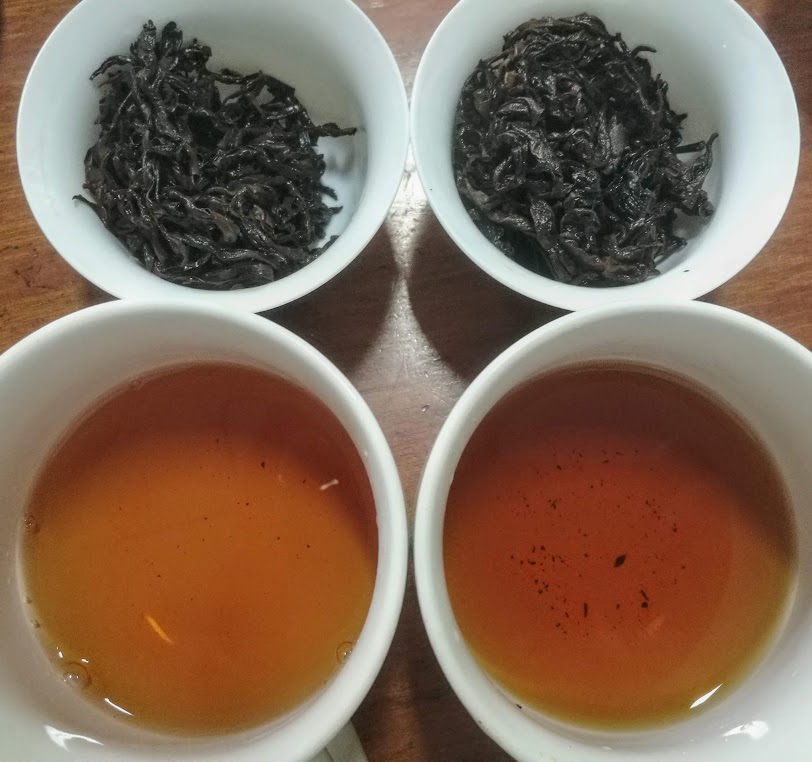
Farmerleaf purple leaf black left, Hien Minh right


labeling; this Vietnamese tea is from Ha Giang


I'm comparing a Farmerleaf 2018 "Zi Juan" purple black tea (the leaves are purple, the processing style is just Yunnan black tea) and a Hien Minh (Hanoi shop) 2019 black tea, which is from Ha Giang province in Vietnam per the label, in the far North beside China.

Again comparisons here are for different reasons, sometimes to highlight minor differences in two similar versions, sometimes to use one standard version as a type or quality level baseline for the other, and in some cases just to get through more range in limited weekend tasting sessions, when I get behind.  I don't think it will shed a lot of light on either of these, resulting in as much a style contrast post as anything (based on different leaf material, growing regions, processing, tea age, etc.).  It will be interesting to see if a general impression of one is more favorable. 

It would've made more sense to compare this Vietnamese tea to a Northern Thai version I reviewed a few months ago, but I'll just try them together sometime without the note taking process.

The Farmerleaf tea is sold out, but this is the description listing:


This tea comes from Menglian County, about 40km North West of Jingmai as the crow flies. Mangzhong is a Dai village located close to the county city, at an elevation of 1000m. The plantations were established in the early 2000's around the village.

This tea comes from the Zijuan varietal, also known as purple tea. It is a cultivar selected for the high amount of anthocyanins in the tea leaves, which give the leaves its purple color. Such mutation can appear naturally in the usual assamica varietal of Yunnan, and is also more prevalent in some wild tea species.

Apart from its unusual leaf aspect, the zijuan cultivar features a very special fruity aroma, which comes out very well when the leaves are allowed to oxidize. This black tea displays this cultivar's fragrance, and is therefore quite different from the typical Yunnan Dianhong made of seed-propagated Assamica...


Hien Minh can also be reached through Facebook, and again Pop (Danittha) provided product listings to cite.  I don't think this tea is one of these, even though it's closest to the first, but at least that covers some general scope of what they're offering, which includes plain teas and blends:


Citing health benefits (in those descriptions) can be a bit of a red flag, since researching how well grounded hearsay claims are in better reference materials isn't reassuring, but I tend to ignore marketing themes anyway.  Background locations and information about cultivars or processing steps can be interesting, but in the end how the tea turned out is more relevant.

It's a little odd that the Farmerleaf version might well have been better in the middle of last year (if it was an oven-dried version, which isn't really clear), and the Hien Minh 2019 might well be better next year (if it's actually sun-dried, which seems likely).  A little more on that tied to character aspects occurs in the review.  Black teas are fairly consistent year to year, as types go, so it's less of a factor than it would be for many other tea types.


Review


Farmerleaf left; darker leaves and lighter brewed liquid


Farmerleaf 2018 Zi Juan purple black tea:  it's definitely different.  To me tartness is something of a least favorite black tea characteristic, since I prefer warmer, richer tones like fruit, cocoa, roasted sweet potato, and so on, and this includes some tartness.  It's in an unusual form because usually that's on the light side, dominating a flavor profile, and this is softer and warmer, but still a little tart.  Beyond that there's the usual black tea complexity that could be interpreted in different ways, warm tones that don't stand out so much as leather versus dark wood or spice at this point, some floral, and so on.  I'll cover it more next round, as it develops.


Hien Minh 2019 Ha Giang Red Tea:  definitely different; no significant tartness; much warmer and richer in general range.  There is a touch of cinnamon spice, not the main flavor element, but it stands out.  The warm range is complex, but it could be more distinct.  It probably includes a range of related flavors, making it come across that way, some dark wood along with that spice and some malted grain as well.


Second infusion


Farmerleaf:  it's better; tartness faded and intensity picked up, as well as flavor complexity and depth.  Sheng really needs a round or two to develop but other types can change a lot over the first couple of infusions too.  It's a shame when those rounds are much better than the rest but usually it goes the other way. 

It's warmer in nature, leaning a little towards a spice aspect now as well, just not clearly cinnamon or anything else.  The hint of tartness (mostly dropped out, but still present) reminds me of dried cranberry, or maybe that along with other dried fruit.  A hint of savory range is closer to sun-dried tomato, an addition that works well with the rest, integrated, and lending it complexity.  Other flavor complexity probably relates to floral tone, but it's non-distinct.

As to feel and aftertaste it's full enough and not thin, but black teas in general give up a lot in this range to various sheng or oolong, in general.  I don't prefer them as pronounced aspects enough for that to diminish the experience as long as they don't come across as too thin or limited, and this doesn't.  It's pretty good black tea.  Sweetness and balance works, complexity is ok but not really well above average, the overall flavor effect is clean and rich.  From there personal preference determines how well it all works.


Hien Minh:  cocoa really kicked in.  Any impression at this point would relate to preference for or against cocoa in black tea, which I do like.  It's a bit richer and fuller than the other tea version, with more depth and complexity.  Probably leaning into warmer flavors with a main aspect I like versus being a little tart is biasing my interpretation, even though I just mentioned completely separate aspect range, how complex or rich in feel it is versus what the flavor range covers.

If this is a sun-dried tea I'd expect flavor intensity to be limited, it covering more depth but being a bit thin in terms of that, which would develop more over the next year or two, and some of that pattern may hold.  The flavor range is good but the intensity and the higher-end sweetness is a bit muted, a toffee or molasses like taste.

To be clearer on general impression both of these are very nice teas, just different in style and expressed aspects.  Both could add a bit more aspect range here or there to be even better forms of this general range of tea, but both are good examples that are easy to appreciate and like.


Third infusion


Farmerleaf:  warmth might have picked up, adding a little more flavor towards cocoa or cinnamon than the other floral and prior dried fruit aspects, with those others fading.  It's complex in a limited sense but it could be more complex, and flavors could be more distinct. 


Hien Minh:  cocoa still stands out but it transitioned into a slightly musty range, adding a touch of tree-fungus aspect.  It usually goes the other way, that aspects like that fade out over the first two infusions, versus picking up in a transition later on.  It's not storage related, which would seem clear even if the tea wasn't essentially brand new.  It's still quite nice but less positive.


Fourth infusion


This will probably be a good place to leave off.  I'm brewing these at high proportions, and for moderate times but not short infusions, towards 20 seconds.  They could be stretched for another infusion or two but late-round tapering off isn't an important part of the story. 


Farmerleaf:  this is definitely fading but still pleasant, still hanging in there for another positive round.  It's not changing beyond thinning a little, with the range that is present still nice.


Hein Minh:  the mustier aspect faded away already; odd.  Cocoa is still pronounced, and warmer dark wood tones, floral, etc.  That one sun-dried tomato aspect, quite limited in relation to other flavor range, still gives this the effect of being a more complex tea than the other.  If this really is a sun-dried version it will probably pick up some sweetness and flavor aspect intensity over the next year or two and really shine.


Conclusions


Both nice for what they are, different styles of black tea, both typical of Yunnan versions though.  It might be that the character of the purple leaf material could match my preference better, ending up with it being described less positively.  It seemed more floral than fruity to me, beyond tartness matching some fruit range.

It was interesting to try, well worth it for a moderately priced version.  Given that Farmerleaf sells a broad range of black teas (when they're stocked; they tend to sell out) trying a round of samples and then later purchasing what you like best makes sense, just without too much delay.


I'm finishing editing this post just after doing some hei cha tasting, and of course other types keep coming up, and to me black teas and oolongs form my natural preference range, which has evolved to include liking sheng and shu as well over time.  Hei cha versions can be fine too, and white teas can have their own appeal, but good Chinese black teas really stand out as a favorite basic type.


I never did mention an ankle sprain here; at least I have a good nurse to help out