I've meant to write something related to Russian tea culture for awhile. We visited Russia over Christmas and New Years of 2018, which led to more research, writing, and online contact related to that theme. But never to a blog post specifically on Russian tea culture, except a TChing post about it, which was really to summarize a lot of other content in short form.
I'm still no authority on the subject, but one of the more interesting contacts I'd talked to online visited Bangkok not so long ago, Alexander Vorontsov, one founder of the Russian Tea Lover's group page on Instagram. Or it was not so long ago when I started this post draft a month ago, since I kept adding to it. That online group corresponded to a number of people who regularly meet and drink tea together, not stopping at online discussion, as many groups do.
 |
with Kittichai, the Jip Eu shop owner |
This covers my limited understanding of tea culture in Russia, what I took away as Alexander's input about that subject, combined with input from other discussions. Any tea enthusiast active in related groups living in Moscow or St. Petersburg would have a more informed perspective, but then I do end up talking to Russians about tea more than most. Part of that relates to this blog, and to talking to people in the role as admin of an international themed Facebook tea group.
 |
the last Russian tea enthusiast to visit in April, Tatiana Zhukova |
Background: vacation experiences and other pre-conceptions
It goes without saying that I had no ties to Russian culture prior to visiting Russia, but all the same I'll say it. I know two Russians selling tea in Thailand, one of those only through online contact, but to me that doesn't count as significant input about there. That made visiting the country all the more interesting.
There was the Cold War background, since I'm old enough to have grown up during that (I'm 50; to save younger readers from doing the math I graduated from high school in 1986, five years before the end of the Soviet Union). My family loved that vacation visit, which I won't go into here, sticking to the subject of tea (but I already did cover that other travel scope in this post).
 |
lots of pictures like this in that post |
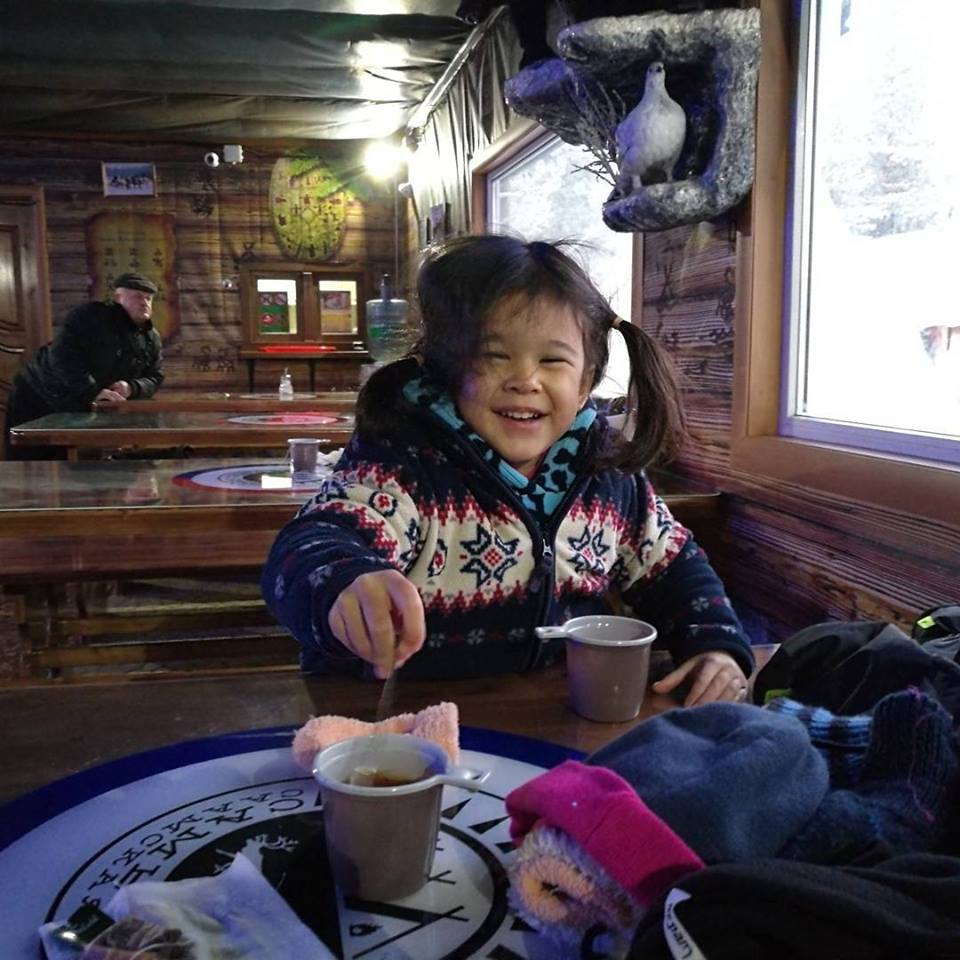 |
Ceylon tea bag tea at reindeer farm (with great company) |
I visited a few tea shops there but it didn't amount to much. One interesting version was Perlov in Moscow, a truly beautiful place. But the tea was on the ordinary side, mostly boxed versions with a good-sized set of one loose version per category type jar teas. That's a great start for a tea shop but only a start.
 |
a very helpful local, in the Perlov shop |
Moychay shops went further; I bought tea in those in Moscow and St. Petersburg. Georgian black tea was the closest I came to finding Russian tea, except for a green version from Perlov, which sort of doesn't count since that's my least favorite tea category (although it was a good version). One Moychay Nan Nuo sheng pu'er I bought a cake of on a whim was one of my favorite sheng versions I've yet to try, way fruitier and more intense than sheng typically ever is (and approachable in style as a young version; that wouldn't be for everyone).
 |
a small Moychay shop; (you can interactively browse that shelf here) |
 |
friendly Moychay staff in a St. Petersburg branch |
That link below the first shop photo goes to a page with a very interesting feature; you can look around the shelves and room of those shops, using what seems to be Google Streetview as a viewing platform. It's especially cool for me because I've been inside those two shops, in Moscow and St. Petersburg, and it's like stepping into them again. Moving on.
Still on the subject of vacation outings and visiting, meeting the owner of Laos Tea at a tasting in Moscow stood out as a cool exception to the limited tea theme exposure.
 |
Laos Tea tasting, Alexander Zhiryakov (left) and Dasha (smiling) |
Onto more general starting points: Russians are into tea but the tea enthusiast context is an exception there too, just a much more common and better developed exception than where I live, in Bangkok. That's odd, isn't it? Chinese culture underpins Thai culture, along with Indian influence and secondary local influences. Tea probably played a bigger role in mainstream culture here at one or more points in the past but it's just not much of an influence now. Bubble tea is popular.
It's especially odd given that Thailand produces tea, but then I'm not claiming that no one drinks any of it, instead that forms of what I would consider to be tea enthusiasm almost doesn't exist here. If you ask 100 random people what Da Hong Pao or Longjing are maybe none will know, and for sure none could taste an example of a version and let you know if it's typical of either. I know at least a dozen people who are probably exceptions to that in Thailand, but it took a lot of doing getting in contact with them, and half are tea vendors. There's only one well-known tea cafe in Bangkok, in Chinatown (Double Dogs), with related shops scattered around, especially in that area.
Russians as a whole are more into basic Ceylon black tea; fair enough. Back to the tea enthusiast scope Chinese tea culture has a strong hold there, and not much else. I walked into a business selling Japanese green tea looking for one of those Moychay shops in St. Petersburg, and talked to the owners a little, but I don't like Japanese tea enough to have seriously considered trying or buying any. It's clear enough why some people are on that page when I do taste those, and I've reviewed versions, but it's just not for me related to how my preference maps out, at least for now.
I researched Russian tea history related to a random contact asking what an East German tea blend might have been just after the Cold War started, covered in that post. Not much new turns up in that, except the idea that at one point Russia consumed a lot of tea from Georgia. This is the kind of idea that one runs across pretty early on in any exploration of Russian tea culture. Other themes: how a samovar works, how Russian tea was typically prepared, about mixing tea and herbs there, or stirring jam into it per one older popular practice.
 |
old version of a Cold War tea (original source credited in an earlier post) |
We even tried tea mixed with herbs prepared in a samovar in a visit to a dogsled camp in Murmansk. It was ok. The general idea is to brew the tea very strong, to "brew it out," and then to dilute it with water to taste, and probably add milk and sugar too given the flavor profile that results. Adding herbs--particularly Ivan Chay, also known as willow herb, or fire weed--helps on two levels, making it more mild and further stretching the tea.

As to current Russian tea enthusiast context and forms of experience, I'll say more about that related to what Alexander mentioned.
Meeting Alexander Vorontsov; about Russian tea culture
We met at my favorite local Bangkok Chinatown shop, at Jip Eu. The owners of that shop feel like family to me; they're great hosts. I was going to say more about that shop in general but since I've visited there a few times recently I think I'll split that out to a later post.
 |
meeting a friend from Laos there, within the last week (Somnuc Anousinh) |
This also won't cover that visit in terms of most of the personal discussion details, beyond the parts about Russian tea culture, because it's running too long. Alexander seems nice, and genuine; I'll mostly stop at saying that. And he's genuinely obsessed with the subject of tea, so we have a good bit in common. To shorten the rest I'll cover it by subject.
Tea groups: this stands out to me as the main difference between Russian tea appreciation forms and elsewhere. His Instagram page / group has 5295 followers (at time of first draft; surely some from overseas enthusiasts, since people tend to just click add related to their topic interest), so probably a lot of real-life local "club" members. I don't know how formal that club really is or how many local active members ever meet, but all that isn't really the point here, at least in this section.
 |
that's him, along with group stats and a cool logo |
There are at least two other large groups of somewhat organized enthusiasts in Moscow: Global Tea Hut more or less has a branch there, and Moychay operates a series of tea clubs (like cafes, but not like cafes), that seems to represent a fairly well organized social group. And Tea Masters is there; that probably counts as a fourth, although it's something different than a social club, sort of a training organization that holds very formal, developed competitions.
The trend seems unique. Eastern Europeans seem a bit more organized in forms of tea practice and social networking (as reviewed in looking into tea culture in Poland here and here), but seemingly nowhere else is on that level for group structures.
I'll clarify what I mean by that. There are a lot of small, informal groups of tea enthusiasts in the US, and Facebook groups, and shops and cafes, but as far as I know almost nothing related to those forms of groups. Tea Masters just started up there in the past year; there's that. Global Tea Hut would have US followers, but as far as I know nothing like a branch outlet. And no "tea clubs," in the sense the Moose and the Elks were US social clubs in the past (and still are, just "traditional" forms of them).
 |
Global Tea Hut Zen tea master monk Wu De; different (story here) |
Taking tea interest way too far: lots of people in different countries go there, right? Maybe not in the same form. Beyond those clubs and the prevalence of shops and small vendors there's an emphasis on trying rare or interesting teas with developed back-stories, like those narrow regional theme versions tied to Longjing, Da Hong Pao, and the rest. Everyone likes a good story, and an exceptional tea, but I get a vague sense that sub-themes take on a life of their own there.
In Western tea circles--which the Russian form could be considered a part of, but I mean elsewhere--there are one-upmanship games that get played related to experiencing high quality teas, possessing deeper knowledge, or owning teaware, a sub-theme that branches a bit. Maybe I'm mistaken but I get the sense that Russians extend that to embracing stories more, to really appreciating traditional background themes and rarity in versions, and of course also tied to those other familiar forms.
Some Western vendors do use stories to sell teas (a number of examples come to mind), but it seems a minority practice. Most would talk about the teas themselves, their positive attributes, and largely leave the claims about exclusivity and tea history out of it (beyond reference to legends of statues coming to life and such, good for entertainment value). Except for claiming that sheng pu'er versions are gushu, from old plant sources, I guess; that's as common as grass. There's some degree of push-back related to people flagging gaps in the stories that do come up, with tea tree age claims making up the main point of contention. Not necessarily about pu'er being gushu, although low-cost gushu is often questioned, more about the 1000+ year old plant claims.
Or then again maybe I really am overthinking all this, or basing it on limited input, and Russian tea enthusiasts really are mostly just looking for interesting and higher quality tea.
Tea and popular culture, especially music: I once saw a Russian rap music video of a guy stealing a pu'er cake, and the trying to smoke it at one point, that I'd love to find again. It lost something for me not understanding the words or being completely into the music form but the impression stuck with me. That's not necessarily an exception; there is a connection between the two themes and scopes there, popular music culture and tea.
One tea shop that comes up a good bit in images has a tie to a famous music performer as the primary owner, a type of association that I'm not familiar with in the US. The shop is Gazgolder (with that link seemingly tied to the primary manager, versus a business profile page, and this a Trip Advisor link about visiting), owned by a rap star Basta, with this video on the tea club part there. This is a music video (by Basta / Баста) with a connection to those other themes and tea. With over 8 million views this isn't related to marginal following, quite mainstream instead. Watching foreign language music videos typically doesn't go well but that one is worth a look.
Tea and prison culture: Alexander told a cool story about what "prison tea" refers to, about how brewing up a large pail of very strong tea in prison works as substitute for alcohol. I'm sure the stories of this connection go a lot further, and the real-life linkage does too. It's hard to imagine the popular culture image of US prisons matching up with any form of tea consumption.
He mentioned a reference about this describing this connection, which I won't go into further here.
Tea sourcing differences: I'll summarize prior discussion with Alexander and others related to this point more than what we actually talked about. He had said before that Russians tend to focus on using Russian sources for tea, vendors that buy and resell Chinese versions. It's my understanding that Yunnan Sourcing (a main US vendor) also sells a reasonable amount of tea in Russia too, but the ideas still don't necessarily conflict; the theme and generality is about relative proportions.
In fact smaller vendors or larger resale theme outlets are how consumers in the US obtain most tea too, by a large margin, so me expecting tea to be purchased directly from abroad instead probably just relates most to my own preconceptions and personal experience. If we had more Thai shops and online outlets selling better teas maybe I'd not have expected that.
The amount of "better" tea being purchased and consumed in Thailand is probably negligible compared to in Russia, with most of that Thai-produced oolong. It would be natural for some to see that as "not that much better," but the use here seems clear enough, better than what tends to turn up in tea bags or on grocery store shelves. Which just depends on the grocery store too, I guess, as much as local culture and broader demand. Grocery stores in Russia did tend to have slightly better selection for black teas, flavored versions, and blends than I typically see here, just a bit more limited range related to inexpensive oolong since Thai versions are around.
 |
so many iconic places there (GUM in Red Square) |
Moychay: I've reviewed a lot of tea from this vendor and have even written some article content for them. Their main owner, Sergey Shevelev, seems like a genuine tea enthusiast to me, surely focused on business goals, but also personally connected by the same interest tea drinkers experience (more obsessed ones; the people discussing it in more advanced theme Facebook groups). That's essentially true of every tea vendor, but the form and level of knowledge and experience varies. You don't need to take my word for all that; scan some related background videos on Youtube, which can even do automatic translation now to make that content more accessible.
Their diversified role as a main physical shop chain, online tea source, and provider of tea club experience (like a cafe, but not really that) stands out as something unique. In the US this would almost seem to be too much influence for any one vendor to have, even beyond there being no parallel to the club theme. But there, with tea culture a bit more mainstream, and options more diverse, the context is different.
 |
helpful Moychay staff; meeting Russians made visiting Russia great |
Why US popular tea culture and vendor concerns don't match up with those in Russia
There is an unrelated concern about Western (US and other) tea culture and vending, which I'll cover in the form of a long tangent here, since this helps place the broader context difference.
Teavana consolidated a lot of US physical shop ownership and sales under Starbucks at one point, only to see profit margins narrow, and then folded, leaving a gap in shop availability. This is really only one individual concern, that one vendor growing too large and then failing could impact local consumption. Prior to that Teavana put focus on blends instead of better individual teas, which can command a higher mark-up and profit margin. This used their influence to offset what I see as the main opposite trend in natural personal tea preference transitions, moving from blends to original, single-type and source teas.
It's too much of a tangent to firmly establish here but it's my impression that T2 (a chain originated in Australia) represents a similar problematic theme, again related to a large corporate interest. I bought good, single-origin, high quality teas at a T2 on a visit in Australia some years ago, and upon checking selection later after their Unilever buy-out those types I'd bought just weren't part of the stock. That's too much to claim in a tangent, isn't it? Judge for yourself; here's their current oolong selection page, and a version captured from July of 2012, a year before Unilever bought the chain. You don't need me to interpret what changed.
 |
they had a cool aesthetic going; it's a shame selection quality didn't match it |
Of course I'm not saying that Moychay or any other large vendor there shouldn't be expanding or covering different roles for some reason; quite the opposite. It's my impression that more large chains have developed there; that alone offsets this kind of risk and problem. If anything I'm positively biased towards Moychay as a vendor, and the rule of supply and demand and open competition keeps their direction in check. Their teas seem to represent generally good range and value to me, and to be sold with a reasonable degree of information about what products are, adding more value for educating consumers about tea options. The two shops I've visited--smaller versions, per my understanding--were beautiful, with good selection of different types, sources, and quality levels of tea, and very friendly and helpful staff.
 |
a Moychay pressed tisane; extending a current trend beyond "real" tea |
Moychay did seem to possess the potential for a similar degree of local tea-culture influence comparable to all of the current US tea vending combined, since there's more developed tea culture there to begin with; that's what really led to this line of thinking and comparison. It's just not as singular an influence as happened to occur with Teavana; a consolidation and unified development didn't occur in the same way.
Of course Unilever "gets" tea, just not the teas I drink, or what some of the range of tea culture is all about. Offering flavored teas and blends to consumers based on demand is fine; that's quite appropriate. Steering away from also offering the other range of "better" teas because per-unit profit margin is lower is something else altogether, especially if there wouldn't be other store options around. Those other parts of the tea market should be supported, and expanded demand for Lipton and flavored teas should serve as a gateway to other types. Both the demand and the shops would have evolved together more organically in the US, with the consolidation and then closure perhaps setting that back a bit.
I'll be clearer yet; it seemed short-sighted to me for large outlets like Teavana or T2 to disregard rather than embrace the entire range of teas produced and available. It seemed likely that a single-minded focus on per-unit return and short-term profit offset educating consumers. Or maybe that happened because demand would naturally extend onto what other vendors are selling, outlets like Yunnan Sourcing (and others), and it made more sense to restrict expectations to a narrower range than to try and compete across a broader scope.
I really don't know the causes, but it is disappointing that more potential wasn't realized, to increase broader US demand and to help support specialty tea producer demand. Large scale high volume producers, who make the teas used to make blends, are more securely positioned, and although surges in individual type demand could increase prices (an issue on the consumer side) small growers and producers are often working within narrower margins for success. That's my understanding, at least.
Including so much discussion of a few particular vendors serves a secondary purpose; I see commercial structure and direction as one main underpinning condition for local tea culture, even if the internet helps broaden that back out. If I were to talk further about present US tea culture, beyond discussing Teavana, I would explore why tea subscriptions have come to play such a large role in organizing consumers into groups, or why Yunnan Sourcing has a vendor themed Facebook tea group, what causes that to make sense and what it means. I've discussed the problems and limitations with such a single-supplier theme in that group before; as you could imagine that went over really well.
It's a positive thing that the themes of people gathering into social networks and groups mix with those of vendors providing commercial services. This only becomes negative when the normal forces of supply and demand become disrupted, and marketing issues steer people towards the highest return forms of tea, versus supporting awareness of options and naturally evolving demand.
Back to the main subject here, Russian tea culture.
Conclusions, and what I don't get
These are glimpses and fragments related to why I find Russian tea culture to be fascinating, even though to be sure I understand relatively little about it.
I really don't completely get the Tea Masters or Global Tea Hut themes at all. I don't do much with formal tea ceremony, or tea in relation to religion or mindfulness practice. That's even though I do have a long personal history with the study of Buddhism, and I'm sort of a part of an Eastern culture due to living in Asia (Bangkok).
 |
more into religious practice at one point, but not drinking much tea there |
Surely beyond these more formal forms or expressions of tea interest I'm not familiar with where other Russians fall, in between drinking Ceylon from a grocery store and the rarest of rare types, and training in formal tea ceremony practices. Broad categories of ideas that would come up I've not addressed here, for example a demand for organically produced teas, concerns about health risks related to chemical use in production. Alexander mentioned this is a significant concern among Russian consumers, but that there aren't always good ways to address risks related to different kind of growing conditions as teas are now sold, at least not in a lot of cases.
A lot of people there must just like tea, in a basic form. One of the nicest people I met in visiting Russia (and most of the people we met were very kind) helped me check out what was in those jars in the Perlov shop, and he clearly liked tea but wasn't swept up with an obsession with it. He probably would have passed that Da Hong Pao / Longjing identification test I mentioned, spotting familiar types. But probably not in the same form Alexander and I would, related to really being able to place examples, and the next sets of main types as well.
This seems no suitable place to end, as if exploring disconnected themes just leaves off. Learning about foreign cultures is like that. My children have had a number of Chinese school friends (and from Japan, India, Taiwan, etc.), and as we get to know them and their parents better perspective and customs become more familiar, but the learning process is slow. Visiting a place doesn't lead to as much insight as one might expect, because short discussions with locals only go so far, and local travel themes tend to dominate concerns. I'll keep learning about tea culture related to Russia, and other places, as shared observations from others fill in details.
 |
not a common type, not even a standard hei cha, but something interesting |


