Monday, February 5, 2018

Ten years in Thailand; on Thai culture and Quora answers


I've actually been in Thailand four months over ten years now so it's not exactly an anniversary.  More than that milestone other things have triggered me thinking about Thai culture versus US culture.  And of course also "what am I doing with my life?,"  which goes without saying.

One thing stands out as a prompt for introspection, perhaps not what you'd expect:  answering questions on Quora.  Quora is the social media site version of Yahoo answers.  They add functions and tracking to make it more personal, or rather to help people keep score for answering well (I guess, or at least for being popular).  Where Facebook has post and picture likes and a friends count Quora has answer upvotes, views and follower counts.  It's a little odd that knowledge sharing can be a form of entertaining interaction (like reading Wikipedia for fun), or that it would be possible to turn it into a popularity contest, but it all works together.

a recent school fun-day here; kind of a universal experience


About Quora and other forum participation


Initially I was just answering questions about tea, a continuation of this blog writing, and also forum and FB group discussion.  Then I answered a few questions about Thailand, travel, and Buddhism, even parenting.  More recently about Russia (where we vacationed), and even one about snowboarding, reaching back to expertise from a past life stage.

This does circle back to Thai culture, a central theme related to participating there.  I'll stick to meta-level discussion of Quora first, and say a bit about general format and discussion of those ideas, before getting back to that.  That won't include how Quora works, about using direct messages there, or how making comments, following, and giving "upvotes" seems to fold together with view stats.  There are already Quora answers and comments discussions there about all that, and I've not really got it all figured out.

I posted one link to Thai culture themed answer in an online expat group, to see how it would go over.  Expat groups--which are not really an example of native Thai culture at all, but still sort of a variation on that theme--cover a range of contexts.  Some forums are populated by bitter, older, barstool-crowd expats.  Many of those don't really care for Thai culture much, and spend hours a day complaining about local culture in discussion forums, some logging thousands of comments in doing so.  Somehow insulting other expats goes along with that, blaming people for assimilating with local culture, or just calling others names for no reason, trolling.  Good times.

I'll have to keep a description short but I think Jordan Peterson nailed the cause behind that in a Joe Rogan podcast interview.  His point:  you can't make it a practical goal to retire to drink margaritas on the beach, because even if successful after a few weeks of that you'd get bored, sunburned, and be in poor health from all the sugar and alcohol.  I suspect some expats set up low expense, comfortable lives out in the country and set to drinking beer for a pass-time.  Only later does it come up that maintaining limited ties to a local culture and lacking more to do is a real problem, along with the focus on alcohol consumption.  Of course there are well-integrated, personally balanced expats of different ages too, and different lifestyles can work out. 

Q & A or picture posting themes make up most of the rest of expat forum discussion scope, talking about travel or mundane subjects like where to get some type of Western food.  Introspective analysis of subtle culture variations isn't really well received where most of those other subjects are playing out.  Overthinking things goes over badly in general, which is one reason why Quora works:  no matter what obscure theme someone is on others are either right there with them or not seeing those posts.

One comment about that forum-posted answer about standard cultural differences was interesting, if a bit harshly framed.  The point was that it only repeated cliches, eg. Thais smile a lot, Americans are loud.  That was accurate, to an extent.  The funny thing about those cliches is that they're based on something; they're partly true.  It works to use those as a starting point, to describe in what senses they really are accurate, and the limitations of those generalities, or why a specific rough interpretation of them may be completely false. 

Most expats in Thailand aren't alcoholics, per my experience (which goes without saying, really, but it can't hurt to be clear).  About limitations of those two prior generalizations (about loudness and smiling), I'm American and I'm on the quiet and calm side, and there's no reason why any given Thai couldn't be quite somber. 

Let's examine another standard one:  Americans tend to be nationalistic, and to extend that to narrower group loyalties like following sports teams.  To some extent I've just described human nature, across lots of cultures.  It would be more rare for few citizens to associate with nationality, and hard to completely get away from sports enthusiasm, in most countries and cultures.  Not everyone in the US thinks America is number one (or that such a thing could really mean much), or is into sports, although on Superbowl Sunday it probably would seem that a majority are.

More on Quora and answer specifics


This might be a good place to swing back to more specifics, to dig a little deeper.  I'll see what I can turn up from a Quora question answer on something, but first a few of my Quora stats will serve as more background on what goes on there (from when I started this post draft, over a week ago now):


different ways to "keep score"

Answers338 / Questions0
Followers 56 / Following 19
Topics 28
241.7k answer views
29.7k this month

Pretty much what you'd expect, I guess.  It's hard to know what to make of those counts and easier to relate to how they seem to change.


I'll go further on that question about Thais smiling related to citing from an answer there, since it is a starting point on a main difference:


Why do people say that Thai people smile in different occasions than us Westerners?


...a smile can mean someone is happy, that they are trying to be polite when they actually feel neutral, or even to express disapproval or disagreement. That’s it; there are slightly different smiles that mean different things. Or maybe instead it’s that smiling comes across slightly differently when it’s supposed to be the same expression, that the expression seems more genuine when it reflects happiness...  I could swear that I can spot a distinct version of a smile that means “I disagree” though.

It just seems like part of the culture. It’s the same as some Americans being very open and genuine, and others more reserved, and in some other US sub-cultures in some regions a bit less genuine. To put locations to that I’m from PA, the mid-West side, and people are friendly and relatively on the surface, which switches to being more reserved on the East Coast (NYC and such). I visited LA quite a bit at one point and what is displayed on the surface there isn’t necessarily what someone is thinking or feeling. I was just in Russia and people there are more reserved and serious...


So that's it, self-expression norms vary by culture, the context for how open people should be, or how pleasant.  People in Japan are really reserved, to the extent that two people (Thai friends) who lived in Japan mentioned it taking a long time to break into as a social-group there, months just to talk to people normally.  I don't think Thais are actually any more open than Americans (or that much less), and maybe the form only changes related to the emphasis on public persona and appropriate reactions.  I covered more along that line in a post (answer) about Are Russians really as cold-hearted as they are portrayed in the west? 


The short version:  no.  Slightly longer:  again it's just a matter of public persona and how people present themselves in crowds or among people they don't know (per my limited exposure; we did only vacation there, which only goes so far).  Russians seemed to warm up quickly once you actually talk to them, and seemed the most somber when occupied by a commuting routine, which doesn't exactly bring out the best in everyone.  Thais looked like zombies while commuting when I started that here ten years ago, seemingly barely awake for the task, or even nodding off, and now they're all just staring at phones instead.  I could swear I noticed some of those same superficial patterns that one might pick up in comparing NYC and LA when we visited Sydney and Melbourne too.


a friendly Russian woman who helped with instructions in the Moscow metro


It really takes years to feel comfortable with a local culture though, to be able to "get it."  After two or three it felt a lot more familiar here, and after five or six I seemed to turn another corner in regards to relating to it more.

Onto deeper subjects (maybe, sort of).


On Thai beauty ideals (not the deeper subject theme yet)


What are the differences between living in Thailand and the US?

This is the post that was criticized, although I think part of that related to citing a short partial version of it as an intro, which didn't capture much of the detail (as this second partial citation won't).


...there are people living out a broad range of lifestyles in Thailand, which changes an answer more to a range of answers. Even rural people, living on a much lower income, are living modern lives in a sense (eg. entertainment and electronics use is similar...

Culture is something else...  For one person an emphasis on arts or literature is at the core of culture, the higher forms, or for another differences in everyday perspective, eg. how open people tend to be, in general. I’ll speak more to the latter here, how people tend to come across, extending into minor differences in worldview and outlook that shape everyday experience... To me minor variations are usually not significant...

...people share more attributes in common than they don’t share that separates them, across different countries and cultures...  Social roles are quite similar, and shared stuff to own and communication forms bring people together more now...  All other things being equal—which is never how things work—I’d probably be more comfortable in my own country, back in the US. Language issues drop out there and there’s less to deal with related to differences, for example observing Loy Krathong versus Halloween (not held at the exact same time but not far off).


my kids, one a bit put off by something, the other "as pikachu"

...It would be nice to describe the difference in Thai everyday perspective versus in the US. Lots of little, subtle differences add up to a worldview that’s not identical, even among IT professionals, even if both share lots in terms of broad strokes...  Humor isn’t the same; there’s one. My son—who is bilingual—says that he can’t make jokes in English.  I think it’s more because Thai humor is slightly different instead of that he can’t shift the same patterns from one language he is fluent in to another he also is. 


The water cooler talk in my office, which looks exactly like an office back in the US, is slightly different, in ways that would be hard to pin down...  Here I would always be a foreigner, always a little off the norm, approaching “getting” their worldview but never completely there.


That's a bit over half the answer but it catches the broad strokes; I mention a few specifics but mainly talk around differences and a bit more there.  I think beyond not designing an active life for their retirement that issue of integration is the other problem some expats are having.  If a foreigner can become completely fluent in the local language, eat the foods, work with Thais, share hobbies, etc. then they can relatively completely integrate, and the more of those things that remain separate the harder it is.

I really do like Thailand, of course.  My two favorite people are Thai, and I think it makes it easier raising kids, since shared experiences of changing diapers transitioning to going to piano and swim lessons are similar in lots of places.

a better look at that pikachu look


That's probably almost enough rambling on about Thai and US culture, isn't it?  I'll let this diverge a bit more with one more answer anecdote, not as directly related to culture.


What is your “only in Thailand” moment?


...[while ordained as a Thai monk] I once went out with an older monk to visit his father in the hospital outside of Bangkok, in the country, and realized in the taxi that was my first time in Thailand not being around anyone who spoke any English. I felt a bit of panic, but there was nothing to do.


with our cat, who I met there, a kitten then and now a ten year old


We stopped somewhere and looked over fruit at a stand (monks don’t buy fruit, or anything, by the way; they live off alms-round offerings), so maybe the driver was interested. I knew very few words but I wanted to try to use a couple I did know, so I asked a young girl selling the fruit if it was sweet (wan, mai). She looked a little uncomfortable and simply walked away. 

I only later found out that “sweet” can also be used to describe a person, maybe in a similar way as in English to describe pleasant character, and she probably thought I was asking about her, or even hitting on her, even though I was a monk, standing there in orange robes. It loses a little because there was no “shock-value” moment of me understanding it, but that did sum up my experience in a different way; I just didn’t catch everything.


I guess that I still don't completely catch everything.  My own kids can switch to Thai and know that I'll understand less than half of what they say, and they have to explain Thai culture to me.  At least the older one can; I'm at least even with a four year old's perspective on local culture, just not for long.

On that last trip to Russia (a subject I wrote about here in this blog, and in Quora answers) my son explained that in Thai culture if you lose something small it's a foreshadowing of losing something important, which drove my wife to great extremes to find a missing mitten.  That mitten was stuck between the seats in a tour van, but we kept being picked up for outings in other vehicles by the same guides after, and their staff weren't turning it up.  No one was ever going to explain that losing-things generality to me (superstition?), except for some reason he decided to, even though just answering direct questions is usually outside the scope of his interests.


somehow that image does describe him


Family relationships are seen differently here, emphasized more.  Public image is more important.  Formal speech plays a larger role, or rather changing communication form according to social level, and to some extent adjusting content too.  Small-scale prohibitions like not touching someone's head stick around, but that sort of thing and the superstitions they still adhere to don't amount to all that much (like you can't point at a rainbow, or my family members can't sleep in a room without either a window open or an air conditioner or heater moving the air around).

Loy Krathong; meant here to represent Thai culture

Meanwhile on the larger scale ethics are similar enough.  Marital infidelity is just as common, if not more so (although it's not my thing, obviously).  There is a word for "someone you only sleep with," gik, while in the American expression you have to spell that out as a string of concepts: "friends with benefits."  People really are more the same than different though, there are just lots of small differences that make "culture" a real thing, and foreign cultures something interesting to experience.


I should add that Thais are nice, and to some extent that pleasantness isn't just form.  But then I've liked the people in pretty much all the countries we've visited, a count that's starting to add up.  Either I'm just not choosy or maybe there are positive aspects in different cultures, or people in general are just ok in some sense.


Race and culture issues here and in the US


I just had lunch with friends visiting from the US, initially online contacts, now two meetings in friends "IRL," and a lot of these themes came up.  They have visited a number of times before, and were just here for something like six weeks, so they sort of have one foot in each culture, or at the least are familiar with here.  It's always interesting considering culture shifts back in the US, but that's something we'd talked through a lot more before online.

We talked about problems my son faces being bi-racial and multi-national, and compared those to theirs (they're not white, but that are completely American).  My son's mixed race / culture status is nothing overwhelming but it's not positive for him, not even neutral; he has problems to deal with.  He's moving into figuring out who he'll become, which I already covered in a few rounds of life-crises. 


my wife in an older form of transportation we took there

It's funny how for me beyond those kinds of broad strokes, making peace with specific Thai culture issues, a different level of comfort with experiencing things here emerges.  My wife and I just went on a short outing to Buriram, Isaan, to the Northeast of Thailand, and it felt oddly familiar to be in a small town again there.  I wrote more on that trip in this relatively neutral expat discussion forum post).


It's not familiar to me there in Buriram, at least not in the sense that it ties back to anything in my background from prior to a decade ago.  I'm originally from a rural area but it's much different, and I'm definitely still a foreigner.  At least in Russia I could pass for a Russian, at a glance, but not so much in Isaan.  It was an odd feeling, for once trying to pin down why I felt in-place versus out of place.


About that picture of the rickshaw / samloh, two funny things came up related to using that transportation.  That guy was a bit drunk, and it seemed like he didn't catch that we were asking about going several kilometers away, which really took it out of him.  Two street dogs went with us--his friends, it seemed--who he kept yelling instructions at to help them not screw up running along in traffic (very light traffic, by Bangkok standards).  It almost seemed like they went along to keep an eye on him instead, to help with things if something went wrong.


slightly more standard transport, a pick-up truck version of a local bus


So much for funneling to a central theme conclusion.  I'm not sure which parts of Thai culture became more familiar, or if it's just that spending a few days alone with my wife reminded me of that earlier time in our lives when we had the freedom to investigate Oahu together once in awhile.  I also think the small town vibe worked for me.

When we were in that pick-up truck shuttle (in the picture above) one part of it occurred to me:  I really didn't care how those people in the truck with us felt about me being a foreigner.  It probably helped that they didn't seem to care, although looking at that picture one woman might not have been keen on having her picture taken.

For a long time that had given me pause, how I might come across, and what I should do as an input to that.  It seems like letting it completely drop might be one key to other people also not really being concerned about it.  I've always thought there was a built-in flaw in the idea "it's not my business what other people think of me."  One part of that is about dropping obligations to appear a certain way, or even to fulfill a standard role, possibly ignoring societal norms, and another is about letting the internal friction go instead.  Taken in that second sense it completely works, and in the first it's more about bowing out of shared social obligations, and then maybe it doesn't.

It's been interesting offering perspectives on making those types of adjustments here in Quora, and also answering trivial questions, like Why does Bangkok smell?


monthly stats at time of posting; my score is improving


Wednesday, January 31, 2018

Moychay (Russian vendor) Nan Nuo commissioned sheng


that Japanese tea company, Hangetsu


I already mentioned buying a nice Nan Nuo sheng cake in St. Petersburg, from the second Moychay tea chain shop branch I visited there.  I just didn't review it, which I'll cover here.  Chance led me to that shop, along with Google Maps search results, surveying the area near our hotel.  It's right beside a vendor just starting a business selling Japanese teas I dropped in on there, but not being into Japanese teas so much I didn't even try one.  It wasn't really a cafe or typical shop outlet anyway, more of a distributor, but cool to know people are working on different things related to tea there.


St. Petersburg Moychay store staff, very friendly and helpful


small cafe area (they said there's a larger shop in the city though)


the shop is small but the product range isn't


Review:


The initial infusion the tea is nice, as I remember it, very bright and fresh.  Astringency and bitterness are a little more pronounced than I remember because I'm preparing it brewed a bit strong for this first infusion, using a relatively standard high proportion of tea for Gongfu brewing.  I let the time run a little long, out toward 30 seconds, as a result of talking to my daughter about something.  I was thinking of writing about how low bitterness and astringency really could be a limitation of this tea, since those are connected with aging potential by many (issues it'll take me years to piece together more), but this tea isn't thin or soft.


Prepared more normally the slight bitterness works in combination with the sweetness and fruit, which I'll say more about over the next couple of infusions.  It also still allows for a pronounced aftertaste aspect of the tea; it draws out over a period of a minute or so, fainter but still present after that.  That particular aspect isn't really long or pronounced as better sheng versions go but in the range of decent sheng, per my limited experience. 


I tried a flash infusion on the next round.  Astringency and bitterness drop way back, although aftertaste stays consistent, still pronounced for the first minute, remaining after.  The tea was described as tasting like fruit and it really does, plum and white grape.  That bright, sweet flavor and overall freshness are so pronounced that it's hard to notice much beyond those aspects.  There is more going on; some warmer aspect range fills in more flavor experience grounding the rest, maybe towards a hint of nutmeg. 

Mineral range seems the right description for covering what tastes that bitterness and astringency map back to (as much as flavors and feel seem to tie together related to the second, probably as much my interpretation as an objectively solid link).  Or it also tastes a little like a touch of aspirin, I guess, but invoking that seems unwarranted for this tea.  Maybe a very light metal aspect is closer than mineral, or traces of both together describe it.  Mineral and even bitterness can be very positive when those balance well (and it's hard to imagine sheng not including any mineral range, really), and they do balance in this. 


I love the fruit in it, and that overall "bright" effect.  Often when I'm drinking sheng made within the past year I'm saying this might be better in a year or two, a little less edgy, but in this case I'm not so sure.  If that brightness were to decline, as it would to some extent, the balance might be just as positive, or more so, or the tea could've been best drank when very young like this.  I'll have to try to not drink or give away too much of this tea so I can keep trying it over the next few years.


Lately I've been going over value and cost a lot more than previously in posts.  The idea has been that what a tea is sold as defines part of how well it lives up to that billing.  A tea sold as a "basics" $6 / 50 gram Dian Hong (Yunnan black tea, really a general range of types) isn't supposed to be on the same level as a similar version sold as a "high quality level" $16 / 50 gram version.  Forgiving some limitations of range or very minor flaws in the first tea sold as "average" would match those expectations; a tea sold as the second wouldn't meet seem to without covering such scope and including a bit more complexity and depth, and being distinctive and interesting in some way.


On this version's page instead, related to sheng, a tea sold as a $35-45 factory-produced decent sheng should show some nice character (or maybe potential, depending on the aspects theme), and be pleasant enough, without significant flaws that detract, but a tea sold as a $60+ privately commissioned version should go further.  This is the latter; I paid just over $60 for it, if I've got the exchange rate right.  To be fair that may equate to paying slightly less for an online shop version; physical shops tend to price in a bit of their higher overhead.  That's reasonable; being able to talk to a human in person or look at things adds some value.  It's a longer story about how it seems to me that expectations shift (in terms of desirable aspects) as one moves from basics sheng into better versions, a process I've not experienced that much of, relatively speaking, since it takes lot more exposure for this general type.  Oddly enough--for having just spent time introducing all that--I'm going to largely drop that sub-theme and just describe if the tea meets my own expectations for a tea in this type of quality range.


Since I love that flavor range and the overall effect and other aspects really work for me it does.  It wasn't so long ago that someone asked in an online group about what shengs are fruity, seeking out that in versions, and I commented that maybe other tea types would be a natural better fit.  Some oolongs are really fruity, for example.  Floral aspects comes up a lot in sheng, and mineral base aspects, lots of directions of complexity in aged versions, etc., but I've not experienced much for a very fruity sheng.  This one is an exception.  It's not just that; the balance of the aspects really works (for me), related to pronounced sweetness and all the rest.  So far this is my favorite of the teas I've tried there or brought back from Russia.


Bonus review; a compressed tea of an unknown type


I mentioned buying a compressed tea sold in the Moscow Moychay branch as "not a standard hei cha," a version we gave most of to a monk (in this post, reviewing Laos teas made by Russians).  I've included pictures of it before but I'll add them again here.


It raises a lot of questions, doesn't it?  What is it?  How in the world did they separate out that middle part, and why?  What might that taste like?

I don't know what it is.  I'm going to keep assuming it's actually tea (and it was sold as such) but even that could be clearer.  They cut the large block with a saw in the shop.  My wife requested a section that included that symbol, since somehow that made sense to her related to giving it away as a gift.  I often feel bad for people who deal with my wife (not so much including me; I brought it on myself, and she's generally ok beyond being difficult).  Obviously the tea contains some stems, and smells as earthy as it looks.

I'll keep the review part short:  it's earthy, to a degree no other hei cha or shou I've tried ever reached.  It tastes woody, a bit like aged barn door might, with a light version of peat or tree bark as alternative descriptions.  The tea doesn't brew completely clear, and the liquid is actually brown (which I've not photographed yet--a bit of a gap), but the taste is a lot cleaner than it sounds for being in that range.

I'm not sure if I like it but I think I do.  Sometimes new versions of tea are so far removed from expectations that it really takes time to settle into an opinion.  It's not a standard flavor or other aspect profile for tea, for sure, but the novelty counts for some points.  I guess it works for me in the way Liu Bao does (a type of hei cha).  I reviewed five of those last year, none the exceptional quality level 20 year old version that might be ideal for the type.  They're earthy, in a different sense than this tea is, but it's possible to appreciate them for an unusual range of aspects, if someone can adapt preference to extend to that range. 

It more than meets my expectations for trying something unusual and inexpensive, and with more exposure I might come to like it even more.


Monday, January 29, 2018

Reviewing multiple year versions of Qiaomu Yiwu Mountain Pu'er


Based on talking about pu'er online with Philip Lee, owner of Yiwu Mountain Pu'er Tea, he generously offered to send some teas for review.  In this case it's partly about supporting my exploration of sheng pu'er, probably as much as getting feedback about the product or whatever promotional value there is from mentioning products here.

One aspect of pu'er that I've not explored much yet is how aging changes specific teas.  It typically takes time to gain exposure to that experience.  No matter how much you try different teas of different ages, even relatively identical versions from different years, it's very difficult to place storage conditions variations related to other factors.  You don't always know where those teas spent the prior years, and even relatively consistent annually produced teas could still vary related to minor condition variations.

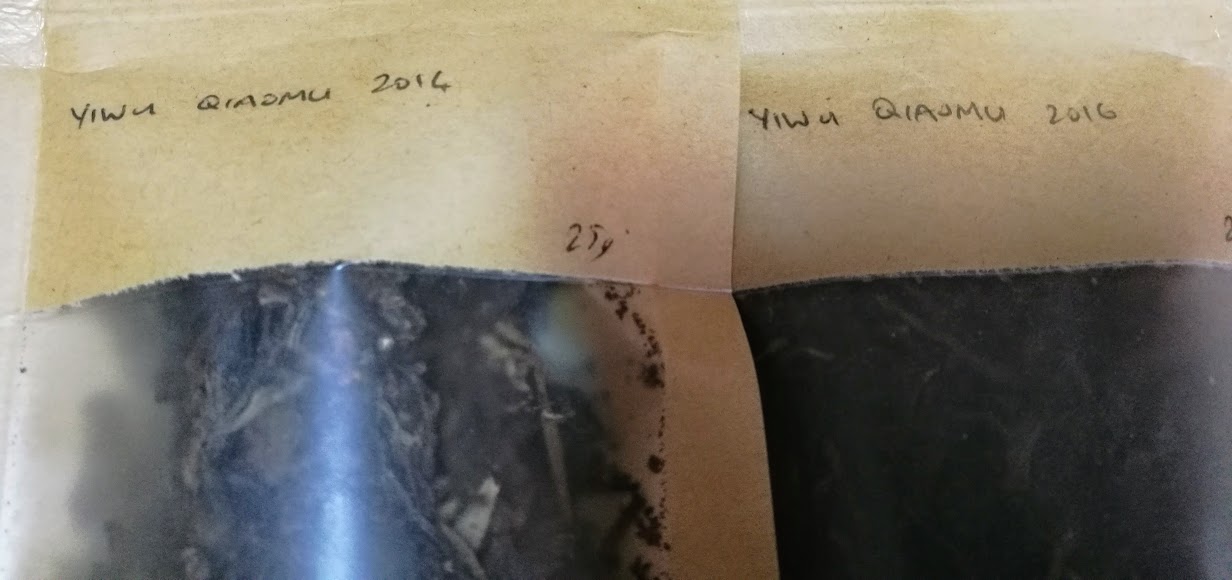
Phillip sent a number of similar teas from different years (qiaomu origin pu'er from Yiwu, which refers to wild arbor trees).  These were stored and therefore aged in similar conditions, so this should be a great chance to experience aging differences more directly.  That's as good an alternative as is likely to come up, aside from owning cakes and drinking them year to year over a long time, and remembering back or reviewing notes to identify transition.  I've bought a couple of sheng cakes in the past few months but I'm still not really doing justice to that standard project approach, and may never ramp it up to a relatively ordinary level.

Since I'll be trying a number of teas from them it seems as well to mention their background and the description of this set, starting with the intro in their website:


Our Mission: provide authentic premium-quality Yiwu Mountain Tea and support the families of Yiwu

My wife's family is based in Gaoshan Village, Yiwu Mountain, Mengla county, Xishuangbanna. We currently operate a small family business in Guangzhou, selling authentic premium-quality Yiwu teas.  This website was created to help support the sales of pure Yiwu-sourced teas to the global market, as our physical location focuses on local customers... 
 
How it all began:
This business started with Mr Li Jia Cai, our father and a true local of Yiwu, who has been tending to the family tea plantations ever since he was a young boy.  As the eldest son of his immediate family, he took responsibility for selling the family tea planted by his ancestors and this helped to build his reputation for sourcing organic, high-quality tea...  To this day, most of our teas are still sourced by his local knowledge and immaculate ability to find great tea.


Sounds good; that's the kind of background one might hope to hear about.  Onto a description of this sample set (which they do also sell as a commercial product offering, not exactly in the form of samples I received, but something comparable):


It is a very accessible set of teas, especially good for those relatively new to Puer and/or Yiwu.  If you are relatively new to tea, this pack will help you learn more about specific characteristics of different Yiwu productions.  If you are a more experienced tea drinker, you will still be able to learn more about our company products, clean Guangzhou ageing, and likely experience nuances about mouthfeel, cha qi and huigan, especially when compared to blended or non-Yiwu products.

The version he sent me includes all years from 2012 to 2017, so designed to really emphasize aging as an input, with that sample set listed online including the following instead:


2017 Yiwu Qiaomu
2012 Yiwu Qiaomu
2017 Yiwu Gushu
2012 Yiwu Gushu
2015 Yiwu Huangpian
2016 Yiwu Ripe


Yiwu shou; that's different.  The versions I have aren't gushu, matching those Qiaomu samples instead.

A couple of last details before moving onto tasting notes.  Philip suggested paired tastings, which makes sense.  It is possible to taste three or four teas at the same time but even with tasting two versus only one the detail of what you pick up can fall off.  It gets to be a lot to take in.  That really also depends on practice in doing comparison tastings, and how ideal the tasting environment is for focus, related to background noise and such.  Tasting in a hurry doesn't really work either, at least not for tea that's not very straightforward or already very familiar.


Initially it looked as if there were two 2016 sample versions, based on my interpretation of the handwriting.  The samples look like maocha, as if none of them were pressed, but in discussion with Philip the 2017 hasn't been pressed yet but all the others were.  It seems they were carefully separated back out into loose tea again for distribution as samples, probably a little more broken than an unpressed maocha would be, but it's hard to notice that difference at a glance.  Philip explained why this is possible related to the teas being hand pressed instead of machine pressed, and not as tightly compacted.


Next one might wonder if Guangzhou climate is wet or dry, related to other familiar storage locations (with more graphs related to those other areas in this post).  Here's a chart (no graph turned up right away; this format will do).


Temperature variation is interesting (or relative lack of it), but humidity is more of a concern (66 to 84 as monthly averages).  It doesn't look quite as consistently warm and damp as Malaysia but not so different than Hong Kong, still on the humid side, more humid, warmer, and more consistent than in Kunming.


Tea storage areas throughout East and SE Asia (and where I am, BKK)


That one friend I keep referring to in Wuyishan just mentioned that it's right around zero (C) there for a daily low lately; odd it seems a little cooler being so close, based on noting Fujian just slightly to the North on that map.  But local weather does depend on elevation and other factors.

Review, comparison tasting 2017 and 2016 Yiwu sheng:


2016 left, 2017 right; lots of color difference


The 2017 sheng version experience is nice; bright, intense, and complex.  The profile is as I generally expected from previous exposure to other Yiwu versions, not that I have sub-region and other variations completely mapped out.  Floral range accounts for a lot of the taste, along with a strong mineral base that links with feel and aftertaste effect range (or at least seems to).  The tea is intense while you drink it and the experience stays with you, the taste and feel not subsiding after swallowing it.

Astringency versus bitterness and feel can be an odd range of somewhat related aspects to describe for young sheng.  That full feel is essentially the astringency of the tea coming across, and the apparent tie to mineral range flavors is a typical part of the experience.  Sometimes it also relates to a taste of actual bitterness.  Not so much in this case, but the experience is complex, so it does include just a little of that too.  Sweetness and other aspect range makes it work; it balances.  I'll get back to those next levels of detailed description across other infusions.

The 2016 version experience is quite different.  There is some overlap, but a warmer, sweeter, richer range of tastes dominates.  I was concerned this initial tasting would mostly point towards a likelihood of more significant change across more years (the ages of samples extends back to 2012), but that won't be the case.  I wouldn't have expected this much change in a tea in one year.  Of course there are going to be other factors since tea producers can't make exactly the same tea year to year, for lots of reasons.


2016 left, 2017 right; slight color difference in brewed liquid as well


Before going further with similarities and differences, it occurs to me that there is a reason essentially no one gives clear, detailed, specific, meaningful review descriptions of teas (even me; the rambling on here doesn't necessarily count as an exception).  Breaking down and describing the flavors requires interpretation, and the feel and other range all the more so.  Even related to a relatively accurate, clear, complete description from an experienced, more-objective reviewer a different person with similar background and skills could easily interpret the same tea slightly differently, or perhaps even completely differently in terms of individual aspect-description sets.

I also suspect that it's a flawed premise underlying reviewing that a tea's flavors can meaningfully be reduced to 5 or so flavor elements.  That's only true for that description being objectively accurate and complete; of course it can work to pass on a very descriptive impression, especially after a reader has tried some of the same teas as a reviewer to identify how those descriptions and interpretations match up.  Enough reviewing philosophy aside; back to these teas.


The flavor range I would associate with sheng aging is apparent in the 2016 sample, or at least that's how I interpret it.  The general flavor warmth is based on an aspect range that moves from bright floral and intense mineral a little towards a root-spice effect.  It has softened and rounded out more than I'd expect possible in a year (again based on assuming a very similar starting point, which isn't a given).  That did lead to trading off the brightness and sweetness, with the mineral layer intensity also softening.

It's a character trade for one type of appeal for another, and for many this second one year older version would be more approachable, even though I expect for most young sheng drinkers the 2017 sample already is that.  I think maybe two years ago prior to more sheng exposure that would've been more true for me, that it would be easier to relate to the softer tea.  Related to trying a tuocha of Dayi pu'er I would guess is somewhat type-standard awhile back this 2017 version is very smooth and pleasant tasting, and that tea had been around for a few years already.  It drifts into a subject I won't treat here but it's a given that tightly compressed teas--like that tuocha--age relatively slower.  Of course the starting point had to be much different, since the comparison is with a very young tea (less than a year old) and a very slightly aged one, not yet into middle-age (3 years).


next infusion (2016 left); again both bright with a slight color difference


The 2017 version softens a bit on the second infusion; I'd expect it will transition a bit more over the next couple.  It's funny how softening and warming a little leads it to being so similar to the 2016 version on the first infusion.  It still does retain more mineral in the flavor, and more brightness and freshness, and pronounced floral aspect.  The aftertaste seems more pronounced for this version (in a sense I associate with hui gan, if I'm using that concept to map to an experience properly).  I wouldn't be surprised if it is actually a slightly better version of tea than the other, and that's not just an age related factor, that aspect diminishing a little.


I think it's not just the flavor difference that makes the experience so dramatic, but also the feel, and not just related to some general level of fullness or astringency, also where the tea affects your mouth.  The first you feel more in sides and rear of the mouth, and the part that lingers on, also on the rear of the tongue.  This 2016 sample feel (and to some extent taste effect, it seems) is more pronounced in the middle of your tongue.  I wouldn't naturally guess these two samples are from the exact same origin, if tasting them blind.  Of course there are lots of other factors beyond growing conditions and plant types that go into how a tea turns out, with processing as much an input as those, or even more, according to some opinions I've ran across.

I accidentally went a bit longer on that next infusion, a bit over half a minute instead of more in the 15 to 20 second range (for once I didn't go overboard with proportion, keeping it in a more normal range, or I'd be on flash infusions instead).  In general it seems to work to try the teas brewed very lightly to notice more about flavor aspects and more medium strength to focus on feel and aftertaste (just my impression; take that part for what it's worth).

The 2017 tea has softened enough in "opening up" that it's not bad at all slightly more intense, and for someone drinking the tea more to appreciate that feel and aftertaste intensity maybe this is actually optimum.  The experience of the tea is still really pronounced a minute later.  I've tried tea versions where that extends lots further, so that five minutes later it's still not really diminishing much, but this still seems significant.

To be honest it's not an aspect range I'm particularly attached to anyway.  I sort of get why people learn to appreciate it, and why that's a common theme within strands of tea culture (often regionally based, leading into a longer story).  But at the same time you have to learn to want to experience that, it seems to me, and that type of appreciation seems more a developed cultural aspect than a natural inclination, or one that develops naturally with experience.  Then again I never really got why some experienced wine drinkers love French wines that taste like a nail was stored inside the bottle, back when I was into that.  There was probably a natural preference transition going on I never did follow that interest far enough to appreciate, only moving from liking merlots and red zins into syrahs and different blends.


It would be nice if I could place that flavor range in the 2016 version better.  It tastes like storage effect to me (fermentation, but an effect that varies with conditions), a very specific warming, softening, and flavor-range shift, but one that's hard to describe.  Moving into a flavor like sassafrass is as good a description as I'll probably come up with, but it's not that simple.  Extending into warmer mineral tone is also part of it, and the flavor complexity isn't describable in tasting like one thing, or even as a set.  I'd expect that for either of these teas aged for a few more years (as in the 2012 and 2013 samples) I might still struggle with description but the transition would be so pronounced into a different range that more might come to mind.  Or I might just continue to fail to capture what I mean by "warmer mineral" aspects instead.  The one year older version kind of makes more sense brewed slightly stronger, to me, even if the feel and aftertaste don't match that range of experience in the other, or maybe because of that, because taste just intensifies but the rest still isn't as significant.

The next infusion sees both teas smoothing a bit but not transitioning much.  It seems they're going to produce a lot of consistent infusions, which is a good sign, but really also just kind of what I'd expect.  Both teas strike a really nice balance related to the prior described aspect range, and continued to do so for another half dozen rounds, with allowance for extending brewing time to keep infusion strength up.


Thai demigods; unrelated filler photo


Conclusion:


They're nice teas.  They're also just what I would have expected, and quite similar to the range experienced in that Yiwu tasting event last year (a Ding Jia Zhai village area sheng pu'er vertical tasting, to be more specific).  The difference in years (with one year of aging) is a lot more significant than I'd have expected, but trying other samples might inform if that was instead related to differences in tea versions as much as to one year of aging.  It was a good start on tasting a range of different related teas, the first time I've ever experienced such a thing to this degree, or at least in a form anything like this.

These two samples raise as many questions as they answer, and trying the others should help cover some of them.  I'm curious how aging will change the older samples, with the sequence going back to 2012.  It will be interesting to see to what degree I can separate out any year-by-year variation from that input.  I'm wondering what age / level of fermentation I'll prefer, or if it just doesn't work out that they're all different, with the variation more interesting than any one version.

Per some accounts sheng pu'er is said to typically age through a middle-age period where aspects flatten out, and then re-emerge in a different positive form later.  How that cycle times out, or even how regularly that particular pattern holds, probably relates to both the starting point for aspects and personal preference for a particular range.  Per another standard take pronounced bitterness and astringency are critical elements in brand new sheng that relate to aging potential, translating into aroma later.  This samples tasting series won't be able to fill in background related to those sorts of issues, but it will be fascinating to experience more about how one approachable, pleasant version of Yiwu sheng changes across a number of years.