Sunday, January 23, 2022

Gopaldhara Spring White Teas


Not exactly timely, reviewing spring versions of white teas in January, but I wanted to keep on with trying spare samples, and passing on thoughts on those.  I never did get around to this range trying Gopaldhara versions from a set sent by them to try last year.  They'll be really good, of course, but maybe in some interesting way.  Or maybe I'll just keep writing about them being sweet, complex, fruity, refined, etc., just what I expect.

One is described as a Bai Mu Dan; that might be different.  It's a reference to a Chinese white tea style, of course.  The other referenced something about being an early harvest version, which only became clear later after talking to Rishi about what it was, since that didn't match up with a website marketing name version.  It was something they didn't sell by direct retail, a batch they only sold wholesale.

This review gets a little strange because that earlier guess, from the review notes, that their white teas just repeat in style was completely wrong.  The Bai Mu Dan was really unusual for being processed in a different way than was typical for them, which I've just heard about, but which I'm not really going to try to summarize here.  Processing details tend to go in one ear and out the other, so I wouldn't do that justice.  It was pretty much just left to dry, so it's a standard white tea, but there was a little more to it than that.

The other white tea version was relatively broken.  In these review notes--written while I tried the teas--I guessed that it probably wasn't like that as they sold it, that I probably got the last of a large bag for the sample, broken material that had settled out, and Rishi guessed that's probably what it was too.  To me that makes for an interesting test case, because I've wondered how similar their teas would be to more conventional and more broken leaf Darjeeling, and this will test that.  Of course I could just split a sample that's relatively whole leaf and crush half, and then brew both parts separately, but I never get around to that.  Intuitively astringency level would be higher, and flavors might change just a little, and that's kind of how it worked out.

I'm not changing the contents of these notes based on learning those extra details, but not that much changed in relation to the Bai Mu Dan version anyway.  I think Rishi said that it's from AV2 material, but that's already in the web page description anyway:


As is typical they keep a flavor description limited, which is probably for the best since different people would always interpret flavor aspects differently:


Instead of rolling and oxidizing, this tea is sun-dried in a controlled method that preserves its unforgettable smooth, creamy and fruity texture. The picturesque dry leaves are greenish-grey in appearance with lots of silvery tips which brew into a pale yellow-green coloured liquor. A hint of honey and notes of wildflowers can also be felt in this tea.


Review:


Gopaldhara Early Harvest White (2021):  I might've went with the more typical fast infusion time to adjust for this being more broken than usual, but instead I let it go longer to avoid writing about how I would know better next round.  This is too astringent to really evaluate.  In a sense that works to help identify flaws in the tea, what the rest of the character is really like, but it won't work to evaluate it against preference.  Except that nothing really stands out except the astringency.

This is oxidized more than I expected.  White teas vary a lot related to that; it just depends on how much air contact occurred during processing.  And using broken material would really ramp it up too. This is going to seem more like a black tea than their first flush versions typically do.  I'll try a fast infusion next round and can talk about how it is then.


from their website; I spaced taking dry leaf pictures, which never happens


Bai Mu Dan:  infusion time was just about perfect for this version (towards 20 seconds, quite long for a typical Gongfu first infusion).  This is really unique.  At first it seems like that novel flavor includes a lot of melon, but I might adjust that after considering it.  Yep, melon.  Probably like honeydew or something such; I kind of hate melon so those could be more familiar.  Oddly that really doesn't carry over to disliking teas that taste like melon, so this is nice.  

Beyond that it's hard to describe.  There's a warmth to it that's hard to place, and a depth of fullness to the feel.  Warmth might be a bit like really fresh croissant, with a warm and mild floral tone mixed in, like chrysanthemum.  It's really unlike anything else that comes to mind.  And this range isn't too far from how Bai Mu Dan can be too, which is odd.  I suppose for being this novel it would be atypical but still that's right somehow.


oxidation level difference is easy to see in the brewed liquid


Early Harvest, second infusion:  for normal Darjeeling this would be good; it has plenty of astringency edge, and lots of floral flavor, and it's clean, with good sweetness.  It's hard to even place that in relation to the other Gopaldhara teas I've been trying, for awhile.  It's that astringency bite, which brings with it green wood flavor, or at least seems connected to that to me.  At half this proportion it would be brewing better, even at the same flash infusion I just used.  

It's just not what I expected, the intense, fruity and floral, approachable, very sweet range.  I can't say that a tea that seems like a typical Darjeeling is a complete miss to me; that doesn't seem fair.  It just seems harsh in comparison to their other range.  Most likely if I try another white from what they sent (I think there might be two more in that set) those will be what I expected, and this just isn't.  

It can happen that you get a sample from towards the end of a larger package, that it being this broken isn't really typical of what it's sold as.  Tea reviewers, or customers in general, can end up feeling put out by that, but it is what it is, and results aren't always really negative in relation to that.  Last year a vendor sent me what had to be the end of a batch of Thai Oriental Beauty (an interpretation of that style, really) and that really worked, with the extra astringency and edge supporting the mild style of that tea nicely.  That was a tea I bought a normal amount of, not a sample, but since I liked the tea there was nothing to complain about related to that form.  Looking back at that post the tea in that bag near the top wasn't as broken, with the bottom half just fragments.  Either way, it was nice.


Bai Mu Dan:  warm tones pick up a bit, so that melon doesn't stand out as much.  It's still a bit bright and sweet, but offset from just that in tone.  The way some faint aspects come together is catchy, the general effect.  It wouldn't be completely off to interpret this as including mild citrus, it's just not exactly how I see it.  It's mainly floral tones, but a range of those.  That warm part I mentioned is similar to fresh baked bread of some type, or interpreted differently leaning a bit towards balsa wood.  It all works though.


Early Harvest, third infusion:  getting a lot more pleasant.  That floral range is really intense, and the astringency is really easing up.  Probably next round it will be in an even nicer balance.  "Intense floral" can mean a lot of things but most of those wouldn't be this intense.  A different reviewer might question whether or not this is a flavored tea, but it's absolutely not, since they wouldn't send that, and the difference in effect is clear enough.  

It's odd how this comes across as more oxidized than standard first flush Darjeeling.  Brewed color alone clearly indicates that, and of course warm toned flavor range and astringency.  The next round should indicate what this really is.


Bai Mu Dan:  it's strange how richness picked up a lot, even though the other general aspect range didn't change that much.  It's a little "cleaner," not that it was musty or murky in some sense before, but the flavor range is brighter and clearer now.  No set of words would capture that one "catchy" effect that I mentioned.  It's an emergent property of how the other aspects come across, not one thing, or even clearly tied to a set of a few aspects.  That said I think there might be one main thing causing it that I've not done justice to describing.  Maybe it's how that fruit tone, now harder to identify, mixes with the floral tone and warmer range, what I've described as like fresh baked bread.


Early harvest, fourth infusion:  it's interesting how this reminds me of most Darjeeling first flush versions I experienced in the past.  Heavy floral tone is offset by an astringency edge, which has moderated to a level that's pleasant.  That floral range is so intense that it carries over as a more pronounced aftertaste than most tea types provide.  

This would've been better made using half as much tea; I wasn't thinking that broken leaf effect through.  It's just not the page I'm typically on, and I've been preparing teas more or less on autopilot for awhile now.  Using the same proportion and modifying timing works really well for a broad range of teas, just not necessarily this example.  Or for broken leaf versions in general, really.  This would've been a more positive sounding review if I had dropped dry leaf amount to half this, even though I'm trying to describe how the input changes things.  Or Western brewing probably would've went better.


Bai Mu Dan:  this is going to come across much differently not just for being whole leaf, and a different character of tea, but also because I used less dry tea to make it.  It took up about one and a half times the gaiwan space as the other dry but double would've been more suitable (best achieved by cutting back the first, as described).  Of course I'm adjusting timing to longer for this version than the other to offset that, but I'm still drinking these at two completely different brewed intensity levels.

All that said the description from last round still works.  I'll probably not add any more notes on later rounds, even though these will shift some, because the basic story is already covered.  Some degree of brewing error is part of it in relation to the first, but it's also just broken leaf first flush Darjeeling, which is pleasant enough brewed as fast as I'm making it, just not the type I expected.


Conclusions:


That Bai Mu Dan version was interesting, and novel.  I'm not sure that I like it more than their typical first flush white tea versions, but it's in a similar range for positive aspect character, and sometimes just being different is better.

The other version was interesting for that broken leaf form experiment.  Tried as a whole leaf tea it would've brewed a lot slower, with much lower astringency, and less of a green wood / plant stem sort of flavor input.  Not that all that is so terrible; someone could actually prefer both those inputs, especially if they were acclimated to expect them.  To a limited extent we like what we expect to like.  Only to a limited extent though; people are generally also open to new experiences being positive.

It's drifting way off the subject but let's consider an example from my life; what kinds of things did I experience moving to Thailand that were novel at first, that I liked a lot right away or else needed time to adjust to?  Sticking to foods will keep it simple.  One of my favorite deserts, that I'm reminded that I could eat and enjoy every single day when I have it, is something I didn't like at first, a mix of  Chinese beans, dried fruits, ice, and longan juice.  That's a little different, about a set of flavors and overall food experience being novel.  

Food texture differences stand out a lot more here; lots of things are mushy.  Some mushy foods I absolutely love now, like congee (boiled rice soup), and others I'm still so-so on, like those gelatinous desert cubes they make from rice starch.  I think I loved mango and sticky rice the first time I tried it here, but to me it would seem odd for someone not to.   Those could hardly pair any better, with the sticky rice flavor and texture adjusted by adding coconut, and with an extra coconut sauce.  All of this isn't really supposed to tie back to how Darjeeling style expectations would work out, it's just a tangent.

Thursday, January 20, 2022

Tea vendor bias and group identification


Sergey Shevelev in the Moychay Amsterdam shop


I had mentioned talking about tea vendor perspectives in a meetup session summary post, about appreciation for or bias against Moychay by Russian tea enthusiasts.  I'll go into more on that here, reviewing how I see cases of vendor support or negative impressions.  I think it might have more to do with embracing shared group perspective and association than what one might take to be more intuitive inputs, about range of selection, best quality offerings, or about value issues.

Alex said that the further along tea awareness exposure among Russians you go, relating to people with more developed preference and awareness, they tend to have a more negative opinion of Moychay.  But why?  It could be because they are better informed to judge, but that's not what Alex added as his main take.  He thought it's because as a vendor grows, gains a lot of exposure, and seems more "corporate" opinions naturally become more divided on them, including significant negativity.  To interpret that a little, it could be that tea "beginners" appreciate supporting introductory content, and haven't yet sorted into preference related groups.

We can see that in cases like Yunnan Sourcing and Mei Leaf, although maybe there's not a direct parallel to the layers of controversy surrounding Mei Leaf.  Or maybe we can set aside problems with plant age claims, exaggerated descriptions, and that one glitch related to branding through a Native American cartoon image, and perspective issues might start to match back up across vendors again.


I've noticed myself being more critical of Don Mei's content than may be justifiable (explained at length related to causes and limitations in this post).  In some cases his Youtube content contains minor gaps or errors, but even when a number of statements aren't wrong, but aren't clearly objectively right either, and that's all presented as background to sell a specific tea version, it seems a bit dodgy to me.  It could be like that with Sergey (the Moychay owner), that people are overly sensitive of tone in presentation, suspecting that a lot of the range is as much indirect marketing as it is genuine background content.  

Back to Don, I'll cite an example to place what I mean.  In one post about a Rou Gui he mentioned how the link between that type and cinnamon flavor--what Rou Gui translates as--is often overstated, that it doesn't necessarily taste like that.  Some do taste like cinnamon, or cassia, and some don't.  But if he had said exactly that it would be providing good background information content that could support selling the version he was discussing (which didn't taste like cinnamon), but as I interpreted his statement he implied Rou Gui just doesn't really taste like cinnamon, which is wrong.  Then probably if he had been selling a version that happened to include that flavor the opposite would have been emphasized.  Maybe I'm wrong about that; I tried to look up that video to re-watch it to evaluate that again, but I'm pretty sure that video has been deleted.  He did upload another on judging Rou Gui and Wuyi Yancha (Wuyishan area "rock oolong"),  but it's not the one I'm mentioning.

In that second video on judging Wuyi Yancha quality most of his ideas seem fine, it's just not how I would put similar interpretations.  He doesn't really get into mouthfeel and aftertaste as considerations, which to me leaves a lot out in terms of describing what people experience and value.  Complex flavor is part of it too, and I tend to frame descriptions a little differently than he would, but I can't say that he's wrong about what he said in that.  


There is an intensity and hard to describe character to good Wuyi Yancha that isn't exactly about flavor, feel, or aftertaste, but spans those.  I see it as a liqueur like or perfume like fragrant and aromatic quality, which comes across and balances differently in different versions.  His take is more about a long flavor list occurring, including subtle flavors, which is ok.  Different people can focus on different things, flavors really can be complex, and they do tend to transition over rounds, further complicating things.  People new to tea do tend to focus on flavor as the main experience, which never completely drops out later, but it's often seen as only part of what one is experiencing.


It's interesting how Yunnan Sourcing avoids this particular range of objection by Scott (the owner) not really using Youtube content as marketing, and erring on the side of limiting written product description of teas, just saying a little to give a bit of sense of what they are.  There's a good chance that half of his Yunnan Sourcing Fans Facebook group--which kind of is a sales tool, but a different subject, since Scott isn't really active there--aren't familiar with his Youtube content, because they just don't emphasize it.  

Different people do pass on thoughts on teas there in that group, so that's not different and could support sales, and marketing could still be the main point of the Youtube product description videos.  Part of this point relates to Yunnan Sourcing having 6000 subscribers on their Youtube channel, compared to 3900 members in that Facebook group; just promoting videos there would surely add to that viewership and follower count, but they don't do that.


Scott Wilson (of YS) making light of image issues, through a "caption this" contest, as I see this


Mei Leaf has almost 90,000 Youtube followers, and Sergey Shevelev of Moychay has 105,000.  Mind you I see nothing wrong with vendors producing tea background content to serve as both marketing and information for customers, and others.  It promotes the industry and general awareness, in addition to one vendor's products.  Everyone else selling or promoting tea should be grateful that both are successful at it.  

The point here is that in developing a lot of content, and being successful in gaining a following, even without self-promoting as a tea expert a vendor would automatically seem to take up the mantle of being an authority, one step towards being a "tea master."  To me it seems to help a little if there is less marketing angle and they are de-emphasizing their own reference content, as Yunnan Sourcing seems to.  William of Farmerleaf strikes a really great balance; nothing in their Youtube background information material seems geared towards sales, more just on background, but of course it could still support sales in that form.  He has 6000 subscribers too, as YS does; you can make of that what you will.

I can't really offer any opinion about most of Moychay's video content, related to that factor of balancing general information and promotion, because I've only seen a half dozen of their videos, mostly geared towards a Western audience, the translated versions.  It seems sales emphasis neutral, but there could be indirect marketing concerns with the more viewed Russian videos, for all I know, with that content open for critique.  It's sort of a slippery slope.  One might say that Wuyi Yancha is good, and then that this particular version is, and then that you should buy this through our shop.  It takes a deft touch to offer informative background but to not take the last step, so that it doesn't feel like watching an ad.


Alex's point that people are just going to be divided makes sense.  

Next one might consider whether or not there are broad quality or value issues that could trigger negative reactions from some Russian tea enthusiasts.  I'm not sure.  Moychay's product quality and value don't seem so different than Yunnan Sourcing's, to me; pretty good in general, covering a lot more range than is normal for standard vendors.  Some is exceptional, above average tea selling at a great value, or representing really novel offerings, with other examples just kind of normal related to all that.  Eventually a below average quality or value product might turn up from any source.  

For teas that are completely unique it can be hard to identify value, for brand new types, hybrid style versions, or rare aged teas.  For example, this yellow tea from Khosta, Krasnodar region, 2021 sells for $20 for 100 grams.  Sounds kind of low to me, but who knows, it might also depend on how well it turned out.  I doubt that there is a second yellow tea from that Russian area being produced to set a market value, not that I would know if there was.  I tried a yellow tea from Mississippi last year, from Jason McDonald's farm, which listed for $14 per ounce (50 cents a gram instead of 20), but production overhead in the US would probably be much, much higher, and the tea could be better, or the target audience could vary.

The main opinion expressed about Mei Leaf is that their tea is good, which is the main thing, but that value isn't very good, that you could get the same quality level of products elsewhere for less.  Then some Mei Leaf fans reject that last part, seeing the teas as unique and positive enough for above average level pricing to be fair.  A sub-theme about people liking or disliking Don Mei almost eclipses whether or not his teas are good, or a good value, as discussed in this Facebook group thread.


Where am I going with all this?  How vendors present themselves and end up being perceived is an interesting theme to me, especially related to forms and causes.  My final take may be way off, that people are really looking for a way to self-identify and connect with others in a lot of cases, even though they may or may not see it that way, framing their own outlook as a normal shopping perspective.


Group identification related to tea vending


For one particular reason I think Mei Leaf probably doesn't get fair treatment, in retrospect, maybe even from what I've communicated, even though I think their tea is probably generally overpriced too.  I think Don "rubbing people the wrong way" as a video persona factors in a lot.  I don't think Scott Wilson of Yunnan Sourcing gets too beat up online, but it seems like any successful vendors can easily become targets for criticism, justified or not.  Maybe justifiably so?  A bit of pushback here and there might keep them honest.  Reddit comment discussion sometimes tends to go a couple steps beyond that.  Scott did get involved with a messy discussion issue there once, but then that's Reddit for you, not much better than Twitter for sometimes being harsh.  

That's only half the story though.  People love Don Mei more than seems justified too, clear from that Facebook group post I mentioned:


*In Mei Leaf's most recent video*

Commenter: "Why does the Facebook Gong Fu Cha goup hate you so much?"

Don: "🤷‍♂️ Maybe I would dislike myself if I was on the outside"

Lololol I don't buy Mei Leaf teas because of shipping costs, but I love Don so much.


I guess that he loves Don because of his sense of humor?  I'm not sure that comment was offered as humorous.  The comments there talk about appreciation for his teas, his online content, and for him being an interesting and charismatic person, the part that people are divided over.

I think group inclusion is the extra component that's not as evident.  Why would almost 4000 people join a Facebook group to talk about tea from one vendor (Yunnan Sourcing Fans)?  To be fair Q & A discussion does go better there than in most places, but cutting off discussion at one vendor's selections seems limiting.  Why are there lots of vendor specific Discord servers now, with varying degrees of engagement?  I only belong to Farmerleaf's and Liquid Proust's, because I was just checking those out more than participating, since I wouldn't have anything to add for not being a regular customer for either.


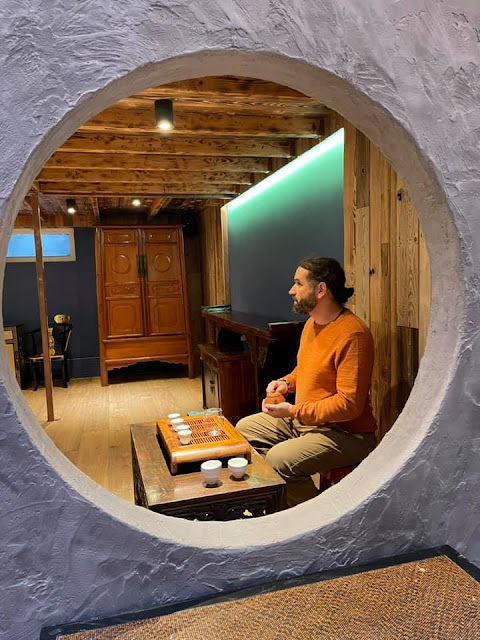
Moychay's tea clubs theme is something else, but it connects.  That adds in drinking tea in a setting that goes a long step beyond a cafe for being decorative and establishing a vibe, and it supports a more ceremonial take on tea experience.  All the same it is also shifting individual tea experience to social experience.  


this is more a tasting area than a club, but Moychay's club theme is an interesting subject


The online group case is more interesting to me though, because then it's reduced to being abstract, having more to do with self-definition and text message discussion contact than real life.  Or the "main" Discord group, Communitea, is big on voice / audio based meetups; I guess that's more in the middle.

In a podcast comment discussion someone once mentioned being "on team Xiaguan," not just saying that they like Xiaguan, but emphasizing how that put them in a group.  To me that's odd, even though that form of expression comes up more and more now.  Podcast creators tend to lean into this social dynamic, making their audience feel like part of a group, by establishing specialized use of slang, or even a nickname for group members (as "teaheads" is used).  Theo Von and Chris Delia are good examples of comedians using this form.  Oddly on one Reddit subforum Joe Rogan podcast followers connect and unify related to seeing Joe Rogan as an idiot, reveling in dumb things he says, or making fun of him for using steroids, for being short, or for his anti-vaxer position.  It still works, I guess, it just seems backwards, unifying as fans connected by partial dislike.

Vendors could make use of this, the positive part, right?  That's essentially what the Discord groups represent.  It's not negative really; to the extent someone wants to feel like they are a part of something for liking Don Mei's teas, or those from Yunnan Sourcing, Moychay, Farmerleaf, and so on, that's fine, and it really is also about sharing information.

Next more experienced and older tea enthusiasts might look down on all that, and see it as silly how younger and newer participants cling to odd forms of association.  But it happens in more subtle ways across a broad spectrum, even when people don't feel a need to formalize the link.  If someone loves Essence of Tea, Teas We Like, Tea Encounter, or Hou De you won't tend to hear about it, but there's no reason why someone couldn't value "being in the know" in a similar form, just with less post comments for interaction.  Without even taking up the external role as an elite, experienced, "higher" form of tea enthusiast the more subtle social role as isolated participant may still be regarded as meaningful.  Not joining a group or talking about it could be seen as just following a different code:  those who talk don't know, and those who know don't talk.


Let me pass on a thought that ties to this, that might clarify it.  To an extent I get the impression that some more introverted expats--foreigners living abroad, somehow implied as higher in status level than "immigrants"--like the social role because it defines them as different, and as being a certain way, without any need for setting that up or interacting.  Just being white is a stereotype, where in the US you need to pair that with class / economic status to make a start, and then it still doesn't go far, and you also have to add political affiliation.  Here in Thailand, where I live, foreigners are respected but also disliked a little, seen as quirky and odd but likely to be intelligent, and interpreted as probably having questionable morals, related to paying for romantic relationships.  It's not quite that simple, but basically you are a type, just for being white.  Let's set aside how that would go for other races; that's not the point.

The point is that stereotyping, and to some extent group inclusion, is almost freely granted, and some people seem to value that.  In tea groups you just need to adopt shared perspective, which isn't quite as easy, but which may not be very difficult.  

Tied to Mei Leaf support expressing or just feeling that "I love Don" is more than enough; you're in, even without buying the tea, as that guy explicitly stated in that post.  As a Yunnan Sourcing fan you just need to have placed one order, and to have liked one tea version, and to express intention to keep going.  If you want to feel at home among 10+ year experience tea snobs on Tea Forum--no offense intended; those people are nice--it's not quite so simple, but parroting what others say goes a long way.  In the Gong Fu Cha Facebook group you just need to buy a gaiwan, and to be looking into yixing, or post any photo of drinking tea outside.  R/tea on Reddit isn't a unified social group, but posting a picture of a half dozen boxes of grocery store tea-bag tea in a cabinet will draw at least 100 upvotes.

Why are we like this, group oriented to a strange degree?  With me included, surely.  An online contact put it well in a Quora answer about how social interaction is evolving: 


There's a broad emphasis on smaller and more detailed clustering, which in turn relies on people having a firmer sense of self and on them defining themselves in certain ways. We assign ourselves to many categories which are smaller and more specific than perhaps they've been in the recent past.


Right! A half dozen years ago people might group together in relation to tea interest, but that has pushed down to which teas people like now, or how they brew and experience them, and on further to which vendor sources of those teas they prefer.  Embracing or rejecting someone with a high profile online as an information source, or sub-culture leader, is just an extension of that.  


there's nothing wrong with combining being charismatic and informative, as So Han does


People can even now unify, to an extent, in relation to shared dislikes, not just personal associations and likes.  So this seems to be the last component of the negative mixed feelings related to many tea vendors; it's attractive to dislike a lot of things, and even to identify through that.  It automatically places you above that subject or person, for looking down on them.  If you dislike Dave Chappelle for making transgender jokes that identifies you as more sensitive to minority perspective than him.  If you can criticize the people who make that criticism, for being "woke," then you are implied to have a broader view of how social commentary works than they do.  Even not liking a movie can place you socially.

Never taking up these kinds of connections and oppositions would be a very reasonable and functional option.  But then there wouldn't be that much to talk about on social media, so that perspective would tend to not be expressed, or wouldn't seem interesting if it was.  There's normally a strong inclination to like or dislike things, to agree or disagree with ideas, so remaining neutral isn't so simple.  It's natural to react, and to place yourself in relation to that kind of perspective.


William Osmont of Farmerleaf


Wednesday, January 19, 2022

Tea Themed New Year's Resolutions

First published in TChing here.

My own goals related to tea tend to stay the same year to year, if a bit general:  to experience something new.  Not so much related to new types, since I've mostly set aside broad exploration, and try whatever I happen to try, or pushing on to higher quality or more distinct examples of already familiar types, but just new to me in some sense.


sheng "pu'er" from India (from Ketlee), a novel tea I tried last year


For the past two years that has related to a long exploration of online video meeting contact, originating with a few random sessions in early 2020.  That was based around a core group of friends meeting, moving on to more involved sessions with subject experts in 2021.  It wasn't so far off a podcast theme, just not recorded or broadcast.  Prior to that, in 2019, I was messing around with tasting themes instead, and sometime around then I put focus on starting a Quora Space (Specialty Tea).  It's a decent reference now, and I keep writing there.  


This will be about how other types of resolutions might work out, based mostly on talking to a lot of people newer to the subject in lots of online groups, returning back to what I might do that's different.


Drink better tea:  the obvious direction, which could be taken lots of ways.  Anyone drinking tea bag tea might move on to loose leaf, and people still on Harney and Sons blends range--which is fine--could explore better single input teas.  It's easy to sort out how to try better versions of what you already like, but it can take time and effort to get input for leads on better sources.  One approach towards that is to explore social media outlets related to tea, to hear about what's out there, and sourcing suggestions and so on.  This general intro post might help.


Connect with others with a similar interest:  to many this would seem a stretch; why go there?  Some reasons:  to experience in-person tasting sessions, to learn about types and teaware, or to exchange teas.  Or it could just be that identifying with a subject seems odd when you don't know anyone else who does, and it sounds interesting to resolve that through online contact.  

The starting point for this is level of tea interest.  It is actually possible to discuss tea themes with people who are still on flavored tea bag or grocery store tin versions, which to many tea enthusiasts is only an early starting point, naturally leading to more in-depth exploration.  The Facebook Tea Drinkers group or main Reddit r/tea sub-forum focus on that level.  The Gong Fu Cha group is an example at the other extreme.  Discord servers are interesting for using a form similar to old chat boards, and for being populated by really young people, for the most part, and they tend to fall in the middle related to prior exposure.


Drink more diverse tea, at limited cost (improve value):  it's funny how tea enthusiasts tend to split into two sets, with one seemingly not concerned with cost much at all, seeing spending $20 on 50 grams of tea as no big deal, since that would brew quite a bit of tea (a couple of dozen cups, maybe).  For the other set and perspective parting with $20 seems like a significant expense, regardless of volume being considered, so moving beyond what is in grocery store shelves is problematic.  

I can relate to wanting to find a balance in the middle, for working with a very limited tea budget, but still wanting to try a range of teas.  That tends to involve ordering some tea in batches, with expense between $50 and 100 per set kind of normal, or more later, as quality expectations change.

In the past ordering through a general vendor that sells medium quality tea would be a good intro point, one like Adagio.  Unfortunately their marketing theme has shifted, enabling them to move on to selling a broader range of blends and to ramp up pricing, so that for the same cost you could actually buy better tea from other types of vendors.  Chinatown shops are a good way to get to a middle ground, providing access to tins or loose versions of modest quality teas at low cost, examples that are still much more diverse and better than specialty grocery stores would tend to carry.  

Now ordering through a foreign based vendor works best for this general goal, one like Hatvala (for Vietnamese teas), or Chawang Shop (for Yunnan origin Chinese versions).  Yunnan Sourcing is not so far off that theme, a kind of broad outlet selling a large range, but any vendor carrying 1000 versions of tea puts workload on a customer to try and sort it all out.  You don't need to understand what those 1000 teas are but you do need to somehow put a dozen or less in an online cart.


Improve brewing skill and range:  this one is easy, since buying a gaiwan is half the resolution, and practicing to use it most of the other half.  Gongfu brewing, the related approach of using a higher proportion of tea to water and many short infusions, really only works better for some tea types:  sheng pu'er, high quality whole leaf black tea, twisted style oolongs, and to a lesser extent rolled oolongs.  For broken leaf black tea or green tea a Western approach is more or less the same, and shu pu'er gives pretty good results made in lots of ways.  Results related to white tea vary by type and preference.  

It's too much to go into what Gongfu brewing is but a recent Quora answer about how to brew oolongs covers the basics, with lots of guides out there covering a more step by step explanation (just search Gong Fu tea in Youtube to watch a few).


Get family and friends into tea:  good luck!  Don't expect this to work in most cases, but it is cool when it clicks a little for the right person trying the right tea.  There really is something special about a tea party, regardless of what you choose to do with form, or how much the guests love the drink.  

There's no need to cut that off related to what you like most, or tend to drink.  If you can't give children "real tea" due to a concern over caffeine the same theme can work using chrysanthemum, and the kids will love the form.  If you don't have children, or nieces and nephews, that's probably a stretch, but hopefully there are people in your life who can still tap into that exploration range to get the most out of a related form.  A lot of people's moms would love it.  

Try including different snacks, or set it up outdoors, or maybe just do it all on your own, and treat yourself to the same theme without needing others to share it.  If you think that you really should have a ceramic teapot or some range of interesting cups that's a great prompt to check out a local thrift shop, and give new life to tea equipment that someone else needed to pass on.  The "matching set" theme isn't a necessary part of it, as I see it, but individual judgment and style would factor in related to that.

More formal types tasting is something else; for someone on that page the options really span a lot of range.  I've held tastings in a park and a zoo before and the results were pretty nice.  In one other context tasting a guest tried a Chinese black tea and commented that they never knew that they liked black tea until that moment; that can be really special for a guest and the host.


My 2022 new direction:  not identified yet.  If anyone has ideas or leads on directions to chase feel free to comment wherever you see this, or look me up to talk, maybe easiest through my blog's Facebook page.  I've long since thought that broad tea awareness and culture development won't take a next step until it finds its way into mainstream media communication, but I explored that direction and didn't get far years ago.  

A podcast theme would probably work but I don't feel motivated to do that; it's already being done.  Last year that meetup discussion theme included 20 or so interesting and influential tea producers and vendors, from a dozen or so different countries; it might work to extend those introductions and background theme coverage to a networking scope.  The last talk we held covered tea processing details based on input from producers who are exploring new directions from the US, India, Laos, Georgia (the country), and Nepal.  It frees up potential direction in that I don't really need to focus on my own personal gain; that discussion was about them sharing ideas for their own interest and benefit.


A simple resolution might be better than all that:  to relax and enjoy the quiet once more frequently while having tea, just putting the phone down and being in that moment.  I'll try that.