Showing posts with label Tie Kuan Yin. Show all posts

Sunday, November 18, 2018

Comparing two versions of roasted Tie Kuan Yin


my daughter already has plans for this box, for hair clips and jewelry


A friend in Malaysia passed on some teas; I'm reviewing two versions of roasted Tie Kuan Yin from that set.  That's the same friend who passed on insight about what hui gan is, a "returning sweetness" effect in tea, really more related to what the "gan" aspect is, a type of bitterness that also extends to an experience of sweetness afterwards in that form in tea. 

I couldn't identify an online reference to exactly what it is (just different teas, I mean more on that), but it's from Dragon-i, a restaurant chain there and in Hong Kong (with more information and reviews here, but it's about food).

The set is too much, really.  It's ok if I give someone tea without getting anything back but somehow not right if it goes the other way; eventually I'll have to balance the scales, even if I have to go to Malaysia to do it.  Here's what the two teas are:

Teh Oolong TGY

Teh Gui Pin TGY


Of course Teh is tea, and TGY is Tie Kuan Yin (spelled as Guan; maybe I'm wrong to always use the other spelling).  I tried to look up the Gui Pin reference but it didn't pan out.  Since I'm writing this after the tasting session part I know what it is, roughly, it would just be interesting to trace that label and general type description back.  It was just more-roasted lightly oxidized Tie Kuan Yin, I think.

They seem to almost certainly be from around Anxi in Fujian, China; there's no way these teas are from Malaysia, being sold from a Chinese shop.  I've never heard of anything but commercial CTC black tea being produced in Malaysia, although surely there must be an exception or two out there.

Review

barely getting started; Teh Oolong left, Gui Pin version right


Teh Oolong TKY (hereafter referred to as "oolong," but they both are that):  the first sip probably lets me know where this is going to go; this is one of the best roasted Tie Kuan Yin's I've yet to try.  It's clearly very well made tea, complex, clean in flavor profile, with roasted flavor aspect range that's new to me.  I'll say more about it next round and just list a couple first-impression flavors for now:  more-cooked caramel stands out, with fruit beyond that covering both raisin and something more interesting, with an awful lot of depth to the complex range beyond that.  I could say more but I'll leave off until next round, since it will show more of what it's going to be then.


Gui Pin TKY:  this is similar in overall range, just a lot different in character.  Where the other was heavy caramel this is a bit inky in flavor impression (mineral intensive), with the roast coming across just a little more as roast, or as light "char" as I describe that in Wuyi Yancha.  It will also have more depth and a cleaner, better balanced overall range and effect than I may have ever ran across in more-roasted TKY.  These teas will be an education in a potential I've just not got around to covering.

It's no surprise that it exists, or that I've ran across over-roasted light versions that weren't on this quality level in the past.  That's how that would go, unless someone gets sourcing better sorted out.  I wasn't so clear on it at this point in the tasting but the first ended up seeming a lot more interesting and novel to me later.

she liked both but I didn't get much review out of her

Second infusion:


Oolong:  it's interesting the way this is so different than any more-roasted TKY I've tried, that much better.  The warm rich flavors are shifted a little towards cinnamon now, with the other fruit still present but falling into a lighter balance.  That roasted caramel range might be coming across closer to cocoa now.  Part of it I'm just not getting to describing, like a dried fruit range well beyond raisin, but that's the closest familiar version of that general range.  It's towards prune but not that either.  It works well for me because of a match to preference; I like the way more oxidation together with some roast effect works versus just roasting a light version instead, which is what I tend to run across.  That oxidation occurs early in processing, the same step that makes black tea into what it is, or oolong different from green tea, of course with baking / roasting occurring at the end instead.


Gui Pin:  this is a little more familiar, the character of this tea.  It seems to be a lighter roasted TKY version that uses the roasting step to shift character quite a bit, versus the other seeming to be oxidized more (what I just covered).

Related to aspects a light char comes across.  This general type of tea I've tried before; it's a pretty good version though.  Depth picks up a little more than in the first round but the general flavor is still the same.  I really like the first better for being so novel and for combining so much fruit and spice, and overall depth, along with novelty.  This is good tea though.

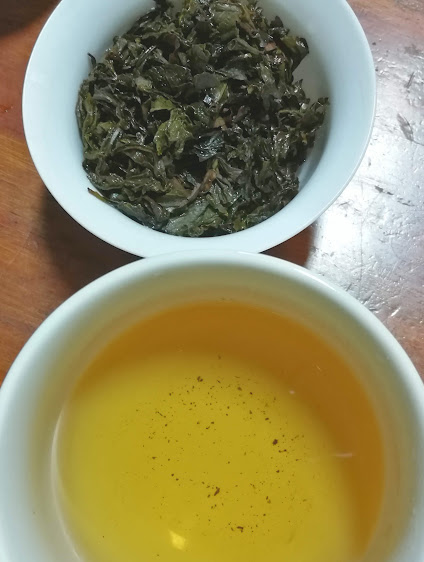
I didn't make anything of it in the tasting notes but the brewed tea of the first version is a lot darker.  I'm interpreting that as due to it being oxidized more.

Third infusion:


Oolong:  the roast effect picks up a little but the complexity is still the main thing that stands out, so much going on and balancing so well.  The same flavor list as last time applies, just with part diminished a little and swapped out for a more general trace of char joining in.  The feel is full but that part could be thicker.  The aftertaste effect is more pronounced; that really lingers.  Mineral tones carry on longer than the rest of the range, a dark version of mineral, paired with some of the fruit that is as close to prune as anything.  For being as earthy as the tea is it's still sweet, intense, bright, and clean.  It's that balance that more roasted or oxidized oolongs struggle to reach, beyond just getting factors like level of roast to contribute as much as possible without tasting like char.


Gui Pin:  floral tone picks up.  It's odd I've went so far into a TKY pair review without saying that, since floral range is most pronounced in the type, in general.  The other version was too far into fruit and spice to notice it and the char had been too strong in this.  Now it's not; it has faded somewhat and this is mostly floral.  If I go back and taste the other version and focus on the level of floral it's there, just not as pronounced as the rest.  This picks up a bit of old book or furniture taste to go with that; the char dropping back gave it plenty of space to evolve.  In the right level that type of aspect can be nice and it works in this.  For personal preference I like the range of the other tea better, maybe in part for it seeming less like what I've experienced before.  I've tried plenty of teas from other places that overlapped a little with it, leading to the guess that it seemed to be oxidation along with roast as a cause, but none with really similar overall character.

That late interpretation of floral tone reminds me of the last review, how it barely came up in talking about three different sheng, even though floral tones typically tend to stand out in those.  One in particular was from Jing Mai, and to me that's characteristic of that region, just less so and in a different form than in Yiwu, where it can be really intense.  Part of that might have related to that one tea being over two years old.  Tea character changes a good bit over that time-frame, with brighter and more intense aspects diminishing, along with bitterness and initial astringency.  Much later warmer, earthier aspects like dried fruit, spice, or tobacco might emerge (although that seemed like spice to me already).  Another part is that milder or non-distinct floral tone might just seem like a general sweetness; someone might call it honey-like instead, or associate it with the other mineral or earthy range, just as non-distinct sweetness.

The last possible interpretation is a bit touchier:  I was rushed and distracted during that tasting.  Usually on the Saturday tasting sessions my wife is off with my son at his Chinese lesson and this time she came back during it.  Even a level of noise will throw off how much detail is picked up in tasting, and make interpretation harder, but someone urging you to "wrap it up" is even worse.  We had that temple outing to get to (with photos in the last post), and plans for an errand after that.  These reviews aren't supposed to be a last word on what the teas are like, just an informed impression, but that impression is clearer when conditions are more ideal.  At least I didn't have a cold; that's worse.

Fourth infusion:


Oolong:  the tea is still brewing with plenty of flavor, using only around a 20 or so second infusion time, maybe just over that.  Others might like it stronger, and it would still work well brewed twice that long, but I'd see this infusion strength as conventional, and to my preference as roughly optimum.  The flavor and other aspects haven't transitioned enough to say more about that.


Gui Pin:  this tea is probably the best it's been at that point, while the other might just be leveling off and fading a little now.  Both these teas have more story to tell, about this many more infusions or more to go, about how they would evolve over that.  Per one take how well a tea retains it's character and how much pleasant tea it brews relates to the overall quality of the tea.  That seems partly right, but that also relates to different styles of tea, instead of just quality.  To me how pleasant and enjoyable all of the infusions come across is the main thing.


Teh Oolong (left) leaves are definitely darker


Later rounds / Conclusions


I did keep coming back to these teas, drinking a couple extra rounds a few times.  They really just seemed to keep thinning from there, without anything really interesting coming up due to extending infusion times, and without aspects "going off" in any ways, transitioning negatively.  

Teas come in a broad range of quality levels and these seemed pretty good.  "Good" is always relative; I think someone well-connected with good sources, willing to spend a bit on better versions, could still find better.  For Americans buying what turns up in typical online sources they're probably well above average.  Related to what turns up in Bangkok shops you tend to just not see good versions in these styles, even with a really broad range of "good" applied.  The bright green versions come in range of quality levels, and some few versions that are roasted some, but decent more-oxidized TKY  oolongs don't as much. 

The same challenge applies across lots of tea types.  It's easy to find really mediocre versions of many, online or else in shops, depending, but as you go up the scale of quality level that gets much harder.  Spending your way to better versions, finding options selling for more, is a promising approach but it offers no guarantee.  I'm familiar with a couple of well-known vendors who just add a more flowery description and sell roughly the same lower-medium quality and cost teas for twice as much.  I hope these teas didn't cost too much but they probably weren't a steal.

There are more to get to.  I'll mention how that goes, probably limiting it to covering the most interesting versions.

A origin story about the Iron Goddess of Mercy


That Malaysian-Chinese friend passed on a story about Guan Yin, familiar from being associated and the tea type, with the plant type and finished tea both named after a statue of the goddess or bhodisattva.  His version of the story is similar to one found in this Wikipedia reference (the Legend of Miaoshan version), but it's also quite different.  It came up due to sharing pictures of my children's visit to a local temple where there was such a statue:


I had thought both statue images there might be Guan Yin, but maybe not:


We were there to offer food (alms) to local monks, as part of observing both our kid's birthdays (two visits about a week apart), as shown:


In Thailand it's a cultural observance that monks never seem cheerful, as part of being even tempered and free from conventional emotional experience.  Of course they're still just people, so it's a mannerism as much as truly symbolic.  That monk is one of my favorites because he is cheerful instead (even though I don't know him; I just see him around, and my daughter and I "wai" to him, the Thai hand gesture next in the series of photos of that alms offering).


what the Thai "wai" looks like


Ordinarily I cite quoted text in bold lettering here but since this story from my friend is longer I'll skip that part in the following.  He really does write as if he's creating literature in every sentence, in all the messages.  It makes for great reading, and he makes a great online pen-pal, for sharing ideas even more than for sharing tea.  I considered editing this down but it's all too good a read to take out any part.  No need to frame it, or comment further after citing it; his version is clear and quite complete.


The statue depicts a princess, the youngest of the three daughters of an emperor of China. She was nearly killed upon birth by her own father, for wanting a son to someday continue rule the land, but the empress managed to stop the slaying.

During the reign of the emperor, due to his arrogance claiming himself to be the most powerful man on earth, he dismissed the might and the presence of the heavenly beings. To show his displeasure, he banned all Buddhism teaching, commanded the wholesale destruction of all Buddhist temples and scriptures. He ordered the round-up of all Buddhist monks, all of them defenseless, to be publicly reprimanded, some were even beaten, in public squares, for the sole purpose to invoke fear for and submission to him alone, amongst the villagers.

As fate would have it, an unburnt page of the sacred writings from the fiery flames was carried by the light breeze on a windless day and it landed in the chamber of the princess. She picked up the charred piece and perused it contemplatively. Her interest piqued ever since with many unanswered queries, apparently oblivious to the mayhem his father have caused throughout the kingdom, the many invasion of nearby states, unmannerly amassing more land and wealth.

One day, during the princess's visit to the town, a divine being gifted her a copy of the Buddhist scripture. She read it surreptitiously in the palace but no less attentively, unbeknownst to her that she would someday be pivotal to bringing peace and solace to the whole world with the knowledge gained.

A dignitary from a neighbouring state was granted an audience with the emperor and the princess had a premonition that he was about to impale his father with a sword hidden amongst the treasures to be presented to the emperor. The princess dashed to shield her father and successfully foiled the assassination attempt but she was stabbed on the forehead by the tip of the blade, precisely the very spot between her eyes. Therefore, the appearance of the red dot seen on the sculpture, below her hairline. All efforts were made to revive her but failed, nonetheless. During the period of time the princess was comatose, she met a mighty and powerful figure. The utterly great and supreme Buddha. Buddha called on the princess to use her empathy and innate compassionate nature to help the people in misery by disseminating the teaching of Buddhism.

However, whilst in the realm of the mortals, the royal physician had declared that the princess could not be saved. Her body was set alight on the funeral pyre, thereby hampering her return to the corporeal existence.

The divine being, the one the princess had met in town, told the royal household that the princess could be brought back to life only if flowers were to bloom in the pond of the palace. Lots of flowers were then placed gently on the surface of the pond, with chrysanthemums, peonies, but all harshly sunk to the bottom of the pond. A warrior, not long ago volunteered to be the protector for the princess filled with extreme remorse and guilt for failing to keep the princess safe, jumped into the pond, his only way to show contrition by ending his own life and very nearly drowned. His act of loyalty was blessed with the blooming of lotus flowers, the 'flower that bloomed in a pond', one of the giant blossoms bore the princess.

And ta-da, the princess was brought to life.

Therefore, the statuette always sits criss-cross applesauce on top of a lotus flower.

[that's one of my daughter's favorite expressions!]

she can do the seated meditation version  too


The adviser to the emperor, a very devious person that was instrumental in bringing chaos all over the country, eventually committed an act of betrayal. An attack by armed insurgents he led, was launched against the emperor and within the palace. Alas, the emperor committed suicide.

The warrior, the protector for the princess, having royal blood himself, succeeded his uncle, as the new emperor.

The princess's undying love for her late father was undeniable. She 'journeyed' to hell to save his father, hoping to bring him back to the world. Due to her immense filial piety towards her father, the God of the underworld granted her request, permitted the emperor to be reincarnated as human. However, the emperor declined as he had fully repented and wished to reborn as cow or horse to serve the human race. He was allowed to be reborn as cow.

It is most probably for that reason, many Buddhists do not consume beef.

Whilst saving her father, the princess cut off her left arm to feed the hungry ghosts that obstructed her gateway back to earth. The new king had a statue of the princess sitting on the lotus flower commissioned, to commemorate her miraculous and safe return. A temple was also built adjacent to the palace, allowing the princess to further her teaching of Buddhism to the villagers. Well, the new king was actually in love with the princess all the whilst, wishing her to always stay close by his side and believing that the new temple would do the trick.

However, the princess was destined for great things, to promulgate calm and peace for all mankind through compassion, kindness and mercy. And in fact, no reward could win over her special calling, required of her beyond the confines of the temple and the palace.

The mason had finally produced a statuette but with a missing arm, mimicking the princess's current state, much to the chagrin of the new king. Upon seeing the anger the new king had displayed, the villagers had each brought a sculpted arm for the mason, all to be affixed on the figurine to pay homage to the princess for her bravery and devotion to her parent.

Consequently, in modern times, there are many versions of the figurine of the deity, one with many arms and hands attached, in particular.

The princess eventually achieved enlightenment. She left the temple built for her, travelled all across the world in a lotus flower as a disciple of Buddha. She acquired the name '觀音' or 'Goon Yum', the heavenly title bestowed by Buddha, also famously known as the 'Goddess of Mercy'. '觀' or 'Goon' means 'to observe', whilst '音' or 'Yum' means 'sound'. Goddess of Mercy, a godly being that listens to the plight of the people in need of her help and relief.

The name '觀音' or 'Goon Yum' was also used as name for a tea. The tea '鐵觀音' or 'Theet Goon Yum', also known as 'Tie Kuan Yin' to many others, means the 'Iron Goddess of Mercy'. It was rumoured that '乾隆王' or 'Khin Loong Wong', also called 'Emperor Qian Loong', was so captivated by the tea, its sturdiness that resembled the characteristic of an iron, with the taste that all but paralleled to the beauty of the Goddess of Mercy.

It takes good skill to carve the face of the statuette of the goddess to look compassionate and kind. The Cantonese would usually present the amulets of this goddess, usually made of jade, to family members, to be worn as necklace to ward off evil spirits or for mere protection, especially those making a long trip or having it placed in a crib of a newborn. It is not uncommon to hear accounts that a person wearing the jewelled ornament survived major accidents with minor or came through the ordeals unscathed, but left with the broken green talisman, having it 'absorbed' all negative impacts, both physically and spiritually.


Thursday, August 16, 2018

Blind tasting Huang Tan, an oolong sample from the Jip Eu shop


unusual to see mixed colors


that's what it is, right there


In a variation on blind tasting I'm trying a tea sample Jip Eu passed on that I don't remember the type of.  I asked them based on sending a picture of the Chinese characters, so I will know within an hour or two, most likely in the middle of this tasting.

It looks vaguely like a Wuyi Yancha, but not that close though, since this leaf presentation isn't familiar, not really twisted (that style), or rolled or flattened for that matter.  Since that's the type they sell most of I'm automatically inclined towards guessing that range, so I'm thinking maybe it's a Shui Xian, even though it shouldn't be that green, or mixed in color.  It wouldn't be that hard to check that; I could just look up what those characters are.  Or it is possible to use a text character reader online based on using the image.  But both would cancel out the intrigue of a blind tasting.

Trying it initially you mostly just taste roast; more indication it might be Wuyi Yancha.  The tea character under that doesn't stand out much compared to the roast effect at this point.

The tea isn't bad, it's just not exceptional (much as I can judge it at all; it'll take another couple of infusions to).  It's not in the fruity style I like, as Cindy's teas tend to be, and I'm not noticing pronounced cinnamon either (that earthy version of it from Rou Gui).  It doesn't express the subtle, perfume or liquor like aspect that relates to a number of different Wuyi Yancha types.  I suppose people might say those teas exhibit aroma more than flavor, but I don't tend to rely on or even refer to that divide much in reviewing, unless it comes up in a tea comparison contrast.

That leaves this tasting a bit woody.  There is a bit to the aroma part, a hint towards that cognac / liqueur effect.  The flavor is ok, and the body and the rest of the balance is fine.  The roast level doesn't overwhelm the tea, in one sense, but in this initial infusion it's not balanced, a bit too strong.  It has a vegetal edge to it that implies the oxidation level is low.  It's far from green range but seemingly not in the standard level for oolongs, especially Wuyi Yancha / Fujian rock oolong.  The optimum is "balanced" of course, so that you don't even notice the parts of how the final effect occurred.


still opening up; still different colors


I wouldn't be surprised if this was more than one tea, blended versus being a single type.  Beyond the different colors making sense that would account for a couple types of character ranges seeming to come across, the more pronounced roast, the lower oxidation level "green wood" effect, and the liqueur like flavor / aroma range.  All that integrates better than it might sound it does but it makes for a broad set.

Second infusion:  it pulls together a little more.  That earlier speculation was too much to extract for interpretation from one light infusion; we'll see what I change my mind on.

The leaves are different colors, easier to sort out when a bit wet; it looks more like a blend now, or it could just be that they used different types of leaves, including the older yellow / huang pian ones.  The flavor gains complexity in this round, and the roast integrates better.  The roast effect is picking up, in one sense, and dropping out in another.  It changes and deepens but other flavor range increases.  I think this is better tea than I judged it to be in the first round.  An old-furniture effect kicks in, not my favorite range for roasted oolongs but it can be nice in the right balance and combination.  The wood aspect comes across as fresher, picking up even more vegetal character, that's still overwhelmed a bit by all the rest.  One aspect trailing into a liqueur effect gives it an extra dimension.  All this could be horrible if it didn't balance, but it does.


those Ong Yong Choon shop owners were really nice

Since it's moving away from typical Wuyi Yancha character as it develops--much as it ever expressed that--I really don't know what it is.  It's too green and too vegetal to be that, at least in forms I'm familiar with.  I've had Tie Kuan Yin that wasn't so far off this before (from the local Ong Yong Choon shop, reviewed here, the one beside Wat Pho and the flower market).  TKY can be vegetal, and they're often floral, often roasted to different levels (just more often not roasted much at all), but they're not typically like this.  They tend to be smooth and sweet, and this vegetal green wood edge isn't standard.


The "blind" part of this tasting just went by the wayside; the owners of the Jip Eu shop told me what it is by message:

it's one kind of oolong tea , some thing like tie-kwan-yin>>>Huang Tan


That explains some things, why I'm having trouble making sense of those aspects.  That green wood tone leans a little towards vegetal not so far from corn, it's just not that.  The roast level makes sense with the one other style of Tie Kuan Yin, not the bright green version, the roasted kind.  That often gets prepared as tea burned to a cinder but really it doesn't have to be like that.  This was lightly oxidized (I got that part right), with a medium level roast.  I guess that could be seen as upper-medium or lower-medium, depending on an interpretation bias in expecting really charred tea or not thinking that's normal.  I think the teas one runs across that are blackened probably don't represent any traditional style; they're just overcooked (over-roasted), maybe by accident or maybe to cover something else wrong with the tea.

If this tea had been rolled I would've been interpreting it quite differently.  Maybe not the aspects, so much, but how to make sense of them.

That's the last piece to this puzzle, that different quality levels of tea express aspects differently and come across differently.  Inexpensive Shui Xian isn't the same thing as much better versions of Shui Xian.  That's true too of Tie Kuan Yin, a bit closer to this version, but in a different sense.  Inexpensive Shui Xian are often a blend of different versions, and a higher level of roast can be used to mask limitations in the tea, or to bring an old version back to life.

This tea would be very good for an inexpensive tea, and quite limited for an expensive version.  It's in the middle.  It doesn't have enough flaws or limitations to come across as "cheap tea," and it has too much going for it.  It's not standard; that preparation style and mix of colors seems a bit unusual, as does the set of aspects.  It also doesn't express the strong positive aspect range, unified character type, and really nice overall balance of a more expensive, higher quality tea.  To associate local pricing with that, based on this Jip Eu shop, they sell really nice Wuyi Yancha for 1000 baht for 100 grams, or $15 per 50 grams, and the Shui Xian types extend across a range that runs really low in price at the lower end, maybe a quarter of that or less.


I asked and they sell this tea for 250 baht per 120 grams ($8 or so), priced on that low side.  For that it's quite good tea, I think, and maybe they should charge a little more than that.  It is unconventional though; that might make it harder to sell.  They added a little more detail in discussion:


Its not wuyi yancha, It's from unsi-fujian.  I think this tea that you just taste it , now is old one, may be about 2 years, so the taste and flavor are change much more.  It's better when new one, have flavor of flower, tea leaves look more green colour.  This kind of tea not good for keep.


Usually I edit English use to clean it up but I'll pass on how they expressed that since it's very clear.  So all that is the last of the puzzle; aging muted flavors that worked better when fresh, for this particular version.  A re-roast might have even brought the taste back to life (might have occurred, I mean, accounting for the roast level / initial char effect).  It's not ideal for the type due to aging, according to that input, but it probably started out as a pretty good tea, just maybe not great.


On the next infusion it doesn't transition much.  Those flavors are integrating better as infusions go on.  The roast level and the old-furniture effect are dropping back, with plenty of green wood towards other vegetal character remaining, taking over the balance.  It's interesting; different.  It's hard to imagine this being someone's favorite type of tea but it's well worth experiencing.  I said that about that recent Moychay Guangdong oolong too, a Bao Ing Huan Zhi, and probably about that Ong Yong Choon version too.  I think this is a little sweeter than that Moychay oolong, which does help those aspects come together.


It's not as if I'm just being nice, or biased, in describing an unusual tea that doesn't match my standard preferences so positively.  Trying different styles of tea is interesting.  It's also more pleasant when the aspects really click with you, and I can appreciate this version and range but I've loved almost all that I've tried from Jip Eu more.  I'm not so into TKY (or teas like that), and types along that line I do like best are softer, "rounder," sweeter, more floral versions, or the creamy Jin Xuan versions, or intense mineral and floral high mountain Taiwanese types.  Medium roasted lightly oxidized teas seem a bit odd, to me.  Add more initial oxidation level, more like a Dong Ding style, or other teas described as "red oolong," and that's back to working better per my preference, a step closer to a black tea.

The next infusion--4 or 5 maybe--is even better.  It's much more aromatic, picking up cleaner, brighter flavor range, with a bit more perfume-like character coming across.  The flavor extends slightly from the earlier liqueur range towards floral, it just doesn't really come across as mostly that.  Even sweetness picks up just a little.

I might share some of this at the tasting I have planned for this weekend (for tomorrow, now), although it's not a natural fit for that.  It's not a standard type, not necessarily beginner range for aspects, but it is interesting.

I might also mention that I tried this the next day as a cold-brewed version, setting it aside in a tea bottle in lukewarm water in the refrigerator, at around where these notes end in the brewing cycle session.  It is possible to just let the leaves sit and brew more later in the day too, or even the next day, but the hot, humid weather in Bangkok isn't as ideal for storing tea leaves for a day.  Cold brewing draws out more sweetness and moderates astringency in teas, if there is any.  This was really nice made that way.  It didn't have any astringency to work around but the intensity and sweetness dialed way up, which worked well with that floral range.  The roast "char" and old furniture flavor dropped out, maybe due to the difference in brewing approach, or as likely they were naturally only going to come out more in earlier infusions, just part of that brewing transition.


not long after that session, at the local zoo (where I'll hold that tasting)


A short tangent about other Chinese oolongs


It may or may not be familiar but if you walk around cities like Beijing and Shanghai there are two types of teas you see most often:  light rolled oolongs, either inexpensive TKY or teas made like that, and Longjing style green teas, probably various interpretations of the original region based version as often as actually being that.  I can relate to why.  Teas just a bit off those in style, like this one, can be quite nice, but there's something really catchy and easy to relate to in those two other forms, even in inexpensive versions.  Jip Eu does sell a range of different Tie Kuan Yin, but the real Anxi origin versions, since that owner has family in both the Wuyishan area and there.  I just don't say much about them since I've always been more into Wuyi Yancha (for a number of years now, anyway), so when I visit there I try those and end up buying mostly that.


at the Forbidden City; it's not easy to look more like tourists than this


It's not clear that the same impression wouldn't come across in Bangkok, about a limited set of standard, lower quality teas being much more common.  I may just be referring to what you see when you don't dig a little deeper, into varying range and better quality teas.  I'll add some photos of a last visit to the Bangkok Chinatown that I don't think I mentioned at the end to show what I mean by that.


Two versions of mid-range Dan Cong I've tried from Jip Eu point out another alternative I'd tend to go with from there (since this has bridged over into talking about different oolong types, rather than just being that review).  "Good mid-range commercial Dan Cong" really could be seen as a mix of terms that don't go together, an oxymoron, but if you go there and try some--assuming they have some open--you could experience it yourself.  Those versions I tried were fresh, lightly oxidized, lightly roasted, very fruity oolong, just not quite as subtle and intense as the higher quality level versions.

I bought a standard glass teapot here for use in tastings


I've been meaning to get around to trying some of the inexpensive, large-jar stored teas from the Chinatown Yaowarat Soi 6 shops as an experiment.  They wouldn't cost much, and I'd see what different moderate quality tea versions are like.


I bought some small cups at this shop a couple weeks ago too


these!  3 for 100 baht, or $1 each, not bad.


Wat Traimitr Withayaram Worawihan (on the other side)


Wednesday, April 25, 2018

Roasted Tie Kuan Yin from a Bangkok shop, Ong Yong Choon


the friendly shop owners


I mentioned a local Bangkok tea shop in that post about my son becoming a novice monk, the Ong Yong Choon tea shop.  It's near the flower market that's near Wat Pho, the Pak Khlong market.  I haven't been checking out many new shops in Bangkok for awhile, so this post about local shops from a year ago wouldn't change much based on what I've turned up since.

I'm finally reviewing a roasted Tie Kuan Yin rolled oolong from that shop here, about a month after buying it.  The tea is nice.  It wasn't sold as an exceptionally high quality level version, just a good basic tea, moderate in cost, and that's what it is.  It's a bit unique for the roast level not being unroasted (the "nuclear green" TKY version), or charred, the typical take on a traditional style.  It's in the middle, at a level that seems to bring out nice character in the tea.

An online friend visited this shop not too long ago and bought a decent Shui Xian there (Wuyi Yancha, a twisted-style roasted oolong instead).  I did "try" some of those by smelling sample jars and one of a few I sniffed seemed like it probably was pretty good, but I was in a hurry that day, midway through my son's ordination training at Wat Pho nearby, so I just went with some TKY instead.  I shared most of what I bought that day directly with monks in that temple.  Just because they have limited opportunity to go out tea shopping they shouldn't have to skip drinking decent tea.


one of the owners again


two different languages I can't read


packaged versions, but they do sell tea from loose bulk stock too


that TKY packaging was identical to those portioned out, as single servings


teaware!


Review


The tea itself is a bit dark, and has a nice roasted smell to it, a bit rich, maybe just a little off related to scent tone, along the line of old books or car engine smell.  Taste is the main thing; we'll see if that's clean, complex, and full or not.


It is nice on the first infusion, rich with good depth.  It's clearly a medium roasted version, giving up brightness and potential floral nature to pick up more depth and other range of flavors, warmer and in a different range.  A creaminess underlies the experience, not a foreground part of the aspects but a nice supporting element.  The feel and aftertaste check out, even this early in the process; both are not as exceptional as in the best examples of rolled oolongs but quite decent.


The flavor is complex, hard to pin down.  It might taste like a well toasted rice, which could be interpreted by some as woody, and part of it relates to that old book scent in the dry tea, although really it's closer to old furniture.  I mean that in a good sense; I can see how saying a tea tastes like a dresser or end table might not be a good thing.  It's clean, complex, and well balanced, so it works.  That one unusual part that gives it depth could easily be just a little off and the tea might be horrible (sour, or too woody, or just strange), but in this case it's not, it works really well.  It's nice tea.


For better versions of similar oolongs the complexity remains throughout many infusions as interesting and pleasant transitions continue.  For more average range versions of similar style tea aspects drop out instead of complexity picking up or shifting, and the taste range might drift off being as positive in later rounds.


I went a little longer in the second infusion to get the tea fully opened up and brewing, so this will describe a stronger version (around a half a minute; I'm brewing the tea Gongfu style, in a gaiwan).  I'll try a short infusion (10 to 15 seconds) next and the tea should be unfurled and infusing well enough to show where it is clearly in early rounds.


The one aspect picks up more in woody range, which is nice.  It's not the bright, somewhat edgy woody aspect range that young sheng can sometimes express, which gets interpreted as lots of different things, more a tropical hardwood range instead.  Again there's a trace aspect that drifts just a hint towards nail polish that invokes old furniture, and again that still works out better than it sounds.  The mineral tones that are harder to notice ground that nicely, and the creaminess and fullness help it all make sense and balance.  Some would describe part of the sweetness as floral, maybe along the lines of lavender, versus brighter orchid tones in some other oolongs, and once I think of it that way that's clearly what it is.  It might already be clear in the rest of this but I do leave space for subjective interpretation in tea experience, for "seeing" or interpreting aspects in different ways.

Another way to interpret that roasted effect is through the concept / aspect description of "char."  Usually I wouldn't say much about that unless a tea is roasted a good bit further and does tend to taste like a charcoal.  Darker roasted Anxi Tie Kuan Yin can  be like that, and usually is, or more roasted Wuyi Yancha (Fujian twisted style roasted oolong, from the Wuyishan area instead of Anxi).  It works to say that trace aspect I just described as being chemical in nature really is that char, just a very light version of it, and that sounds a lot better.


Per the input from the owner of my favorite local tea shop, Jip Eu, that aspect is preferred by most Wuyi Yancha tea drinkers in Bangkok.  My sense was that he and I both meant that it's one range of preference that people have, not really a higher or lower form of preference, or invalid, just different.  Cooking a tea to a cinder can cover up flaws, of course, and make it hard to appreciate more subtle aspects in a good tea, so to me it's not necessarily completely neutral as preferences go, but at the same time people can like whatever they happen to like.


Even brewed on the light side that char picks up more in the third infusion, seeming more like char in this infusion.  It still does balance nicely.  It's clean and balanced; there is nothing wrong with it, with the roast seeming to draw out the potential of the tea.  On the more negative side there would be more depth of aspect range if this were better tea, more going on, and the feel would be that little bit fuller, with more aftertaste and overall intensity.  Tea that is good, balanced, and interesting is fine for me; I definitely don't need those extra levels to appreciate one.


All the earlier description still works for this infusion, the balance of them just shifts slightly, and it's as well to not overwork explaining in what way.


I took a long break from the tea, going out to get a haircut, and gave it a relatively short infusion to start back in, a bit under 30 seconds.  It seems about the same.  Often I would just leave off reviewing around this point anyway but since number of infusions and aspect character in later rounds is one sign of tea quality--not a direct indicator; those things can vary independently of quality--I'll give it a little longer and describe how it works out after the half-dozen infusion mark.


darkened by roasting, still a bit green


The flavors are still ok, still clean and decently balanced.  The char picks up a little since the more subtle flavors fade slightly but that doesn't.  I like the tea, but not everyone would.  If someone drank oolongs for the brighter floral aspects, or liked vegetal range, or the intense sweetness some exhibit this isn't on that page.  Even for medium level roasted oolongs some pick up more of a yeast / bread dough aspect, or flavors more like cinnamon or cocoa, or floral tones can still come through in a different form.  "Old furniture" wouldn't be a primary flavor range everyone is looking for.  For a medium quality oolong it's nice (with that sort of grading quite relative to what a person normally experiences), and I can appreciate the novelty of drinking a style of tea I normally don't get around to experiencing.

I bought an inexpensive light rolled Chinese oolong in a restaurant here a month or so back (maybe six weeks now), again a gamble of sorts, for what I think was 100 grams for around $8, so not that much of a gamble.  At that price and with very little information passed on, and from that source, I didn't have high hopes for that tea, but did hope it was decent and slightly interesting.  It wasn't quite as good a quality level tea as this one (which I think cost a little more but in that general range), and was much different in character.  It had some slight but obvious flaws but the general impression was positive, a bit on the creamy side, with decent complexity, and a reasonably "clean" overall effect.

This other Ong Yong Choon flower market shop tea is slightly better tea, but also just different, roasted more.  I guess I'm not as certain as I could be that they're both even the same thing.  They both could be Tie Kuan Yin, or then again it seems possible that other tea is local Jin Xuan instead.  I think this flower market shop tea was sold as Anxi TKY, but those come in a broad range of styles and quality levels, definitely not all a similar thing.


This tea is fading, around 8 infusions in.  It takes a 45 second to a minute infusion just to get the same intensity that a 15 second version had earlier on.  It's still nice though, still not "going off" and transitioning to negative aspect range.  If it was lower quality tea it would've done that before this round.  It seems quite possible for producers to give rolled oolongs like this one a bit more roast time to help mask flaws or transition negative aspects but in this case it was probably more about getting a desired aspect range out of a tea that was decent to begin with.

I went back to a medium length infusion time, a bit limited for where this stands now, around 30 seconds, and it's still nice on the lighter side, and not finished yet.  The feel is still decent and the aftertaste still works, and that balance of aspects hasn't changed much (mild floral, old furniture, creaminess, limited mineral base).  I think this might make a good old-person's tea, related to a Malaysian online friend commenting about how some vaguely related character in Liu Bao isn't for young people, and that younger people can't appreciate bitterness in the same way.  This tea isn't bitter at all, so maybe I'm mixing ideas and he wouldn't make that comparison.

I'll try to stop back and check out a better Shui Xian version.  Those owners speak perfect English (kind of strange, really, but one had lived in the US), and they were nice to visit and talk about tea with.  They mentioned that shop was there for the last 80 years or so, so beyond talking about tea versions they could pass on impressions of how tea culture has changed in Bangkok, and did so to the degree that limited time allowed that day.


Pak Khlong is the flower market, Wat Phra Chetuphon is the long name for Wat Pho (in the upper left), which is closer than it looks.


Thursday, June 30, 2016

Trident Booksellers Long Feng Xia, compared to two other oolongs


I recently tried the last tea sent by Trident Booksellers (surely a decent place to try a cup of tea in Boulder, Colorado) as an extension of discussing teas with their knowledgeable tea procurer, Peter.

This Long Feng Xia lightly oxidized Taiwanese oolong was great, a very nice example of the type, and really of Taiwanese oolongs in general.  I'm too new to tea to place it in relation to other Long Feng Xia oolongs, since I'm only three years into making an obsession of tea, so to help place it I'll mention a couple of other teas that I've recently tried, Thai and Chinese oolongs.  The styles aren't so similar, with the point being to identify the variances through comparison.

Long Feng Xia review


The tea is lightly oxidized, as it was described (winter 2015 top-grade light oolong). The first taste relates to a normal lighter oolong profile, with a couple of exceptional characteristics.  The basic tastes are mineral and floral with a bit of vegetal scope, complex with different elements that integrate well together.  There is a notable fullness to the feel of the tea and a nice sweetness.  That mineral element is a bit hard to place, maybe in between granite and slate.  There's just a bit of butter, different than the expression of butter in a Jin Xuan, which can be stronger.

The floral element is more subtle and integrated than those sometimes come across.  I'm not so great with floral scent memory but the range might be lotus, sweet and rich, a little subdued but a nice complement to the other flavors.  It's hard to fully appreciate but there are no negative flavor aspects, no apparent flaws in the tea, and it all really balances and works.

A green vegetal flavor element gives the flavor range a fullness that reminds me of a Japanese green tea, just at a much lower level, the umami aspect.  It's not a principle component of the tea flavor or experience profile, but that bit of extra range stands out when tasting it initially.  After just a few sips it seems familiar and not so noticeable.  That component joins with the mineral tones in this tea, and doesn't extend to accompany seaweed or other vegetal aspects as might be associated with it in Japanese green teas.

Is that general point clear?  Umami is a savory taste, picked up by the tongue, overlapping quite a bit with MSG (it's an effect from glutamates; MSG is mono-sodium glutamate, one of those).  I wrote a lot more on that in reviewing a Japanese Gyokuro green tea (from Trident, as it worked out) in an earlier post.  Other vegetal flavors can seem to pair up with it, since seaweed and Japanese teas can express a common range related to umami and also other separate vegetal taste elements, more like spinach, but really most like seaweed (which of course is circular, saying that seaweed tastes like seaweed).

Brewed a little stronger the vegetal elements really stand out, and the flavor shifts a little towards sweet corn, towards a typical Tie Kuan Yin range.  Of course there is no astringency in the sense of other tea types, just a bit to give it a full feel and a hint of dryness.  After some infusions the taste gets richer yet and softer, with the fullness remaining, and after many more some of the aspects fade while the mineral element stays strong.


Compared to two other lightly oxidized oolongs


I've been trying to get in the habit of writing simpler, more basic reviews, and that would have been one place to leave off.  But it sounded a little to me like I was describing a standard high-mountain lightly oxidized Taiwanese oolong, without the full effect of how such a tea really comes across.  I've been drinking a couple of other lighter oolongs that will help place everything that goes right in setting up that standard experience, which really only typical in better examples, so maybe atypical.  These other teas just happen to be from Thailand and China, so not exactly comparing apples to apples, but the point is more about traits that come up, that compare or contrast.


I picked up a Thai Jin Xuan in passing very recently, the kind of thing I usually try not to do, since without proper version screening that tends to lead to an ordinary tea experience.  But I was at a local Chinese elementary school where we might send my daughter for pre-school, and they had a small Chinese cultural center or sorts, and I couldn't resist.  My wife reminded me that I tried the tea before (my son did a Chinese-theme summer camp there awhile back) and said it was so-so, and indeed it is.


It's typical for Thai Jin Xuan to have a bright, sweet, floral nature, with a distinctive buttery flavor aspect.  Better examples have nice clean flavors, and some degree of fullness, and worse examples just taste off.  This is in the middle, with an unusual wood-tone aspect dominating the flavor profile.  There isn't so much butter to it but under that there is a nice honey sweetness, which shows up better in smelling the empty cup than it does in tasting the tea.


Jin Xuan, but the label is in Thai and Chinese

It has a floral element, a bit soft and subdued, maybe along the lines of a light lavender, a bit less "bright" a floral component than many lightly oxidized oolongs exhibit.  It's not bad but it doesn't really fully come together; it doesn't click.  To use this as comparison for the Long Feng Xia, it's hard to fully appreciate that clean presentation of complex, positive taste aspects that does balance well, but easy to notice the lack of all that.


I've recently been drinking Tie Kuan Yin that Tea Village provided, one of the nicest vendors in Thailand, along with teas I ordered.  Tie Kuan Yin could get some negative exposure for showing up as a commonly available oolong, for turning up in grocery stores, but it comes in a range of different quality levels.  It's a plant type grown in Taiwan, China, and Thailand, maybe the most commonly seen prepared in a lighter style (although here Jin Xuan is more common).   This version is from the Anxi area in China, the origin best known for this tea type. The best examples have an amazing floral sweetness that words couldn't really do justice to, in bright tones like orchid.  Mid-range versions can also be very nice, as this one was.


nice and bright green

This version stood out for being very clean and bright, and relatively sweet.  The primary taste was closer to sweet corn, mixed with a vegetal element like fresh sugar snap peas or fresh green beans.  That doesn't sound as nice as it comes across, like nice fresh versions, nothing like frozen vegetables.  That clean, bright effect is really what the Jin Xuan was missing, relating to the effect and general quality level that such teas should have.  The other Taiwanese oolong was really on the next level, different in character, but also adding complexity, structure, full feel, and more subtle taste components to it, in addition to a lot of mineral range.


I guess to some extent this maps back onto a warning about sourcing, something along the lines of "you get what you pay for." Or maybe it's just that you can only trust sources to the extent that they actually try to find and sell you better teas.  Some random stall in a traditional market here is a gamble (not where I bought this Jin Xuan, but that has come up, with mixed results), with more consistency in shops you already know.  Finding rare, better teas doesn't really work well by chance, unless you happen to be in the place those are made, and even then maybe not.  Tea quality doesn't necessarily map directly back to cost but tea producers and vendors tend to sell teas for going market rates.  That Tie Kuan Yin was nice, for what it was, but I'd have rather paid twice as much for the Jin Xuan to get a better tea.

Thursday, September 24, 2015

Looking to score some Tie Kuan Yin?


Not so long ago I met an expat here looking into selling tea (Anthony; I'll pass on more contact information later if it becomes relevant).   This post will include a review of a nice tea he sold me, a Tie Kuan Yin, and a bit about selling tea.


One of lots of people's favorite tea bloggers, Nicole, wrote advice about this not so long ago, some things to consider before starting this type of business.  Most of it is sort of common sense, really basics to think through.  Two online contacts that sell tea--maybe friends, depends how one uses the concept--have told me that doing it for the love of tea and the connections it helps maintain instead of financial returns are the key to them staying in business, and two other online contacts have closed tea businesses in the last year, so it's my understanding that it's not so simple.

Everyone knows tea is becoming more popular, even here in Thailand where that trend is less pronounced, but the process will take time.  Businesses succeed or fail in months or a couple of years while beverage preference trends and specific product demands run at their own pace.

This contact is early in the process; it may or may not go as far as a serious attempt at a business.  It's not so difficult to come by tea at some version of wholesale prices in a country that grows tea--Thailand does; most of Eastern Asia does--but finding better grades of tea and more interesting products are a different story, especially related to putting it all together as a business, and "wholesale" can mean different things.

I picked up the teas at an expat social function in Bangkok, in a hand-over that wouldn't have been so different if it was something the law didn't allow me to have, it would've just been less out in the open.  I bought the tea pretty much at a normal retail rate here--but then it all depends on grade, doesn't it?--for a price lots of tea drinkers in other countries would like to run across.  The different teas were nice, familiar, Jin Xuans and Ruan Zhis, just not really exceptional, teas you can find lots of places.  Up until a recent stroke of luck in my aunt finding unusual hill-tribe produced oolong and black versions of Thai teas were mostly like that for me, consistently good, not really ever great, with a few exceptions (like this Oriental Beauty style Thai tea).

One recurring theme in my perspective on tea is that it doesn't always need to be great; that lots of people drinking tea from tea bags--long story about that--or bottled tea, coffee, whatever else, could discover ordinary grades of products that could open new worlds for them.  I walk by a dozen bubble-tea vendor stands and a few coffee shops every day and can't help but think their customers all could've had something better and healthier that cost less.  Really nice tea costs maybe $1 for two grams (you might use double that to brew a couple large cups), with quite decent alternatives for a fraction of that, so although the premise is that they are paying for convenience the value just isn't there (per my preference, of course; value is a relative thing).


On to what the Tie Kuan Yin was like


Hard to describe what separates a good tea from a mediocre one or a great tea, or at least to capture that in a summary.  Reviews tend to talk about tastes, flavors, and then drift into feel of the tea and finish, maybe qi if someone is so inclined (feel in a much different sense--the outcome, the effect on you).  This tea was good, not the best Tie Kuan Yin I've had, but a better-than-average version, better than one might ever find in a grocery store, even in Asia (better to not test that too much, really, try one or two and then take my word for it).


The taste was light and sweet, with lots of floral aspects (not my strong suit, separating out which flowers teas taste like).  Early on in getting into tea one tea-friend said that she thought sweetness and floral components marked better Tie Kuan Yin, and less sweetness and flavors more towards sweet corn predominated in mid-level versions.  Allowing for lots of natural variation by product, growing region, production, etc. that seems reasonable, based on what I've tried.


This tea was interesting for having a light, sweet component that inclined slightly towards citrus, tasting nothing like an orange juice, but more about that impression you get when you squeeze a peel and the oil sprays in the air, a refreshing sweet feel that's not exactly a taste.

The body was also a bit thick and smooth, with a lingering aftertaste.  Versions that are better yet take that to amazing extremes, so that your mouth is experiencing unusual feelings and taste that doesn't diminish much at all after drinking the tea, lingering for longer than makes sense.  It was nice to get some of the effect though.

One might note I haven't said much about what the tea really is; a Thai-grown tea, or brought in from China?  That I don't know.  I'd guess that it was actually Chinese--Thai teas tend to pick up a distinctive range of flavor profiles--and I think Anthony said it was Chinese, but that may be wrong, what do I know.  This leads back to one of the points Nicole made in those suggestions:  someone considering selling tea should know as much as possible about their potential products, tea in general, and especially what they plan to sell.

Is there any chance it wasn't Tie Kuan Yin, maybe a cultivar from Taiwan I'm not familiar with (like some of these), or something else entirely?  Sure.  I've tried a good bit of Tie Kuan Yin but none for awhile, and given that teas aren't always what they are sold as maybe some of it wasn't.  Another concern relates to the possible use of pesticides and chemical fertilizers, with "trusted" sources less likely to do so (the reasoning), but in a sense that just adjusts the leap of faith a bit.

It was a nice surprise to try a nice tea like this from such an unlikely source.  The others were decent versions of teas that are normal here, something I'd probably have appreciated a lot more if I hadn't already been drinking more Thai teas than normal this year.  I'm more onto Wuyi Yanchas now, and interesting black teas when I run across them, but lighter oolongs are staples of my tea habit.  One Ruan Zhi green tea was also nice, very bright in flavor, light and sweet, with traces of spice notes typical for that tea, but it really seemed a style in between what I've tried of Thai green teas and oolongs.