Showing posts with label Yaowarat. Show all posts

Sunday, September 3, 2023

An over the top tea meetup at the Sen Xing Fa Bangkok Chinatown shop


About another meetup, one that resulted in trying a lot of pretty good teas.  I wrote this event summary in the Facebook group I organized it through, the Bangkok Tea Tasting Club I founded there (just cutting out the thanks part):


We tried a crazy range and amount of tea, I think the most I've ever tried at one time.

It covered white tea, green (Longjing), several Wuyi Yancha and Dan Cong, a Taiwanese and a traditional Anxi Tie Guan Yin oolong (so a lot of the main oolong range), hei cha, sheng and shu pu'er. Wow! Odd no black tea; that's almost all that we missed.

I'll write more about details in a blog post. Chinatown shops tend to let you try teas but nothing like that; they took it on themselves to make it into a special tasting event. Then again Sen Xing Fa probably is the best shop for trying a range of teas I know of here in Bangkok, related to the kind of shop it is.


That's what happened, in short.  I'll break it down a little more by topic but will try to keep this short and readable.


Sen Xing Fa (the shop):  they're close to the main tourist area in Chinatown, on a main food street soi off Yaowarat, the main strip.  They sell a really broad range of teas; pretty much all across the Chinese tea range, onto Thai and Taiwanese oolong range.  This shop was the first place I bought decent loose tea in Bangkok (Longjing), on advice from Chinese vendor staff, or at least a second outlet shop of theirs was, in a market alley a few sois over.

It's interesting contrasting this shop and Jip Eu, the one I keep calling my favorite.  They carry a more limited range of teas, but some options really stand out in that range, unusual versions and great value.  Jip Eu's customer base is locals either buying inexpensive Wuyi Yancha / rock oolong, blended Shui Xian or else good Wuyi Yancha versions, and either tourists or local foreigners seem to be the main customer base for Sen Xing Fa.  Sen Xing Fa may be a better place to try teas because it's set up for that as a result; tourists explore range that's new to them more than locals buying similar teas over and over.  SXF carries a lot of Thai oolong as a result, and Jip Eu really focuses most on Chinese teas, with some exceptions.

As to value since that ties just as much to personal preference versus price as to objective quality level--interpreted in one way, at least--you have to sort through options to maximize that anywhere.


Mr. Tian, one of the family member owners


maybe from 2017, added to this 2018 post


who attended:  it was nice seeing two people I've met before, one a member of the early tasting sessions that FB group was founded to support, Noppadol.  He was sort of a co-host of those, and serving as a part-time tea vendor he shared or sold me some very nice tea, including a Thai Lamphang sheng tuocha, and this sheng sample from Myanmar.  A couple of the others I've talked to a good bit by message, so they all felt familiar.  

In a sense the other earlier tasting seemed less formal, more like meeting at an uncle's house to try some teas with friends, in part because of the smaller group size and less structured theme.  This felt like a tea tasting, even working from lighter to heavier teas, the standard approach.


what we tried:  what didn't we try?  I'll just mention unusual exceptions.  An early Longjing / Dragonwell wasn't atypical but for that being a good quality example of the one type of green tea I really like it was nice (they're probably still a good source for that in Bangkok).  Some of the Dan Cong was pretty good, and good range Dan Cong is a really nice experience.  "Good" is all relative; maybe quality level was still in a upper normal range but pleasantness stood out.  Flavor range was very positive, generally type-typical, sweetness pleasant, and astringency quite moderate, with only secondary factors like full feel, length of aftertaste, and refinement falling short of the highest end versions.

We tried pretty good sheng and shu pu'er, an older CNNP shu (99?), and a CNNP / Zhongcha 7542 version from 96, I think it was.  That's more typically a Dayi / Taetea version (recipe), but CNNP did make their own versions earlier on.  Another participant mentioned that the separation between Zhongcha and Dayi may have been different in form in the mid-90s, which is tea history that I'm not clear on.  Storage input for that aged sheng pu'er seemed too clearly positive for the tea to have spent most of the time in Bangkok, since heat and humidity is great for pushing aging transition / fermentation tempo but not for the most optimized outcome for conventional sheng style teas, and the shop staff confirmed that it had spent more time in China, in the Menghai area.

It was interesting trying a pretty good hei cha, light, complex, and spicy, kind of rushing through that for it being at the end, even though it could've been more of a centerpiece of a less crowded tasting agenda.  One oolong was unlike any version I've tried, described as processed to a finish that doesn't involve completely drying the leaves, pressed to small square tablets, and distributed and kept frozen.  After all that it was still not too far off higher end and typical Taiwanese oolong style, but a little different.  

I think a Rou Gui towards the end was better than I could fully appreciate for being so blasted by all that tea at that point.  Quality markers stood out quite positively in that, if I had it right, the few aspects that show how the tea would probably be evaluated in tea specialist circles (feel and aftertaste again, a match to the pronounced cinnamon input, getting the oxidation and roast inputs balanced just right).


our first host in that shop


So that's it; lots of nice teas experienced with good company.  It was great that the shop seemed to really respect that tasting event as something more than a few tea enthusiasts dropping by, which was kind of how I saw it.  If you signed up for that sort of tasting as a paid event--not that anyone would schedule trying that many teas at once, which didn't fit into the 3 hour original scheduled time--you could expect to pay $50 or more (1500+ baht).  

I'm familiar with the shop, and I've been there a number of times, but that still doesn't explain them taking it all that far.  It seemed they saw it as an opportunity to share some tea and make a special event of it, which was really nice of them.  The one staff I had met, a primary owner, showed up late and swapped in as the shop host, and us trying a few extra really interesting versions late in the session is probably another main thing that extended it.  If you visit there they will try teas with you too, and I suppose if you never leave and keep trying them the count could add up.  

A quick word about good form:  if you taste a tea or two and don't like them there's no obligation to buy the teas, but if you do try a number then it's appropriate to buy at least a little of something.  Or so I see it.


That reminds me of a tangent:  if your tea budget is a little loose I tried an aged brick of Oriental Beauty oolong there once that was really something; you might want to check into that.  That was 8 years old (9 now; that was last year), a half-kilo / 500 gram brick selling for $200.  It sounds like a lot given my budget but that's really inexpensive for aged OB of that quality level (although maybe the price went up too; the price of everything else everywhere did).  Maybe some of the other teas there are selling for rates that aren't as good a value related to market rates, but whenever rarity of a type of version come up there may not be a lot of clear comparisons to be drawn on.  They sell basic factory sheng for reasonable prices, or aged Xiaguan tuochas; that's a nice resource to have.  

It's not unusual for something like aged white tea in Chinatown shops to be whatever it happens to be, something unique related to variable starting point and a random aging input, which is exactly why sorting through options in Chinatown shops is all that much more special than conventional online sourcing.  Not as special when you experience misses along with the hits, but if you are trying what you buy first that helps.

On this visit I bought a couple of basic Taiwanese oolongs to give away to monks, and a standard benchmark version Dayi sheng pu'er cake (8582) to try and probably hold onto for awhile; that's more where my budget lands.  Not according to my wife, who is convinced that I have enough tea, but she's a little more open about teas for that particular gift purpose (monks can't shop for their own tea), and I had to spend a little in thanks after that extensive tasting.  It's a little odd trying a dozen or so really interesting and novel teas and then buying very basic factory sheng, but it's a gap in what I own.


the kids visiting there during covid era


Saturday, May 7, 2022

Three visits to the Bangkok Chinatown


I write about visiting this area all the time, last to buy tea for gifts for people for Christmas, not that long ago.  The third visit was on that theme, buying tea as gifts for my wife to take for people while traveling, on an outing back to Hawaii, where we met and lived together in grad school awhile back.  Let's describe the outings in order though:


First visit, street food in Chinatown, buying tea to give to a monk


My wife and I went to Chinatown about three weeks ago now, in part to buy tea as a gift, but really to eat at a street food outlet with a friend of hers.  The Thai oolong for a gift we bought at the Sen Xing Fa shop, here:


The kids just weren't with us on that visit; this is from the most recent outing, which they did join.  Standard Thai light rolled oolong is ok, it's just not typically exceptional.  Above average range versions from Taiwan are better, and to me the higher end from Vietnam seems better.


Eye with her friend, and with me.  People make too big a deal out of how interesting and delicious street food is, when food courts or food shops sell roughly the same things, but that bowl of noodles and pork balls and the rest was fine.  I didn't get a picture of it but a shaved ice, beans, dried fruit, and longan juice was even better.  The feel of Chinatown is the thing, all the sights and sounds together.  They sell things that you don't see elsewhere, like fresh roasted chestnuts, but beyond that it's just a really interesting and diverse range.


Second visit:  visiting a temple with Sergey, of Moychay, and Chinatown dinner


Oddly this didn't relate to tea, even though we visited with one of the most interesting and personable vendors I know (the founder and owner of Moychay).  We toured that temple that I keep bringing up, Wat Pho, with Sergey, and went to Chinatown for a casual dinner afterwards.  Why mention it here?  Mainly to show a couple pictures of the temple outing.


Chinatown is 2 or 3 stops away from Wat Pho on the metro (subway), depending on which side you go to, so it's a quick 15 minute commute between the two.  We don't live near a metro stop so that doesn't work as well as a trip from our house.  I'll often take a river ferry there, since there is a river stop not so far from our house, which makes me feel like I'm on vacation.  I've walked from Chinatown to Wat Pho a few times and it's not that far, and although it looks a little rough in spots in the middle, as one place where homeless people sleep, I never felt like anyone was going to cause me any problems there.


My kids really enjoyed meeting Sergey.  We don't meet tea contacts for those sorts of outings, but when we do meet people on outings for different reasons the kids usually tolerate it instead of enjoying it.  I see it as a really good sign of positive character when someone can easily connect with children, as he did, or with animals.

Some people might think that for a neutral, objective, journalism media oriented blogger I'm a bit too familiar with Moychay, and it's that I don't see my tea blogger role in that way, like a major paper food reviewer role.  I think personal connections don't affect my descriptions of teas during reviews, but it would be normal if they did, and readers would be justified in assuming that it might work out like that.  In the last Moychay aged sheng comparison post I said that I liked the $100 cake more than the $150 cake, so apparently I'm not extending that to taking a complete party line, echoing what a marketing department would probably say.  

If anyone is concerned about this theme I also really like Cindy of Wuyi Origin, Anna of Kinnari Tea (of Laos), Rishi of Gopaldhara, and Geoff of Hatvala, and I tend to only express that all their teas are good, because I think they are.  The Jip Eu Chinatown shop owners seem like an extra aunt and uncle to me, even though we're not that far apart in age, but you have to be careful about selection there, because they sell a broad range of types and quality levels.


Third outing:  buying tea for gifts


My kids finally met those shop owners from Jip Eu I love visiting, and vice-versa.


only the one that never poses for pictures would pose; strange


It's really rare to find inexpensive versions of tea that are also medium quality level, as those were, pretty good teas, punching way above their weight for value.  I described it in this way in a comment about it:


I use quality as a broad blanket term with no clear meaning, not really even a clearly defined range of meaning. If I taste that shui xian beside a high quality wuyi yancha version a lot of specific meaning would come to mind. Such a tea would be more intense, complex, refined, and balanced, and it would brew cleaner from early rounds into a longer cycle of infusions than this one. One hard to grasp aromatic quality tends to stand out, a liqueur or perfume like aspect in better versions. But it's ok tea still, it's nice.


That makes it sound more limited in appeal than it really is, given that it could easily pass for a decent version of Da Hong Pao (or Shui Xian, what it is).  There I'm saying that good value 40 or 50 cents a gram versions are that much better than that tea, which costs under 5 cents a gram, but it's probably on par with a lot of what is selling for $10-15 per 50 grams in Western website outlets, at around ten times the price. Exceptions and value like that are really rare in Chinatown shops; you would have to try teas for years to accidentally run across one.  I can appreciate even more flawed teas than this though, but it's nice having it both ways, experiencing that value and tea quality.

The other tea, for gifts, is a jasmine green tea, a version they make themselves from a decent basic Chinese green tea.

We stopped by Sen Xing Fa again, that other shop, to check out tea bricks I didn't get around to trying that first time, due to being in a hurry.  I was just there to grab some Thai oolong as a gift the first time (which tends to sell for $10-15 for 200 grams, still inexpensive, but it's not so different than medium quality Tie Guan Yin, just ok for what it is).  The bricks I thought might be random aged sheng, which is an interesting scope to check out, well worth buying if the character is interesting and pricing is moderate.


it makes you curious, doesn't it?  air conditioning is not ideal related to storage conditions themes, but it could still be ok.


It turns out there were three kinds of bricks there, an aged sheng, what I expected it all to be, some Fu brick tea (hei cha), and an aged version of Oriental Beauty, which is unusual (Taiwanese highly oxidized oolong).  I would try the aged sheng then, right?  It didn't work out that way.


aged Oriental Beauty brick


The shop owner suggested that we try the Oriental Beauty, so we did.  It was 8 years old, if I remember right, and turned out to be quite pleasant, fruity and rich, complex, well-balanced, maybe picking up extra depth due to aging.  The catch:  it was selling for around $200 for a half-kilo brick.  

That's probably actually about right for what that is (40 cents a gram; it sounds expensive, but go price aged Oriental Beauty and see what turns up).  My wife joined us soon after and there was no way I was spending $200 on tea.  I wouldn't have anyway; if a sheng brick happened to be $50 or 60, and novel and pleasant, I would buy that (and I think it was more like $45, 1500 baht), but I've been spending too much on tea lately to go in for a standard $90-100 low cost aged cake.  If I buy any of it using cash and my wife isn't there it's like it never happened, no paper trail to see, but with her joining us that entire theme went out the window.

That Oriental Beauty would make a good gift tea, if someone wasn't keeping track of what they spent, which isn't how it works when I give people tea as a gift, which is why those others were at the opposite end of the pricing scale.  It had a deep honey sweetness, with lots of rich fruit showing through, and warm spice tones, exactly what pretty good OB is supposed to be.  I really wanted to move on to buying either that partly aged sheng, or at least get a modest Dayi cake, to serve the role of a paying customer, but three other people were waiting in the car for us to finish, so I had to put off that next step. 


What is the take-away from all this, the running thread?  I like Chinatown?  My kids were pointing out how it felt like we were on vacation while there that second time, even though we just stopped by for a dinner.  Chinatown in the day, that last visit, is noisy and smelly, which I love, but at night it feels less like a Bangkok wholesale oriented sales area and more like a different country, like China.  Oddly parts of China lack the rough edged feel of the Bangkok Chinatown version, even though others would surely be rougher.  This is a typical market and shop area in Shenzhen, the last place I've visited in China, 3 years ago:


That whole city is a new economic development zone that didn't exist when the Bangkok Chinatown shops already looked exactly as they do now in the 1950s and 60s, so it's not an equivalent comparison.  Hong Kong looks more like how people think of China and Chinatowns:


Hong Kong is cool looking, lots of parts of it.

Thursday, August 16, 2018

Blind tasting Huang Tan, an oolong sample from the Jip Eu shop


unusual to see mixed colors


that's what it is, right there


In a variation on blind tasting I'm trying a tea sample Jip Eu passed on that I don't remember the type of.  I asked them based on sending a picture of the Chinese characters, so I will know within an hour or two, most likely in the middle of this tasting.

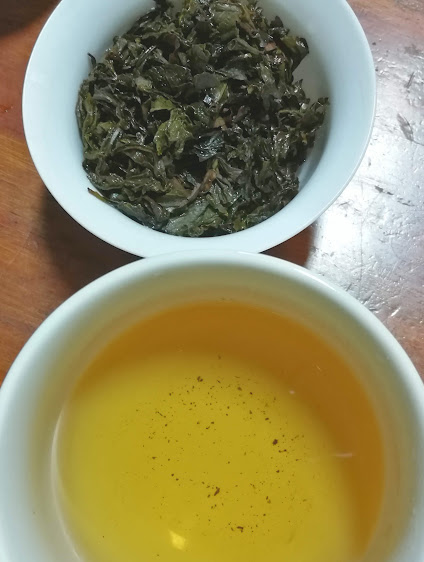
It looks vaguely like a Wuyi Yancha, but not that close though, since this leaf presentation isn't familiar, not really twisted (that style), or rolled or flattened for that matter.  Since that's the type they sell most of I'm automatically inclined towards guessing that range, so I'm thinking maybe it's a Shui Xian, even though it shouldn't be that green, or mixed in color.  It wouldn't be that hard to check that; I could just look up what those characters are.  Or it is possible to use a text character reader online based on using the image.  But both would cancel out the intrigue of a blind tasting.

Trying it initially you mostly just taste roast; more indication it might be Wuyi Yancha.  The tea character under that doesn't stand out much compared to the roast effect at this point.

The tea isn't bad, it's just not exceptional (much as I can judge it at all; it'll take another couple of infusions to).  It's not in the fruity style I like, as Cindy's teas tend to be, and I'm not noticing pronounced cinnamon either (that earthy version of it from Rou Gui).  It doesn't express the subtle, perfume or liquor like aspect that relates to a number of different Wuyi Yancha types.  I suppose people might say those teas exhibit aroma more than flavor, but I don't tend to rely on or even refer to that divide much in reviewing, unless it comes up in a tea comparison contrast.

That leaves this tasting a bit woody.  There is a bit to the aroma part, a hint towards that cognac / liqueur effect.  The flavor is ok, and the body and the rest of the balance is fine.  The roast level doesn't overwhelm the tea, in one sense, but in this initial infusion it's not balanced, a bit too strong.  It has a vegetal edge to it that implies the oxidation level is low.  It's far from green range but seemingly not in the standard level for oolongs, especially Wuyi Yancha / Fujian rock oolong.  The optimum is "balanced" of course, so that you don't even notice the parts of how the final effect occurred.


still opening up; still different colors


I wouldn't be surprised if this was more than one tea, blended versus being a single type.  Beyond the different colors making sense that would account for a couple types of character ranges seeming to come across, the more pronounced roast, the lower oxidation level "green wood" effect, and the liqueur like flavor / aroma range.  All that integrates better than it might sound it does but it makes for a broad set.

Second infusion:  it pulls together a little more.  That earlier speculation was too much to extract for interpretation from one light infusion; we'll see what I change my mind on.

The leaves are different colors, easier to sort out when a bit wet; it looks more like a blend now, or it could just be that they used different types of leaves, including the older yellow / huang pian ones.  The flavor gains complexity in this round, and the roast integrates better.  The roast effect is picking up, in one sense, and dropping out in another.  It changes and deepens but other flavor range increases.  I think this is better tea than I judged it to be in the first round.  An old-furniture effect kicks in, not my favorite range for roasted oolongs but it can be nice in the right balance and combination.  The wood aspect comes across as fresher, picking up even more vegetal character, that's still overwhelmed a bit by all the rest.  One aspect trailing into a liqueur effect gives it an extra dimension.  All this could be horrible if it didn't balance, but it does.


those Ong Yong Choon shop owners were really nice

Since it's moving away from typical Wuyi Yancha character as it develops--much as it ever expressed that--I really don't know what it is.  It's too green and too vegetal to be that, at least in forms I'm familiar with.  I've had Tie Kuan Yin that wasn't so far off this before (from the local Ong Yong Choon shop, reviewed here, the one beside Wat Pho and the flower market).  TKY can be vegetal, and they're often floral, often roasted to different levels (just more often not roasted much at all), but they're not typically like this.  They tend to be smooth and sweet, and this vegetal green wood edge isn't standard.


The "blind" part of this tasting just went by the wayside; the owners of the Jip Eu shop told me what it is by message:

it's one kind of oolong tea , some thing like tie-kwan-yin>>>Huang Tan


That explains some things, why I'm having trouble making sense of those aspects.  That green wood tone leans a little towards vegetal not so far from corn, it's just not that.  The roast level makes sense with the one other style of Tie Kuan Yin, not the bright green version, the roasted kind.  That often gets prepared as tea burned to a cinder but really it doesn't have to be like that.  This was lightly oxidized (I got that part right), with a medium level roast.  I guess that could be seen as upper-medium or lower-medium, depending on an interpretation bias in expecting really charred tea or not thinking that's normal.  I think the teas one runs across that are blackened probably don't represent any traditional style; they're just overcooked (over-roasted), maybe by accident or maybe to cover something else wrong with the tea.

If this tea had been rolled I would've been interpreting it quite differently.  Maybe not the aspects, so much, but how to make sense of them.

That's the last piece to this puzzle, that different quality levels of tea express aspects differently and come across differently.  Inexpensive Shui Xian isn't the same thing as much better versions of Shui Xian.  That's true too of Tie Kuan Yin, a bit closer to this version, but in a different sense.  Inexpensive Shui Xian are often a blend of different versions, and a higher level of roast can be used to mask limitations in the tea, or to bring an old version back to life.

This tea would be very good for an inexpensive tea, and quite limited for an expensive version.  It's in the middle.  It doesn't have enough flaws or limitations to come across as "cheap tea," and it has too much going for it.  It's not standard; that preparation style and mix of colors seems a bit unusual, as does the set of aspects.  It also doesn't express the strong positive aspect range, unified character type, and really nice overall balance of a more expensive, higher quality tea.  To associate local pricing with that, based on this Jip Eu shop, they sell really nice Wuyi Yancha for 1000 baht for 100 grams, or $15 per 50 grams, and the Shui Xian types extend across a range that runs really low in price at the lower end, maybe a quarter of that or less.


I asked and they sell this tea for 250 baht per 120 grams ($8 or so), priced on that low side.  For that it's quite good tea, I think, and maybe they should charge a little more than that.  It is unconventional though; that might make it harder to sell.  They added a little more detail in discussion:


Its not wuyi yancha, It's from unsi-fujian.  I think this tea that you just taste it , now is old one, may be about 2 years, so the taste and flavor are change much more.  It's better when new one, have flavor of flower, tea leaves look more green colour.  This kind of tea not good for keep.


Usually I edit English use to clean it up but I'll pass on how they expressed that since it's very clear.  So all that is the last of the puzzle; aging muted flavors that worked better when fresh, for this particular version.  A re-roast might have even brought the taste back to life (might have occurred, I mean, accounting for the roast level / initial char effect).  It's not ideal for the type due to aging, according to that input, but it probably started out as a pretty good tea, just maybe not great.


On the next infusion it doesn't transition much.  Those flavors are integrating better as infusions go on.  The roast level and the old-furniture effect are dropping back, with plenty of green wood towards other vegetal character remaining, taking over the balance.  It's interesting; different.  It's hard to imagine this being someone's favorite type of tea but it's well worth experiencing.  I said that about that recent Moychay Guangdong oolong too, a Bao Ing Huan Zhi, and probably about that Ong Yong Choon version too.  I think this is a little sweeter than that Moychay oolong, which does help those aspects come together.


It's not as if I'm just being nice, or biased, in describing an unusual tea that doesn't match my standard preferences so positively.  Trying different styles of tea is interesting.  It's also more pleasant when the aspects really click with you, and I can appreciate this version and range but I've loved almost all that I've tried from Jip Eu more.  I'm not so into TKY (or teas like that), and types along that line I do like best are softer, "rounder," sweeter, more floral versions, or the creamy Jin Xuan versions, or intense mineral and floral high mountain Taiwanese types.  Medium roasted lightly oxidized teas seem a bit odd, to me.  Add more initial oxidation level, more like a Dong Ding style, or other teas described as "red oolong," and that's back to working better per my preference, a step closer to a black tea.

The next infusion--4 or 5 maybe--is even better.  It's much more aromatic, picking up cleaner, brighter flavor range, with a bit more perfume-like character coming across.  The flavor extends slightly from the earlier liqueur range towards floral, it just doesn't really come across as mostly that.  Even sweetness picks up just a little.

I might share some of this at the tasting I have planned for this weekend (for tomorrow, now), although it's not a natural fit for that.  It's not a standard type, not necessarily beginner range for aspects, but it is interesting.

I might also mention that I tried this the next day as a cold-brewed version, setting it aside in a tea bottle in lukewarm water in the refrigerator, at around where these notes end in the brewing cycle session.  It is possible to just let the leaves sit and brew more later in the day too, or even the next day, but the hot, humid weather in Bangkok isn't as ideal for storing tea leaves for a day.  Cold brewing draws out more sweetness and moderates astringency in teas, if there is any.  This was really nice made that way.  It didn't have any astringency to work around but the intensity and sweetness dialed way up, which worked well with that floral range.  The roast "char" and old furniture flavor dropped out, maybe due to the difference in brewing approach, or as likely they were naturally only going to come out more in earlier infusions, just part of that brewing transition.


not long after that session, at the local zoo (where I'll hold that tasting)


A short tangent about other Chinese oolongs


It may or may not be familiar but if you walk around cities like Beijing and Shanghai there are two types of teas you see most often:  light rolled oolongs, either inexpensive TKY or teas made like that, and Longjing style green teas, probably various interpretations of the original region based version as often as actually being that.  I can relate to why.  Teas just a bit off those in style, like this one, can be quite nice, but there's something really catchy and easy to relate to in those two other forms, even in inexpensive versions.  Jip Eu does sell a range of different Tie Kuan Yin, but the real Anxi origin versions, since that owner has family in both the Wuyishan area and there.  I just don't say much about them since I've always been more into Wuyi Yancha (for a number of years now, anyway), so when I visit there I try those and end up buying mostly that.


at the Forbidden City; it's not easy to look more like tourists than this


It's not clear that the same impression wouldn't come across in Bangkok, about a limited set of standard, lower quality teas being much more common.  I may just be referring to what you see when you don't dig a little deeper, into varying range and better quality teas.  I'll add some photos of a last visit to the Bangkok Chinatown that I don't think I mentioned at the end to show what I mean by that.


Two versions of mid-range Dan Cong I've tried from Jip Eu point out another alternative I'd tend to go with from there (since this has bridged over into talking about different oolong types, rather than just being that review).  "Good mid-range commercial Dan Cong" really could be seen as a mix of terms that don't go together, an oxymoron, but if you go there and try some--assuming they have some open--you could experience it yourself.  Those versions I tried were fresh, lightly oxidized, lightly roasted, very fruity oolong, just not quite as subtle and intense as the higher quality level versions.

I bought a standard glass teapot here for use in tastings


I've been meaning to get around to trying some of the inexpensive, large-jar stored teas from the Chinatown Yaowarat Soi 6 shops as an experiment.  They wouldn't cost much, and I'd see what different moderate quality tea versions are like.


I bought some small cups at this shop a couple weeks ago too


these!  3 for 100 baht, or $1 each, not bad.


Wat Traimitr Withayaram Worawihan (on the other side)


Wednesday, August 1, 2018

Visiting Chinatown, riding bikes in Bangkok


Yaowarat, the main street


Noppadol and Kittichai, in the Jip Eu shop


the pier for the river ferry; a cool way to get to or from Chinatown


I've talked about visiting the Bangkok Chinatown before, which would definitely be a unique experience for someone who hadn't been to there.  Since we just did a lot of running around during a long holiday weekend this will do as much with picture sharing as tea, venturing into travel blog range, with a second part on going on a couple of biking outings in Bangkok.

Some prior running themes really came together in this Chinatown visit, although there are still a few loose ends to continue with.  I stopped by to pick up small tasting cups (in that earlier shop picture here), to move away from using paper cups at a later tasting event, onto something like Noppadol supplied for that recent tasting event in the Benjasiri park.


K. Muikee Tea


On the first stop I visited K. Muikee Tea, the place that Huyen visited that I didn't make it to, also a vendor Noppadol mentioned being familiar with.  I didn't have much time to sit and drink tea but I did try a Shui Xian they were already drinking; it was nice.  "Nice" covers a really broad range; it was somewhere in the middle of that, if one includes how inexpensive blended versions work out, not limiting it to single-type higher end versions.

I bought some of those white tea and shou pu'er stuffed oranges I had wanted to try.  More than I'll probably drink, since I bought the 100 gram lot or around 10, as they typically sell them, for 400 baht (around $12).  The monks at Wat Pho I share tea with should enjoy trying those too.  I talked just a little with Natapol, the owner, who seemed very nice, but I had other stops to make so didn't stay long.


white tea and shou pu'er stuffed dried oranges


teaware at that shop (K. Muikee Tea)


Huyen with Natapol in K. Muikee Tea


Then onto Jip Eu, my favorite shop.  I was surprised to see Noppadol there, already visiting.  If I were a more superstitious or spiritual-theme oriented person I'd see that as a clear sign that everything is connected, and nothing really happens by accident.  Of course I tasted a few teas with them there; that's just being polite, for as good a host as Kittichai is.  We tried some Wuyi Yancha there, Fujian oolongs, a couple interesting versions.  I missed seeing his wife on the last visit so it was nice to run across her again this time.  As always they were busy with people coming and going to deliver different teas, but that gives the place a nice feel.  It's like visiting your grandmother's house when spare aunts or cousins keep drifting in and out, or maybe more like tea tasting at a local park with joggers and a group doing yoga there, adding a pleasant busy background.

They sold those little tasting cups there (20 baht each--60 cents apiece), so I bought 30 there, more than I'll probably ever need for an event.  As I'd mentioned in another post Kittichai passed on a lot of Jin Jun Mei, a slightly aged version that I think he said they don't even sell, his own tea.  We'd just been talking about rare teas some during the tasting part of that event, about versions he tends to never mention to people because there is so little of it made or available.  A lot of what they sell are medium to slightly above that roast level better-than-average Wuyi Yancha instead.  Those volume sales, what the guys coming and going tend to be delivering, were blended versions of Shui Xian, what people tend to drink or local restaurants serve, a Chinese roasted oolong version of an English black tea blend (more or less, but that's just my take).  Those are fine, just not easy for me to appreciate being conditioned for better single-type versions now.


a different kind of tea shop, a market-stall version


Jip Eu sells lots of tea types.  Noppadol bought a ten year old sheng pu'er tuocha while we were there.  That's where I bought a silver needle cake to give to a Thai princess, to HRH Princess Sirinthorn.  Mid-range Dan Cong I've bought there (Ya Shi, or "duck shit" last) would make for a great lower cost introduction to that type.  Pleasant, type-typical, low cost Dan Cong oolong is a bit of an oxymoron; that just isn't how that works out.  Versions of that type of oolong are usually either expensive or bad, with less than average middle ground to try out.  But they do sell it there: tea selling at 550 baht for 100 grams, as I remember, maybe up to 600 now, or a bit under $20.  That might not seem inexpensive, for someone not familiar with better tea, but to put that in perspective it would make around 50 cups of tea.  One single pot of a better quality version costs that same amount in a higher end local cafe, not the kind of place I'd be a repeat visitor at, but more moderate but better tea would cost 300-400 in a cafe, for one sitting's worth.

I've been considering promoting a tea-shop open-house as an event theme, getting those shops to plan to host a more than an average number visitors over a limited period of time.  There's no space for more than a half dozen people to sit and drink tea in either of those shops, but the idea was that if a few shops joined in that would make for a great format for two or three dozen people to visit multiple places over a couple of hours, to spread the foot traffic out.


that one tea shop I'd visited way back when

I walked over to the pier to catch a ferry back home, ducking through a main market alley on the way.  In a flashback moment I saw a shop there I bought Longjing in way back when I was first starting on loose tea.  I'd been drinking Thai oolong that's in grocery stores before then, and a few other versions I'd picked up in travel, Laos, Vietnamese, and Japanese teas, from those countries, when a Chinese friend mentioned the spring's Longjing harvest was selling in local shops.


Those shops sell either loose tea sitting out open in bins (not a good way to store tea--best to avoid that), or stored in very large jars (better; worth a gamble, if you know which types are going to endure that better, like rolled oolongs, or jasmine pearls, or white teas).  Off to the back there's usually a refrigerator where they keep Longjing that's much better (perhaps the main Chinese green tea), safely removed from the effects of Bangkok heat.  I had tried their two highest quality versions that day, six years ago or so, and could tell the difference but didn't prefer either, so I bought the cheaper version.  That's how starting on loose tea tends to work out.


Another shop had teaware, and I really should have thought through that I could use a sharing pitcher and strainer for these events too.  At home I just brew directly from a gaiwan or clay pot--or infuser, for Western style--into a cup; a leaf or two might get through but it works.  I'll have to go back.  They had lots of interesting looking stuff in one in particular, but time was drawing short.  I chatted with the owner a bit and left without buying anything, and saw some interesting things on the way through the rest of the alley based market area.  Even the smells in Chinatown are interesting.


market and shops areas are along Soi Yaowarat 6; the following pictures are from there


It's worth noting the route that I took that day, since it really does work out for a short tour of Chinatown.  Hua Lampang MRT station (the subway), is just off of the lower right corner in that map capture, a block or two over from Jip Eu, with K. Muikee tea in the middle. That road is called Rama 4 road there, and switches over to being Charoen Krung road as the two meet at a 5 way intersection a bit further on.  Yaowarat, the main road, is a block "down" (South), the one that Double Dogs Tea Room is on in that capture.  All of the South of Yaowarat are small wholesale oriented shop areas, closed after 4 or 5 PM, but really interesting to wander around in the morning or afternoon.  It's kind of a shame to do a quick pass through Chinatown, as I just did, crossing over that top road and then down through the market alley to the pier, but then I have already been there lots of times.


small shops full of all sorts of thing crowd a narrow alley


probably a good place for picking up an inexpensive gaiwan or teapot


just across Yaowarat from that market soi, the street vendor foods area


Biking in Bangkok


the floating market area, part of it


We went on two biking themed outings over this past long holiday weekend in Bangkok, and in this part I'll do more with sharing pictures than talking through all that.  One place I've been hearing about for years is Bang Krachao, or "Bangkok's green lung."  One part is local neighborhood, like a suburb, another is a floating market (less "floating" than one might expect, but it is perched up on platforms on and around some canals there).  And there are bike trails out through a more natural setting, the main draw.


roasted pig, crispy pork style


lunch party

To make a long story short they don't rent bikes for young kids there, or have bikes to rent with a rear seat for a small child, so we couldn't do that part, the main reason we went there.  Some bikes did have two ordinary seats, so Kalani could've just held onto an adult the whole time, but it wasn't worth the risk to us to go that route.


It's funny we're so risk averse, considering how often I see toddlers holding onto a motorcycle handlebars, unsupported by an adult or any seatbelt, but that's just not for us.  I recently saw a video of a woman riding a motorcycle with one hand, while a toddler hung on by themselves, while looking at a smart phone with the other, and she actually took both hands off the handlebars at one point to the type out a message.  Life can seem cheap here.


That market area was nice, for what it was.  I had nice fire-grilled chicken and sticky rice for lunch.  One local vendor made really detailed Pepper Pig and Hello Kitty pancake images, drawn freehand, and Kalani snagged an inexpensive Barbie and two Pepper Pig cups, one to share with a school friend who is moving back to China (gone now; that was her last weekend).


Pepper Pig, with the pancake artist


with Kero Keropi and Hello Kitty pancakes


a spiky tropical fruit; those are nice (50 baht, around $1.60 for that pack)


battered fried bananas, a personal favorite


We also went to Rot Fai Park the next day (or Railroad Park, near Mo Chit), our favorite place for renting and riding bikes in Bangkok.  They cost next to nothing there, around $1 for a rental, and the selection is broad.  That circuit is around 3 km long (a bit over a mile and a half), through a mature park that had been a golf course in the past.  It looks less and less like one as the plant life reclaims the space.

I'm going to really miss that little girl who went with us, Olea, Kalani's short-term classmate for summer camp.  Even though she couldn't really use English--or of course Thai; she's Chinese--her bright spirit was a good match for Kalani's.  Kalani can speak some Mandarin, since she's been studying it for two years now, but I think they just didn't need to talk much to be friends.  It was nice playing with two little girls; hearing two different versions of laughter as different things struck them as funny.


three monkeys instead of two


lots of bikes to choose from


playground break at that park, in the middle of riding bikes


with Amber, her mother (left; my wife is on the right)


proof that I was actually with them; a cafe in that park