Tuesday, January 18, 2022

Talking with Alex and Bruce about Russian tea, other themes


We had the first online meetup of the year recently, meeting with Alex Phanganovich, who I've mentioned before here, and Bruce Carroll, an American friend living in Chiang Mai.  Alex and I first met at a Monsoon hosted talk about tea and sustainability presented by a Russian ecological researcher, Alexey Reshchikov.


Alex is looking at Kenneth Rimdahl in the back, there at Monsoon


he met the kids that day, visiting while I was at swim class with them


I wanted to write this partly to cover discussing Alex selling a bit of tea he's ran across along the way from living in Chiang Rai, and also to mention Huyen's brother mentioning a new online sales outlet.  Huyen's whole family has an amazing vibe, and they are all tea experts, so it has been nice when they can join the meetups.


it's nice seeing Huyen's nephew join; soon he'll be talking about tea too


We were supposed to talk about tea tourism in Chiang Rai; that was the initial point.  We just didn't get to it.  I think there are only a half dozen main producers that Google search would mention there (like this does), and more unconventional and interesting smaller producers would be something else, maybe further out of the Mae Salong area.  Alex mentioned that learning about local tea culture was interesting while staying there, which we didn't get to far into.

We didn't talk about tea all that much, as those meetups usually go, delving pretty far into introductions, and how covid went for people, even into how tobacco storage and consumption parallels tea themes, which led to talking about weed.  Legalized marijuana is being developed in Thailand, and another friend here uses it for a rare problem with facial muscle pain treatment.  All that is what it is, already familiar or not.  

The point about tobacco comes up in discussing humidors quite a bit.  The main difference between tobacco storage and tea is that aromatic woods used for tobacco storage can add positive flavors, and for tea you don't want anything but the other tea contributing to the changes.  Then apparently for tobacco you use different pipes for different kinds of tobacco, as with clay teapots.  Who knew?

It has been snowing in Sochi, where Alex is living now, and a main place where tea is grown in Russia.  And also in Krasnodar, I guess?  In the US tea plants used in Sochi are known for being among the most cold tolerant types that exist, which applies fairly directly for a lot of the US too.  We talked a little about Russian tea preferences, and produced styles, about changes in gaba development and shu and such, but no developed sub-themes that really need to be filled in here came up.


hopefully they're cold tolerant


A question came up about Russian blends really being smoked or not, which didn't get far in discussion.  It's my impression that this is either something made up, or a reference to Russians importing and then mixing smoked Lapsang Souchong with other teas, or to tea transported from China by horseback picking up a smoke flavor from campfires as it was transported.  My guess is the first, that it was made up.  I'd expect most of the tea that made a trip by horse, earlier, was pu'er or hei cha instead, which would make it easier to transport, and matches the theme of Yunnan producing tea for Western and Northern Chinese areas that are too cold to make their own.  Not that I'm well informed about any of that; I asked someone by message before posting this but it didn't work to get more input.

Huyen covered a bit about range of Vietnamese teas, but I've been through a lot about that here in the past.  There are two really good articles on all that by Geoff Hopkins, the owner of Hatvala, on history and evolution of tea there and on origin areas, geography, and types.  Some interesting backstory on the article source:  per my understanding when the old World of Tea blog (by Tony Gebely) transferred content to become the Tea Epicure blog some of the material went to a partner's site instead, which is what that killgreen.io site is.  So unless I'm completely wrong that had been a World of Tea guest article, which is cool.

So I'll mention a little more on those two tea sales updates and let this go.

Huyen's family has long since founded a cafe in HCMC (Saigon) and a chain of gift shops with different outlets, Tra Viet.  I might have reviewed at least one tea from them but I never kept track of origins of what Huyen shared.  Her brother is now expanding to selling tea through Amazon.  It's nothing too novel, but if better tea really is starting to creep into outlets like that it would be good.  I don't think they'll kill off small tea vendors or foreign outlets any time soon, although minding that concern makes sense.

Alex specifically mentioned that he's not necessarily trying to become a mainstream vendor (he can be reached through Facebook though, or Instagram), and that he mostly sells a bit of what he picked up in a year or so of living in the north of Thailand.  Or in general gaba tea, gushu versions, or aged shu, per asking him for this write-up, and maybe later on more Russian teas.  Maybe that's especially relevant to someone living in the Sochi area, since meeting up with someone and trying some teas helps a lot for getting a sense about such things.

This has barely touched on tea issues in Russia so far, right?  That's partly because the general background about what teas Russians like and perspective on the subject repeats what is in other posts (like this one on Russian tea culture).  An interesting sub-theme came up about perspectives on Moychay, a Russian outlet I mention a lot here, for reviewing a lot of their teas.  Some Russian tea enthusiasts love Moychay and some don't--normal enough.  They share teas for review in this blog, to be clear, so my potential bias should be noted, which isn't going to come up here since I'll set aside going further with that discussion for another post.  Alex offered some thoughts on what objections might be, or how different biases could factor in, and how it relates to perspectives on other vendors, and that really got me thinking.

Short discussion came up of a book on tea by Sergey Shevelev, the Moychay owner, Geography of Chinese Tea.  He posted a nice intro of that as a Youtube video recently.  It pretty much matches the review I wrote, talking about what's in it, about Chinese tea types, geography, history, some old stories, tourism sites, processing steps for teas, and so on.  

For covering all that, and for including a lot of photo content, it's a bit general, but that seems fine for what it is supposed to be.  It's not a manual for how to process tea, but it does contain a lot more of the typical processing steps than other books I've read.  It's not a tourism guide, but it could work to cover ideas for what to see related to tea while visiting China.  It's not a comprehensive guide to tea types in China, although it is pretty close to covering all of the main types in limited detail, and many less known versions as well.  Someone just mentioned what they took to be a rare steamed Chinese green tea type in the Gong Fu Cha group, a tea from Hubei, and there was a short section on processing steps in that book on it.


So it was the usual, nice keeping in touch with people and making new contacts, and talking a bit about tea.  It takes the pressure off to do justice to a subject not talking to a tea producer or sub-theme expert, freeing up space for covering tangents.

Saturday, January 15, 2022

Osmanthus black and Shui Xian oolong from Jip Eu (Bangkok Chinatown)

visiting Jip Eu that day


A few weeks ago my wife and I were doing a rushed version of Christmas shopping that included a quick pass through Chinatown, so I stopped by my favorite shop there, Jip Eu, mostly to buy tea for gifts.  I bought 6 packs of an inexpensive Shui Xian, all but one to give away, and a spare Xiaguan tuocha there, and some Thai oolong and a couple of Dayi tuochas elsewhere, at Sen Xing Fa.  

Kittichai (the shop owner) gave me a tea there as a gift, an osmanthus black tea, which I'm reviewing here, along with the Shui Xian.  Very kind of him!  Those guys do feel like extra family to me, and I would probably visit them even without buying or drinking tea.  Maybe it feels slightly less like that for me only seeing them a couple of times last year, but that's how the covid era goes, Bangkok keeps shutting down and opening back up.  I don't work out of my office, almost ever, so stopping by Chinatown while on that side of town doesn't combine together.  I suppose I could be biased about their teas, liking what I would prefer to like; it's worth considering.


One might wonder what else is in Chinatown as gifts for kids.  There is a toy area of the wholesale shops there but my kids are both moving on from Legos and dolls and such.  We did buy some of those educational toys, about setting up a demo water filter and a seed sprouting kit.  Some extra clothes and such were most of the rest, some hair accessories, and we picked up a half a kilo of chrysanthemum due to almost running out.  It wasn't one-stop Christmas shopping; another trip to a department store and going to a sporting goods store later that day rounded it all out.  They do have online shopping here but we are slow to move to that (my family, and that also works for Thailand in general).

On to how the teas worked out.


Review, Osmanthus black:


first infusion:  really nice, although that interpretation depends a little on how one takes tartness.  Floral tone stands out most, leaning a lot towards fruit, along the line of roselle (hard to describe, between rose petal and cranberry, I guess).  Smooth, warm, rich tones fill in beyond that; this is definitely not an edgy version of black tea (astringent, or harsh, or flawed in any other way).  That roselle tone, which really has to be osmanthus, given what this is, includes a bit of tartness, or I suppose that's just as likely coming from the tea, but seems to link to the floral range.  Black tea contributes really mild mineral tones and other warm toffee like sweetness.  Probably floral will fade in a second infusion and wood tone will pick up, maybe even warmth like spice, which should also be nice.

Where to go from the basic flavor list for discussion?  The only other flavored black tea I ever tend to drink, besides Earl Grey, is jasmine black tea.  That's probably my overall favorite flavored tea form, the way that input can integrate in a good version.  Osmanthus is pleasant too, sweet and rich, floral towards fruity, not disagreeable in any way, and well suited for blending with tea.  

One might've tried mild osmanthus oolong and edgier, intense jasmine green tea, or strong versions of jasmine white, and think that jasmine has too harsh an edge, but that's most typically coming from the green tea.  How it works out for white is a bit strange; that tea has to mild, if it's white, but jasmine input can get to be a bit much.  I suppose at some point the balance is determined by the level, and producers making adjustments by mixing actual flowers (versus layering tea and flowers to add flavor), or adding chemical agents to extract flavors is something else.  What is the word I'm leaving out here?  Along the lines of solvent.

Anyway, this isn't as good as the best jasmine black tea I've ever tried but it is quite good.  For someone with more of an osmanthus preference that opinion could easily be reversed.  It's probably as well to say more about the tea base after a second infusion, since heavy floral input extracted relatively quickly this round, and dominates the flavor range, which isn't so bad.  I tend to brew Western style on the heavy side, using a proportion that works well for three infusions (maybe 4 grams for a 12 ounce cup, but I don't measure either, so I don't really know).  In this case, for flavored tea, the first two infusions will be quite positive, but very different, and the third might well be pushing it.


second infusion:  maybe a little better, for the black tea input ramping up.  The floral and fruit range didn't change much, just fading a good bit, but the tea input did.  It has nice toffee range sweetness, and a bit of a savory edge to it.  I have no idea what tea this is but it's not like the Dian Hong I drink most of.  I suppose it's closer to Wuyishan Fujian black tea I've been having, or it could be something else altogether.  

It kind of doesn't matter, exactly what black tea style this "should" be like.  It's suitable for a flavored tea base, mild and rich, maybe just a bit non-distinct to stand alone, but it would be easier to determine that trying a plain version.  Mineral tone gives it more of a positive base effect, along with the mild towards wood or spice range aspects.  If it's fruity or floral at all it's not possible to separate that from the osmanthus input.  It's good.


Review, Shui Xian oolong:


first infusion:  this won't be the fairest appraisal of this tea because I'm using the end of a bag that I separated out as two separate parts from an original paper wrapper.  I've drank this a few times and it's quite pleasant, but that form was more whole leaf than this.  Since I took out the top half to put in another bag just thinking it all through better earlier would've resulted in using the most whole material, instead of the most broken, but I'm not that clear minded first thing in the morning.  Or even now, at 11; there's a narrow window in the afternoon where I'm more optimum, maybe between 1 and 3.  My kids and I sometimes joke about how I'm not a morning person or an evening person, and it's not just a joke.

This has a really nice inky mineral base and strong woody sort of flavor, like tree bark, towards spice.  There's a Chinese name for that I'm forgetting; I'm not good with memorizing that list of main tea terms.  It makes you sound so much more knowledgeable and authoritative too, like you are speaking for an old tradition.  

This includes some cinnamon as well, more than I would expect for Shui Xian.  The flavors are really intense and clean, with what I take to be good input from a roast step, and a great level of oxidation (probably mixed, since they blend inputs to get to the most positive outcome in these sorts of teas).  It all works better than it should.  I've tried Cindy's Qi Lan again since drinking this and the character overlaps a good bit (Wuyi Origin's, really good tea, a version from a different quality level).  To say this is more rustic or rougher edged implies more of a difference than I'm really experiencing, since that degree is so limited, but I suppose that's it.

This tea most definitely punches above its weight.  If you bought this for $8 for 50 grams it would seem like a good buy, as standard tea versions go, and I paid $3 for what could've been 100 grams (I think it was that).  Packaging was entirely in Thai (maybe with some Chinese mixed in), and I didn't have it translated, and was in a rush when I bought it.  It's odd how this tea is a great value whether it was 50 or 100 grams; it usually doesn't work out like that.  For $6 it still would be (200 baht instead).  It goes without saying but twisted style teas like this taking up a lot of space in a package is what makes it hard to determine amount; it was mostly whole leaf, and again this is the end of the "bottom" half.

That's the opposite of how that would almost always go in buying random Wuyi Yancha, to some extent even there at Jip Eu.  Very inexpensive teas can be drinkable, positive and interesting, but not this good, with this degree of balance, intensity, pleasant aspect range, and lack of flaws.  I suppose it just so happened that they bought Shui Xian versions with limitations that merged to become really good by matching up.  An inexpensive version like this should be a "daily drinker," the kind of tea you would have with breakfast but not focus on in a session as the main theme, but it could stretch and cover both.

To put that in perspective Cindy's (Wuyi Origin's) Qi Lan sells for $17 for 50 grams, and to me it's a good value for that.  It's better than this, but the character overlaps, and this tea should have notable flaws that it doesn't have.  For that tea slightly cleaner and more intense flavors and better feel and aftertaste would all mark it as being different, with general flavor range not as different as would be normal.


for outdoor tasting level of sunlight can affect images a lot


Second infusion:  so nice, that intensity, and again the cinnamon with inky mineral and an aromatic tree-bark version of being woody, pretty close to spice range.  I should get back there and buy a few more of these packs.  I did buy 6, but only one was for me.  Three others went to monk friends, and two to local shopkeepers, one the family Happy is a part of, that local cat that I love visiting with.

Another aside:  our cat, Myra, just changed from being an inside cat to more of an inside-outside cat, spending days outside, then visiting some inside and nights in a pen (cage).  She's been adjusting to those other environments for over a month, but just made the switch in the last week.  Kalani said that she's so proud of her, that she can do it.  She ends up exhausted at afternoon nap time, when she gets a lunch, and in the evenings, after she spends all day exploring.  Later I guess she will just head up to the roof spaces to hang out, like the other two cats often do.


I didn't edit these pictures; my "new" Huawei phone does ok, a new but a dated P20 model


Not much to add about this round or this tea.  A bit of a heavy earth edge is as close as this gets to a flaw, a bit towards a roasted coffee tone.  Even that is nice, to me.  You can't really spot the quality limitations without being familiar with the intensity, feel, and aftertaste experience of better versions, and I suppose prior to adapting to prefer those they wouldn't be that much of an improvement.


third infusion:  flavor deepens; inky mineral picks up and cinnamon fades a bit.  This will shift in character, and probably not be as positive as higher quality versions after 8 or 9 rounds, but it's kind of holding its own now.  I tried this with an orange cake a couple of weeks ago and the way that heavy mineral and towards-spice tree bark flavor matched up was just fantastic.  

From trying it a number of times already I already know it's not going to fade away quickly, as can occur with some modest quality Wuyi Yancha versions.  The depth in this indicates it's not like that; lower quality versions can have good flavor if you push them through early rounds, but they can't back it up with the same kind of complexity.  A touch of cardboard flavor range often also gives up lower quality versions; this doesn't include that.  Roast input is typically heavier in lower quality versions too, used to cover flaws, and to integrate blend inputs together that don't completely match.


Conclusions:


Two really nice teas!  I don't know what the osmanthus black sells for, although I suppose they probably do sell that, but it's a lot better than a standard grocery store blend would be.  It's a full quality level better than anything Twinings would sell, probably at the top end of the range for high profile French vendor blended teas.  You might be able to buy something comparable at local TWG outlets for five times what Jip Eu sells this for.

I mentioned this experience in a post about oolongs in a Quora Space about tea I developed, Specialty Tea, and someone on there commented that it's always nice finding an inexpensive gem of a tea version.  It's almost not about the expense, because if I'd spent two or three times as much it wouldn't have changed much.  It's that I'm drinking much better tea than I expected to, and the people I bought it as gifts for are.  I've got other Wuyi Origin tea around, so I can have some when I feel like good Wuyishan oolong, but I can use a pretty good version as a daily drinker through this, for rushed breakfasts and such, or experimenting with grandpa style brewing.  I mostly use mixed tisanes along with sheng for that now, sometimes just with chrysanthemum.


If others reading this want to visit Jip Eu they might wonder what types are best there, beyond inexpensive oolong and floral flavored black (which they almost don't carry any of).  They stock good Wuyi Yancha, that other quality range I mentioned, but it helps trying versions with them to match style to preference.  Slight variations in oxidation, roast level, plant material input, or general style can vary outcome a lot.  I've written about buying a couple versions of aged sheng there, not necessarily rare and high cost versions, but those were sold as CNNP / Zhongcha and old Dayi, so not really random stuff.  Half the time I go in there I restock an older Tulin tuocha version, a nice basic aged tea, not so far off Xiaguan range.  

If you bring up aged sheng that automatically raises authenticity discussion, and to me the heavier range fermentation effect of teas being stored in Bangkok is another main consideration.  They are kind of like Malaysia stored teas, but I at least think I can taste a difference.  Again visiting and tasting pins down what you'll get, and match to preference.  You just can't buy aged sheng or supposed good Wuyi Yancha without at least having a really good idea of what a vendor sells, and how they tend to describe versions, and what Jip Eu sells isn't supposed to represent a consistent, narrow range.  Tasting a tea first is ideal, and they're open to try teas with you.  You need to be patient there if you only speak English; that will work, but 100% of discussion content won't come across in both directions. 

I've bought pretty good mainstream commercial Dan Cong there a few times; that's an odd thing to come across.  Relatively moderate cost Dan Cong is usually so edgy that you end up balancing really fast brewing with not extracting enough positive flavor, but that wasn't like that, or as good as the more typical 50 cents a gram range versions either.  I've even bought Thai versions of black tea that were nice, and jasmine green (which I usually don't like, but did), and local, wild origin, very unusual sheng ("pu'er-like tea," in relation to that Thailand origin).  

One thing I almost never experience there:  trying the same tea twice, even varying year versions.  If you walk in and walk right back out with some tea, as I just did, you aren't approaching shopping there correctly, in general.  It worked that time though, a perfect time for it to, since the tea was for gifts.


Monday, January 10, 2022

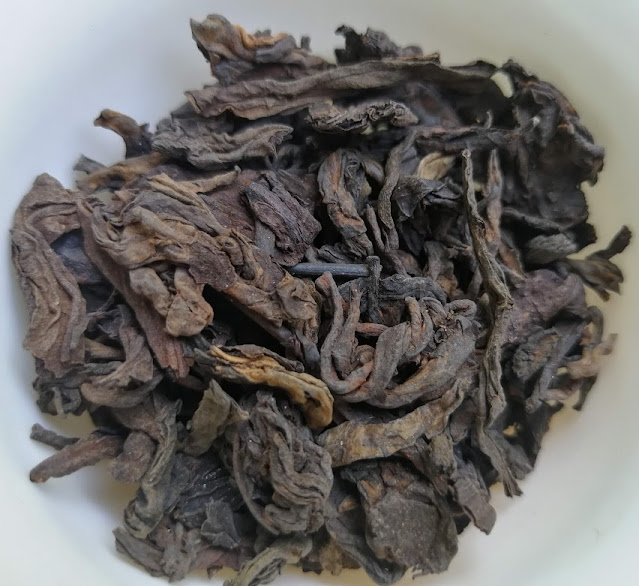
Moychay 2005 Lincang cha tou shu pu'er


This should be a really nice tea.  I've expressed that I see shu as a tea type that varies a lot less than many others in the past, the "shu is shu" idea, which I always clarify by adding that some is better or worse, or more interesting.  Examples of cha tou, or tea heads, clumps of shu that form naturally during production, have been an interesting and pleasant exception in the past.  There's a particular range of experience that seems to differ in those, one that I've lost track of for it being so long for trying a version.  Of course it could be that I just happened to try a really good version one time, and extrapolated from that incorrectly, but this is a commonly expressed opinion, that versions can be interesting and nice.

This version is from Lincang county (the Shuangjiliang District of that, which doesn't mean anything to me), which doesn't change my specific expectations, but that sounds ok.  The age is interesting; for a heavily fermented shu it will just smooth out in transition over time, and not change that much (per my impression; of course plenty of others would disagree), but less fully fermented shu can transition more over time, and 17 years is awhile.  The experience is the thing, more than back-story themes, even when those are interesting, so I'll move onto that.

Since this label includes a description I'll break normal form and add that here before tasting and editing, the opposite of more typically tasting without seeing any input (also on their site listing):


The brewed tea has matured, refined nutty balsamic bouquet with hints of chocolate, dried berries, herbs, and autumn leaves.  The aroma is deep, viscous, nutty balsamic.  The taste is rich, complex, sliding, a bit sweetish and spicy, with a slight bitterness and sourness.  The aftertaste is juicy, lingering, velvety.


Part of citing that is looking for one distinct typical character range in cha tou.  I could look up what I've written before, but it's not as if I've reviewed versions so many times a pattern would emerge, maybe only once or twice.  There was something really catchy that I'm not remembering well, maybe along the lines of fresh baked bread, but towards a darker grain range.  Or maybe that's way off, and there is no consistent aspect pattern in shu clumps versus the rest.  I just looked up three other vendor references for versions, one of which I reviewed here, and they were just described as extra sweet, creamy, and in some cases tending to have a berry like aspect.

I might also mention that some other cha tou versions have seemed a bit more clumped than this, not that it means a lot to me as an input.


Review:


First infusion:  I only used a fast rinse, all I ever go with.  Some others mention a 10 or 20 second soak, but I just rinse shu, aged shengs, and hei cha versions quickly.  This first round will be a bit light then, because it won't start infusing well quickly.  

It's promising.  Cocoa does stand out, and I can kind of get the berry range beyond that.  There is no dominant or heavy earthiness, quite different from some shu range, and the overall effect is quite clean.  For standard versions, regardless of form, origin, or fermentation level, it's often said that rougher edge fermentation product aspects will fade over 2 to 3 years, the heavy peat and petroleum and such, and 17 years is a long time for that transition to finish.  This tea could've even finished fermenting naturally, if it was at a light level initially.

Spice is a nice input already, towards a warm and aromatic incense spice, but I would expect flavor aspects and feel will be easier to evaluate over the next two rounds.


Second infusion:  I brewed that about 15 seconds, longer than would really be necessary for a high proportion, but that will move it along to a higher intensity and towards the character range it's getting to.  For being brewed at twice the infusion strength of the last round the earthiness ramped up.  It's along the line of slate, like a wet chalk board smell.  It still seems relatively clean, with a lot of other range filling in along with that, the cocoa, berry, and spice.  Aromatic wood would be a decent interpretation for another main aspect at this stage.  I would expect this to "clean up" a lot over the next two rounds and for that heavier range to give way to a more refined character.  It's not musty though, and barely contains any of the heavier and odder fermentation related flavors, so I don't mean in the same sense as for some shu becoming more approachable.

It's nice; it seems appropriate to pass on an impression of liking it, even if it is early for that.  It's a little light as shu goes, with even the fullness of feel a bit light compared to how very heavy flavored and intense shu can come across.  The trade-off for losing some of that weight or creamy fullness is this positive flavor range, complexity, and refinement.


Third infusion:  there is a dark bread like quality to this, which emerges more across the rounds.  Of course it would be possible to just eat a dark bread to get a very intense experience of that, but this is different, combined with a novel mineral undertone range, and other cocoa, warm spice, and light fruit complexity.  Feel and aftertaste are nice, but it's easy to expect a lot of thickness of feel related to how heavier shu comes across, or some sheng, especially related to lengthy aftertaste experience.  To me those fill in positive depth to the overall experience, with the refinement and flavor range and complexity more exceptional.

At the same time that this rejects the generality that all shu is similar it also partly supports that.  This version is more complex, refined, and interesting than most shu, by a broad margin, but it's also an easy to drink, relatively simple to experience tea.

A discussion with a friend about cha qi warrants filling in, yet again, that I'm not overly sensitive to that factor.  I can't say how this tea makes me feel any different than drinking Indian black tea with breakfast yesterday.  When sheng effect is very strong I notice that, but I seem to lack a consistent baseline for inner experience that makes it easier to notice variations.  My energy level varies for a lot for other reasons, even though my mood is a lot more stable than for most.  I think the noise of living with kids throws off that degree and type of inner self-awareness; I'm most calm when the background noise dies down, and have the most energy when the demands taper off.

I'm also completely not into drug-like effects of any kind, so changes or inputs can seem interesting to me but I wouldn't necessarily value them.  I don't drink alcohol or consume any other kinds of drugs; I've already done my time with all that.  I've nothing against alcohol, and would drink some at a wedding, it just doesn't come up.  I exercise at an intense level when running, and that gives you a bit of a buzz after, but I can't relate to people valuing that either.  It's a minor adjustment of form of life experience, nothing too significant, and it passes quickly enough, and carries no meaning while it happens.  Communing with nature during a hike, walking on a beach, or during a tea session outdoors, is something else, that's a longer term experience of a connection outside yourself, a real change of experience form.  

I'm not rejecting that some people experience and value "cha qi" as the main desirable effect that is related to tea experience; surely they're really getting that.


some variation in leaf color is interesting


Fourth infusion:  oddly the finish / feel of this tea seemed to transition the most; it is more velvety.  Tone seems just a little richer, darkening a little, but this is absolutely smooth and clean at this stage.


Fifth infusion:  I don't get the impression that this is going to evolve or transition quickly, or perhaps so much at all over a half dozen more infusions.  Which is fine; it's really nice as it is.  It has a nice depth to it; it's not just that the flavor range spans some scope, but it comes across as layered for having that plus the feel richness.  Aftertaste intensity is a bit limited, but that's normal enough for shu in general, compared to potential for sheng.  If someone really valued that they could brew this twice as strong, but as I experience it intensity is fine at a moderate level.  

One concern that occurs with aged teas in general is value, cost.  For sheng versions that weren't expensive at all that could still be moderate, but just as likely any aged sheng cake at all (from this time-frame) would be in the $150 and up range, at least 50 cents a gram, and how much someone values that experience has to factor in related the more significant expense.  This really is novel compared to other shu experience, but only to a certain degree.  Then again how people see spending 50 or 75 cents per gram versus 20 or 25 depends as much on their budget as tea preference, or variation in what they could experience.  If this does cost in the lower aged sheng range, which I would expect, it's worth it in the sense of being novel, but at the same time not so different.  Shu is shu, even relatively unique shu.


Editing note:  it's listed for $37 per 100 grams, which seems quite fair to me given what this is.  "Clumpier" cha tou might provide a bit of aesthetic edge but the character of this is nice.


I think the appeal of this tea would be relatively universal; there is that.  It's novel enough that someone who drinks shu could recognize the uniqueness and approachable enough that for a relative beginner at least it would seem pleasant.  I was trying to explain how that works from the other direction in talking in a group oriented for early exploration about someone trying a shu mini-tuo.  Typically at best those aren't so bad, but shu can still be nice to experience in moderate quality versions, it just doesn't warrant as much attention.


Sixth infusion:  what I interpret as root spice range is picking up, and creamy feel ramps up further; this is still transitioning.  I should give it a slightly longer soak to check on what one more round and that brewing difference changes and leave off taking notes.


Seventh infusion:  it's nice the way that cocoa stays present, even though the minor berry or fruit range kind of faded, giving way to more spice range.  An earthiness in this is catchy, the way that driftwood smells, something unique.  


Conclusions:


This reminds me of talking to a tea friend and mentioning that to some extent people see in teas what they want to experience.  The opposite can happen, or other surprises, but quite often people expect a tea to be unique and exceptional and find it to be so, partly related to bias.  This tea someone could judge as one of the most amazing shu versions they've ever tried, as novel, well balanced, and distinctive, or as kind of not so different than other good shu.  I guess I expected to see both in it, and do, so that still kind of works.  I can't imagine someone not liking this tea but seeing it as not so different than other shu versions would be easier to justify, I just don't see it that way.

The range of aspect variation isn't narrower for shu than for green, black, or oolong tea versions, so it's probably really just the crazy complexity and diversity of sheng that makes this type seem simpler in comparison.  Or at least that's how I see it.


Keo's idea of posing, looking away while moving


meanwhile glamour shots of her turn up in my phone gallery