Wednesday, November 13, 2019

Water type experiments, with Wuyi Origins Rou Gui and KTM Lao Man E sheng


This is all a bit much.  I've been meaning to test the effect of using different water versions on tea for awhile, it was just always too much messing around to get to it.  Now that I finally did results were interesting, but one part related to sample type selection could have went better.

In retrospect it was odd using teas I hadn't reviewed before, and teas of this quality level for this purpose.  Cindy's Wuyi Origin Rou Gui versions are about as good as that type ever gets, and the fruitier version is a strong contender for my favorite tea among all types and versions.  I guess the reasoning was that using good tea is going to tell more of the story related to what input the water has, versus using teas that are of medium quality, and trying to extrapolate results to likely outcome if the teas had been better.  It was also about just using interesting versions that I had around.

The same concern and atypical theme applies for the King Tea Mall Lao Man E sample; this is a gushu version from a respected, in demand origin area.  It's questionable judgement, shifting focus off the tea onto the effect water mineral content variation has on preparing it.  One might argue that both can be covered at the same time, but per the actual experience a lot gets lost.

About water type / input testing in general, it had always seemed next to impossible to identify what a really good or ideal source of water would be.  Really doing that process justice would involve trying lots of water types, and then probably folding in how that varies across at least a few different tea types.  Online discussions of water mineral levels as an input have been interesting, and standard patterns of opinions do emerge, but nothing that works well as starting point guidance. 

Avoiding high levels of calcium is generally advocated, for example, but my own interpretation of what would be low, medium, and high based on sampling lots of hearsay may or may not be remotely reliable.  I mentioned some advice passed on by Peter Jones in covering some theory in this post, which was really about trying a Myanmar Kokang shu version:

We are still several months away from any conclusions. But basically you want your alkalinity to be 1/2 your total hardness, a pH in the 7s, and a balance of 2/1 of Ca to Mg. The other positive ion mineral salts also play a role in extraction...

The form I finally arrived on--definitely not a final word on a practical, functional approach--was to try two completely different teas using Volvic water (which gets mentioned as some people's personal favorite), compared to the filtered local Bangkok tap water I use at home.  It was a stretch but I picked two relatively random, opposite type teas I happened to have on hand, a Rou Gui and a sheng pu'er.  It turned out to be not the best selection because I didn't factor in the high level of bitterness in the sheng version (a Lao Man E); kind of an obvious mistake to make, in retrospect.  Trying an already familiar, milder version would've made a lot more sense.

I can't describe what the local water is like in relation to lots of other sources, but of course I have tried the same teas prepared using it and also other spring water, RO water, and whatever is being used in other places.  My friend Sasha had a favorite spring water he used, for example, and some of those teas I had tried at home, a number of versions tasted there many times.  A vendor at an expo had been using RO water, and I re-tasted the same teas I tried with them again at home within a couple of days, and I try teas in shops sometimes.  To really isolate differences trying the tea prepared together is all but essential; the point here is that how differences in water source work out in general, and how the local water compares, isn't completely unfamiliar.

Bangkok municipal water had been truly awful, years back.  It varied so much even the color and smell could be off.  We used bottled spring water for years, or at least local water sold as such, which really could be different things.  As of a few years ago we switched over to using a multi-stage filtration system, and the water seems fine.  Per online hearsay the tap water here is based on rainwater sources instead of natural spring origin, so it's low in mineral content, which makes sense given that it rains a lot and we're not exactly near a mountainous or even hilly area.  Per other hearsay local distribution systems are a main problem for water quality, the pipes from there to houses, not so much what the processing centers put out, or even use of old pipes in your house.  It probably helps to live right beside one of the main Royal palaces in Bangkok as we do; infrastructure seems pretty stable and well maintained.

One might expect the water quality and mineral contents to vary based on lots of local factors, and I'm not certain that it doesn't.  I've included a number of captures from the local Bangkok real-time water quality monitoring system, from when I tried these teas, but of course those don't include a measurement of contents broken out by mineral grams / liter at any given time.

It would make the most sense to run this type of comparison multiple times, evaluating tea types one at a time.  I didn't do that, I tried two types together.  That I still don't consider a mistake; I've been training to do comparisons that make sense, or else those that don't instead, for about three years now.  I've tried hundreds of teas over uncountable combined tasting sessions.  It's familiar ground.  If someone without that odd tasting habit wanted to get the clearest results I'd definitely recommend using the more intuitive approach, trying the teas one at a time, perhaps using 3 or 4 types of water to add review complexity.  Selecting mild, well-known versions of teas would probably work best, regardless of type; that part was a mistake.

I'll probably try this again with a rolled oolong version to see how it works with a very mild but complex tea, which should also help to isolate feel effect even better.


Review, comparison of Wuyi Origins Rou Gui with two water types:


Rou Gui with Volvic:  just amazing tea!  I'm not sure if that's the water though.  This didn't say if it was fruity type or cinnamon Rou Gui but judging from the heavy, warm cinnamon taste it's that.  Flavor is intense, feel is thick, level of roast is perfect, slightly noticeable but only complimentary.

Rou Gui with filtered tap water:  this is similar but the flavor may pop a little less.  It seems to be drawing out a lightly different vegetal note, as if the warm mineral resembles celery just a little.  Cinnamon is slightly flattened out.  This difference is so minor that tasting across different times it wouldn't really stand out as much, but side by side it does quite a bit.  Sweetness is down just a little too.  It's the same great tea, almost the same flavor profile and feel, just a little different.

an early round; color differences didn't seem to tell a lot of story, so I'll pass on adding more about that


Second infusion:


Rou Gui with Volvic:  this tea is just perfect as cinnamon intensive Rou Gui goes.  The balance, intensity, all the profile taken together; this is it.  The cinnamon part really jumps out.  It's warm and rich, almost connecting a little with a very subtle roast level, or maybe it only seems that way.

Rou Gui with tap water:  it's almost the same experience but it is missing some of the one high point that makes the other tea experience so special, the brightness, sharpness, and intensity of that cinnamon flavor.  The deeper tones and supporting elements carry across fairly well; fullness and body isn't bad, kind of similar.  The first version might have a slightly heavier, oilier feel, which is more positive.  It's a quite similar tea experience but funny how those parts that seem most interesting and critical are what flattens out.


It's too early for conclusions but the results already seem clear enough; this local water doesn't work as well.  I don't foresee buying bottled water to drink tea with though.  I wouldn't throw out a few large plastic bottles a week to get this effect difference, or probably even one 1.5 liter bottle a week to review using a different version.  It's a shame the local water isn't better but adding expense and impacting the environment to drink slightly different versions of tea isn't going to work out.  Maybe a charcoal treatment effect will help; that idea comes up a lot.

Later edit:  it was too early for conclusions; the opposite kind of trend turned up in the fourth and fifth infusions, a trend that was much more pronounced in the sheng version.

Third infusion:


Rou Gui with Volvic:  This tea is probably evolving a bit in character but I've lost track of clear prior impression to describe that.  It's still great, probably with a slightly shifted balance of aspects.

Rou Gui with tap water:  it's great with this water too, with less difference standing out than had initially.  It's still not quite as intense, giving up just a little sweetness, and more so dropping out just a little punch in the warm cinnamon aspect.  There is a very minor difference in the mineral tone, so subtle it would only come across in direct comparison, but it doesn't work to describe it or judge how negative it is.  I think it is slightly negative versus neutral, but that's a judgement call at this point, as much just a difference.


Fourth infusion:


Rou Gui with Volvic:  a slightly dry underlying mineral in this might have increased this round, it just doesn't stand out as much in this as it had for the sheng at this stage, or take exactly the same form.  The tap water version is just as good this round, or perhaps even slightly better.  So strange; I have no idea why that would be.  I would expect effects to shift a lot for increasing brewing time in later round but this isn't really onto that as much as it would be in two more infusions.

Rou Gui with tap water:  still really exceptional, not losing anything for intensity or positive range.  I think depth is picking up, that the one-note emphasis on cinnamon is deepening to include a lot of other warmer tone range, that it balances even better.  It was great the other way too though, focused more on that one flavor aspect.

Fifth infusion:


I'll lengthen infusion time slightly but these teas are holding up; adding a lot of time for that wouldn't be positive.  I'm brewing these over 10 seconds now, for what I'd take to be optimum, maybe around 15, but it goes without saying that I'm not timing this, since I just don't.


Rou Gui with Volvic:  mineral is a bit much in this, a dry version of it.  Looking at the mineral profile calcium and magnesium seem to be at the level I'd expect to work best, based on following online discussions about that (12 mg and 8 mg, respectively).  It's not "hard" water, but that should be enough to play a standard role in extraction and setting profile.  The rest, the total dissolved solids value, would be a bit much; there's lots of other minerals in this.  This is still really pleasant, and a very nice citrus aspect is ramping up in this tea, a "chen pi" dried mandarin peel type effect.

Rou Gui with tap water:  slightly better than the Volvic, for not including so much of that dry mineral effect.  The rest of the profile is similar.  The citrus part may be at a slightly lower level, so not as intense or positive, but the overall effect is better for not tasting as much like that dry version of mineral.  Mineral is great in tea, in the right balance; it grounds the experience.  Older plant source teas and natural origin teas seem to express a lot of that, an underlying mineral element supporting overall complexity.  It's just slightly nicer in this tap water version for balancing better, in this particular infusion of this tea, per my judgement.  The difference in extracting other flavor range hasn't dropped out but is has shifted in balance; it seems to matter less.

I didn't note differences or aspect range for feel or aftertaste much for these; that didn't seem to vary as much as flavor related to the water type input.


a later round; adjusting infusion times would change effect of color difference


Lao Man E sheng water source input testing:


King Tea Mall 2018 Lao Man E sheng gushu with Volvic:  bitterness stands out; to be expected.  One could learn to love that effect, even at this level, but I haven't.  If it balances well with the rest I can appreciate it, even like it, but this is a bit much.  The tea seems to obviously be good tea; all the other markers for quality work out, thick feel, clean flavors, depth and complexity, lingering aftertaste.  That front end bitterness really defines the experience though, then it trails on, not dropping that much intensity for awhile.  At least sweetness goes along with it, and there is plenty of other range.  I'd expect it to drop off a little by round 3 or so but I'm not sure how far past that I'll get.

Lao Man E with filtered tap water:  a touch of metallic taste seems to be added to the rest.  That extended aftertaste is going to make this a terrible choice for combined tasting though, about as poor a choice as one could make.  I might have considered that, but it's not like I'm drinking Lao Man E all the time.  Rinsing your palate with plain water (not warm, not cold) works, but it's a lot to rinse in this case.  Making mistakes to learn from can be a good thing, it's just more pleasant when they're less obvious, less stupid mistakes.

In general the flavor profile seems to pop a little less, again, with that mineral difference the main change.  Sweetness may be slightly reduced but bitterness is dominating the flavor profile anyway, so it would stand out less.

Second infusion:


Lao Man E with Volvic:  bitterness is easing up; it's balancing a little better.  It won't be until the next round this approaches a more conventional sheng profile though, more evened out.  The point here is the difference anyway.

Lao Man E with tap water:  beyond a touch of mineral difference in this (not really a positive one; a touch of metallic flavor) and a slightly reduced fullness of feel it's similar.  The other Volvic brewed version comes across as slightly sweeter.  In the case of the Rou Gui it's about a shift in the best attributes being slightly dimmed, but the character isn't so different beyond that.  In the case of this it comes across differently.  That shift in underlying mineral, slightly less full feel, and slight reduction in sweetness seems to add up to change the tea character more.  They're only small shifts, and the basic aspects are the same beyond that, the general feel, flavors range, aftertaste, feel, but the effect is more of a change, or a change at a deeper level.  Again the Volvic brewed tea is just better; there was no trade-off that benefited using this local Bangkok tap water, at least not yet at this stage of infusions.

Third infusion:


Lao Man E with Volvic:  this is much better balanced for transitioning over those rounds.  Not in comparison with sheng that doesn't emphasize bitterness, if someone doesn't like bitterness, but I'm fine with it at this level, it's just definitely not a close match to personal preference.  The thick feel is nice, how clean this tea is, how the different layers of aspects work together.  One part under that is actually a little floral, drifting a little towards fruit, but deeper light mineral is really stronger. 

Rich, full feel is nice.  Aftertaste works a lot better for dropping off.  Usually people would couple those last two descriptions with where the feel impacts your mouth or throat, with aftertaste also related to a lingering feel.  I'm never so good with all that, in part for not valuing it.  It probably is as much a valid quality marker as what I do pick up more, but it seems a developed preference that would be as natural to never develop.

Lao Man E with tap water:  this finally works about as well as the other version.  It gives up a little thickness in feel but somehow the fruit and floral range (complex, but subtle, hard to define) is standing out a little more in this.  It might be working out as well or even better for not stripping out as intense a version of that bitterness.  Feel losing a little thickness isn't as positive.

The floral and fruit range I can try to define, to describe, but it would be a guess:  it's bright and sweet, so along the line of plumeria and dried mango.  There are lots of types of dried mango, so those tend to vary a lot, but that gets complicated to wade into that.  The brighter, sweeter, more citrus oriented kind.  In retasting both that bitterness hitting a little harder in the Volvic version isn't quite as positive, to me.  It may make for an exception that stripping out a little less intensity wouldn't always be a bad thing.

Fourth infusion:


Lao Man E with Volvic:  it's really strange how this is exhibiting a stronger mineral aspect, a slight metallic range.  It's almost as if I've mixed up the water sources, but then this probably does have more mineral content, so maybe that makes sense.  I have no idea what that means.

Lao Man E with tap water:  it's nice how that balance evened out.  Bitterness is still pronounced but the proportion is more relatable now.  The complexity is nice, the range of flavor, and how feel and aftertaste contribute to overall effect.


Fifth infusion:


Lao Man E with Volvic:  a dry mineral input is much stronger in this tea version.  It tips just a little towards how chlorine comes, that's just not it.  It's much more positive to say it tastes like limestone, and to be fair it's really in between the two.

Lao Man E with tap water:  there is less mineral effect in this, making it come across as sweeter in character, and better balanced.  I don't know that it is actually sweeter; that may just be how it seems, without as much of the mineral input changing things.  The tap water version was actually slightly better over the last two infusions, but to be fair the difference is a bit minor.


Conclusions:


It's crazy that two main shifts occurred in difference, varying a lot in early and later rounds.  Volvic brewed tea was clearly much better over the first two infusions, and clearly not as positive in the last, probably more even in the fourth, with tap water working just a little better in that round too.  I can't really unpack or explain that.  Somehow a shift in flavor and feel proportion across rounds favored the Volvic earlier on, and the filtered tap water later (which probably contains a lot less mineral).

It's worth noting that different people can and do use completely different timing sequences related to brewing different rounds to different infusion strengths.  It's more common to use lower proportions and longer times, and then to extend the timing more across later rounds than I tend to.  Why that is becomes a lot to account for, and beyond citing personal preference some of the rest wouldn't be clear.  It's hard for me to account for why people like tea prepared differently than I do; to some extent I suppose I never could.

It could be interesting to consider the water mineral content though, starting with the Volvic listing:


I'm kind of guessing, since I have been involved with plenty of discussions about water content but haven't memorized ranges, but the calcium and magnesium levels look ok, if maybe even a little low.  Per discussions those two are the main factors, with a moderate amount improving results, and high levels throwing them way off.  Looking back through old discussions and references, Rie Taluli did a review post comparing tasting results using of a number of types for green tea, and in a discussion comment of that post Peter Jones (who is into reviewing mineral effect themes) cited listings of standard mineral content of a number of brands:


EVIAN - Natural spring in France - 290mg/L sodium bicarbonate, 81mg/L calcium, 27mg/L magnesium, 6.7mg/L sodium. 

AQUAFINA (Pepsi), DASANI (Coke) - Municipal water through RO - no sodium bicarbonate, no calcium, no magnesium, no sodium. 

GLACEAU (Coke) - Municipal water through RO - no data, but unlike Dasani, they then add back in for flavor the calcium, magnesium, and bicarbonate. 

FIJI WATER - Natural spring in Fiji - 153mg/L bicarbonate, 18mg/L calcium, 14mg/L magnesium, 18mg/L sodium. 

NESTLE PURE LIFE - Municipal water through RO - no bicarbonate, 7.4-11mg/L calcium, 2.9-5mg/L magnesium, 4.4-9mg/L sodium. 

ARROWHEAD (Nestle) - Natural spring in Arkansas - no bicarbonate, 4-66mg/L calcium, 1.4-19mg/L magnesium, 3-17mg/L sodium.


I can't imagine that using Evian would work well, and it's odd that Arrowhead water is so inconsistent, but I'll leave off saying much more about the rest.  I do come back to the sodium level idea related to the local water version level.

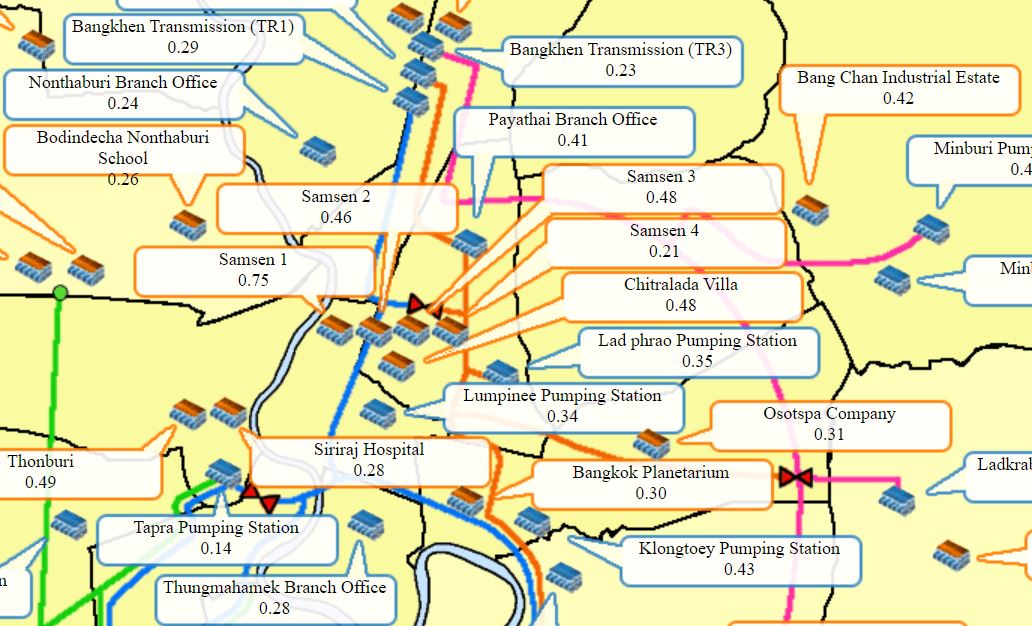
About the local water description, some input is offered by Bangkok real time tap water quality monitoring (http://twqonline.mwa.co.th/EN/map.php?type=).  We live next to the Chitralada station, in the center.  These don't mean that much to me but they could to someone else:


free residual chlorine levels, Nov 9, 2019, 1 PM


chloride levels (mg / L)


turbidity (NTU)


ph


salinity, listed as g / L (seems wrong, too high?)


July 2019 ph capture (to show variability)


I don't know what was in that water, for specific mineral content, and I don't know what the filtration process would have removed.  Chloride level was around 4 mg / l in this water, versus 15 mg / l in Volvic, but what of that?  Salinity just seemed wrong; those readings would seem like way too much salt, in the 150 mg / l range.  What if that is right; shouldn't the water taste like salt?  As a baseline I checked how much is in seawater:

On average, seawater in the world's oceans has a salinity of approximately 3.5%, or 35 parts per thousand.  This means that for every 1 litre (1000 mL) of seawater there are 35 grams of salts (mostly, but not entirely, sodium chloride) dissolved in it.


So 35,000 mg / l, which still doesn't answer if I could taste 150 mg, but it's a context of sorts.  It occurred to me that salt is sodium chloride, so unless I'm missing something the two values don't match up, the measured amounts of chlorides and salinity.  That prompted me to look up answers to both questions, how much salt can one taste, and what are normal levels for these.  This WHO reference covers the first:

Taste thresholds for sodium chloride and calcium chloride in water are in the range 200–300 mg/litre (2). The taste of coffee is affected if it is made with water containing a chloride concentration of 400 mg/litre as sodium chloride or 530 mg/litre as calcium chloride (3).


I don't think we can take that second sentence as good input about coffee enthusiast perspective.  More input from that source pins down range of chloride in typical fresh water:

The mean chloride concentration in several rivers in the United Kingdom was in the range 11–42 mg/litre during 1974–81..


That still doesn't resolve the monitoring inconsistency between salinity and choloride levels, but it is interesting to compare that to sodium levels in the other bottled waters.


Further conclusions:


That last section was mislabeled, wasn't it; not much for conclusions in there, or even speculation.

I suspect this tap water version ended up with very little mineral content in it, due to starting out with limited amounts and filtration removing some.  It's interesting to consider that tea producing more positive infusions initially might generally relate to producing less positive infusions across later rounds.  At least that did happen here, per my interpretation, and it may work out as a somewhat uniform generality (or may not; that goes without saying).  This could explain why some people push teas to produce very long counts of infusions, and others tend to not like them as much after a much shorter sequence, although simple preference difference seems to be just as relevant an input. 

Then again, who knows.  Round after round of trying out lots of water and tea versions would tell a longer, more accurate story.  In online discussion it's not uncommon for people to claim that they prefer different water (mineral content, presumably) for different tea types, and that would intuitively make sense.

I've never ran across much detailed speculation of why soaking bamboo charcoal in water is said to improve the results for making tea with it, even though people advocating that practice comes up a lot in discussion.  Even when it's being sold for this use, as in the case of this Yunnan Sourcing version, there's not necessarily a reason for why it might make any difference.  It probably does, it would just be interesting to hear guesses about why.  Here is one that Google search turned up, Tony Gebely's input, but somehow it's not satisfying as a complete and plausible explanation:


The idea behind bamboo charcoal, and any charcoal for that matter is the fact that it is extremely porous and will absorb impurities in water. It really isn’t “filtering” water if you set a stick in the water, in order to filter the water, the water must pass through granulated charcoal or some other medium (this is how Brita filters work)...


It would seem that it could be both adding and removing minerals from the water, and that only testing, instead of speculation or traditional input, would shed light on this.  I would tentatively accept that it really does improve results, although that would be clearer to me if I tried it myself.

Sunday, November 10, 2019

Assam Teehaus Orthodox Enigma and Wild Origin Assam


I'll add more photos in the next samples post; this doesn't show much


I'm trying two interesting looking Assam versions from Maddhurjya Gogoi of Assam Teehaus, dropped off by his cousin Chittaranjan, who recently visited Bangkok.  I've reviewed teas of his earlier, and have reviewed a tea and told some of his story. 


I passed on a little of this to the Jip Eu owner, Kittichai, to try when Chittaranjan and I visited recently.  It never works out like that, trying a tea sample before I actually review it.  It was malty, definitely Assam, but light and soft in character, along with being sweet and complex in flavor.  It was really good. 


It definitely seemed to match a typical Assam flavor profile, but at the same time backed off the astringency as better orthodox versions tend to do.  From there quality relates to getting the growing conditions and processing issues right, bringing out intense, complex, positive flavor, the feel working out, etc.  It checked all the boxes fairly well.  Since I'm trying the same tea again for review I can go through more detail about that.

This was a remote tasting, held at my kids' swimming class area beside that pool; that's different.  I didn't even start an early Sunday morning tasting session due to using the time to cook French toast and bacon instead, and eating some of it (without tea; odd being in a rush and passing on that particular morning routine step).  Priorities come up, and it was my daughter's birthday yesterday, so she deserves just a little more focus than usual this weekend, and tea gets bumped if the two sets of demands conflict.

later that morning


Review:

on-location reviewing; photos aren't what they normally would be


Enigma left; it looked redder, less dark


Enigma (first infusion):  it's nice.  Malt stands out as the main flavor aspect; that's normal.  Malt really spans a range of different flavors, as I understand and use the concept, crowded into a dry-mineral sort of version (the one in Assam, this one), and the malt in malted milk balls or Ovaltine, a little closer to fermented grain animal feed, which smells a lot better than it sounds.  This malt aspect isn't dry, rough, limited in scope, towards how rocks come across (maybe just a little like a reddish colored sandstone, I guess that would be), but it is the mineral intensive malt, just a soft, complex version of it.

I like brewing teas Gongfu style to adjust how far I push them for timing and infusion strength round to round, and to see how the flavors transition, and then later rounds I tend to skip making notes for.  I brought a Western device this time so I'll only be doing two infusions here.  That limit relates to how much water I brought too; I can't imagine the hot water they supply at this pool doesn't taste a lot like drinking water out of the pool.  I just did a water tasting experiment yesterday, but I really don't want to drift too far into that, so I'll leave off saying more until I finish that post editing.

The flavor has good complexity, but it's hard to extend that to a list.  Construction noise nearby is a part of that; funny how a high level of background noise limits what you pick up.  Of course I'd forgotten about that from last weekend.  Malt extends into cocoa, which isn't so far from that flavor.  Really those two flavors, with malt first, are most of what I'm picking up.  Beyond that might relate to a warm, aromatic wood tone, hinting a little towards cedar or redwood, just not strong enough to stand out as that.

Kittichai mentioned that he thought this wasn't fully oxidized, as black teas go, that they'd backed off that range a little to give it a different character.  Maybe.  It looks pretty oxidized as wet leaves.  Some bud content always ramps up dryness, and shifts flavor profile a bit towards even more mineral, and this contains that.  That kind of thing occurs in Yunnan black teas too, not limited to a change based only in Assam.  Oddly buds-only black teas can tend to be really smooth and subtle instead; I'm not sure how that maps out, since those two ideas seem to imply a bit of contradiction.


Single Origin Wild Seed Varietal (first infusion):  much, much different; this just turned into a contrasting types review.  A lot of the base flavor is common but there's a front end aspect that hits you hard, something quite novel, which I interpret as being pretty close to fennel seed.  Malt isn't pronounced at all; strange.  Beyond that other warm, rich tones do fill in complexity, and this might be slightly sweeter.  Cocoa doesn't stand out either, so there is mostly only overlap in the base flavors range, the aromatic wood tones.  Probably a mild, subdued version of malt and cocoa are mixing in with that, since it comes across as complex, but very limited malt as most Assam goes, next to none.

The effect of that spice is unusual.  It works well; it's clean and well-integrated, just really novel.  It shows up a lot stronger in the initial flavor, so that it tends to shock you a little in the first half a second, then the rest of the flavors come on strong and it fades back to being a mild supporting element, almost hard to pick up.  I don't remember a flavor working like that before, so strong as a front end, then dropping way off in part of a second.  I'm not even in the habit of talking about that kind of range of experience, temporal flavor effect order, beyond aftertaste splitting out as a different thing than the taste while teas haven't been swallowed yet.

Overall balance is important for teas like this, especially when drank this way, as a good-sized mug worth.  Both these seem to work.  They are brewed a little on the light side, intentionally so, since that makes identifying flavors a lot easier (to me).  The proportion is probably slightly high per conventional Western brewing but timing was only around 2 minutes.  Made like this these teas would prepare three good, strong infusions, and probably stretch to a fourth, if one preferred.

Ordinarily I'd guess the amount of tea and the brewed liquid, since I can estimate that, but it seems to work well to leave it as a vague kind of thing, since experimenting to get to what you like best either involves making teas over and over by look and feel or else carefully weighing and measuring amounts.  I do the first; I must have prepared 1000 cups of black tea this way before.  It would be a shorter process following the second approach instead, being more precise; the learning curve would narrow faster.  Since different teas work out differently, even if they look the same, you can't arrive at an optimum based on past experience and expectations.  The look and source patterns only tell so much of a tea's story, and soaking the dried leaves in hot water tells the rest.

Ok, I will guess the amounts; this was probably about 4 or 5 grams of dry tea used to make about 8 ounces or 240 ml of brewed tea (so a lot).  At a normal infusion time that would've been way too strong.  Put one way I tend to prepare black teas as a hybrid version of Western style, adjusting that a little.  Water temperature factors in too.  Since I brought water here by thermos it lost some temperature, even the second it hit the thermos, even though I pre-warmed them.  The edge to this version would be stronger at full boil, and it would've brewed a little faster, making this infusion stronger. 

Some people would say that only using full boiling point water would bring out these teas' potential, and some would think a good bit off boiling point would be optimum, down around 90 C, not far off how these were prepared.  The right answer probably depends on preference.  I'm sympathetic to both preferences; drawing out more flavor and intensity at higher temperature is nice, even for adding a little more astringency edge, but a softer, sweeter, milder version also works.  Since these are relatively mild feel-character Assam versions I think hotter might be better, per my preference.  Both are a little rounded-off in character as I'm experiencing them.  1000 cups of tea in you can sort of see how those factors come into play, and I don't think I've really optimized these.


Enigma left; redder, less dark leaves as well


Brewing tea Gongfu style is much different, giving different results, but one main advantage is the ability to "see" the tea from different angles, using a slightly different approach round to round.  Brewing temperature can drop a little if you use a slow process, because the leaves will keep cooling between rounds, but running through two infusions in a row fairly quickly can even that factor back out.

Another aside (this has turned into a really conversational post):  they're making Loi Krathong krathongs at the table next to me, the small flower "boat" type things used to float for the holiday coming up soon, tomorrow.  Supposedly those carry away your sins, not so different than how Easter works out, as I understand it, except that Jesus is on top of that on a more ongoing basis.


Second infusion:


I'll go a little longer on this round, maybe slightly over 3 minutes, to draw out a stronger infusion.  Really using less tea and a full 5 minute brewing time is the standard approach, the ISO process version.

This will be it because I only brought this much water.  If I do a third round it will be using the water here, which really should be awful.  If it's well-filtered tap water it could be exactly the same, but even then warmers can build up scale in them, and that adds a lot of mineral flavor to water while heating it.

Scratch all that; I ran out of water halfway through the last infusion, and had to blend in some from the pool-staff heated water source.  This is a bit heavy on mineral; I can smell it in the water as it pours.  It's tempting to draw on experiences from that water tasting yesterday to talk about that but again it's too much.  The short version:  the right level (and type / proportion) of minerals works much better than too much or too little.


Orthodox Enigma:  I'm tasting that water input in this, but I think mineral might've been likely to ramp up for brewing it stronger anyway.  That just happened in the other, and I used the water from home in that one, and a mixed version of both water sources in this.  Warmer tones ramp up too; that is the brewing difference, along with infusion round transition.  It's a pleasant effect.  It does taste like rocks, not so much that red sandstone but onto dryer, warmer, even heavier range, volcanic rock types instead. 

The balance is the thing; all the aspects work well together.  Malt has dropped back, cocoa is still present but milder, earthier tones in the range of that warm mineral contribute more, and aromatic wood tones towards cedar or redwood contribute.  It's quite pleasant.  It's all very clean in effect, with no trace of anything off or muddled.  That doesn't happen by accident; people making tea have to get the steps right.


Wild Origin Assam:  brewed a little better; slightly stronger suits this. That hit of fennel seed (or whatever spice) is still unusual, the main thing that stands out, even though it drops out part-way through tasting it still in your mouth.  It's pleasant though.  A strong, warm mineral base stands out in this (not from that water input; I ran out brewing the second infusion, and made this one first).  It even has a slightly savory taste to it, definitely not in the range of umami / seaweed as in Japanese teas, but instead essentially not different than salt.

Conclusions:


Two very good teas.  The first, the Enigma, is a little closer to a standard Assam version in style, but a well above average version, even for decent orthodox range.  It's not that far off the Latumoni versions I reviewed not so long ago; I'd have to try both together to place differences better.  When you compare teas side by side very fine levels of differences stand out, and those could occur, different degree of complexity, slightly thicker feel to one, or other variations in body, etc.  For trying the teas a few weeks apart they're pretty close.

These are about as good as the highest level of Assam gets.  The other versions that I tried from Oiirabot seemed closer to Chinese black teas in style, really in between for some reason.  That related to flavor profile and feel more than quality level, since versions from all three producers were really solid.

This Wild Origin version is something else, a completely different experience.  It probably relates mostly to being an unusual plant type, but growing conditions would factor in as well.  People often claim that growing together with other plants changes the flavor of a produced tea, which could account for the atypical flavor range, especially that one fennel-seed spice aspect.  They'll even say a plant will pick up flavor of what grows near it, so a spice growing nearby would make a tea taste like that spice, or corn, or whatever it is.  Or that could be a plant-type / cultivar input.  "Cultivar" tends to be used to mean an intentionally replicated plant type, whether bred by mixing other strains or not, but the end effect isn't so different than that of tea plant types varying naturally, those are just not controlled.

I'll do a more careful, controlled review of some of the other versions Maddhurjya passed on (and Chittaranjan, his cousin, who just visited Thailand and actually brought the tea here).  These results are valid but tasting the teas under more carefully controlled circumstances would've turned up a few more aspect notes.  It would sound like the flavor was more complex, reading a longer flavor-list version, but really the teas were complex and exceptional as they were.  I was just tasting them under less than optimum conditions, out in public, brewed Western style, with a bit more background noise than is typical, introducing mixed water sources as a variable.

I did brew a third round of this tea there, and it was fine, the water wasn't as bad as I expected.  And a fourth at home, with the tea not diminishing that much in range or pleasantness for being stretched a little at that point.  Brewing a lot of positive infusions is a good sign for teas, one marker of quality level, although just one of many.  The tea tasting and feeling like it did was the main thing, balancing really well across all the aspects.


the finished krathongs


Sunday, November 3, 2019

2014 and 2015 Dayi Jia Ji sheng tuocha, and 2012 Xiaguan


they look similar enough separated out


This comparison theme really started with a tea friend passing on a fourth Xiaguan mini-tuo recently, a tablet-sized version, one each of sheng and shu.  It reminded me that I bought a set of 5 2015 Dayi / Taetea Jia Ji tuochas from Yunnan Sourcing earlier in the year, and hadn't tried one yet.  I've tried a Xiaguan 2012 sheng tuocha I had around before but seem to have never mentioned that here (from a local Bangkok store, Jip Eu, that one I keep mentioning).

A 2014 Dayi (Taetea) Jia Ji tuocha I've reviewed initially (three years ago; a good time-frame), and re-tried a couple of times, but I wasn't rushing to finish it to see how it changes over time.  That works better with a set of 5; then you don't run out right when it's most drinkable.


I didn't remember the value was that good


The Xiaguan I could do more research on to identify a specific version; that is a bit broad, just calling it by a producer name, since they make lots of versions.  The problem would be that it wouldn't likely tie to a good description anywhere even if I did.  Sales pricing would imply quality level and that would probably be about it.  Even if I could turn up an online review I wouldn't know about that person's judgement, or storage conditions, etc.  Aging potential is probably as much or more a concern as how that drinks now, and no one would be bold enough to describe what a tea will be like in a half dozen years in the future, factoring in storage as an input and guessing likely changes.

I had considered trying all four together, including the one Ralph passed on (that friend), but trying four teas is too much.  Three is a bit much, and I can relate to people thinking that tasting two teas together is already way too much.  I could ramble on more about other examples or storage conditions issues but as well to get on with it.  I'll mention the Yunnan Sourcing listing first:


Jia Ji Tuo (甲级沱茶 Special Grade Bird's Nest ) is a high quality blend with that characteristic heavy Menghai area qi!  Good mouth-feel and huigan this is a great choice for aging.  Affordable, but packs a punch!

Net Weight: 500 grams per bag (5 tuos at 100 grams each)

Batch: 1501


That 2014 version I bought really did need some aging as of three years ago, also related to that comment about the 2015 versions, and has much improved since.  The packs of 5 tuos are sold out already there; isn't that always the way?  Single tuos are still available but probably not for long.  I just bought a few more of each of my favorites from a Chawang Shop order from around this same time-frame, to avoid experiencing that when trying to reorder later on instead.

Review:

Dayi 2015 left, 2014 middle, 2012 Xiaguan right (in all photos)


2015 Dayi Jia Ji:  this tea version is notably greener than the other two, and the third might be slightly darker than the second (2012 Xiaguan versus 2014 Dayi).  Normal enough, for the year less aging and being in a dryer environment in Kunming.

Lots of astringent green wood stands out right away.  The 2014 Dayi tuo had been more like that earlier on, as I recall, but won't be similar now.  Although they're only a year apart in age Bangkok's hot and humid climate changes tea fast; you can tell a lot of difference over the course of a year.  It's hard to be certain what kind of judge of aging potential I am for young sheng, that could use some transition, but this seems promising.  It has good sweetness, and already leans a bit towards dried fruit.  It's quite clean; there might be a faint hint of smoke but no mustiness, no rough earthiness, and the mineral effect is clean.

I'm not sure how positive it will become over later transitions this time, beyond softening just a little, but at a guess in a couple of years this should be ok, and in another half dozen probably very nice.  I'd think in 8-10 more years it will be much better yet; we'll see.

2014 Dayi Jia Ji:  the difference is really significant, but the commonality--shared range--makes that more interesting.  I don't intend to claim these must have been identical at time of production; of course the opposite could as easily be true, that they might've been quite different.  I'd guess similar:  this product version is intended to represent a distinct style, per my understanding, or at the least match a quality level.  They can use blending to help them adjust character, so smoothing out some differences should have been at least partly possible, heading towards a similar end point.

The green wood bitterness and astringency is there, along with a lot of much warmer tone.  It's a bit medicinal, the rest, kind of hard to describe.  Some is in the mineral range, like a very warm, rich version of rock, or even corroded metal.  Or aged, partly fermented tree bark, like a fallen tree smells.  It's probably closest to birch or aspen, even though those have a much brighter, more mineral intensive (flinty) smell when live or freshly cut.  Maybe I'm mixing the parts I'm describing, the mineral and earthy ranges.

2012 Xiaguan:  way different, of course.  The distinctive green wood taste has a related counterpart but it's not the same at all, and to the extent that probably had been present it has transitioned.  It has a dry edge to it, a completely different feel.  It's not quite as clean; the warm mineral content has a bit of roughness or murkiness to it, not so much like tasting of overly damp storage, but that could be part of what led to the effect.  There's one primary aspect I'm not doing justice to, a sweet, rich flavor in between a spice and dried fruit, out towards a bark spice (just not necessarily cinnamon) or dried persimmon, or maybe that's date / jujube (Chinese date).  It should be easier to sort it out in the second round.

Second infusion:


I've kept this infusion relatively short but for preparing three at the same time it stretched out towards 10 seconds.  It seems likely the results this round will have me try to dial that back on the next, to speed it up.

2015 Dayi Jia Ji:  this transitioned more than I expected, even though it's not completely different.  That astringency edge and bitterness settled out, definitely not entirely, but a decent amount.  That kind of early round transition will probably take another round or two to play out.  This really isn't undrinkable now; it has aspect range that's pleasant.  It is on the bitter and astringent side, as young sheng can go.  It would just depend on preference whether that current aspect balance is very enjoyable, a bit neutral, balanced between what works well and doesn't, or not pleasant at all.  Personally I'd taste this tea once a year and probably enjoy it more later on.

The green wood flavor range has moved on towards something closer to tobacco, how I'd imagine tobacco that's partly through a curing phase to be, but still with some warmth and richness.  It's clean; there had been a hint of smoke but that's essentially faded already.  The hint towards medicinal or light dried fruit range is promising.  Sweetness level is good, pleasant; feel is fine, and aftertaste is positive.  Even though higher quality sheng versions have a rich, full feel to them that this doesn't match it's still pleasant.

2014 Dayi Jia Ji:  this has shifted too; green wood is still present, again at a much lower level of proportion of that input, but other range has picked up.  A pronounced pine / rosemary aspect is dominant.  There's still enough astringency and bitterness in this that it's not a soft, smooth tea but it's all clean in effect, with no negative musty, murky, or "off" mineral range affecting that.  The warm and rich range reminds me of well-aged sawdust, tying to that brighter (but still warm) pine and rosemary range.

As a child we would go play on a sawdust pile located on our property, a remnant of an earlier lumber mill operation based there; it's a little like that smell.  Right, I had an unusual childhood.  I have no idea why my parents were ok with us kids off roaming woods, or me climbing trees at a very young age, granting me the nickname "chipmunk" from my grandfather.

2012 Xiaguan:  completely different, as one might expect.  Two aspect ranges hit you right away:  a dryness in feel, seeming paired with warm mineral range, and rich, sweet, complex higher tone.  It's so sweet and leaning towards earthy range that although standard descriptions like leather might apply it tastes a little like a sweeter, lighter tisane too.  It's like  the bael fruit tisane that's common here, or maybe even roselle (which is totally different, so odd that I'd be connecting the two).  It spans range; I think that's it.  Even the sub-themes, the richer mineral, warmer earthier tones, the brighter and sweeter parts towards a rich dried fruit all span range of their own.  It's much cleaner than on the first infusion; it will be interesting to see how that carries forward.

This really could use even more aging time, for sure, but it has interesting promise, of a different sort than the other two.  It's more intense, more complex, and shifted in aspect range.  The other two seem more promising related to covering a specific, more limited aspect range, this for having more depth and for covering more scope.  It's just as intense as the other two in spite of being 2-3 years younger and spending time in Bangkok; it might well have been somewhat challenging that 2 to 3 years ago.  I probably first tried it at least a year and a half ago and I think that was my impression; best to set it aside and suspend judgement for awhile.

I will try to move towards a fast infusion third round to see how that goes, even though intensity wasn't a problem for these on this round.

Third infusion:

older Xiaguan (right) slightly darker but that's about it


2015 Dayi Jia Ji tuocha:  slightly warmer, rich, sweet, and complex.  A "darker," towards-spice aspect is picking up a bit, along the lines of sassafrass (root beer), but warmer in tone than that typically is.  It's still a little woody too but now in a warmer tropical dark wood range, mahogany or something such.

2014 Dayi Jia Ji:  there are comparable aspects to all that set, just warmer and sweeter in tone.  The spice like range is out towards bark spice instead, and the woody tone more towards some form of well-cured wood.  Aftertaste stands out a lot more; I'm not sure if that relates to varying tea quality or just that these particular flavors tend to carry over more.  The latter seems to be the case, especially since that has shifted since the last round (as I interpret it, anyway; there is no objective, 100% accurate take on a tea to be had, it's just not all subjective guess-work either).  Intensity for both is good, and character is pleasant.  Pine / rosemary is still present but no longer a dominant aspect, now just part of a set.

2012 Xiaguan:  it's interesting how tasting those two first linked teas is such a different experience than switching over to this one.  It's warmer than the 2104 Dayi, not quite as clean but not murky or off in any way.  It's both more intense and more complex, and in a different flavor range.  A bit of dryness is still present but it has softened a good bit through transitions.  All that going on about fruit and aged wood in the last round still applies, in only a slightly altered form, so I'll skip running back through it.

It was definitely the right call to not add a fourth tea to this tasting.  I can probably make it through two more rounds, to see more transitions, but nine small cups of these teas is already quite a bit.  It would have made sense to scale back quantity and stretch infusion time just a little, to get farther and to brew less.  I'd been considering that, especially related to potential to add that mini-tuo tablet to the mix, but ended up using a default quantity instead.  I'm brewing these as I'm most accustomed to, using a high proportion of tea, which isn't ideal for tasting three versions together.

Fourth infusion:


2015 Dayi:  I'm noticing a bit more smoke this round; odd that it would drop back and then pick back up.  Tone is shifting towards a petroleum like range that's more common in young shu, versions that haven't settled from fermentation (wet-piling processing) yet.  There is still woody flavor, and strong underlying mineral, but a heavier other tones are picking up.  One interpretation would be that it's medicinal; that works about as well as any other.  It's still relatively clean, even though it might not sound it from that description.  Tasting a little more like slate, warm mineral, is probably a more relatable description, and not really wrong; that is part of it.

2014 Dayi:  the prior description works; it didn't really shift.  It's still in the range of warm, complex wood tone, pine / rosemary, and strong underlying mineral.  Aftertaste is stronger in this than in the first but I think that may have picked up a little with the flavor-range shift in the first version.  Or maybe not; maybe I imagine that, from expecting it.  It's nice how clean this comes across, and how the flavor and other complexity (sweetness, feel, and aftertaste) all work well together.

2012 Xiaguan:  a bit of warm, dark wood-tone in this draws closer to part of the effect of the second.  It's piney too, but more like the scent of pine cones lying on the ground, slightly cured versions of those, with the 2104 Dayi closer to pine wood or dried needle.  A hint of dryness keeps fading but may never really completely drop out.  The range seems a bit narrower, maybe related from using a relatively fast infusion time (those would vary, based on a lack of careful control).

I think this seems less "clean" related to the other two being notable for that effect.  I bet if tasted alongside the Xiaguan version I bought from Chawang Shop this year it would seem quite clean, since that had a bit of mushroom earthiness to it.  That's an unreliable guess though, based on memory of trying a tea version months ago.

wet leaves don't look all that different


Fifth infusion:


This will probably be it, related both to me needing to go do something and 15 small cups of these teas being plenty for me.  If I get time in the afternoon it will be interesting to do a number of additional rounds but it's too much to keep making notes of that, adding a second page of text to this review.  Typically adding some general impression is plenty.

It goes without saying that I've been using drinking water to clear my palate between trying these teas; the carry-over would make picking up flavors and other range impossible otherwise.  Ordinarily, when drinking just one tea version, it can be nice how the flavor and other experience is continuous, and can even build, but you give that up doing comparisons.

2015 Dayi:  smoke is just as pronounced, or maybe slightly more so.  So strange.  This must be a good example of a natural smoke flavor aspect in a tea since smoke from contact would've surely shown up in the early rounds at the same or higher level, not dropping back and picking up again.  Varying infusion times will do that, shifting which aspects stand out the most due to overall brewed intensity changing, or even shifting in proportion at the same intensity level.  I've been letting these trail to lighter infusion levels versus adding infusion time to adjust for a slight fade in intensity.  They work well lighter, and I could have been using 5 second infusion times in the earlier rounds, I just wasn't rushing.

2014 Dayi:  more of the same, just a bit lighter, maybe giving up a little intensity and aspect range (complexity).  Still not changed much though, so the last description still works for this round.  That shift due to using slightly longer infusion times would apply from here on out, but I'll skip making notes on how it works out.

2012 Xiaguan:  that dryness never is going to drop out, or apparently even fade further.  I'd be surprised if it didn't increase related to brewing these longer, after the next round or the one after.  Flavor range is still fine, unchanged.  Related to feel and aftertaste it doesn't seem to match the quality of the 2014 version, which may be slightly higher than the 2015, unless the change instead relates to a year of aging.  At a guess the 2014 version really is slightly better tea, and beyond other unrelated differences in character this Xiaguan isn't quite on their level.

Quality isn't some abstract, identifiable, unified variable, of course; if someone liked the Xiaguan character better for whatever reason then it would be a better tea.  I see markers as identifying it (quality), as a general indication, like thickness of feel and aftertaste type and duration.

Conclusions:


This was all as much about keeping really detailed notes to look back on later as it was communicating how partially aged tuochas work out (although it works for that too).  All three were fine.  I'm not sure if the 2014 really was slightly better quality tea than the 2015 version, for being more complex, and slightly thicker in feel, lacking smoke, etc., or if the difference in aging caused all that.  At a guess it may have been slightly better.  That will be clearer in a couple of more years once fermentation transition evens out for both.

I liked the Xiaguan version almost as much as the two Dayi versions, but to me it wasn't quite as positive.  Flavors were a bit more muddled, and a touch of dryness in feel wasn't positive.  It was in the same general range, still nice.  The point for all of these is how they'll turn out after years more aging; we'll see about that.

I could enjoy them as they are just now but it's kind of a shame to not let them transition to achieve more of their potential.  I expect that green wood aspect in the two Dayi to shift into a range that I enjoy a lot more.  The Xiaguan may well be roughly where it's going to be within another couple of years stored here.